

Archaeologists discover the residence of Emir Mamai on the bed of the drained Kakhovka reservoir

· 2 min read
The blowing up of the Kakhovka hydroelectric dam by Russian occupation forces led to the shallowing and then the complete drying up of the reservoir. As a result, huge areas that had been under water became accessible to archaeologists and historians.
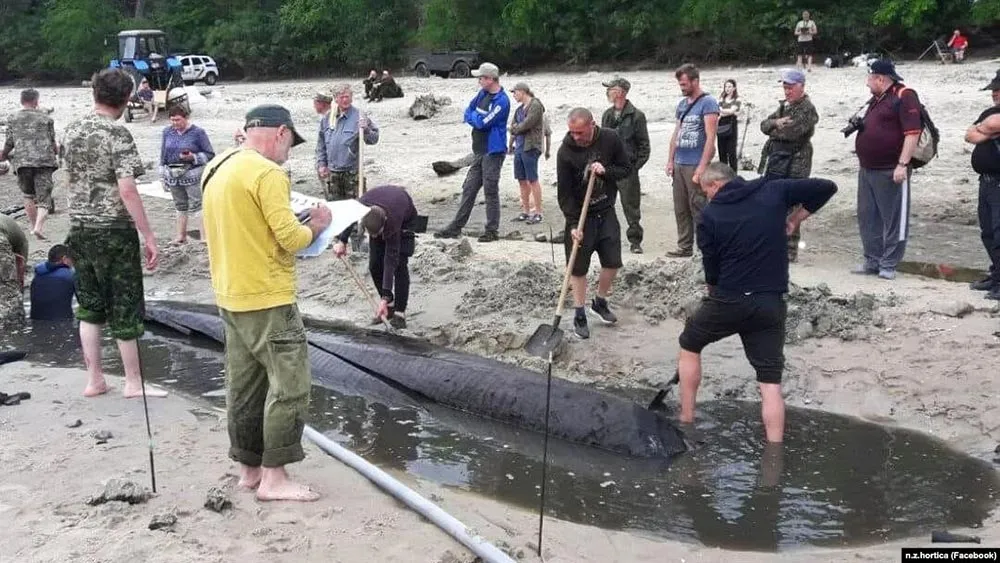
A dugout boat made from a single oak trunk, almost 7 metres long, found on a previously flooded stretch of the shore of Khortytsia Island on the Dnipro. Illustrative photo (Khortytsia National Reserve)
From the 14th to the middle of the 18th century, Muslim states existed one after another on the territory of the future reservoir and the adjacent lands: the Golden Horde and the Crimean Khanate. Before the Kakhovka hydroelectric station was built in the early 1950s, archaeological excavations in this area were carried out only sporadically and on small sites, and after the reservoir was filled they became impossible altogether.
According to “Islam in Ukraine”, at the end of June 2023 Ukrainian archaeologists began studying the accessible areas of the former Kakhovka Sea. According to Oleh Vlasov, a staff member of the Khortytsia reserve, the residence of Emir Mamai was located in the area of the Dnipro floodplains. Several place names connected with the name of this influential Golden Horde statesman have survived: Mamai Luh, the Mamai hill-fort and the Mamai-Surka River.
Mamai’s residence was a full-fledged city with the ruler’s palace, a mosque, baths and several substantial residential buildings. The city was excavated in 1953, after which most of the territory ended up under water. Only in the area of the Kuchuhury tract did fragments of the urban buildings survive. It was there that the local historian Volodymyr Shovkun found 3,700 Golden Horde coins.
Of course, full-scale excavations and study of the monuments of Islamic civilisation will become possible only after hostilities end, but it is already clear that the bed of the former Kakhovka reservoir is a kind of “Muslim Atlantis”, and its secrets are yet to be unravelled by scholars.


