

Strusiv’s “striped” synagogue is gradually falling into ruin

· 2 min read
Today we have two “Jewish” dates at once: the anniversary of the start of the mass executions of Jews at Babyn Yar and the beginning of the celebration of the festival of Sukkot.
“Ukraine Incognita” respects all the peoples for whom our country has become a home, so today we will tell you about one of the most interesting synagogues of Galicia and about the sad traces the Holocaust left on its façade.
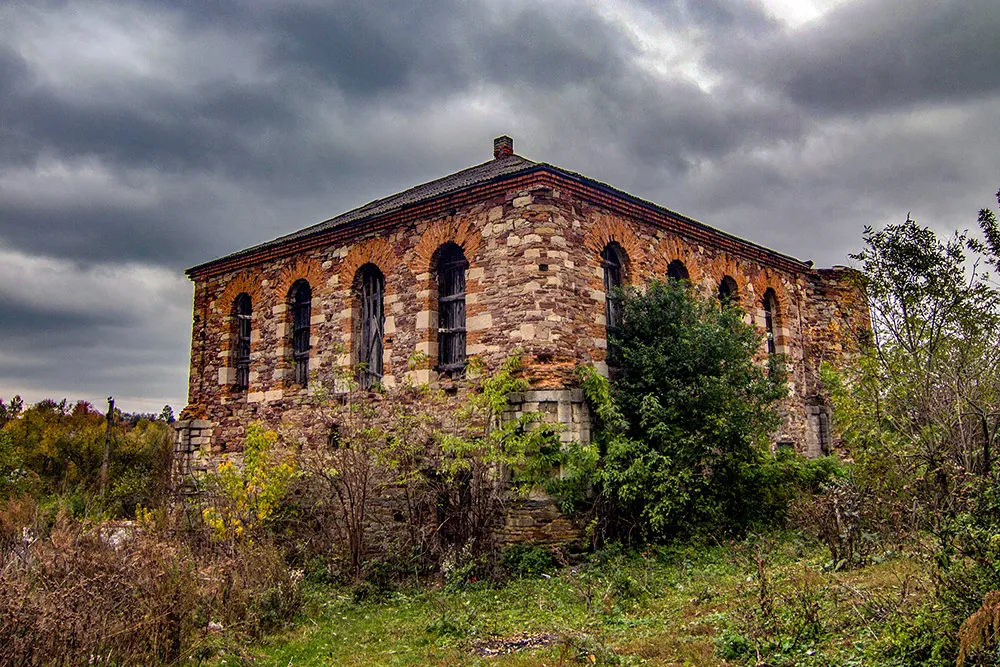
The synagogue in Strusiv (Ternopil Oblast, Terebovlia area) differs little in outline from its numerous small-town “sisters”. Yet it has its own unique “highlights”.
For example, the outer walls of most synagogues were traditionally plastered. In Strusiv plaster was not envisaged from the start. The walls of the local synagogue are built of rough blocks of red Terebovlia sandstone. Architectural expressiveness is achieved by using contrasting elements of white dressed limestone. The builders combined white and red stone very successfully to decorate the windows. The “half-columns” that adorn the southern and south-eastern corners are also made of white stone. Against the background of the red walls this looks quite striking.
Such “striped” masonry is found nowhere else on Jewish sacred buildings.
It was built in the second half of the 19th century. This is reported, among other things, by the memorial plaque above the entrance, where we read (in Hebrew, of course): “With the help of the Creator of the Universe our holy house was completed in the year THIS IS THE GATE OF THE LORD, THE RIGHTEOUS SHALL ENTER INTO IT”.
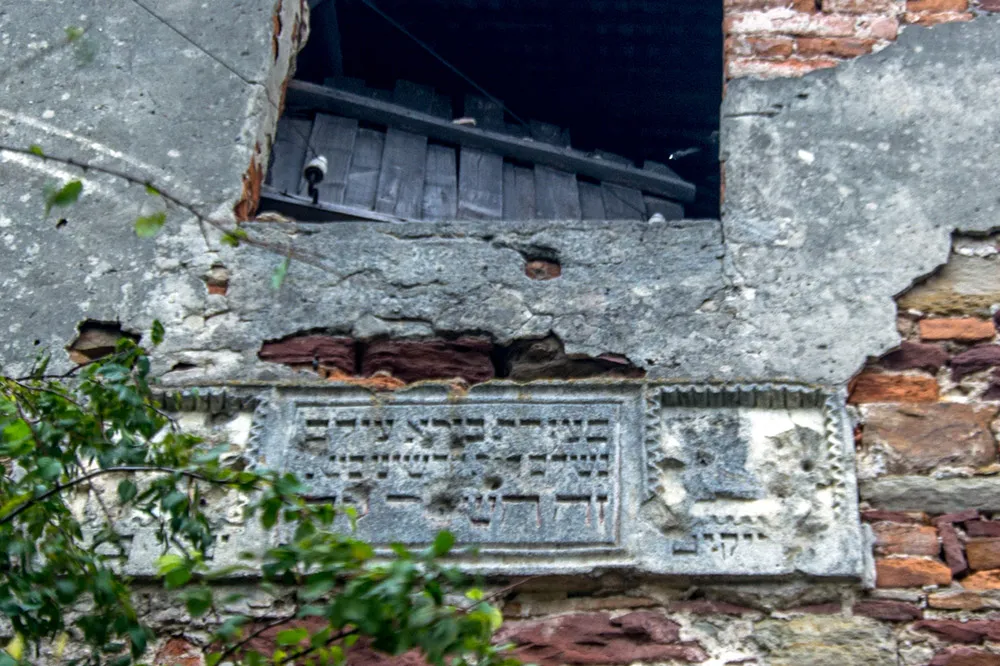
Bullet marks
Jews use letters instead of numerals. The sum of the numerical values of the highlighted letters gives the year 5622, that is, 1861 or 1862 in the usual reckoning. “Or” is used because the start of the Jewish year does not coincide with the start of the Christian one.
The same plaque is also a symbol of the tragedy of the Holocaust. It is pocked all over with bullet marks. The Germans deliberately shot at the Jewish inscription.
The end of Jewish Strusiv (and the Jewish community here is known from the early 17th century) was the same as in other small towns. On 8 July 1941 the German army entered Strusiv. Already on 26 July the occupiers shot the first 6 Jews. In August 1942 the Nazis shot another 20 people. At the same time 646 people were taken to the Belzec death camp. The remaining 322 were deported to the Terebovlia ghetto, from where most were soon sent to the same Belzec. Only the healthiest and strongest were kept for heavy labour. They were shot in the spring and summer of 1943 during the liquidation of the ghetto.
After the Second World War the synagogue “housed” a carpentry workshop of the Mykulyntsi furniture factory. Carpentry work went on here until 2008. Since then the synagogue has stood empty and is gradually falling into ruin.


