

Russians damaged burial mounds near Vesela Hora: archaeologists’ report
As “Ukraine Incognita” reported earlier, the Russian army built trenches on burial mounds in the Vasylivka district of Zaporizhzhia Oblast — as a result, effectively half of the archaeological site “Lysovska Mohyla” has been destroyed. This is not the first destruction of burial mounds and ancient burial grounds by the occupiers. In particular, the new 2025 issue of the scholarly journal “Archaeology” has published a study describing in detail the damage done by the invaders to a group of burial mounds near the village of Vesela Hora in Luhansk Oblast. This is reported by sci314.com.
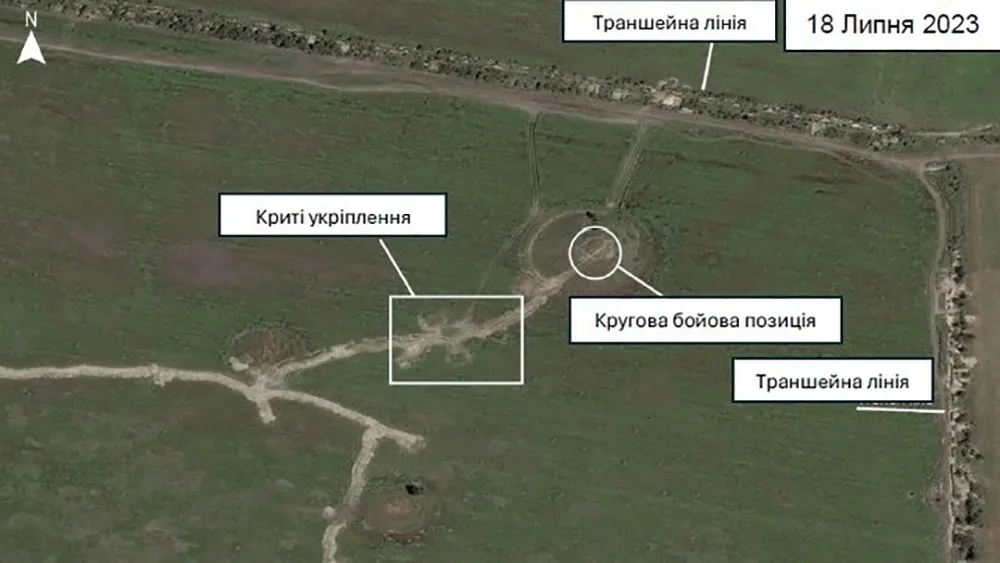
Illustrative photo: Russian army defensive structures on the site of the partially destroyed group of mounds “Lysovka Mohyla”
These ancient earthen mounds, which have state registration number 1390, became the object of military use and destruction between 2014 and 2022.
The mounds are located 1,873 metres southeast of the Church of the Annunciation in the centre of Vesela Hora and 4.8 kilometres from the town of Shchastia. They lie on the right bank of the Siverskyi Donets River, on the watershed between this river and the Luhan.
The group consists of four mounds, the largest of which reaches 47 metres in diameter and 2.6 metres in height. These monuments were first recorded back in the mid-19th century on topographic maps of the Russian Empire, and in 1947 they were described in the archives of the Institute of Archaeology of the National Academy of Sciences of Ukraine. It was noted then that one of the mounds already bore traces of trenches from the Second World War.
The study showed that the new damage began in 2014, when the region became a theatre of combat. At first Ukrainian troops set up a checkpoint on the H-21 highway 724 metres from the mounds, and later the Russian occupation forces began to use the mounds themselves to build defensive structures. Google Earth satellite images dated July 2014 recorded the appearance of a dirt road near the largest mound, and already in August of that year trenches and firing positions appeared on both main mounds. In 2015 a platform was dug on the western side of one of the mounds, probably to place equipment.
The most active use of the mounds fell in 2017−2020. Images from this period show the trenches extending westward and traces of vehicles around the mounds. In 2019 signs of additional earthworks appeared on the top of the second mound, possibly to create a shelter. At the same time, activity near the mounds gradually declined until 2021, when the trenches began to be overgrown with grass because of the reduced military presence in the area. By June 2022 use of the mounds had become minimal, but the damage done remained significant.
For the analysis the scholars applied a method of remote monitoring, using satellite images from open sources such as Google Earth, HereWeGo and Sentinel Hub. This approach made it possible to trace changes in the condition of the monuments over recent years without direct access to the occupied territories. The researchers compared current data with archival records, in particular the 1947 card compiled by T. Lytvyn and the 1977 passport of the mound group prepared by O. F. Horelyk. It turned out that two smaller mounds described in 1947 were no longer recorded by 1977, probably because of ploughing of the fields or natural erosion.
The author of the work stresses that the war creates new challenges for preserving archaeological heritage.
Besides direct damage from combat, such as shell craters, monuments suffer from the setting up of military facilities, the mining of territories and the construction of infrastructure in occupied zones. In the case of Vesela Hora there is a risk that during trench digging burials dating to the Eneolithic, the Bronze Age or the Middle Ages may have been destroyed. An exact assessment of the losses can only be made after the region is de-occupied.
This publication became part of a broader initiative to monitor archaeological sites in wartime. The work underlines the need to document such cases for future reparations and the restoration of Ukraine’s cultural heritage. The study was carried out by Serhii Anatoliiovych Telizhnenko, Candidate of Historical Sciences and academic secretary of the Institute of Archaeology of the National Academy of Sciences of Ukraine, drawing on archival materials and modern remote-analysis technologies.


