

Nesebar
· 7 min read
Nesebar is a town in Bulgaria on the Black Sea coast, on the UNESCO World Heritage List. Founded more than 3,000-3,500 years ago, it is one of the oldest cities in Europe, and not only beach, sun, sea and holiday.
The old, and therefore interesting, part of the town lies on a small peninsula 850 m long and 300 m wide, separated from the new town by an isthmus up to 10 m wide and about 400 m long.
At first the city was called Melsambria, that is, the city of a certain Thracian, Melsa. The Greeks, who pushed out his descendants, gave the city the “original” name Mesembria, that is, “city by the sea”. Something is still left here from the Thracians, ancient Greeks, Romans and Byzantines. However, the town now has little in common with the ancient one: it is typically small, as it might be in Greece or in Turkey. A powerful earthquake not only destroyed the antiquities but also halved the size of the island, so the ancient buildings are now “resting” under water, away from tourists.
The city was snatched from Byzantium by a Bulgarian khan, who gave it the name Nesebir or, as I have come across various transcriptions, Nesebar, Nesebr, Nesebyr, Nesebir. Then for a long time Byzantines and Bulgarians replaced one another in the city, until for a moment an Italian appeared here.
What has Nesebar to do with Italian Savoy, or Bulgarian pepper with Savoy cabbage, but it turns out there was a period when popes, emperors, counts, tsars and sultans chopped them together a little into a salad.
Amadeus VI the Green, Count of Savoy (Amedeo VI il Conte Verde), took part in numerous tournaments, advertising his native Savoy cabbage. Always dressed in green, he was nicknamed Count Ze, the Green Count. In 1366, at the call of Pope Urban V, he organized a “Savoyard” crusade against the schismatic Orthodox Bulgarians and the Ottoman Sultan Murad I. The latter had just before that suddenly decided to become a European and annexed the Gallipoli peninsula and Edirne. A paradox, but for the pope the Turks and the Bulgarians were equally loathsome.
Amadeus VI the Green briefly recaptured the Gallipoli peninsula. From there the hero went to Constantinople, where he received 12,000 gold coins from Empress Anna to continue the campaign, now against Bulgaria. The Bulgarians did not expect at all that the Green one, the cousin of the captured Byzantine emperor John V Palaiologos, would come to take revenge for him.
In the first days of October, on the golden sands of the Sunny Beach of Bulgaria, it is the velvet season. But Amadeus of Savoy had no time for sunbathing: he captured Sozopol and Mesembria-Nesebar and besieged Varna. While the Bulgarians were deciding whether to keep fighting or to release cousin Amadeus, he placed his headquarters in Mesembria. The Bulgarians deliberated for a long time, the crusaders suffered from the unusual winter and the cold winds, and even signs of plague appeared. Just in time for the Bulgarians to hand over John V.
The count was the victor, but his hopes of a rich “brotherly” reward from his cousin for the release were not fulfilled. John V practically had no money, since he no longer had the rich territories of the empire either. So the count returned the conquered cities and fortresses to the emperor for next to nothing, 15,000 florins, and set off back to his Italy with magnets, exotic birds and parrots, a bear from Bulgaria and a camel from Asia. Without doubt, Amadeus of Savoy fought more battles with the Orthodox Bulgarians than with the Turks, but this did not prevent him from being met in southern Europe with triumph and given the bodybuilder’s title “athlete of Christ”.
The Ottomans searched a little for the count under the walls of Nesebar, but the Turks finally captured the city 3 months before the fall of Constantinople.
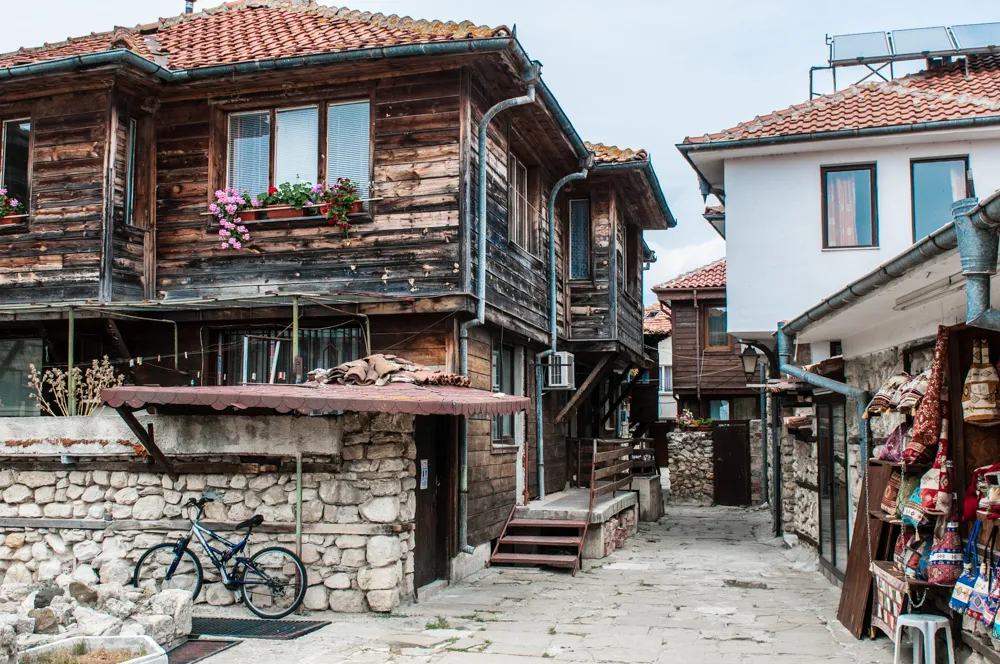
From the Ottoman era, it seems, comes the modern look of the town, resembling a huge Turkish street bazaar with souvenirs and stalls in the streets. Add restaurants with barkers at every step and decide whether you will feel the spirit of an ancient city here. However, the most colourful monuments of Nesebar also date from the 17th-19th centuries: they are residential two-storey houses. The first floor is of stone and the second of wood, overhanging the street and larger in area.
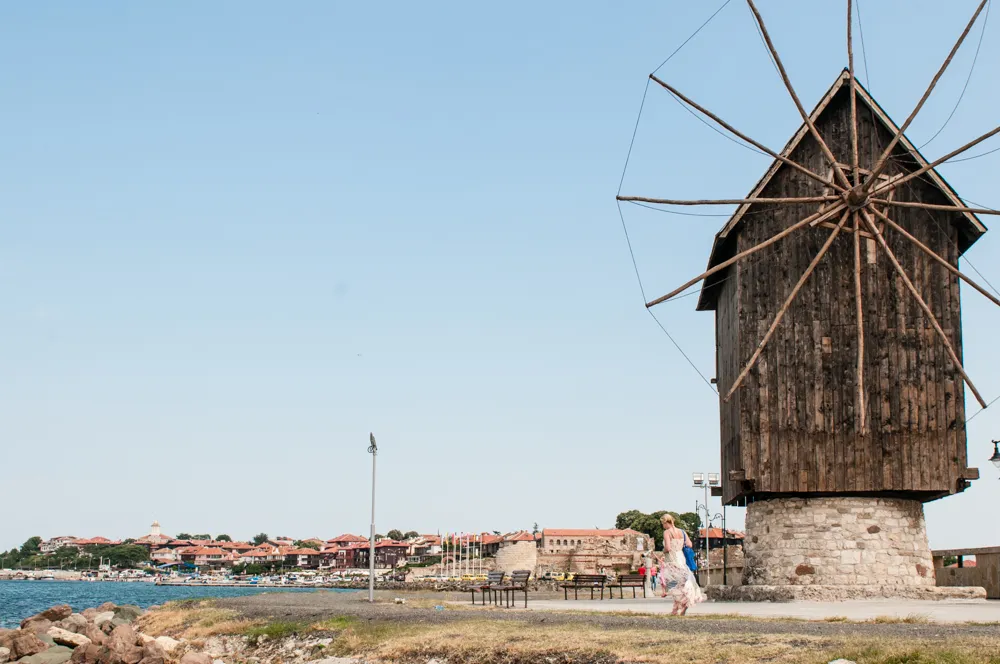
So what else is there to see in Nesebar besides Turkish-Ottoman dwellings? One cannot fail to mention the old mill. Judging by the number of photographs of it, some tourists go straight to the beach after a photo with it. The foundation of the mill is the ruins of a Byzantine church founded about fifteen hundred years ago. When exactly the utility building was placed on the ancient stones is unknown, but it is certainly several centuries old. Another of the dozens that once stood in the town can be found in the town.
About a hundred metres of Nesebar’s fortress wall have survived, in places up to 8 metres high. Plaques explain how to recognize the five stages of its existence: Thracian, ancient, Byzantine, Bulgarian and Turkish.
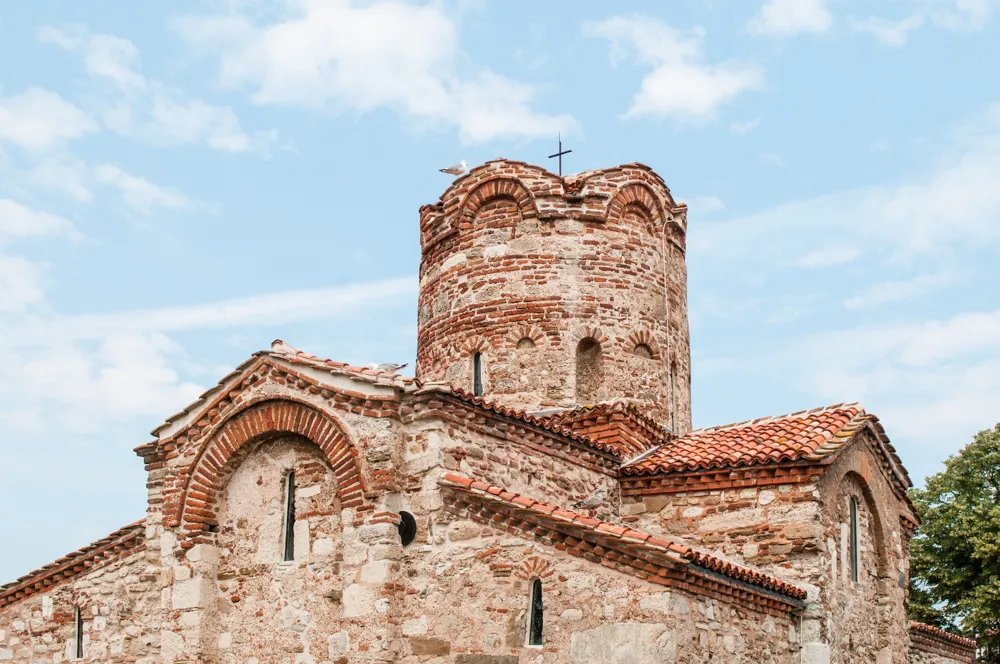
Back in the 14th century Nesebar was called the “city of forty churches”. Such a number of churches is explained by the fact that they were family churches built with the private funds of donors. Far from all have survived intact to our time. Though the churches differ, most are built of brick and natural stone with patterns made of brick. That is why guidebooks, which like to give “eloquent” names, call them “vyshyvanka churches” (embroidered-shirt churches). What to see in Nesebar of this stone embroidery.
The Church of St. Sophia, or the Old Metropolis, late 5th – early 9th century. This three-aisled basilica was part of the residence complex of the Metropolitan of Nesebar.
The Church of St. Stephen, the New Metropolis, 10th century. A typical medieval Lego set: cornices, capitals and reliefs of earlier destroyed buildings were used in its construction.
The Church of Christ Pantocrator, the Almighty, first half of the 14th century, which has now retrained as an art gallery.
The Church of St. John Aliturgetos, the Unconsecrated, 14th century, has a rare architectural solution: northern and southern entrances.
The Church of St. Theodore, 13th century, built in the Byzantine style. To prevent destruction during earthquakes, wooden inserts were walled in between the stones in the structure of the walls.
The Church of the Saviour (Ascension of Christ) was built in 1609 during the rule of the Ottoman Empire. It was built with the funds of a rich townsman. Since Christian churches were forbidden to be built taller than a horseman, the floor of the church was lowered below ground level.
The Church of the Dormition of the Most Holy Mother of God, 19th century, is the only one active in the town. Since the Virgin Mary is the patron of Nesebar, the day of the town is celebrated on her Dormition. According to one of the legends, the church icon with the miraculous image of the Black Most Holy Mother of God Hodegetria chose the place for building the church by itself. In those distant times a school stood on the site of the present church. One day children in the yard saw an icon of the Mother of God in a tree and carried it to the church. But the next morning everything repeated itself. The local residents decided not to argue: what they teach in those schools is unknown, while a forty-first church was lacking.
Want more? The churches of the Mother of God Eleusa, 6th century, St. Theodore, 13th century, St. John the Baptist, 11th century, St. Demetrius, 11th century, the Archangels Michael and Gabriel, 13th century, St. Paraskevi, 13th century, St. Clement, 17th century. Enough?! Better go to a restaurant and eat some fish. And do not recall that the Greek ichthys, fish, reads as an acronym for Jesus Christ, God’s Son, Saviour, and is not a mandatory sticker on your car.
Text and photos by Serhii Shcherbii



