How the Cossacks beat the musketeers

· 13 min read
The French interest in the Ukrainian Cossacks is shown both by the documents attached to the previous post and by the meetings of B. Khmelnytskyi (then still a clerk) and the Cossack officers with the French ambassador, Count Viscount de Bregy, which took place at the direct demand of Cardinal Jules Mazarin. They discussed the terms of the Zaporozhian Host’s participation in the late episodes of the Thirty Years’ War. But so as not to break the chronological course of events, we will not go into these episodes of cooperation here, and will begin with how the French actually learned about the Cossacks, where they were able to assess their military skill, and under what circumstances they got a good thrashing from the Cossacks ?
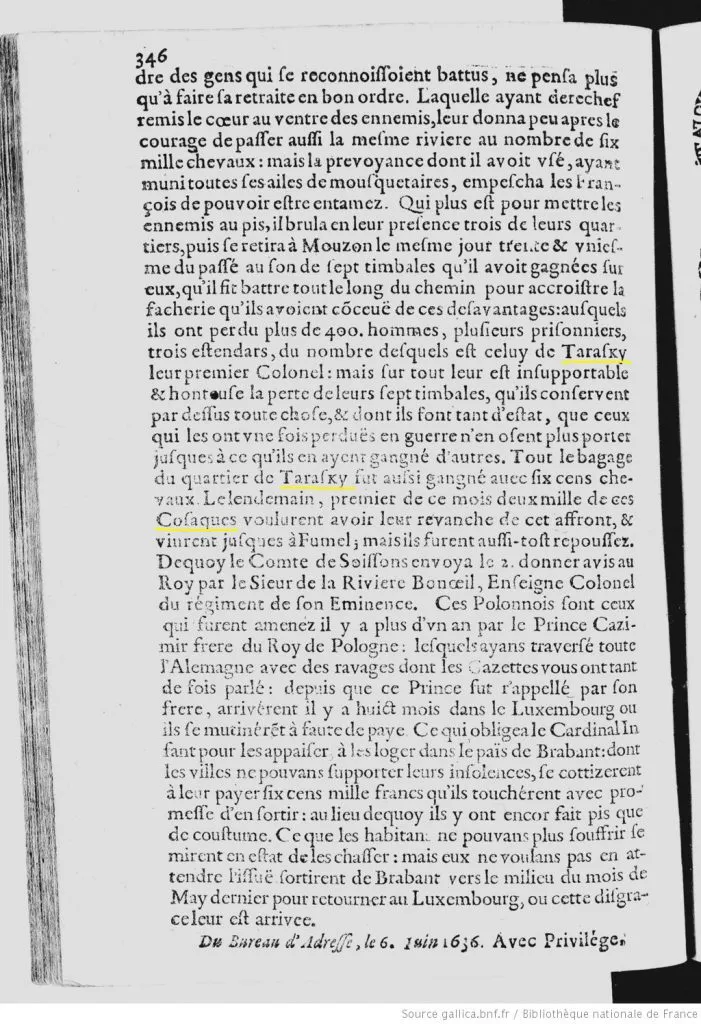
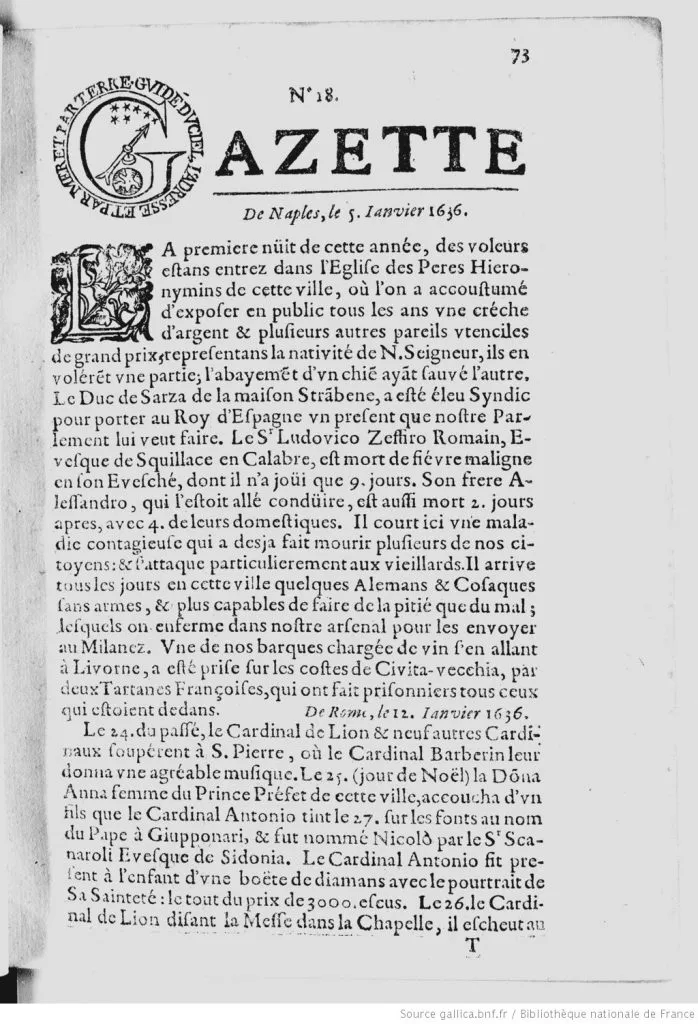
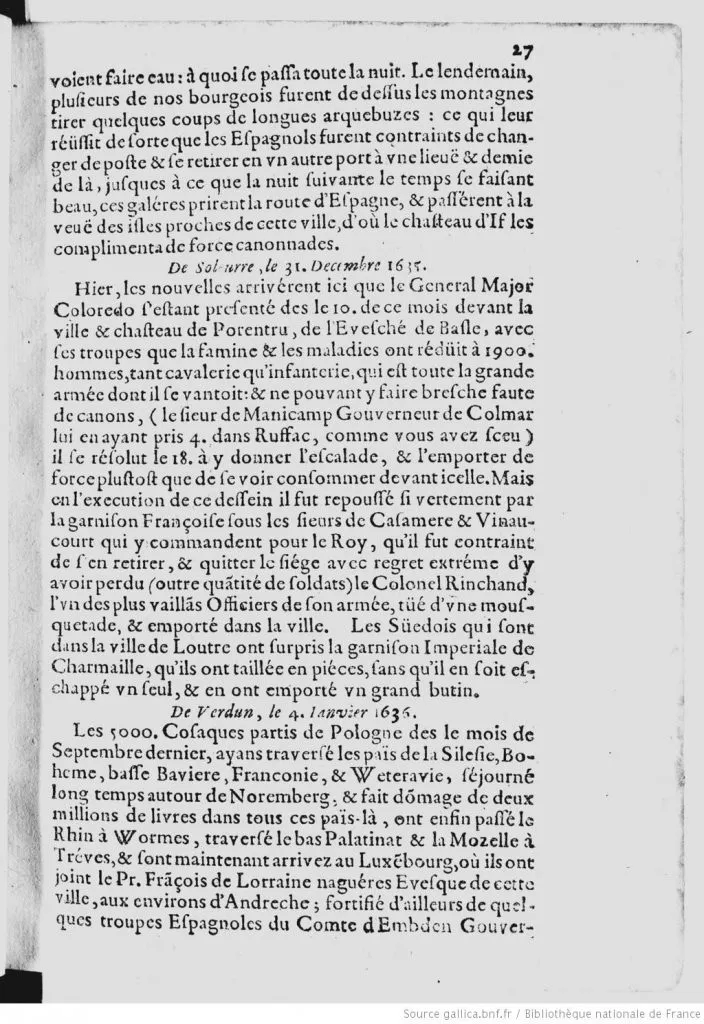
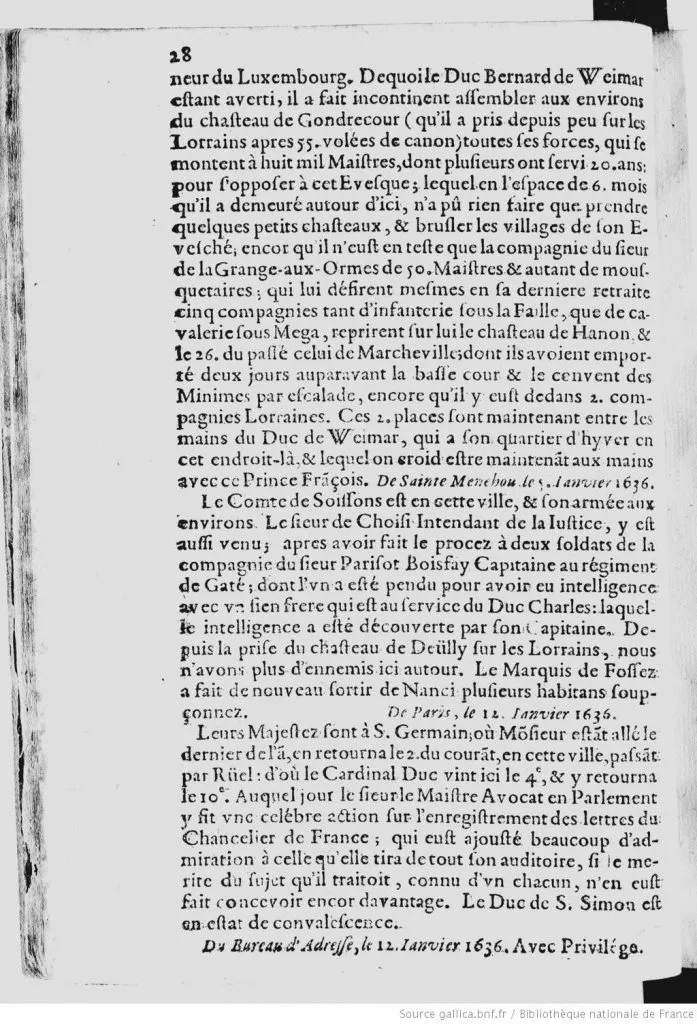
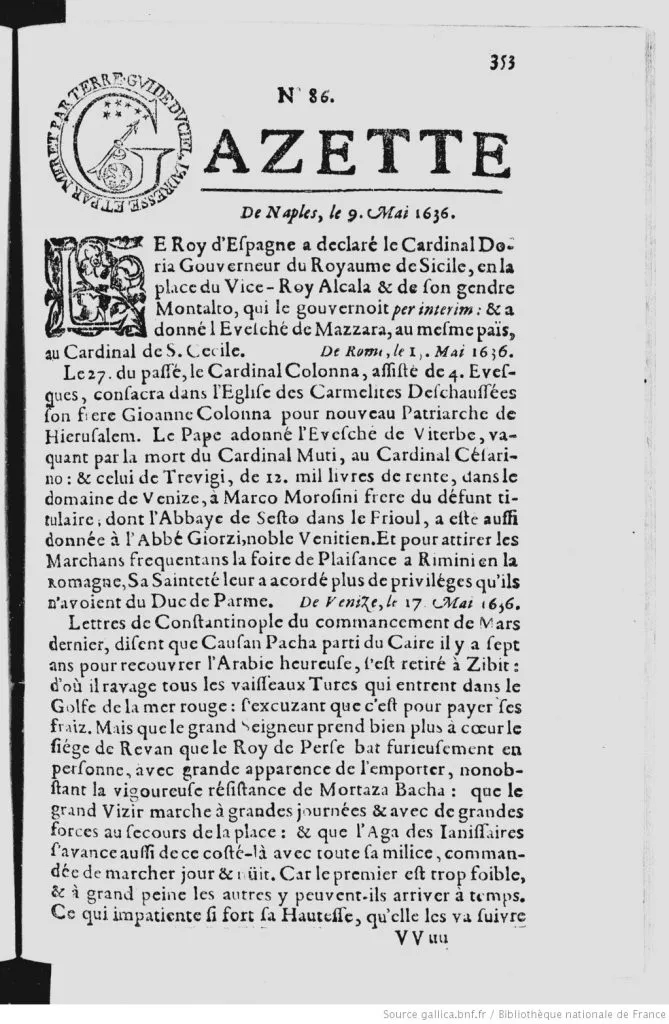
A hint of this was in the previous post, where a clipping from the French “La Gazette” of 1636 contained a rather shocking report of another episode of “the era of great Cossack geographical discoveries” (as I call it :)):
“5000 Cossacks… crossed Poland, Silesia, Bohemia, Lower Bavaria, Franconia… spent a long time around Nuremberg… Then, finally, crossed the Rhine at Worms, crossed the lower Palatinate and the Moselle at Trier, and are now arriving at Luxembourg…”
The very geography of the journey aroused admiration, but it was not only that which amazed the French, who then got the chance to get to know the Cossack army in battle too (before that they had read about it and admired it, as I have already written :)).
It was precisely this that would later lead to negotiations between the Cossack officers and the French ambassador (more about that in the following posts).
I will say a little more about what we know of the details of this campaign, which interested many in my previous post.
As mentioned in passing earlier, the Cossacks took part in earlier episodes of the Thirty Years’ War too, almost from its very beginning in 1618, in various parts of Europe. But for now we will consider the year 1634 and the events after it.
The successful short war of the Polish-Lithuanian Commonwealth and the Zaporozhian Host against the Muscovite Tsardom was ending. That year Smolensk was liberated from Muscovite occupation. Quite a few Cossacks remained in the Commonwealth’s service, some of whom had distinguished themselves in these battles but were considered unreliable in the Commonwealth (like Hasan/Taras Fedorovych). The Commonwealth was dealing with the next episodes of the great war, against Sweden. There was not much money in the state treasury to keep the Cossacks, and the Cossack uprising led by the same Hasan in 1630-1631 was still in the memory of the frightened Poles. So when the Austrian emperor Ferdinand II approached his Polish counterpart with a question about the Ukrainian Cossacks, already well known in Europe, he received from him a complete carte blanche to invite the Ukrainians/Ruthenians.
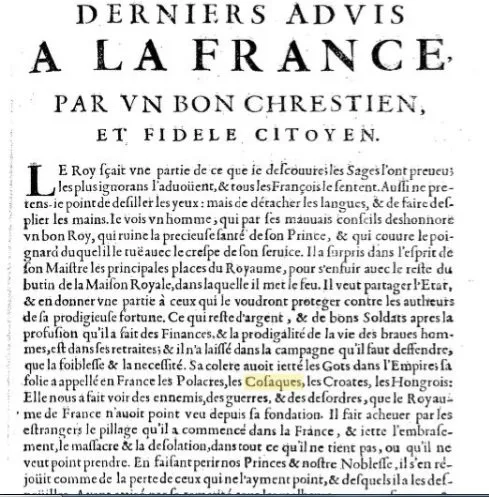
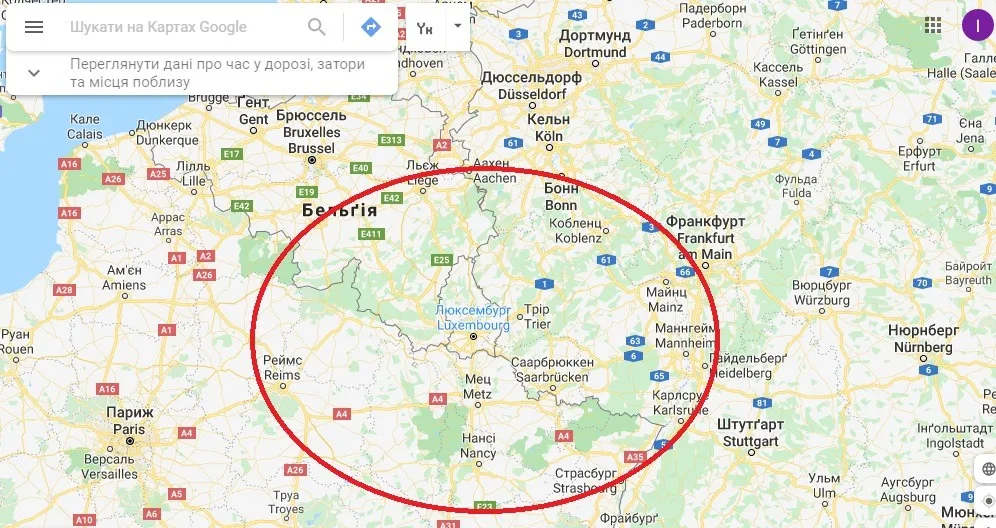
In the works of the Polish historian M. Dzieduszycki I found a mention that at the beginning of 1635 several thousand Cossacks (precisely from Ukrainian lands, since he mentions others too) were already serving in the Austrian army. They distinguished themselves in one of the first battles of the new episode of the great war, when France threw down the gauntlet to the Spaniards on 21 May and in early June French troops entered Belgium and began the siege of Leuven. The Cossacks and Croats were sent there as quickly as possible in order to hold back and wear down the French army.
The well-known researcher V. Holobutskyi, in his fundamental work “The Zaporozhian Cossacks”, referring to the work of another Ukrainian scholar, V. Sichynskyi, “Foreigners on Ukraine”, wrote that the French press then mentioned:
“A four-thousand-strong detachment of mounted Ukrainian Cossacks under the leadership of Tarasky, which fought in Luxembourg under the banner of the Austrian emperor against the French general de Soissons…
The Cossacks attacked the French with a terrible din; the French, unused to such a din, were so frightened that they took to flight and retreated to a swamp on the other bank of the river…” (p.).
I checked this episode against the French press and indeed found it in issue No. 81 of my favourite “La Gazette”. I can confirm that such a report did exist. The only thing is that it literally mentions “4000 Cosaques” led by “Tarasky”, and it stresses that he commands not only Ukrainian Cossacks but also horsemen.
It is appropriate to explain here that historiography fairly unambiguously identifies “Tarasko/Taras” as a Cossack otaman of Crimean Tatar origin, whose real name was Hasan/Khasan (rebaptised in the Sich as “Taras Fedorovych”, and known by the nickname “Triasylo”), whom I mentioned above. His origin and Cossack fame are an interesting moment of the ancient Ukrainian-Crimean relations, as a shared one, which professional historians should develop and raise to the state level, so that such a hero would remind us of Ukrainian Crimea and the shared history (his monument is crying out for Kherson right now, and later for Crimea). But for now I will only mention that the weak link for the Cossacks was precisely horses, of which there were not enough, and so joint campaigns with the Crimeans were often explained by the fact that the latter organically supplemented the Cossack army with cavalry. It is quite logical that O. Baran and H. Gajecky consider that “during Taras Triasylo’s hetmanship Cossack cavalry appears in the Cossack armies, which together with the infantry begins to play an important role. Even the official name of Triasylo’s army changed. Now it is called ‘Cossack cavalry and infantry’.”
Good fame and successful early battles required the massive presence of a professional Cossack army in the hottest spots of Europe. In such conditions the greatest problem was how to lead this army, dangerous to the Poles, across their whole territory.
An extraordinarily interesting historical investigation of this was carried out by the Italian-based diaspora scholars H. Gajecky and O. Baran, who carefully studied the Vienna archive and the corresponding correspondence between the Austrian and Polish courts. I will not retell the whole history of this correspondence, but let us focus on how the Poles ultimately solved the problem for themselves. By the king’s will Polish commanders were assigned who were to be responsible not only for recruiting soldiers from Ukrainian lands but also, most importantly, for organising all the practical aspects of the march, so that the Cossack army would not do harm to the Poles.
This is how the Austrian archives interestingly attest to it:
Finally, on 20 March 1635 an official answer came from Marshal Jan Lipski, who on behalf of the Sejm and the king announced permission for Emperor Ferdinand II to recruit Cossacks and lead them through the Polish kingdom, provided only that this unruly army did not cause great damage to the population of Poland during recruitment and the march (Haus-Hof-Staats Archiv Wien, Polen I, Karton 57, Conv. 1635 Martii, fol. 165-166 v.).
By imperial will the matter of recruiting Cossacks and all negotiations was entrusted to the ambassador in Warsaw, Matthias Arnoldini of Clarstein. He in turn turned for help to Stanisław Lubomirski, who had become famous in the legendary joint battle of Cossacks and Poles at Khotyn (1621), when he gained good experience of coordinating troops with Petro Sahaidachnyi. Lubomirski promised to recruit as many as 8,000 Cossacks from Ukrainian lands.
The Polish side insisted on the mandatory leadership of this campaign by two colonels, first Mocharski and Liashch, who had already several times commanded Cossack forces in conflicts in Eastern Europe. But the course of events in the Polish-Swedish war, and some other reasons, forced these colonels to decline such an appointment, since Poland was just then preparing a strong regular army for an attack on East Prussia.
The Poles clearly had no time for this, but Vienna insisted and indeed got its way, obtaining Cossack reinforcement of its army. For finally, in mid-July Arnoldini wrote to the emperor a long relation in which he “announced the first dispatch of 2000 Cossacks, with additions up to 8000 to follow. Recruitment is concentrated in Ruthenian Lviv, and then in Lublin, where the adjutant of the Palatine of Rus’, Dvorzhanskyi, receives Cossacks from Ukraine… and already issues an advance so that Cossacks from distant parts can easily reach the Silesian quarters prepared for them” (Ibid., fol. 221-222 v.). “These were the companies of Wegel and Noskowski, which included many Zaporozhians and other Cossacks tried in battle” (Ibid., fol. 27-27 v.).
On 23 September the agreements between the Austrian government and the Cossack expedition were fixed in a treaty (as the Cossacks had been accustomed to since earlier times, such as the treaty of 1624, when the Ukrainians rescued the Crimeans). The treaty was signed on the imperial side by Arnoldini and Colonel Winss, and on the Cossack side by Pavlo Noskowski.
Among the most important terms of the treaty one must single out, as we would say now, the “essential” one, that is, the “price” ?
The following monthly pay (salary) was offered: Colonel 200 thalers, Captain 100 thalers, Lieutenant 50 thalers, Standard-bearer 30 thalers, Quartermaster 50 thalers, each company 30 thalers, each Cossack 6 thalers. Knowing the Cossack habit, they immediately agreed that the Ukrainians/Ruthenians had the right to earn from war booty too:
“Prisoners may be held for ransom, except for generals and senior officers, who must be handed over to the imperial authorities.”
At the beginning of October, during the first official count, 4007 Cossacks were in the training camp at Brieg, and over the following three weeks more than 2000 more arrived. Ultimately this figure correlates with the news of 04.01.1636 in “La Gazette” mentioned above. That is, we see not only the reliability of the facts cited but also their extraordinary promptness for that time. Moreover, we even find the lost thousand in scholarly studies: “And another 1000 Cossacks remained behind. These were 4 companies of Zaporozhians who, under the command of the captain Yaroshevskyi, separated from the main group and only on 9 November reached the Czech border” (V. Liva, Prameny k Dejinam Tricetilete Valky, Praha, Naše Vojsko, 1952, vol. IV).
There were many more interesting adventures with the Cossacks, but eventually they set out straight towards Franconia and near Worms reached the Rhine. The French were everywhere on the defensive and feared a general offensive by the imperialists, now reinforced by Cossacks too. This fear turned into alarm when they heard of the arrival of the Cossack army (Baran A., Gajecky G. The Cossacks in the Thirty Years War).
Cardinal Richelieu, as usual at such critical moments, applied diplomatic means. He sent Count d’Avaux to Gdańsk in order to persuade Poland to recall the Cossacks from imperial service. But the Poles only spread their hands and officially denied their involvement, declaring that “it is not the army of the Polish state” (Haus-Hof-Staats Archiv Wien, Polen I, Karton 58, Conv. 1635 Sept., fol. 127-131). The Polish historian M. Dzieduszycki writes that part of the nobility, having interests in France, tried to influence the Cossacks, for which even Leszczyński was sent to them, but he too failed to persuade them not to fight.
As we say: “Nothing can stop an idea whose time has come!” (p.) ?
And if the Cossacks have decided to give the “musketeers” a good thrashing, so be it ?
I will not retell the whole course of events, because one can open any work on the Thirty Years’ War for the year 1636 and read it. But I will single out only the episodes with the Cossacks: having crossed the Moselle and entered the territory of Luxembourg, our men, despite the winter weather, harassed Bernard’s enemy army every day, and near Thionville even provoked a larger skirmish, so that the Protestant general had to move his headquarters first to Étain and then on 10 January all the way to Fresnes. The Cossacks pursued him all the time and, together with the equally skilful Croats, reached the very environs of the city of Metz.
Under the constant pressure and pursuit by the Cossacks and Croats on one side and Colloredo’s advance from the other, Bernard retreated as far as Verdun and Toul. In Luxembourg a light and very mobile army was organised, which could carry out lightning raids on northern France. The commander of this army was the Duke of Lorraine, who had 15,000 cavalry and 6,000 infantry under him. The main striking force were the Croats and Cossacks. In the second half of February they crossed the Meuse near Verdun and entered the province of Champagne, “spreading alarm everywhere for several months” (as “La Gazette” wrote).
In the end, after numerous victories the joint imperial army rested on its laurels, while the French brought up reinforcements.
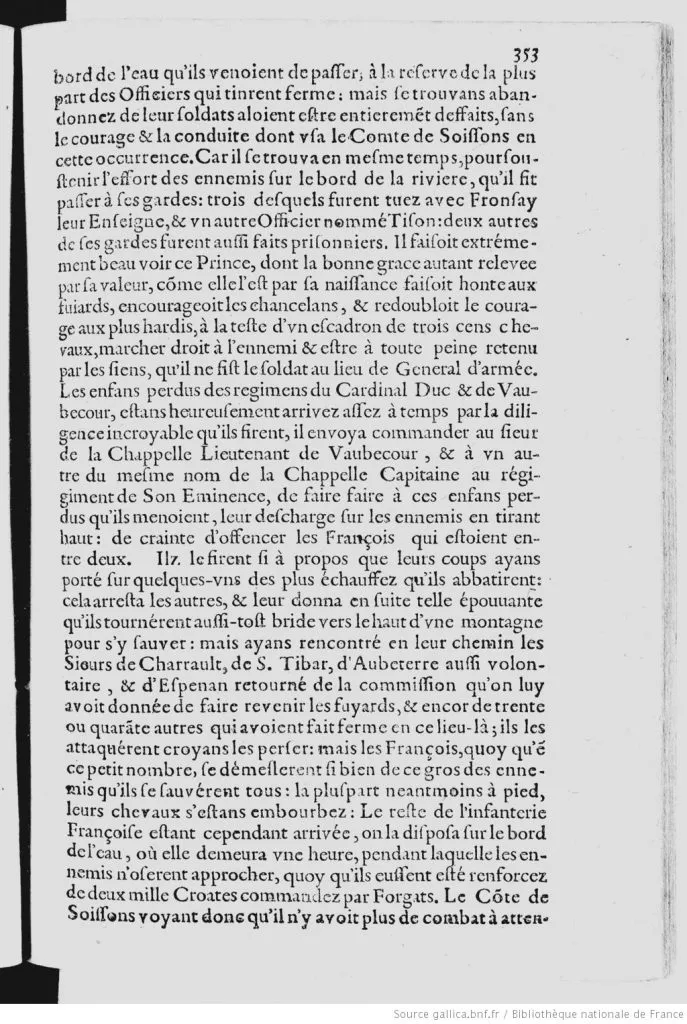
In the town of Yvoy, near the border, on 31 May a fierce battle took place between the detachments of Count Soissons and the Cossacks. The French made such a bold attack on the Cossacks that at first they had to retreat. During the retreat they lost many wagons with accumulated wealth and several hundred horses. Captain Taras Fedorovych (Hasan) and his company suffered most there. But by the end of the day fortune changed, and the Cossacks repulsed the enemy attack.
The battle of Yvoy in 1636 was studied from the point of view of the peculiarities of the Cossacks’ tactical art in the Thirty Years’ War by the historian A. Fedoruk, who, using the example of this clash between a French contingent and Cossack units in Habsburg military service, traced the peculiarities of the latter’s tactical methods.
Tired, homesick for their families and dissatisfied with the emperor’s promises and the actual payments, the Cossacks, as usual, began to protest and fight for their rights.
Vienna did not like this.
The Polish royal court, although it had been an intermediary in the negotiations with Vienna at the start, did not stand up for the Cossacks, effectively disowning its formal subjects. So our men packed their bags and, not without a scandal, headed home.
The next year the Poles would get a new Cossack uprising for this, in which most likely these same warriors, who had made such an extraordinary voyage and a whole series of geographical discoveries, almost reaching the Atlantic, would take part.
The French would long remember the Cossacks and the thrashing they received, and in the following years would make real efforts to persuade the Cossack army to join new episodes of the Thirty Years’ War, now on their side.
Our men, having seen the world and shown themselves, returned to their farms, because war is war, but one has to eat something ?
ps.
This post turned out a bit academic and tedious in its numerous references to historians’ works, and therefore will not gather as many reposts as the previous one. But I had to please the schoolchildren and give a little more reading literature. And besides, although some of these events were covered in historiography in a certain way, they remain unknown to the wide public. So your reposts and comments will help spread knowledge )
pps.
As for the ambiguous assessments of such campaigns, I will answer at once in the words of the historian A. Fedoruk:
“the contradictory existence of the Cossack knightly ideal in new historical conditions found an echo even in folk creativity:
the Polish nobility declared to the Zaporozhians:
“We fight for honour, and you for money”,
to which the Cossacks replied:
“Whoever lacks something fights for it ?”.
Author: Ihor Poluiektov
Beginning and continuation: