The 1918 ethnographic map of Europe, which shows a much wider settlement of Ukrainians than today and presents the nation as fully formed and striving for statehood

· 7 min read
My chapter in the book “Treasures of the Swedish Archives” is titled “A few pages of Ukrainian history through maps from European archives” and, using 20 maps and their stories, outlines the main milestones in the development of Ukrainian lands.
From the first mentions to the stormy events of the Cossack centuries, from the birth to the establishment of the Ukrainian nation.
Today I will introduce you to the twentieth map, which seems interesting and topical in light of the events every true Ukrainian has been painfully living through for the past eight years.
The Ukrainian nation
By the beginning of the 20th century the Ukrainian nation was fully formed, with an understanding of its place in history, its ethnic borders, and an awareness of its right to a sovereign state. Despite all restrictions, bans, deportations and wars, Ukrainians clearly assert themselves and refuse to put up with a diminished status and rights.
The “Ethnographic Map of Europe” shown below was prepared by the well-known Lithuanian diplomat Juozas Gabrys (1880–1951) at the Libraire Centrale des Nationalités (Switzerland) and published by the Institut geographique Kummerly & Frey in 1918 (see Illustration 23, Map 20). It records information on the national composition and settlement of ethnic groups in Europe somewhat earlier than the stated date of publication.
It is an excellent visualization that shows what Ukrainians’ confidence was based on and how they were perceived and assessed in the world of that time.
Not only the map itself has survived in excellent quality, but also the book that comments on it. In it J. Gabrys stresses that the map was the “result of long research and lengthy work on the spot, as well as in general and special libraries”. Describing the Russian Empire, he points out that some in Europe believe that, bearing such a name, it has absorbed almost 180 million “Great Russians”; but in fact those formerly called “Moscovites” number no more than 40 million. The rest are several peoples “whom they wanted to rule, but showed their complete own incompetence at disposing of the fates of others”. As a result, the author is careful about describing precisely the national composition of this dying Empire, because he had access to information from inside.
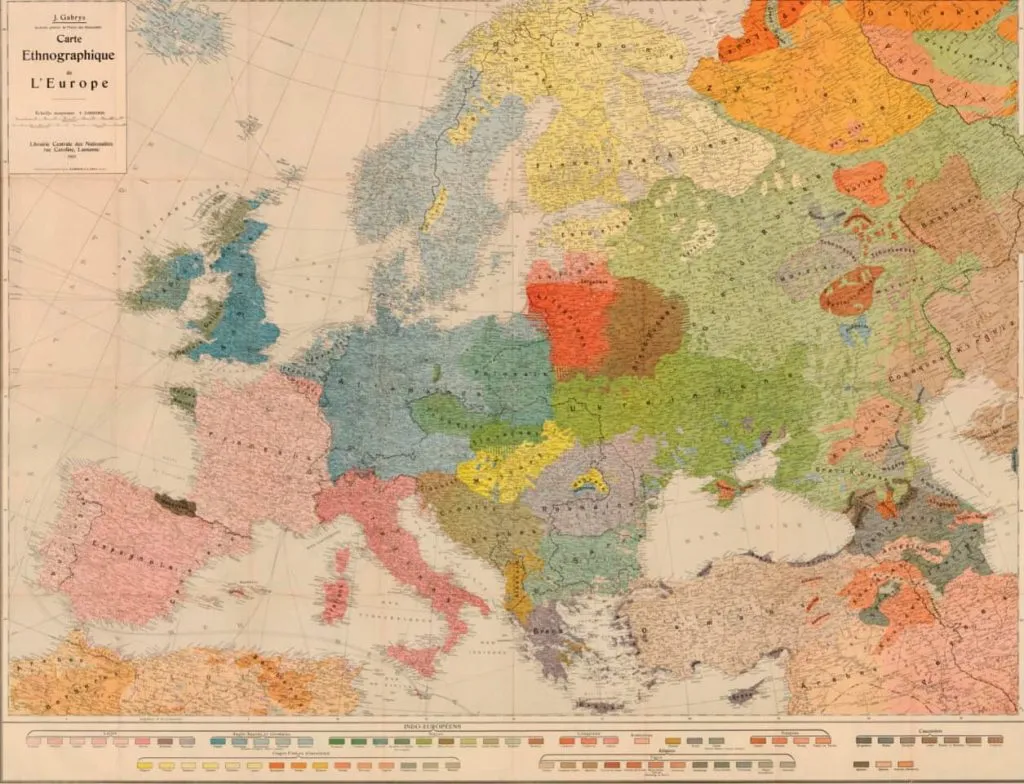
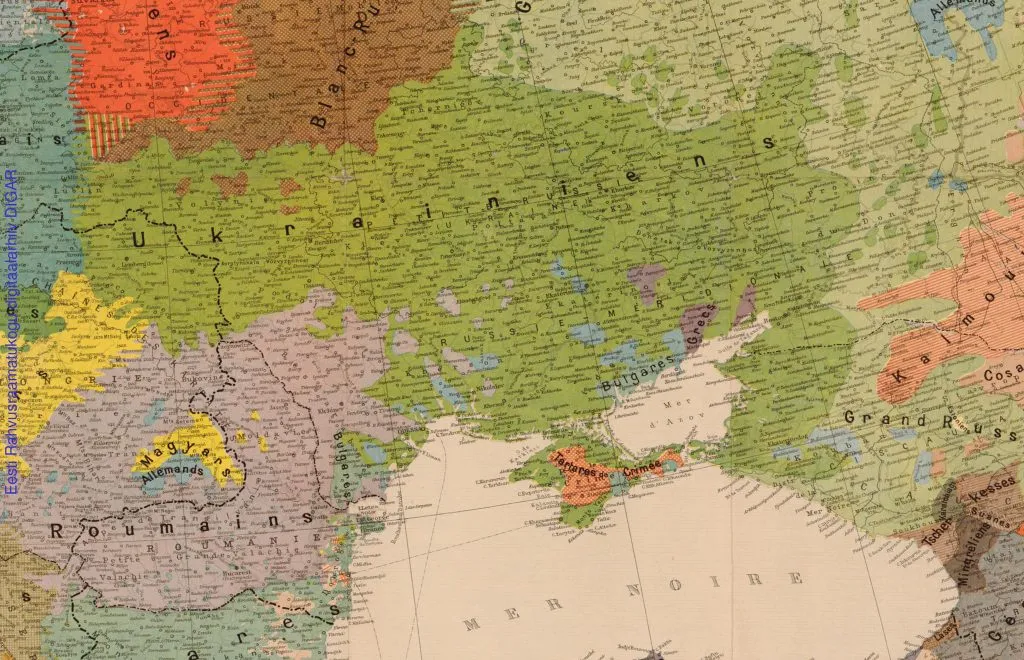
Ukrainians [Ukrainiens] are classed here as Indo-Europeans (Slavic group) and coloured dark green. As we can see, their settlement was substantially wider than the existing borders of our state. The author shifted the western limit of Ukrainian settlement somewhat east (in fact the communists had not yet carried out Operation Vistula at that time, so Ukrainians lived in large numbers, among other places, in the so-called Zakerzonnia), drawing it precisely along the San River.
The southern border of settlement runs along the Danube, and the eastern one, as you have already guessed, along the Don and even farther (as we saw on other maps of previous centuries).
As you can see, we end our story about historical maps with the same boundaries from which we began on the first ones analysed. Nature itself outlined these borders for us many centuries ago, and therefore nothing can change them.
The lands of modern Ukraine (whose outline is easy to recognize) were at the beginning of the 20th century occupied by Ukrainians, who form an absolute majority.
The northern Azov region is characterized by the presence of Bulgarians, Greeks and Germans, as confirmed by many sources. Crimea is divided between the predominant Crimean Tatars and Ukrainians, as well as Bulgarians and a minor presence of other groups. All this corresponds to the historical context.
Between the Dniester and the Danube we see four groups represented almost equally: Bulgarians, Ukrainians, Romanians and Germans. The author somewhat overestimated the area of settlement of Moldovans (Romanians) in Podillia. Historical sources do not confirm such a presence of theirs on Ukrainian territories. In Volyn the influence of Belarusians is noticeable. At the time the map was compiled there are no areas of settlement of Muscovites (called “Great Russians” by the author on the map) on Ukrainian lands.
This testifies to their insignificant presence in Ukraine before all the events of the following years: political persecution, three Holodomors, World War II, repressions and deportations, which would later affect the change in the composition of the population in no good way.
Meanwhile Ukrainians formed a majority or were settled en masse in some present-day territories of the Russian Federation. We see this as far as Bryansk and Kursk, on the historical Cossack lands of Starodub region. We see it almost to Saratov, where they bordered the areas of compact settlement of Germans (who would later be deported). They lived in large numbers along the Don River and formed an absolute majority in Taganrog district and on the Taman Peninsula.
As we know, it was on Ukrainian shoulders that the settlement and development of the Kuban was laid, and therefore their presence at the beginning of the 20th century on lands as far as Anapa and Yekaterinodar (Krasnodar), founded by the Cossacks, is a well-known fact.
Interestingly, the south of the Empire, between the Azov and Caspian seas, was settled by a whole group of peoples among whom “Great Russians” do not form a majority; Ukrainians, Tatars, Kalmyks, Nogais, Germans, Kazakhs and others are present there. This is on the question of “historical lands” and so on.
The renowned scholar Serhii Yefremov was indignant in a 1905 article at the new imperial attempts to impose on everything Ukrainian the false phrase “primordially Russian regions”, with which they wanted to justify the oppression of the Ukrainian language, as if striking from life the 80 to 92 per cent of the population of the Kyiv, Podillia, Poltava, Kharkiv and other governorates who were Ukrainians (even by imperial calculations; the 1897 census):
“…even the Ukrainian population in one part of its territory is now declared simply non-existent, replaced by some “local residents of Russian origin”. What has happened in this half-year? Were new surveys undertaken that revealed a capital error regarding the ethnographic physiognomy of the “South-Western Region”? Or did its population suddenly change its appearance beyond recognition, becoming “primordially Russian” in the sense in which this expression is used by the organs of the protectionist press? Or did some special cataclysms, sweeping like a hurricane through three governorates, wipe the Ukrainian population off the face of the earth within their bounds? Nothing of the kind, of course, happened: there were no surveys, and sudden sociological cataclysms, like the invasion of the Huns, are now impossible, and everything is, of course, as before…”
An excellent scholar, intellectual, a very moderate and cultured man, for these scholarly works and similar public reflections, after 10 years of torture he was tormented and died in the Vladimir prison of the GUGB in the russian city of Vladimir (10 March 1939).
Interestingly, in those years even population surveys were conducted, which recorded quite interesting results:
1. In the town of Zolotonosha (now Cherkasy Oblast) 378 people (aged 16 to 65) were surveyed.
To the question “In which language, Little Russian or Russian, is teaching in school preferable?” 324 spoke in favour of Little Russian teaching, 46 were indifferent, 8 stood for Russian teaching. To the question “Do they more willingly listen to and read Little Russian or Russian books?” 198 stood for Little Russian books, 78 stood for Russian books, the rest were indifferent (especially the illiterate).
2. In the 1860s a similar survey was carried out in Poltava.
To the question “From which book does the pupil wish to study?” 129 chose a Little Russian book, 12 were indifferent, and 12 pure-blooded Great Russians naturally chose the Russian book.
3. According to the reports of the Nizhyn correspondent of “Kievskie otkliki”:
“…of the 8 village reading libraries of Nizhyn district, only 2 had no requests for Ukrainian books; in all the other libraries there was a very intensive demand for books in the people’s native language.”
Later the situation would change.
As Norman Davies, professor at the University of London, wrote, “Ukrainians became victims of the greatest man-made catastrophes on the continent and of general genocide. Their losses during the war of 1918–1920, the collectivization of the 1930s, the terror and the Holodomor of 1932–1933 and the destruction of the Second World War must be close to 20 million people.”
But even this did not break the Ukrainians, and only tempered them in their aspiration to have their own state, their own Ukraine. Therefore the path the Ukrainian nation travelled to emerge at the end of the 20th century as a state, one that at the beginning of the 21st century will be called a true European phenomenon, that will demonstrate wonders of inexpressible resilience and heroism, deserves not only a leading place in world history but also a future worthy of such a history.
Author: Ihor Poluiektov