Slastion’s schools

· 6 min read
100 years of solitude
(subjective notes on the publication of the photo album “The Zemstvo Schools of Opanas Slastion”)
The Art Nouveau style can enchant and make you fall in love at first sight. My colleagues and I became convinced of this in the year 2000 AD, when our eyes stopped on a newly published, outwardly unremarkable book by Viktor Chepelyk – “Ukrainian Architectural Modernism (UAM)”. The subject seemed familiar, the author did not. It only seemed so – because it turned out that our acquaintance with Brussels Art Nouveau, the Vienna Secession and Barcelona Modernisme only underlined a catastrophic gap in our own education.
Professor Chepelyk, already deceased by then, made a strong impression – not so much with architectural discoveries as with his outlook. His deep, yearning, genuine love for Ukrainian Art Nouveau as the highest point of Ukrainian art was a powerful call to find the lost national treasures. One thing surprised us – why was the book illustrated mostly with the author’s graphic drawings and contained so few photographs? And when we set out to look for thematic materials, especially photographic ones, we were struck again, this time unpleasantly: there were practically none in open access! (we stress that this was before the virtual era). For some reason, both in Soviet and in independent Ukraine only a few familiar, recognizable examples of the style were reproduced, such as the Poltava Zemstvo building, the St. George Church on the field of the Battle of Berestechko and the Myrhorod hydropathic establishment (the latter mostly on mineral water labels); and even those were presented mostly as historical and architectural curiosities. Meanwhile the world had long been going wild over national varieties of Art Nouveau. We knew this for certain, because we had more than once seen rows of corresponding splendid albums in many foreign bookshops – from Brazil to Russia.
So another page of the old saying opened: if UAM would not come to us, we ourselves went to it. Naturally, the final goal of such an expedition had to be a luxurious and comprehensive photo album.
Our expeditions from Lviv to Kharkiv were chaotic but fruitful, especially after the appearance of digital photo equipment. In parallel a catalogue of Ukrainian Art Nouveau monuments was compiled. By 2007 it included several hundred churches, schools, clubs, hospitals and simply beautiful buildings, among which only a handful were entered in local monument registers. Besides Viktor Chepelyk’s book, the cataloguing and systematization were served most by the encyclopedic reference book “Poltavshchyna” of 1991. There we found an uncertain and incomplete, but intriguing list of zemstvo schools of the former Lokhvytsia county of Poltava Governorate, built in the national style in 1910–1916 to designs by zemstvo technicians and by Opanas Slastion – an outstanding architect, artist, teacher and theorist of UAM.
The lack of exact data on the number of Slastion’s schools (different sources gave figures that differed several times over – from 30 to 140) added a healthy adventurism and even excitement to our travels. So from 2008 to 2016, across the Lokhvytsia, Chornukhy and Lubny (Poltava region), Varva (Chernihiv region) and Romny (Sumy region) districts we found 54 Art Nouveau schools. Along with them, in various regions of Ukraine we came across dozens of other schools built in the 1910s–1930s in imitation of the “Lokhvytsia” designs, but with bright and unique features.
During our search, the 100th anniversary of Opanas Slastion’s zemstvo schools arrived and tried to pass unnoticed by Ukraine. Of course, we could not allow that. That is how the idea of a narrowly themed “school” photo album arose. In its final form it contained a short study of the history of building the zemstvo schools of Lokhvytsia county and two illustrated sections with information on 65 monuments. The publication became possible thanks to the selfless help of friends from the National Centre “Junior Academy of Sciences of Ukraine”, the advertising agency “Yasno” and the editorial board of the magazine “International Tourism”.
Already during preparation, the album turned from narrowly themed into conceptual. For now, not from books and articles but with our own eyes, we became convinced that after Slastion’s intervention in rural building the “pysanka” of the Ukrainian village began to play with fundamentally new colours. Joining Baroque churches, thatched cottages and well sweeps, Slastion’s zemstvo schools wonderfully complemented that unique silhouette of the Motherland which became for the people a symbol of everything dearest and most beloved…
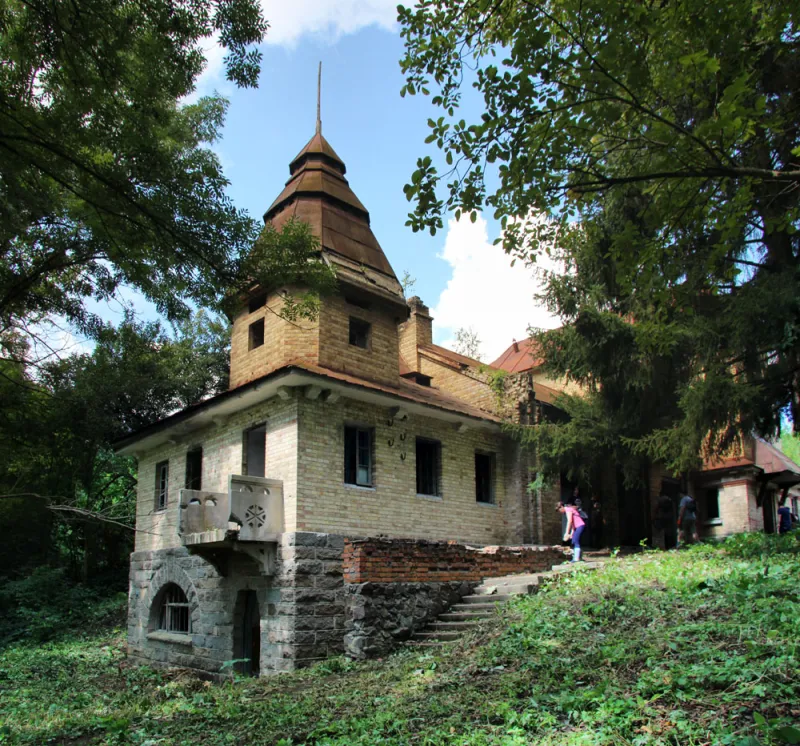
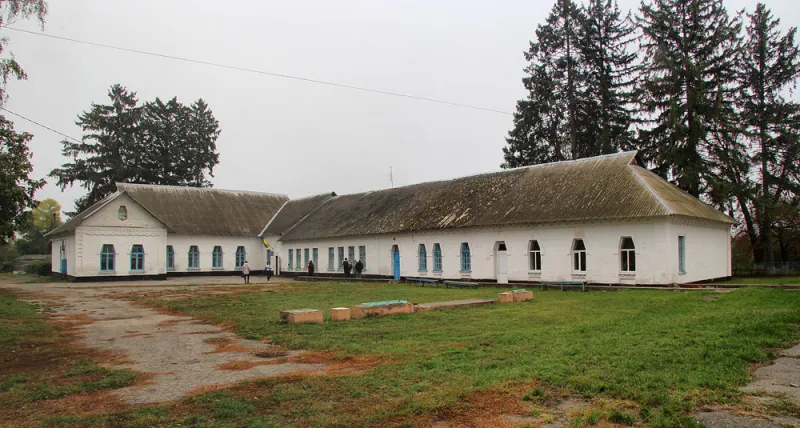
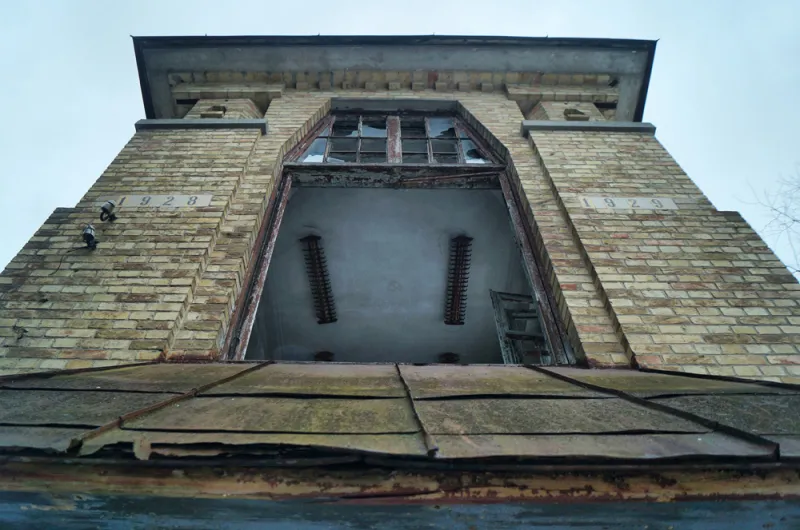
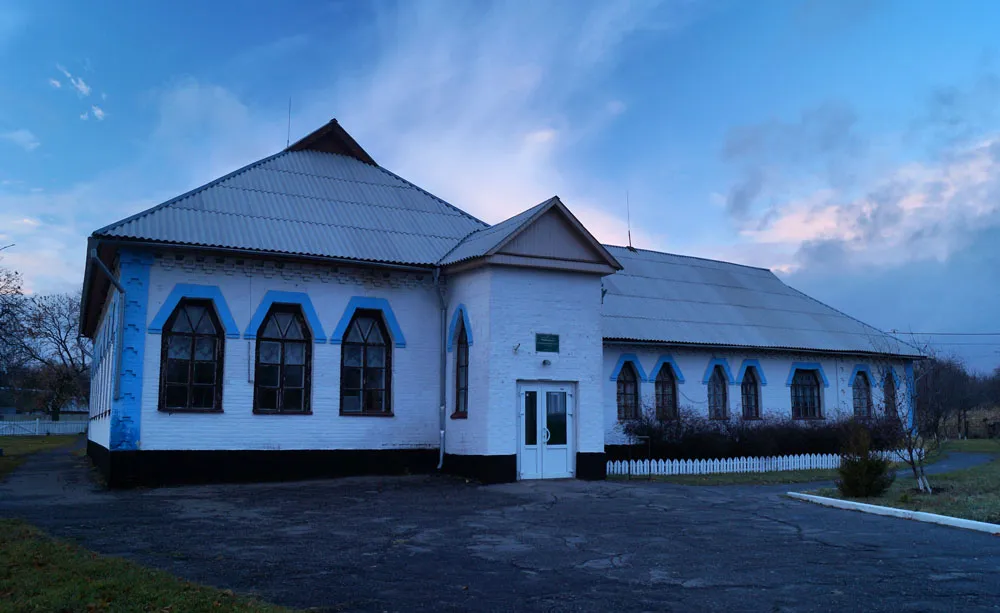
…We travelled from village to village, and amid classic Poltava landscapes our eyes rapturously met these buildings, only rarely well kept and filled with children’s noise. All expressive and highly artistic, decorated with elaborate brick ornament, trapezoidal windows and doors and, here and there, marvellous turrets with tall iron spires. Sadly, most of those turrets were dismantled back in Soviet times in the heat of the struggle against nationalism…
But why point at the USSR – already in the 21st century dozens of Slastion’s schools have fallen into ruin. In 2011 two wonderful monuments disappeared completely from the face of free Ukraine, including the best example of the whole Lokhvytsia series – the school in the village of Zapadyntsi, which was burned down by local vandals. It is very sad (but also telling) that such an epochal loss was noticed neither by the professional “cultural” authorities nor by the “cultural” public of Ukraine. These communities will be able to rehabilitate themselves only by an exact reconstruction of this wonderful monument – of course not in the discredited Zapadyntsi but, for example, in some open-air museum. Although, to be honest, one hardly believes in such a turn of events…
Over a hundred years, tens and hundreds of thousands of children have flown out into the merciless world from Slastion’s schools, where the very walls taught young Ukrainians not to renounce their kin on the roads of life, not to lose love for their native land, language and culture. Until recently none of these walls had any protection plaque. Only in 2016, through the efforts of our followers, enthusiasts from the Facebook community “Schools of the Lokhvytsia Zemstvo”, 19 schools received the status of monuments of local significance. Perhaps such a status will slow down, at least a little, the destruction of Opanas Slastion’s marvellous creations. Or perhaps not. Because now schools often die together with the villages, once populous and now unable to fill even one small classroom. Is that not why Slastion himself looks so sorrowfully at his descendants from the gravestone in Myrhorod’s Trinity Cemetery?
Will he ever be comforted? God knows. But there is hope: here and there in abandoned zemstvo schools village cultural centres, churches and even monasteries have already been opened.
Some materials from the photo album “The Zemstvo Schools of Opanas Slastion” (Archpriest Andrii Vlasenko. Kyiv: Institute of the Gifted Child, 2016. – 152 pp., 351 ill.) can be viewed on the website “Garden of Ukrainian Art Nouveau”
Author: Archpriest Andrii Vlasenko