Three battles that changed history

· 8 min read
The history of Ukraine as it was taught to me at school is an unbroken tale of suffering, defeats and endless misery.
This is certainly not what can interest and inspire. Yet the very vocation of historical science is to provide lessons for making the right decisions in the future.
When I began searching on my own for answers to questions that had recently interested me, I discovered that our historiography pays less attention to victories, while European primary sources about Ukraine (formerly Rus), our warriors, glorious pages and battles write about them far more interestingly: they not only knew of them but covered them quite widely and fully, sometimes even with admiration. Moreover, this was often simply on the pages of newspapers published on a regular basis from the early 17th century.
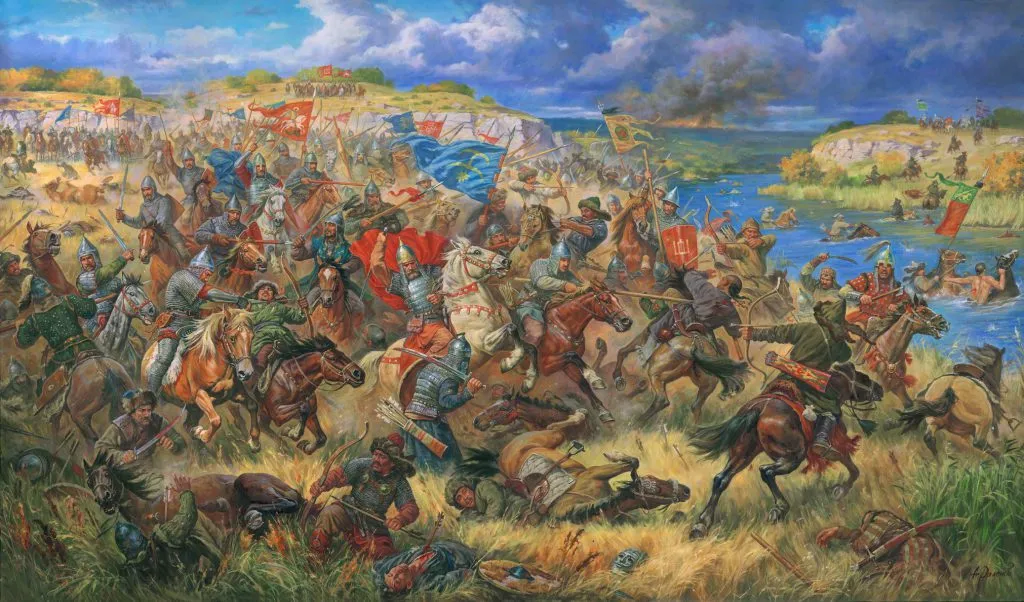
Photo: The Battle of Blue Waters, 1362, by Orlenov
But before I begin to set out curiosities from the European primary sources of that era, I will recall three decisive battles that preceded the formation of the reputation of Ukrainian warriors and also became the basis for subsequent events.
.
THE FIRST BATTLE.
1362.
The Battle of Blue Waters was the decisive offensive against the Horde, which freed the lands of Rus (including Kyiv) from dependence and began a new, almost 300-year stage of Ukraine’s development within the Grand Duchy of Lithuania, Rus and Samogitia, and Poland.
The joint Rus-Lithuanian army attacked the Mongol army led by three Horde khans, which for more than a hundred years had ruled the Ukrainian lands undivided.
This offensive formed the main content of the whole anti-Horde military campaign and was carried out operationally in two expeditions of the Rus-Lithuanian forces: the first, directed south through the Dnipro-Don interfluve all the way to the mouth of the Don and Azov (only by moving along such a route could the Horde be driven “as far as the Volga”, Azov and Crimea, as is clearly attested by the “Chronicle” of Maciej Stryjkowski and cautiously hinted at by the Rogozhsky chronicler), and the second, which reached the mouths of the Dnipro and the Southern Buh and during which the Battle of Blue Waters took place.
Danylo Ostrozkyi, whose family would glorify the Ukrainian lands and whom I will mention again below, took part in the battle.
As a result of the battle:
The long-standing political conflicts within the Horde state deepened, and would lead to its weakening and decline.
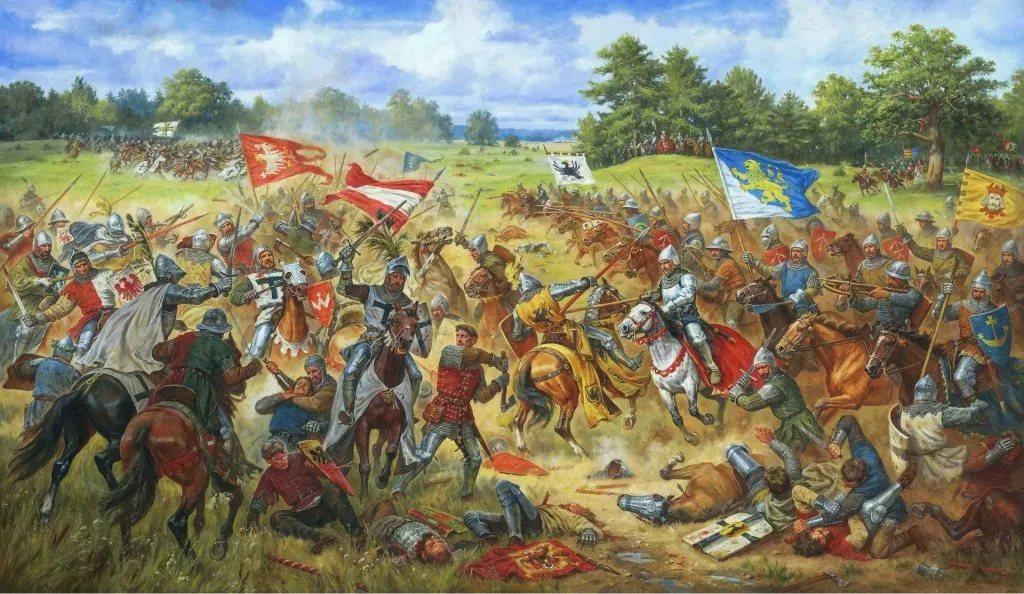
Photo: “The Galician banners at the Battle of Grunwald on 15 July 1410”. Painting by Artur Orlenov
Rus was freed from total dependence on the Horde, the Podillia principality of the Koriatovych princes arose, and on the throne of Kyiv (which, according to various sources, began its liberation as early as 1329–1333) Volodymyr, son of Grand Duke Algirdas, the first Kyiv prince of the Gediminid dynasty, established himself for more than three decades.
The Grand Duchy of Lithuania, Rus and Samogitia would stretch from the Baltic to the Black Sea, becoming one of the largest states in Europe at the time.
.
THE SECOND BATTLE.
1410.
The Battle of Grunwald is one of the main pages of history, which determined the course of events for the following centuries for many countries of Central and Eastern Europe.
The Teutonic Order of crusader knights, which had ambitious plans to expand its territories and threatened the existence of the Grand Duchy of Lithuania, Rus and Samogitia (the joint state of Belarusians, Ukrainians and Lithuanians), was losing sources of funding and urgently needed new conquests.
A multinational army fought against the Teutonic Order in that battle. According to the contemporary chronicler Jan Długosz, the large united army included banners formed on the territory of present-day Galicia, Podillia and Volhynia: the Galician, Przemyśl, Lviv and Chełm banners, the 40th banner of Marcin of Sławsko, and three Podillian ones: Zhydachiv, Terebovlia and Podillia. The army also included land banners from Kyiv, Kremenets, Starodub and Drohiczyn. Our countrymen also fought under other land and personal banners. Establishing the national identity of the participants is a difficult and lengthy task, but there is no doubt that these regiments consisted mostly of Ukrainians. Their history is reflected in privileges, charters and family trees. Nor should we forget the numerous detachment (according to various data, from 300 to 1,500) of Tatars who lived on the territory of present-day Ukraine, joined the army and took position on the battlefield on the right flank, immediately behind the Rus (Ukrainian) army.
The victory brought not only numerous awards for Ukrainian heroes, among whom the Galician Ivanko Sushyk is usually singled out, but geopolitical consequences for many countries:
The Order was doomed, while Poland and the Grand Duchy began a rise and development that would make them the main players in the region for several centuries.
.
THE THIRD BATTLE.
1514.
The Battle of Orsha on the Dnipro was a victorious war of the heir of Rus, the joint state of Ukrainians, Belarusians and Lithuanians, against the heir of the Horde, the Principality of Moscow.
From 1501 the Moscow ulus of the Golden Horde did not abandon attempts to seize the lands of the Grand Duchy and carried out permanent raids on Smolensk, trying to avenge the defeat of its masters in 1362. Having been given a bloody nose in 1508, the Muscovites lay low, built up strength and waited for the moment of a new attack.
In 1514, after three failed attempts, Smolensk was unfortunately captured. This opened a direct road to Vilnius, which was the capital of our state at that time. The Muscovite forces clearly outnumbered ours, and their self-confidence was off the scale. Only a miracle could save us.
And that miracle was the hetman of the Grand Duchy of Lithuania, Rus and Samogitia, Konstanty Ivanovych Ostrozki.
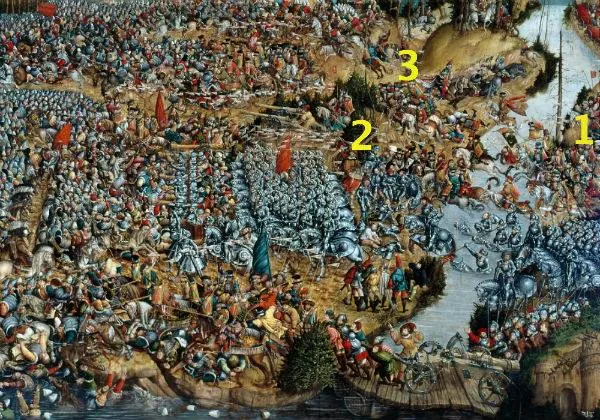
Photo: “The Battle of Orsha”, 8 September 1514. A 16th-century painting. The artist depicted Ostrozki three times, retelling the course of the battle and the hetman’s part in it.
He was called the uncrowned king of Ukraine, such was the influence on our lands of this military and state figure of Volhynian origin.
He declared mobilisation and quickly gathered an army in the Ukrainian lands, then united it with the Lithuanian and Polish forces, marching to meet the hordes of the Muscovites.
From the very beginning it was clear that the protracted wars, first with the Horde, then with the Teutons, then with the Tatars and in recent years with the Muscovites, had greatly weakened the state’s military power. So it would not be possible to gather even a comparable army.
Moreover, this time the Muscovites had prepared well for the attack, concluding agreements with the Germans and the Tatars, who almost simultaneously began their campaigns on the northern and southern borders of the state. Thus it was difficult to resist Muscovite expansion from the east.
In the end, the joint army of Ukrainians, Belarusians, Lithuanians and Poles gathered at Orsha was inferior to the Muscovite one by almost 1.5 times.
However, Ostrozki did not intend simply to stand on the defensive: he forced the river and found himself directly opposite the forces commanded by the voivode I. Cheliadnin. He caught him by surprise and took a more advantageous position, which would lead to victory.
Thanks to the genius of the Ukrainian commander and the desperate courage of the warriors, another Muscovite attack on the heritage of Rus was repelled. About two thousand boyars were taken prisoner, the captured trophies substantially strengthened the Rus army, while the Muscovite one was routed and suffered such losses that it would not soon recover.
For a long four decades the Muscovites gave up their designs on our lands.
This time was put to good use for the development of science, culture and law in the Grand Duchy, including the compilation of three editions of the Lithuanian Statute (1529, 1566 and 1588), which became the successors of the Rus Law (Ruska Pravda) on the lands including Ukraine. I wrote about this two posts ago.
.
After the Battle of Orsha, K. I. Ostrozki would be called the Rus Scipio in Europe, and books and pamphlets would be written about him for royal courts. For example, the papal legate in Poland: “Prince Konstanty may be called the best commander of our time; he was victorious 33 times on the field of battle… in combat he is not inferior to Romulus in bravery”.
The outstanding hetman was buried in the Kyiv Pechersk Lavra.
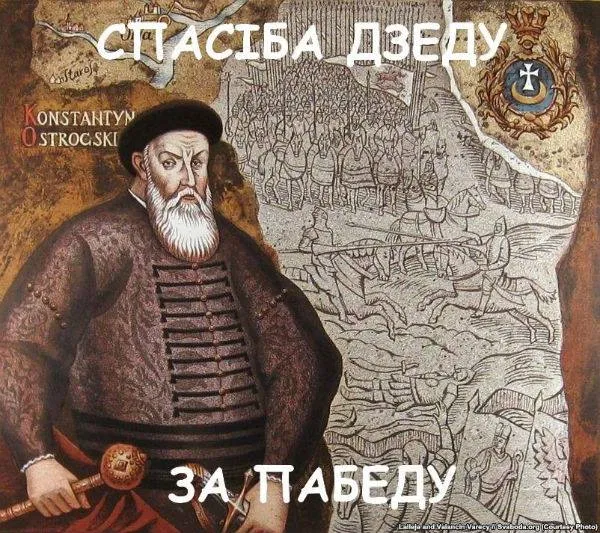
Photo: Whoever does not remember the past has no future
And his son worthily continued the service to Ukraine, spoke in favour of internal reform of the church and of improving the level of educational training. At the family estate in Ostroh he founded the first institution of higher education in Ukraine (and east of it), the Ostroh Academy. He invited Ivan Fedorov to Ostroh, opened the first printing house on our lands and turned his estate into a true scientific and cultural centre. He was distinguished by tolerance in matters of faith and in principle favoured the unity of the churches, but he envisaged a church union on a universal scale (an idea that was ahead of its time).
In 2017 Ukraine, the Republic of Lithuania and the Republic of Poland named a multinational military unit, the “Lithuanian-Polish-Ukrainian Brigade”, after the Great Hetman Konstanty Ostrozki.
Which symbolically sums up the results of the three outstanding battles I have described, in which Ukrainians, Belarusians, Poles and Lithuanians jointly confronted threats from the south, the north and then the east.
Each of these battles substantially influenced the development of Europe and has become relevant again in our time, with yet another raid of the horde from the east.
Author: Ihor Poluiektov