

Ephesus (Efes), part II
· 26 min read
So, the temple of the Greek goddess Artemis in Ephesus is one of the Seven Wonders of the Ancient World. Despite its Greek roots, the Temple of Artemis is today in a completely different country. What was called Asia Minor in the ancient world has changed the outlines of its coastline, its borders and its names over the millennia, and now the official geographical location of the famous ancient temple is given as: İzmir Province, Turkey.
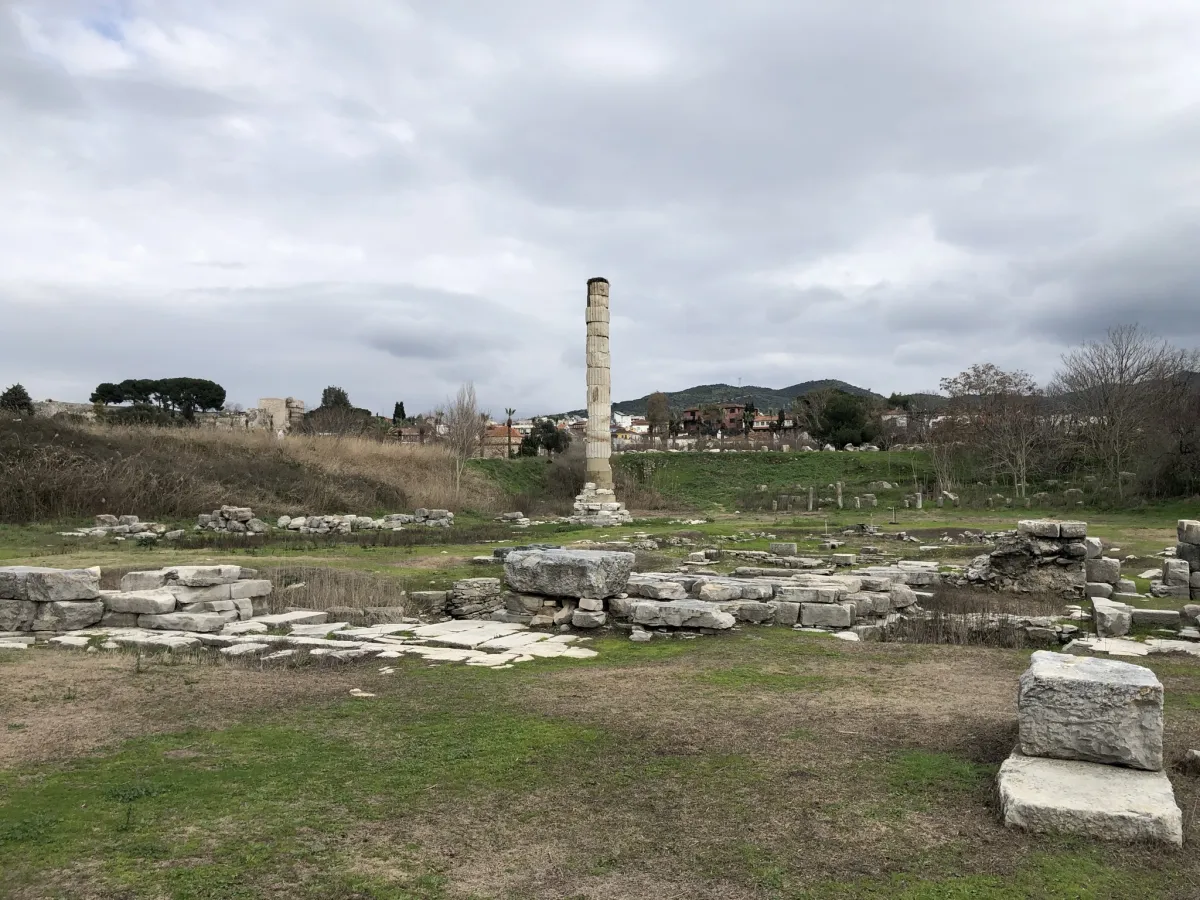
Can you imagine what a temple – a wonder of the world – looks like? Yes, this one single column out of 127, hastily put together by the Turks in some swamp, is all that is left of the temple. If it were not for the information plaque, nobody would know what this famous place is.
The majestic Temple of Artemis, as I have already written, was built in 450 BC by the Lydian king Croesus. The project was designed by the father and son Persiphon (Chersiphron) and Metagenes, Greek architects from Knossos (did the palace of the Minotaur inspire them? No idea).
The temple was built entirely of marble and was possibly the first Hellenistic stone sanctuary. But at first, when the idea of building the sanctuary appeared, nobody knew where to get enough marble for such a huge temple. No deposits of stone were known near Ephesus before then. This is not Aphrodisias. While the local philosophers were pondering, one of the shepherds drove his sheep out to graze. And at some moment near a rock two rams decided to test their strength with a run-up, but for some reason (probably Artemis diverted them) they missed each other. One of the rams slammed into the rock and knocked off a white, solid piece. “Marble!” cried the delighted and, from then on, very rich shepherd.
The choice of the building site looks like an interesting idea: marshy terrain. The architects explained their choice by saying that on such ground an earthquake would hardly be felt. And so that the temple would not sink into the swamp, a pit was dug under it and filled with charcoal and wool. The swamp is still alive today.
No less interesting was the solution for erecting the roof. The legend says that the goddess Artemis herself came to help in Ephesus and helped to install the structure.
A legend is an interesting thing, but in fact the architects, in order not to damage the 18-metre columns with the upper beam (the architrave), came up with the idea of first laying down sacks filled with sand but not tied. In this way the beam pressed on the sand and not on the capitals, the sand poured out, and the beam settled neatly into its intended place.
One of the main difficulties in the process of construction was the same swamp: it is very hard to deliver marble across it. But while the stone for the floor and steps could still be broken up, it was impossible to do such manipulations with the columns. Then Chersiphron suggested an ingenious method by which the ancients levelled the ground.
Iron rods were driven into the ends of the column, reinforced with lead, and onto these axes, on both sides of the column, wheels were fitted of such a size that the stone column itself worked as an axle. Then long poles were attached, oxen were harnessed, and the column, turned into a sort of wheelset with an axle, rolled over the viscous marshy ground.
The Temple of Artemis was for a long time the largest sacred structure in ancient history. The perimeter of the Artemision was 110 x 55 m, and the height of the columns reached 18 metres. The gabled roof was made not of tiles, as in ancient temples, but of marble slabs. At the corners of the roof stood four marble bulls of gigantic size. The pediment of the temple, whose top was 25 metres above the ground, was lavishly decorated with a majestic marble sculptural composition.
Inside the temple stood a sculpture of the goddess Artemis made of ivory and ebony, covered with gold ornaments and jewels. The sculpture was 15 metres high. Do you think the statue of Artemis resembled an elegant, fragile girl drawing an arrow, with a frightened animal at her feet? That is the common museum and park version. No way. The statue, known to us in hundreds of copies, represents (how best to put it) a pillar with a head and arms, from which, where normal women have breasts, as many as four rows of who-knows-what protrude.
Traditionally it was accepted that this was like female animals – many teats. That is, as is often written, a symbol of the fertility of the goddess Artemis, who was the goddess of fertility and nature. Supposedly that is why she has so many breasts. This version was very widespread among archaeologists and historians up to the 2000s. Even now not everyone has given it up. Only what is depicted is unambiguously not breasts. Archaeologists have found in Anatolia several images of the god Zeus in a similar guise, and he, surely, cannot be suspected of nursing everything that crawls and runs.
We reread the ancient authors and made sure that those who described the Temple of Artemis in Ephesus in ancient times had no such association in their heads. So who called Artemis “many-breasted”? It turns out that the first to write about the lewd goddess were “competitors” – Christian authors. They could be forgiven – perhaps in their asceticism they had not even seen a woman. Though I doubt it. The competition for souls in those times was fiercer than the one now between iPhone and Samsung.
So what is it? On no copy of this statue, in no variant of the “many-breasted” one, is there such an important thing as nipples on all these clusters. The only exception may be the Tivoli fountain, where Artemis has little holes, but that is a very late interpretation, and who knows what they came up with in the Renaissance. And we can be sure that, unlike the early medieval Christian sculptors, their ancient brothers of the hammer and chisel were far more skilful and precise.
From the descriptions it is known that the earliest original statue was of black wood impregnated with oils. It was dressed in a chiton and many ornaments. When ancient sculptors copied the prototype in marble, they made the goddess’s hands, head and feet as black as the wood, and left everything else light. If these breasts had been part of the body, they would have had to be black too. Logical. So the four rows are not “breasts” but some ornaments, elements of clothing.
There is an original version that these are the testicles of sacrificial bulls, which were offered in the temple, worn by the goddess. On the statue there are very many images of these animals in the decor. I have read versions about pendants made of gourds – a symbol of fertility – and leather pouches with some amulets.
So what is actually depicted? There is no unambiguous evidence; decide for yourselves.
Evidence has come down to us of a competition for the creation of a sculpture of a wounded Amazon in the temple. The people of Ephesus invited Phidias (creator of the famous statue of Zeus at Olympia), Kresilas (creator of the sculpture of Pericles), the Athenian sculptor Kradmon and Polykleitos of Argos, who won. But what must this work have been like to surpass the art of Phidias himself? Can you imagine with what mastery the other sculptures that decorated the temple inside and out must have been made?
In the city’s heyday the Temple of Artemis was not just a sanctuary. There was a market here, the finances of citizens and even foreigners were kept here, deals were concluded and negotiations were conducted. At the same time the temple was independent of the local authorities – the affairs of the Artemision were run by a college of priests.
The long construction was completed in 550 BC. In its original form the second Temple of Artemis stood for only 200 years. The first great misfortune to befall the temple was in the person of him whose name must not be spoken. Voldemort Herostratus decided to make his name written into history. He set fire to the temple: the wooden beams quickly burned, the roof fell in. Only the columns and walls were left of the temple, blackened so much that the city’s inhabitants decided to dismantle the temple and rebuild it anew.
By decision of an assembly “in which the whole Ephesian people took part”, the name of the man who committed this crime was to disappear from human memory forever. In the official lists he is referred to simply as “one madman”, but in the 4th century BC the ancient Greek historian Theopompus mentioned him, and since then the name of Herostratus has entered history. Actually, just as he wanted.
To reproaches as to why the goddess had not saved her temple, the Ephesians replied that she was busy with the safe birth of the future great commander and conqueror of the world, Alexander the Great. He was born on the day the temple burned.
When 25 years later the grown Alexander the Great approached Ephesus at the head of his army, he wished to restore the destroyed temple at his own expense. There was only one condition: on the restored temple, next to the name of Artemis, his name was also to be immortalised.
The Ephesians thought for a long time. On the one hand, it would be nice to take advantage of a freebie, and on the other, would the goddess not be offended? Finally they diplomatically refused: “It is not fitting for one god to build temples for other gods.” The divine Alexander did not object… and helped the goddess to build her sanctuary in Sardis. So as not to offend Alexander the Great with their refusal, the Ephesians commissioned his portrait for the temple from the artist Apelles, who depicted the commander in the guise of another god – Zeus with a thunderbolt in his hand. The optical effect of the canvas – the hand with the thunderbolt seemed to protrude beyond the frame of the picture – and the likeness to the original so struck the inhabitants that they paid 25 gold talents for the work – the highest price for a single painting. At least, so they said in Ephesus.
In the end the Ephesians rebuilt the temple after Alexander’s death, at their own expense. The work began in 323 BC and continued for many years. The third temple was larger than the second; 137 m long, 69 m wide and 18 m high, with more than 127 columns.
Many celebrated masters of the time adorned the new Temple of Artemis. The delicate bas-reliefs crowning part of the columns were created by the sculptor Scopas, the statues in the inner chambers by Praxiteles. Many wealthy Romans donated gold and silver sculptures to the temple.
The repeated destruction of the Artemision took place in 263, when the might and influence of Rome weakened. The temple, like other buildings of Ephesus, was plundered by the Goths, but was restored again by the inhabitants.
The temple of Ephesus was particularly hateful to Christians, as competitors in the collecting of souls. Therefore, as soon as it was permitted to destroy ancient temples, everything that could be taken and carried away – columns, statues, marble slabs – was pilfered and used for the construction of private houses and temples of the new god. The emperors themselves set the example: Constantine devastated Asia, taking from it various works of art and moving them to his new capital named after himself. When Justinian began to build the temple of the Divine Wisdom, Hagia Sophia, Ephesus became for him a warehouse of ready materials: twelve columns that now adorn St. Sophia were taken from Ephesus. The proximity of the sea made it easier to export various “building materials”. The temple was finally destroyed as a place of pagan worship in 401 by the Archbishop of Constantinople, John Chrysostom, during his visit to Ephesus. And Herostratus went down in history…
Besides the lone column in Ephesus, pieces of columns decorated with reliefs stand in London in the British Museum.
The Cave of the Seven Sleepers
One of the best-known rules of German farmers is the rule of the Siebenschläfer – the day of 27 June: Regnet es am Siebenschläfertag, der Regen sieben Wochen nicht weichen mag. “If it rains on the day of the dormouse (edible dormouse), the rain will pour for another 7 weeks.” Where does the name “Siebenschläfertag” come from? This day did not get its name from the rodent of the same name, in German Der Siebenschläfer, in Ukrainian the edible dormouse (vovchok sirii). As many believe, it refers us to the old legend of the Seven Sleepers, which has a tradition in Christianity and Islam as the “companions of the cave”, and not to the little animal. It is the only Christian legend in the Quran that exists neither in the Bible nor in the apocryphal writings.
Not far from the lone column of the Temple of Artemis are the ruins of a church that was built on the site of the Cave of these Seven Sleepers (in Turkish Yedi Uyuyanlar). According to tradition, in 194 six young men, accompanied also by a dog, were fleeing persecution by the Roman authorities for spreading Christianity. A shepherd they met told them of a cave. The young men at first did not quite believe him, but the dog said in human language that the shepherd was a good man. Irrefutable proof, you must agree. The young men trusted him and, tired out, fell asleep, and their pursuers soon found them. For some reason they did not stain their hands with blood, but simply blocked the entrance to the cave with a boulder.
230 years later, in 425, the “young men” woke up hungry, and since one of them had a gold coin with the image of a Caesar, he was sent to buy bread. The entrance, closed with a stone, opened easily.
When the messenger reached the city, he was very surprised. In the city all the inhabitants freely professed Christianity, and there were many churches. The bread seller to whom the young man approached with an unfamiliar coin was surprised too. Everyone became interested in the coin, which had long been out of circulation. A crowd went to the cave and treated the strangers to food for free. After the seven sleepers had eaten their fill, they fell asleep again, but this time for ever. They were buried in the same cave.
Their names were: Maximian, Dionysius, Matthew, John, Serapion, Martinian and Constantine.
There is another version of the legend. I took it from somewhere, I do not remember where.
This story took place in the 3rd century AD in the time of the Emperor Decius, when Christians were persecuted throughout the Roman Empire, forced to renounce Christ and worship pagan gods. There was no end to the torture and execution of the followers of Jesus.
Once upon a time in the city of Ephesus there lived seven boys. Their names were Maximilian, Iamblichus, Martinian, John, Dionysius, Constantine and Antoninus.
They all came from noble and wealthy families, were in military service and were Christians.
One day the Roman emperor Decius arrived in Ephesus and ordered the Christians of Ephesus, on pain of death, to gather in the city square for a festival and to offer sacrifices to the Roman gods. But the boys refused to do this and did not go to the square. Decius was informed of this and ordered the servants to be seized. They were brought in, in shackles.
“Why did you not offer sacrifice to the gods?” asked the angry emperor.
“We have one God,” Maximilian answered him, “and we will not worship your idols.”
Decius ordered their military belts to be taken off (such belts were worn by boys from noble families, future Roman warriors) and wanted to subject the Christians to torture. But seeing that they were still mere children, he took pity on them and let them go – until the time when he came to Ephesus again.
But the boys had no thought of renouncing their faith, so they fled the city and settled in a large cave on Mount Ochlon. There they prayed, asking God to strengthen them for the coming feat.
The youngest, Iamblichus, was sent out for shopping. Part of the money he spent on alms, and the rest on food.
Going to the city, the boy always changed clothes so that he would not be recognised. In ragged clothing he walked the streets and asked whether the emperor would soon arrive.
And then one day Iamblichus saw Decius entering Ephesus.
Soon heralds appeared and read out an imperial decree: all noble citizens, officials and military commanders were ordered to appear in the temple the next day and offer sacrifices to the gods.
The seven boys were remembered too – the emperor ordered them to take part in the sacrifice together with everyone. Iamblichus was very frightened and ran to his friends. Learning that tomorrow they must appear before the emperor, the youths fell weeping to their knees and began to pray. Evening came. Iamblichus divided the bread and all ate a little. The friends talked quietly, comforting and encouraging one another, and so, sitting, they dozed off.
Decius learned that the boys were hiding in a large cave and ordered the entrance to the cave to be walled up with stones so that it was impossible to get out and the inhabitants would die in the dark of hunger and thirst.
When the wall was almost ready, the imperial scribes (they were secret Christians) wrote the names of the young martyrs on a tin plate and put it in a casket, and hid the casket in a crack between the stones.
But the boys heard nothing – they were asleep. It was no ordinary sleep: the Lord had commanded them to sleep for long, long years…
Many years passed – Decius died, and after him ruled others like him, pagans and persecutors of Christians. Many years later Christian emperors sat on the thrones, and the youths still did not wake.
At that time a certain man decided to build a stone fence for sheep on Mount Ochlon.
In one place on the slope there were especially many stones suitable for the fence. The workers gradually took them out until a narrow passage opened; but they did not know that it was the entrance to a cave, and did not go in.
One early morning the seven youths woke up. Getting up, they prayed and wished one another good morning. The children were sure they had slept only one night – for neither they themselves nor their clothes had changed at all. Remembering that they were to suffer for Christ, they sent Iamblichus to the city and told him to find out what was going on there.
“Buy bread and come back quickly,” said Maximilian.
“We will not sit here long like cowards. Get ready – today we will go and die for the faith!”
At the entrance to the cave Iamblichus noticed a pile of stones and was surprised – there had been no stones yesterday evening; where had they come from?
Descending the mountain, he approached the city walls with fear and could not believe his eyes – on the gate there was a large cross.
The streets and houses seen beyond the walls were not at all like Ephesus.
In amazement Iamblichus went to another gate – and there too was the image of a cross. Having walked round the whole city, he was astonished. “Is this not a dream?” the boy thought. “After all, only yesterday crosses were hidden so that nobody would see them.”
At last he plucked up courage and entered the gate. The people he met were dressed very strangely – not at all as they had been yesterday. But even stranger was to hear their talk – the townspeople mentioned the name of God, saying: “Glory to God!”, “God forbid!”, “Lord, have mercy!”
“Clearly, I have got lost,” decided Iamblichus.
Paying for the bread, Iamblichus gave the merchant a coin of the Emperor Decius and was detained. He was brought to the city governor, with whom the bishop happened to be at that time. The priest understood that the young man was hiding some secret and went with the people to the cave. There, among the pile of stones, he found a sealed casket. Having read on the tin tablets the names of the saints and the circumstances of their walling-up, the bishop entered the cave and saw the boys alive in it.
The bishop immediately wrote about everything to the Emperor Theodosius in Constantinople. Soon the emperor arrived in Ephesus and talked with the youths in the cave. Then the holy youths, before the eyes of everyone, bowed their heads to the ground and fell asleep again, this time for ever.
That is the legend (I would like to give a link to where I took it from, but I do not remember). The boys slept about 194 years (and according to some data more than 300 years). They, as it were, fell out of time and became a symbol of the transition from the era of persecution of Christianity to its triumph.
The traditions of the legend of the holy Seven Sleepers differ in the number of youths, their names and the length of the sleep. This legend is also reflected in Thomas Mann’s philosophical novel “The Magic Mountain”. The author compares the situation of the novel’s hero Hans Castorp to that of the seven sleepers.
The House of the Virgin Mary in Turkey? Is that possible? How is this theory worse than the one that Christ was a Galician, or did not die on the cross and went to India?
The House of the Virgin Mary, Meryemana in Turkish – the House of Mother Mary. Some 8 km north-west of Selçuk in a picturesque mountain area near the summit of Bülbül Dağı. It is a place of pilgrimage for Christians and, strangely enough, also for Muslims. They too revere Mary as a particularly holy woman and the mother of the second greatest prophet. Incidentally, Mary seems to be the only woman mentioned by name in the Quran.
Christian tradition says that the Dormition of the Mother of God took place in Jerusalem. There is also a church there with her empty tomb. And where was she after the crucifixion of Christ? At the foot of the Cross the apostle John wept together with the Mother of God and heard the words of the crucified Lord addressed to her: “Woman, behold thy son” and to him: “Behold thy mother.” From that time the Apostle John, as a loving son, cared for the Most Holy Virgin Mary and served her until her Dormition. Together they set out for Ephesus, where it fell to him by lot to preach the Gospel. But before the time of her blessed Dormition the Most Holy Virgin Mary arrived again in Jerusalem, where it took place
This was about 2000 years ago – there were no Google Maps, electronic money transfers or telephones. Nobody would have found the dwelling-place of the Mother of God, were it not for a German nun, Anne Catherine Emmerich (1774–1824), who was an invalid from childhood and never left Germany. One night she dreamed of a little house in the mountains in which the Virgin Mary lived, and in the morning Anne had stigmata. That is serious evidence already, is it not? In 1818 the German poet Clemens Brentano became the woman’s secretary. He wrote down all her visions, which in 1842 were published as a book, “The Life of the Virgin Mary from the Visions of Anne Catherine Emmerich”. The nun’s prophecies aroused the interest of the religious community, and in 1891 Franciscans from Smyrna organised an expedition whose aim was to confirm the existence of the House of the Virgin Mary at the indicated place. Arriving at the spot, the expedition succeeded, seeing evidence of the visions, supported by the stories of local residents. It must be said that local oral tradition had long associated this place with the Virgin Mary. The Greeks living in the village of Şirince said that every year on the day of the Dormition of the Mother of God they climbed the mountain to celebrate the event. They called this place “Panaya Kapulu” – “the Gate of the Most Holy”. The Church did not delay official recognition after the expedition – already in the following year, 1892, the House of the Mother of God in Ephesus was declared a holy place.
Yet real popularity came after the visit of Pope Paul VI in 1967, and later, in 1979, Pope John Paul II visited. Benedict XVI was here too, in 2006.
Incidentally, Mel Gibson in “The Passion of the Christ” also clearly drew on the visions of Sister Emmerich for some vivid scenes. The episode in which Mary cleans up her son’s blood after his scourging may have been taken directly from the book. No Gospel mentions the hooded devil who urges the Jews to demand the crucifixion of Christ or follows him as he carries his cross.
As soon as you pass the offices, the snack bar and the souvenir stand, the first historical site will be the ruins of a large church of the AD 300s that was discovered on this site. A huge keyhole-shaped baptismal pool – for baptism by immersion or for taking a swimming test?
A modest stone house converted into a Christian church. The red painted line marks the level of the structure of AD 300, which was found in 1891.
Nearby is a holy spring (or rather three!), whose water was fed into taps on a small terrace in front of the house.
To a large extent this little house is a tourist attraction: postcards are sold (there is an appropriate postal stamp), plates, figurines of the Virgin Mary.
Another building is connected with the name of the Virgin Mary – the ruins of the Church of Mary in Ephesus. The cathedral of the bishops of Ephesus, built in the 5th century on the site of an ancient Roman basilica in connection with the holding of the Third Ecumenical Council in the city. At it the title Theotokos (Mother of God) was confirmed for the mother of Jesus. Thus it is the first church in the world in honour of the Mother of God.
The ruins of the basilica and the burial place of the apostle John, who lived in Ephesus for a long time. All the action of the Revelation of John takes place in the west of Asia Minor; all seven churches of the Apocalypse, from his revelation, were located near Ephesus.
“I am Alpha and Omega, the First and the Last: what thou seest, write in a book, and send it unto the churches which are in Asia: unto Ephesus, and unto Smyrna, and unto Pergamos, and unto Thyatira, and unto Sardis, and unto Philadelphia, and unto Laodicea.”
There is a tradition that Christ appeared to John with the news that he was taking him to himself. John asked his disciples to bury him on the hill of Ayasuluk in a cross-shaped grave before death came, covering him with a shroud. However, he did not die but fell asleep, and over his grave, as if from breathing, the dust now rose and now fell. When after some time the grave of St. John was opened, there was no body in it.
In the 4th century AD one of the first martyria (martyrions) was built over John’s grave – a memorial building over the grave of a Christian martyr or saint. In the mid-4th century the martyrium was rebuilt into a basilica with a wooden roof.
In the 6th century, on the site of the small basilica, which had suffered from earthquakes, a huge basilica, now known as the Church of St. John (Basilica of St. John), was built in 527–565 in the time of the Emperor Justinian I and his wife Theodora.
This six-domed basilica was the largest church of Byzantium, more than 100 metres long. That is understandable – the builders of the basilica naturally did not lack building materials, for the ruins of ancient Ephesus were nearby. If it were rebuilt now, it would be the seventh-largest Christian church.
In the central nave, between the altar and the ambo, is the tomb of St. John, framed by ribbed columns. The largest central dome of the basilica was located above the burial place of the apostle.
The Basilica of St. John vanished in the 14th century, either during an earthquake or during the invasion of Tamerlane. Incidentally, the apostle John is the patron of the Ukrainian town of Zhovkva.
In the 7th–8th centuries AD the basilica was surrounded by fortress walls to protect it from Arab raids. Building materials taken from the stadium of Ephesus and the Temple of Artemis were reused to build the walls. The fortress around the Basilica of St. John had 20 towers and 3 main entrances.
The entrance through the fortress walls to the territory of the basilica goes through the main southern Gate of Persecution. It is in the wall between two square towers. Above the gate a bas-relief of Eros has survived. Until the early 19th century there was also a bas-relief nearby depicting Achilles and Hector. In 1852 it was taken to England. This bas-relief was wrongly interpreted by pilgrims, who thought it depicted the expulsion of St. Paul from Ephesus. For this reason the gate received its name.
The Basilica of St. John vanished in the 14th century, either during an earthquake or during the invasion of Tamerlane. Incidentally, the apostle John is the patron of the Ukrainian town of Zhovkva.
Above the town towers the fortress of Ayasuluk, Selçuk (Ayasuluk) Kalesi, with a Turkish flag. There are almost more flags in Turkey than in America. It is built of stone and brick. The structures inside the Selçuk castle, which has two main entrances in the east and west, were destroyed by earthquakes and wars. Even the castle walls became heaps of stones. However, it acquired its present look as a result of restorations.
The İsa Bey Mosque was built in 1375, apparently after the destruction of the Basilica of St. John. The serious size of the cathedral mosque testifies either to a large number of inhabitants or to unlimited access to building materials. The İsa Bey Mosque can compete in size with many later Ottoman buildings. Though that is already the history of the town of Selçuk.



