Yurii Franz Kulchytskyi. What does coffee have to do with it?

· 11 min read
In Lviv I could not fail to visit the monument to an outstanding hero of European history, whom I have already written about several times when mentioning the glorious pages of Cossack victories in Europe.
Whoever reads my publications attentively must remember that one of the Ukrainian historians who specialises precisely in describing those events of 1683, Taras Chukhlib, could not find the original of the report that Yurii Kulchytskyi himself published in Vienna right after the war. Chukhlib then appealed to Facebook for help. I managed to find this document in a Polish archive.
Now I am sharing the 1683 report, which shaped the image of this esteemed gentleman and made him a hero of the whole Christian world: “The heroic efforts of Mr. Georg Franz Kulczycki, how he made his way through the enemy camp during the Turkish siege of the city of Vienna”: https://cbdu.ijp.pan.pl/id/eprint/16930/
I have also been researching the coffee culture of Vienna, which is closely intertwined with Kulchytskyi’s name. After working through many documents I wanted to write an article about it, to dispel some myths for and against Kulchytskyi, which abound not only in the Ukrainian segment but even more in the Russian, Polish, Hungarian and even Serbian ones.
However, there is not enough time for everything. Whoever reads me knows this ?
So that material was put off until better times. And now I understand that memory is not boundless, and I will not study a heap of sources on the subject again. So I will do it differently here: in this post I will share three sources that provide a lot of information about his life, his heroic deed in 1683 during the war, and also about our hero’s influence on Vienna’s coffee culture. And interested readers will be able to take from them what is most important, necessary and interesting for themselves. Perhaps someone will write something about Y. Kulchytskyi and tag me. That way, by joint efforts, we will prepare for the celebration of the 340th anniversary of that victory, remind the world of an outstanding Ukrainian, and also fill Facebook with truly interesting information.
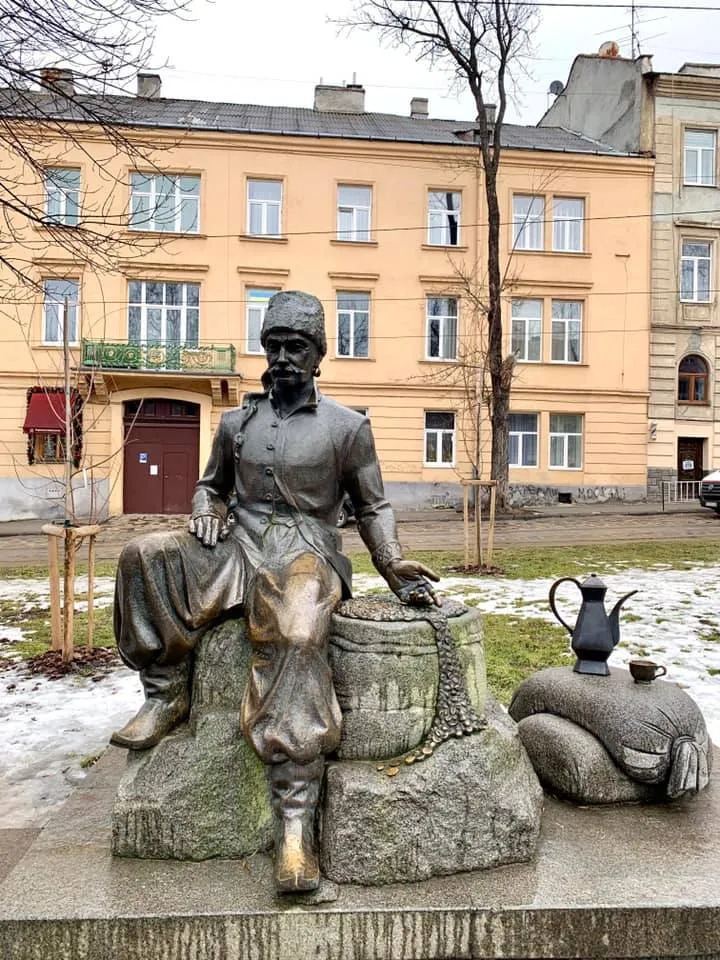
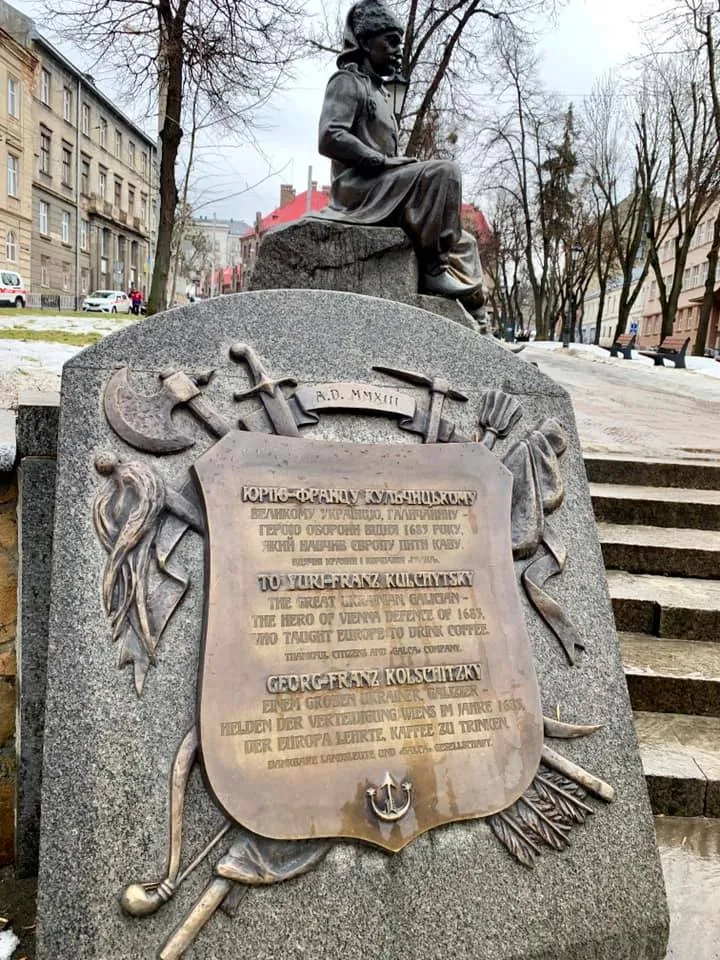
So, the second of the works I found that may be of interest:
“Das Kaffeehaus als Seismograph gesellschaftlicher Veränderungen. Wien ab 1950”, by Sabrina Wolfschluckner: https://phaidra.univie.ac.at/open/o:1310051
It tells of the origins of coffee-drinking culture around the Red Sea and its further spread through Egypt and Turkey, where by the end of the 15th century it became popular. The author writes: “By the 16th century, coffee consumption had come a long way, from its beginnings in Yemen to its spread throughout the Ottoman Empire. In 1554 the first coffeehouse appeared in Constantinople, and twenty years later their number had grown to 600.”
The first news of the exotic coffee drink reached Europe thanks to reports of journeys through the East as early as the 16th century. At that time it was an object of study, and far from an everyday drink for Europeans. Leonhard Rauwolf is considered the first European to describe coffee in more detail; after his journey through the East in 1573-1576 he presented it to a scholarly audience (“Reise in die Morgenländer”, 1582). At first coffee beans in Europe were used as medicine and did not go beyond the circle of scientific interests of some botanists and travellers to the East. For the rest of society coffee was still a curiosity. Attitudes changed only during the 17th century. The Venetian fleet brought the first sacks of coffee from Alexandria to Europe in 1615. The first European coffeehouse also appeared in Italy, in Venice to be precise, under the name “Bottega del caffè”. Then: 1652, the first coffeehouse in London; 1660, in Marseille; 1666, in Amsterdam; 1669, in Paris; and 1677, in Hamburg.
Telling about the first coffeehouses in Vienna, it also describes one of the city’s greatest adventurers, to whom it gives priority in this matter: namely Johannes Diodato (or, by his Armenian surname, Owanes Astouatzatur).
Although this character is more than ambiguous, and almost all the information about him is purely legends and myths, which moreover mostly relate to later times, something is nevertheless known. It is confirmed that from the 1670s he owned a warehouse on Rotenturmstrasse. Merchants from the East often visited it, so it is assumed that the city’s first coffeehouse may have arisen here.
Some even date the opening precisely: 17 January 1685, but there is no confirmation of this in the sources, and it all looks like a late, mythologised chase after priority.
That was two years after the events of that same war. The only certain thing is that on this day a privilege to sell coffee was issued in the name of J. Diodato. There are no records of whether he made any use of it or sold a single cup of coffee in Vienna, since the Armenian merchant worked under an exemption and therefore did not have to pay taxes.
In the 1690s, because of business problems, he had to flee to Venice. It is believed that the Armenian left the running of the coffeehouse to his wife. But no confirmation of any business activity by this lady is documented either.
Moreover, when Diodato returned to Vienna, in 1705 he wrote a letter (it has survived) complaining to the local authorities that nobody in the city respected the privilege issued in his name and that everyone who wished was trading in coffee. That is, this letter confirms that he and his wife did not run the business properly, and, above all, that despite the first dated privilege of this kind, nobody in the city observed it (because there was no one to defend it), and many people traded in coffee. We even know who was among them ?
Later the figure of Johannes Diodato was mythologised by the Armenian community for political purposes; new myths were invented, and unsupported mentions of a “first coffeehouse” were pushed ever further back in time, claiming that he managed to use the privilege and sell coffee ready-made, and so on, none of which has ever been confirmed by sources. Monuments were erected to him, and later a biography was entirely invented for this gentleman, or rather borrowed from our Y. Kulchytskyi: that of a “scout” and “war hero who was wounded on the Kolchak fronts”. That is, another person’s biography was simply substituted and fitted to the history of Vienna for some purpose.
As we see, an ideological and information war has been waged in all years, and whoever says that history is unimportant simply does not understand how this world is arranged and what laws of existence it has.
So forget all these imposed clichés: “the past is unimportant”, “what difference does it make who was first”, “nobody is interested in this”. Just remember the artificial, hastily concocted biography of Johannes Diodato, which the Armenians have been carrying like a flag for two hundred years.
What is interesting is that, as happens in all such cases, all this was and is being done under loud words about “destroying the myth about Kulchytskyi”. This is the classic case when so-called myth-busters do all this only in order to artificially create another myth, more advantageous to them.
Even more tangled is the story of Isaak de Luca, who supposedly was among the first owners of Vienna coffeehouses. At least that is what some researchers now claim, trying to destroy the myth about Kulchytskyi. But a closer study of the biography of a real person of that name shows that his birth date should be 1677 and his birthplace Yerevan. That is, even if he came to Vienna as a tiny child, he could not possibly have had his own coffeehouse before the beginning of the 18th century. And the few, tangled mentions in sources can speak only of some participation and assistance to others.
These two stories best explain why the only thing worse than myth-makers is so-called myth-busters.
But let us return to the work by Sabrina Wolfschluckner, who counts about 30 coffeehouses in Vienna by 1714 (not counting the suburbs). That is, it is obvious that from the end of the 17th century, and especially in the post-war period, when nobody cared about observing privileges and established monopolies, and the townspeople were busier restoring buildings, crafts and economic ties, and also eating better and drinking more, a great many catering establishments and other related business initiatives opened.
Among them, Y. Kulchytskyi’s street coffee trade became legendary; every Viennese schoolchild now knows about it, but, as a rule, does not know that he was Ukrainian.
In this dissertation the author gives the following account of his part in the life of Vienna in 1683 and the following years:
“Kulchytskyi volunteered and, accompanied by his servant, dressed as a Turk, set out. Despite some obstacles they reached the camp of the imperial troops, and then returned unharmed to Vienna and reported that the Polish relief army had already arrived in Austria. Kulchytskyi was generously rewarded for his brave deed and, besides citizenship, received 200 ducats.”
Then the author retells the well-known story of the sacks of coffee left behind by the defeated Turks on the battlefield, which our hero took for himself:
“…coffee beans were considered camel fodder. Without camels, the Viennese thought, we also have no need of camel fodder, so they began to burn the sacks. Kulchytskyi noticed the smell, so familiar from Constantinople, stopped the destruction of the beans, declared them his property and immediately opened the first Viennese coffeehouse. This first Viennese coffeehouse was called “Zur blauen Flasche” and was located on Stock-im-Eisen-Platz. It had a “sign depicting a Turk in baggy trousers and a turban”. Here every guest was received and treated without excessive ceremony, and greeted with an embrace and “Hello, brother”. Kulchytskyi was the first to sweeten the bitter drink with milk and sugar and invented the melange. The croissant is added to this legend as well. As for this legend, every Viennese schoolchild knows it. Georg Franz Kulchytskyi remains one of the best known when the subject comes up.”
And to learn still more details about the Cossack participation in the Vienna events and about Yurii Kulchytskyi, you can read this little-known publication, which I found and am also sharing with you:
“COLLECTION OF ARTICLES: YURII FRANZ KULCHYTSKYI AND THE COSSACKS, HEROES OF THE VIENNA VICTORY OF 1683”, compiled by Myron Utrysko and published in Philadelphia in 1983, for the 300th anniversary of that glorious page of European history:
http://diasporiana.org.ua/…/uploads/books/12221/file.pdf
Ivan Nimchuk sums up the hero’s path thus:
“Soon he was selling his first coffee in a modest little premises in the Bishop’s Court (today: Domgasse 4) for a kreuzer a glass, and soon moved to a bigger one at the Stephansfreithof, “Zur blauen Flasche”. Both from the notes of contemporary eyewitnesses and from the drawings of Kulchytskyi the coffee-house keeper it is clear that he went about Vienna in Cossack noble dress. Also in Adolf Schärpe’s article on the development of the Viennese coffeehouse (Volkskalender 1920) it is noted that Kulchytskyi “served his guests in fantastically rich clothing”. It is no wonder that all the estates of Vienna of the time were Kulchytskyi’s guests, not so much for the coffee, to which nobody could get accustomed for a long time, as for his merits and his person, which enjoyed the respect of the whole of Vienna.
At first he sold coffee the Turkish way, that is, without sugar, so the Viennese could not get used to it. Only when he began to add sugar did such a crush arise at his place that even this premises was too cramped to accommodate all the guests. “Bruderherz” (Brother-heart) the Viennese called him, and that is how he addressed everyone who visited his coffeehouse.Later Kulchytskyi received from the burgomaster of Vienna a plot on which he built a large house that already met all the demands of ever more numerous guests. It was a wooden barn with wooden tables and benches, situated in Leopoldstadt “Am unteren Werd”, near what was later the Schlagbrücke, now the Ferdinandsbrücke (today: 2nd district, Haidgasse 8). It was thus the first permanent coffeehouse where coffee was served. After Kulchytskyi’s death this coffeehouse passed to his descendants, who paid the municipality a small rent for it. There, gradually, arose that typical coffeehouse life, that coffeehouse atmosphere which we now see everywhere in Europe, and the creator of the coffeehouse in Vienna, the patriarch of Viennese coffeehouse keepers, is our countryman, Yurii Franz Kulchytskyi. Kulchytskyi died in Vienna on 19 February 1692. He was buried in the cemetery by St. Stephen’s Church, but of his grave, as of that whole cemetery, there is now no trace. However, there are many other memorials to Kulchytskyi in Vienna.”
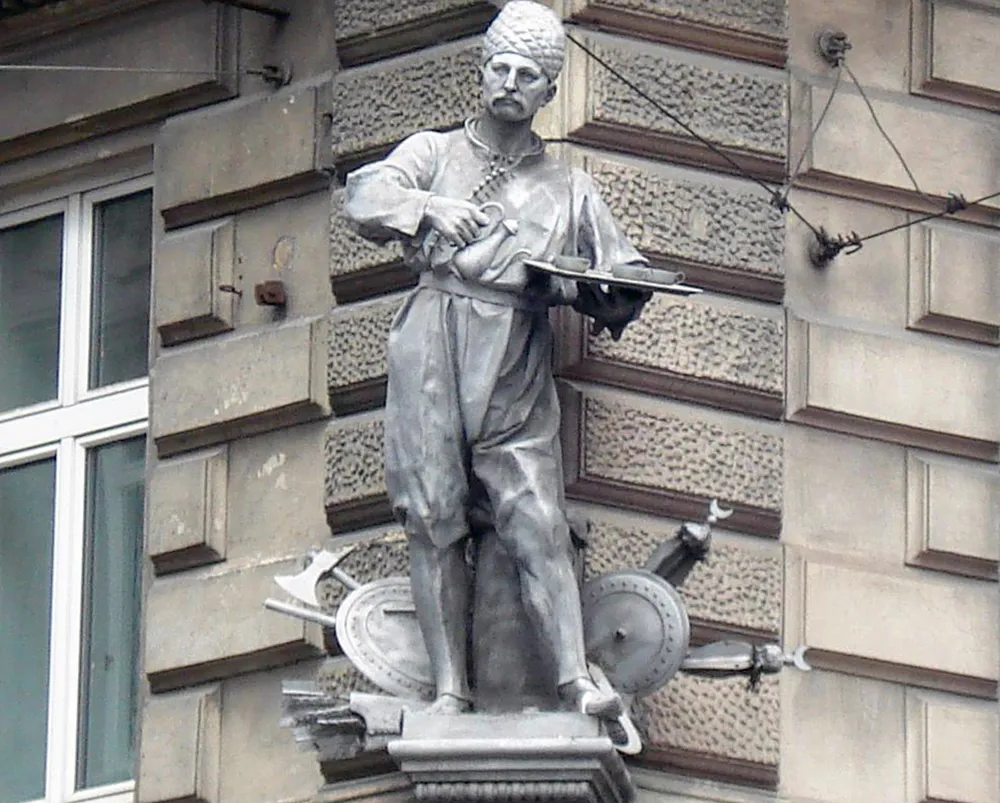
In 1862 one of Vienna’s streets was named after Y. Kulchytskyi.
And on 12 September 1865, on the anniversary of the victory, a monument in his honour was erected on that street (at the corner of Favoritenstrasse and Kolschitzkygasse).
Viennese coffee culture is inseparably linked with the name of this native of the Lviv region. Whoever may try to invent whatever, however much they may strive to steal his history, Y. Kulchytskyi will forever remain a hero of Austria and Ukraine.
Author: Ihor Poluiektov