Kozatske. The Golitsyn manor and arboretum
There are very many villages called “Kozatske” in Ukraine. Our story is about Kozatske in Zvenyhorodka district, Cherkasy Oblast. It is located not far from the village of Shevchenkove, a well-known tourist spot, the homeland of Taras Shevchenko. An old, solid road leads from Shevchenkove to Kozatske. Stone paving. More precisely, a “cobbled highway”. Such rarities are still often found in Cherkasy Oblast, but driving on them is not very pleasant. If you like extremes, drive over the cobbles, but it is better to make a detour through Tarasivka. And better still is to get to Kozatske from Zvenyhorodka. When we were driving, we did not ask for advice. We decided to take the shortest route, which on our map was an ordinary asphalt road. It shook us thoroughly and we swallowed plenty of dust, but we reached Kozatske.
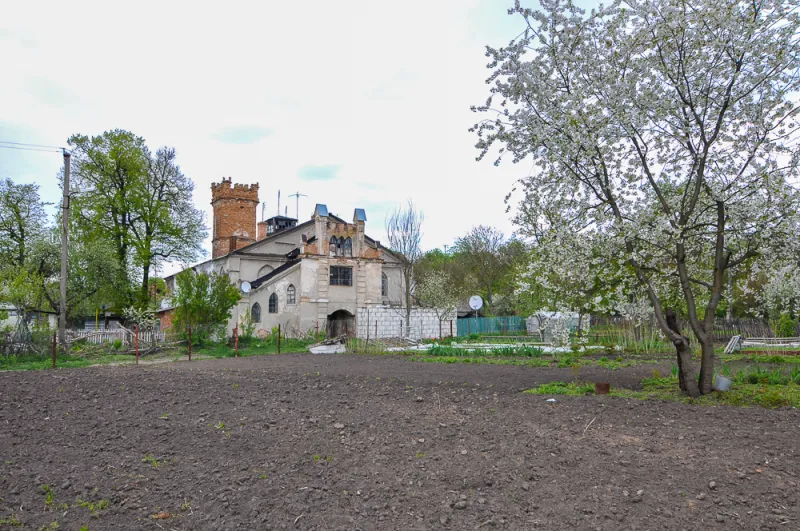
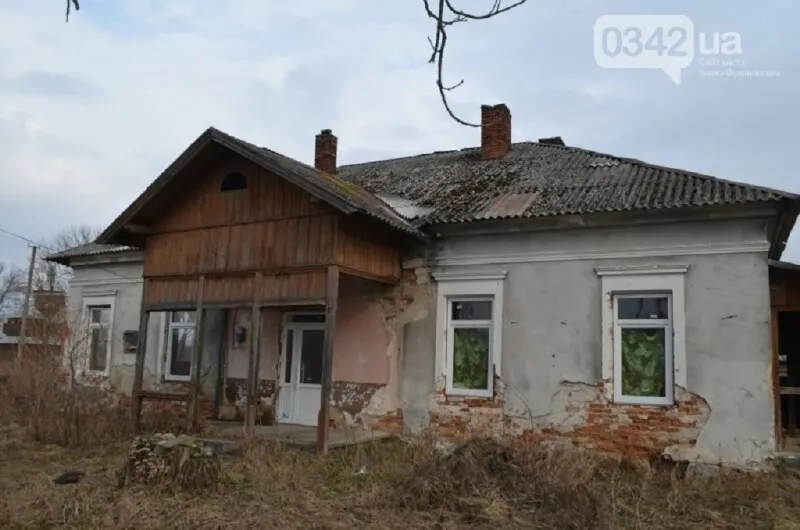
The only thing we knew about Kozatske then was that this village has an architectural monument, the manor of Princess V. V. Golitsyna with a large park, as well as a vocational school. It turned out that the school is housed in the buildings of the princely manor, of which only the outbuildings, the manager’s house and the impressive entrance gate have survived. To the left of the entrance gate, above which hangs the sign “Vocational School No. 37”, there is a very long one-storey utility block. This surprisingly well-preserved building now houses various facilities: a church, workshops of the technical school, a mill and much else. Next to the utility block, opposite the entrance gate, stands the two-storey manager’s house, to the left of which is a fairly large outbuilding. The manor has one more utility block, although it may once have been an inn. It is a long one-storey rectangular building with columns, a collapsed roof and the pipe of a “potbelly stove” sticking out of a window. On the whole the manor has survived relatively well, and if the park surrounding it were put in order, tourists would flock to Kozatske.
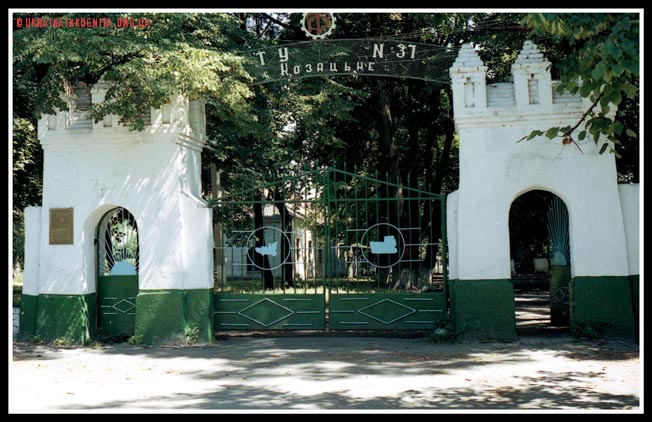 |
| The gate of the manor-technical school |
The arboretum in Kozatske is a monument of landscape gardening art of national significance. Its area is 51 hectares (which is not small), and it was laid out at the end of the 18th century. The park is very elongated. In its northern part there is a cascade of ponds, to which a very long alley, straight as an arrow, leads. This alley could serve as a wonderful set for any historical, or better still mystical, film. It is paved with cobbles that over the centuries have been covered by a layer of soil, and is surrounded by gloomy ancient trees. It is this alley that is the compositional core of the park. Once the Golitsyns, who founded the park, took horse rides along it, and now the residents of Kozatske and a few tourists walk here.
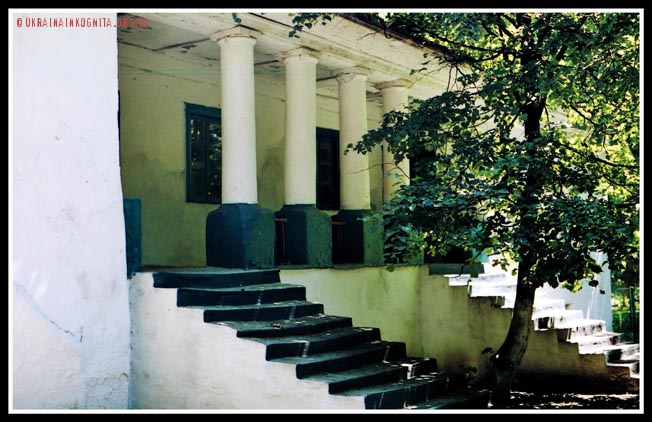 |
| The manager’s house |
The village of Kozatske has been known since the beginning of the 18th century. Until 1791 it belonged to Grigory Potemkin, and after his death it passed by inheritance to Varvara Vasylivna Engelhardt (Golitsyna), Potemkin’s niece and the sister of Oleksandra Engelhardt (Branicka). In 1779 Varvara Vasylivna married Prince Sergei Fedorovich Golitsyn (1748–1810). This branch of the Golitsyns was not very well known and not very wealthy. Sergei Fedorovich was a general, a Knight of St. George and a well-known military commander. He had a large estate in the village of Zubrilovka, which is now one of the finest examples of landowners’ manors in Russia. But after the death of Catherine II he fell out of favour with Emperor Paul I.
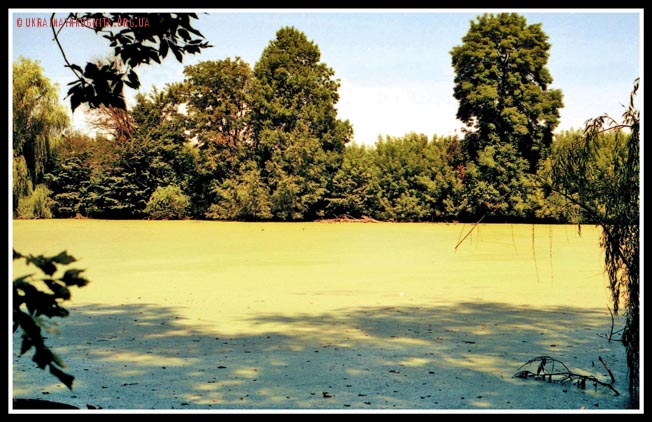 |
| A pond in the old park |
In 1797 he was sent to Kozatske together with his whole family (the Golitsyns had nine sons). Together with the Golitsyns, the prince’s personal secretary and the tutor of his two sons, Ivan Andriiovych Krylov, who was not yet a famous fabulist, came to Kozatske. Krylov stayed in Kozatske for four years. Here he wrote the comic tragedy “Trumph” and the comedy “The Pie”.
When the Golitsyns arrived, the estate in Kozatske was in a neglected state and brought almost no income. This is how the well-known Russian writer Filipp Vigel, who spent a year at the estate, wrote about it: “The village of Kozatske was one of those estates which the Polish kings handed out to magnates in Ukraine after its division into Polish and Russian parts. The magnates never came to them, lived in Warsaw or Vilnius and received only the income from them” (quoted in translation from the Russian original). And this is what the estate was like in 1798 according to Vigel’s description: “An endless yard surrounded by a wattle fence, in the depth of which a wooden manor house opened, built in haste, and on the sides there were six fairly spacious clay-walled huts in place of outbuildings, and a garden planted only in the autumn, which was just rows of twigs” (quoted in translation from the Russian original).
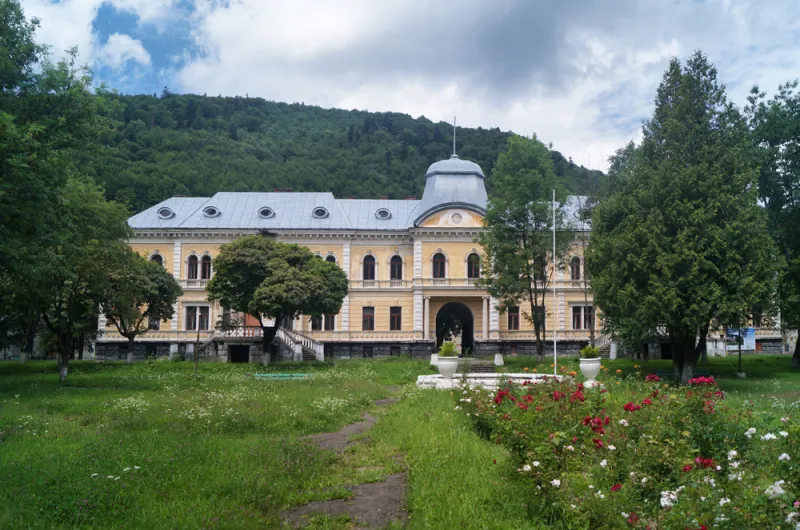
The princess ran the household of the Golitsyn family. It was she who set up the estate in Zubrilovka, and she also began setting up the estate in Kozatske. The princess wanted to increase the income from the estates in Ukraine and therefore moved to Kozatske. Here, using the labour of serfs, she laid out the park and built the manor, the remains of which stand in the village even now. V. V. Golitsyna died in 1815. The large utility block to the left of the entrance gate was built only in the first decade of the 20th century by the new owners of the estate, and of the princely palace not a trace remains.
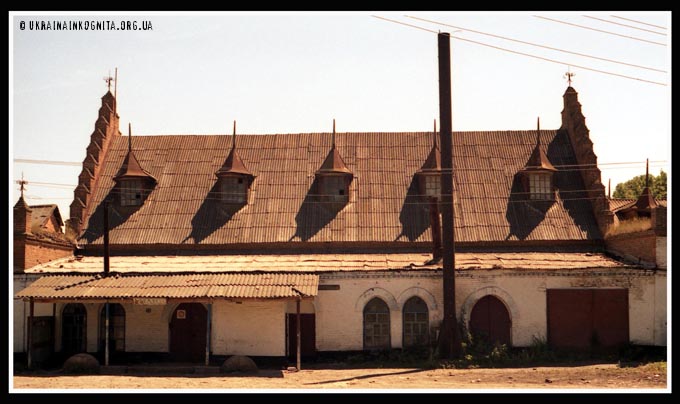
A utility building of the estate. Now a mill
Now Kozatske lives a quiet provincial life. A collective farm (KSP) and the vocational school somehow function, the buildings of the Golitsyn manor are slowly collapsing, and the arboretum is becoming overgrown. Natives of Kozatske include well-known Soviet scientists: I. H. Pidoplichko, zoologist, palaeontologist and academician of the Academy of Sciences of the Ukrainian SSR; M. M. Pidoplichko, botanist and mycologist, corresponding member of the Academy of Sciences of the Ukrainian SSR; O. P. Pidoplichko, professor; and also the well-known Soviet artist M. S. Pohribniak. Reference books report that Kozatske has a folk amateur choir founded as early as 1918, but how active it is now we were unable to find out.
Author: Roman Malenkov