Baroque polychromy of the Kamianets Gate in Sataniv and the mystery of an ancient monogram
We are used to thinking that antiquity is necessarily the snow-white marble of the Parthenon and the sculptures of Phidias or Praxiteles. And that the Middle Ages or the Renaissance are the greyness of Gothic carving… In reality, if some ancient Greek were to find himself in a modern museum of antique masterpieces, he would within a moment fly out of it headlong, shrieking in horror, convinced that he was surrounded by the pale shades of the dead who had crawled out of Hades.
Ancient sculptures were in fact bright and multicoloured, and the nude parts of the body were neatly painted in the natural colour of human skin. The same applies to architecture. All that carving was carefully covered with bright colours. If anyone thinks that later it was different, they are cruelly mistaken. One should understand that in the vast majority of cases the sculptural and carved decoration of churches, castles, fortresses and so on was polychrome. It is just that not everything has survived to our time. Besides, in the 19th century a fashion for a certain asceticism arrived, including in colours.
A striking example of polychrome architectural decoration is the Church of the Holy Trinity in Olyka, one of the most beautiful early Baroque monuments in Ukraine, built in 1635–1640. However, this article is not about polychromy in the architecture of antiquity, the Middle Ages, the Renaissance and the early modern period. The topic is much narrower: the decoration of the town gate of Sataniv.
The latter, by the way, is a truly unique monument. Unfortunately, the word “unique” has today been defiled and levelled by inept local historians, and especially by innovative small-town would-be museum workers who, through complete professional unfitness, stick it on whatever they please. But in this case such a proud epithet is entirely deserved.
First, today only 7 settlements in Ukraine can boast medieval-Renaissance town gates.
Second, very often only “horns and hooves” are left of them. Of the authentic Golden Gate of Kyiv, for example, only two walls have survived to our day. Everything else is a full-size model.
Of the town gates of Lviv we have only the image on the coat of arms.
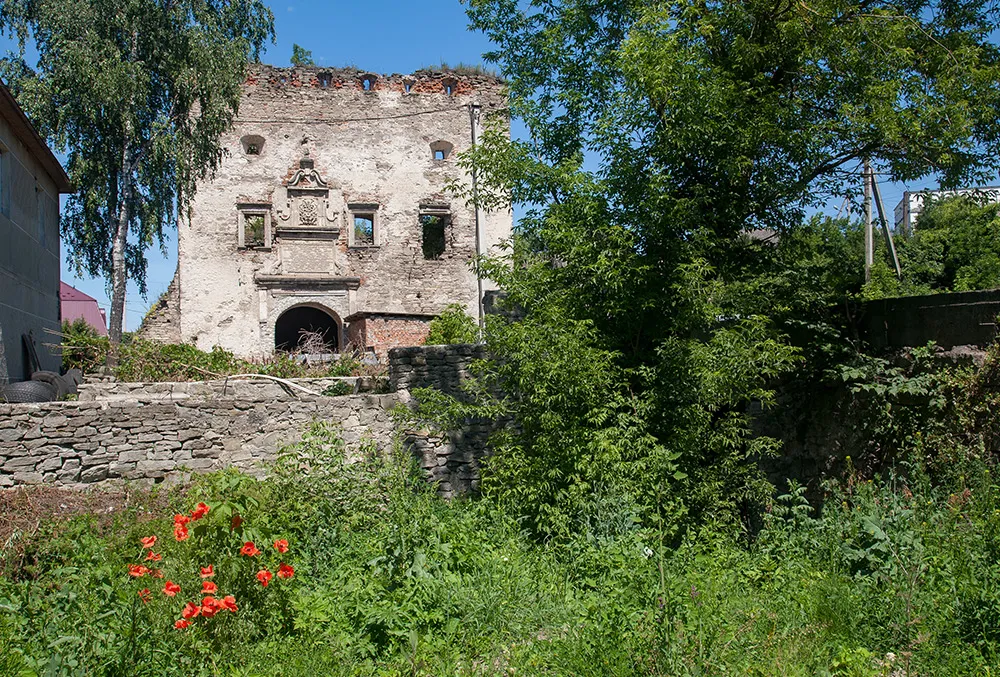
The Sataniv town gate, however, has survived to our day practically intact. What is more, it is also the most richly decorated with architectural flourishes among all its Ukrainian sisters. It was not embellished for nothing. From ancient times town gates, besides their purely defensive function, played an important representative role: they were a kind of face and symbol of the town, and at the same time triumphal arches through which distinguished guests entered the town or a victorious army marched in. That is why they tried to decorate and adorn them accordingly. Of course, not all gates, but only those that served as the main, ceremonial entrance to the town.
The southern gate of Sataniv, which is the one that has survived to our time, was precisely such a ceremonial gate. The road to Kamianets, then the capital of Podillia, began from it. Hence its name: Kamianets Gate. Sataniv also had the Horodok Gate, from which the road led to Horodok. It stood somewhere in the area of today’s bus station. All that is known about it is that it existed. One may assume that, owing to its marginal position, it was hardly famed for special decorations.
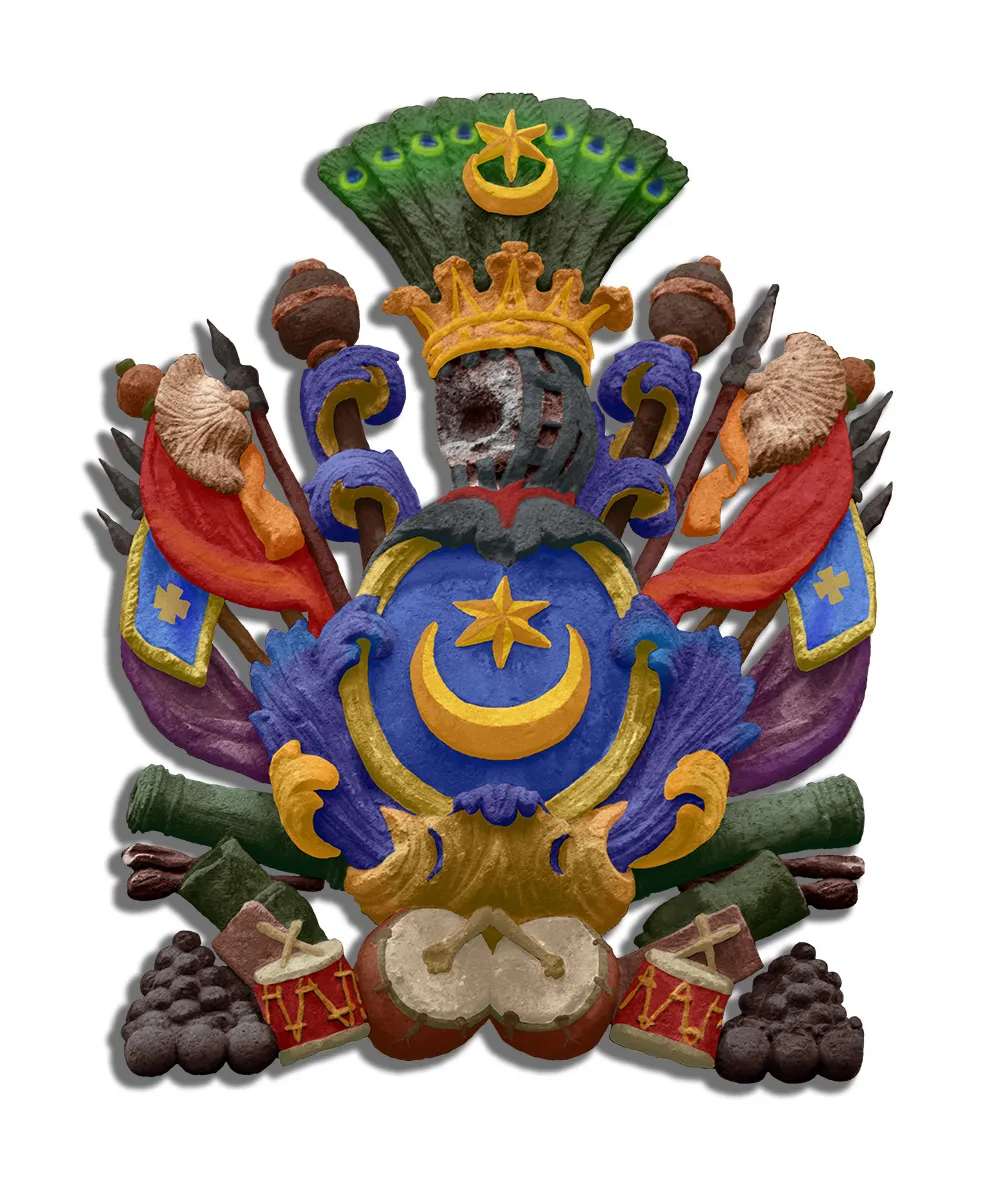
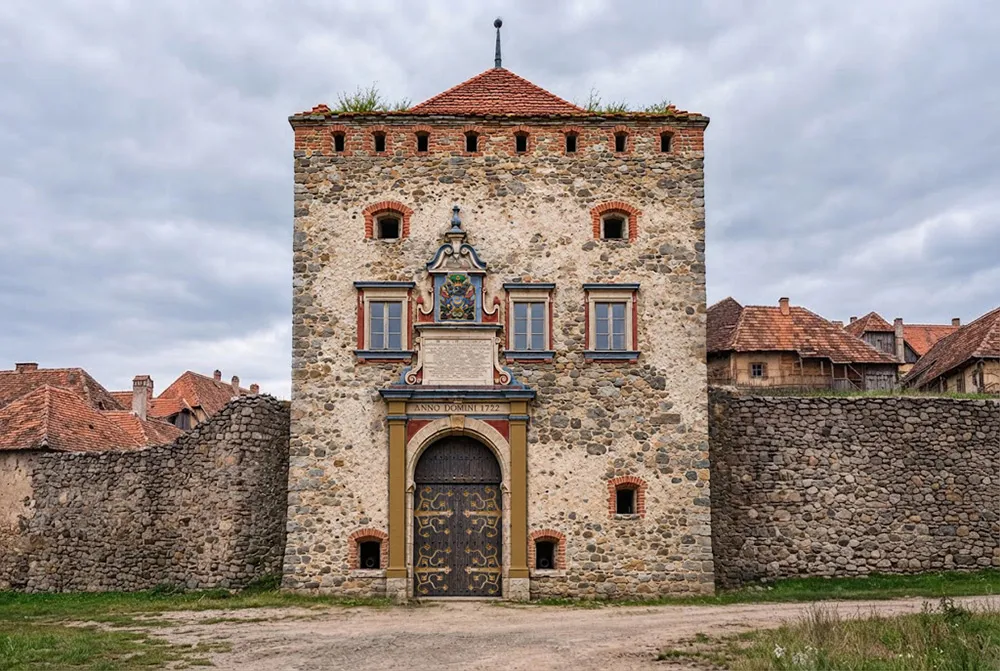
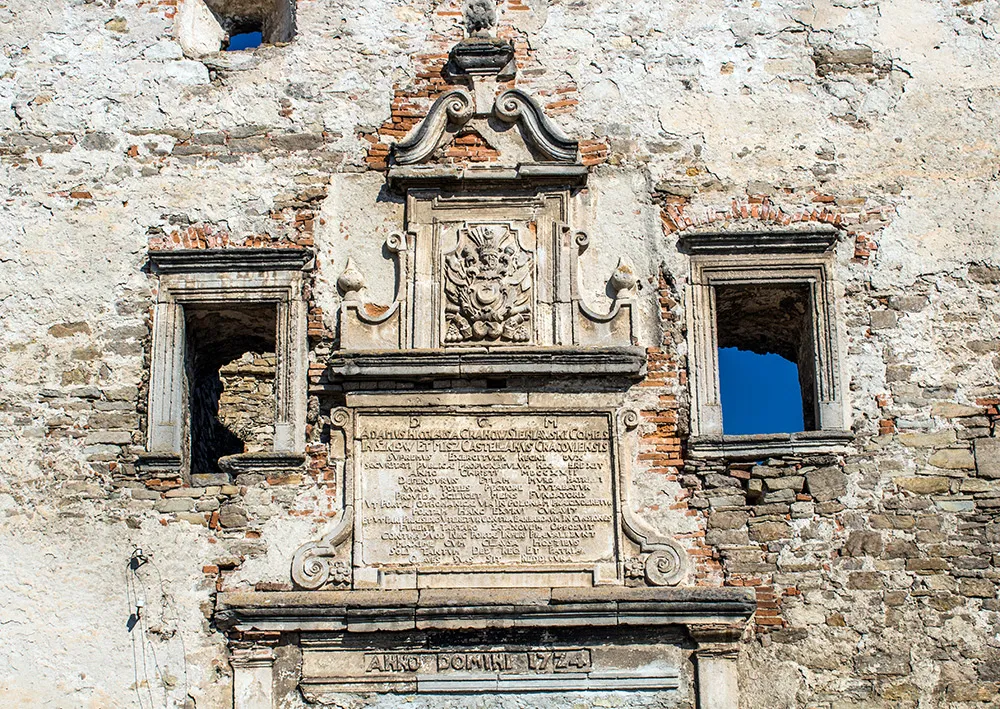
During the reconstruction of 1722–1724 (the Kamianets Gate had suffered badly in the wars of the second half of the 17th century), Grand Crown Hetman Adam Mykolai Senyavskyi, who was the town’s hereditary owner, rather generously decorated his “calling card”. The main highlight and accent became his family coat of arms, Leliwa, placed against the background of a so-called militarium, a composition of military banners, cannons, cannonballs, drums and other martial paraphernalia.
Beneath the coat of arms, on Senyavskyi’s orders, a huge foundation and memorial plaque with an extensive inscription, typical in style of the glorious Baroque era, was placed. Translated from Latin:
“Adam Mikołaj of Granów Sieniawski, owner of Shklov and Mysha, castellan of Kraków, supreme commander of the Crown army, for the safety of the citizens restored this fortification in the year of the Lord 1722, intending to defend with walls the Fatherland that he had so many times defended with his own breast. Thus the lofty thought of the founder saw to the construction of this gate in order to bar the Ottoman Porte’s way to Poland, so as to be able to resist the attacks of barbarians with equal force. Sataniv was set against the wicked Tatar, against which even the gates of hell shall not prevail. And when this fortress is closed against enemies, it will surrender its keys only to God, the King and the Fatherland. In the year of the Lord 1724.”
The author especially likes this: “It will surrender its keys only to God, the King and the Fatherland.” How beautifully put!
It seems that the author of the text was Senyavskyi himself. Adam Mykolai had a good command of words, as his rich epistolary legacy attests.
That the decoration of the gate was most probably polychrome we can say on the basis of analogies. In particular, it is reliably known that the so-called Jesuit Postern of Lviv was multicoloured. Posterns were the “younger sisters” of gates and were an integral part of town fortifications. In Sataniv, besides the Kamianets and Horodok gates, there were also two posterns, one of which was called the Furriers’ Postern (probably built at the expense of the furriers’ guild).
The situation was similar in much larger Lviv, where, besides the Halych and Kraków gates, two posterns led into the city: the Ruthenian (Bosatska) and the Jesuit.
While gates allowed the passage of carts and horsemen, posterns were intended exclusively for pedestrians. But this did not make their significance in the life of the town any less important. Posterns, note, were not just a hole with a little door in the wall. Towers, or at least small turrets, were also built for their construction.
Construction of the Jesuit Postern began in 1608, and permission for it was given by King Sigismund III Vasa himself, since it was connected with the question of the city’s defence. A numerous deputation of city authorities travelled to Warsaw to approve the project.
We shall skip the details of the construction as secondary. What matters is something else. Among the expenses for building the new postern it was recorded: “the city coat of arms made of stone and for painting it 5 zlotys were spent”.
Besides the city coat of arms, the postern was also adorned with a royal one. Both stone coats of arms, as can be seen from the expenses, were painted in different colours.
One more important fact. The city coat of arms that adorned the postern bears the inscription: “Erekta sum anno dom[ini] 160[s] octavo domine fiat pax in virtute tua” (“I was built in the year of the Lord 1608. O Lord, let there be peace in Thy strength”). Here we see a direct analogy with the decoration of the Kamianets Gate in Sataniv. Except that there the coat of arms and the foundation inscription are divided between different elements of the decoration, while in Lviv they are combined in one element.
The postern was later destroyed, but the coat of arms of Lviv that adorned it was later found during archaeological research in 1978. Traces of polychromy in red, green, dark blue and ochre were found on the find.
We have confirmation of “façade polychromy” in Sataniv itself too.
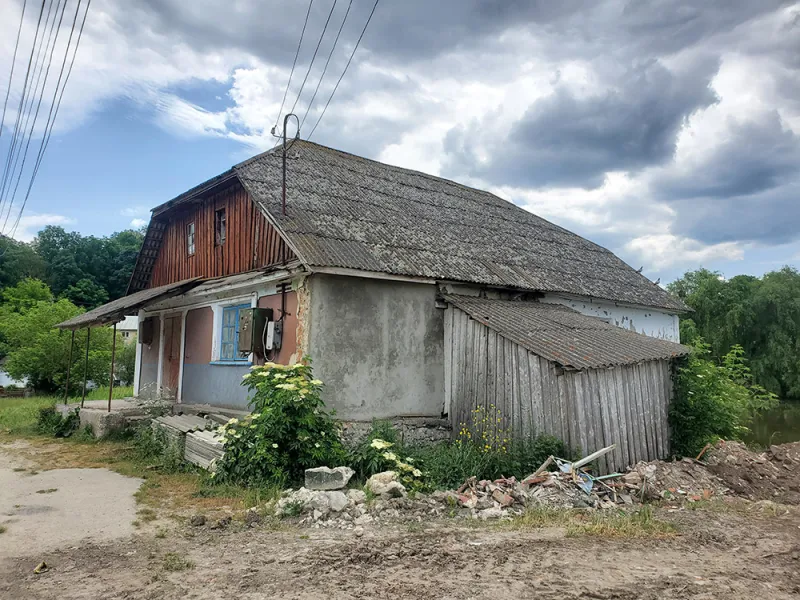
Some ten years ago, in the historic centre of the town there stood a stone house (in Soviet times a bathhouse), whose pediment was adorned with a large carved plaque more than a metre wide. It showed a complex and mysterious monogram surmounted by a heraldic princely crown. Until now its meaning had not been identified, but while working on this article the author was lucky enough to work out who left this artefact.
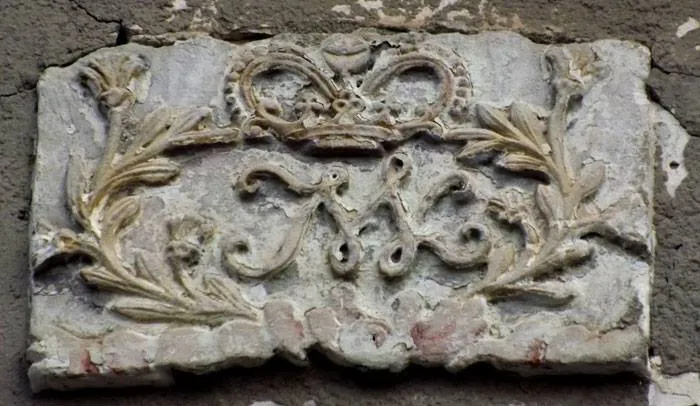
The central element of the monogram is the Latin letter “M”, but if you look closely, it is composed of two letters “S”. So we have “M S S”. On the left we see the letter “I”, and on the right “K”. For a long time those “I” and “K” were baffling, especially the “K”, in which, if one wished, one could also see a hidden letter “L”. A version was even put forward that the owner of the monogram was Princess Izabela Liubomyrska, who for a time owned the town. However, the letters “M S S” did not fit this version. In the end it was decided that this was the monogram of some relative of either Prince Chartoryiskyi or Princess Liubomyrska, who had a house in Sataniv, and there the matter was laid to rest.
After yet another return to the topic of the monogram, the author finally managed to solve this old riddle. Now with 99% probability it can be confidently stated that this is the monogram of Maria Zofia Senyavska, daughter of the aforementioned Adam Mykolai.
So we have: I is the Latin Illustrissima (Most Serene), a standard epithet for a woman of a princely family of such a level as Maria Zofia Senyavska, who became a princess after her second marriage, to August Aleksander Chartoryiskyi. M, S, S are Maria Zofia Senyavska herself. K is Księżna (princess). All together: “Most Serene Maria Zofia Senyavska, princess”.
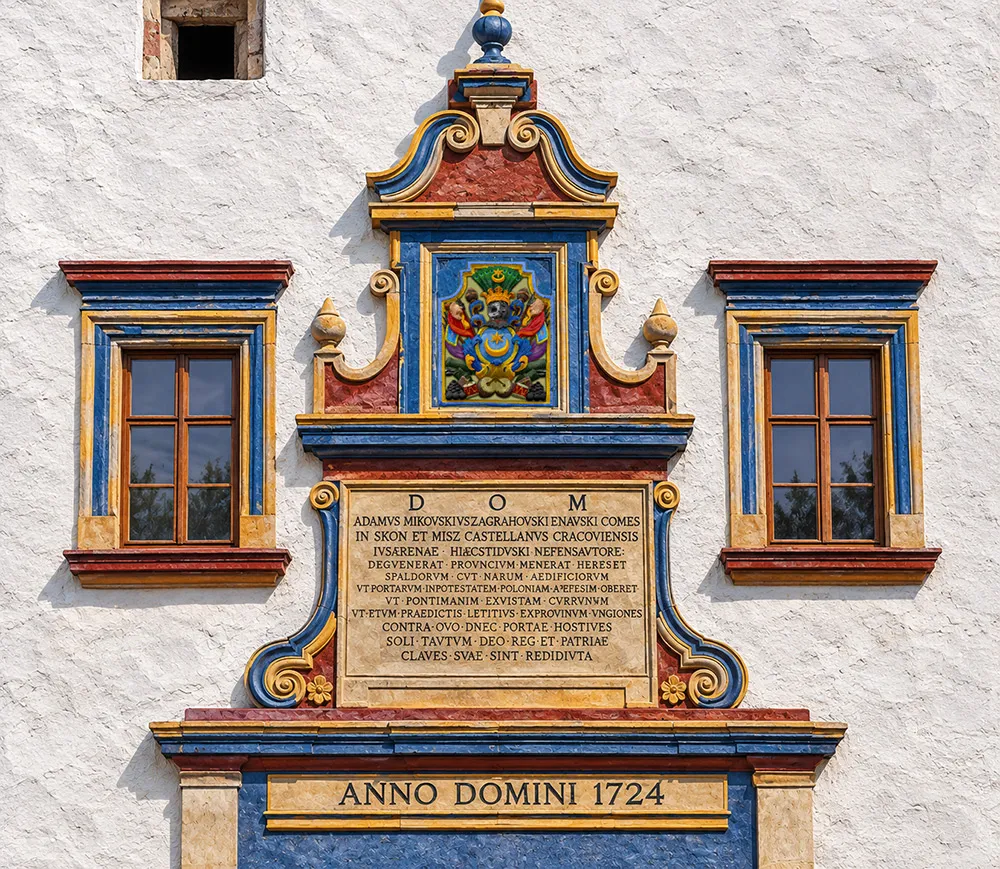
So much attention is paid to this bas-relief solely because the remains of polychrome painting are clearly visible on the plaque with the monogram. The difference between the time of the gate’s reconstruction and the hypothetical time of creation of the plaque with the monogram is some 10–15 years, which in terms of architectural fashion is nothing! That is, the polychromy of Maria Zofia Senyavska’s monogram vividly proves that at least the coat of arms on the Sataniv gate was also multicoloured.
In the photograph, a reconstruction of the polychrome Leliwa coat of arms from the gate was made by the author by hand.
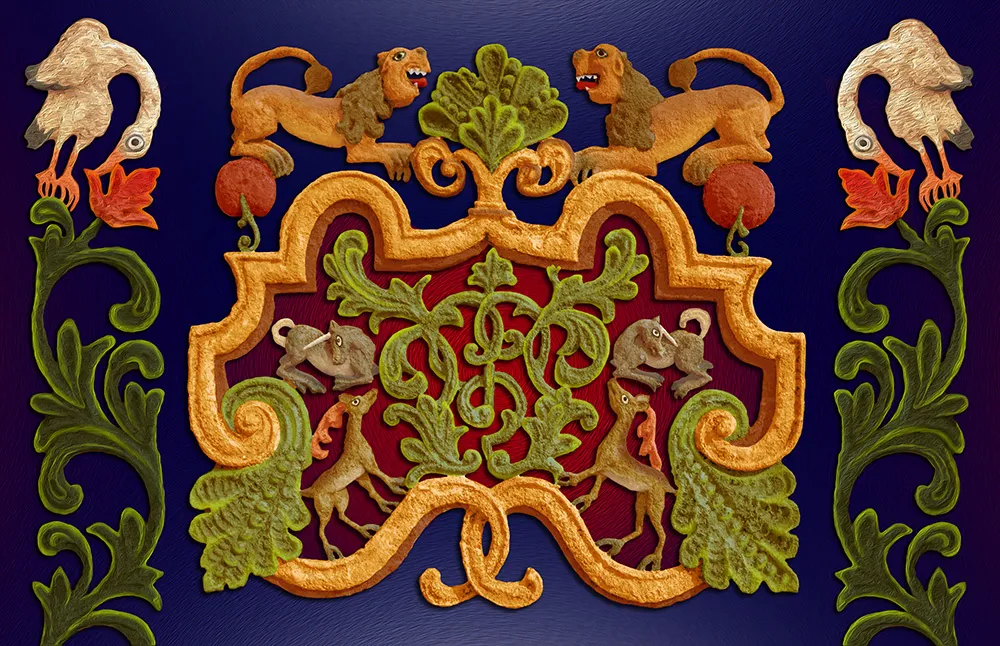
That people of the 18th century (and not only) were very fond of polychrome bas-reliefs is also attested by the matzevot of the same period in the Jewish cemetery next to the gate. Today nothing of that colourfulness remains. Something is visible only on gravestones from the early 20th century. However, on several gravestones from the mid-18th century the author was lucky enough to find traces of polychromy. These matzevot have tilted forward, and in this way the bas-reliefs turned out to be protected from precipitation to a certain extent. Remains of ochre, with which the lions had been painted, a little green paint on the twigs and a blue background could be noticed on them. A reconstruction of the polychrome decoration of the bas-relief on a matzevah is attached.
Today it can be stated with 100% certainty that the façade of the Kamianets Gate in Sataniv was bright and polychrome (the photo shows an AI reconstruction). However, which colours exactly were used, no one can say any more, except through thorough research. Remains of paint invisible to the eye should have survived in the porous limestone.
The author hopes that when restoration of this truly unique monument finally gets under way, its polychrome beauty will be restored as well.
Text: Dmytro Poliukhovych