

Horodok’s old Jewish cemetery in the focus of an international competition announced by ESJF
Volunteers of the partner project “Graves of the Ancestors”, initiated by the Horodok city administration – in particular the Department of Culture, Nationalities, Religions and Tourism of the Horodok City Council together with the NGO “Ukraine Incognita” – have completed a large-scale study of the old Jewish cemetery in Horodok (Khmelnytskyi Oblast).
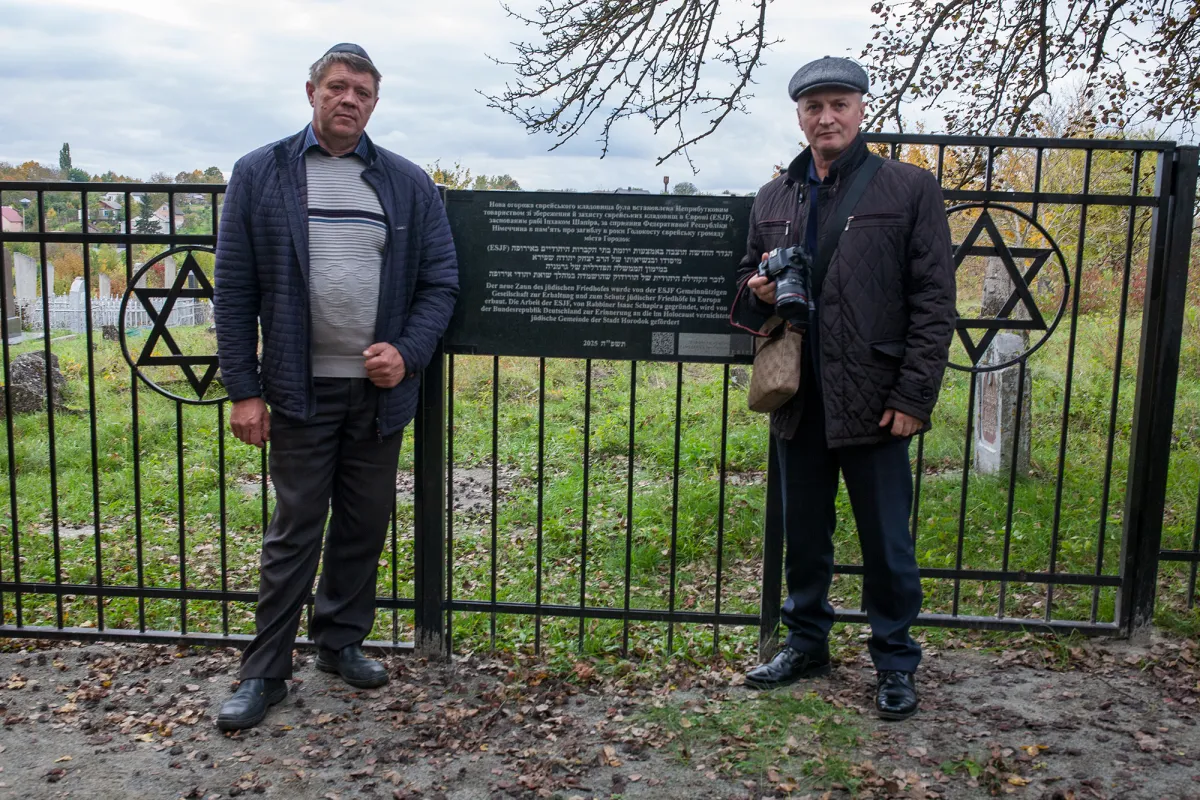
Researchers Valentyn Nyshchyi and Oleh Fedorov by the cemetery gate. Here and below, photos: “Graves of the Ancestors”
The work was carried out both as part of the project itself and as part of participation in the international competition announced by the ESJF European Jewish Cemeteries Initiative – an initiative implemented with the support of the German government.
Recall that the partner project of the NGO “Ukraine Incognita” and the Horodok city administration, named “Graves of the Ancestors”, provides for the study of all old necropolises and burials outside cemeteries in the former Horodok district – Ukrainian, Polish and Jewish. Its aim is to reveal the multinational culture of Podillia, to learn more about the history of the Horodok area, to promote interethnic understanding and to create new tourist routes. “Ukraine Incognita” has repeatedly reported on the interesting, and sometimes unique, discoveries made during the expeditions.
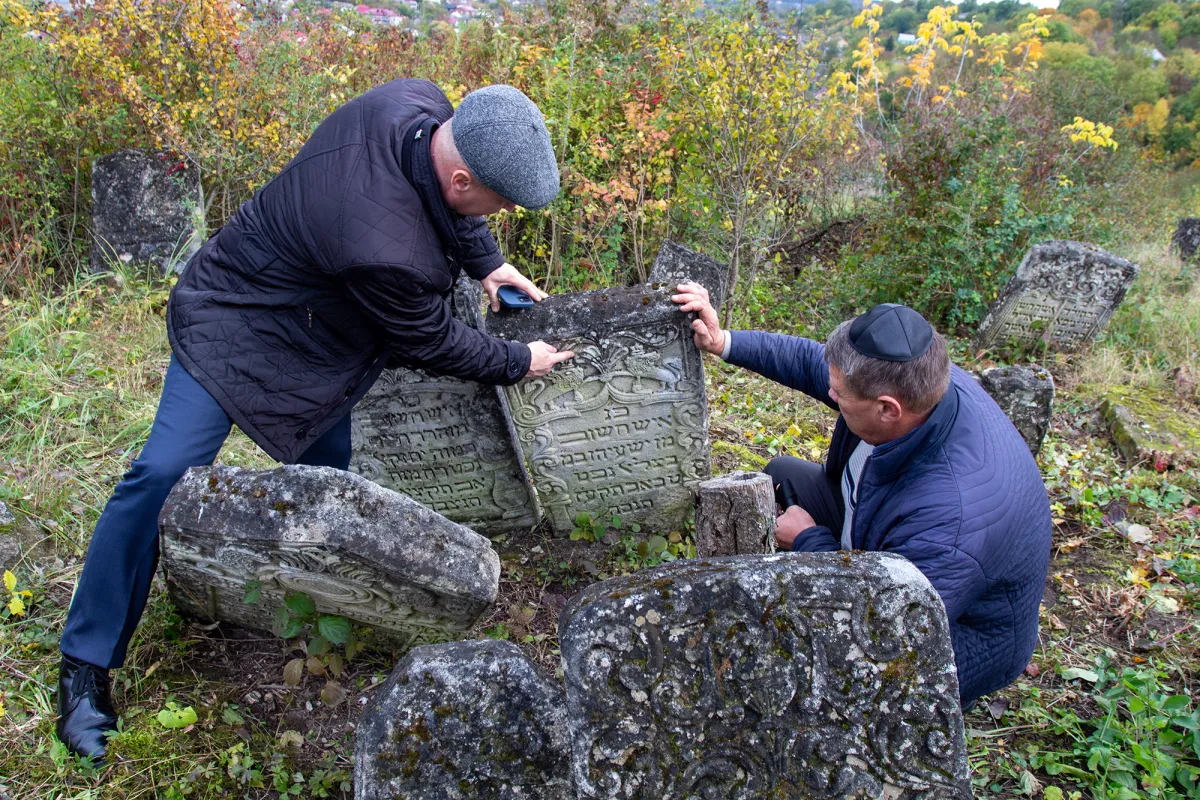
“Crowned” lions
Within the ESJF competition, the best research works devoted to Jewish necropolises will be selected. We hope that the research of our partners, to whom the NGO “Ukraine Incognita” provided advisory support, will take a worthy place among the winners.
After the competition ends, the results of the study of the old Jewish cemetery in Horodok will be published on our website.
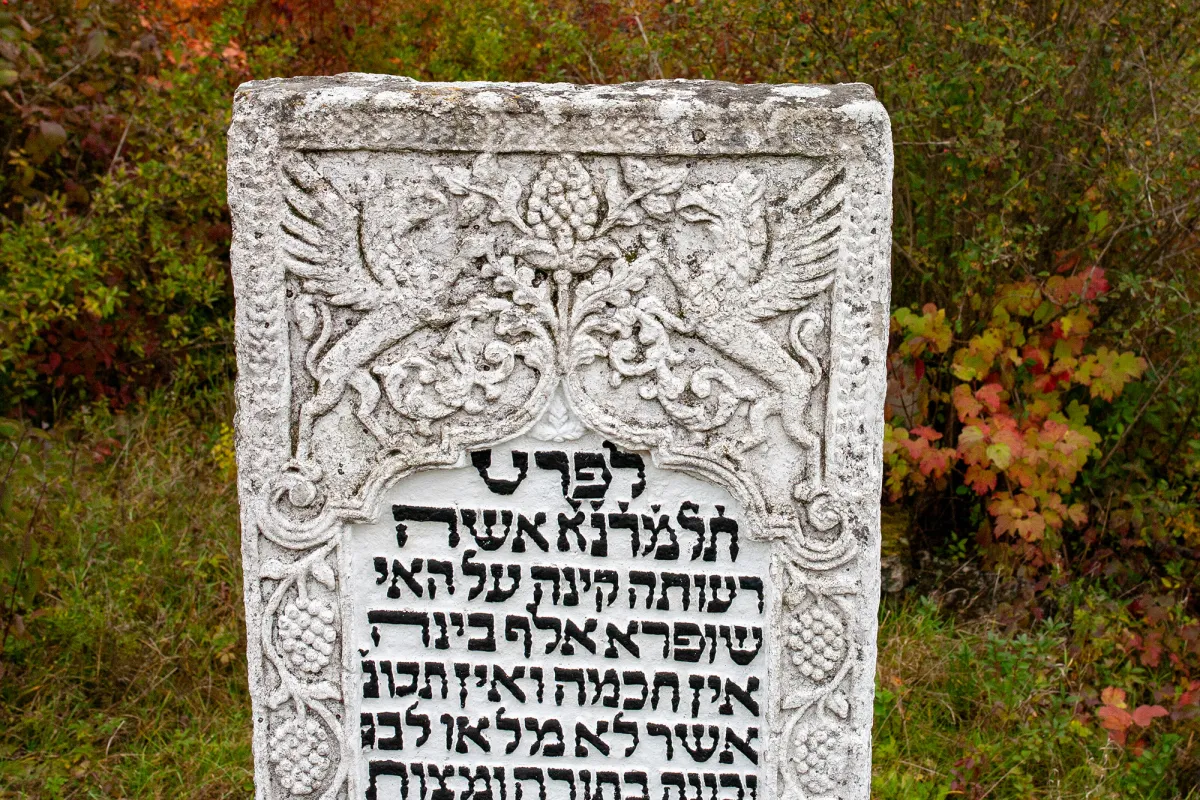
Heraldic griffins (18th century)
In the meantime, we share the main conclusions drawn by our Podillia partners:
- Floral decor dominates the decoration of matzevot throughout the entire period of the necropolis’s existence (from the early 18th century to the 1990s), while zoomorphic images are less common and of limited variety.
- Zoomorphic symbols corresponding to the name of the deceased (for example, a lion for Yehuda, a bear for Dov-Ber, a deer for Tzvi-Hirsh) are practically absent, even in the 18th century, when this practice was popular in other cemeteries of Eastern Europe.
- Horodok craftsmen of the 18th century show reverence for Western European heraldry – in particular, the griffins are depicted not in the folk Jewish tradition but in the heraldic tradition of the West.
- There is a rare practice of “crowning” lions. In Horodok, on matzevot of the late 18th and early 19th centuries, lions are often depicted wearing crowns, which is an exception for the region.
- The craftsmen worked for several towns – matzevot similar in style and in the “hand of the master” have been found not only in Horodok but also in Sataniv, Kupyn, Kuzmyn, Medzhybizh and Smotrych.


