

Don Cossacks in Podillia in 1799. New discoveries by the “Ukraine Incognita” team
Last summer “Ukraine Incognita” already told of an impressive cross seen during one of our expeditions at the old cemetery of the village of Ivankivtsi, near Sataniv. The cross is striking not only for its age, 1799, but also because it was erected on the grave of a Don Cossack, as the epitaph states directly:
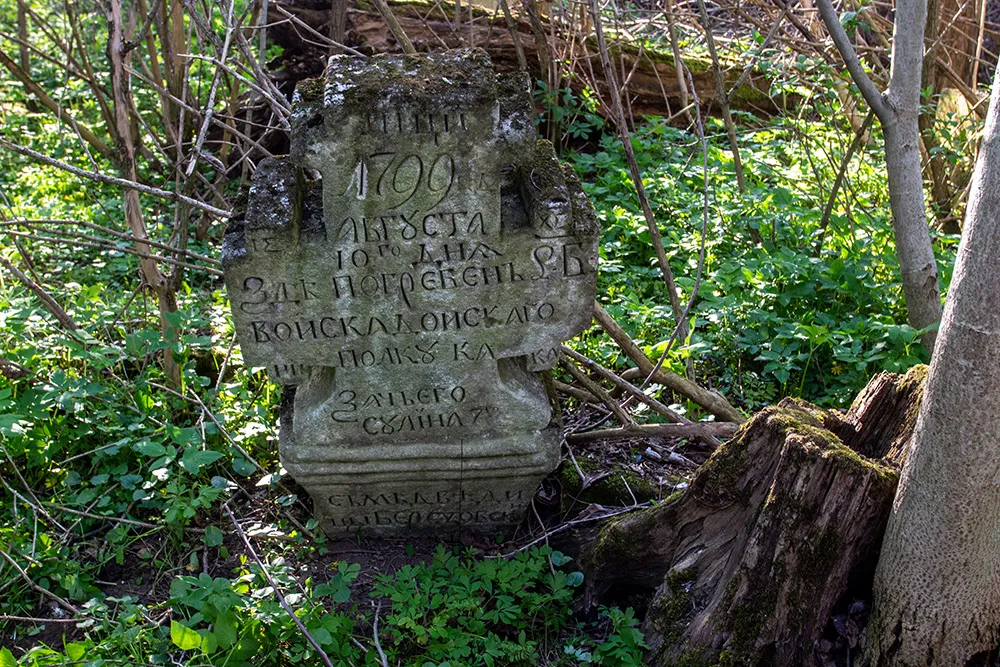
The grave of a Don Cossack
“1799, August 10th day, here is buried R. B. of the Don Host, of the Cossack regiment of Sulin the 7th, from the Medveditsa, of Berezovskaya, Ananii Artemiev’s son, an ataman’s son.”
The capital and lowercase letters here are the same as on the cross.
The volunteers of the “Graves of Ancestors” project decided to look further into this burial, so unusual for Right-Bank Ukraine. It is a partner project of the NGO “Ukraine Incognita” and the Department of Culture, Nationalities, Religions and Tourism of the Horodok City Council.
“We turned for help to the well-known scholar Andrii Diachok, Candidate of Historical Sciences, associate professor and co-chair of the Podillia branch of the Hrushevsky Institute of Ukrainian Archaeography and Source Studies,” says the co-chair of the “Graves of Ancestors” project, head of the culture department Oleh Fedorov. “Could he, as a renowned specialist in working with parish registers, find out any details about this Don Cossack? Mr Andrii kindly agreed and found something interesting…”
Andrii Diachok managed to find an entry about his death in the parish register of the Church of the Transfiguration in the village of Ivankivtsi Satanivski, Proskuriv county.
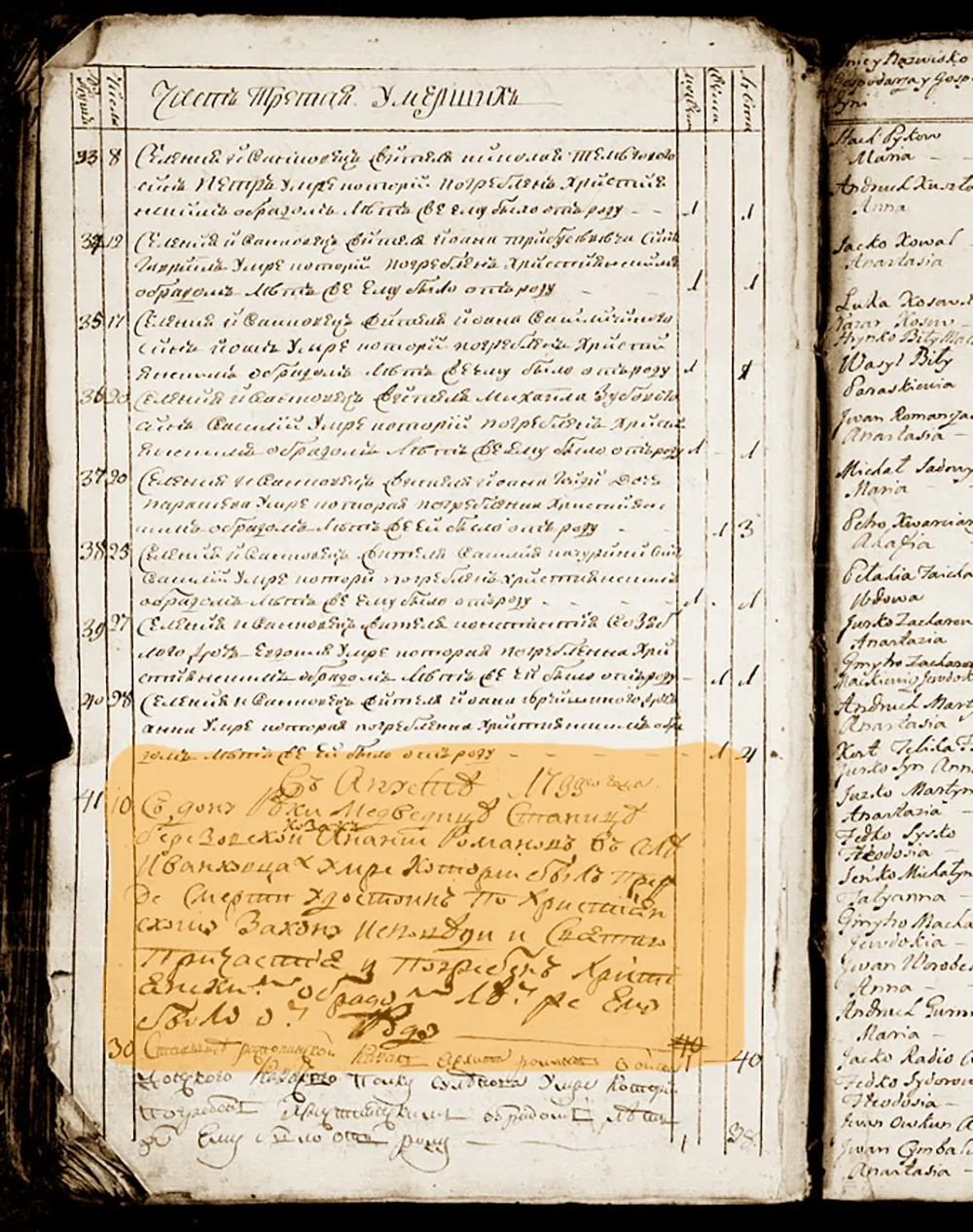
In particular, we read:
“In August 1799… From the Don, from the river Medveditsa, from the stanitsa of Berezovskaya, the Cossack Ananii Romanov died in the village of Ivankivtsi; before his death he was granted, according to the Christian law, confession and holy communion, and was buried with the Christian rite; he was 40 years of age.”
Interestingly, whereas all the preceding and following entries are written in small letters and in the calligraphic hand of the local priest, here we have a completely different handwriting and letters about 2.5 times larger than the others.
In Andrii Diachok’s opinion, judging by the extensive content, the entry was made by someone who knew the deceased well, probably a regimental priest.
Another interesting fact. As Andrii Diachok found, there is one more entry there that again mentions a Don Cossack:
“From the stanitsa of Raspopinskaya, the Cossack Arkhyp Romanov of the Don Host, of the Cossack regiment of Sulenov, died; he was buried with the Christian rite. He was 38 years of age.”
Despite the identical surname Romanov, the theory that the deceased were relatives is unlikely. It is more probably a matter of namesakes, and the surname was quite common.
Unfortunately, we have not yet had the luck to find the gravestone of Arkhyp Romanov.
“In the near future we will try to find the gravestone of that Arkhyp,” said Oleh Fedorov. “Logically it should be next to the already known ‘Don’ cross. There are several there that have been toppled by time. Perhaps one of them will turn out to be the one we need.”
A telling fact: the entry about the death of Arkhyp Romanov was made by the hand of the local priest, not the regimental one. One can cautiously suppose that in the first case the regimental priest intervened because of the high status of the deceased, which is directly indicated in the epitaph: “an ataman’s son”.
The discovery of these burials also reveals a little-known page of Podillia’s history. For information that the newly created border along the Zbruch at the end of the 18th century was guarded by Don Cossacks had not been made public until now.
Oleh Fedorov drew attention to one more fact:
“Parish registers usually always state the cause of death when relatively young people are concerned,” says the local historian. “But here, in the cases of the Don Cossacks, there is silence. Considering that both were buried in August 1799 at an interval of 20 days, one gets the impression that they were simply killed. There was no particular confrontation between St Petersburg and Vienna at the time. Smuggling was still pointless. So it was hardly a clash on the border. Considering the cruelty with which the Don Cossacks treated conquered peoples, one can suppose that they died at the hands of local residents, who dealt with the bloodthirsty newcomers.”


