

The foundations of the Rozumovskyi Palace are now under triple state protection
The foundations of the Rozumovskyi Palace are under state protection, as reported on the page of the Spadshchyna (Heritage) community on Facebook.
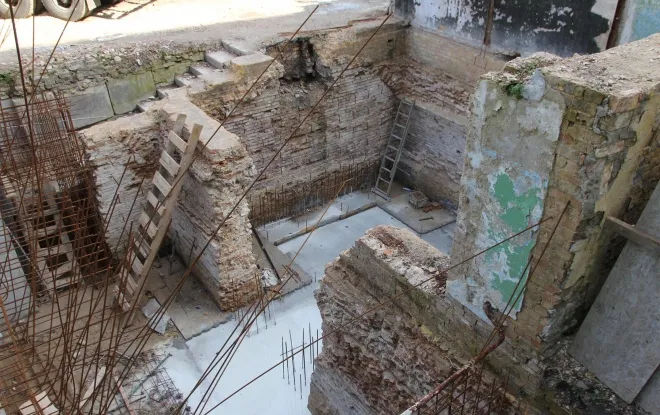
General view of the foundations and the eastern corner of the cellar from the second half of the 18th century, view from the west (Photo by A. Korob, 27 March 2024)
The report states that on 19 May, by order of the Ministry of Culture, the monument was entered in the State Register of Immovable Monuments under three categories at once: history, archaeology and architecture. This means protection and a ban on any construction on the site of the surviving walls of the historic building.
To recall: the foundations were discovered by chance in early 2024 during works by the company “Sobi” LLC at 3v and 3h Mazepy Street. They were studied by the archaeologist Tymur Bobrovskyi, and in the summer of that year the Department for the Protection of Cultural Heritage of the Kyiv City State Administration included the site in the List of Monuments of the City of Kyiv. However, this did not stop the developer: in February 2025 machinery appeared on the site again, and part of the Engineering Services Building of the Kyiv Fortress (1853) was demolished. The works were stopped only thanks to the determined resistance of local residents. After that the prosecutor’s office placed an attachment on the plot and banned any works. And now the foundations are officially in the state register! This is yet another example of how joint action brings results.
Background
Tymur Bobrovskyi, senior researcher at the National Sanctuary “Sophia of Kyiv”, full member of the Ukrainian National Committee of ICOMOS and Candidate of Historical Sciences, wrote the following about this structure:
Bibliographic and cartographic materials make it possible to identify confidently the remains of foundations and cellar rooms of the 18th century. According to the historical survey published in 1930 by Fedir Ernst:
“The first plot on the left after the square (now Arsenalna Square), with a homestead and two oblong buildings, was rented in the second half of the 18th century from the St Nicholas Monastery by the last hetman and one of the richest magnates of the Ukraine of that time, K. H. Rozumovskyi. In the 1780s a huge wooden palace was built here, whose garden façade faced the Dnipro valley. The main façade looked onto a rectangular courtyard, along whose sides, perpendicular to the street, ran the wings.
Enormous sums were spent on building the palace, but nobody lived in it. In 1797, with Rozumovskyi’s permission, the then Governor-General of Kyiv, Count I. P. Saltykov, settled here. Balls, fireworks and illuminations were held here every week, and “it seemed enchanting when it glittered with lights on a summer night”, recalled F. F. Vigel (who lived across the street from this palace).
Somewhat later, when the war with the Turks began, Rozumovskyi was approached for permission to quarter part of the army in the palace. The indignant magnate ordered the palace to be dismantled at once and moved to his estate “Yahotyn” in the Poltava region. Only the courtyard wings remained of the Kyiv palace” (Kyiv, 1930, pp. 469–470).
The palace of Kyrylo Rozumovskyi is absent from the plan of Kyiv of 1780, but its outline appears on the plans of 1799, 1803, 1812 and 1819, where the palace is shown as a large massive building with two lateral projections. Evidently the palace was dismantled in the 1820s, after Kyrylo Rozumovskyi’s death, and somewhat later the complex of the Engineering Yard of the Kyiv Fortress was built on this site (the outline of the Engineering Services building can be seen on the city plan of 1902).


