

Hostynyi Dvir: a sad ruin in the historic heart of Kyiv
Market Square, later Contract Square, was for practically the whole history of Kyiv its heart and centre, where the life of the city was concentrated.
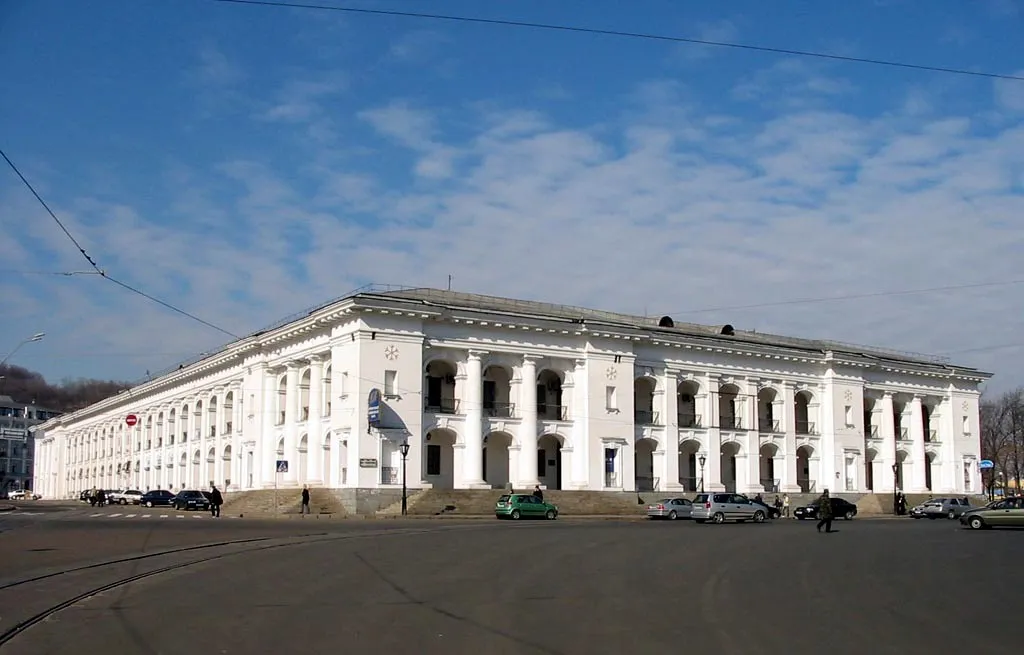
Photo: Wikipedia
By the beginning of the 19th century the trading square of Podil looked rather unattractive. It was a clumsy jumble of motley shops and stalls in varying degrees of neglect. Properly speaking, all those ancestors of today’s kiosks should have been demolished to the devil, but the magistrate did not want a conflict with a whole legion of merchants and shopkeepers.
Quite conveniently, in 1808 another fire occurred, after which of more than three hundred wooden shops “only charred stumps remained” (quote). That fire became the first milestone in the long-suffering history of Hostynyi Dvir.

Panorama of Podil and Hostynyi Dvir in an engraving by the German wood engraver and master printmaker Schwertführer, made in the mid-19th century
After the fire, the “city fathers” decided to build in the centre of Contract Square a huge trade and warehouse complex that would serve Kyiv’s economy and arouse the admiration and envy of the city’s guests. The work on the ambitious project was entrusted to the St. Petersburg architect Luigi Rusca, a native of Italian Switzerland. In 1809 the newly created project was approved by the Ministry of Internal Affairs. Recall that the Ministry of Internal Affairs of that time was not about the police or anything like that, but about everything that went on inside the Empire.

Luigi Rusca’s project for Hostynyi Dvir in Kyiv (1809)
The 1930 guidebook “Kyiv. Guide”, edited by Fedir Ernst, states: “According to the plan ‘most highly approved’ (that is, approved by the emperor himself), along the façade facing the Brotherhood Monastery there was to be the ‘iron row’, on the side of today’s Contract Square (where the old town hall building still stood then) and the Samson fountain, the ‘fur and linen row’, towards the cathedral, the ‘vegetable row’, towards today’s Red Square and Revolution Street, the ‘silk and cloth row’.”
In all, the huge two-storey building was designed for 204 shops (one under each arch).
Construction proceeded at a shock pace and soon the ground floor stood. But…

On 9 July 1811 some local lad decided to play pyrotechnician a little. A goose quill stuffed with gunpowder soared merrily into the sky and, with fatal inevitability, landed neatly on the thatched roof of a neighbouring hut.
The fire, which began near the Zhytnii Market, was helped along by dry and hot weather. A series of circumstances led to the formation of a so-called “firestorm”, just like the one in Picasso’s immortalized “Guernica”. In three days the fire destroyed 2,000 houses, 12 churches and 3 monasteries to the ground.
Hostynyi Dvir was practically unharmed by the fire, but the funds allocated for its construction had to be urgently redirected to dealing with the consequences of the catastrophic fire. The following year, 1812, the French invasion stood in the way of continuing construction. Then they merely put a roof over the ground floor that had already been built.
Because the Kyiv community was financially unable to complete the planned construction, in 1826 the emperor permitted Hostynyi Dvir to remain single-storey.

Trading in the courtyard of Hostynyi Dvir. Very interesting characters and types of Podil of that time. There is even a little dog stealing a pie. Drawing by Mykhailo Sazhin, 1844. Photo: V. H. Zabolotnyi State Scientific Architectural and Construction Library
In 1828 the building was reconstructed for the first time. Its author, the architect Andrii Melenskyi, replaced Luigi Rusca’s light and refined project with a “heavy” imperial Empire style. The renovated Hostynyi Dvir housed 52 stalls, some of which belonged to the City Duma. The income from them went to the city budget.
However, in the mid-19th century the Duma finally abandoned the building to the mercy of the shopkeepers. The latter rebuilt their little shops at their own discretion, and the building, planned as the city’s showpiece and ornament, turned into a revolting “shanty town”.

In the NEP years Hostynyi Dvir still functioned somehow as a trading venue, but after the Second World War trade here fell into complete decline, and it was used mainly for warehouses, some workshops and various offices.
The neglected and ravaged Dvir looked so repulsive that under the 1947 General Plan it was even meant to be demolished altogether.
We will skip the vicissitudes and other details of the events around Hostynyi Dvir in the 1970s–1980s as secondary. Those interested will easily find them on the Internet.

Let us single out the main point.
In 1979 the Council of Ministers of the Ukrainian SSR declared Contract Square (at that time Red Square) a protected area. Under the newly acquired status it was proposed to approve a long-term plan of restoration work on the monuments located within it.
Before that, in the first half of the 1970s, on the basis of Luigi Rusca’s drawings found in a Leningrad archive, the restoration architects Valentyna Shevchenko and Yurii Losytskyi drew up a project for a renewed two-storey building of Hostynyi Dvir.

Restoration began in 1983. However, after engineering and technical studies it turned out that simply adding a second storey, as planned in the original project, was technically impossible — the 19th-century builders and contractors had done a thoroughly shoddy job. Even the brick turned out to be of poor quality. Under the weight of a second storey the building would simply collapse. Accordingly, it was decided to dismantle the building completely and rebuild everything from scratch.

Demolition of the old Hostynyi Dvir building. Photo by Borys Kucheriavyi (NV.ua)
The project was completed only in 1990.
The rebuilt Hostynyi Dvir adorned Contract Square but never became a centre of the capital’s cultural life. It housed the important but rather narrowly specialized Zabolotnyi library, an office and workshops of restorers, and some other offices that were of absolutely no interest to the general public. True, young people liked to sit on the steps, and Kyivans and visitors actively used the arcade “for a pee” (Kyiv has always had problems with public toilets).
In 1994 Hostynyi Dvir was leased to the private joint-stock company “Special Scientific Restoration Design and Construction-Production Enterprise ‘Ukrrestavratsiia’”. The latter openly ignored its obligations to maintain the monument properly, and its condition constantly deteriorated.

2012. Photo by Maksym Kozlenko
As of 2012, within the walls of Hostynyi Dvir, besides the old-timers (PJSC “Ukrrestavratsiia” and the Zabolotnyi library), the Kyiv Academic Drama Theatre on Podil, a number of shops, bank branches and even a sauna had settled.
This large and “tasty” piece of real estate in the very heart of the capital was an eyesore to many. Officially it has still not been made public who stood behind the scheme and would ultimately have become its main beneficiary. Unofficially, one VERY well-known surname in Ukraine is mentioned.
The process of “privatization on the sly” was launched at the highest level back in July 2011. We will skip the details of how the authorities squeezed the monument out for “the right people”. Recall only that first a Cabinet of Ministers resolution removed Hostynyi Dvir from the list of architectural monuments under state protection, and then the then president Viktor Yanukovych also removed it from the List of cultural heritage monuments not subject to privatization.
According to the project by the architect Andrii Myrhorodskyi, the inner courtyard was to be covered with a glass roof, the attic rebuilt into a third floor, and the exterior galleries glazed. The result was to be yet another shopping and office centre. That is, Hostynyi Dvir was being prepared for a repeat of the sad story of the late 19th century. Then, recall, it was abandoned to the mercy of greedy shopkeepers who saw everything exclusively through the prism of potential profit. As a result, an architectural masterpiece turned into goodness knows what…

Reconstruction of Hostynyi Dvir. 2 November 2013. Photo: Wikipedia
Naturally, such lawlessness provoked resistance. On 26 May 2012, Kyiv Day, students of the Kyiv-Mohyla Academy held an “Alternative Kyiv Day” on the steps of Hostynyi Dvir. It was the first protest against the attempt to seize the monument, and it grew into an indefinite one. At the same time a community page “Save Hostynyi Dvir” appeared on Facebook, covering the course of the protests. The page description clearly stated their aims: “Contract Square is located right next to Andriivskyi Descent and the Mohyla Academy, and should become not a shopping centre but an epicentre of cultural events, a unique community, a hub of culture.”
Instead of sitting glumly with posters and banners, the protesters organized a kind of art festival-marathon, during which numerous cultural and creative events took place. In particular, lectures, concerts and even free foreign-language courses were held in the courtyard of Hostynyi Dvir, attended by thousands of concerned Kyivans. The aim was to show that Hostynyi Dvir should become a civic and cultural centre of the city, not another commercial project.

A human chain under the motto “My walls are people”. Summer 2012. Photo by Maksym Trebukhov (NV.ua)
Nevertheless, construction work went on in full swing.
In the night of 8–9 February 2013 Hostynyi Dvir caught fire (the third landmark fire in its history). The fire was fought for as many as 6 hours. Ever since the turbulent 1990s, destroying monuments doomed to demolition or radical rebuilding by “accidental” fires had been the developers’ last argument in disputes with uncompromising heritage-protection activists.
Ten days after the “accidental” fire, Berkut riot police brutally dispersed the protesters, and the most determined were “packed away”. Thus, with a spark and with truncheons, the almost nine-month protest and cultural marathon in defence of Hostynyi Dvir came to an end.

After the fire. Photo: texty.org.ua
Construction work on the monument continued even at the height of the Revolution of Dignity and stopped only on 22 February 2014 — the same day the Verkhovna Rada of Ukraine removed Yanukovych from the presidency. This is not just a symbolic coincidence. The actions in defence of Hostynyi Dvir became the first large-scale confrontation in Kyiv and one of the bright harbingers of the Revolution of Dignity.
After the overthrow of Yanukovych’s regime, all the authorities’ unlawful decisions on Hostynyi Dvir and its status were gradually cancelled, and the building was returned to state ownership. But this did little for the monument itself — because of the fire and the illegal construction work its condition had deteriorated significantly. Recall: without roof, windows and plaster, Hostynyi Dvir has stood since the winter of 2013!
The situation caused concern only in September 2021. True, at first it all came down to the façades of the building being covered with a protective net at the order of the monument’s balance holder, the Sophia of Kyiv National Reserve.

Here and below, the current state of Hostynyi Dvir. Photos from June 2026.
At that time, according to the design and cost documentation, emergency and conservation work was estimated at UAH 33 million. Although the Ministry of Culture, which the monument reports to, allocated only a little over UAH 9 million, as of early 2024 50% of the work had been done. There everything stalled again. The Ministry has no funds to continue even conservation work, let alone complete the restoration. The Kyiv community has both the money and the desire, but not the opportunity.

In April of that year, representatives of the capital’s authorities, the Ministry of Culture and the public gathered on Contract Square to discuss ways to complete the emergency work and to find out what to do next.
The then acting Minister of Culture and Information Policy of Ukraine Rostyslav Karandieiev immediately and frankly stated: “Restoration work at Hostynyi Dvir is possible only after the end of the war. However, we must not lose this site. We must preserve our cultural heritage, identity, spirituality. We must find a way to preserve this unique monument.”


True, the official did not explain how to achieve this noble goal.
The capital’s authorities, for their part, appealed to the Ministry of Culture with a proposal to transfer Hostynyi Dvir into the communal ownership of Kyiv. All the more so since the city is ready to allocate funds for the emergency and conservation work in full: “The Kyiv authorities have repeatedly appealed to the Cabinet of Ministers of Ukraine about transferring Hostynyi Dvir to the community so as to be able to carry out the necessary work to save this site, which is the dominant feature of Contract Square and should again become an ornament of ancient Podil,” stressed Hanna Starostenko, Deputy Head of the Kyiv City State Administration, at the time.
Ms Starostenko added that she envisions a large museum and exhibition space on this site, which in particular should house the Museum of the History of Kyiv.
Recall that after the museum was evicted from the Klov Palace in spring 2004 under Yanukovych’s government, it has been wandering through poorly suited premises for over two decades.


In early June 2026, with the assistance of the Sophia of Kyiv National Reserve and the Department for the Protection of Cultural Heritage of the Kyiv City State Administration, the Reserve’s staff were able to inspect this ill-fated site.
The condition is emergency and super-critical. This is clearly visible in the photographs. It is confirmed by the balance holder, the protection authority, the researchers of the KNMC, and representatives of the public organizations Ukraine Incognita and “Brave to Rebuild”.
With each month, with each day, it gets worse and worse. The situation is not just critical, it is shameful. Who is to blame and what is to be done? We will think about it. The only thing clear at once is that global communication between the public and all branches of government is needed. Public discussions of ideas and concepts are needed, as well as guarantees that there will not be another shopping mall here.


The current state of Hostynyi Dvir is critical. The building stands without a roof or windows, wrapped in a protective net. At the end of 2021 the Ministry of Culture managed to begin urgent emergency work there (strengthening the reinforced-concrete structures, clearing debris and covering against precipitation), which partly saved the building from complete destruction. However, full-scale restoration never began because of a lack of funding and legal restrictions on capital construction under martial law.
Today Hostynyi Dvir officially belongs to the state in the person of the State Property Fund of Ukraine, and the balance holder is the Sophia of Kyiv National Reserve (subordinate to the Ministry of Culture and Strategic Communications).
The site became state property in early 2019, when the State Property Fund registered ownership of it after a long court saga to recover the property from an unscrupulous private tenant.
At the same time, the Kyiv city authorities have repeatedly stated their readiness to take Hostynyi Dvir into the communal ownership of the capital’s community, to restore it with city budget funds and to create a large museum and cultural space there. However, for now the monument’s legal status remains national.
Representatives of the Sophia of Kyiv National Reserve have repeatedly stated that the Reserve cannot carry this ruin, and should not. Sophia is the main shrine and monument of Ukraine. Should it be dealing with this, especially now, during the war? And without a kopeck of funds for it, at that.


