

Italy to restore five architectural monuments in Odesa damaged by shelling
As reported by the Ukrainian Information Service (USI), in the spring of this year the Ministry of Culture and Information Policy and the relevant Italian authority signed a memorandum under which Ukraine was to receive 45 million euros for urgent emergency-prevention and conservation work at damaged cultural heritage sites in the UNESCO protected zone in Odesa. Now Pietro Pipi, head of the Italian Agency for Development Cooperation (AICS), has explained how these funds will be used.
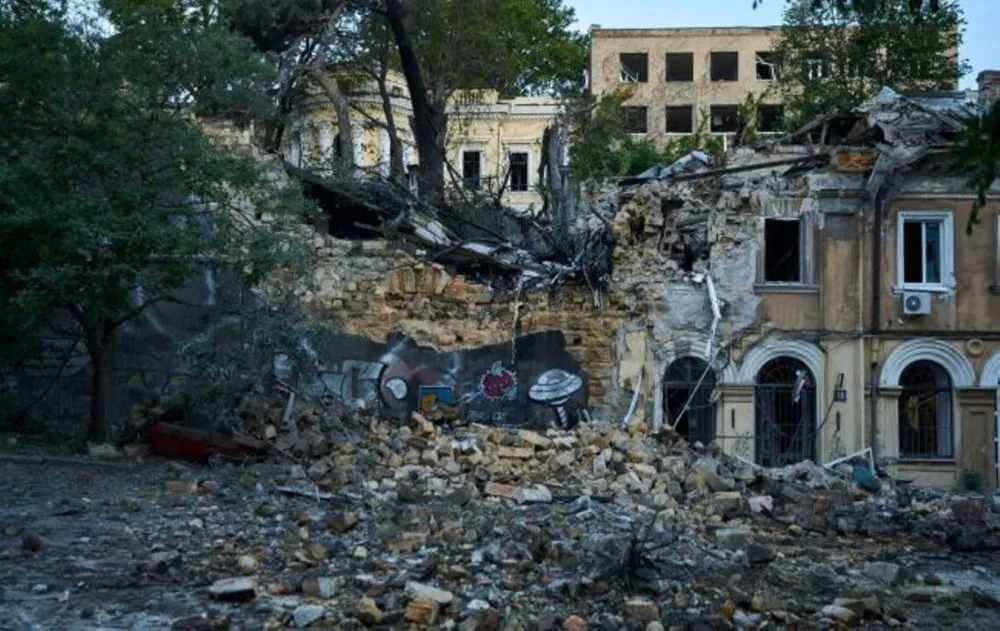
Odesa after the shelling. Photo: t.me/V_Zelenskiy_official
A correspondent of the Ukrainian Information Service learned this from Pietro Pipi’s speech at the Odesa Economic Revival Forum.
Discussion of the project with the Italians began as early as the beginning of 2024. But bureaucratic obstacles arose on the part of UNESCO at that time. Now it has been decided to cooperate directly, without an international organisation as an “intermediary”, and the Italian side is to appoint its representative to the supervisory board. The plan for spending the money provided by the Italians to restore architectural monuments in the UNESCO zone in Odesa damaged by Russian attacks is designed for 3 years, and implementation of the project will begin in 2025.
The programme is divided into three interrelated areas: the construction work itself, an integrated and sustainable system of cultural heritage management, and the training of Ukrainian restorers by their Italian colleagues.
Five buildings will be repaired in Odesa, four of them held by the regional state administration and one by the city council.
Zontag House, a monument of architecture and urban planning at 6 Prymorskyi Boulevard, has been given a special role.
“We want the building we are going to reconstruct to house a centre for cultural heritage management. Something living, a place where lectures, training and so on will take place,” Pietro Pipi explained.
As Ukraine Incognita reported earlier, citizen Orest Berezovskyi, known among admirers of the Moscow Patriarchate by the church pseudonym “Metropolitan Onufriy”, expressed condolences to the people of Odesa in connection with the missile attack on the historic centre of the “Pearl by the Sea”.
Tellingly, in his address to the people of Odesa Mr Berezovskyi did not once use the words “Russia”, “Russian” or “Russians”. From the message of the chief pastor of Ukrainian admirers of the Moscow patriarch Gundyaev (Kirill) it remains unclear which country is to blame for the tragedy and which army exactly struck a peaceful city with missiles. Accordingly, the perpetrator is not named. Whom the esteemed citizen Berezovskyi had in mind when he used the vague phrase “enemy attack” is hard to say. It may even have been Martians.


