Oleksa Dovbush

· 14 min read
“A man once went up to Mount Dovbushenka, and he looks, and in one place a slab is thawing. He pried it up. He looks – and it is a cave. He went in – and it was full of every kind of treasure. He looked around: there was enough to load nine horses. He took as much money as he could. The next day he came with horses and people, looking for that store-room – no way. Gone. Not a trace was left”… This is one of the legends about Dovbush’s treasures. There are hundreds of them in the Carpathians. Dovbush’s rocks, Dovbush’s caves, Dovbush’s stones, Dovbush’s treasures… How is the name Rakhiv explained? The place where Dovbush counted (rakhuvav) money. And why is Dilove (the village where one of the geographical centres of Europe is located) so called? Because Dovbush divided (dilyv) money here. So who is this Dovbush? Well, a robber, the Ukrainian Robin Hood… A resident of Western Ukraine will add that Dovbush was the leader of the Carpathian opryshoks. But in both eastern and western Ukraine, few non-historians can say in detail who Dovbush was, when he lived and what he did.
So who was Dovbush?..
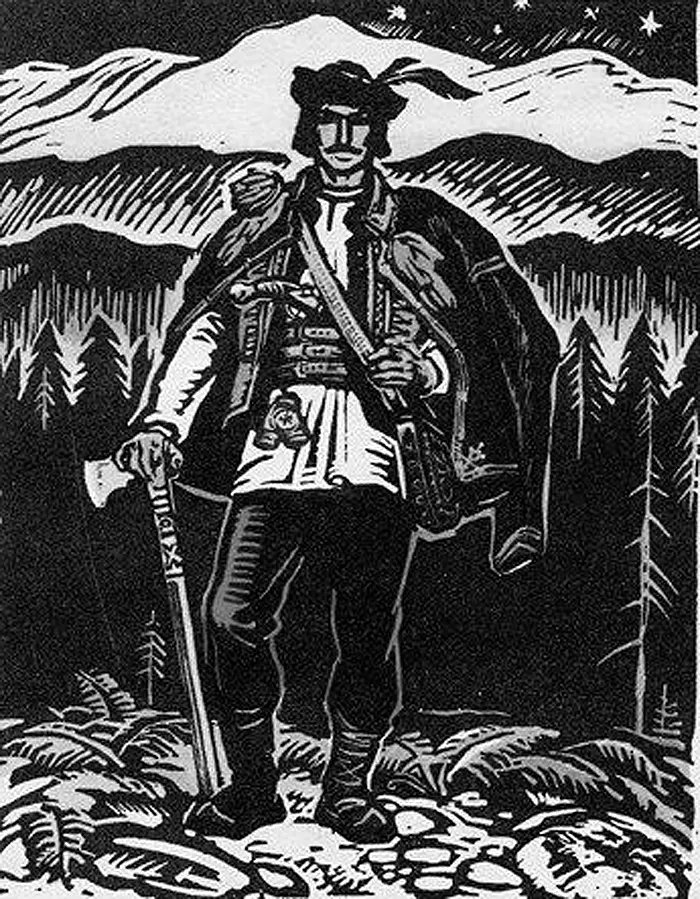
The opryshoks
The period of uprisings in Ukraine (16th–17th centuries) was reflected in the Ukrainian Carpathians in the form of opryshokstvo. Opryshoks were what people called mountain robbers who robbed lords and rich men and, supposedly, handed out the loot to the poor. That they robbed lords is the plain truth, but how generously they shared the spoils is not known for certain. Most historians claim that people joined the opryshoks not for ideological reasons but for quick profit. In the Carpathians a situation arose in which energetic, passionately driven men went to work as shepherds on the polonynas (mountain pastures). There they were free and independent of the lords, so lordly arbitrariness did not trouble them much. Most of those who remained in the villages (in the valleys) were very strongly attached to their families and farms, so they did not dare to rise up against the lords’ oppression. And so those who joined the opryshoks were mostly unencumbered daredevils, or people who could not return to ordinary life because of crimes they had committed.
Opryshok bands were not large – a score or so of men was the entire band. But they knew the terrain perfectly and were practically elusive. The attacks were sudden. The opryshoks took everything of value, often killed the owners, set houses on fire and vanished in an unknown direction. The lords of the Carpathian foothills lived in constant fear of the robbers from the mountains. For the fear they caused the lords, the common people greatly respected the opryshoks. Legends were composed about them, and the people endowed them with superhuman qualities. The Soviet system called the opryshoks rebels against the authority of the Polish–Lithuanian Commonwealth. But the opryshok movement was truly insurgent only sporadically.
The forerunners of opryshokstvo were the uprisings of Mukha (in the 15th century) and Andrii Barul. But the real beginning of the opryshok movement came in the time of the Khmelnytskyi era – it was the result of the Hetman’s call for a nationwide struggle against the lords. The largest band gathered under the leadership of Semen Vysochan from Otynia; it is said to have numbered 15,000 men. Smaller bands formed throughout Pokuttia and the Hutsul region. The Khmelnytskyi era swept through Western Ukraine like lightning and died away, but it stirred the Foothills for a long time.
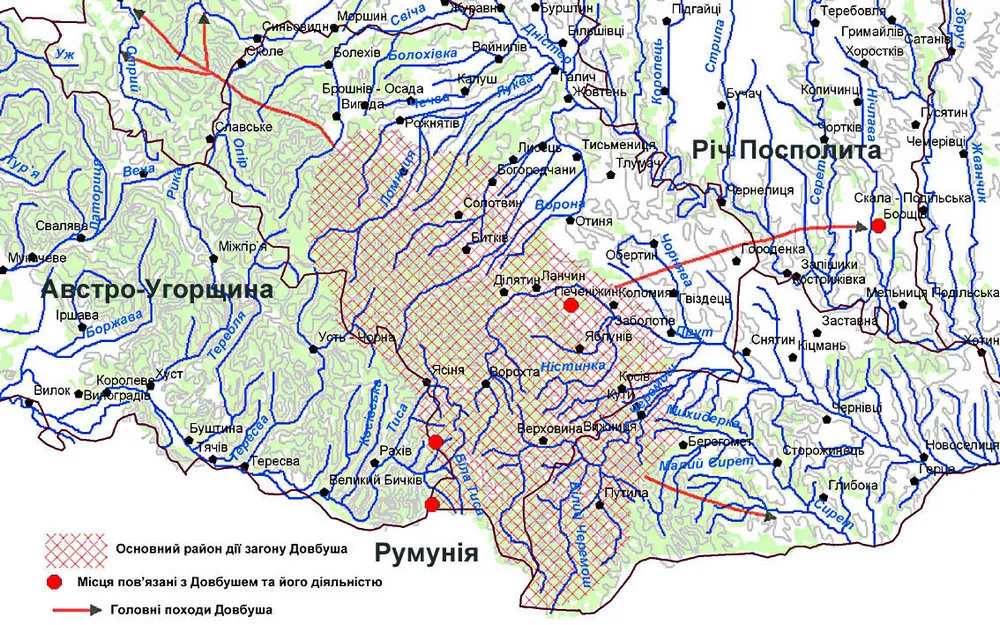
A new impetus to the opryshok movement came during Khmelnytskyi’s second arrival in Galicia. The opryshoks then began not only to destroy manor houses but also to take villages and small towns. The best-known leaders of the second half of the 17th century were Drozdenko (active in 1665 in the Dniester region) and Nestor (caught in Diliatyn in 1683). For almost ten years (from 1703 to 1712) Ivan Pyskluvyi was a real horror for the lords. In 1704 the leader Pynta appeared in the Carpathians. Folk tales have brought down to us the story of his bold attack on the large town of Kosiv. But none of the leaders can compare with the son of a poor lodger from Pechenizhyn – Oleksa Dovbush.
Dovbush.
Three dates from the life of the famous Carpathian opryshok are known for certain: 1700 – the year of Dovbush’s birth; 1738 – the first historically documented mention of the activity of Dovbush’s band; 24 August 1745 – the day Dovbush was killed.
Oleksa was born in 1700 in the village of Pechenizhyn, not far from Kolomyia. He was the eldest son of the peasant Vasyl Dovbush, who was so poor that he did not even have a house of his own but had to rent a little room from the wealthy gazda Havrylo Tverdiuk. The Dovbush family’s only property was sheep.
Oleksa’s childhood was spent in poverty. Almost every year he climbed up to the polonynas to graze sheep. Evidently, from childhood Dovbush witnessed the lords’ arbitrariness, fraud, violence and abuse by the leaseholders. The young Oleksa undoubtedly not only heard about the opryshoks from peasants and mountain shepherds but may also have met them on the polonynas, where they often stopped to rest and to get information about life in the valleys.
From Polish court materials it is known that Oleksa had a brother, Ivan, and was married. Dovbush first appears in written sources in 1738 – by then he was already the leader of a band. But it is unlikely that Oleksa had not been an opryshok before – only a reliable and experienced fighter could be chosen as leader. So it is probable that Dovbush was an ordinary opryshok for a long time. Legends endow Oleksa with great strength. It is quite possible that he really did stand out for exceptional physical qualities, for strength was always respected in opryshok bands.
So, in 1738 a band led by the Dovbush brothers, Oleksa and Ivan, began to operate in the Carpathians. Tradition indicates that Ivan was Oleksa’s antithesis, distinguished by a wild, unrestrained temper, and was cruel and merciless. A quarrel between Oleksa and Ivan in the Pechenizhyn tavern in the spring of 1739 is a historical fact. The quarrel turned into a brawl in which Ivan killed one of the opryshoks and badly wounded Oleksa in the leg. After that Oleksa limped until his death. After the fight Ivan left Oleksa’s band. In the Boiko region he assembled his own band. It is not certain that Oleksa and Ivan remained enemies for ever. Perhaps it was with the support of Ivan’s band that in 1744 Oleksa went on distant raids to Turka and Drohobych. Before his death Ivan bequeathed his opryshok knife to the church in the village of Beniava. On one side of that blade was carved a list of those killed by the hand of Ivan Dovbush.
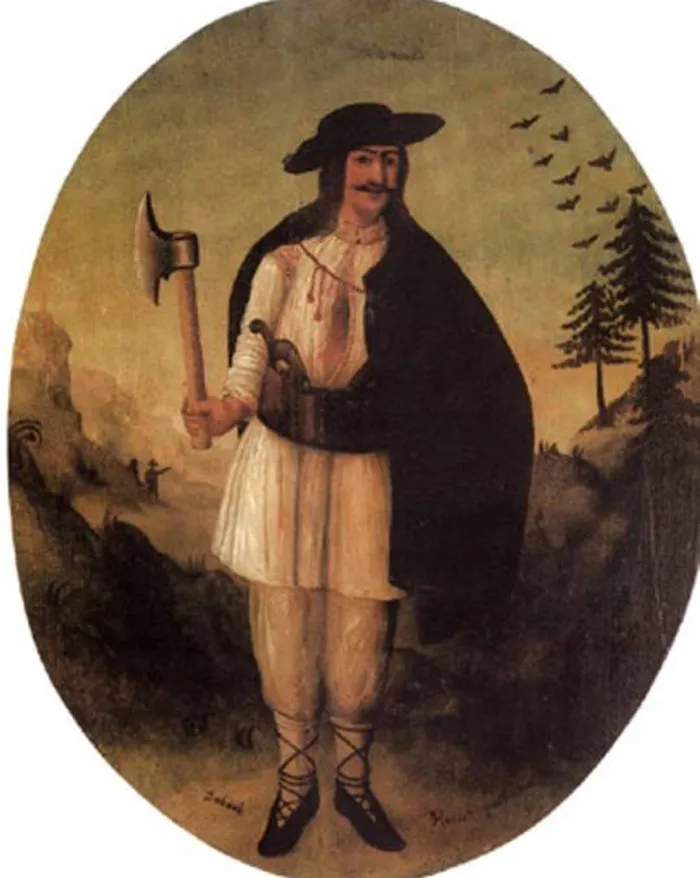
Oleksa Dovbush’s band was fairly large, made up of select, battle-tested, physically strong and hardy fighters (formerly members of the poorest strata of the population: farmhands, shepherds, servants, ruined peasants who had run away). Among the known members of his band were Vasyl Paliiv, Pavlo Orfeniuk, the Dzhamydzhuk brothers, Andrii Lavriv, Vasyl Baiurak and Ivan Boichuk. Among other bands, Dovbush’s stood out for directing its attacks against the landowners and leaseholders most hated by the people. Oleksa often shared the money taken from the lords with the peasants. In 1738–39 Dovbush’s band began operating in the Yablunivka starosty. Later the attacks spread over the whole of Pokuttia, as well as Transcarpathia, Bukovyna and the Boiko region.
Dovbush’s band acted with lightning speed and gave the lords no chance. Lords’ estates burned one after another. The nobility hired guards and called up militia detachments, but nothing helped. Leaseholders often paid Dovbush ransom, promising gentle treatment of the common people. Oleksa became a true defender of the people’s interests. He often made attacks at the request of the inhabitants of one village or another. Trade caravans also suffered from his band. But Dovbush never shed blood in vain. His terror expressed the people’s vengeance. There is a known case when Oleksa attacked the estate of Andrzej Karpiński. Just at that time Karpiński’s wife gave birth to a son – the future classic of Polish literature, Franciszek Karpiński. Oleksa satisfied himself of the Karpińskis’ good treatment of their peasants and did not destroy the lords’ estate.
Dovbush struck great fear into the nobility. And tearful petitions flew from the lords of the Carpathian foothills to the authorities, to the Crown Hetman Potocki, calling on him to send crown troops into the mountains against Dovbush’s band. In 1740 a sizeable detachment of smoliaky* led by Captain Przełuski, together with a punitive special unit – the “Wallachian company” – set out against the opryshoks.
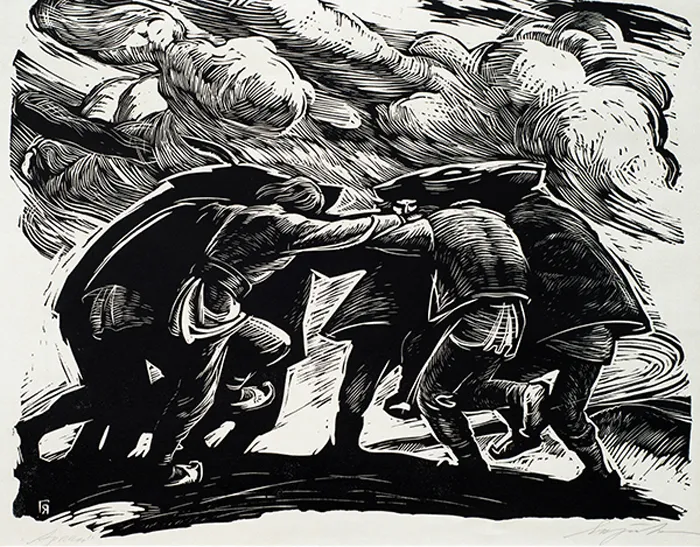
But thanks to its excellent knowledge of the terrain, Dovbush’s band skilfully evaded its pursuers, all the while knowing about every movement and action of the punitive forces and ceaselessly attacking the lords’ estates. In 1741, under pressure from the noble army, Dovbush was forced to retreat to Verkhovyna and, stopping for a time on the Bukovets polonyna, to halt the attacks. It was then that Dovbush began to visit Transcarpathia regularly, which at that time was Austro-Hungarian territory. Here he recruited newcomers to his band. Oleksa recruited especially many future opryshoks in Yasinia, where he even had a “safe house.” Dovbush stopped attacks on Austro-Hungarian territory, because he did not want to break relations with the local authorities. Oleksa did no harm to the Hungarians, and they did not touch his opryshoks.
The most dangerous periods for the band were the long Carpathian winters. In winter it is very hard to flee from pursuers, because any movement is easily tracked in the snow. The band dispersed to winter quarters. Every spring Oleksa had to gather the band again. He himself wintered in the mountains, in special secret hideouts (sometimes in caves) with food stored in advance. Every year the composition of Dovbush’s band changed. Dovbush had special agitators who recruited new members in winter. Every spring a meeting place was appointed, where both old members of the band and newcomers came. One such place was Mount Stih, on the border of Austria-Hungary, Romania and Poland. It was on this mountain that Dovbush’s band suffered its first significant defeat. The band, which had only just returned from winter quarters and consisted mostly of newcomers, was surrounded by smoliaky. A large number of opryshoks were killed or captured. Oleksa, with a few comrades, by some miracle managed to break out of the encirclement.
Dovbush gathered a band again. The band began the struggle against the nobility with renewed vigour. The opryshoks descended from the mountains like lightning, attacked the lords’ estates and vanished again in the forest thickets. The opryshoks’ actions at that time became mass in character. In 1742 the Crown Hetman Józef Potocki himself admitted that it was very hard to destroy Dovbush’s band. It was then that he set out with a detachment of several thousand regular troops for Stanislaviv (present-day Ivano-Frankivsk, then the centre of the Foothills). But most likely this was some kind of political action, because it is highly improbable that a regular force of several thousand would act against several dozen opryshoks.
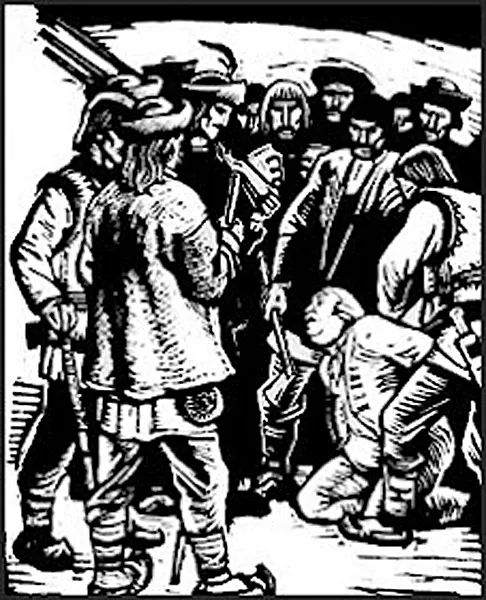
Very often Przełuski’s smoliaky were “on the heels” of Dovbush. But there is a known case when Oleksa caught the smoliaky in an ambush. This manoeuvre was worthy of great commanders. The opryshoks pretended to flee and lured Przełuski into a valley between the mountains. In the thickets on the slopes “snipers” crouched with loaded weapons. They were only waiting for a sign from their leader to open fire on the smoliaky, who were at that moment perfect targets. But Dovbush never gave the order to shoot. “Do not be sorry, brothers, that I gave no sign to shoot. I looked at those smoliaky – and they are our people. They speak our language, all of it… I could hear, because I sat close. One says he left his wife at home and small children, and he grieves… And another says our service is cursed, and if he could, he would throw it up right now. Only the lord forced him into the soldiery… And I saw that they were our people, and they went into foreign service to feed their wives and children. And if we kill them off – who then will feed their children? And so pity pressed my heart, and I gave no sign to fire…” (This phrase was indeed spoken by Dovbush; it was recorded in Polish court records.)
One of Oleksa’s best-known raids was into the territory of present-day Ternopil region, to Borshchiv. There he attacked the estate of Colonel Konstanty Złotnicki – a prominent Polish magnate notorious for his special cruelty towards peasants. Oleksa tortured Złotnicki for a long time before killing him. The opryshoks took not a single kopeck from the bloody colonel’s estate. A phrase spoken by Oleksa to Złotnicki on 4 May 1744 is historically documented: “…I did not come here for your money, but for your soul – so that you would torment people no more. And do not beg, and do not waste words – you will die in cruel torment anyway.”
With this attack Dovbush sowed panic terror among the nobility. The lords understood that this was no ordinary opryshok, that he could not be bought off with money, and that sins would have to be paid for with life. And the hunt for Dovbush began with renewed vigour. Patrols stood everywhere in villages and on roads. But in vain… The lords realised that it would be extremely hard to defeat Dovbush with their own forces, so they began to seek help from the local population, promising a substantial reward and release from feudal obligations. And traitors were found. They were three wealthy gazdas: Mykola Didushko – a very rich farmer from Dovhopillia, Ivan Mochernuk from Mykulychyn and Stepan Dzvinchuk from Kosmach. These three undertook to hire a band of cut-throats from the local population who were to destroy Dovbush.
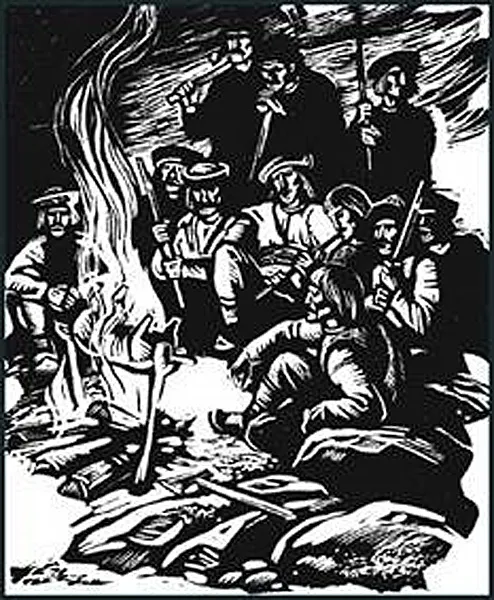
Dovbush learned of the plot. The leader’s heart grew heavy. “And I did it for them…” They say that Oleksa then decided to give up being an opryshok and go to Moldavia, but first to punish the traitors. Didushko was killed first, then Mochernuk. Dzvinchuk was the least wealthy of the three. A legend says that Dzvinchuk’s wife was Dovbush’s lover, but that is a fable, for court documents indicate that Oleksa was married and that in 1741–1745 his wife was in his band. So Dzvinchuk was a wealthy peasant from Kosmach, but not wealthy enough to have a guard. Therefore, when Dovbush went to deal with Dzvinchuk, he took only two men with him.
Dzvinchuk had learned of the deaths of Mochernuk and Didushko earlier, so he knew his turn would soon come. Imagine what panic fear seized Dzvinchuk when he heard dogs barking and saw opryshoks in the yard. Dovbush himself came first.
“– Open up!
– Stefan is mowing for the lord, – answered Dzvinchuk’s mother.
– Oh, you lie, old woman! He is here. I saw him go into the house.
– Have mercy, good people! Oh, people – help!..
Oleksa looked around and saw a gate pole lying in the middle of the yard. He took it and began to pry at the door. The wooden bolt began to tear out of its staples, and the door gave way.
Oleksa threw down the cudgel and, trusting in his strength, pressed with his mighty shoulder. At that moment Dzvinchuk fired through the crack, point-blank” (from Hnat Khotkevych’s novella “Dovbush”).
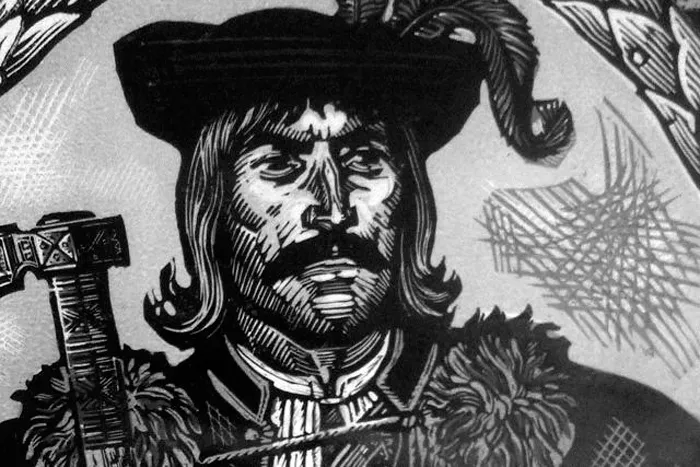
The lives of Richard the Lionheart, Frederick Barbarossa and Petro Sahaidachnyi ended through chance and folly. The life of the great opryshok ended in the same way. They say that Dovbush’s wound was not fatal and that he died of blood loss. The lords carried Oleksa’s dead body around the villages for a long time to convince the people of the hero’s death, then the body was displayed in the Kolomyia town hall. On Hetman Potocki’s orders the leader’s body was cut into 12 pieces and hung on stakes in eleven villages and towns of Pokuttia, so that people would be afraid.
Oleksa Dovbush’s campaign became the brightest page in the history of the struggle of Western Ukrainian peasants against social and national oppression. The people did not forget their protector. Hundreds of legends and myths about Dovbush still wander through the Carpathians today.
“Near the village of Zelena there is Mount Dovbushenka. Come, ask the smallest child – and it will tell you how Dovbush wintered here, had three hundred goats, slaughtered them and ate them with his comrades, poured the fat into barrels and hid it in a cave. And they say that the fat, clothing, weapons and gold – all of it stands to this day in store-rooms, but all of it is enchanted. When Oleksa died those store-rooms shut themselves up, the slabs slid into place, and so it stands to this day. Many went to look for it, but it is all in vain”…
Author: Roman Malenkov; illustrations by H. V. Yakutovych