Archaeological remains of a city gate to be conserved in Ivano-Frankivsk
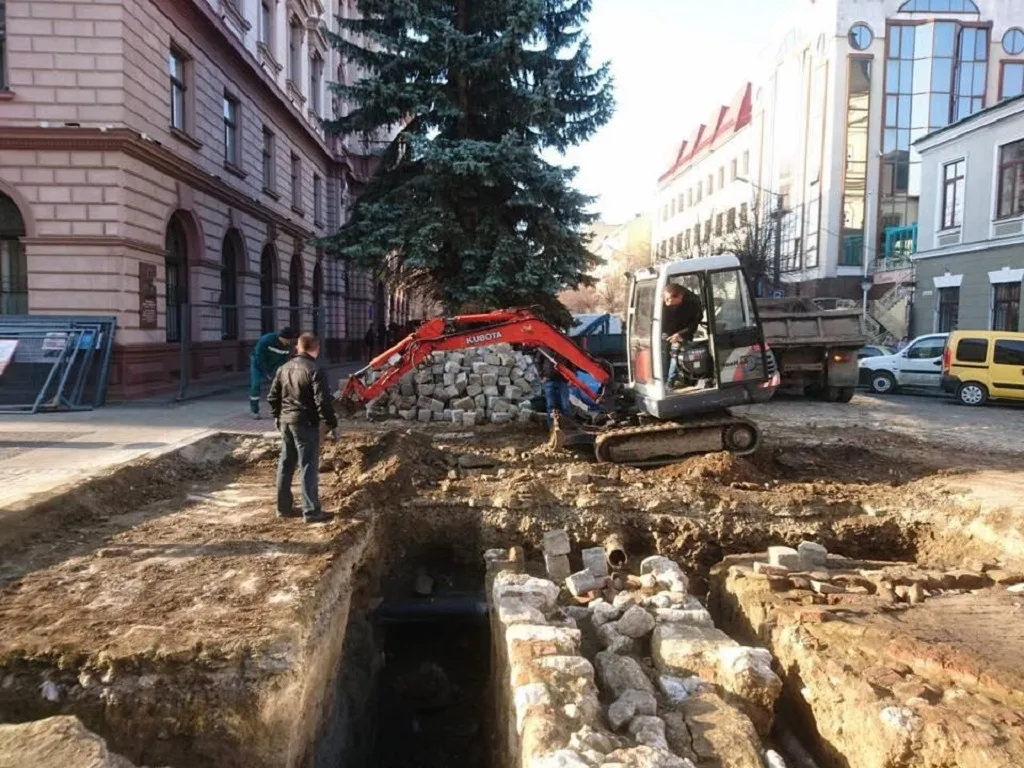
In the centre of Ivano-Frankivsk, work has begun to conserve and mark out the archaeological remains of the Tysmenytsia Gate of the 17th-century Stanislaviv Fortress.
This was reported by the Department of Urban Planning and Architecture of Ivano-Frankivsk City Council.
First, the sand embankment on the site of the find will be compacted. Then the already-studied fragments of the Tysmenytsia Gate will be marked out, said Volodymyr Idak, chief specialist of the cultural heritage protection division of the Department of Architecture and Urban Planning.
The paving will reproduce the textured outline revealed during the excavation of the foundations. Conservation will protect the gate from destruction. The marking is meant to show the position of the gate as an important element of the whole Stanislaviv Fortress, and to demonstrate how this architectural environment has changed over time. It will thus become a starting point for future archaeological research.
Beside the conserved gate an information stele and a metal model at a scale of 1:100 will later be installed. The captions on the stands and the model will be in Ukrainian and English, and also in Braille.
Background: the Tysmenytsia Gate, an important element of the whole Stanislaviv Fortress, was found in mid-2018. The remains were hit upon by municipal workers carrying out street repairs. Specialists of the city executive committee, the initiative “Frankivsk Worth Preserving” and the local history association “My City” then joined the excavation. The municipal workers provided the necessary equipment for the dig and suspended the works around the find. The excavations were carried out by hand.
This gate is considered one of the largest defensive structures of the old town, part of the Stanislaviv Fortress. Maps dating from several centuries ago show that the gate led to the road to the town of Tysmenytsia.
According to Vasyl Tymkiv, director of the municipal enterprise “Pamiat”, the gate existed until the early 20th century.
Sources: frankivsk-future, “Halytskyi Korespondent”, “Halychyna”.