

Kyiv. Lukianivka. A candid account
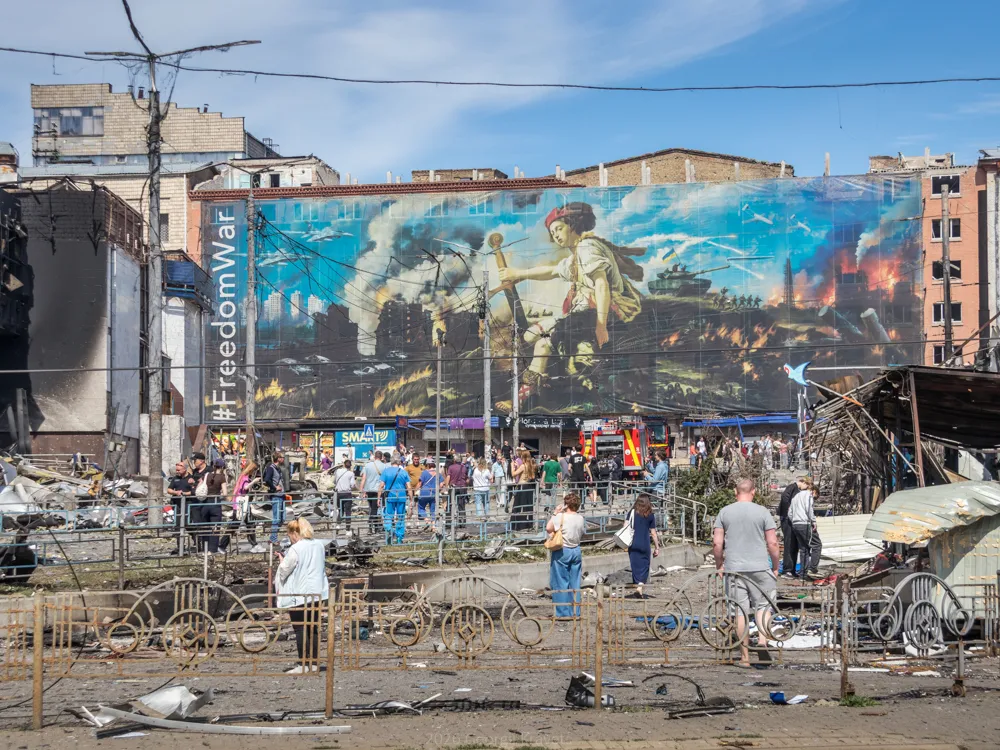
The fabric of the city here is strikingly uneven – Lukianivka has neither clear boundaries nor a single axis. Its history is just as cracked and pitted and, to be honest, full of darkness. It is a place of drama and hardship for the flower of the Ukrainian nation. The imprisonment of its leaders. The deaths of bards and guides. Only now and then does a talented scholar happen to be born in the dungeon of the local prison. Or a royal princess pay a visit once in half a millennium – say, one from the Windsors. And even that, perhaps, for the best. Because, you know, the last time a Habsburg archduke found himself here, he simply died in agony. And that was not yet the sad part.
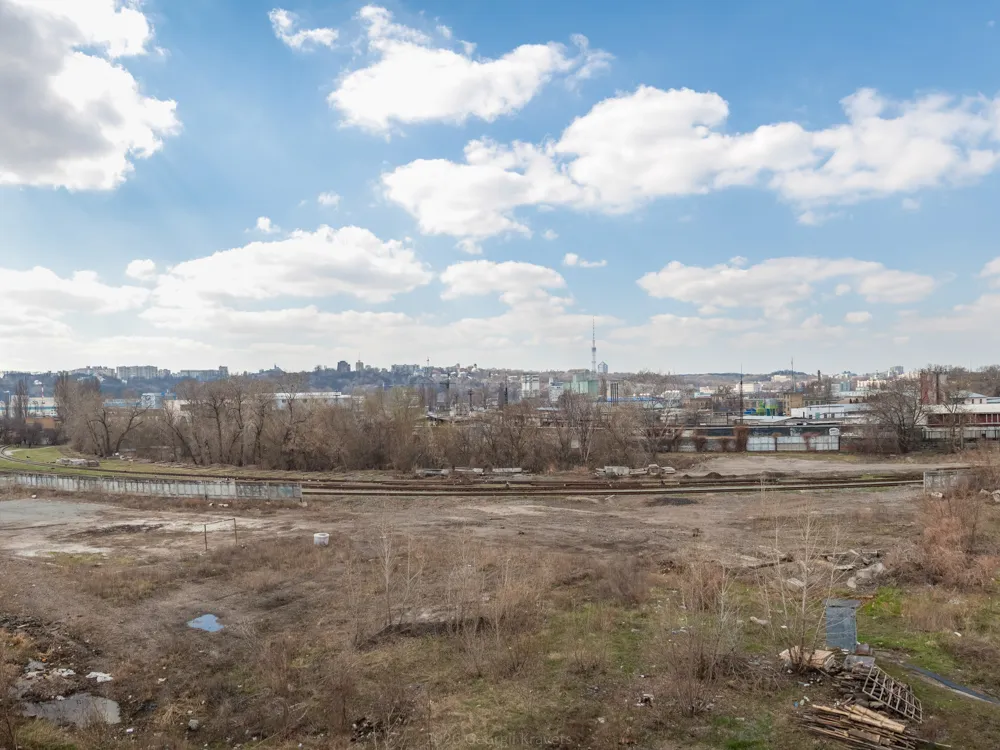
Panorama of Lukianivka, 2012
And at the same time: Kurbas’s productions and the murals of the Boichukist artists, replicas of the shrines of Jerusalem and Inkerman, the so-called Kyiv Switzerland, the first city trams, markets, cinemas – if the sources do not lie, all of this is about Lukianivka too. As is the tallest structure in the country, or the largest wearable shoe, entered in the Book of Records of Ukraine. There is such a thing here, too. And, for reference, there are the offices of the main departments of the state customs and tax services and even… the Economic Security Bureau. And, strictly between us, several defence-industry plants. Also a university from which future presidents went out to lectures for at least two nations. In short, Lukianivka has things not only to grieve over but also to be proud of.
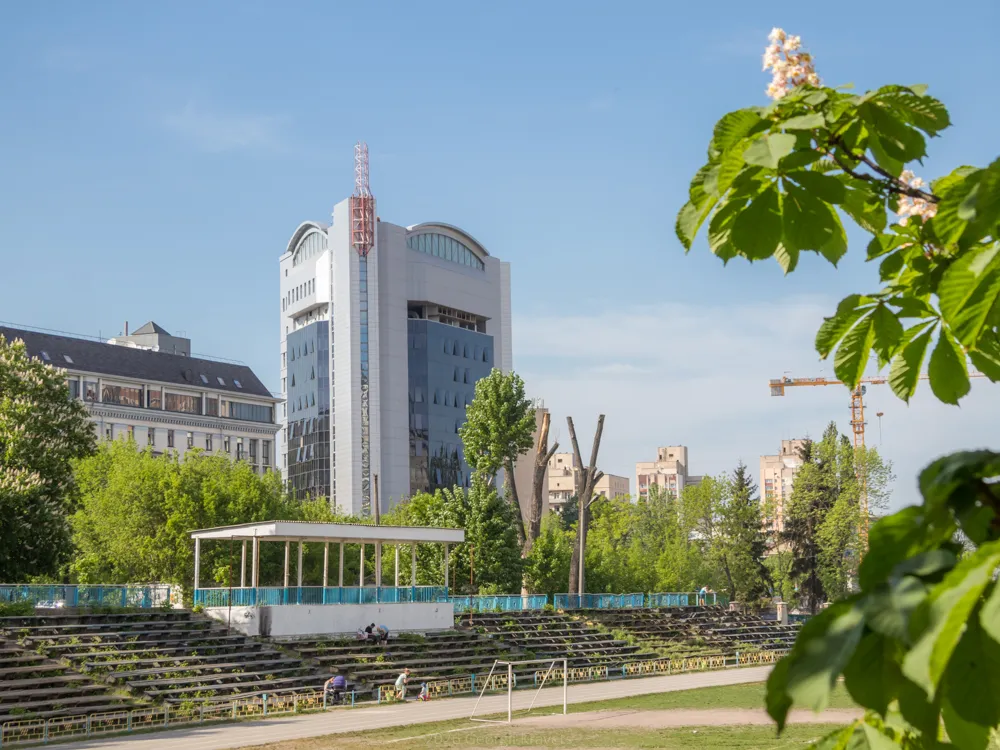
Administrative building in Lukianivka
But let us begin with the plateau. To take in the whole Lukianivka plateau with the eye – still partly visible and not entirely built up – it would be best to find oneself, say, in the summer of 1918 aboard a German airship. The one from which the aerial photography, priceless to this day, was carried out.
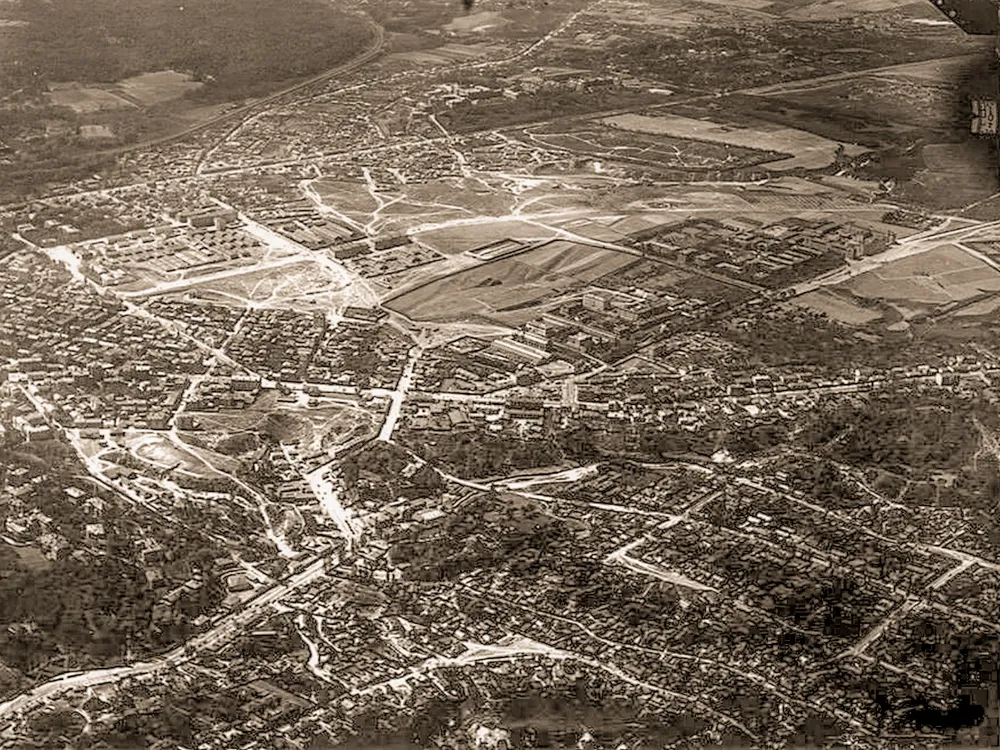
Lukianivka, German aerial photograph, 1918
Then one would be able to see how, from the edge of the Yurkovytsia hill promontory in the north, a broad plain unfolds like a tablecloth all the way to the Lybid in the south. It is bounded on the east by the beds of the small rivers Hlybochytsia and Skomorokh, and on the west by the Repiakhiv and Babyn ravines. The fold of the third local ravine, Kmytiv, separates present-day Tatarka from the rest of the Lukianivka plateau.
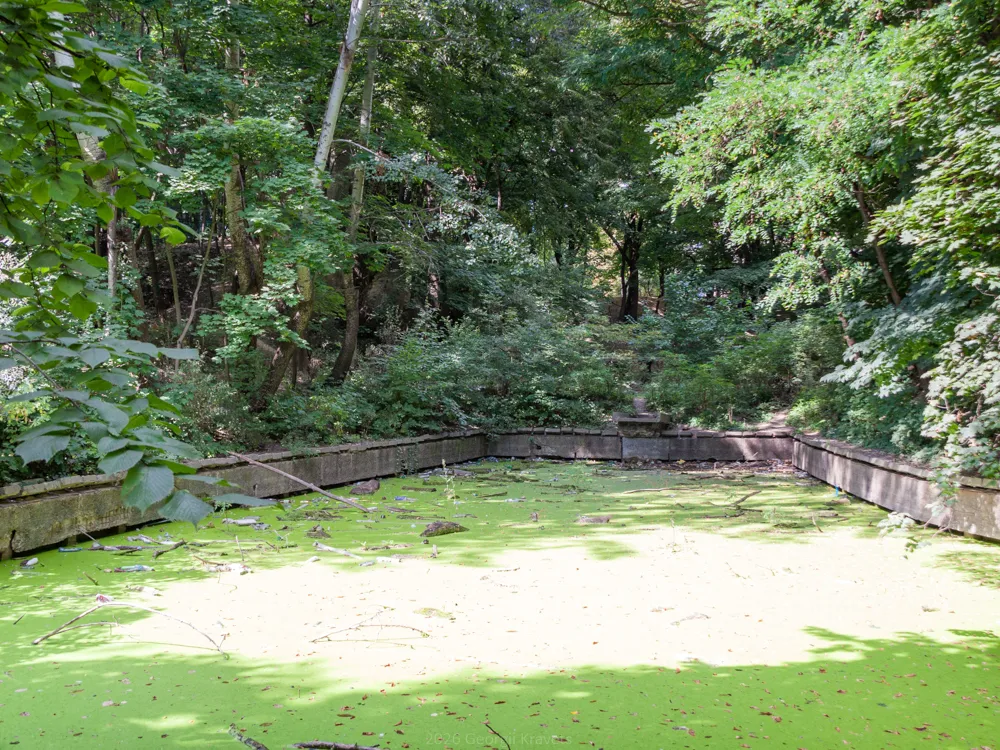
Source of the Hlybochytsia River at the beginning of the Kmytiv Ravine, territory of “Khrushchov’s Dacha”, 2011
The thick layers of loess and moraine deposits of the local hills have preserved many surprises from our most ancient ancestors. Such as the ornamented mammoth tusks from the twenty-five-thousand-year-old Kyrylivska site, or fragments of Trypillian jugs from the neighbouring Zahorivshchyna tract. Or similar artefacts from the Smorodyna Cave – the oldest artificial cave in Kyiv. It is also said that the Zmey Gorynych dragon once lived in it, and that the hero Kyrylo Kozhumiaka fought him there in the days of Prince Volodymyr the Fair Sun.
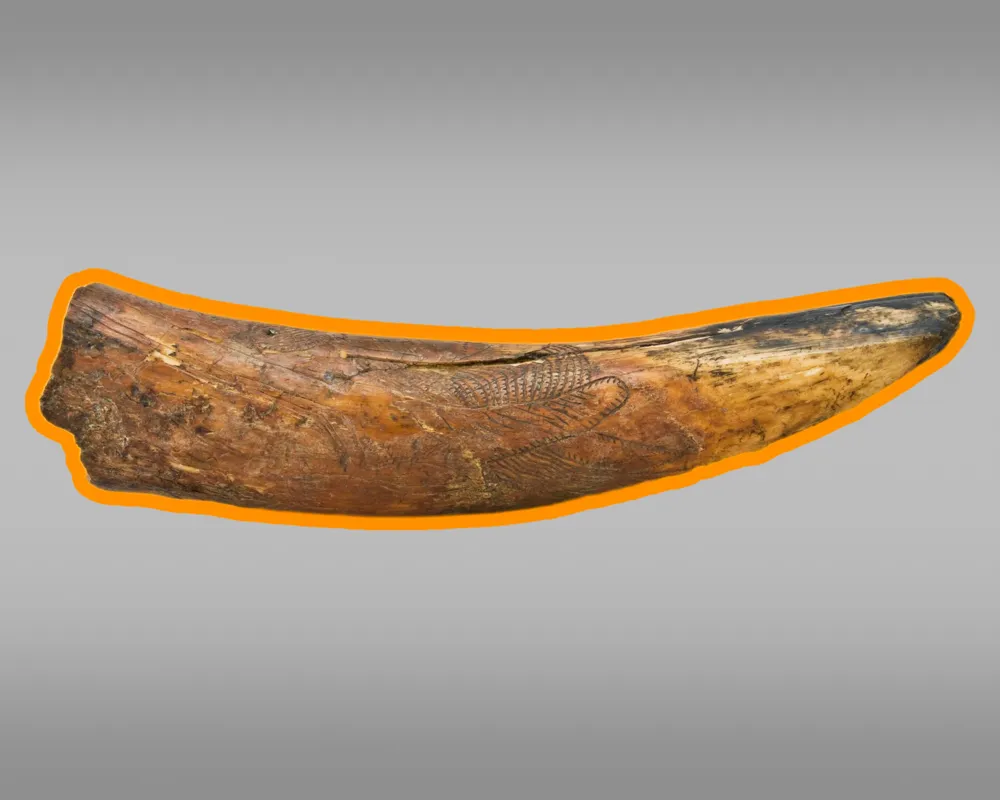
Fragment of a mammoth tusk with zoomorphic images, 19,000 years ago, Kyrylivska Paleolithic site, photo by the National Museum of the History of Ukraine
In addition to all this, some researchers interpret the remains of a fortified Old Rus settlement found near the Yurkovytsia slopes as the city-forming centre. From it, allegedly, the real Kyiv began – perhaps when the brother Shchek was building his estate here. But not even the six-hundred-year-old Lukianivka elder, the Cunning Oak – the oldest tree in the area, which still towers at the edge of a courtyard in Delehatskyi Lane – was a witness to that.
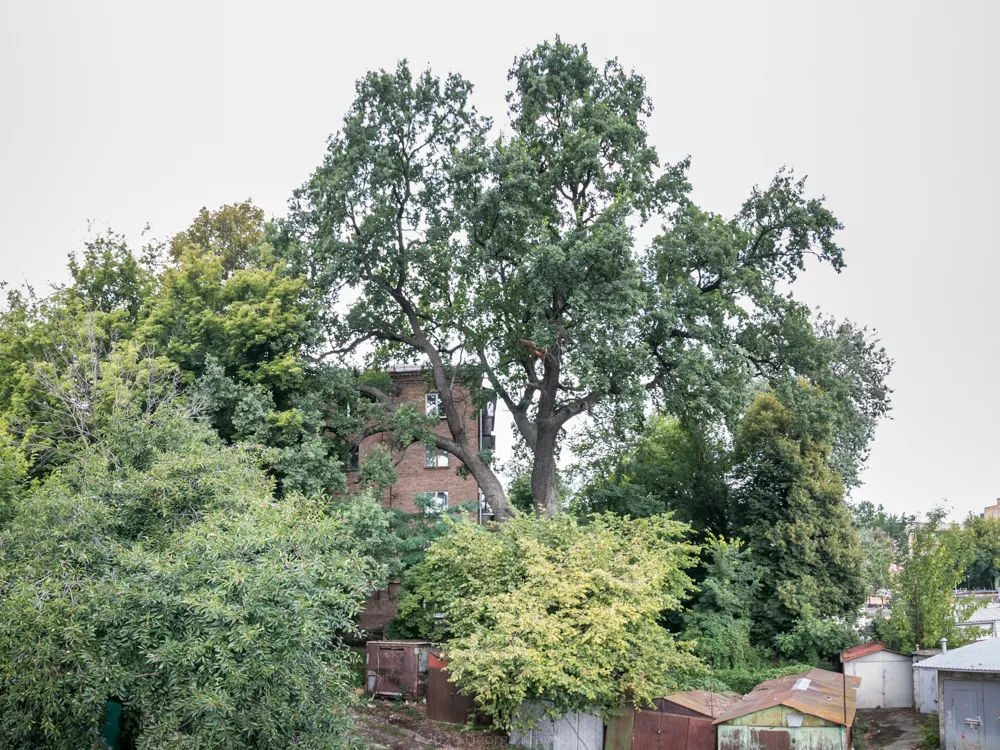
The Cunning Oak, courtyard of the building at 3/5 Delehatskyi Lane
In fact, it is on the 1837 map, precisely where this lane and Zahorivska Street parallel to it are, that Lukianivka first appears clearly marked – as a sloboda. Was it named so back in ancient times? Or after the goldsmith Strelbytskyi, who owned a farmstead here at the turn of the 18th and 19th centuries? Or later still, in honour of the local landowner, the Podil guild master Lukian Aleksandrovych? It is not known for certain.
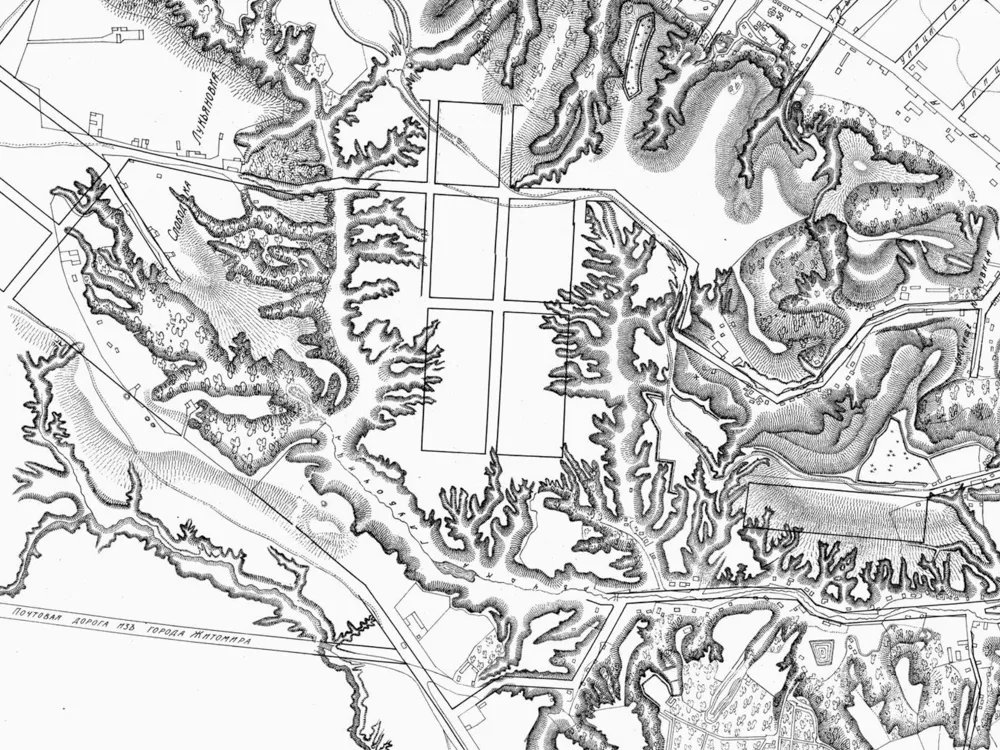
Fragment of the plan of the city of Kyiv, 1837, museum.kpi.ua/map
What is certain is that there was a mass resettlement to the heights from Podil of refugees whose homes had been ruthlessly destroyed by the devastating flood of 1845. They settled in the neighbourhood chaotically and without permits, and apparently in such large numbers that within six years Kyiv had to take their settlement within its boundaries.
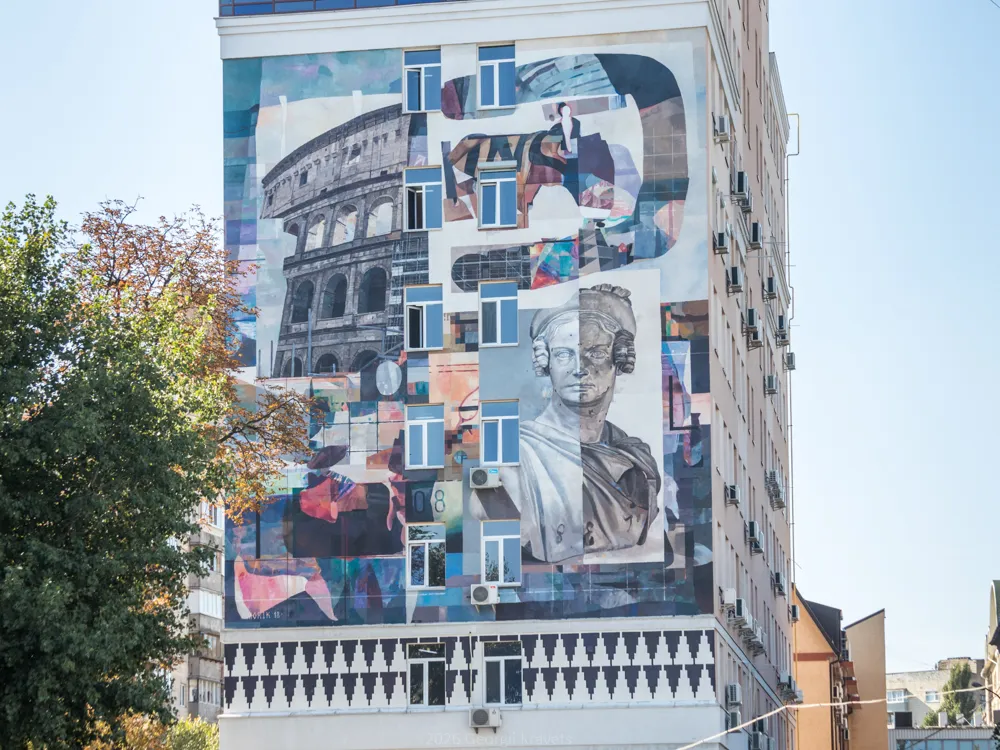
Mural on the end wall of an office building located on the site of the Lukianivka sloboda, 23 Zahorivska Street
To better understand the place where the centre of Lukianivka finally ended up – the square with the market that exists to this day – we must make an additional excursion into the Middle Ages.
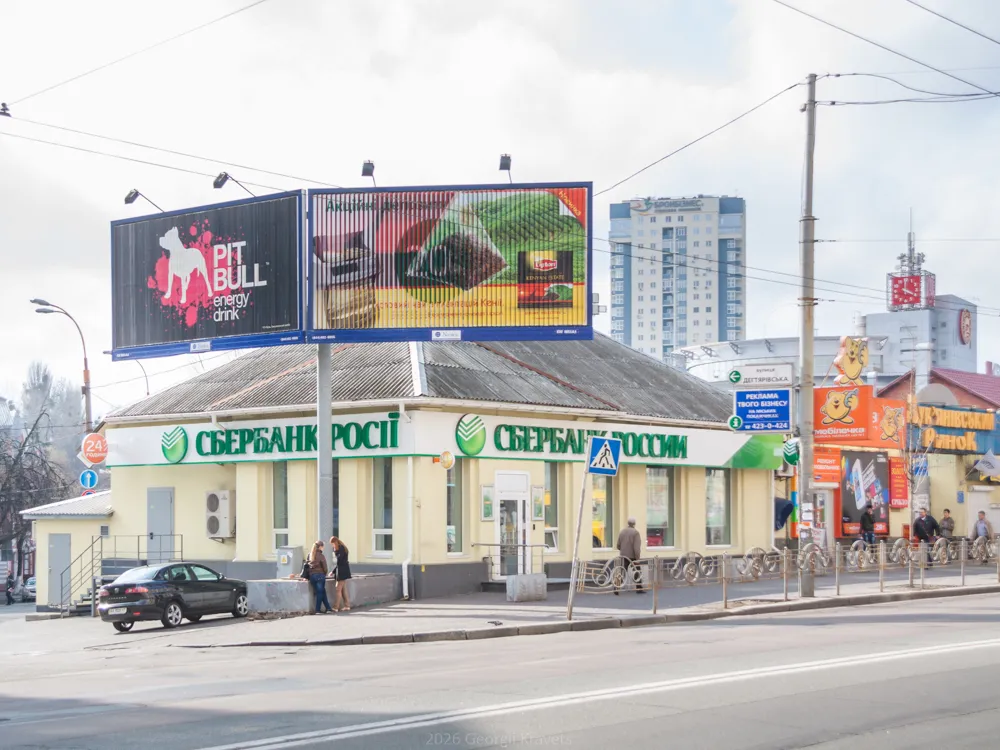
Lukianivka Market, 2012
Via Regia! The King’s Highway – a road under the special protection of European monarchs. Four and a half thousand kilometres of overland connection between the western and eastern parts of the continent. A route along which pilgrims, artists, students, missionaries and, above all, merchants travelled for centuries. A route that stretched from Spain to Poland and Ukraine. A route on which, it is believed, Princess Anna rode out from the Jewish Gate of Yaroslav’s City almost a thousand years ago, to reach Reims and become Queen of France. And so this road, for travellers heading towards Radomyshl, Zhytomyr and Lviv, began for centuries from our city directly at today’s Lukianivska Square.
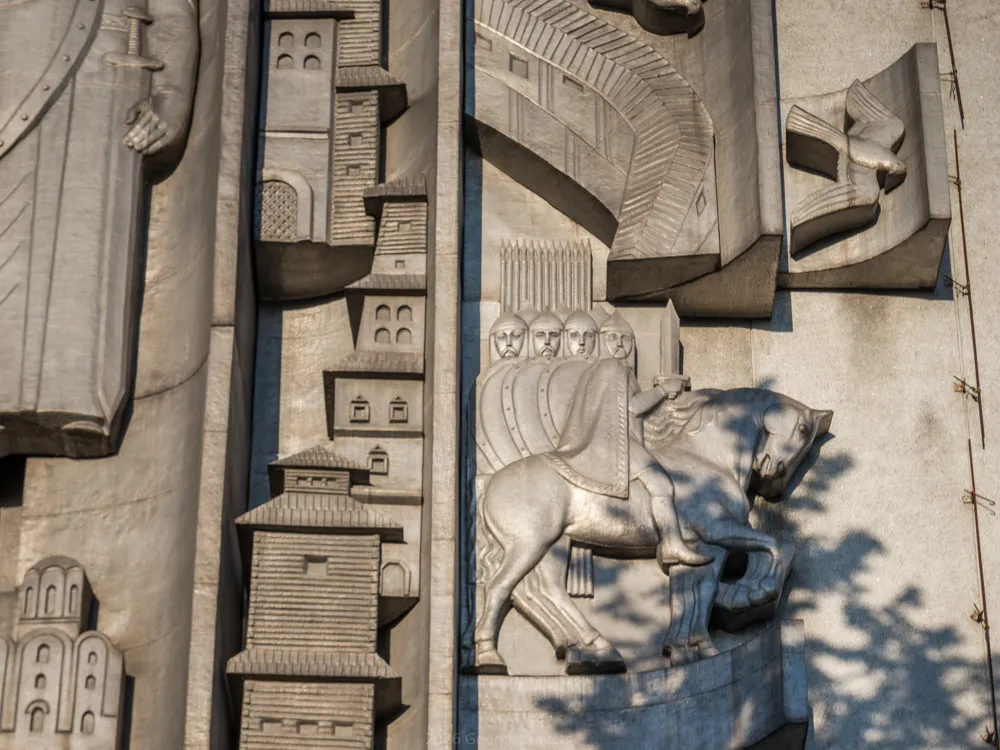
Knights on the road, fragment of a panel on the façade of the Kyivska Rus cinema
However, the Russian Empire chose to mark the starting point of the Via Regia in Kyiv in its own peculiar way. Under Tsar the Liberator Alexander II it built its bulky prison fortress here. Now hidden from view by later buildings, it still hangs over the space with a deliberate shadow. Both purely geographically, setting a gloomy mood for the area, and far more palpably over history. For is there another such location in the country that has layered the fates of the national elite so densely? Sometimes tempering its representatives. But usually erasing them completely.
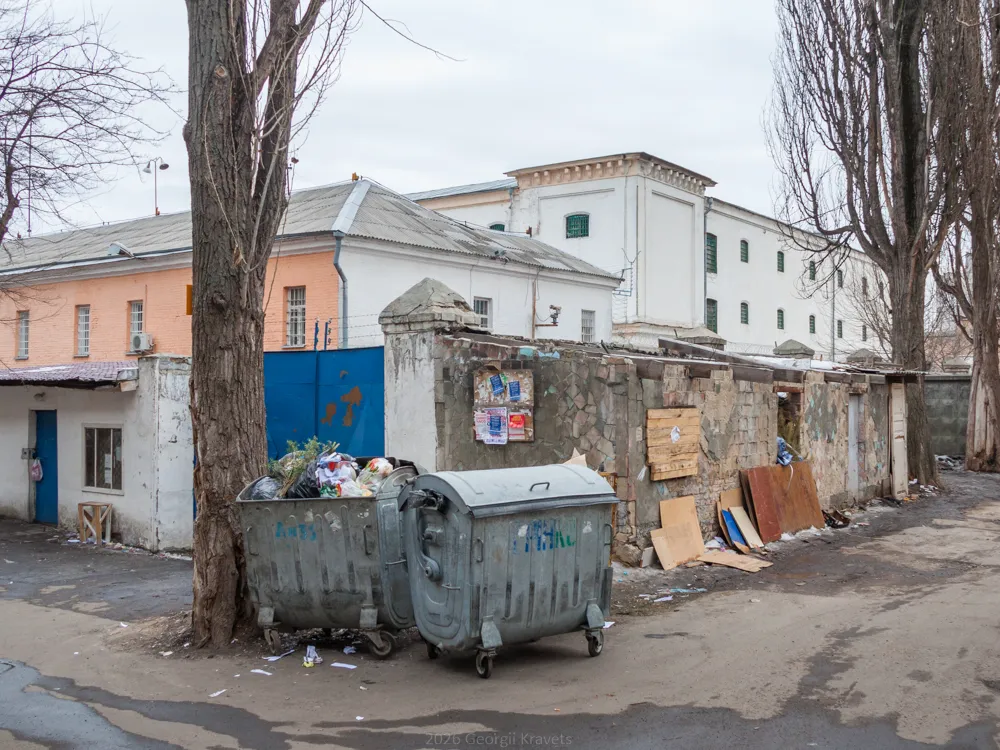
Lukianivka Prison Fortress, 2012
Lukianivka Prison, in the revolutionary days of the early 20th century, was surely passed through by Dmytro Dontsov, Symon Petliura and Hryhorii Kosynka. Probably also by Volodymyr Vynnychenko and Mykhailo Hrushevskyi. Folklore sings of the bold uprising of the Kholodnyi Yar fighters raised here in February 1923. Then came the black 1930s, to which we shall return. And in July 1941 the father of Stepan Bandera, a former chaplain of the Galician Army, Father Andrii, was brought here to be shot.
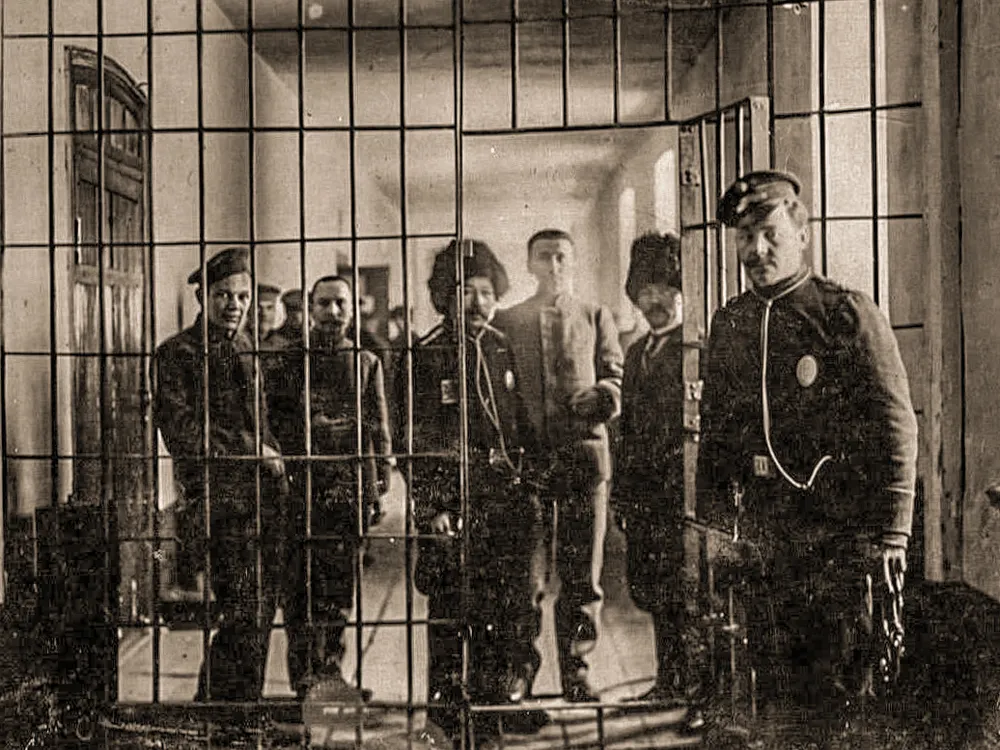
Guards and staff in the corridor of the Lukianivka Prison office, photo from the early 20th century
Later, Ukrainian dissidents and artists of the Sixtiers generation were held in the cells here: Viacheslav Chornovil, Serhii Paradzhanov, Stepan Khmara, Ivan Dziuba, Levko Lukianenko, Vasyl Stus and so on and so forth. Already in independent Ukraine (however contradictory one’s attitude towards contemporary politicians may be), Andrii Shkil, Yulia Tymoshenko and Yurii Lutsenko ended up with Grandfather Luka.
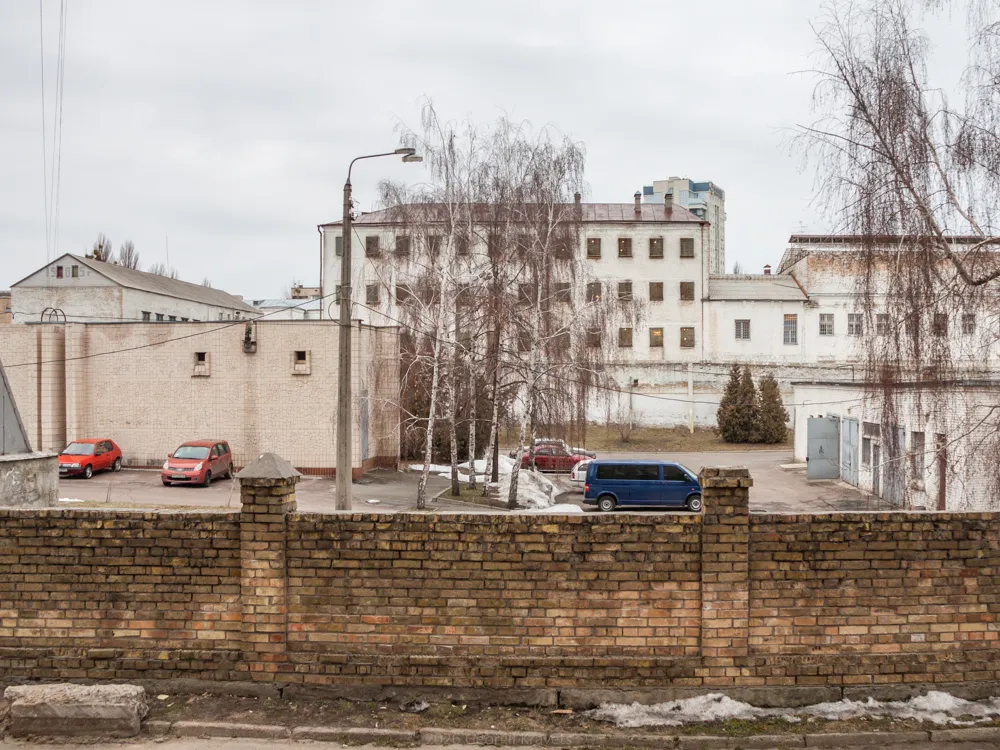
Lukianivka Prison, the “Brezhnevka” block, 2011
We shall build a bridge to the next defining, and no less sorrowful, location in Lukianivka through the biography of yet another heroic prisoner of these sinister casemates. Tracked down and seized in Vienna by Soviet spies after the Second World War, a former colonel of the Legion of Ukrainian Sich Riflemen and of the UNR army, diplomat, politician and poet, the Austrian archduke Wilhelm Franz Joseph Karl von Habsburg-Lothringen, was brought here in November 1947. Also known to us as Vasyl Vyshyvanyi. Exhausted by brutal interrogations, he died in the Kyiv prison soon afterwards. And, like many other prisoners who perished there, he was buried without any marking of the grave somewhere near the fence of the nearby cemetery.
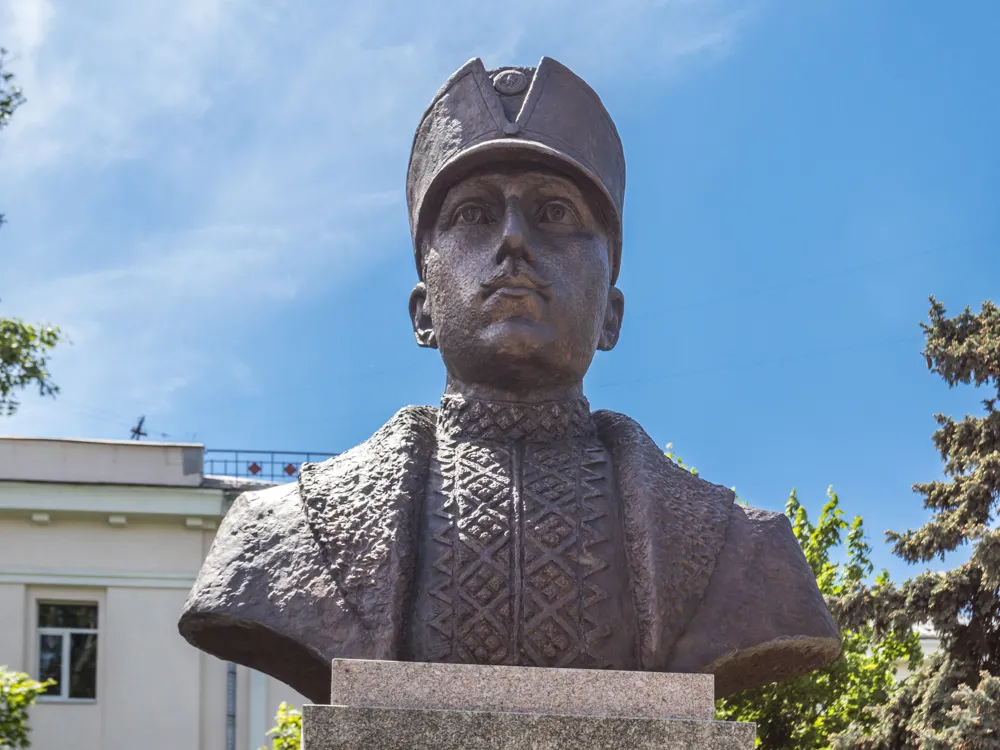
Monument to Vasyl Vyshyvanyi, square near Secondary School No. 61, 39 Yuriia Illienka Street
This is the Lukianivka Cemetery. An old one. For some time the main cemetery of the city. Famous not only for its presumed burials but also for entirely well-known ones. Considering that during the Soviet decades the remains from numerous necropolises destroyed by the Communists were transferred to it, the list of distinguished people who rest here now is impressive.
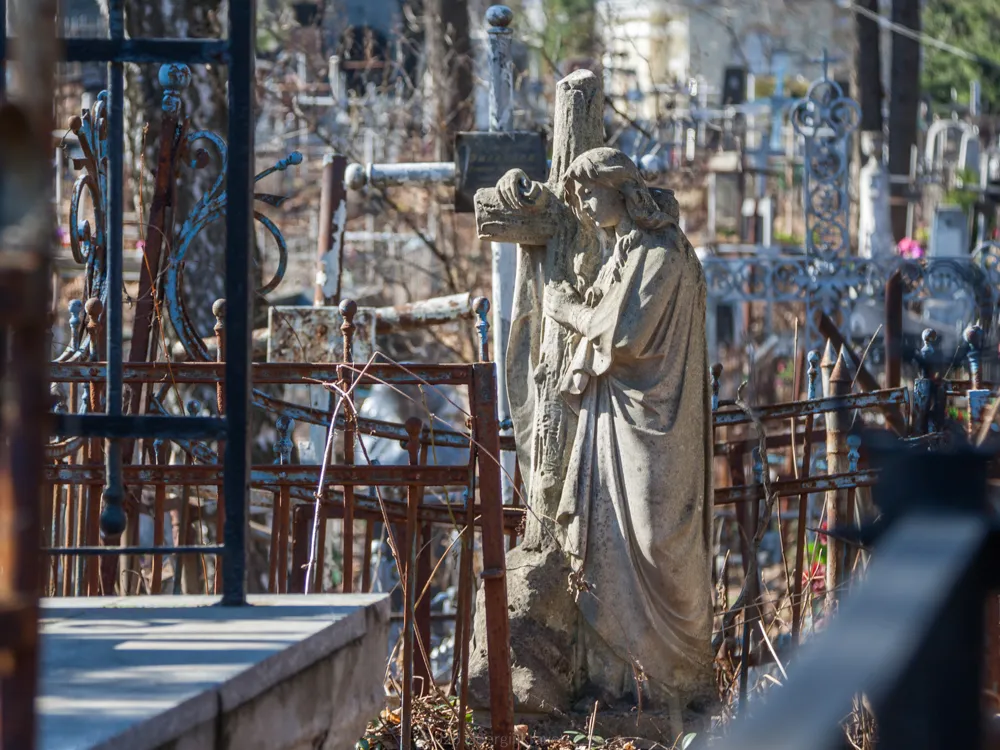
Lukianivka Cemetery, 2012
Among others, these are the celebrated Kyiv architects Volodymyr Bezsmertnyi, Friedrich Krauss, Oleksandr Kobeliev and Pavlo Aloshyn. And the landmark Ukrainian painters Mykola and Oleksandr Murashko, Fedir Krychevskyi, Mykola Pymonenko, Oleksandr Bohomazov and Viktor Palmov. The writers Oleksandr Oles and Hryhorii Kosynka. The composer Volodymyr Pukhalskyi. The art historian Ipolyt Morhilevskyi. The botanist Mykola Kashchenko. The physicians Vasyl Obraztsov and Feofil Ianovskyi. The historian Mykola Vasylenko. The aviator Petro Nesterov. The remains of the Heroes of Kruty, taken from Askold’s Grave. And very, very many other outstanding figures in the history of Ukrainian science and culture. It is no wonder that the Lukianivka Cemetery is now a state memorial reserve.
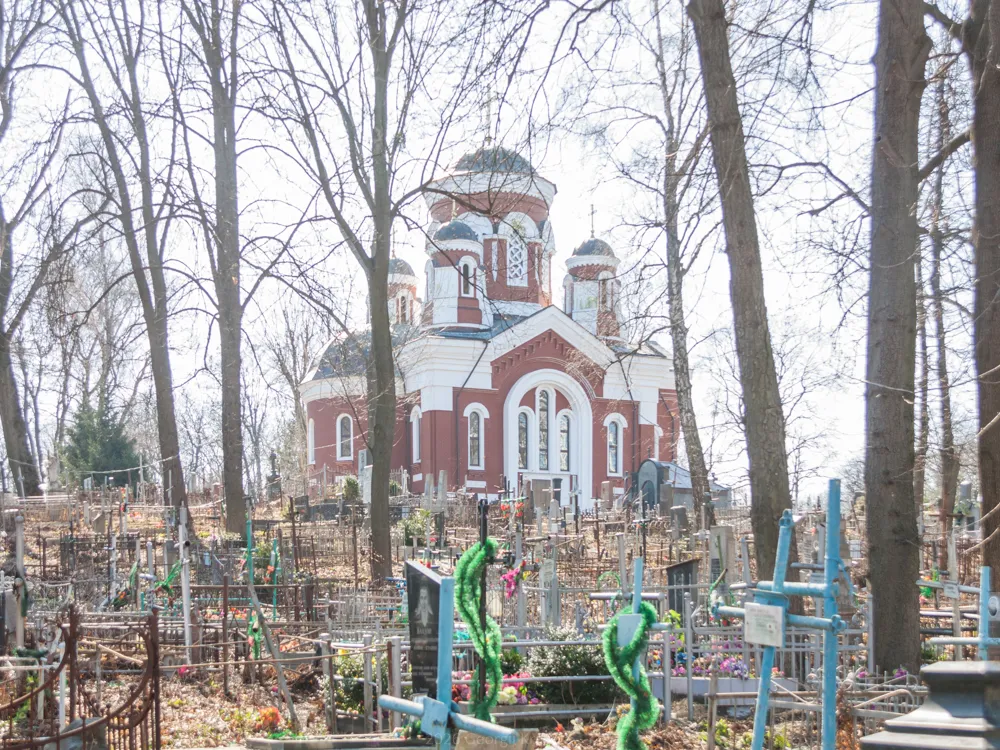
St. Catherine’s Church at the Lukianivka Cemetery, 2012
The cemetery, logically, was originally located at the very edge of the city. To the west of it, in the historic area of Syrets, from the second half of the 19th century the summer training camps of the Kyiv Military District were set up…
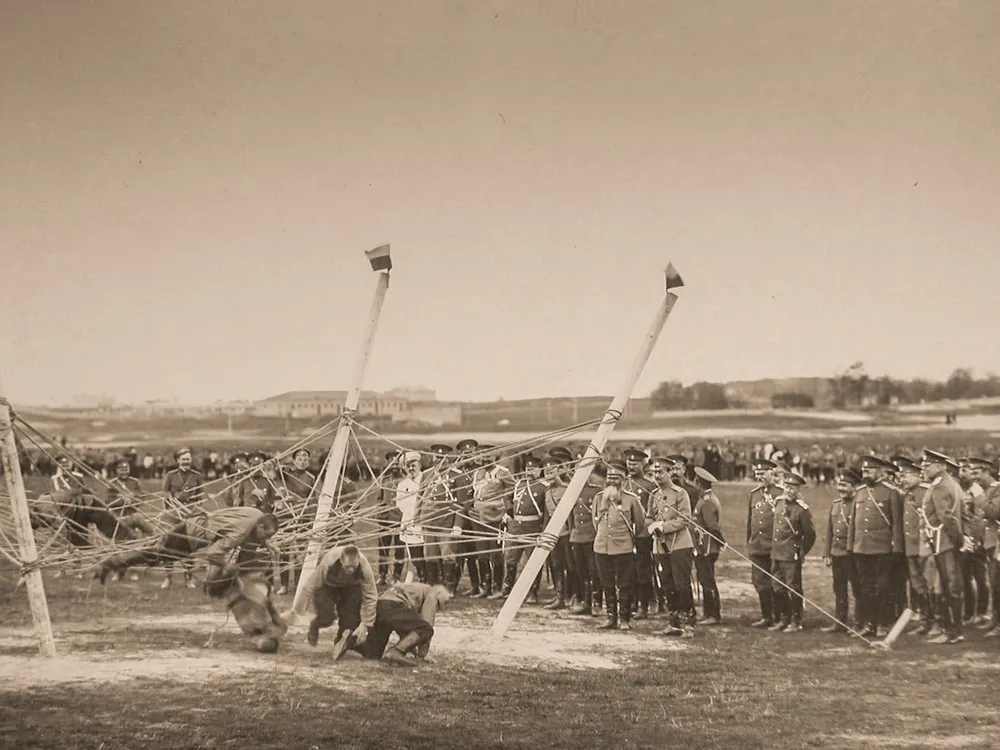
Syrets military training camp, soldiers performing exercises, photo from 1912
And here it is necessary to stop and make an important point. Throughout its entire existence the empire, both the tsarist one and later the Soviet one, concentrated on militarization. Practically everyone and practically everything worked for war. And Lukianivka, as a territory, was destined to become one of the main centres for the constant satisfaction of this bloodthirsty imperial need. Here for a hundred years in a row the empire forged its power and might. From here it planned the directions of attack. Thanks to Lukianivka, among other things, it gained the ability to reach the most distant corners of the globe. And, obviously, it has not forgotten this to this day.
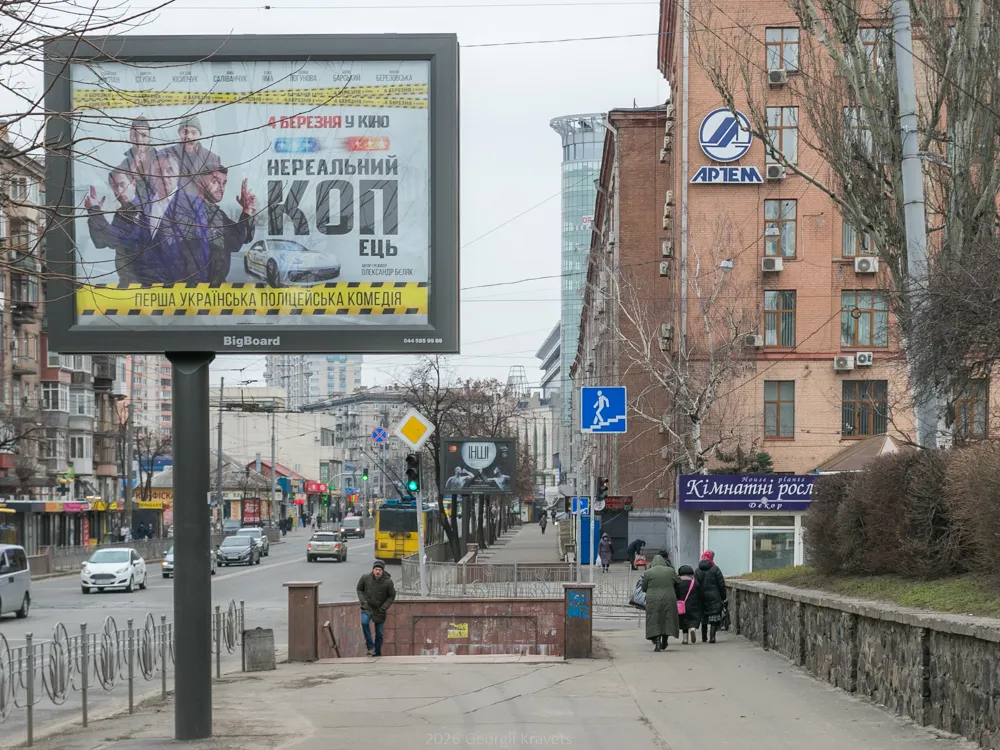
Buildings of the Artem plant, Yuriia Illienka Street, 2021
Artem – the former machine-building plant of Adam Kolb-Seletskyi. Artem, to which the Bolsheviks gave the name of the founder of the Donetsk–Kryvyi Rih Republic, Fedir Serhieiev. A plant that has fulfilled military orders since the beginning of the First World War. Which, after returning from evacuation in 1943, focused on the production of aviation equipment. Constantly increasing its capacity. For whose needs Lukianivka lost most of its cosy old buildings and exchanged them for blocks of Khrushchev-era and panel apartment buildings. Artem, whose fame is guided air-to-air missiles. And also guided anti-tank ones. And, in recent years, the resounding names Adros, Hiatsynt, Vilkha, Oskol, Neptun…
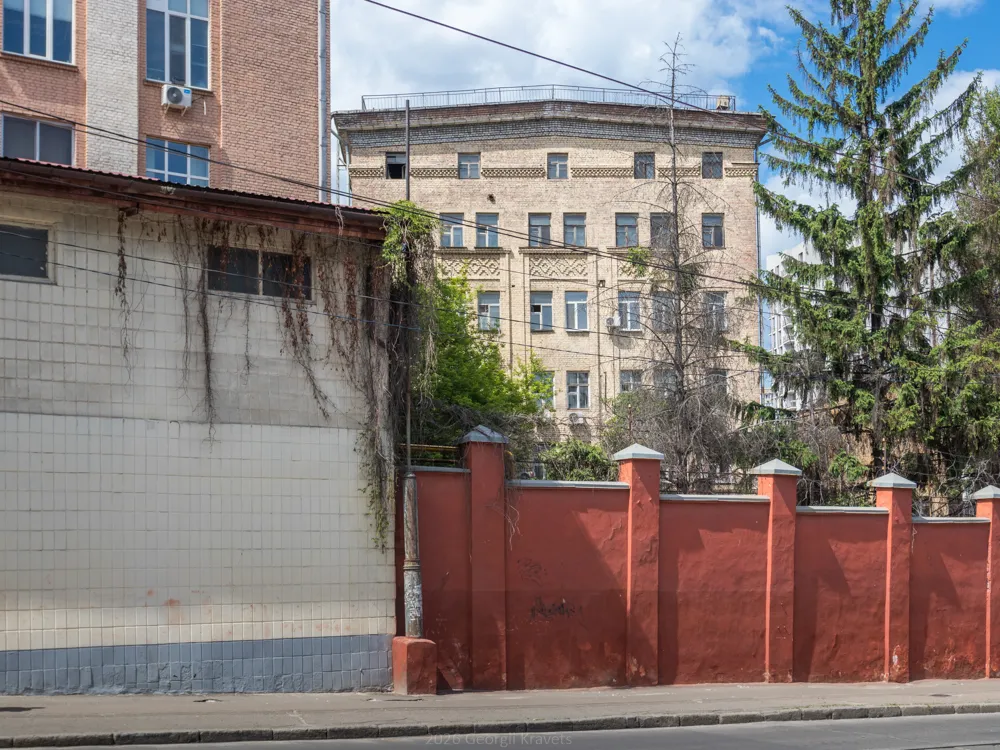
Buildings of the Artem plant, 2018
Artem has been one of the biggest factors in the development of Lukianivka for many decades. And, evidently, the most weighty factor in its misfortune after 24 February 2022. But not the only one. It is an open secret, but until recently the blocks of the district housed (and perhaps still do) institutions such as Ukroboronprom, Ukrspecexport or Ukroboronlizynh. And also Tekhvoienservis. And the headquarters of the Ground Forces Command and the logistics forces of the Armed Forces of Ukraine. And Budshliakhmash – a plant known some fifteen years ago as a supplier of components to the armed forces of Iraq. All this is easy to find out once you type a query into Google.
Whether, with such a diverse and open range of military-oriented establishments, Lukianivka has any chance of development before the end of the current war is a rhetorical question.
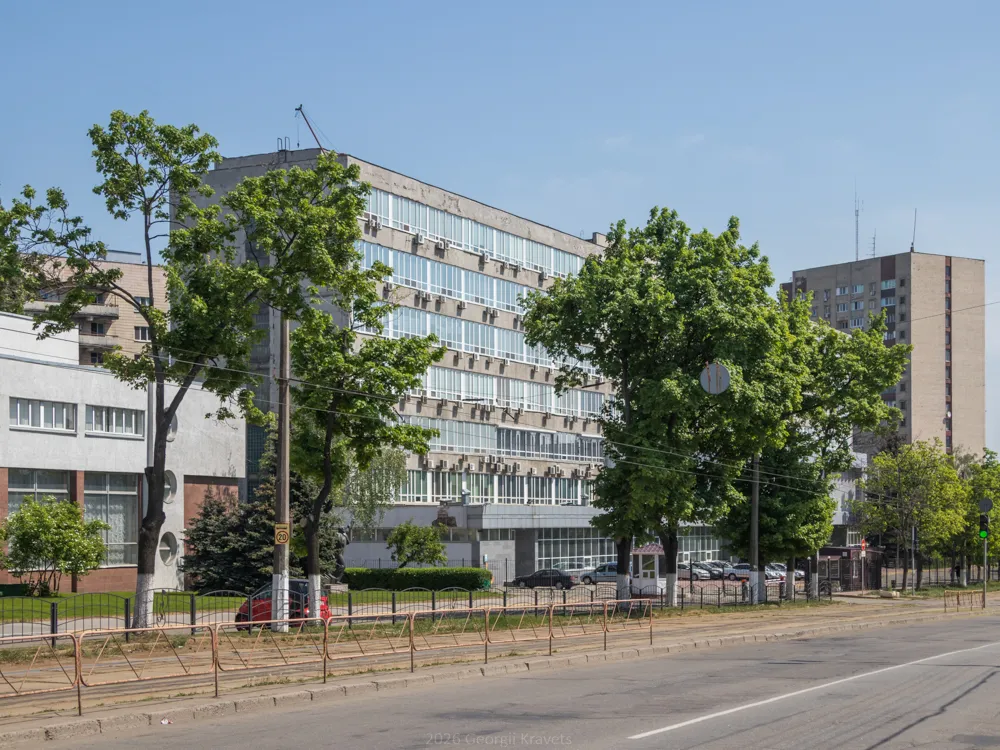
Administrative building, Dehtiarivska Street, 2018
Yet this loop of history seems to have been thrown over this place from the days of its earliest settlement. Remember the Lukianivka sloboda? Do you know who its first known settlers were? Well, for example, present-day Zahorivska Street – the main thoroughfare here – was originally part of the Yurkivskyi Route from Podil. In 1885 the city respectfully gave it the name of the most famous local resident of the time. Who exactly? A participant in the Crimean War and the suppression of the Polish Uprising, General of the Cavalry Oleksandr Baggovut.
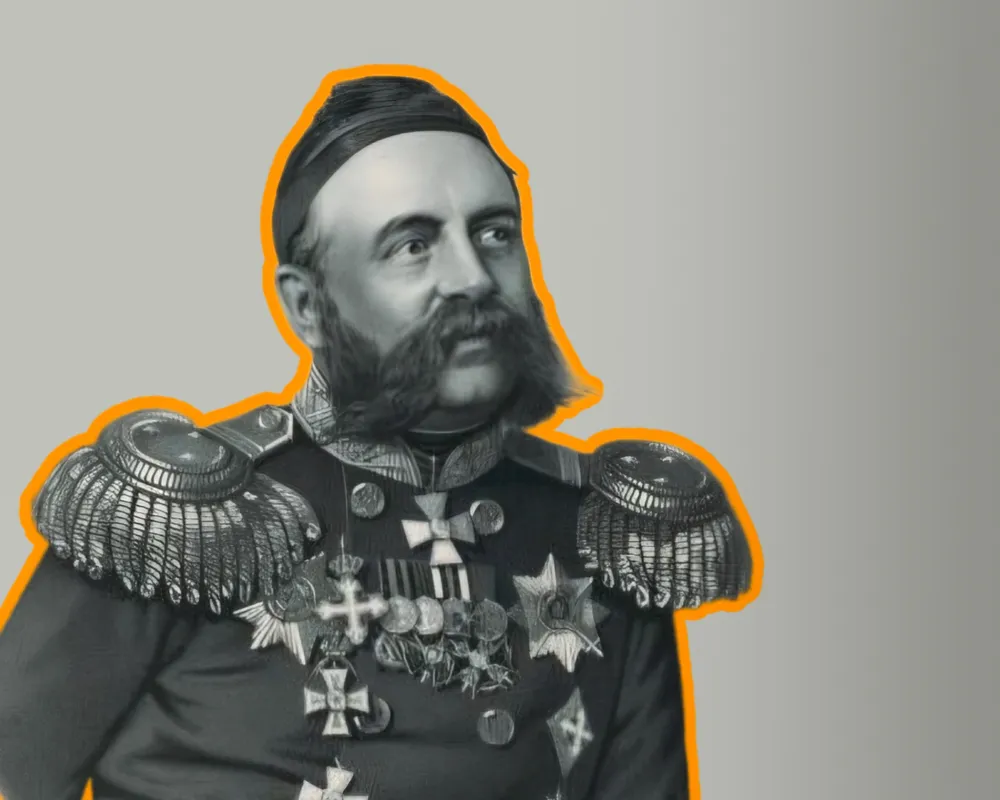
Oleksandr Baggovut, portraits of persons distinguished by merit who commanded active units in the war of 1853–1856
Later, Lieutenant Colonels Pylyp Bakkalynskyi and O. L. Kozarovskyi, Colonel Volodymyr Benson and Major General Pyshenkov set up their estates nearby. We know their names because these owners’ houses have survived. True, they were usually already retired by rank.
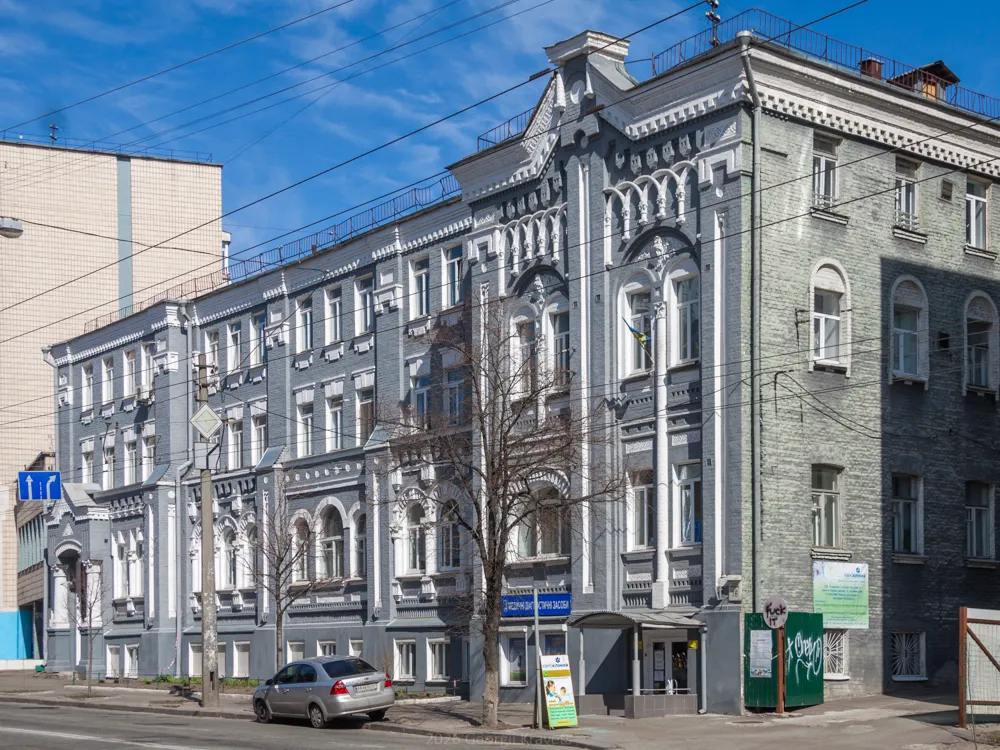
Former income house of Major General Pyshenkov, now Children’s Hospital No. 8, 18 Yuriia Illienka Street
For the active army, from the first decades of the 20th century Lukianivka was a real military town. The barracks of the foot artillery batteries on today’s Rostyslavska Street. The barracks of the Tiraspol Regiment on Illienka. The barracks of the Bessarabian Regiment on Kazarmenna Street, named after those very barracks. And the Lutsk Barracks on Dehtiarivska. Left, left, left! Barracks, barracks, barracks!
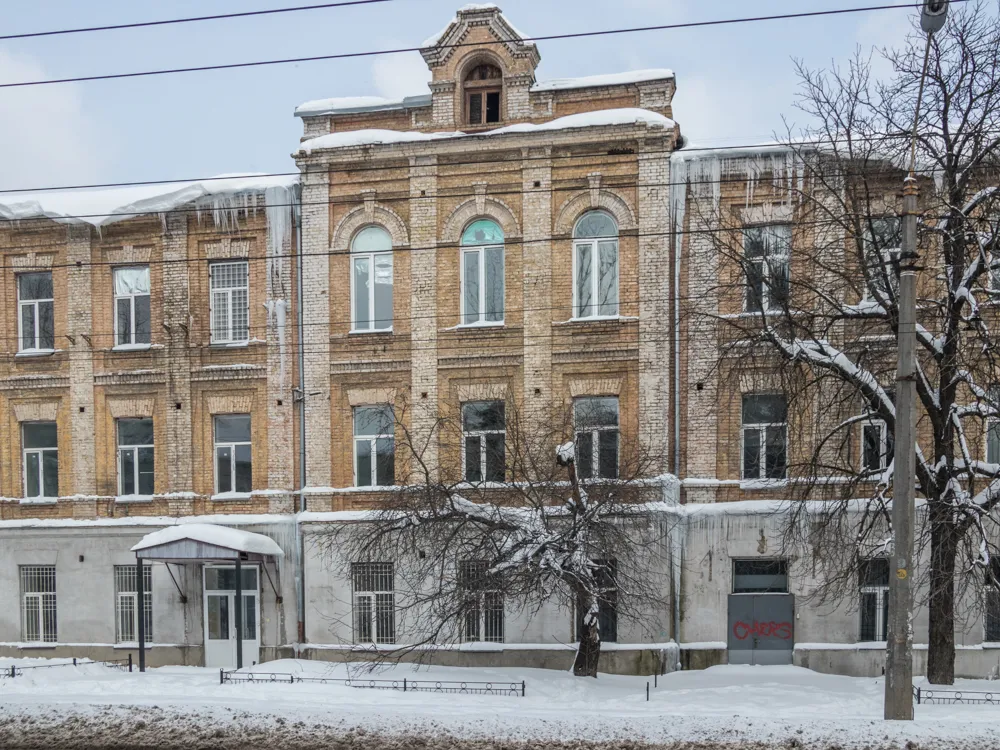
Former headquarters of the city barracks complex, 24 Yuriia Illienka Street, 2016
In the interwar period special housing for the military was built here. The residence of the commander of the Kyiv Military District was located in an old mansion on today’s Illienka Street – where the Embassy of Kazakhstan is now.
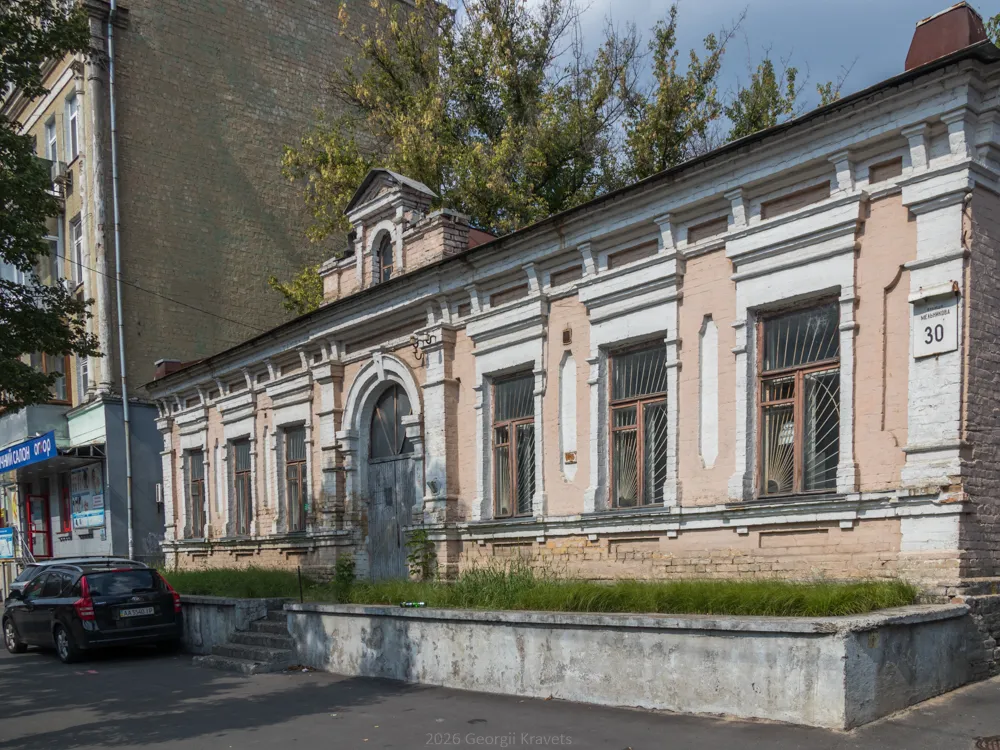
Former mansion of Lieutenant Colonel Pylyp Bakkalynskyi, 30 Yuriia Illienka Street
Next to it, at the end of the 1930s, a building crowned with a proud tower was built for the personnel of the Pinsk Military Flotilla. Incidentally, in September 1941 its ships moored on the Dnipro in Kyiv were blown up by their own crews because of the hasty flight of the Red Army. In short, those river sailors lived in their new apartments for no more than a year.
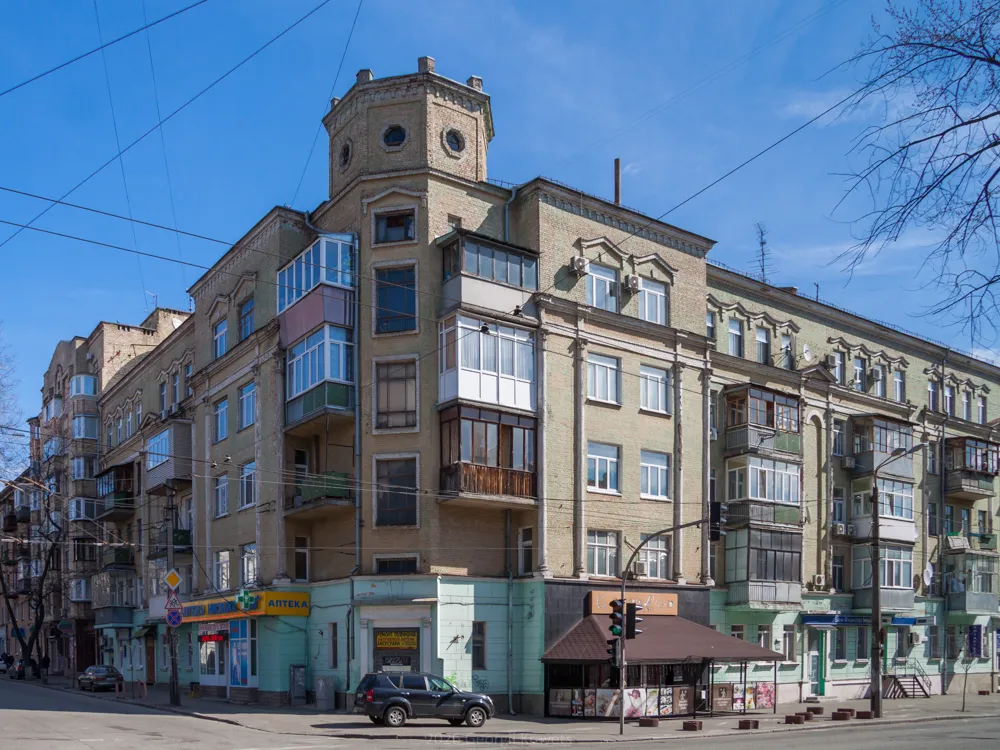
Former residential building of the personnel of the Pinsk Military Flotilla, 32/2 Yuriia Illienka Street
The actual functioning of Lukianivka as a military town also explains another of its characteristic features – the concentration of orphanages here. For example, the former Alexander and Alexei orphanages stand right next to each other, near the corner of Derevlianska and Illienka streets. Kyiv historians usually praise their architecture. They mention the nobility of the cause of opening such institutions. But they often forget to specify that both appeared with a single purpose – to put somewhere the orphaned children of soldiers of the tsarist army. Because the empire fought without a pause. And, accordingly, constantly left the city countless fatherless children behind.
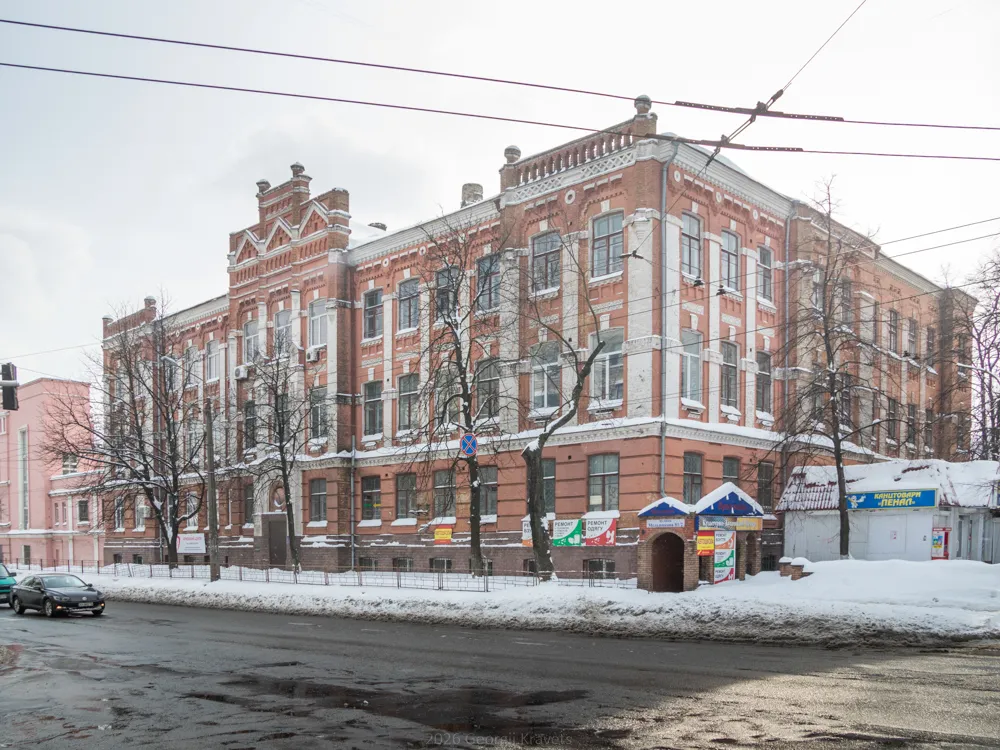
Former Alexei Orphanage building, architect Hieronim Kitner, 81/2 Yuriia Illienka Street
In this context, a somewhat separate phenomenon, and unique in essence, is the almshouse complex that was built in the first decade and a half of the last century in the block next to the prison, on what was then the Old Zhytomyr Road. Buildings for lonely elderly men and women, two more children’s shelters, a hospital, a kitchen, a laundry, a bathhouse and a chapel – such was the weighty part of the charitable legacy of the childless couple Mykhailo and Yelyzaveta Degterev. After the Bolsheviks seized Kyiv, an entire children’s town, “Leninsk”, was housed in the premises. For one and a half thousand pupils!
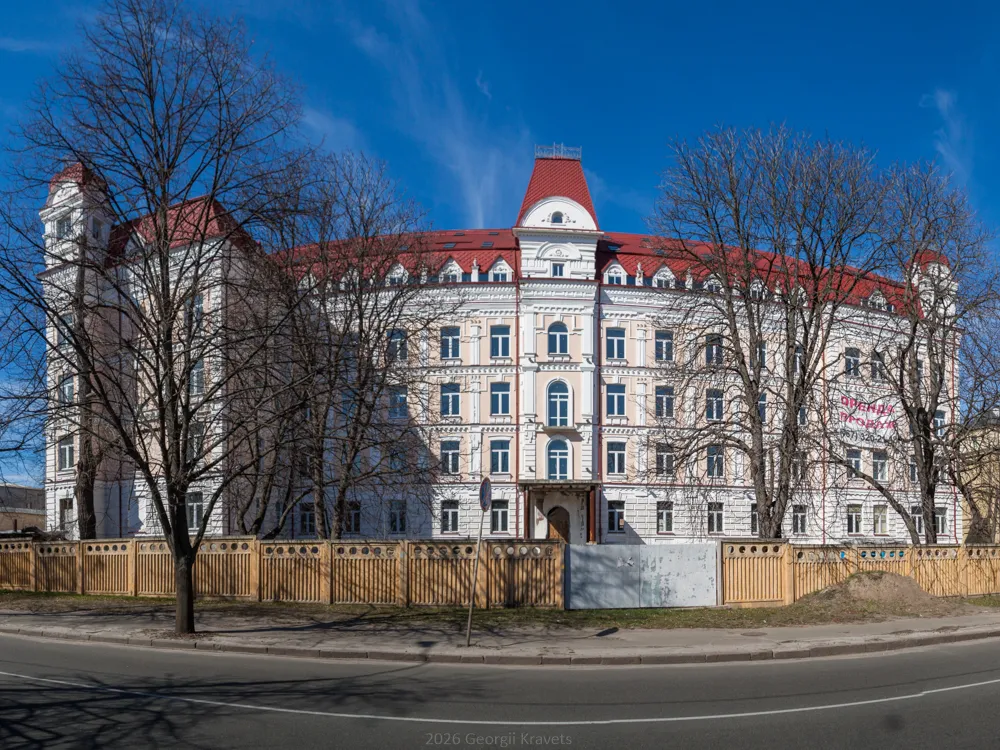
Former Yelyzaveta Degterev Orphanage, 7/9 Mytrofana Dovnar-Zapolskoho Street
Ukrainian culture remembers the Degterev Almshouse as the last address of one of the most outstanding Ukrainian prose writers. On 2 April 1918, here, in the hospital for lonely people, the writer Ivan Nechui-Levytskyi, half-forgotten by the public, died.
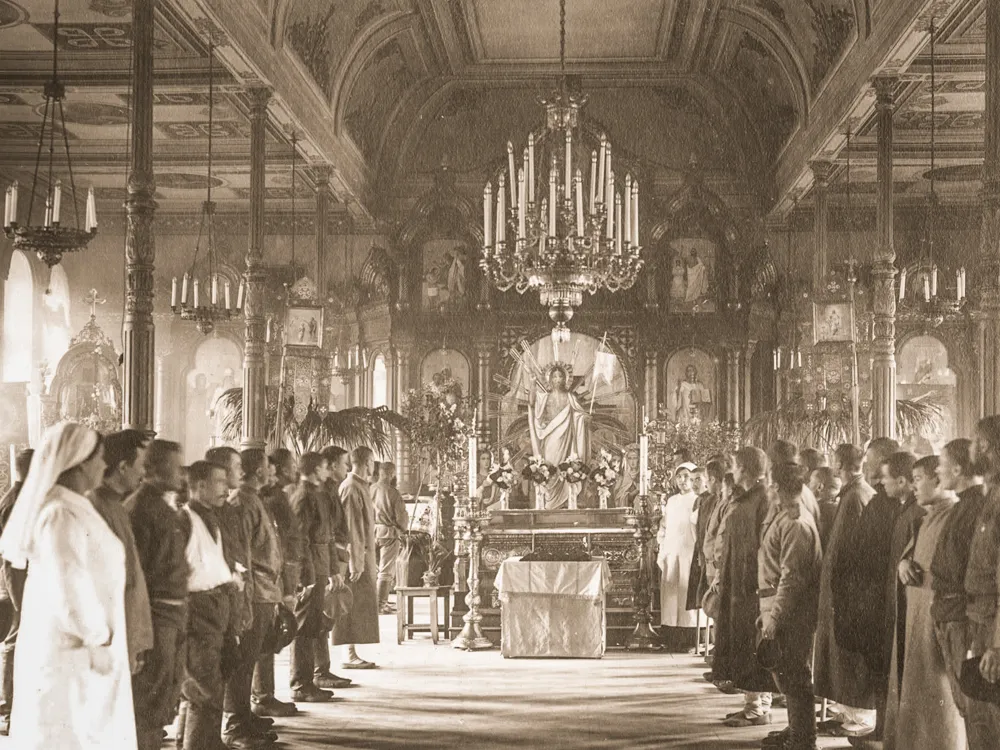
Church of St. Michael in the central building of the Degterev Almshouse, photo from the mid-1910s
Tellingly, Kyiv still has no monument to the author of “The Kaidash Family” and of the comedy “At the Kozhumiaky” (the prototype of the most Kyivan, probably, of plays, “Chasing Two Hares”). However, since 1975 it is precisely in Lukianivka that a monument to the brilliant native of Poltava, the poet Ivan Kotliarevskyi, has stood.
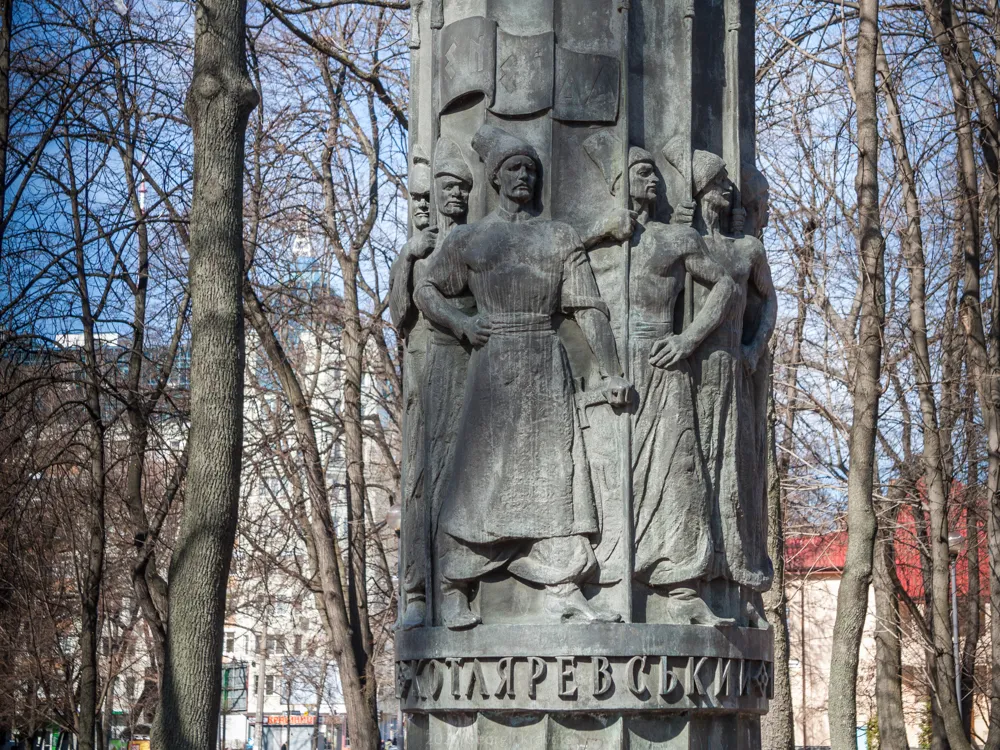
Monument to Ivan Kotliarevskyi, Kotliarevskyi Park
His bust rises on a pillar in the middle of the park. On the site where until the 1920s there stood the so-called Osiivska Chapel. In fact, it was dedicated to the rescue of Emperor Alexander III in the railway accident of 1888. And with its whole gingerbread-and-onion-domed design it affirmed in the area the slogan so beloved of the tsars: “Orthodoxy, autocracy, nationality”!
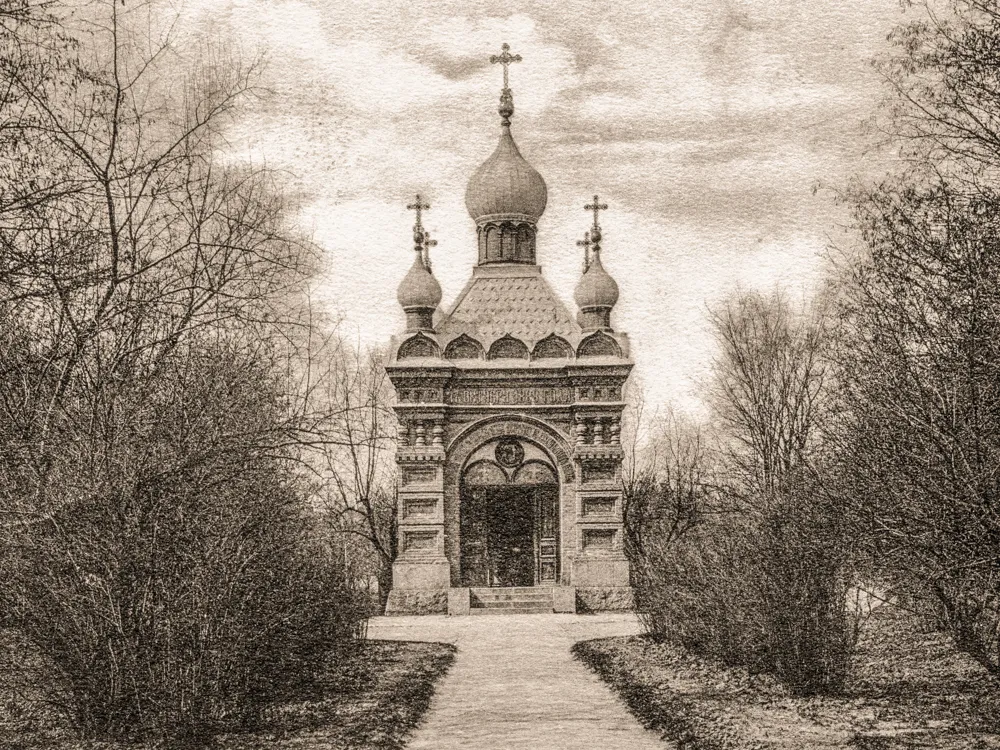
“Osiivska Chapel”, church in honour of the rescue of Alexander III – Kotliarevskyi Park – V. Nikolaiev (Nizhyn Museum)
Of a similarly shabby diocesan sort was the main church of the neighbourhood, St. Theodore’s, built as early as 1874 through the efforts of General Baggovut. Perhaps nobody would remember it much if not for the religious and educational attraction arranged in its crypt at the close of the 19th century. Then an amateur archaeologist with the sonorous name Turvont Kybalchych conceived the idea of digging out under the church two caves – exact copies of the Clement Cave at Inkerman and the Kuvuklia of Jerusalem, that is, the Holy Sepulchre.
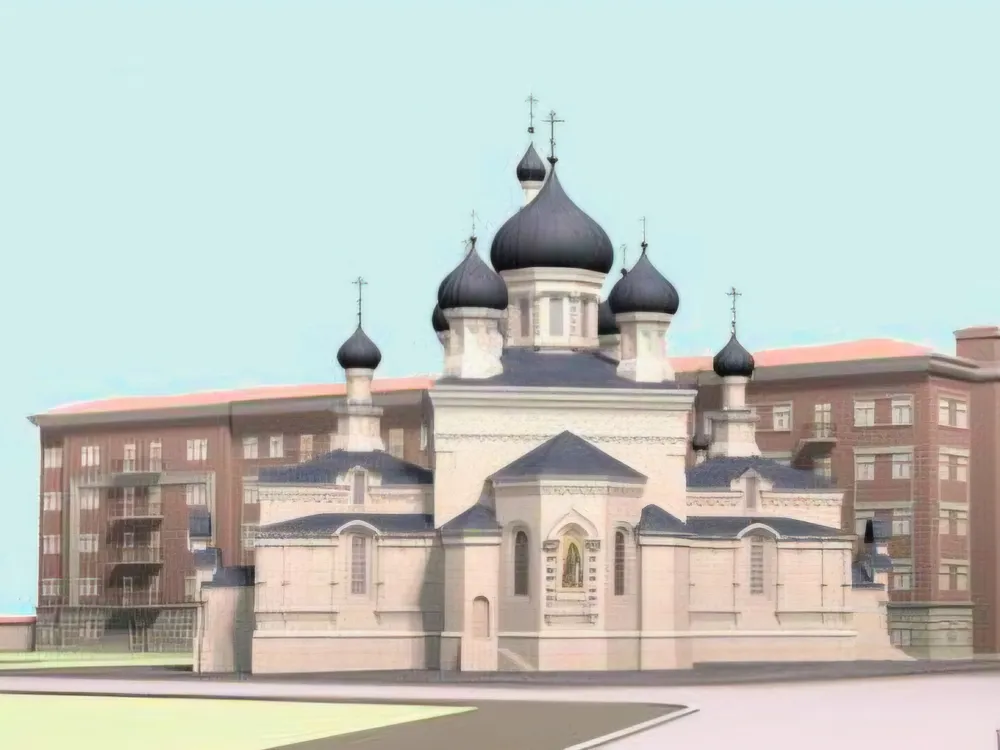
Project for the reconstruction of the Church of St. Theodore the Sanctified, 7A Ovruchska Street
And although the Communists destroyed the main sacred building long ago, in 2008 archaeologists discovered in its courtyard those underground replicas of ancient shrines. This greatly excited the local history community. So soon, without undue hesitation, Lukianivka was declared the Second Jerusalem in the press and in journalism!
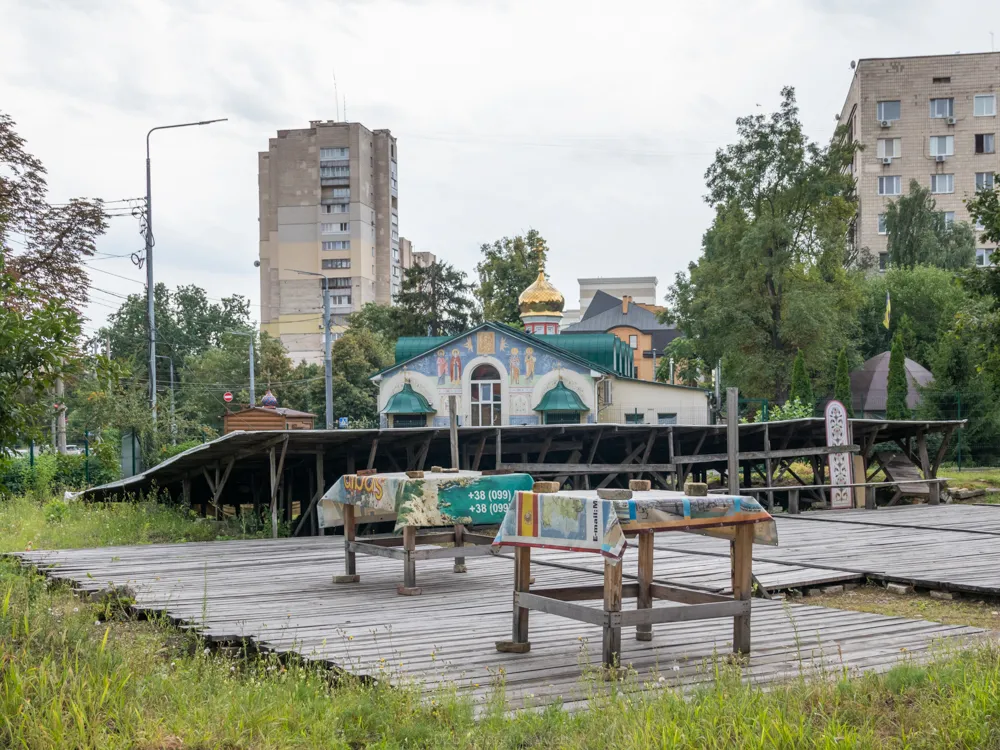
At the excavation site of St. Theodore’s Church, 7A Ovruchska Street, 2026
Such is the unexpected echo we have of the Belle Époque, so fond of all manner of showy gestures.
If we look more broadly, the widespread aristocratic charity already mentioned in connection with the Degterevs was also among the manifestations of the so-called beautiful epoch. And in Lukianivka there is plenty more confirmation of this.
The sugar magnate Mykola Tereshchenko sponsored the construction here, in Zahorivshchyna, of a school-shelter for deaf-mute boys. His business competitors, Izrail Brodskyi and his sons, had earlier allocated colossal sums for the construction nearby of the Jewish Hospital. Later, money for its new departments and barracks was provided by the Jewish entrepreneurs Markus Zaks, Samuil and Dora Frenkel and the Halperin family. For the construction of the Roman Catholic Hospital in the Kmytiv Ravine, the largest donation was made by Sofia Syrochynska, widow of the successful Polish forester Stanisław-Karl Syrochynskyi.
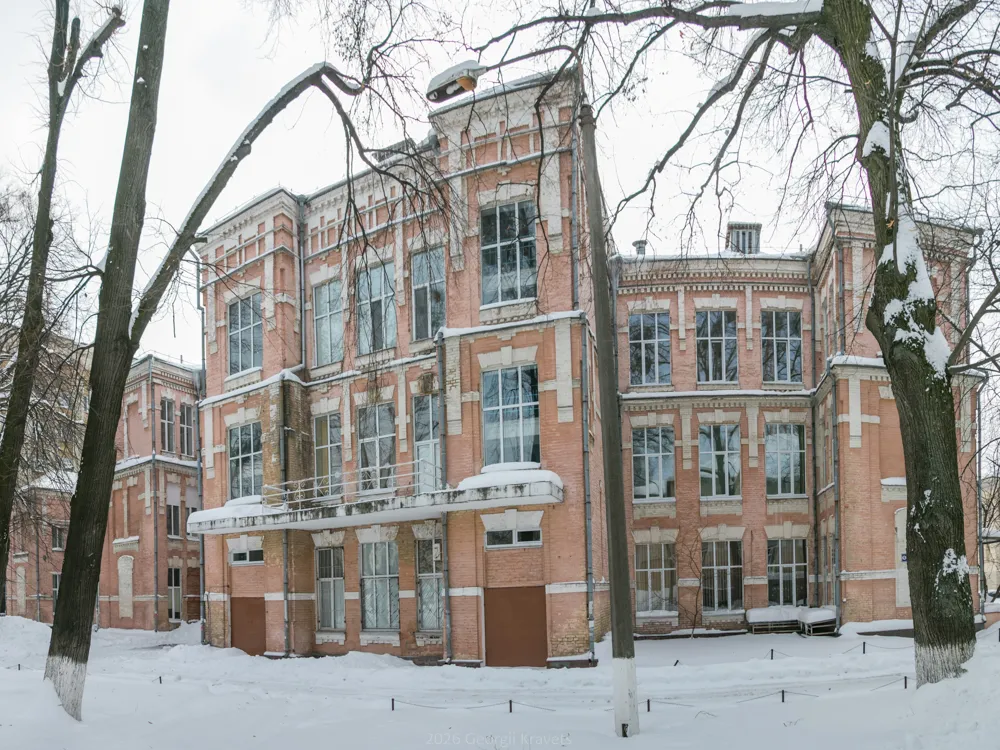
One of the buildings of the former Jewish Hospital, now Kyiv Regional Clinical Hospital No. 1, 1 Zahorivska Street
And although in Soviet times people preferred not to mention the achievements of the businessmen-patrons, their work was generally carried on. And in places even expanded. So to the extensive military infrastructure of the district (discussed earlier) a good deal of medical infrastructure was added. Now operating here are:
- Regional Clinical Hospital No. 1, which appropriated the property of the Jewish one
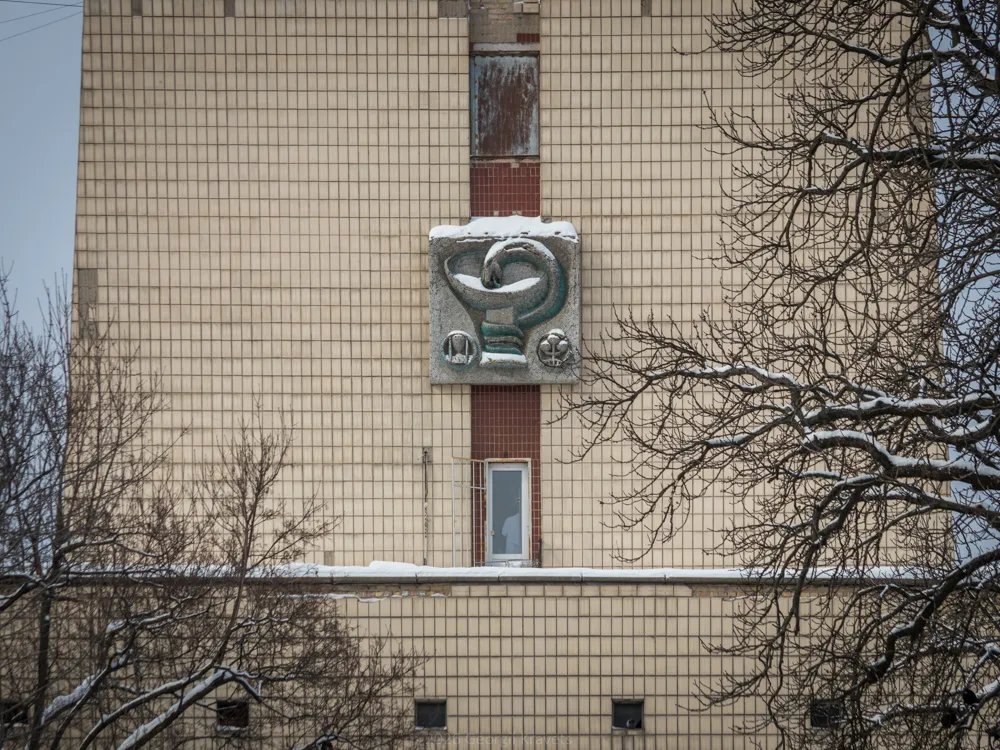
Bas-relief on the Soviet building of Kyiv Regional Clinical Hospital No. 1, 1 Zahorivska Street
- The Romodanov Institute of Neurosurgery – in the buildings of the former Syrochynskyi institutions.
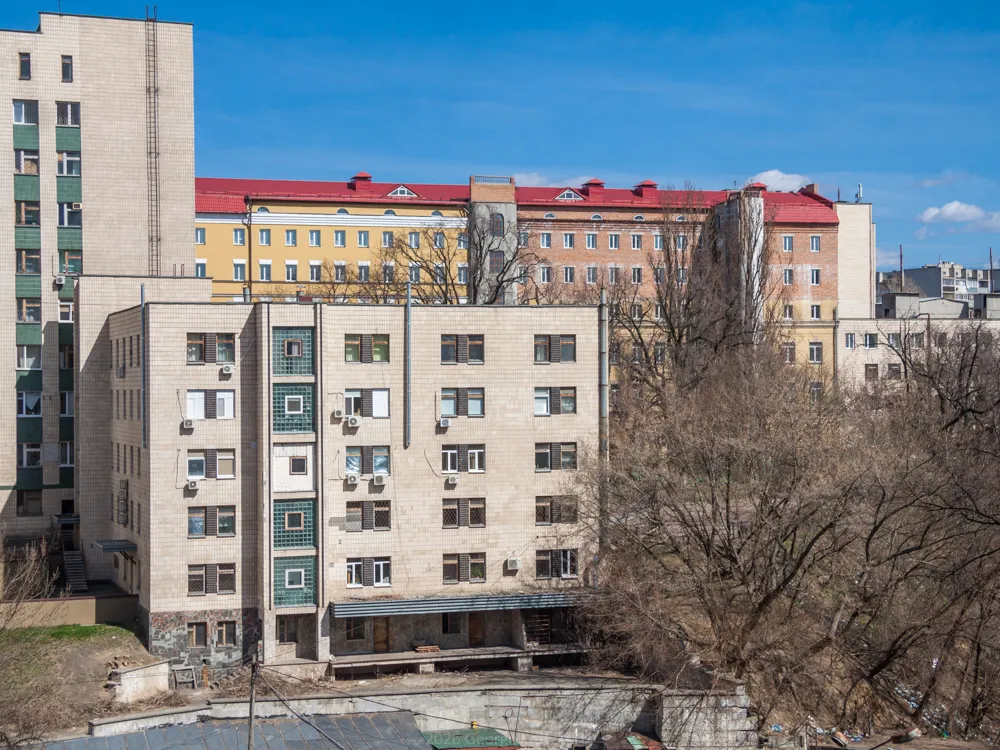
Former Roman Catholic Hospital in the Kmytiv Ravine, now the Institute of Neurosurgery, 32 Platona Maiborody Street
Nearby, in Brezhnev-era grey-beige boxes, are housed:
- The Research Institute of Pediatrics, Obstetrics and Gynecology;
- The City Medical Association of the Ministry of Internal Affairs.
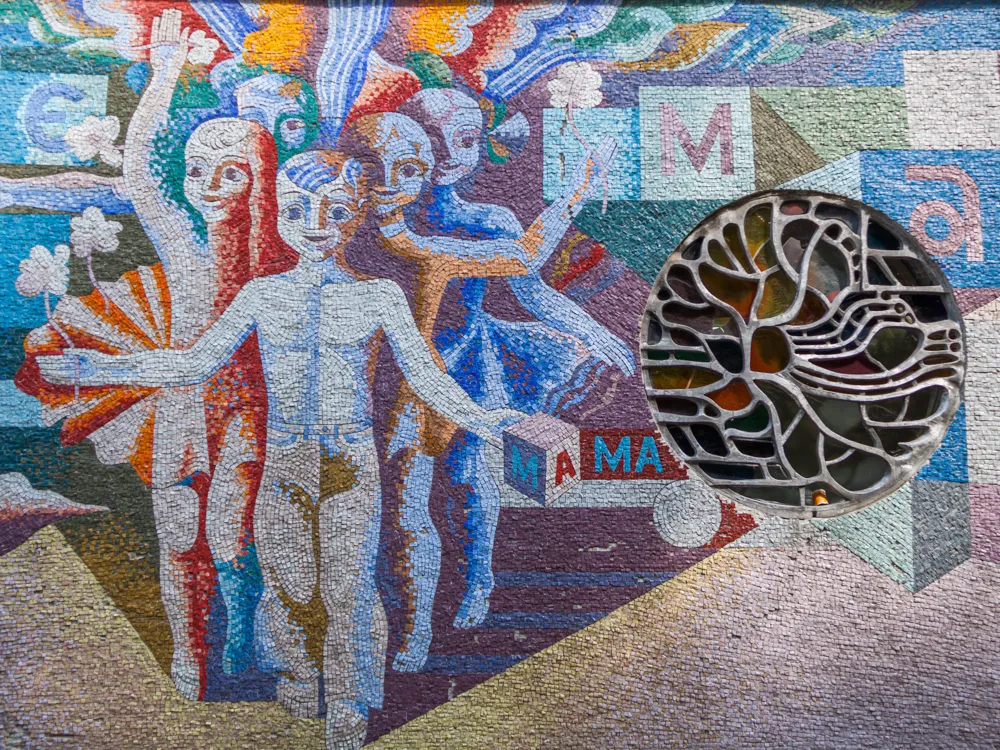
Mosaic on the façade of the building of the Research Institute of Pediatrics, Obstetrics and Gynecology, 8 Maiborody Street, 2011
In fact, the Main Clinical Medical Centre of the Ministry of Internal Affairs of Ukraine is also in Lukianivka. In the mid-1980s its hefty complex occupied a block of homesteads of the staff of the pre-trial detention centre, on Berdychivska Street, near the prison. For reference, also located in Lukianivka are:
- The Institute of Nephrology – at 17V Dehtiarivska Street,
- The Children’s Clinical Hospital for Infectious Diseases – at 23 Dehtiarivska Street,
- The National Research Centre for Radiation Medicine – at 42 Illienka Street,
- The Kyiv Medical Academy of Postgraduate Education – at 9 Dorohozhytska Street,
- The sanatorium boarding school for children with tuberculosis – at 20/2 Dorohozhytska Street
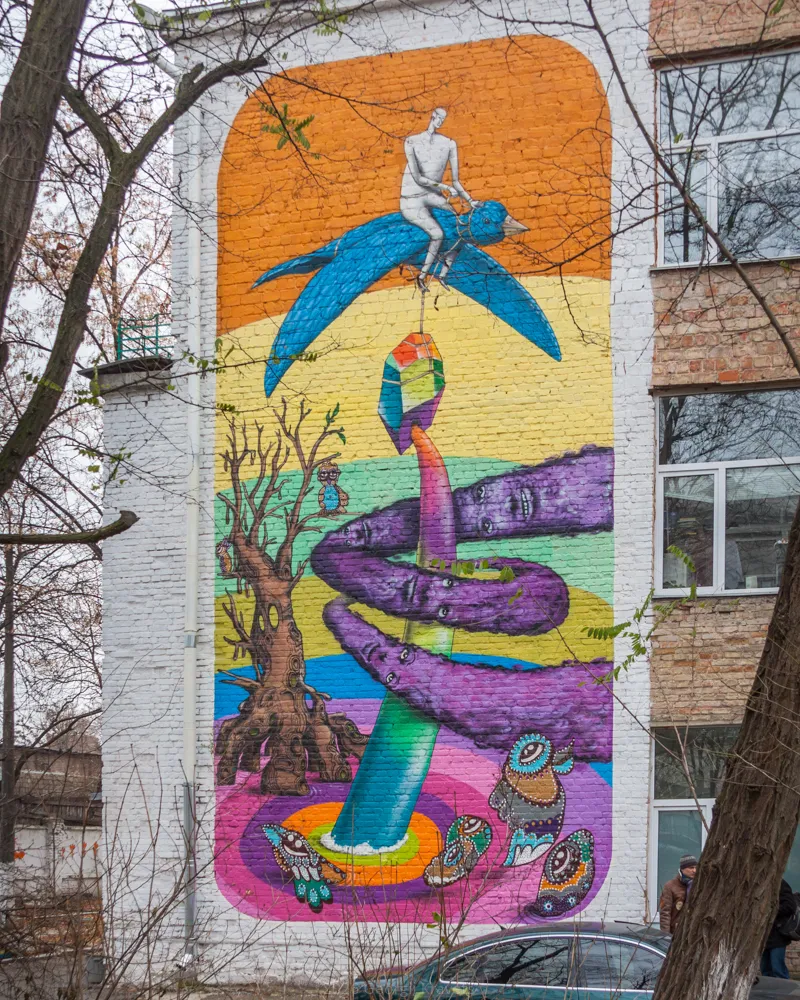
Mural on the building of the Children’s Clinical Hospital for Infectious Diseases, 23 Dehtiarivska Street
The number of these institutions is matched only by the length of the list of outstanding medical scientists whose work was connected with them. There are so many that, with specifics, they could fill a full-fledged reference book. So here is only a brief list: Petro Neishtube, Friedrich Mering, Georg Rein, Karl Tritschel, Feofil Ianovskyi, Mykola Strazhesko, Oleksandr Arutiunov and so on.
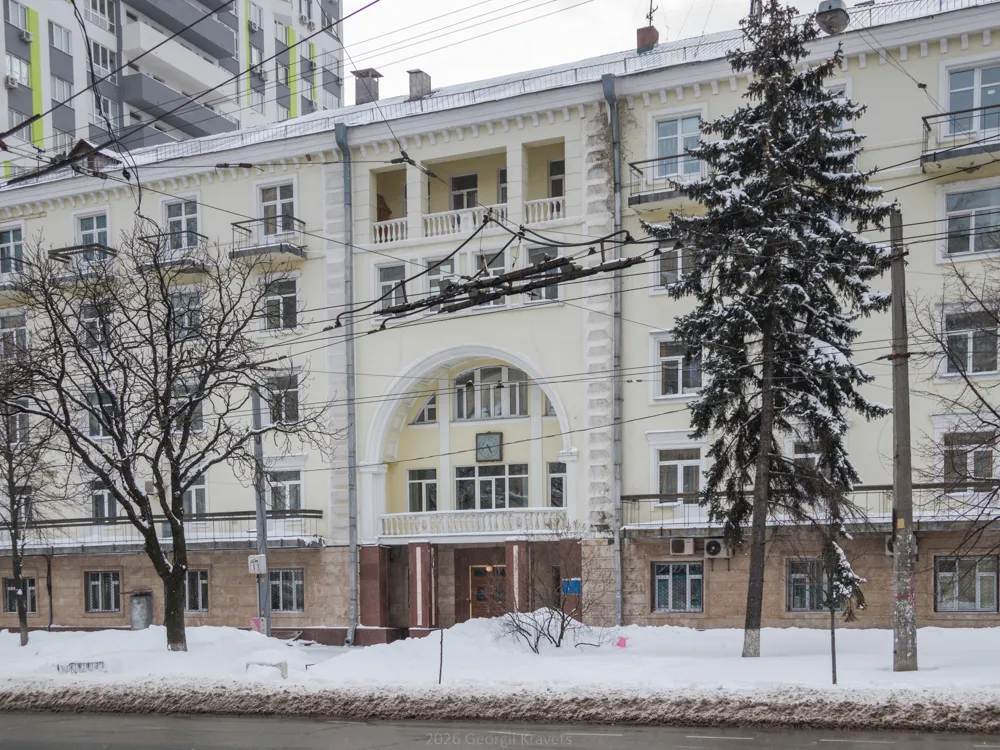
National Research Centre for Radiation Medicine, 42 Illienka Street
Somewhat curiously, the life path of perhaps the best-known physician-researcher who intersects with Lukianivka has nothing to do with the local medical institutions. Oleksandr Bohomolets – a celebrated innovator in endocrinology and gerontology, founder of Ukrainian pathophysiology, reformer of Soviet medical science and creator of a distinct scientific school – was born precisely in Lukianivka. Yet not in a maternity hospital or some manor, but in that same prison fortress. In 1881 his mother Sofia, née Prysetska, from a Lithuanian noble family, was being held right here.
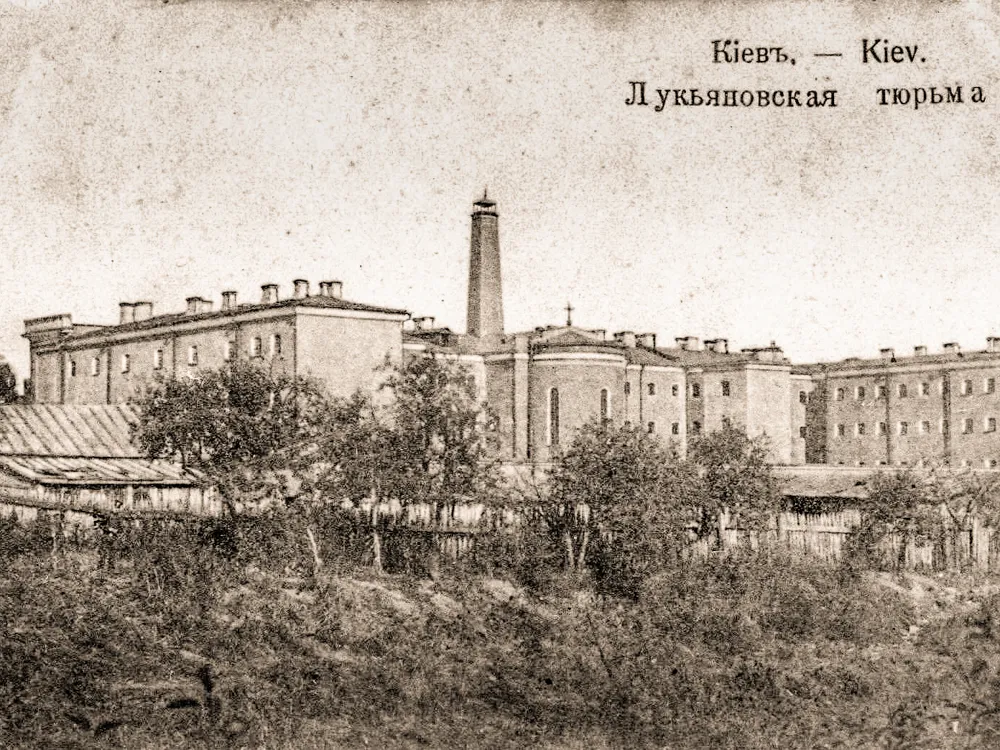
Lukianivka Prison, photo from the late 19th century
As a revolutionary of the Narodnik movement, Sofia Bohomolets was under investigation in the case of the South Russian Workers’ Union. And so, on 12 May, within the prison walls she gave birth to a boy. However, this circumstance had no effect whatsoever on the woman’s sentence. The young lady was sent to hard labour in Transbaikalia for a whole decade. The son was able to see his mother only once. In exile. When Oleksandr’s father finally obtained a short visit to his wife. Not long, as it turned out, before her death…
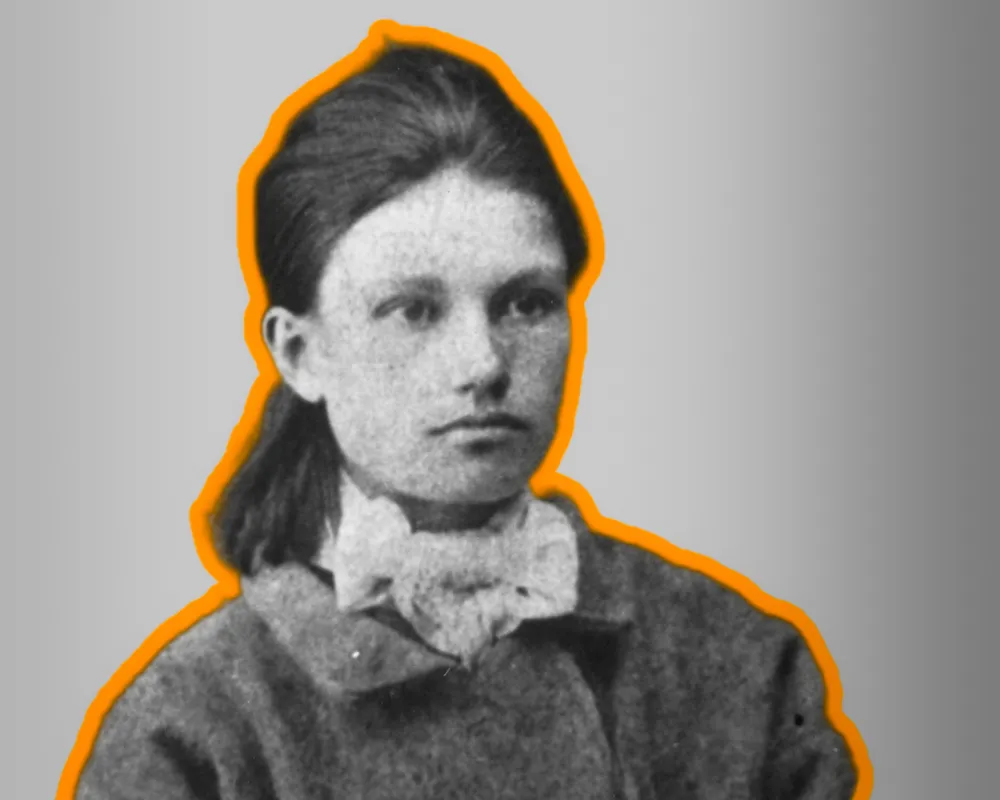
Sofia Bohomolets imprisoned in Lukianivka Prison, photo from January 1881, personal archive of Doctor of Medical Sciences Olha Bohomolets
And, for contrast. In that same year, 1881, the distillery and yeast plant of the Chokolov brothers, also located in Lukianivka – on a plot now entirely occupied by the Lvivskyi Kvartal residential complex – was named one of the best by the empire-wide thematic “Index…”. Equipped with continuously operating spirit-distilling apparatus, mechanical ice refrigerators and iron steam boilers for the stillage, it corresponded in the best possible way to the spirit of progress. A phenomenon uniquely characteristic of that age.
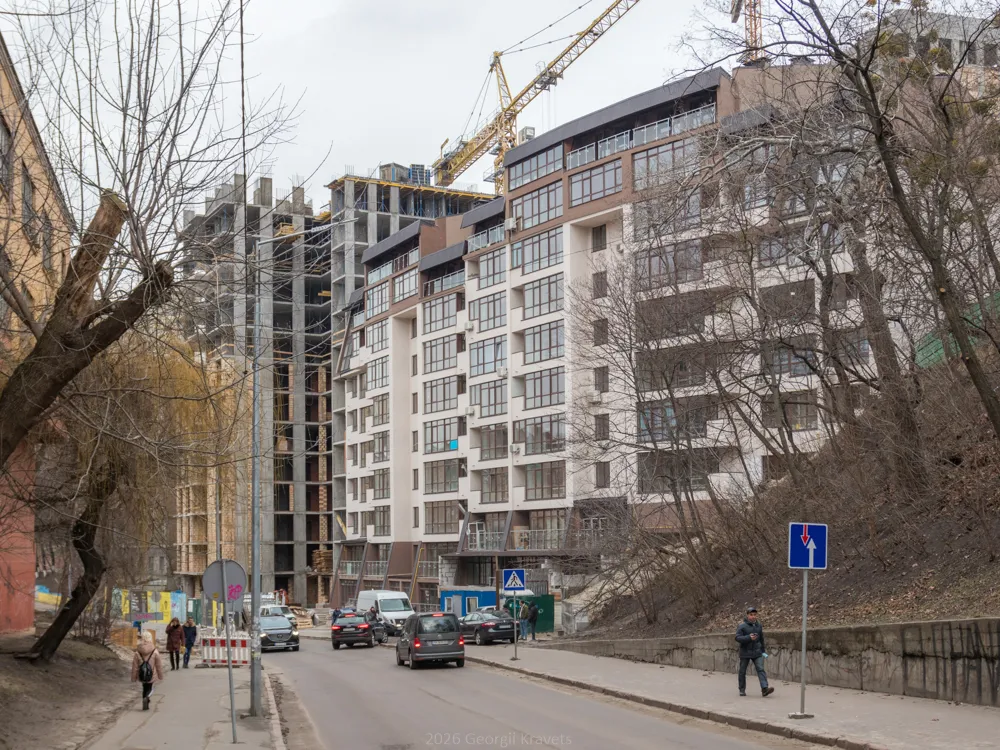
Lvivskyi Kvartal residential complex on the site of the Chokolov brothers’ plant, Tatarska Street, 2020
And all of Lukianivka at the turn of the 19th and 20th centuries seems to have been fed by progress itself. Besides the distillery and machine-building enterprises mentioned earlier, there was, for example, the cement factory of Semen Suskyi. It specialized not only in producing what was then a fashionable building material but also in making paving tiles from it. Of a quality never seen before. Samples of them, for those interested, can still be seen today on the square near the National Art Museum of Ukraine.
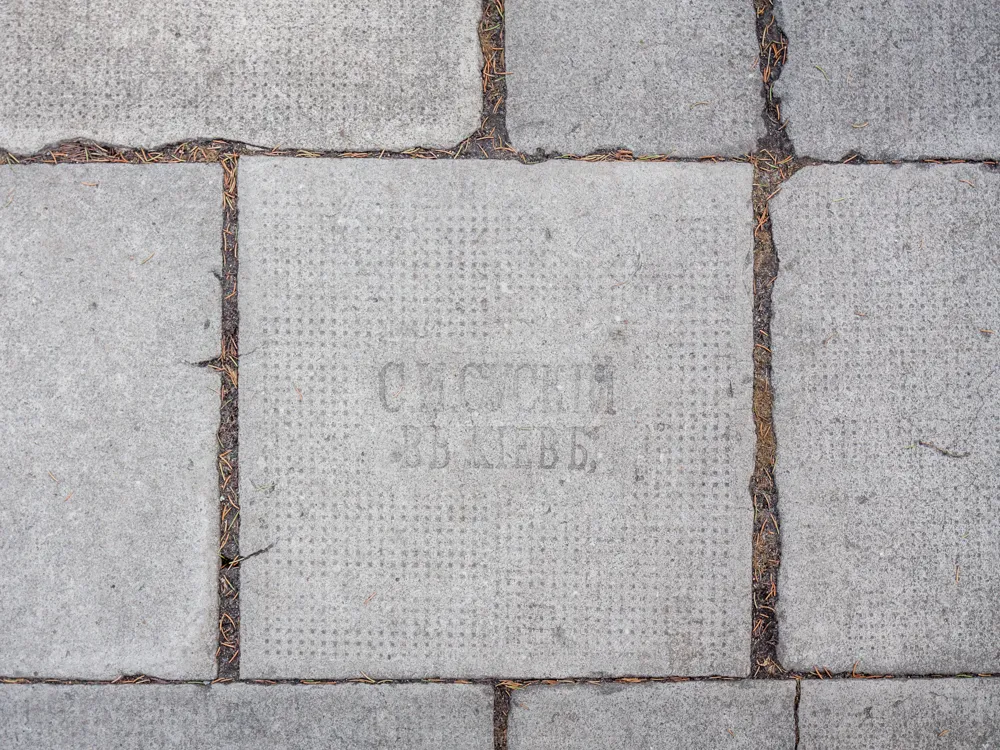
Paving tiles made by Semen Suskyi’s factory on the square near the National Art Museum of Ukraine
Kyiv’s introduction to mass electrification and communications – perhaps the key achievements of the second industrial revolution – was helped by the founding of a cable plant near the intersection of Ovruchska and what is now Zahorivska streets. The future industrial giant – Ukrkabel under the Soviets, and, briefly, Siemens-Schuckertwerke under the Germans – worked practically without a break for more than a century. Through its efforts copper electric wires, insulated wires for lighting, cables for power grids, for telephone and telegraph lines, power cables, enamelled ones and ones in plastic insulation, and so on and so forth – all this stretched for years from the very heart of old Lukianivka to the rest of the city. And far, far beyond its limits.
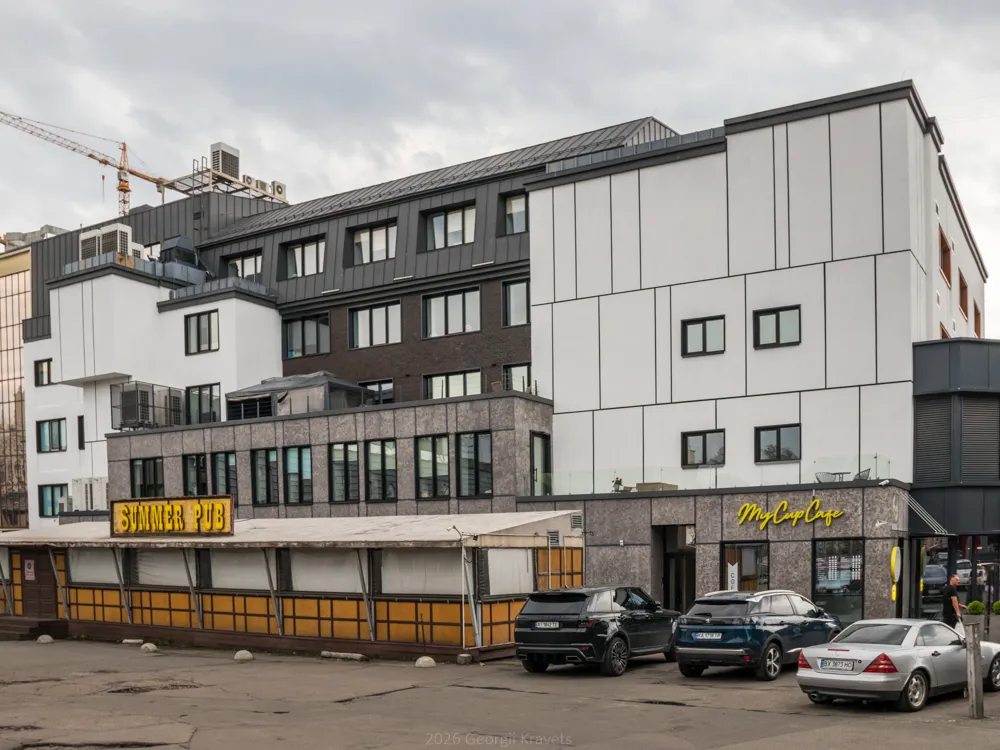
Former workshop of the Ukrkabel plant, now a supermarket and pub, 17/21 Zahorivska Street
In the urban space the most noticeable result of the introduction of electrification was the appearance of the tram. Precisely the kind we know today. For previously this mode of transport was horse-drawn. And it was for that originally horse-drawn tramway that the Lukianivka depot opened in 1892. But very soon current was fed from the new traction substations to the overhead network throughout Kyiv. And along Kyiv’s avenues and streets, steep slopes and deep ravines, pleasant little cars began to run hurriedly from all sides – without any harness.
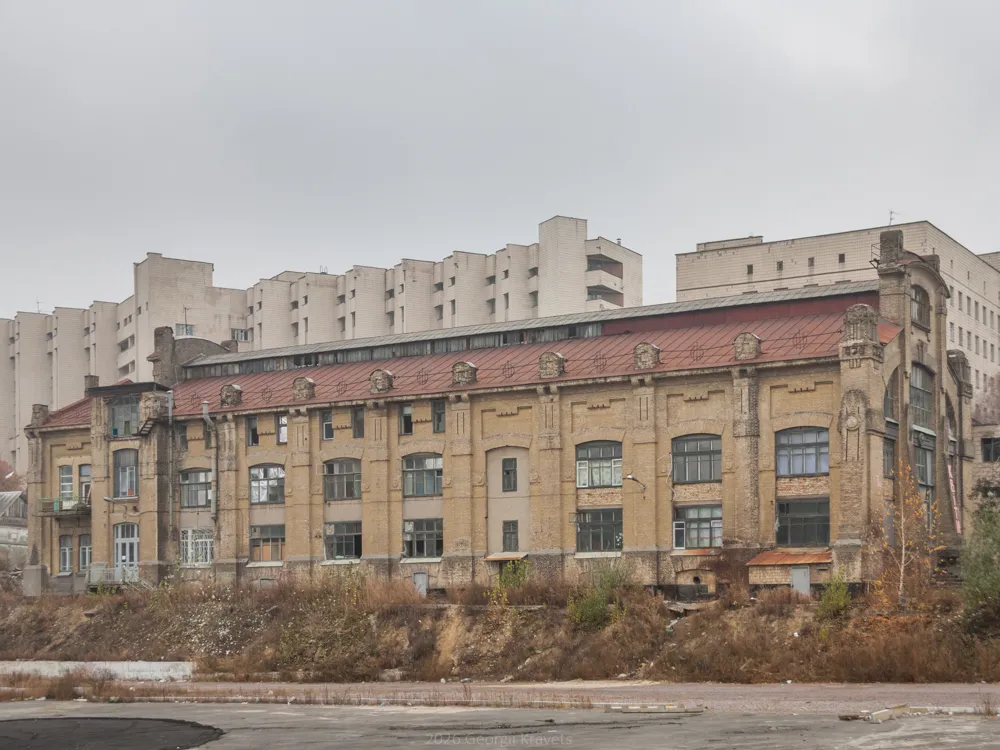
Diesel power station of the Lukianivka tram depot, 2011
The most picturesque tram route, according to the citizens of the early 20th century, was the one that led from Lukianivka to Kurenivka along the cliffs of the Repiakhiv Ravine. It was also nicknamed the Swiss one. And that is why in our own days Lukianivka is sometimes nostalgically called the lost “Kyiv Switzerland”. However, of that entire legendary tram line only a few wooden electric poles remain at present. Somewhere in the thickets near Podilskyi Descent.
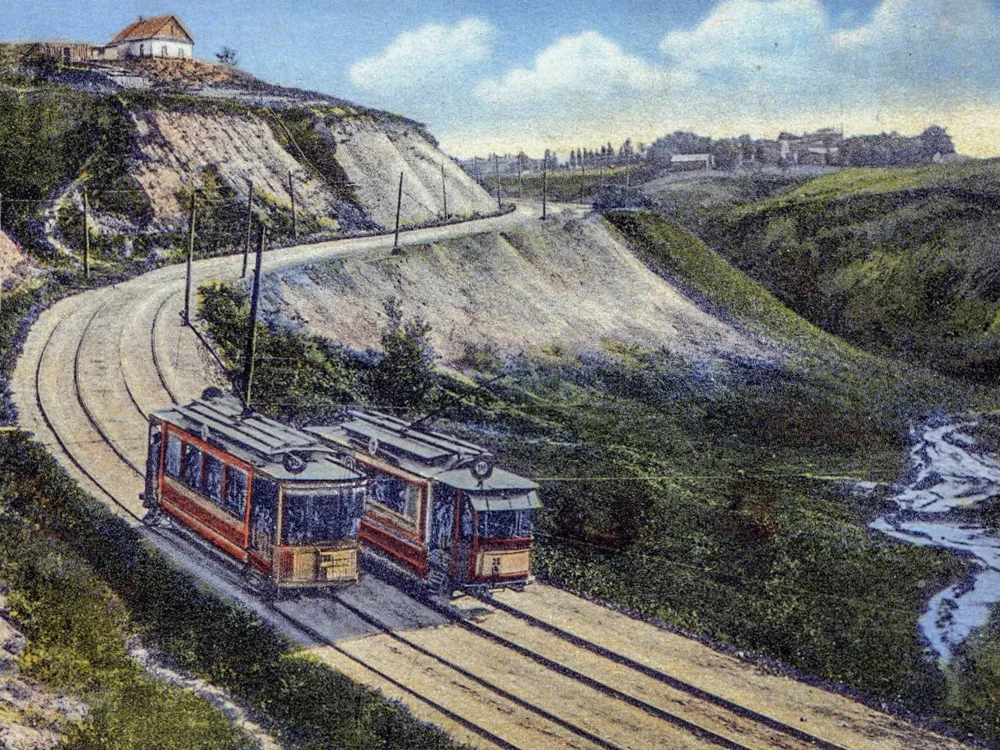
“Kyiv Switzerland” tram route, Repiakhiv Ravine, postcard from 1911
The relentless march of progress over the several decades before the First World War radically transformed Lukianivka. A quiet patriarchal village rapidly turned into an urbanized district. Village-type manors with small gardens here increasingly gave way to multistorey apartment buildings and mansions, massive plants and public buildings. Eventually the outskirts were set apart as a full-fledged municipal unit, a so-called police district. At 91 Sichovykh Striltsiv Street the building of its police station has survived to this day. Sadly, on the night of 19 July 2026, as a result of a massive Russian missile and drone attack, the building of the Lukianivka police station was partially destroyed.
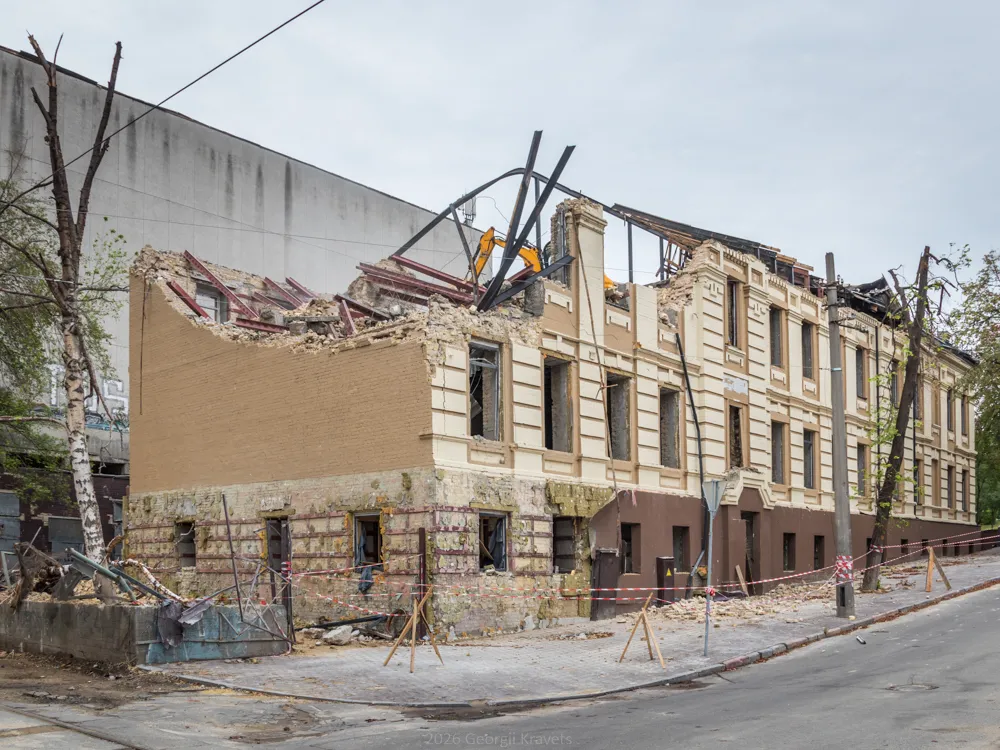
Building of the Lukianivka police station after being hit by a Russian attack in July 2026
The landscape of Lukianivka was changing too. As early as the end of the 19th century, in order to expand their distillery, the Chokolov brothers enclosed the Hlybochytsia River underground. By that time, admittedly, it had already finally turned into a dirty ditch. Likewise in 1914 the Skomorokh stream also went entirely into a collector.
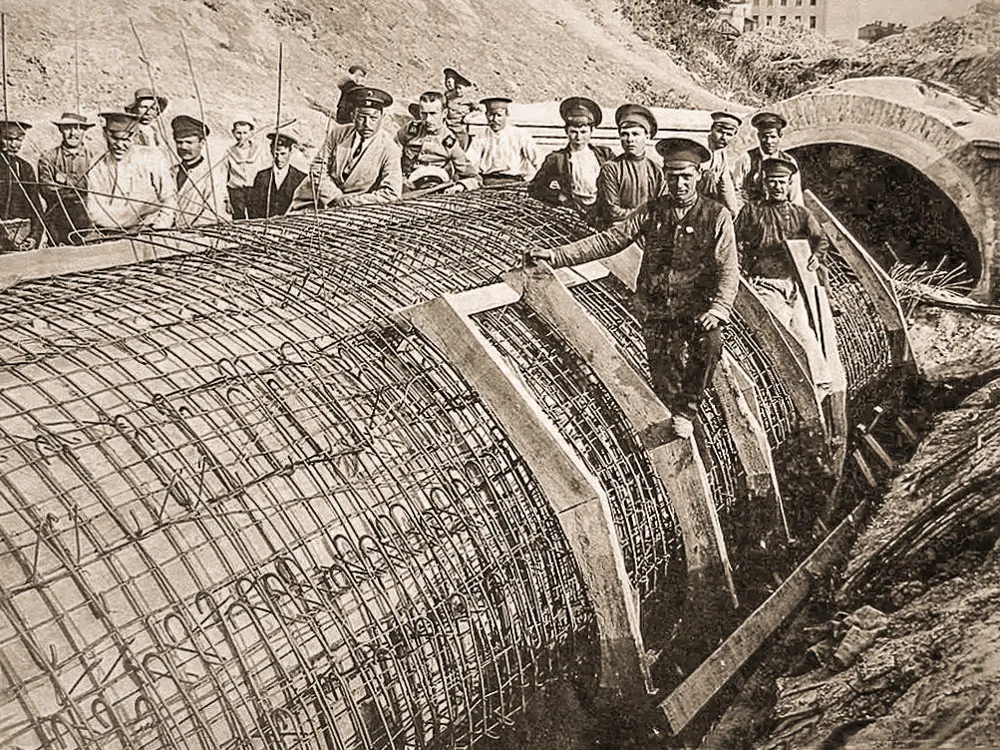
Construction of the collector for the Skomorokh stream, near the intersection of Rostyslavska and Dmytrivska streets, photo from 1914
To lay ever more roads, tram lines and railway tracks, embankments were made in many places and entire hills were cut away. As, for example, was done when laying the railway branch from the Kyiv–Kovel junction to the then newly built Lukianivka freight station. The latter, until the early 1960s, was located in the blocks between today’s Dehtiarivska, Gareth Jones and Illienka streets.
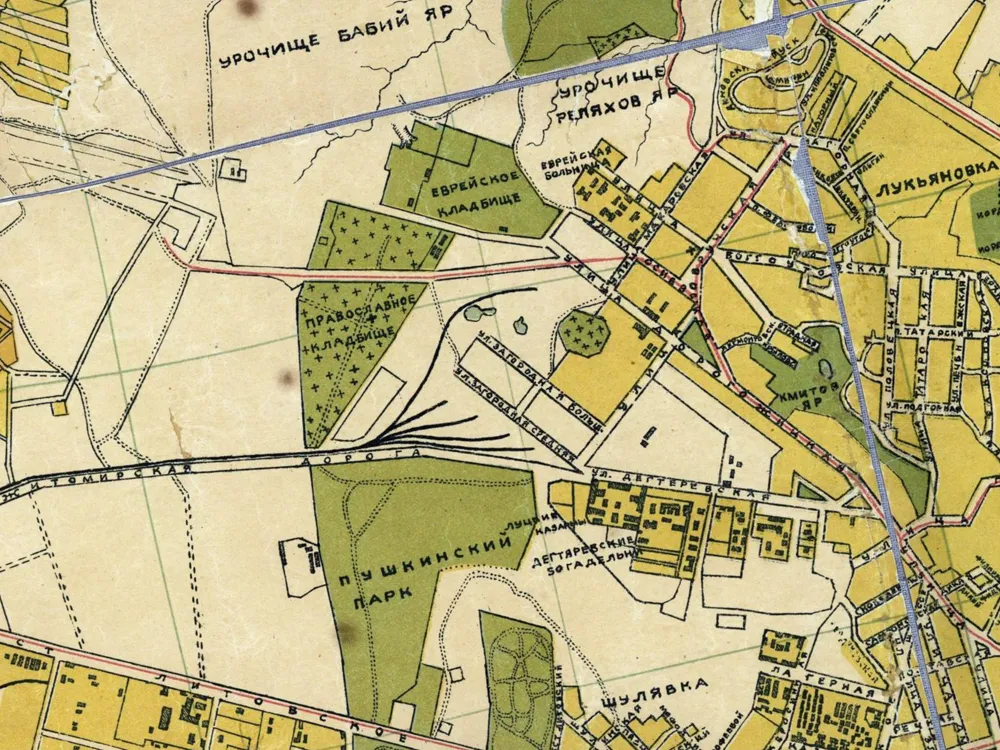
Lukianivka freight station, plan of the city of Kyiv, 1923
The Art Nouveau style, progressive for the beginning of the last century – Art Nouveau in the French tradition or Secession in the Austrian one – largely defined the face of the district. At least those fragments of it that are still pleasant to look at today. In this respect, adjacent Tatarka could be called a kind of reserve of a peripheral variation of the style. In Lukianivka, connoisseurs’ attention is deserved by such examples as:
- the office building and diesel power station of the Lukianivka depot, by Kostiantyn Ostrohradskyi;
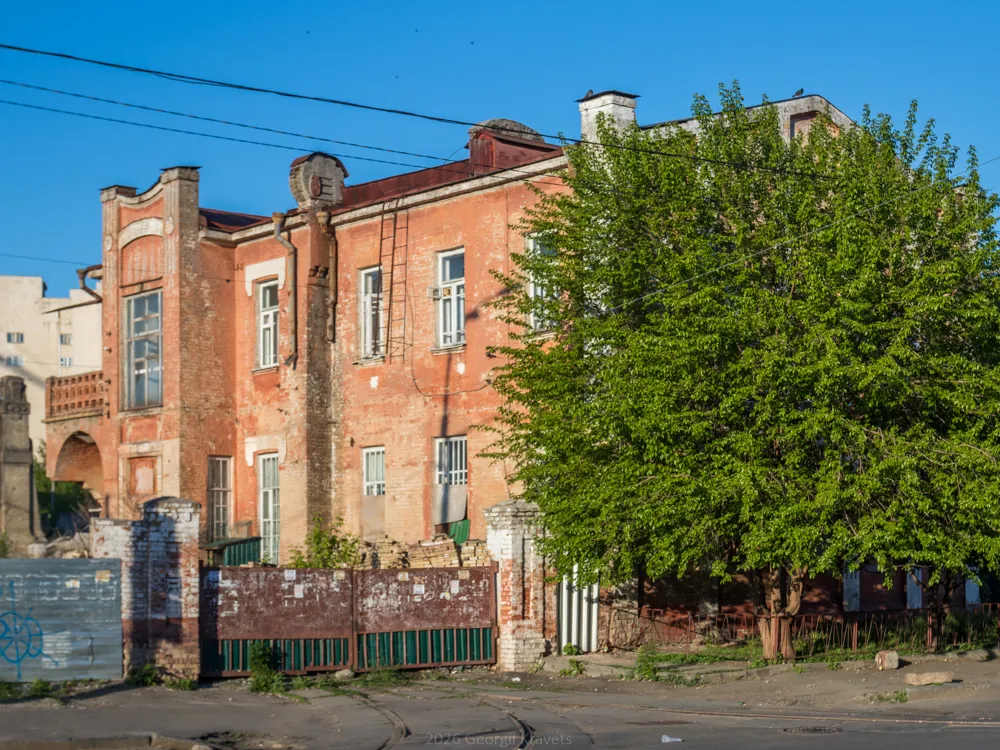
Office building of the Lukianivka depot, by Kostiantyn Ostrohradskyi, 7 Dehtiarivska Street, 2017
- the Neo-Empire income house of Yulia Kondratska at 12 Herzen Street
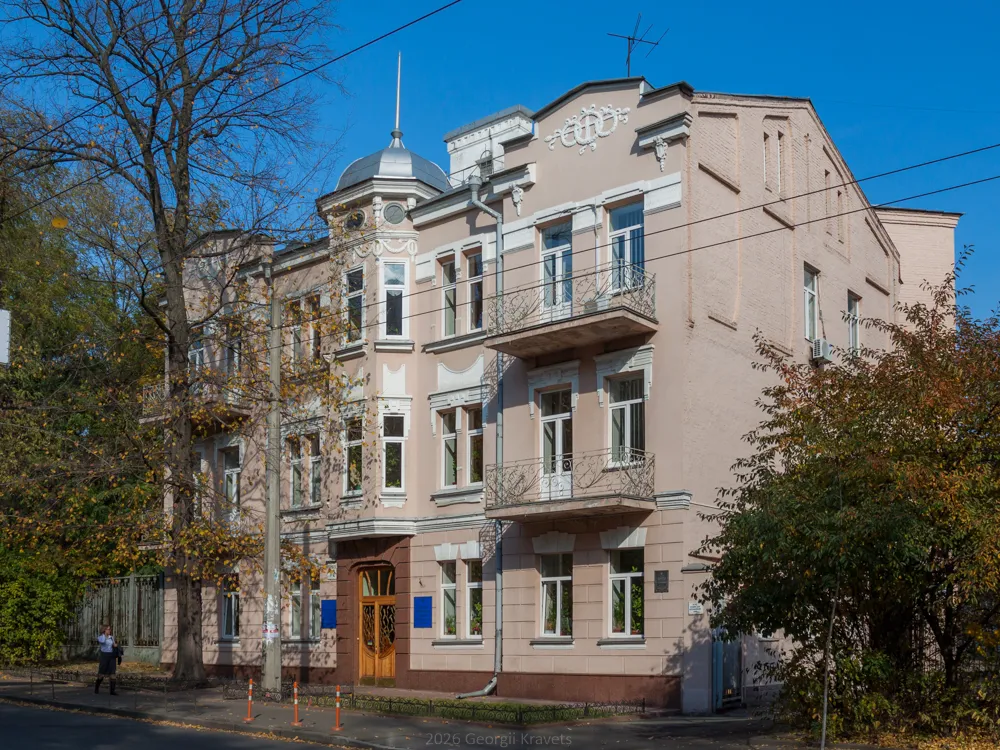
Former income house of Yulia Kondratska in the Neo-Empire style, now the Presidium of the National Academy of Medical Sciences of Ukraine, 12 Herzen Street
- the Neo-Gothic income house of Evelina-Franciszka Schmidt at 21 Kotarbinskoho Street, by civil engineer Pavlo Zhukov;
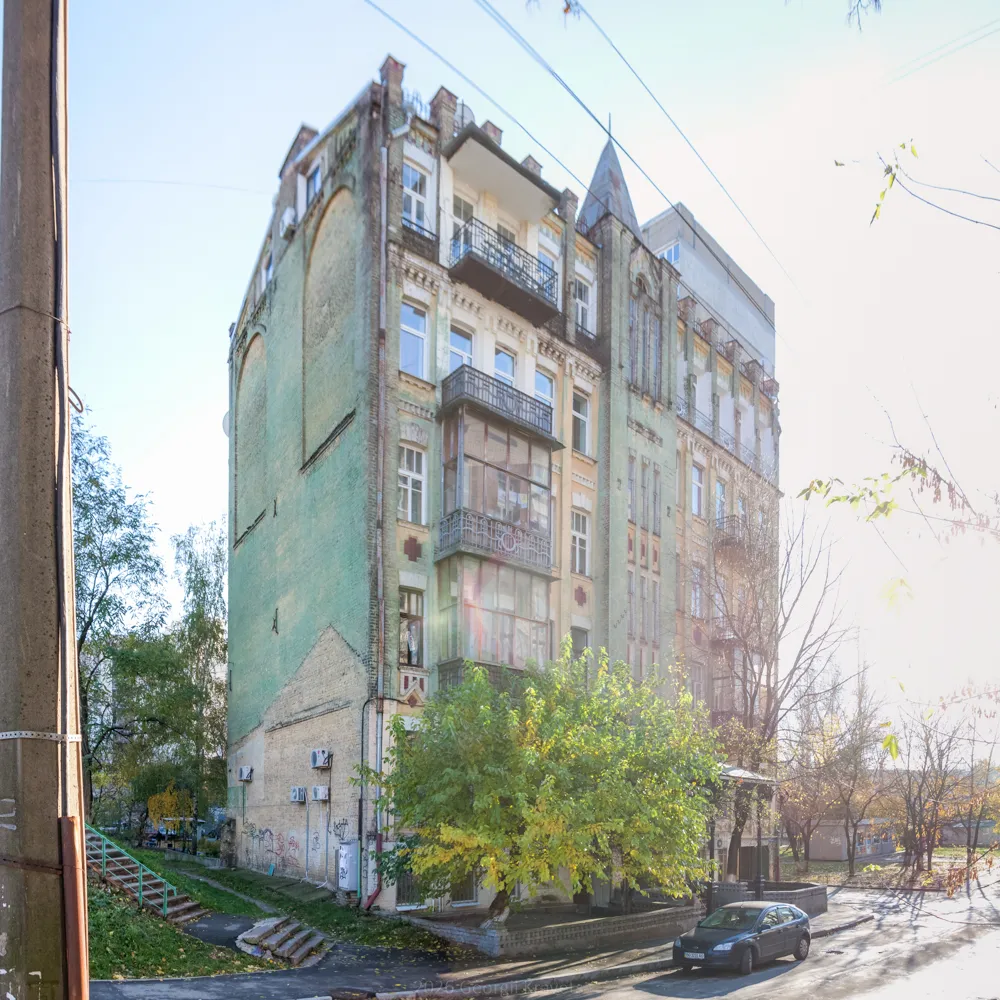
Neo-Gothic income house of Evelina-Franciszka Schmidt, by civil engineer Pavlo Zhukov, 21 Kotarbinskoho Street
- a charming house of Germanic character at 25 Maiborody Street;
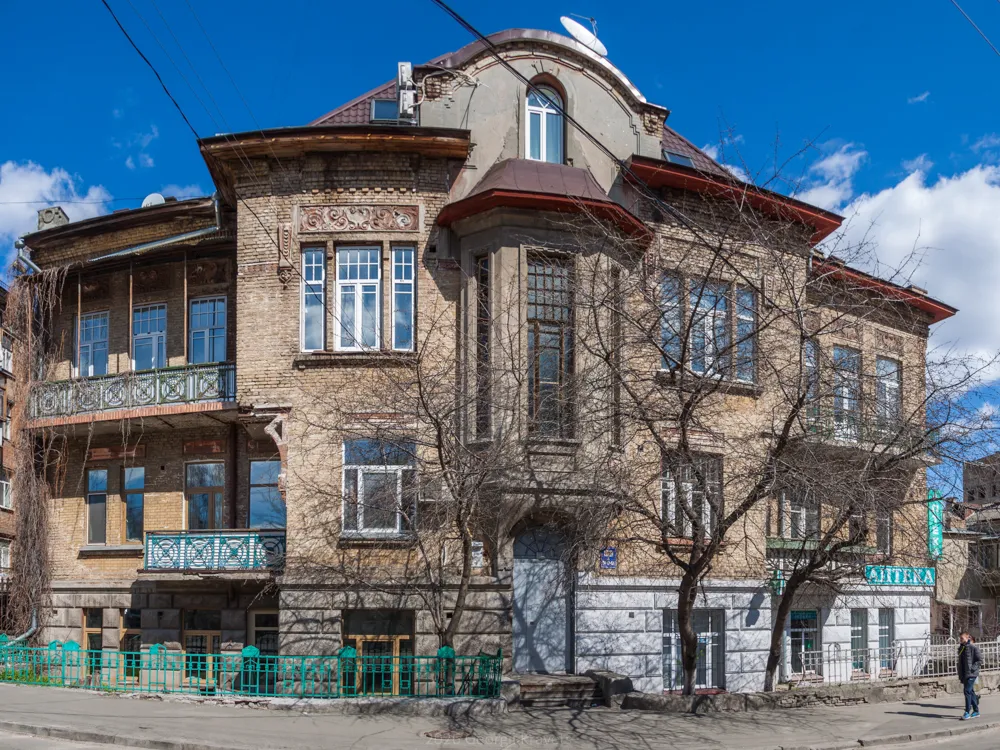
A charming residential building of Germanic character at 25 Maiborody Street
- a residential building with features of rational Modernism and the Neo-Russian style, 32 Zahorivska Street
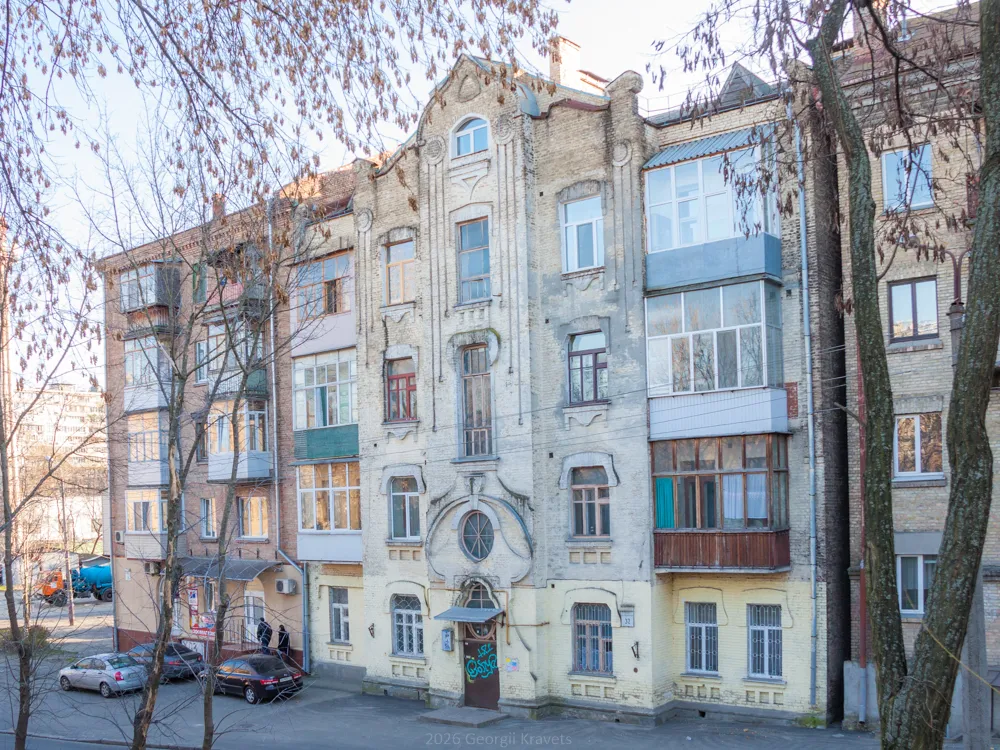
Residential building with features of rational Modernism and the Neo-Russian style, 32 Zahorivska Street
- examples of rational Modernism – the buildings at 32 Zahorivska, and 2 and 3 Dehtiarivska;
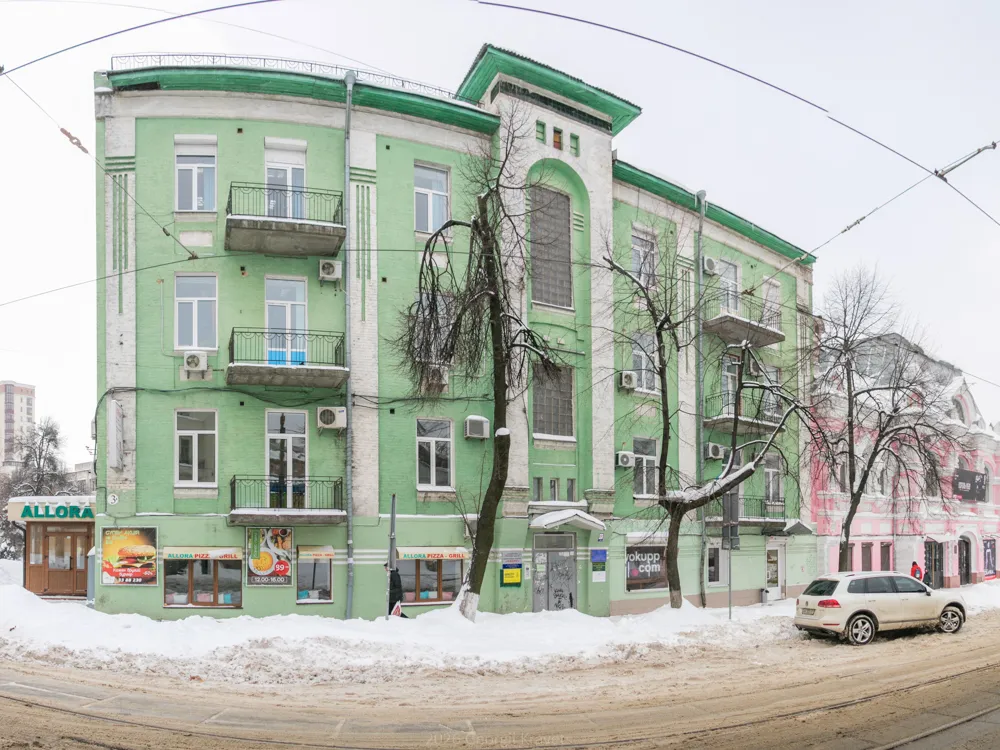
Residential building in the rational Modernist style, 3 Dehtiarivska Street
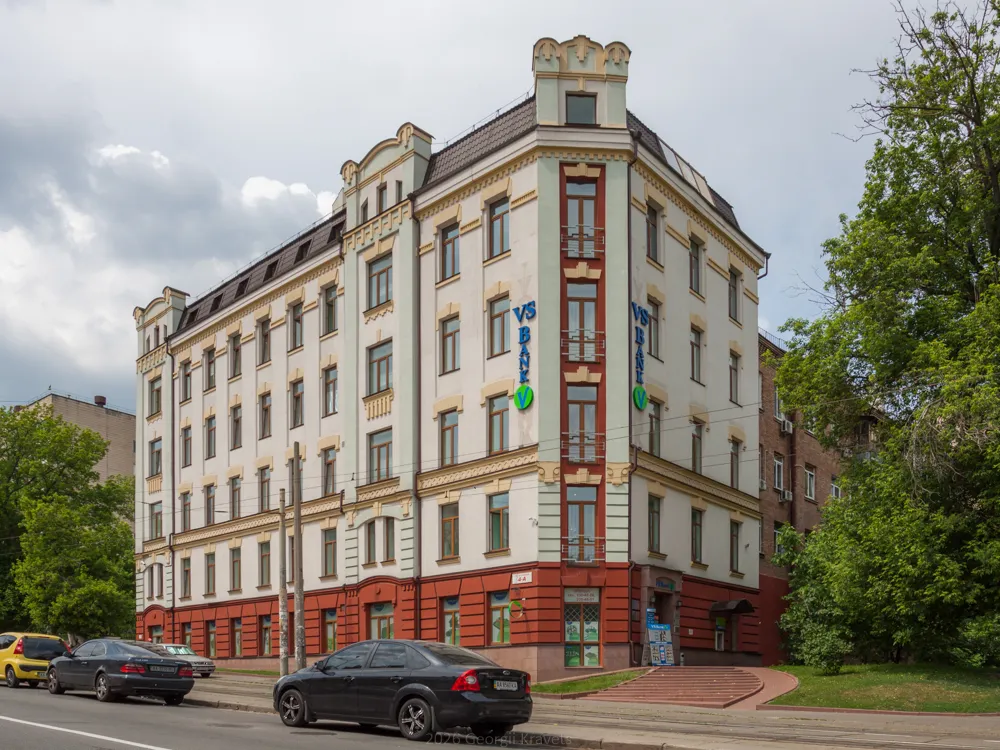
Residential building with features of rational Modernism, 2 Dehtiarivska Street
- the whimsical mansion of Volodymyr Benson at 14 Zahorivska, designed by Ignacy Ledóchowski;
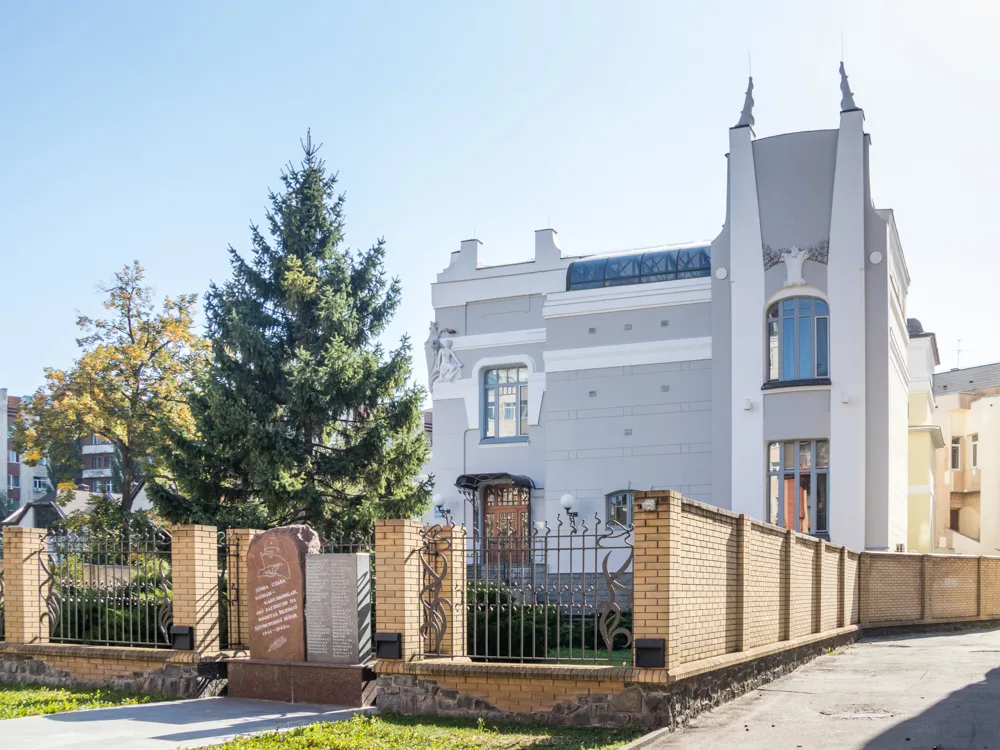
Volodymyr Benson’s whimsical mansion, designed by Ignacy Ledóchowski, 14 Zahorivska Street
- the austere mansion at 6 Herzen Street, built for himself by the architect Eduard Bradtman.
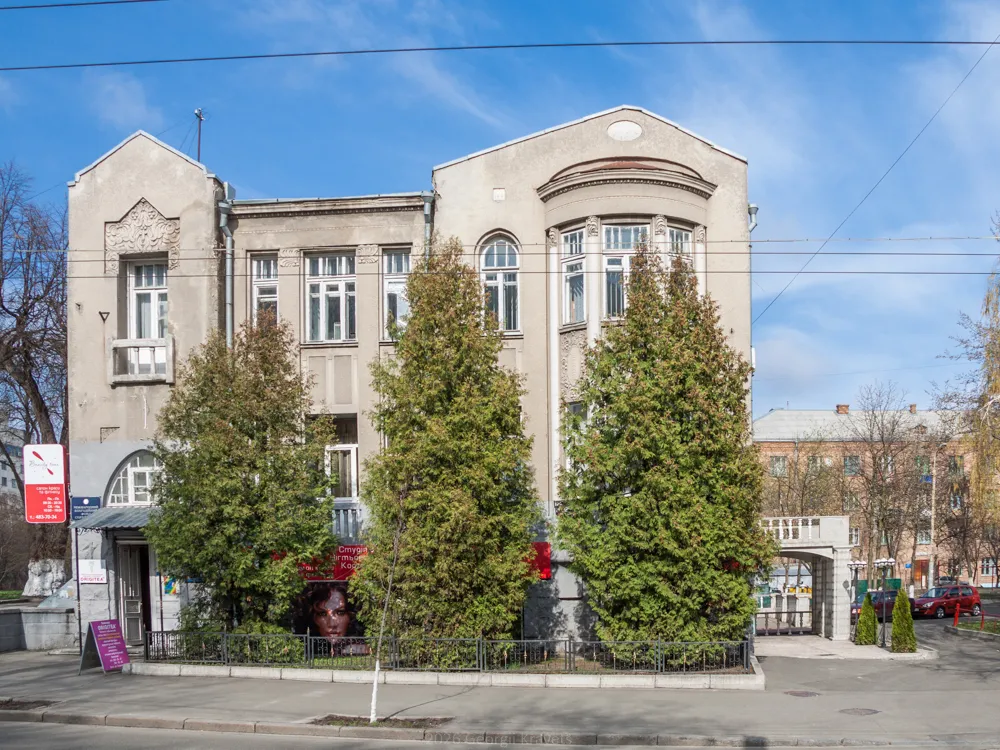
A restrained and elegant mansion built for himself by the architect Eduard Bradtman, 6 Herzen Street
A true masterpiece of Art Nouveau is considered to be the mansion at 8 Illienka Street, which originally belonged to the chairman of the city district court, Mykola Hrabar. It is also called the House with Irises, thanks to its façade lavishly decorated with these flowers.
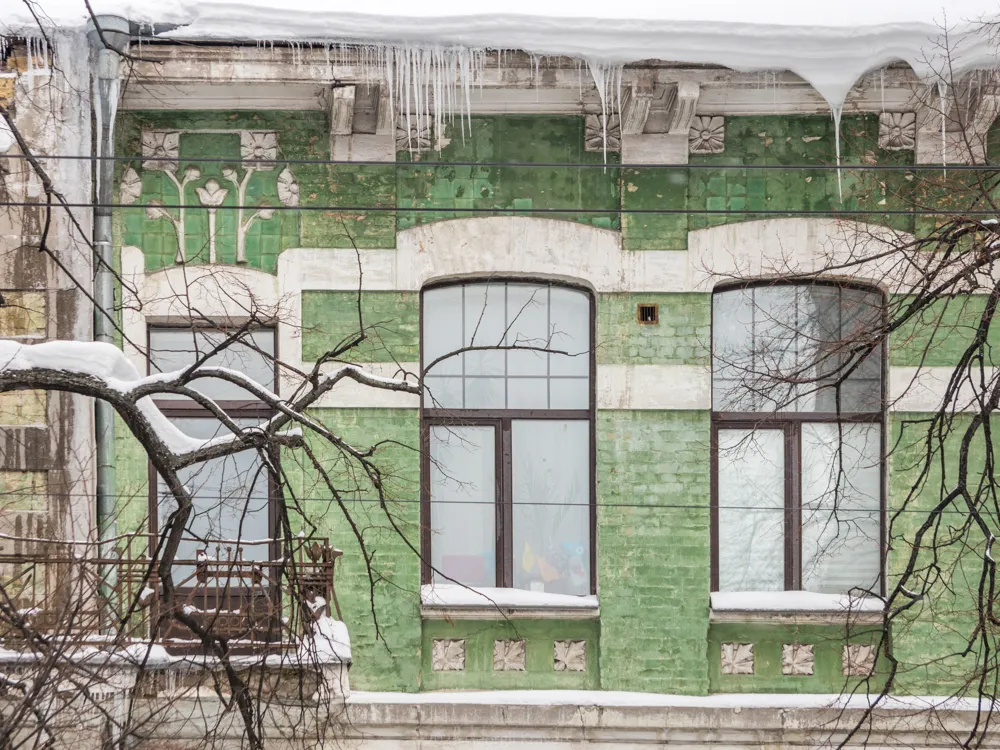
Façade decoration of the “House with Irises”, the former Hrabar mansion, 8 Yuriia Illienka Street
It was built in 1911 to a design by Volodymyr Bezsmertnyi, one of the best Kyiv masters of the era. And, of further interest, the childhood of two future outstanding figures of French science and culture, sons of the judge, passed here: André Grabar, the famous art historian and professor at the University of Strasbourg, and Pierre Grabar, founder and long-time president of the French Society of Immunologists.
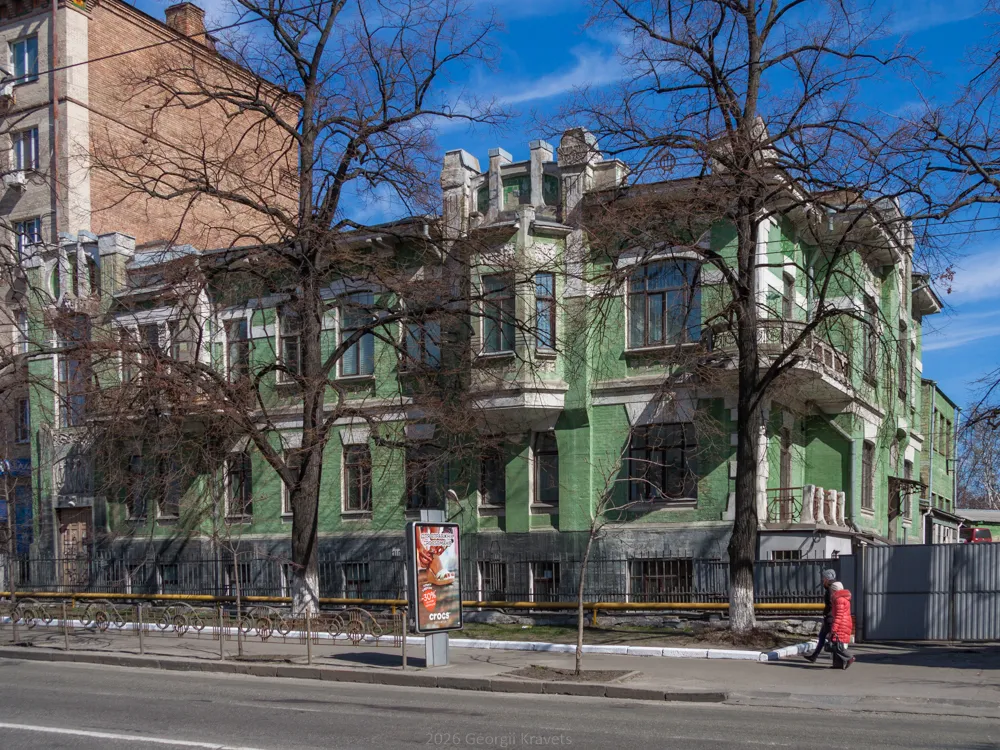
The “House with Irises”, the former Hrabar mansion, 8 Yuriia Illienka Street
As for architects and architecture, Lukianivka is also linked with the name of perhaps the most brilliant builder of our city – Władysław Horodecki. Here, at practically a single point, his professional genius and his main passion in life intersected. As is known, Leszek Desiderius (yes, these are also Horodecki’s names) was an ardent hunter. On arriving in Kyiv he soon joined the local branch of the Imperial Society of Proper Hunting – shooting at animals according to agreed rules… These gentlemen trained on a specially acquired plot on the Old Zhytomyr Road, between what was then the edge of Bahryanyi Park and the eastern boundary of the Lukianivka Cemetery. The grounds had a kennel for dogs and a shooting range.
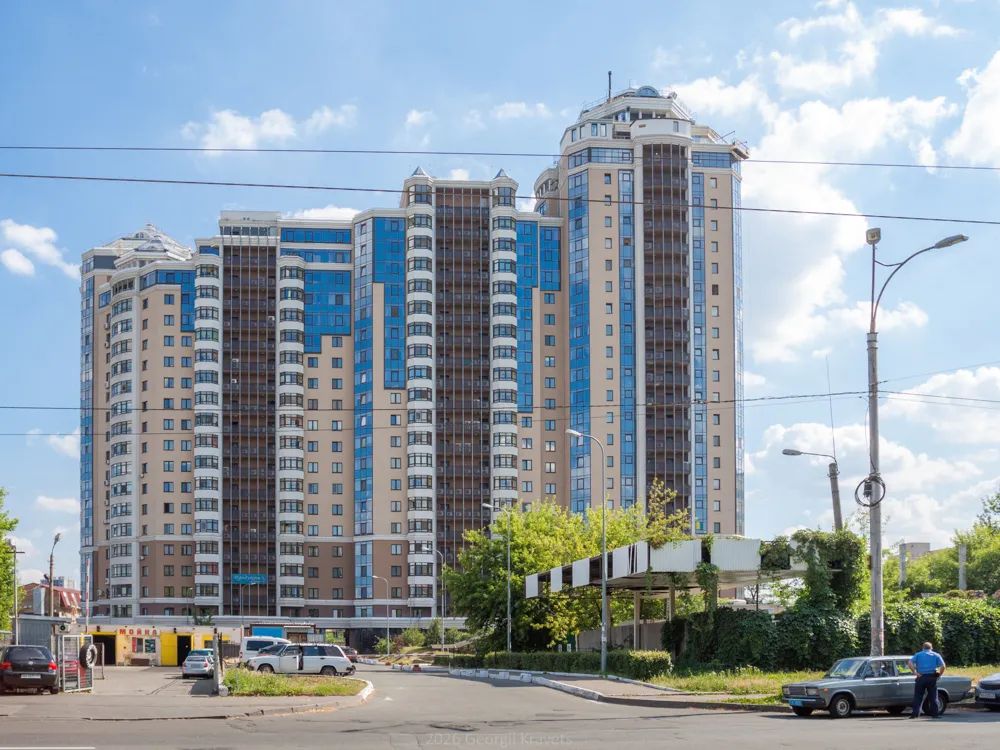
Cosmopolitan residential complex on the former grounds of the branch of the Imperial Society of Proper Hunting, 25A Dehtiarivska Street
Horodecki, for his part, designed a pigeon-shooting pavilion for the convenience of the company in 1893. Two-storeyed, wooden, with special galleries from which to shoot at pigeons… He did this work free of charge and with high quality, which noticeably added to his prestige in the city’s high society. And with that he also received his first tangible boost in his career.
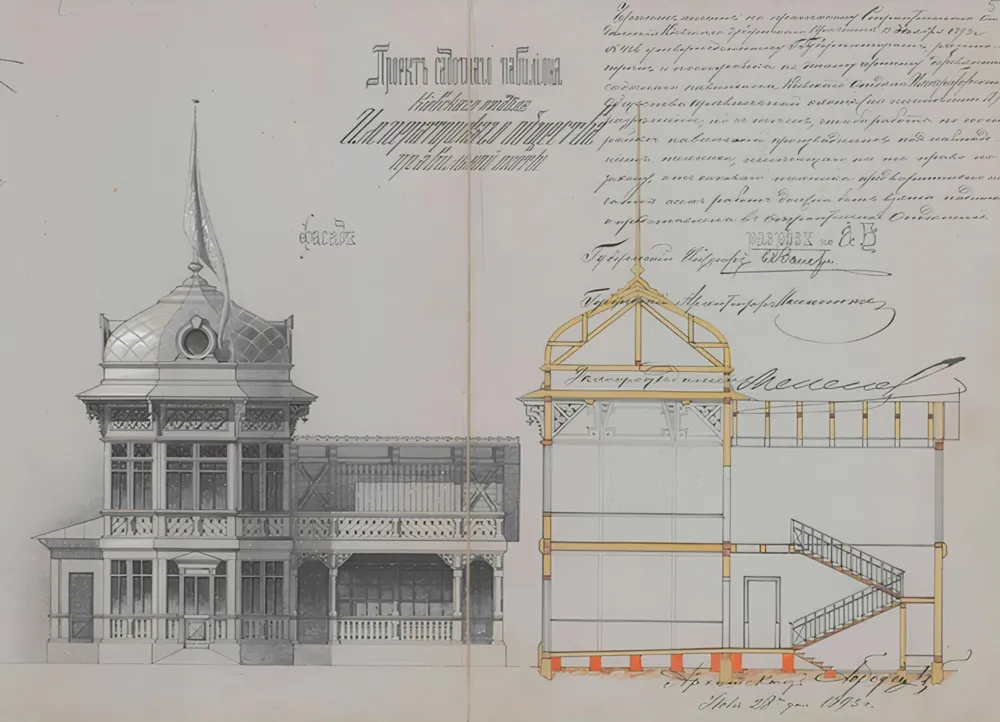
Design for the pigeon-shooting pavilion of the Kyiv branch of the Imperial Society of Proper Hunting, Władysław Horodecki, 1896
Our conversation, you see, has again turned to the old Kyiv nobility. If with the patronage of the Brodskyis and Degterevs everything is fairly obvious, then with the activities of some of their other privileged contemporaries things are not so unambiguous.
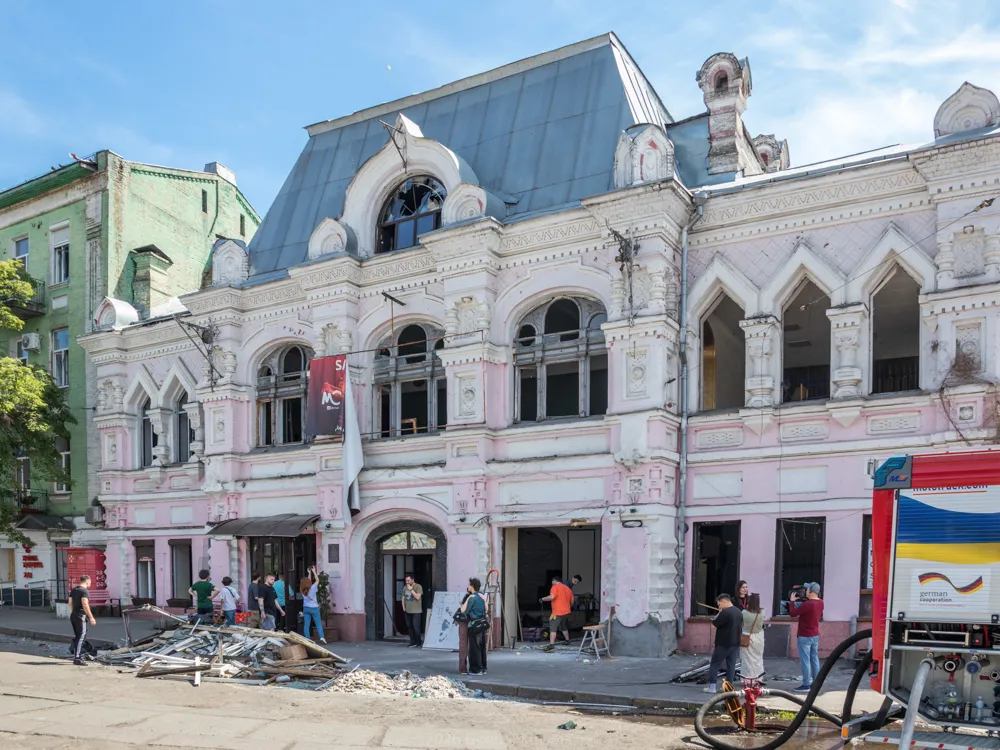
Former Lukianivka People’s House, now the Kyiv Small Opera, 5 Dehtiarivska Street
The building of the Kyiv Small Opera on Lukianivska Square seems the most elegant. Decorated with kokoshnik gables and gingerbread window frames, it looks like a casket from a fairy tale by Bazhov, a native of Sysert in the Urals. And this is no accident. As the People’s House it was built in 1902 at the commission of the Kyiv Temperance Society. At that time it was headed by Professor Ivan Sikorsky.
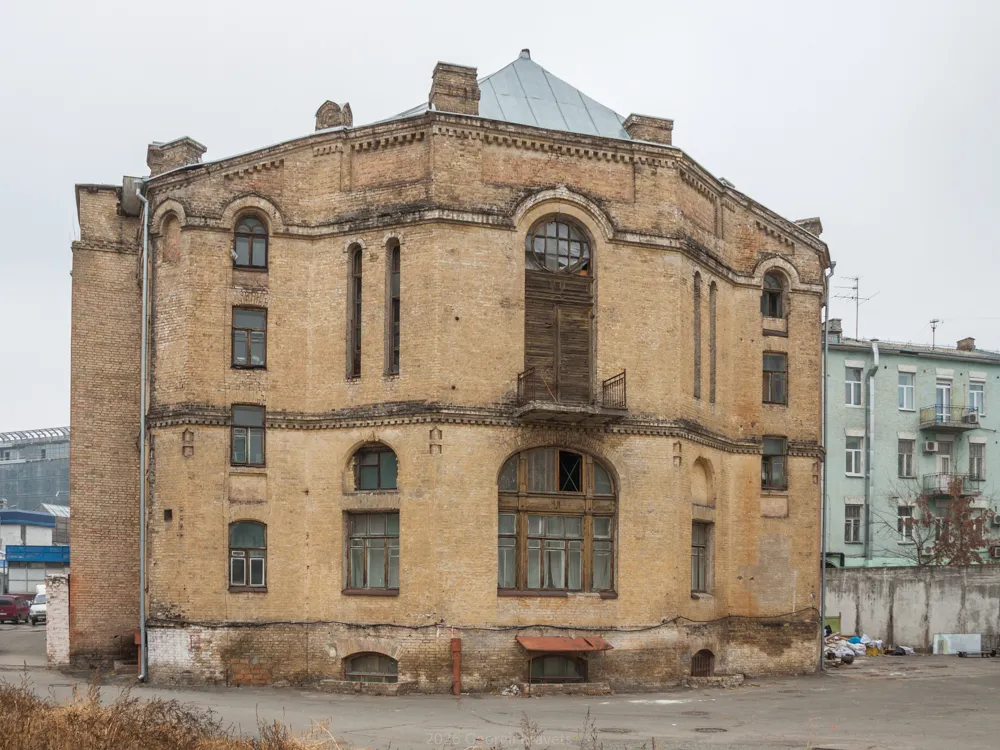
Former Lukianivka People’s House, now the Kyiv Small Opera, rear façade, 5 Dehtiarivska Street
A recognized psychologist and psychiatrist, and father of the famous aircraft designer Igor Sikorsky, he is remembered in Kyiv chronicles first of all as perhaps the city’s foremost Russian great-power chauvinist. An implacable hater of Ukraine and everything Ukrainian and, tellingly, a fierce Judophobe. This figure’s antisemitic activity compels us to turn to one of the darkest stories that ever took place in Lukianivka. And which first made the place famous around the world.
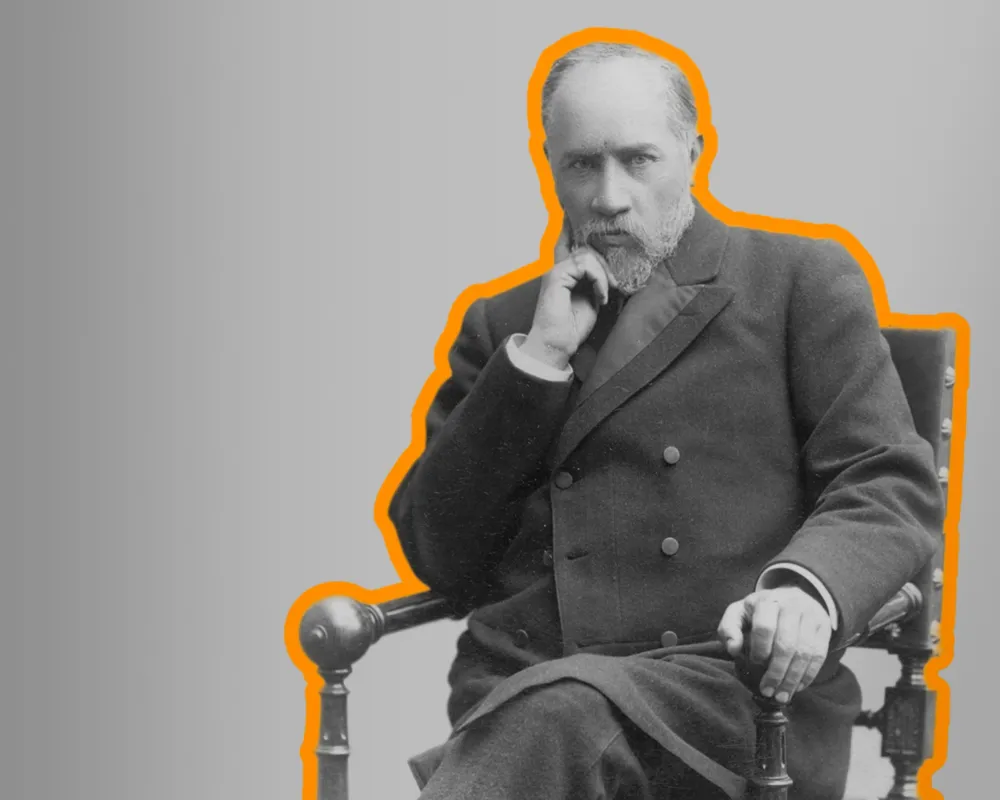
Professor Ivan Sikorsky, photo from the early 20th century
On 20 March 1911, in a cave on the slope of Yurkovytsia hill, near Nahirna Street, the body of 13-year-old Andrii Yushchynskyi was found. Forty-seven stab wounds were discovered on the body. Accusations of murder were soon brought against Mendel Beilis – a Jew who worked as a clerk at a brickworks located next to the scene of the crime. Ivan Sikorsky was brought into the case as an expert psychiatrist. In line with his worldview, he concluded that the child’s murder had a ritual character and had been committed by Jewish sectarians. However, the investigation, which lasted many years, ultimately found that such a judgement had no grounds. Beilis was released. But by that time the trial against him had already received unprecedented media publicity.
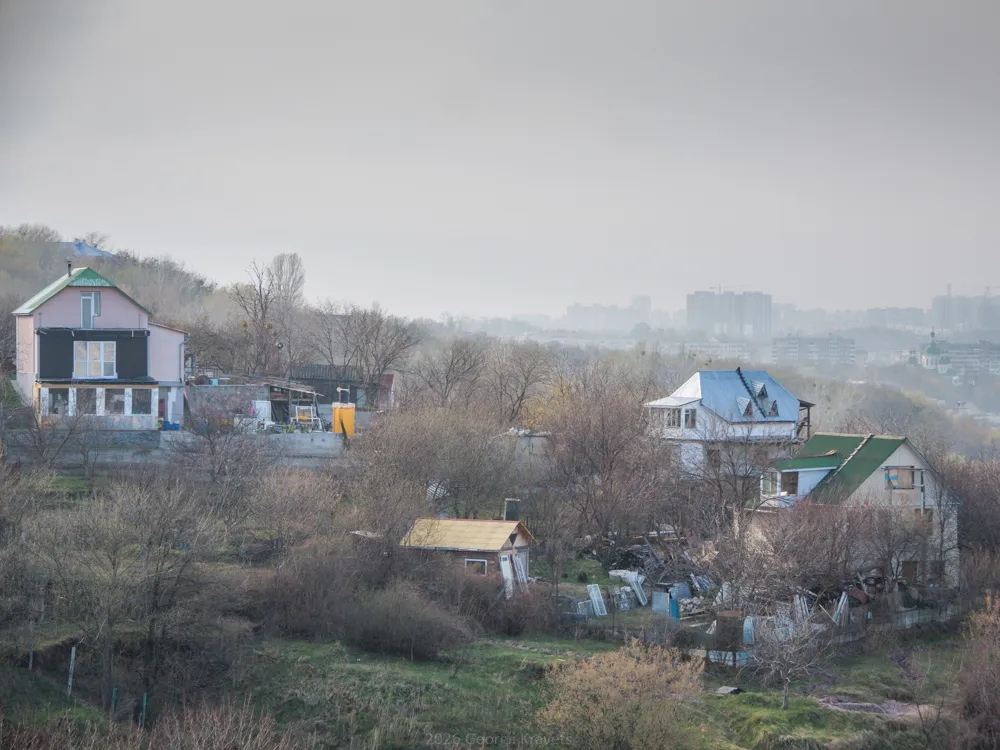
Slope of Yurkovytsia hill where the body of Andrii Yushchynskyi was found, now built up by the Shkirnyk horticultural society
The story is undoubtedly deeply shameful. But an unexpected aspect of it can be seen in Lukianivka’s involvement in the advanced cultural processes of its time. In particular, in 1913, on the present-day grounds of the Institute of Pediatrics, Obstetrics and Gynecology, the Svitlotin film studio was founded by Semen Pysarev. Most likely, the choice of location was determined precisely by the proximity to the sites of the sensational events. Judge for yourself, here are the titles of the pictures that the studio managed to produce before the beginning of the struggle for liberation: “The Secrets of Kyiv, or the Beilis Case”, “The Revenge of the Jewess” and “Murder at the Inn”.
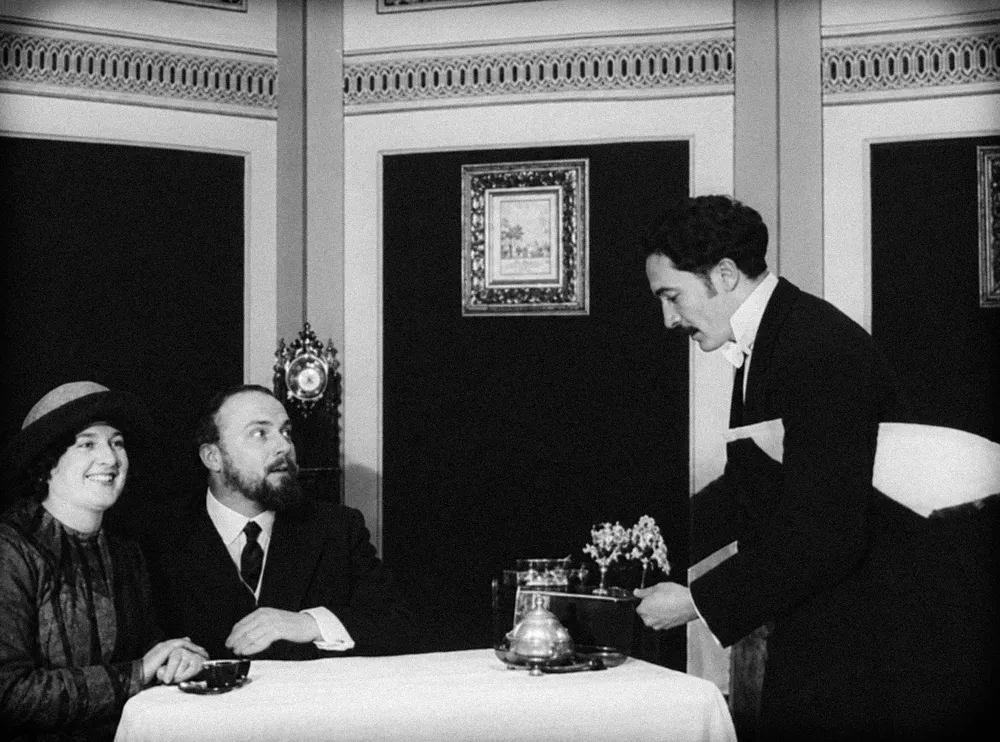
Still from the film “Vera Chebyriak, or the Blood Libel”, directed by Mykola Breshko-Breshkovskyi, Svitlotin film studio, 1917 (image enhanced)
In 1917 the studio released the film “Vera Chebyriak, or the Blood Libel”, which presented the true circumstances of Yushchynskyi’s murder. Today this feature film is considered the oldest surviving among those shot in Ukraine. The rest of Svitlotin’s output is lost. And we can only imagine what the masterpieces such as “The Power of Woman” or “A Slave of Luxury and Fashion” might have been about…
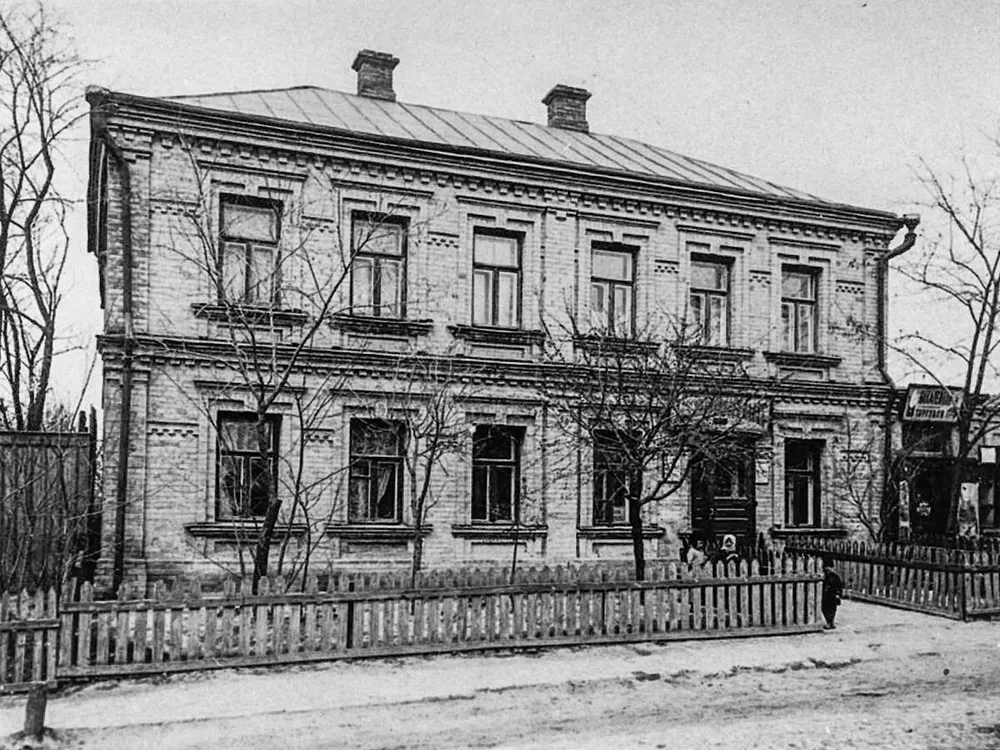
The building at 40 Verkhniiurkivska Street (now Prince Volodymyr Monomakh Street), on whose second floor was the apartment of Vera Cheberiak, where Andrii Yushchynskyi was killed, photo from the early 20th century
Under Hetman Pavlo Skoropadskyi it was planned to organize the state company Ukrainfilm on the basis of the Lukianivka film production. In 1918 preparations even began here for shooting historical-patriotic films “The Destruction of the Sich”, “The Black Council” and “Karmeliuk”. But it did not come to pass.
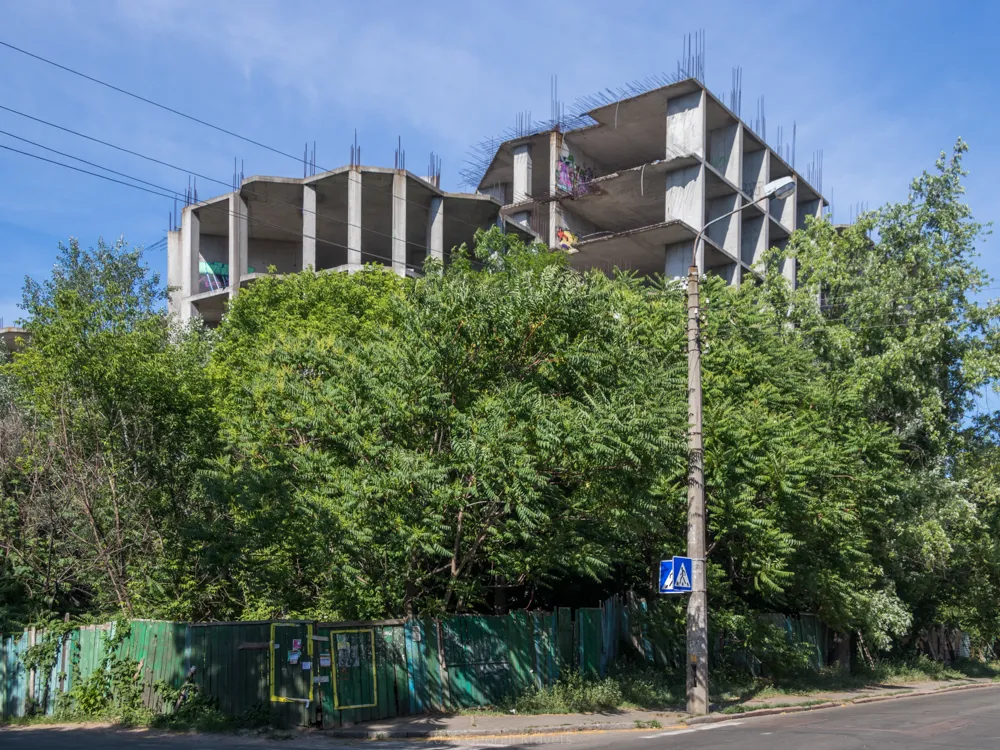
The unfinished Elita Centre on the site where Vera Cheberiak’s house stood, 34–42 Prince Volodymyr Monomakh Street
As for the consumption of film products, here too Lukianivka was usually in the vanguard. One of the first cinemas in Kyiv opened in the premises of that same People’s House. In parallel, nearby, in a two-storey stone house at the corner of today’s Kopernyka and Sichovykh Striltsiv streets, the Lux cinema had operated since 1902. In Soviet times it was first renamed 12 Derzhkino, and then, from 1935 until 1982, it was known to Kyivans as Komunar. The cinema building stands on its site now. But a different one, of which more later.
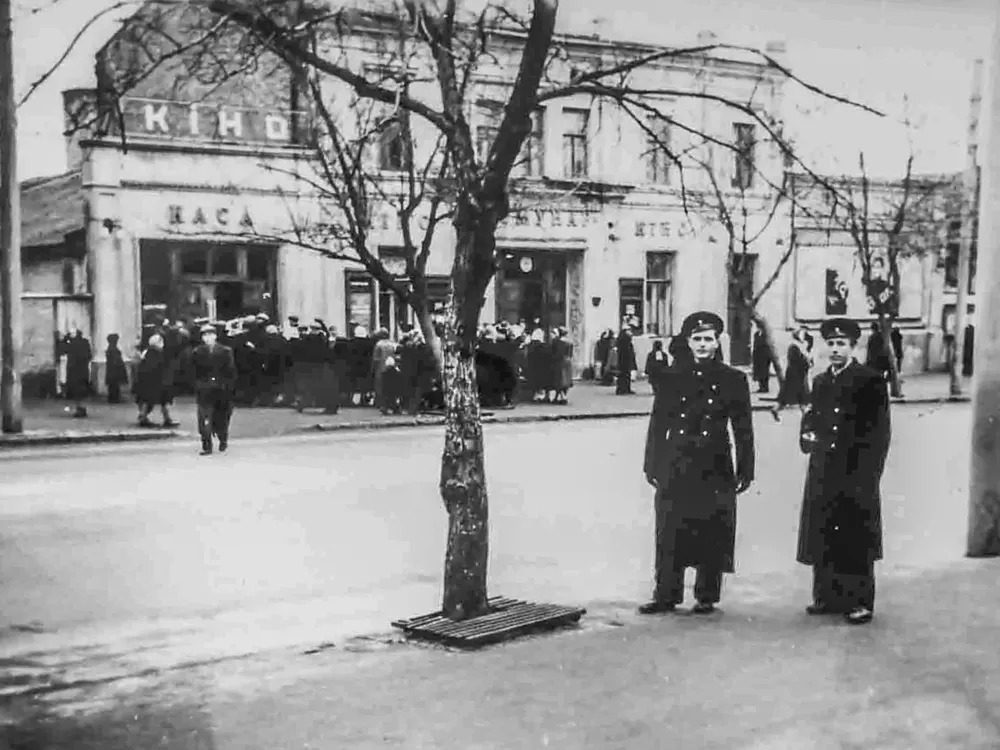
Komunar cinema, formerly Lux, on the site of Kyivska Rus, 1950s
Before we finally part with the imperial period of Lukianivka, we must, if only in passing, get acquainted with some of its residents of the time. All the more so as we shall be speaking mostly of, so to say, the real human treasure of the nation.
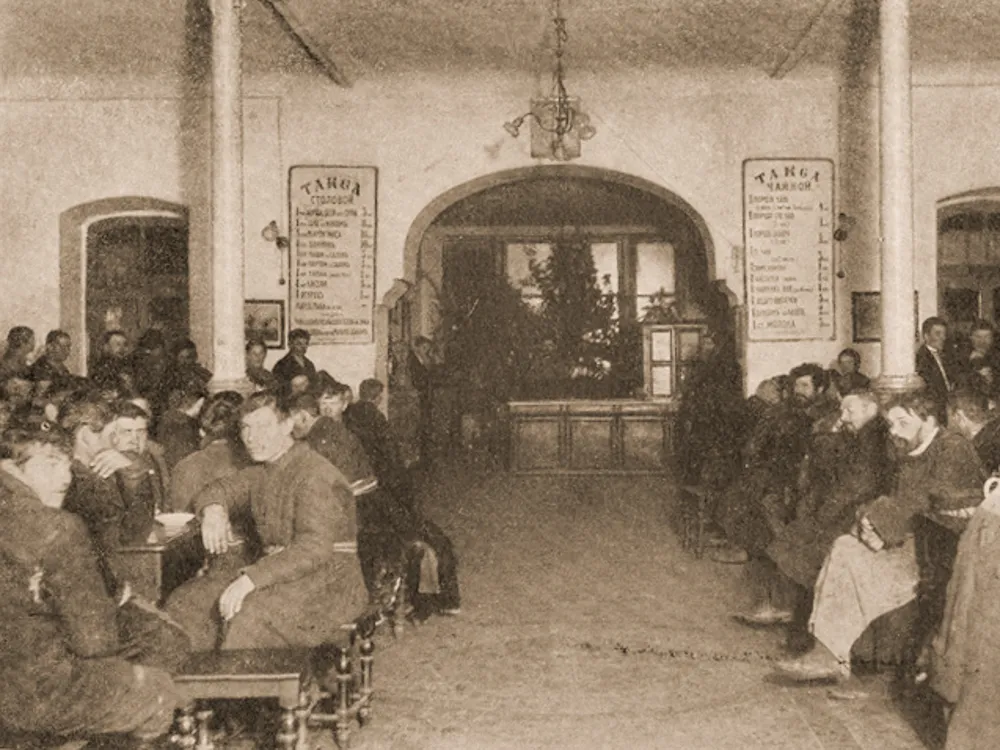
Tea and dining room of the Lukianivka People’s House, photo from the early 20th century
The area at the beginning of the 20th century was favoured here and there by the Kyiv intelligentsia and bohemia, mostly not of noble rank. People of decent but not excessive means chose to settle in spacious homesteads with small gardens, which, without excessive density, stretched here along picturesque streets – on the hills and in the ravines. Many Kyiv educators and doctors also moved to Lukianivka to live closer to their places of work. For, besides the hospitals and shelters already mentioned, specialists were also needed by institutions new to the district, such as
- the Sixth Boys’ Gymnasium, organized between 1908 and 1913 by the city mayor Ipolyt Diakov on today’s Illienka Street;
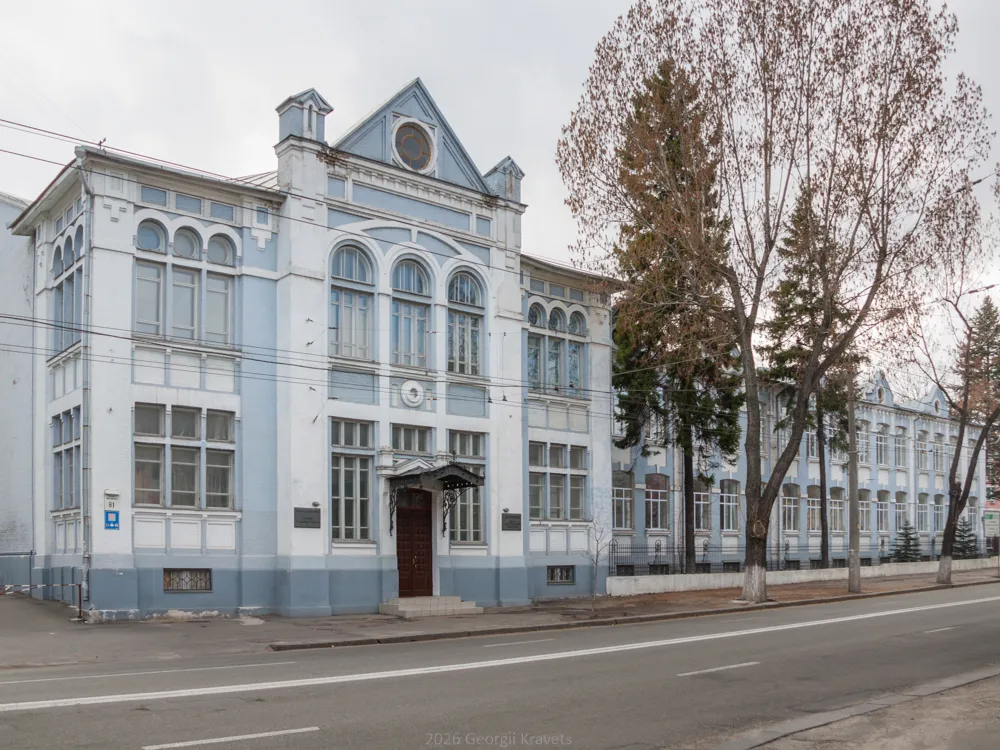
Former Sixth Boys’ Gymnasium, now Building No. 6 of Vadym Hetman Kyiv National Economic University, 79 Yuriia Illienka Street
- A sanatorium for the nervously and mentally ill, founded at the end of Ovruchska Street by the doctors Andrii Sikorsky and Mykola Horbunov;
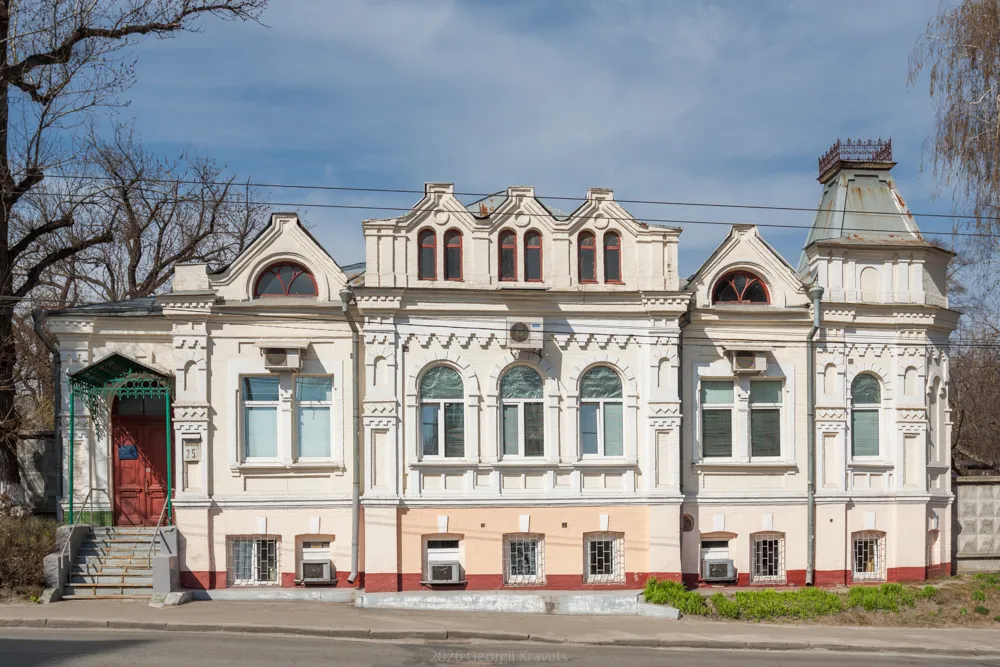
Former sanatorium for the nervously and mentally ill, founded at the end of Ovruchska Street by the doctors Andrii Sikorsky and Mykola Horbunov. Now the central laboratory of PJSC AK Kyivvodokanal, 25 Ovruchska Street
The Church Teachers’ Seminary, built in 1903 at the corner of today’s Romodanova and Zahorivska streets. Its first director was one of the key Ukrainian religious figures of the 20th century, the future creator and first Metropolitan of the Ukrainian Autocephalous Orthodox Church, Vasyl (Lypkivskyi). From the day of its opening the Ukrainian poet Oleksa Kovalenko also worked here. And in the pre-war years music lessons were given to the seminarians by renowned composers:
- Mykola Leontovych, author of the world-famous “Shchedryk”, and
- Kyrylo Stetsenko, founder of the Republican Chapel of the UNR.
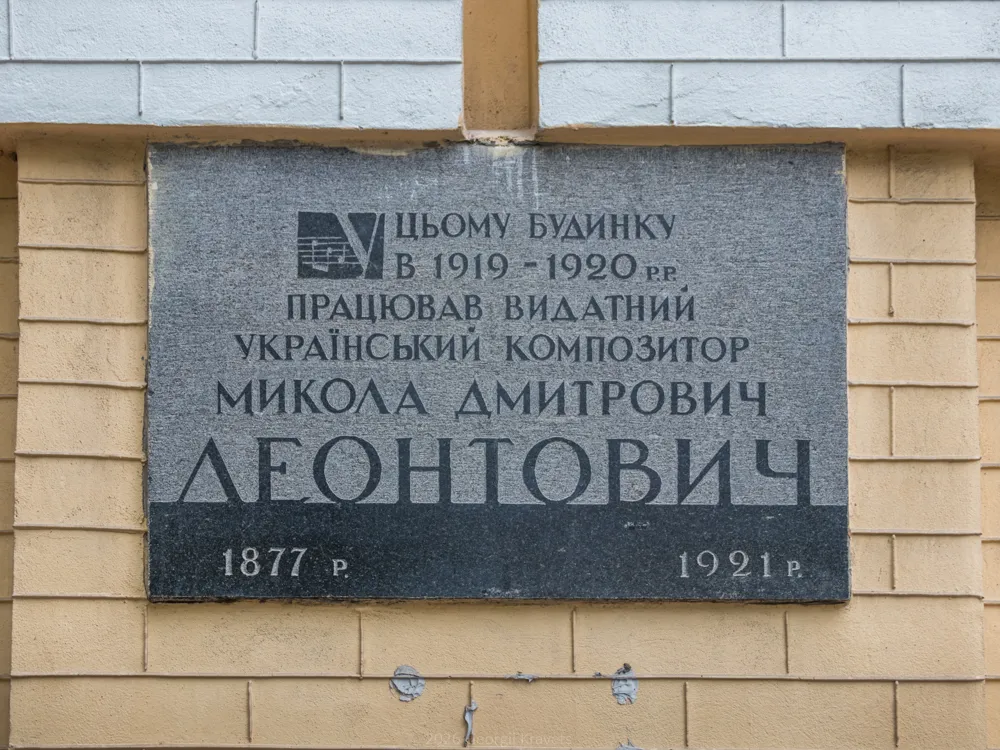
Memorial plaque to Mykola Leontovych on the façade of the former teachers’ seminary building, 12/2 Akademika Romodanova Street
The latter, moreover, is known for certain to have lived until 1910 in the mansion of the merchant Bernard Miller, now at 14 Illienka Street. Here he wrote for the theatre troupe of Mykola Sadovskyi the music for the play “Matchmaking in Honcharivka”.
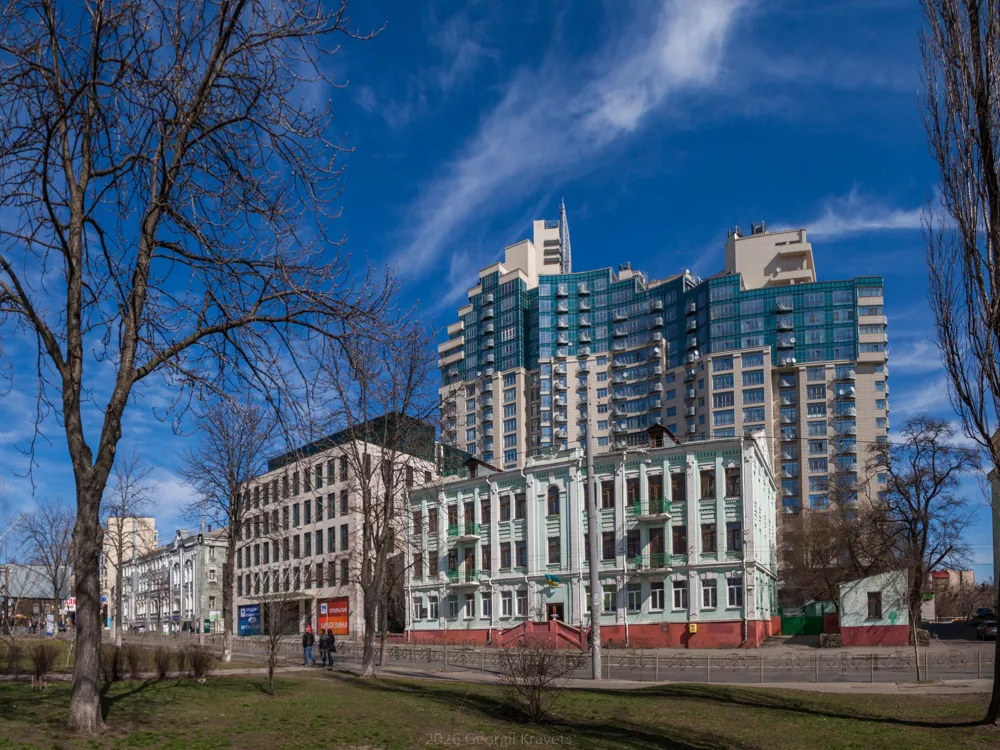
Former house of the merchant Bernard Miller, now the First Kyiv Medical College, 14 Yuriia Illienka Street
Another outstanding musician – the Polish pianist and teacher Henryk Bobiński – rented a small house for several years at 29 Ovruchska Street. This pleasant one-storey building in the Gothic style has survived to this day. By contrast, the estates on Zahorivska Street, where around the same 1910s Professor Yevhen Paton of the Kyiv Polytechnic Institute and the writer Konstantin Paustovsky lived, disappeared long ago.
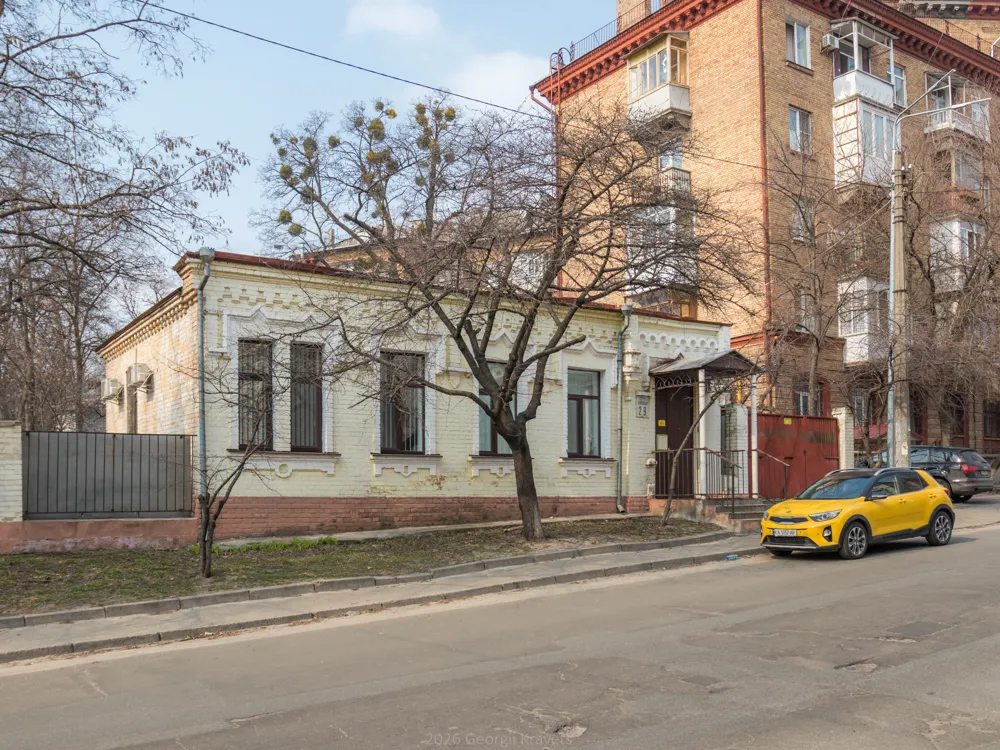
House at 29 Ovruchska Street
But it seems that the greatest number of biographies connected with Lukianivka are those of Ukrainian painters:
- In an apartment in one of the buildings of the Jewish Hospital passed the youth of the theatre artist Oleksandr Tyshler. The stage images of Shakespearean characters that he created later stand out for an expressiveness and whimsicality quite untypical of Stalin’s USSR.
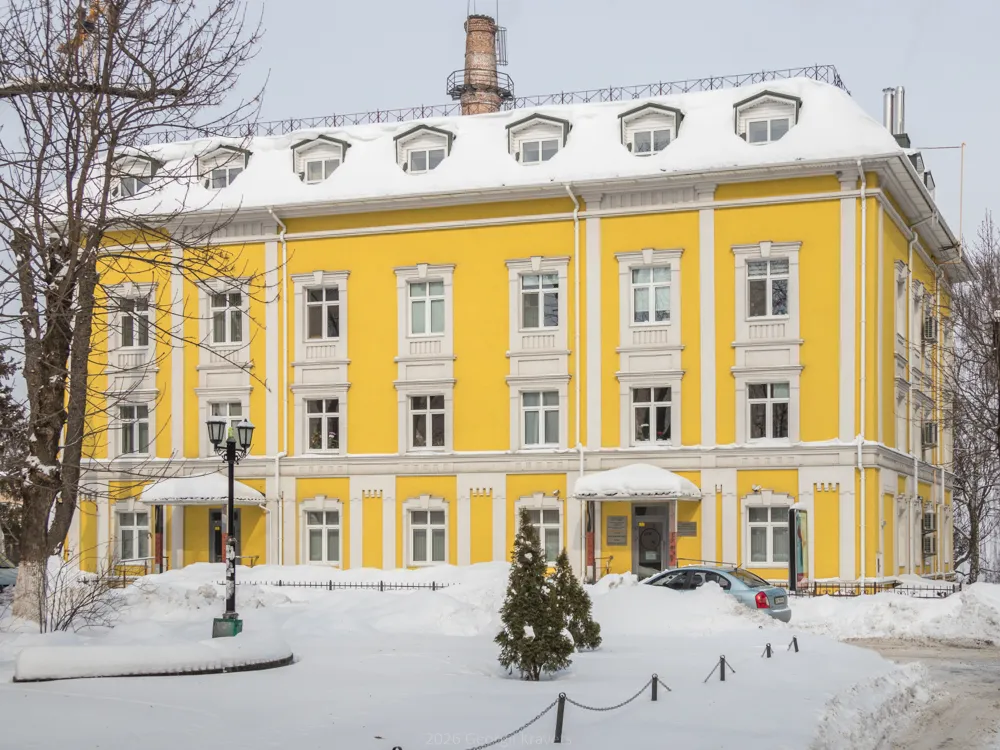
One of the buildings of the former Jewish Hospital, now Kyiv Regional Clinical Hospital No. 1, 1 Zahorivska Street
- The academician Ivan Seleznov is remembered mostly as one of the best teachers at Mykola Murashko’s drawing school and the Kyiv Art School. From 1914 he lived in a house at 8 Ovruchska Street.
- His former pupil, Oleksandr Bohomazov, around the same period taught drafting and drawing at the Tereshchenko shelter for the deaf-mute. Unlike his teacher, this artist is known to the world as one of the most prominent Ukrainian avant-gardists.
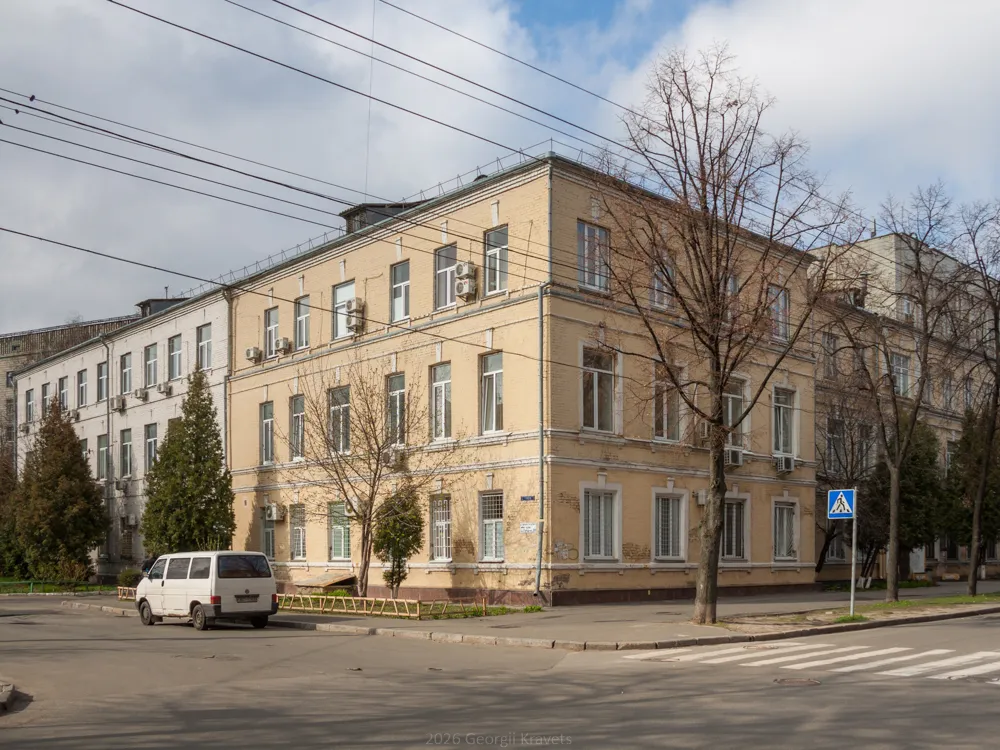
Building of the former school-shelter for deaf-mute boys, now the administration of Regional Clinical Hospital No. 1, 3 Akademika Romodanova Street
Yet it was truly defining and, alas, fatal role that Lukianivka played in the life of the probably foremost Ukrainian Impressionist painter. In 1910, having sold an apartment in the city centre, Oleksandr Murashko moved with his family to a private house at what was then 25 Baggovutivska Street. At the mansion he set up his studio, which soon became a magnet in Kyiv’s cultural milieu. What famous creative people did not visit here…
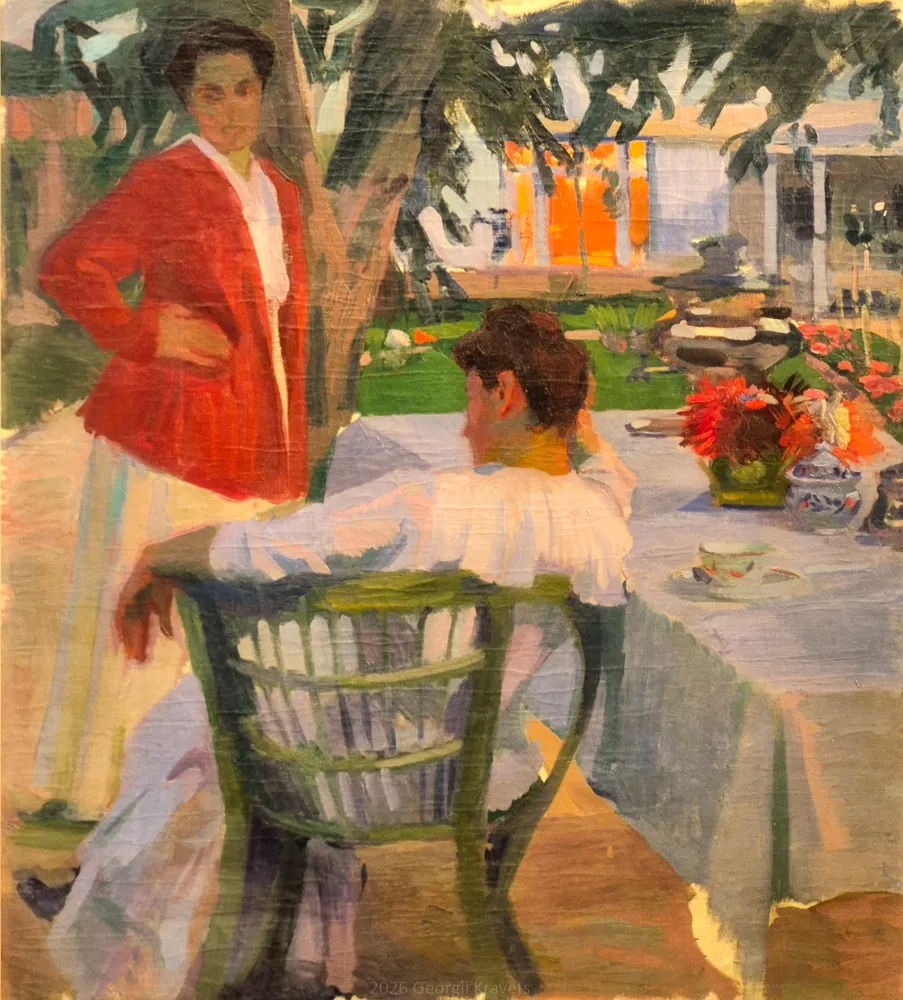
Painting “Twilight. At the Table”, Oleksandr Murashko, 1916
For Murashko himself the decade spent at the Lukianivka homestead became a period of maturity – of the fullest realization of his artistic potential and of considerable public activity. It was then that a significant share of his most acclaimed works was painted. And at the same time he proved himself a great leader of the country’s artistic life – in 1916 he was one of the founders of the independent society of Kyiv artists, and in 1917 of the Ukrainian Academy of Arts.
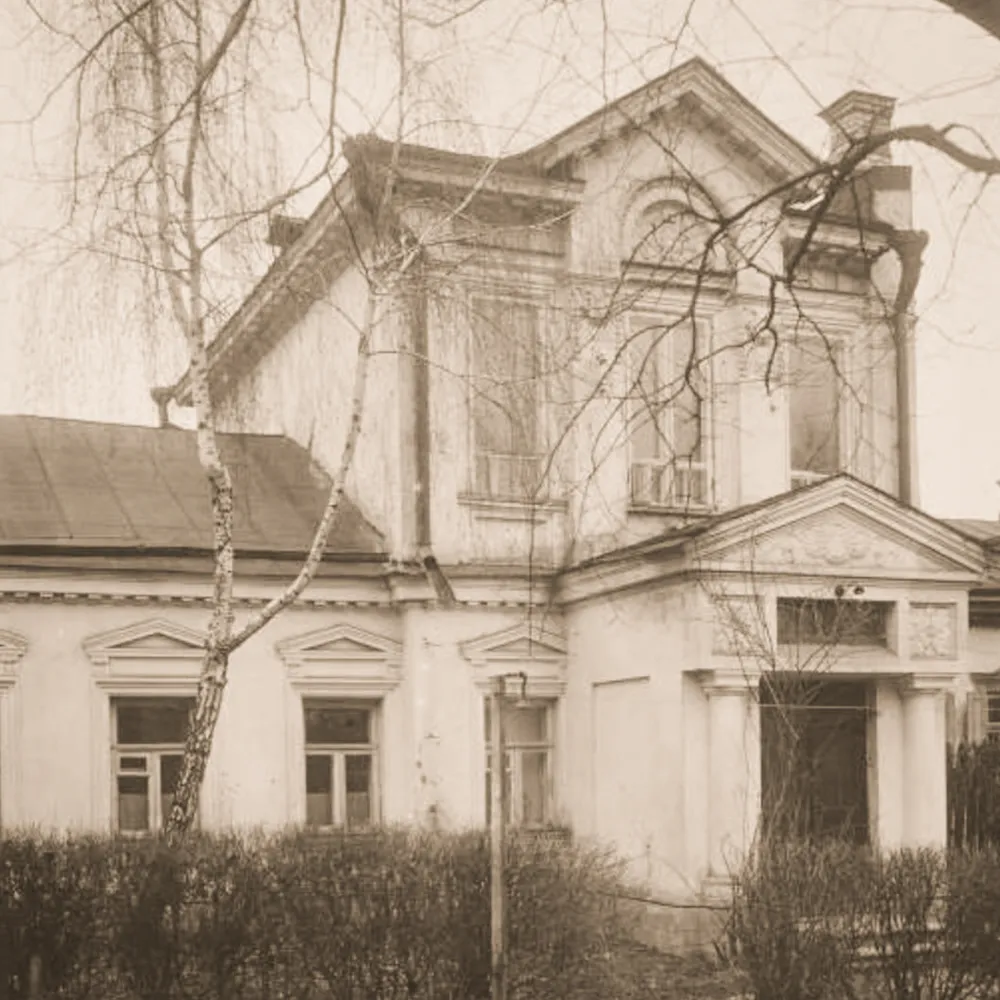
The Murashko house, Baggovutivska (now Zahorivska) Street, 25, photo from 1922, Documentary Archive Collection of the National Art Museum of Ukraine
And then, on the night of 14 June 1919, the artist was killed. By a shot to the back of the head. Right next to that famous house of his. Supposedly at the moment of a robbery by bandits. However, in those very days Kyiv was held by the Bolsheviks. And they had unleashed across the city a broad wave of terror against the Ukrainian community. Many of its patriotic representatives were arrested. Some were executed without trial. Murashko himself had previously been interrogated in a Cheka railway car. And, according to a convincing version, it was those same Chekists who arranged his murder.
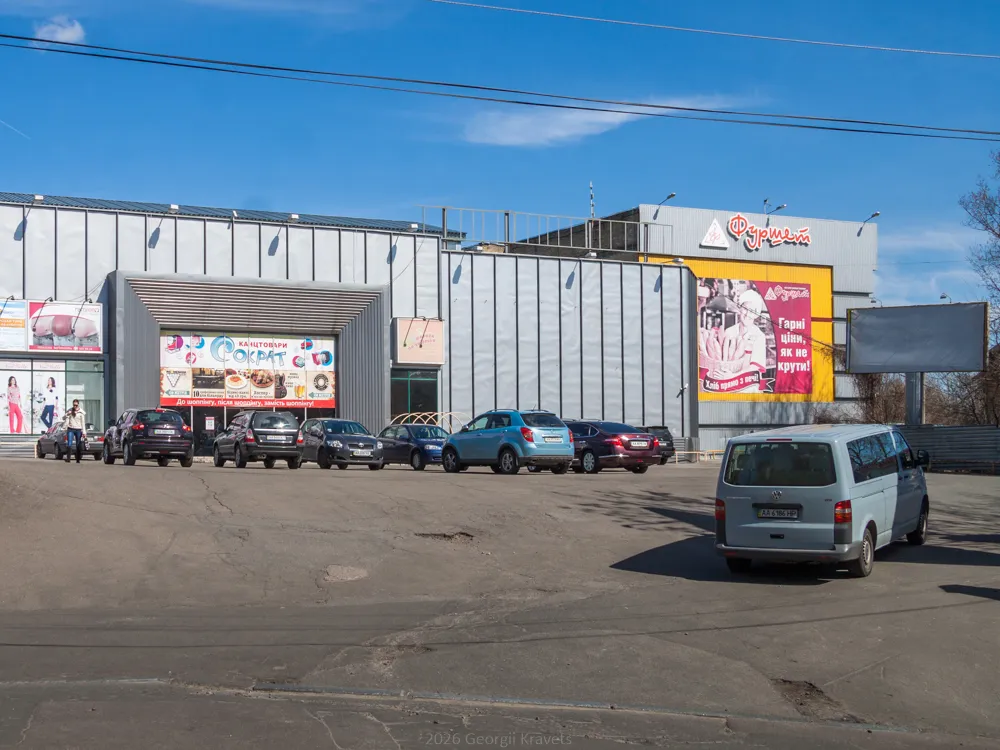
Car park of the Promenada shopping centre, approximately on the site of the Murashko homestead
But this is not yet the whole drama. Some of Murashko’s friends later named among the co-organizers of that fatal attempt on the artist… a man whose weight in the national cultural process is no less than Murashko’s. According to these accounts, the genius of Impressionism’s death may have involved the actual father-creator of the innovative art of the next era. Namely, the monumentalist master, Neo-Byzantinist, founder of an expressive national style and a distinctive school bearing his own name… Mykhailo Boichuk.
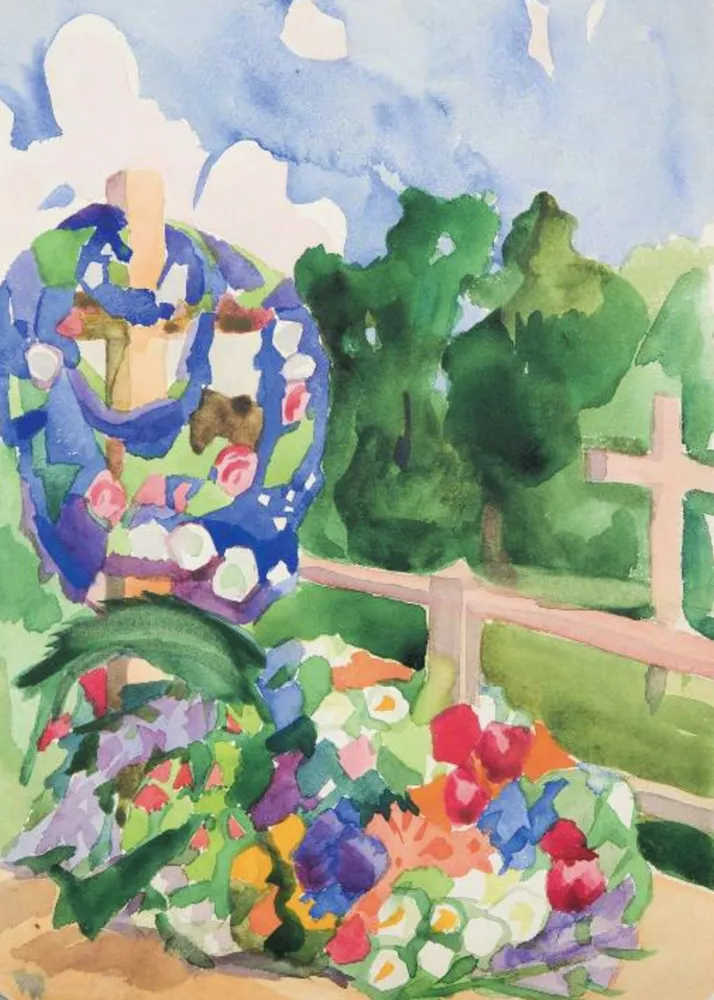
Grave of Oleksandr Murashko at the Lukianivka Cemetery, watercolour by an unknown artist, 1919, Documentary Archive Collection of the National Art Museum of Ukraine
Yet, apart from these not very reliable accounts, there is in this story also a telling and indisputable fact. And, from the point of view of the change of eras, perhaps a far more symbolic one. In that evil summer of 1919, when Oleksandr Murashko was killed, at the opposite edge of Lukianivka an act of creating a new painting was taking place – revolutionary in every sense of the word. The premises of the Lutsk Barracks, then occupied by Red Army soldiers, were being painted by a team of artists led by that same Mykhailo Boichuk. His pupils diligently covered all the interior walls with agitational subjects of a Bolshevik kind. The compositions were titled, for example: “Carouse, Soul, Without a Kuntush”, “The Struggle with the Two-Headed Eagle” or “The Battle with the Hydra of Counter-Revolution”. In short, the customer, the Red military commissar Podvoisky, must have been satisfied with the grandeur of the execution.
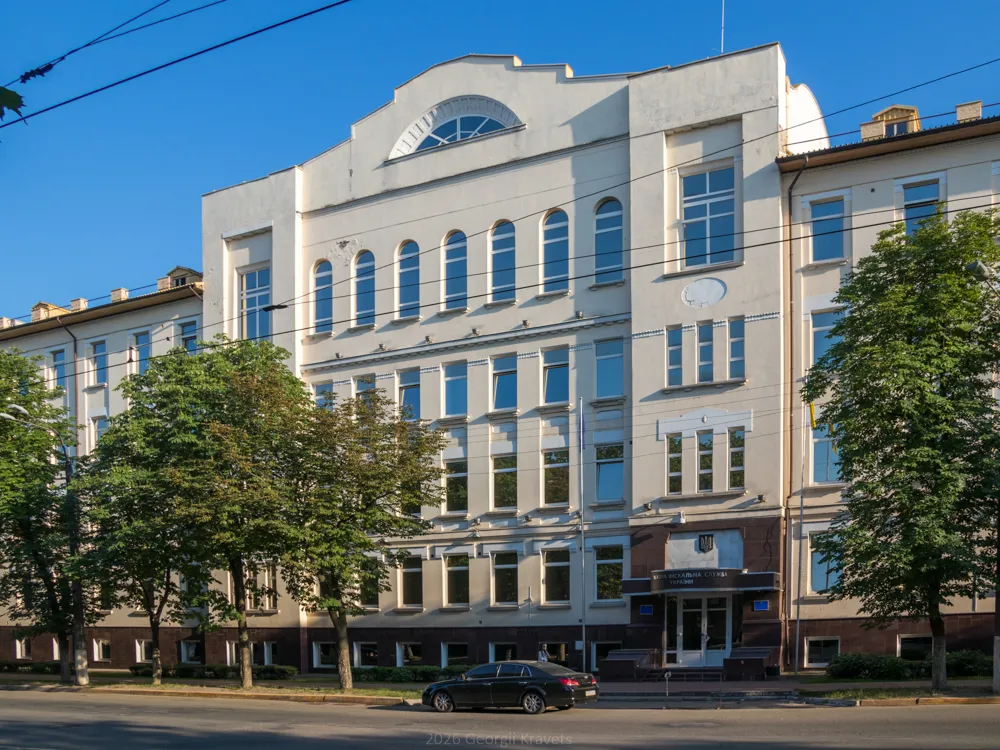
Former Lutsk Barracks, 11 Dehtiarivska Street
The interwar period left a clear mark on Lukianivka. Of the aura of a cosy aristocratic centre almost no trace remained here in the first twenty years of Soviet rule. Income houses went to communal apartments, state institutions were housed in mansions, and some of them were taken as residences by the new red masters of life. Adding along the way a peculiar “socialist” splendour to everything. Meanwhile, the outskirts were industrializing before one’s eyes, and industrial capacity swallowed more and more recreational spaces and the few places still untouched by civilization. Also, as an incidental feature of the area in this period one may note the following: unlike most places, a significant number of prominent Ukrainian intellectuals who lived here then miraculously survived the days of Stalin’s terror. So what follows is partly about a battered but still unshot national revival. Truly, many Ukrainian talents managed to flirt with the young Soviet power in the years of its formation. In Lukianivka alone – in the People’s House, renamed the Workers’ Club – Les Kurbas and Ivan Karpenko-Karyi began staging their progressive theatrical performances. In the former Sixth Gymnasium, converted into the Ivan Franko School, the writer Stepan Vasylchenko, a founder of Ukrainian Soviet children’s literature, worked as a teacher.
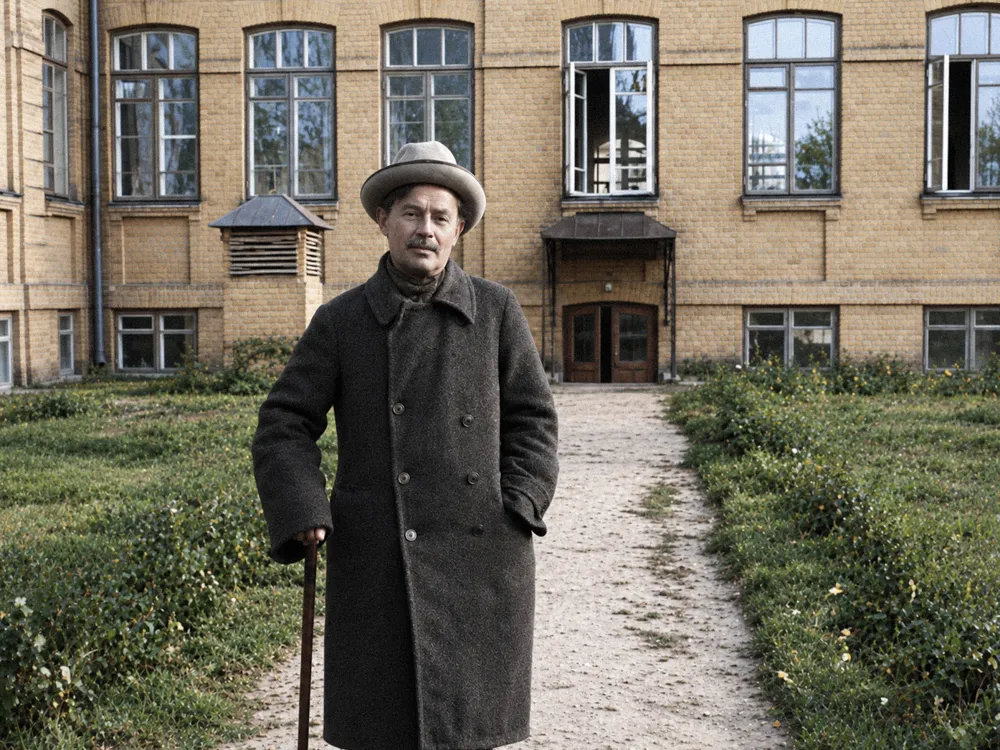
The writer Stepan Vasylchenko on his fiftieth birthday against the background of the Ivan Franko School, the former Sixth Gymnasium, colourized frame from the newsreel Kinotyzhden No. 7/102, 1929
The famous Ukrainian botanist and plant breeder Mykola Kashchenko set up, at the border of what was then Dorohozhytska Street and Babyn Yar, one might say, an entire open-air scientific experimental laboratory.
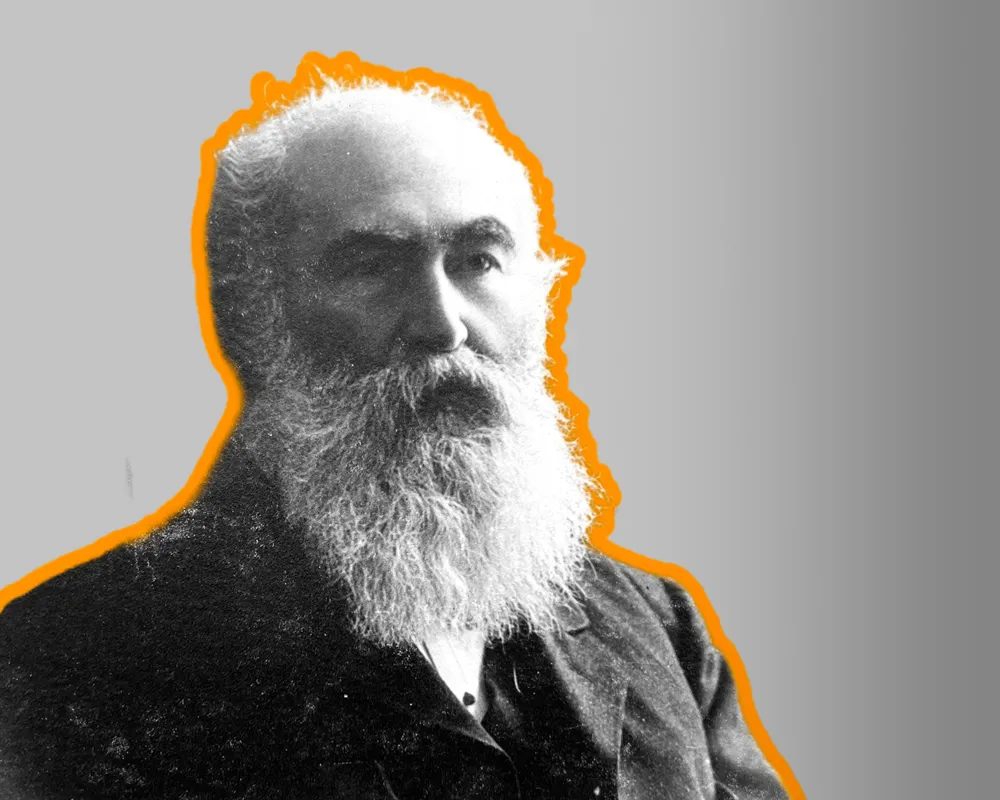
Mykola Kashchenko, photo from 1910
This was an acclimatization garden on a plot of about twelve hectares, where for a decade and a half the scientist worked on breeding new varieties of plants and fruit trees adapted to the local weather conditions. Such as apricots, pears, quinces, grapes and so on. Hence the varieties too – the Kyiv Early and the August peaches of Kashchenko, or the Bahriante apple tree bearing his name. However, it would be fair to add that the professor had to move to Lukianivka from the grounds of the Kyiv Polytechnic Institute in the early 1920s as a result of the so-called proletarianization of the university. And he launched his activity here at first so that his large family would not perish from poverty and hunger.
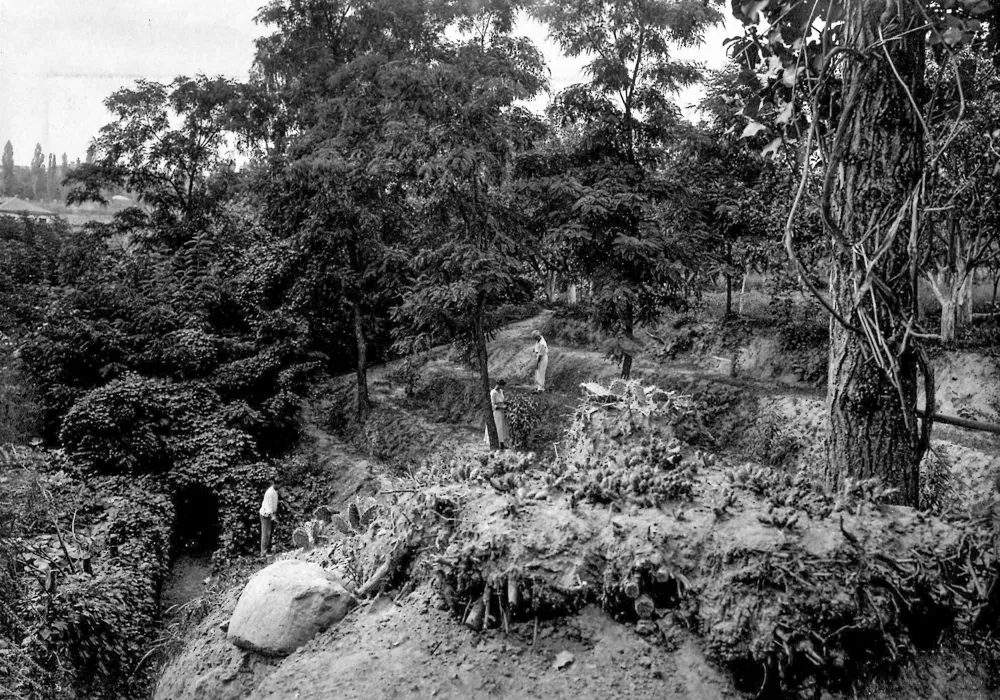
Cactus rockery and peach terraces in Mykola Kashchenko’s Acclimatization Garden, first half of the 1920s
In the 1980s the Soviet authorities decided to build on the site of Kashchenko’s garden the complex of the Higher Party School of the Central Committee of the Communist Party of Ukraine. And cut down absolutely everything. Of thousands upon thousands of bushes and trees only one plane tree survived. And even that is now hidden in a closed courtyard between the dormitories of the institutes of journalism and international relations.
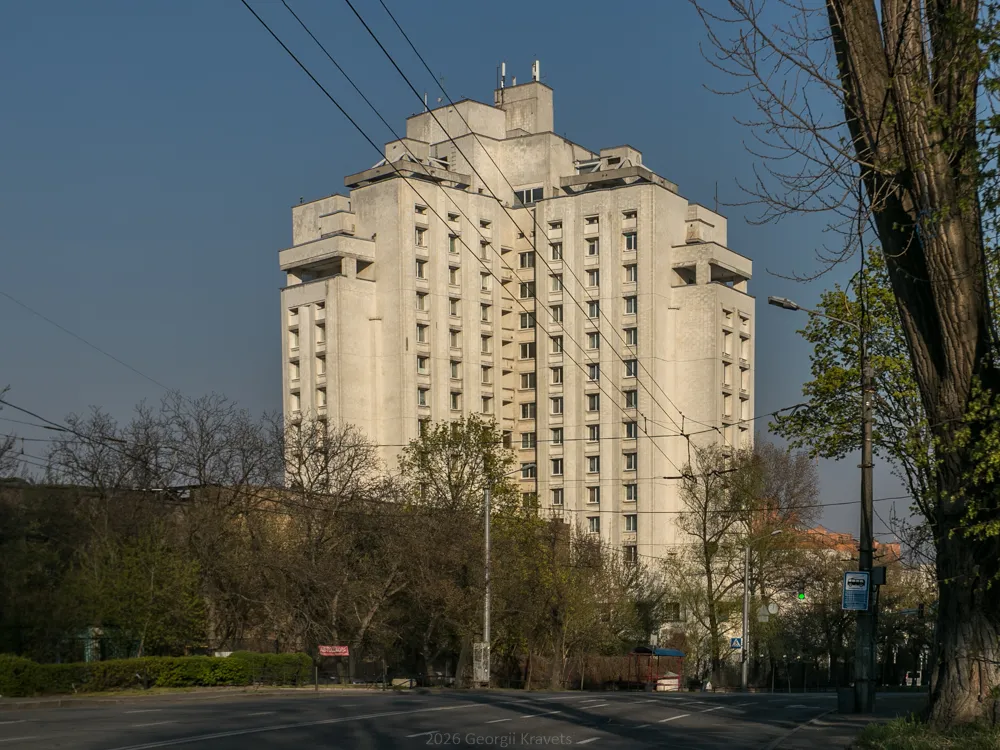
Dormitory of the Institute of International Relations and the National Academy of Public Administration under the President of Ukraine, in whose courtyard Kashchenko’s plane tree stands, 36 Yuriia Illienka Street
In general, the interwar years, also called the interbellum, were marked for the Kyiv outskirts by a clear intensification of militarization and industrialization. On Dehtiarivska Street, eventually renamed Red Commanders Street, the giant of Soviet machine-building, the Budshliakhmash plant, was built, and next to it – the largest bread factory in the city, No. 4.
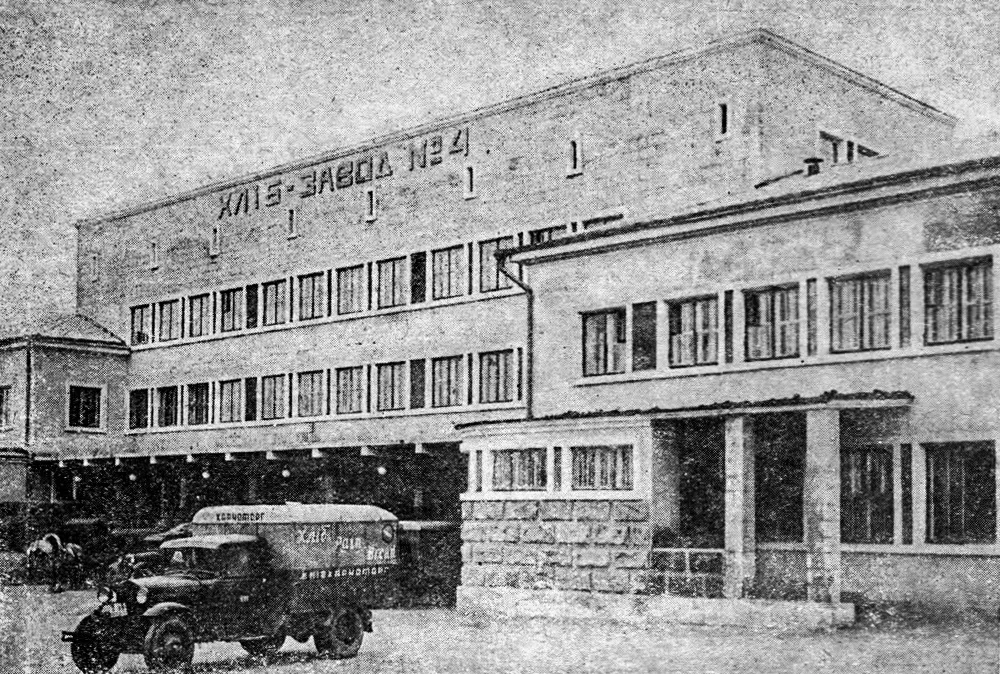
Bread Factory No. 4, 17A Dehtiarivska Street, photo from 1936
The former Degterev Almshouse, after the children’s town, was taken over by the 45th Division, and after it by a tank-technical school. Ukrkabel and Artem expanded. At the beginning of Hlybochytska Street a plant for flour-milling and grain-elevator machinery was set up, and on Kahatna Street, next to the freight station, auto-armoured-vehicle and tank repair plant (ABTRZ) No. 8.
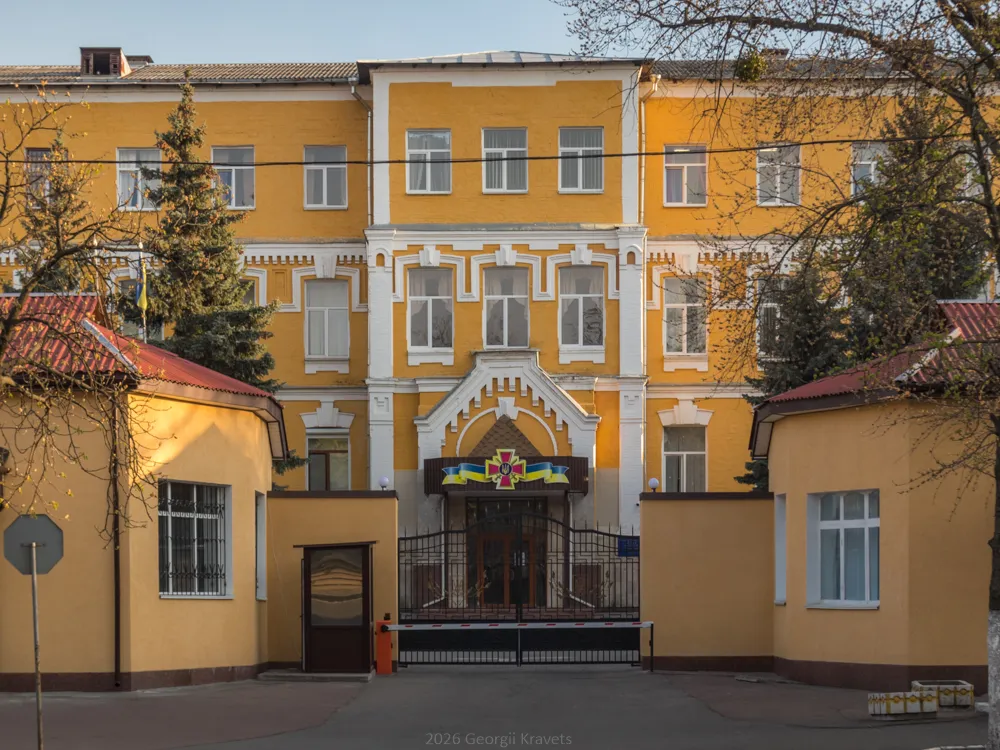
Former main building of the Degterev Almshouse, 19 Dehtiarivska Street
The architectural aesthetics of the area also changed radically. As is known, Constructivism became established as the dominant style in the first Soviet five-year plans. All newly built structures had to conform to its key principles – functionality and geometry.
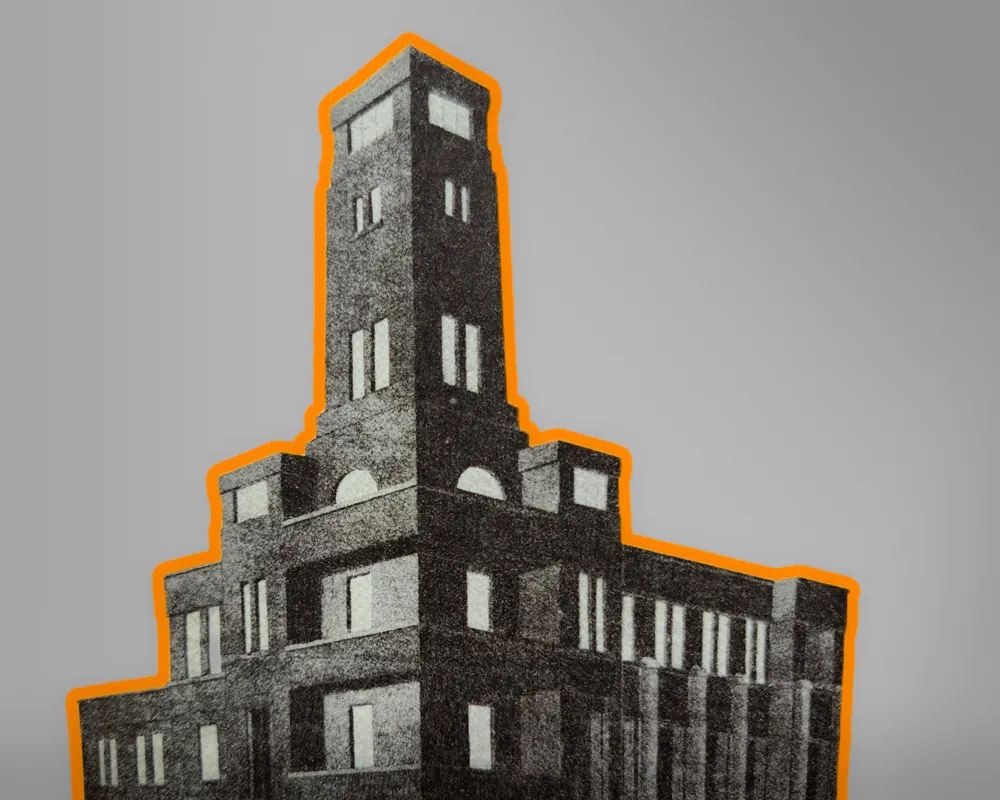
Design for the fire station of the District Communal Economy Department, 1927
And, incidentally, the Kyiv firstborn of this ascetic output was a building precisely in Lukianivka. This is the Fire Station of the District Communal Economy Department, whose construction was completed in 1927 on what was then Lahernа Street.
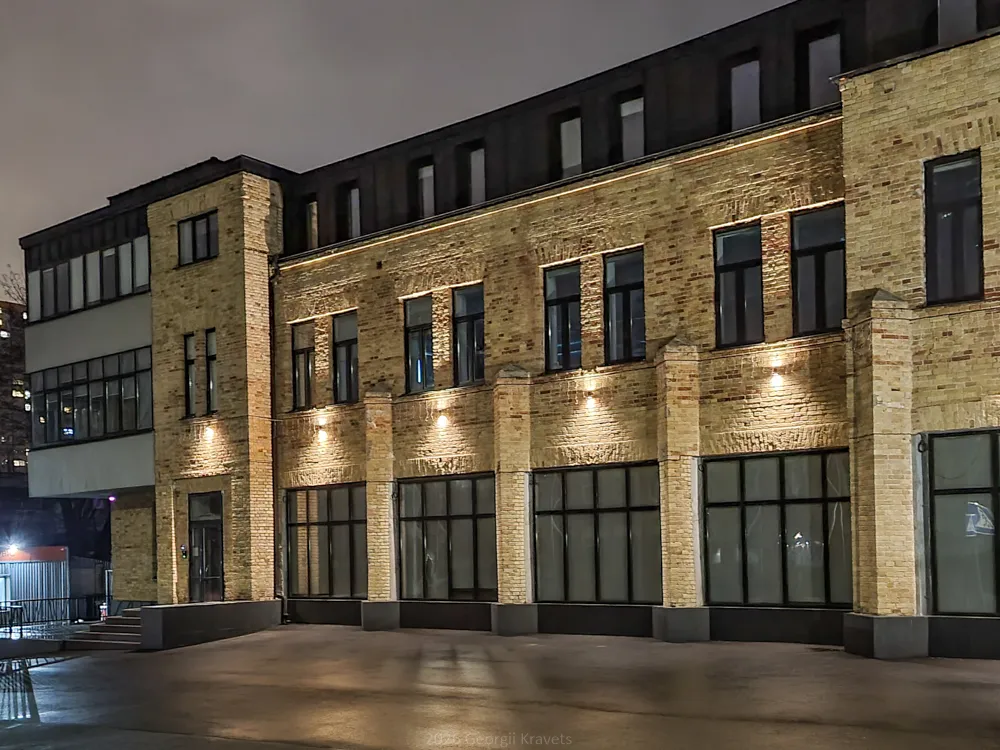
Former Fire Station of the District Communal Economy Department, 11 Rostyslavska Street
The author of the design, the architect Mykhailo Anichkin, soon built nearby, in the blocks of today’s Dovnar-Zapolskoho and Kopernyka streets, an entire advanced residential complex for metalworkers.
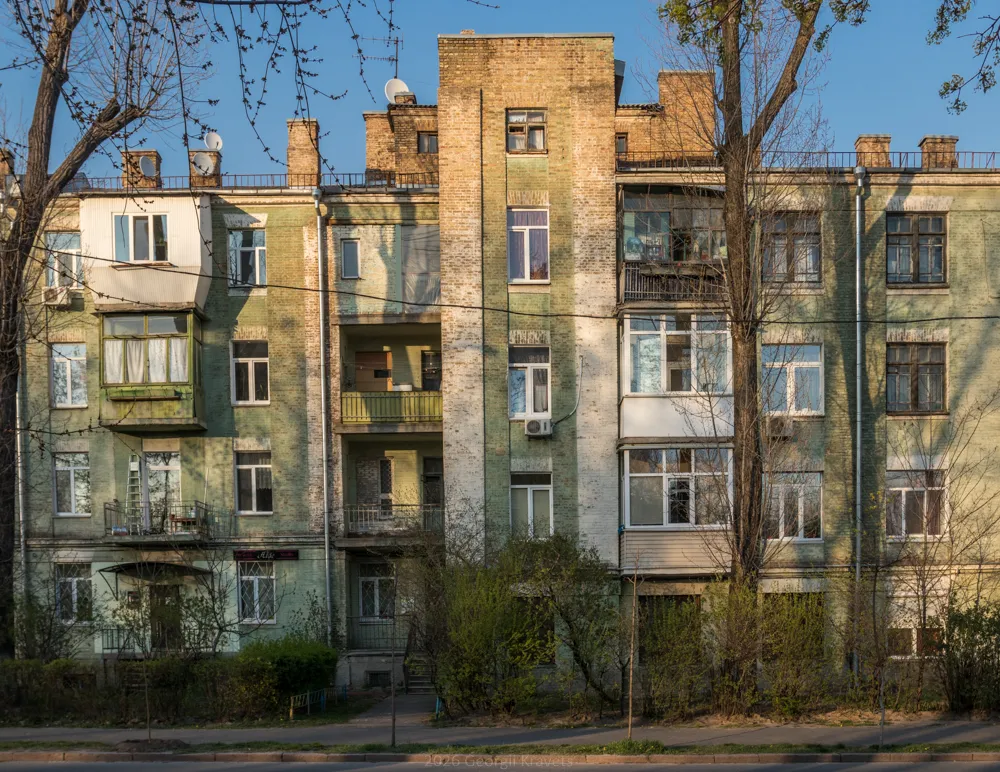
Residential complex for metalworkers, corner of Mytrofana Dovnar-Zapolskoho and Kopernyka streets
Architecture researchers also regard as a unique late Constructivist work the interesting arc-shaped building at 81B Illienka Street. In recent decades it has housed the state penitentiary service, and in Soviet times Kyivans knew it as the main building of the Pokryshkin Kyiv Higher Engineering Radio-Technical School of Air Defence (KVIRTU PPO). It is not known exactly when, by whom and for what purpose this structure was built. According to the main assumptions, it was designed in the early 1930s as the rear headquarters of the Kyiv Military District by the greatest Kyiv architect of his era – Iosyp Karakis.
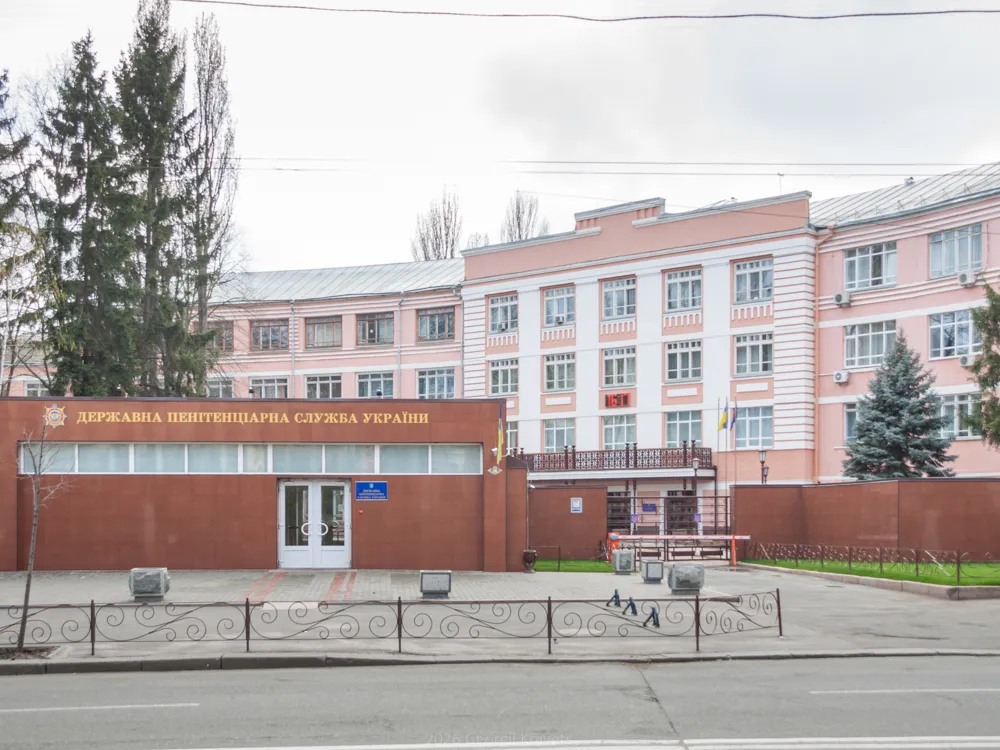
Building of the state penitentiary service, 81B Yuriia Illienka Street
In the block adjoining the former KVIRTU building, at the corner of Illienka and Derevlianska, stands an expressive monument of the transitional style from Constructivism to Stalinist Empire. This is the former building for employees of the People’s Commissariat of Internal Affairs of the USSR. And its appearance here in the mid-1930s, as logic suggests, was connected with the settling nearby in Lukianivka at that time of the head of the police department.
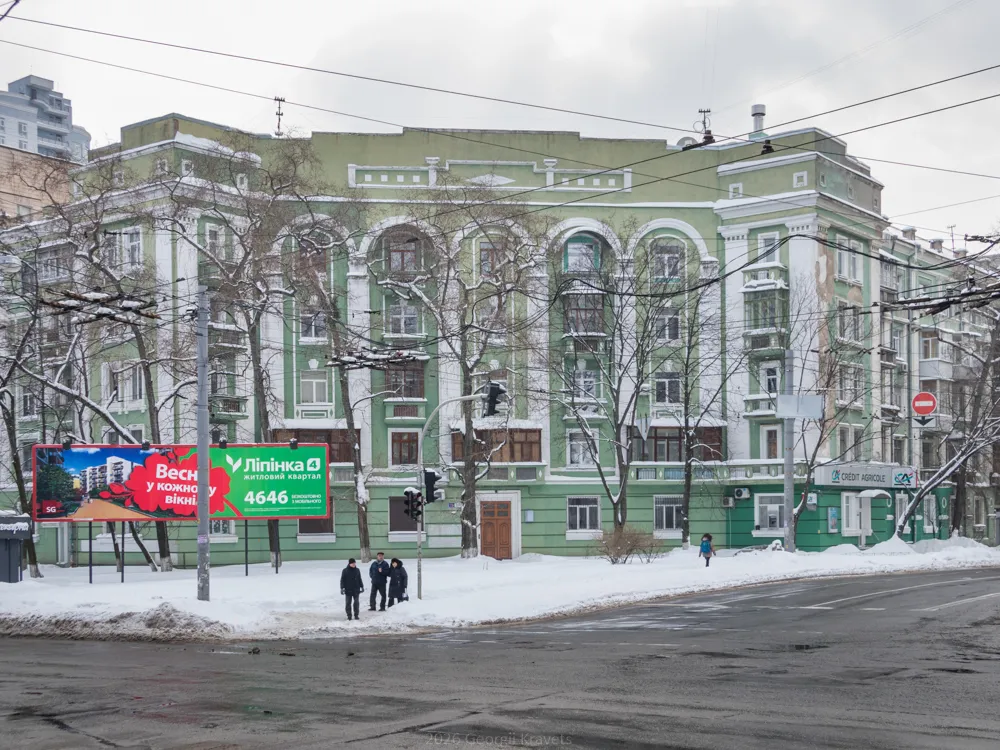
Former building for employees of the People’s Commissariat of Internal Affairs of the USSR, 75 Yuriia Illienka Street
Vsevolod Balytskyi had taken part in Bolshevik punitive actions on the territory of Ukraine since the days of the National Liberation Struggle. Eventually he became People’s Commissar of Internal Affairs of the Ukrainian SSR and in that capacity implemented, by ferocious methods, the policy of dekulakization and collectivization on our lands. He was one of the most active organizers of the Holodomor. And then, when the Soviet occupation administration was moved from Kharkiv to Kyiv in 1934, the commissar chose for his residence a huge estate with a luxurious park at the head of the Kmytiv Ravine.
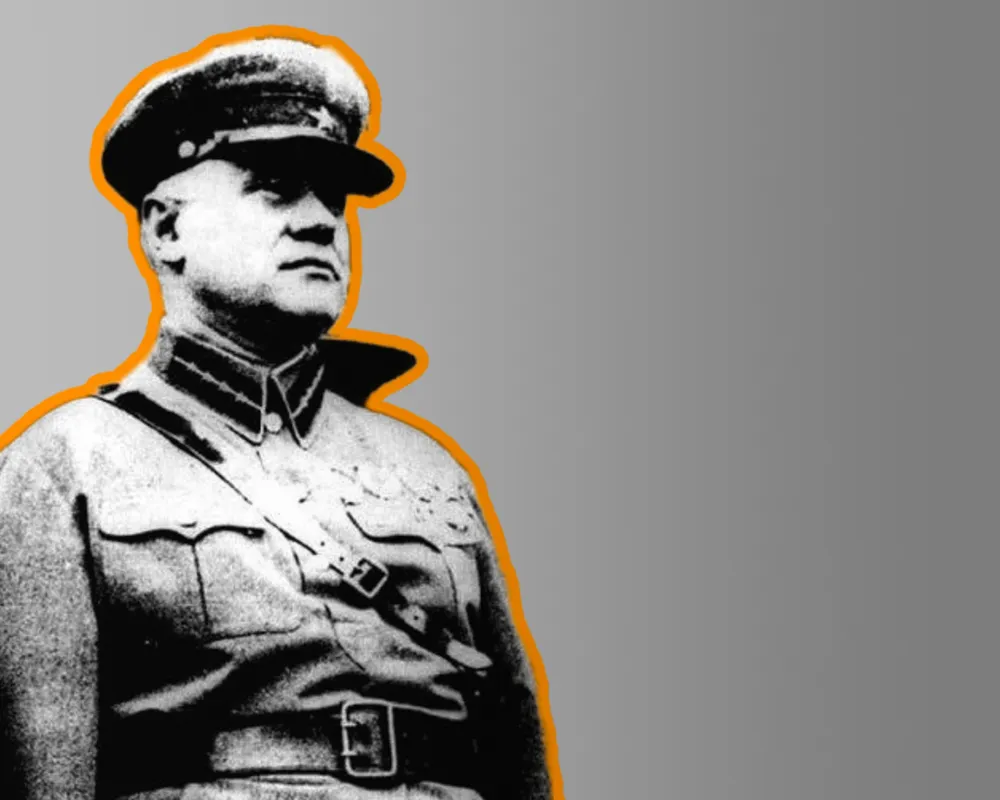
People’s Commissar of Internal Affairs of the Ukrainian SSR Vsevolod Balytskyi, photo from the 1930s
Today this location is usually called Khrushchev’s Dacha. But it was the ghoul Balytskyi who turned it into something like Yanukovych’s Mezhyhiria in its day. By his orders numerous gazebos and statues were placed around the grounds, cages with animals were made and little bridges built over the ponds.
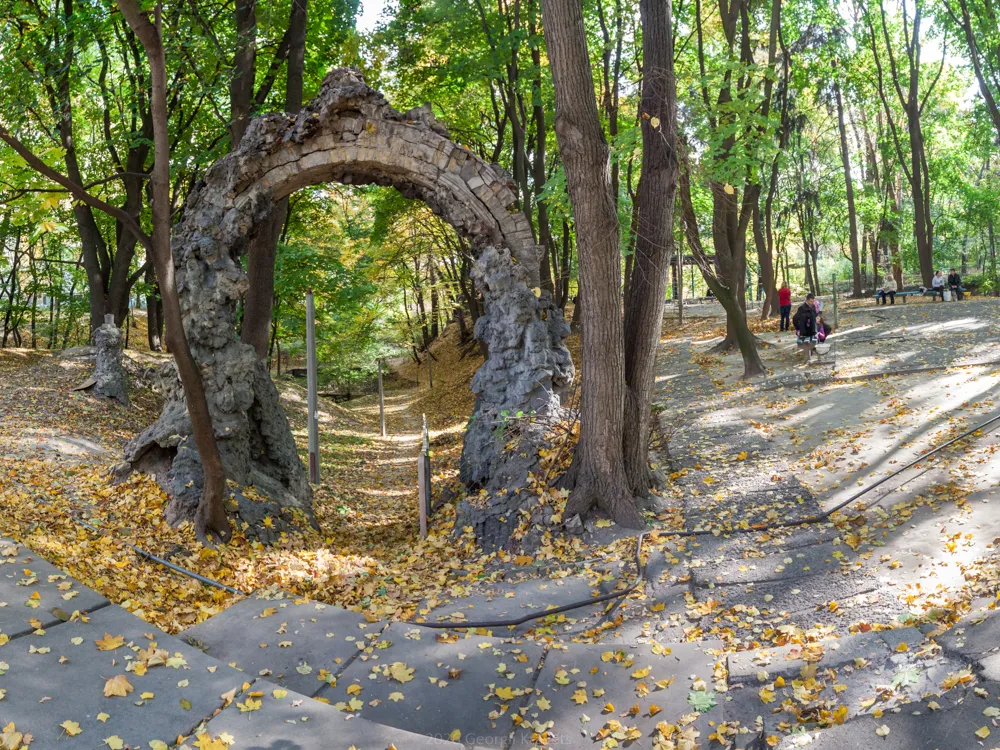
“Khrushchev’s Dacha”, now the grounds of the Institute of Pediatrics, Obstetrics and Gynecology, 8 Platona Maiborody Street
All this beauty was perhaps meant to lend greater zeal to the unfolding of the infamous Stalinist terror of 1937. But, typically, the bloody executioner did not live to the end of that year – already in November he was himself shot.
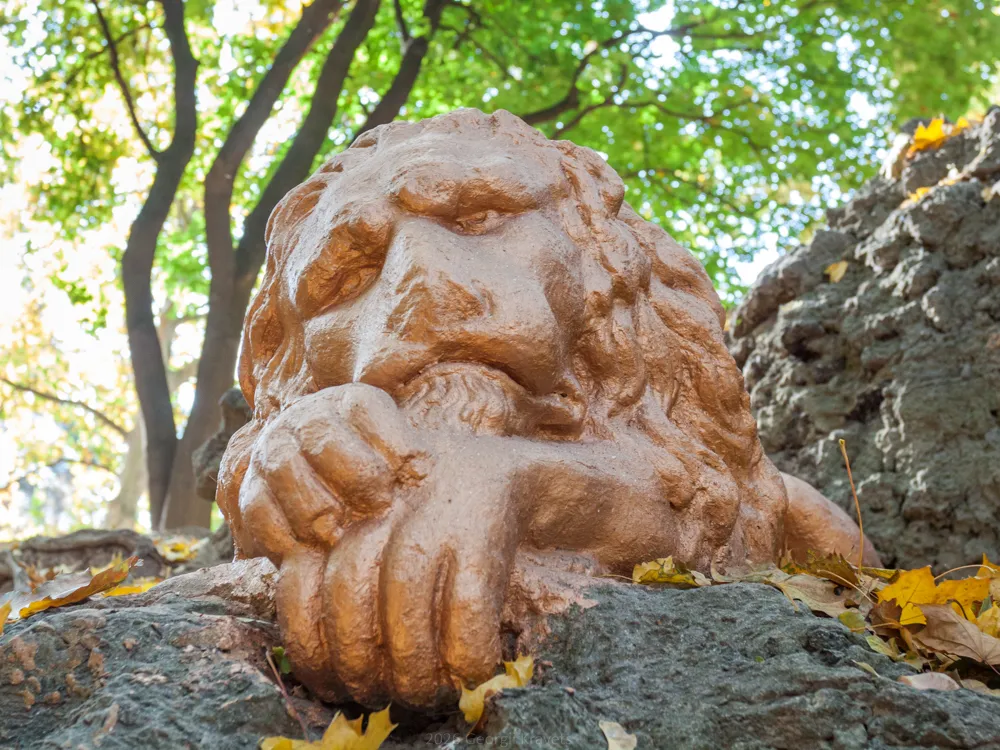
Sculpture of a lion, “Khrushchev’s Dacha”, now the grounds of the Institute of Pediatrics, Obstetrics and Gynecology, 8 Platona Maiborody Street
The history of the estate on today’s Herzen Street begins in 1889, when this land was bought by the future pharmacist Oktavian Bilskyi. He built here two small Neo-Renaissance mansions. In the 1920s the Communists nationalized them, and turned the grounds into a park for public recreation. After the Balytskyi episode a pioneer camp for the children of NKVD employees briefly operated here. With the return of Kyiv to Red Army control in 1943, the de facto head of Soviet Ukraine, Nikita Khrushchev, moved here. After that, as a government restricted-access facility, the estate existed until the early 1970s, when the then First Secretary of the Central Committee of the CPU, Volodymyr Shcherbytskyi, handed it over to the Institute of Pediatrics, Obstetrics and Gynecology. It seems a certain irony of fate, but in the end it was Shcherbytskyi who began fitting out the territory of the Cossack monastery at Mezhyhiria, destroyed by the Communists, as his own country residence.
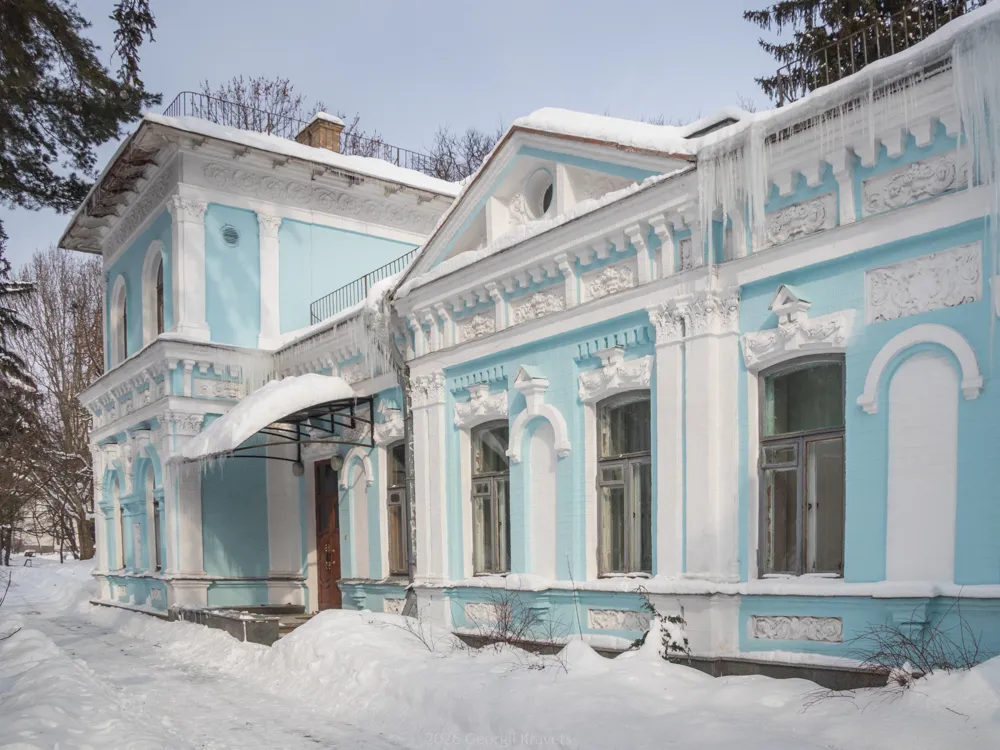
Former mansion of Oktavian Bilskyi, architect Mykola Kazanskyi, 1893, now a building of the Institute of Pediatrics, Obstetrics and Gynecology
Returning to the interwar years, and to Ovruchska Street, adjacent to Herzen Street, let us give somewhat more attention to the building at number 6, where the Embassy of Libya now operates. In this mansion after 1925 lived out her days perhaps the most wide-ranging public figure in Ukraine at the turn of the 19th and 20th centuries – the first Ukrainian feminist, writer, translator, patron, publicist, ethnographer and folklorist, and on top of that mother of the poet Lesya Ukrainka and sister of the historian Mykhailo Drahomanov – Olha Petrivna Kosach, better known by her pen name, Olena Pchilka.
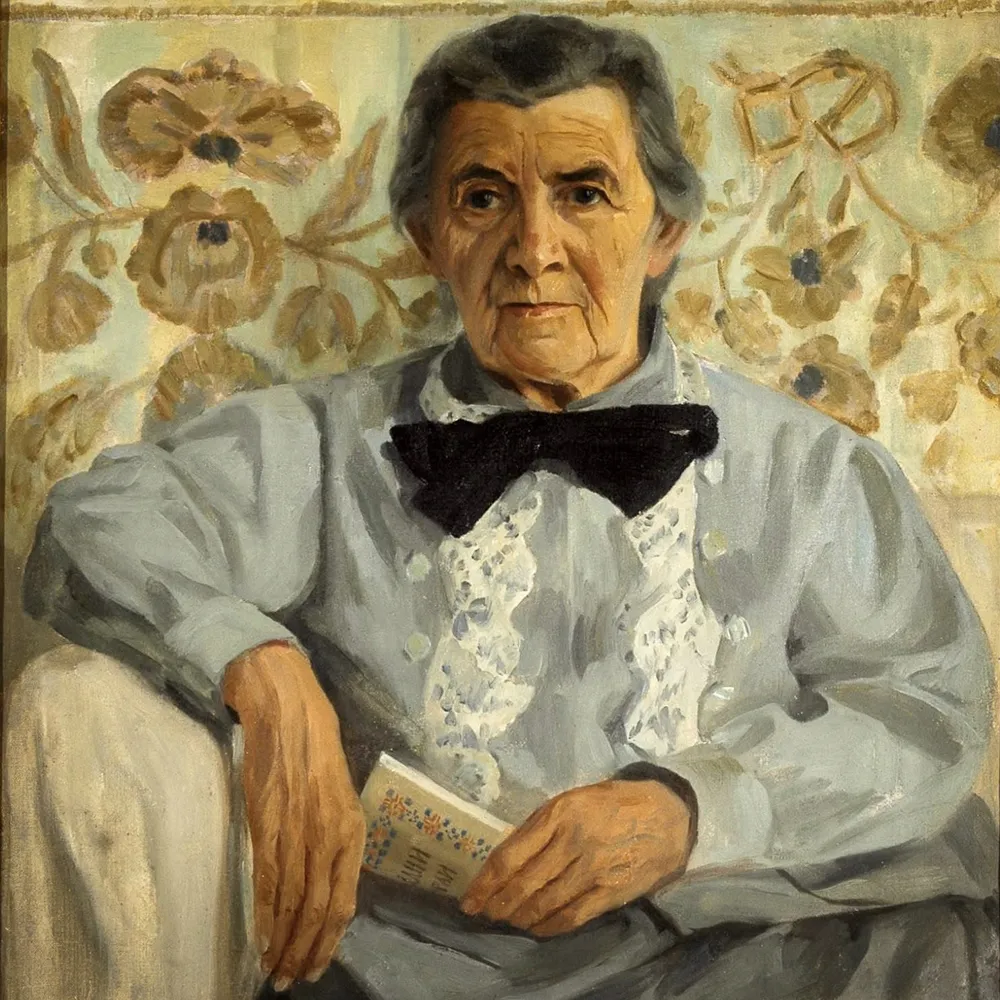
Olena Pchilka, portrait made for the gallery of scholars commissioned by the Ukrainian Academy of Sciences, Fotii Krasytskyi, 1927
With some three quarters of a century behind her, Mrs. Kosach in Kyiv’s Lukianivka was in effect kept by the Soviet leadership in honourable disgrace. Until her death she worked on the commissions of the Ukrainian Academy of Sciences. She mostly worked from home. Here, in a four-room apartment on the second floor, she lived with the families of her daughters – Izydora Kosach-Borysova and Olha Kosach-Kryvyniuk.
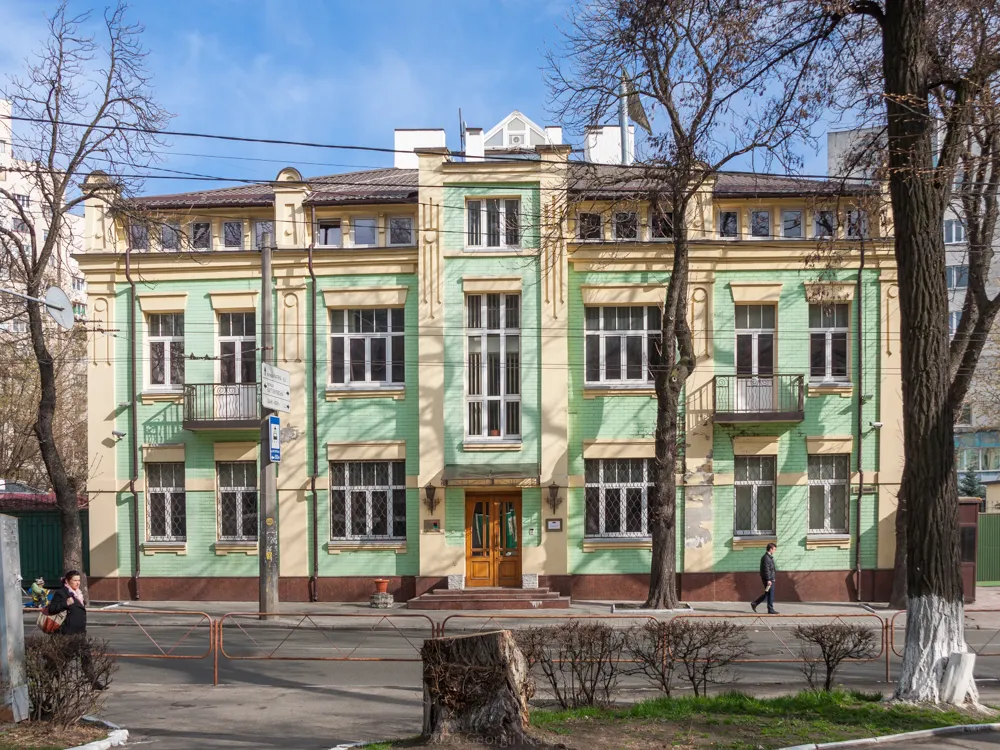
“Olena Pchilka’s House” in Lukianivka, mansion, 6 Ovruchska Street
In 1929 officers of the State Political Directorate (DPU) descended on the Kosachs’ house with searches. They carried out a so-called raid, confiscated family correspondence, and, finally, nearly arrested the eighty-year-old Olena Pchilka. For active participation in counter-revolution. This brutal action evidently finished off the already utterly frail woman. Things turned serious for her daughters as well. Olha’s husband, Mykhailo Kryvyniuk, was detained on the spot. He was sent off in a convoy, and only by a miracle did he receive just a suspended sentence.
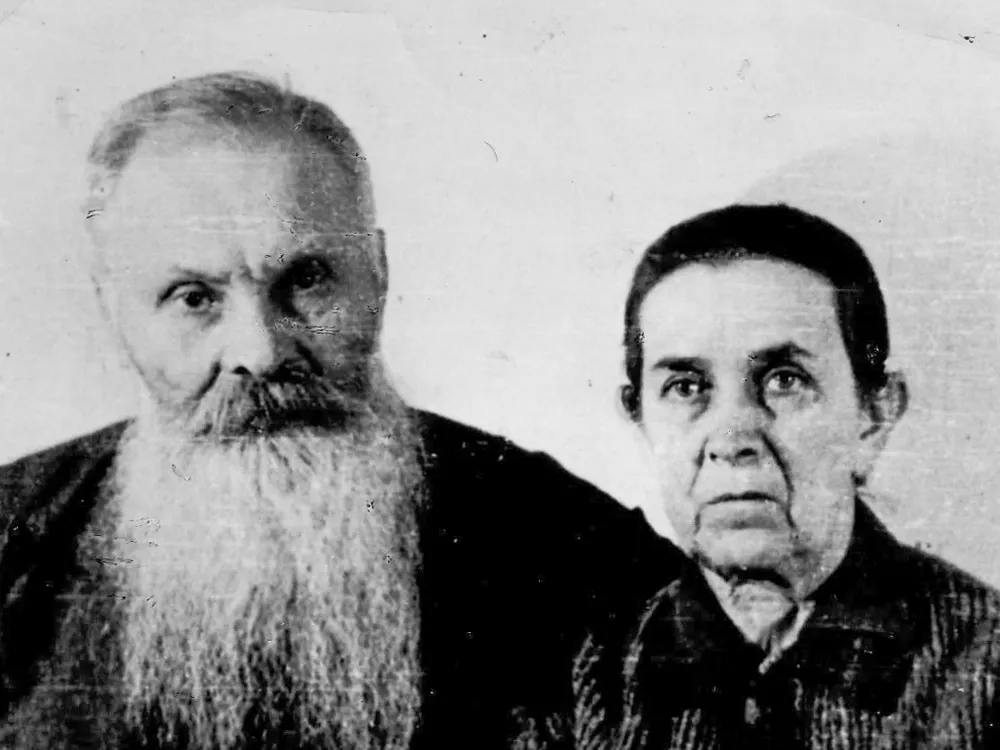
Mykhailo Kryvyniuk with his wife, Olha Kosach-Kryvyniuk, photo from the late 1930s, collection of the Museum of Outstanding Figures of Ukrainian Culture, Kyiv
Izydora Kosach, in 1938, the Soviets, now without any reverence, sent to logging in the Onega camps. True, a year later they came to their senses and returned her to Kyiv – the relative of Lesya Ukrainka (suddenly!) was needed to take part in the ceremonies of the Party’s celebration of the writer’s seventieth anniversary.
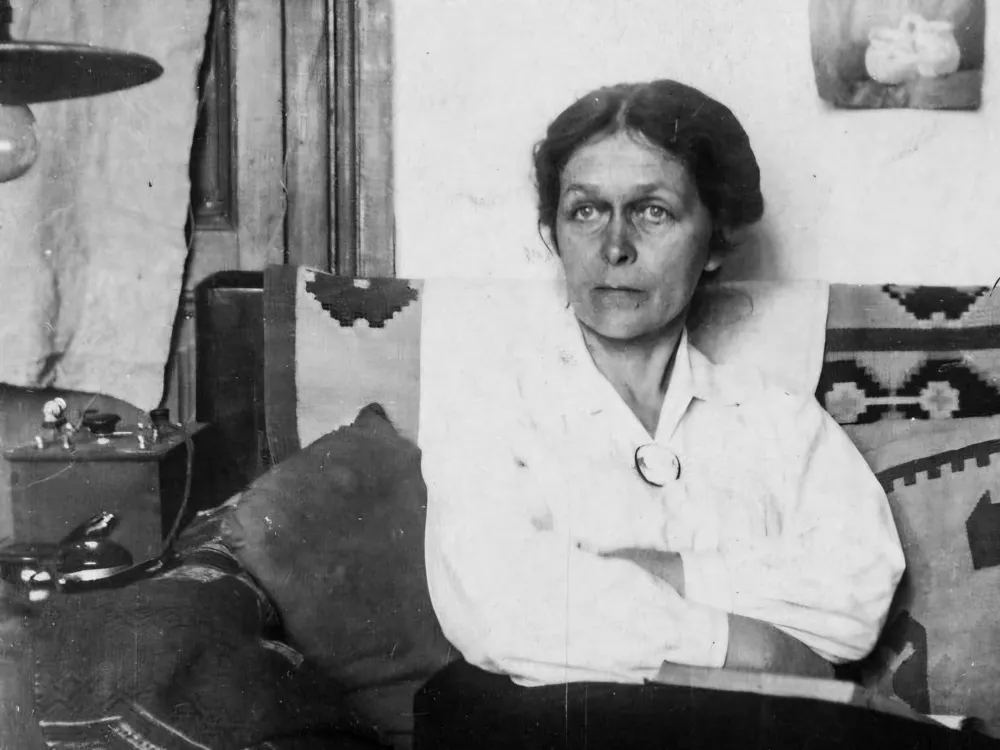
Izydora Kosach-Borysova, archive of the Ukrainian Free Academy of Sciences, Kyiv, 1940
The nodal point of Stalinist terror in the capital of Soviet Ukraine can undoubtedly be considered Lukianivka Prison. During the pre-war decade tens of thousands of innocent victims of repression were put through its cells. Some were killed right within the prison walls. Some were sent to be shot at Bykivnia. Many were distributed from here to the next circles of hell of the Russian GULAG, from which, in the end, only a few managed to return.
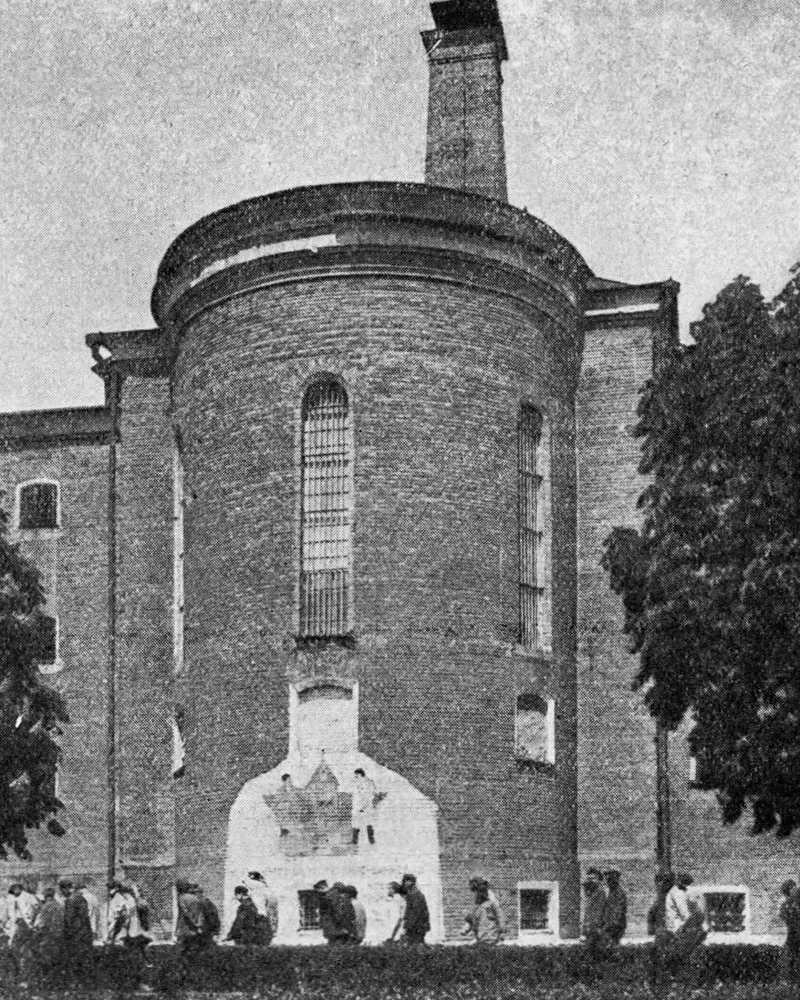
Lukianivka Prison, murals in the apse of the house church, 1929
From spring to summer 1931 the Ukrainian poet Maksym Rylskyi was tortured in the torture chambers of Lukianivka. Where they broke him. Later, in a series of fabricated cases, such as the murder of Kirov or the “Neoclassicist writers”, numerous representatives of the Ukrainian Executed Renaissance suffered cruel torture and abuse here. Among those known for certain:
- the poet Mykola Zerov,
- the ethnographer Borys Pylypenko,
- the poet and actor Marko Voronyi,
- the graphic artist Leonid Mitkevych,
- the literary scholar Ananii Lebid,
- the writer and screenwriter Dmytro Falkivskyi,
- the poet Pavlo Fylypovych…
All of them, like thousands upon thousands of others, were driven off across the boundless Russian northern expanses. The vast majority received a bullet in the back of the head in the end. The system, of course, did not spare women either. For example, the sculptor Maria Mykhailiuk, wife of the poet Fylypovych, was arrested together with her husband and later exiled to Karaganda.
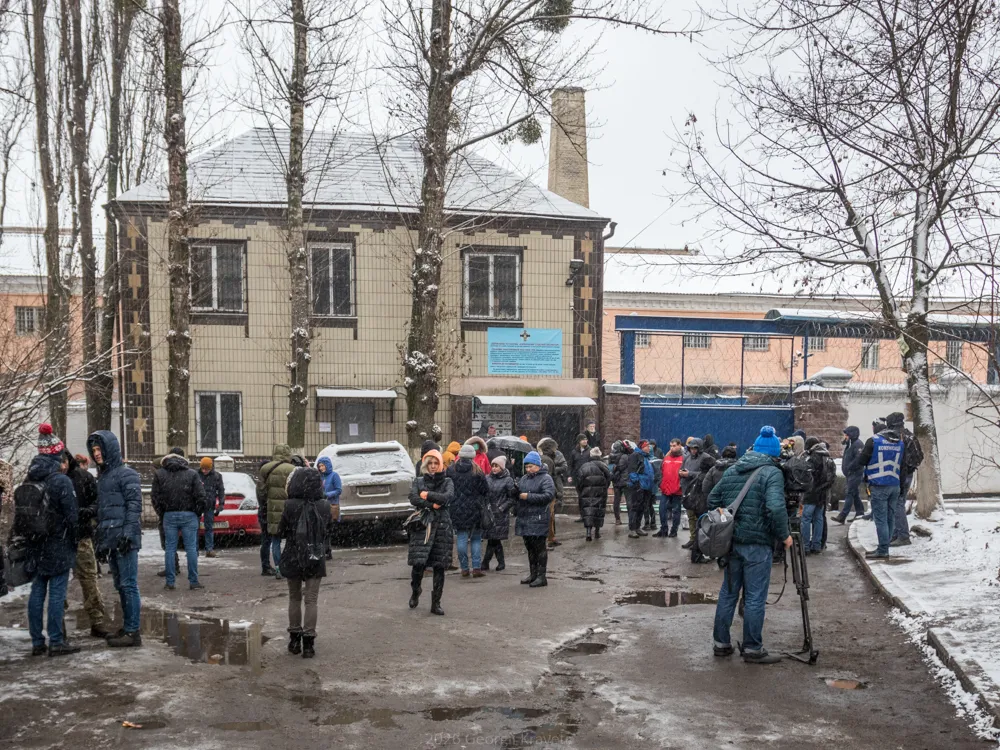
Rally near Pre-trial Detention Centre No. 13, Lukianivka Prison, 29 December 2019
The dungeons of the prison fortress during the days of terror were also passed through by the most prominent religious figures of Ukraine of the time. In June 1930 there was brought here – taken from the mansion at 12 Delehatskyi Lane, which is nearby – the second Metropolitan of the Ukrainian Autocephalous Orthodox Church, Mykola (Boretskyi). The troika of the GPU board hastily passed a sentence of imprisonment in a concentration camp, where the holy father soon perished.
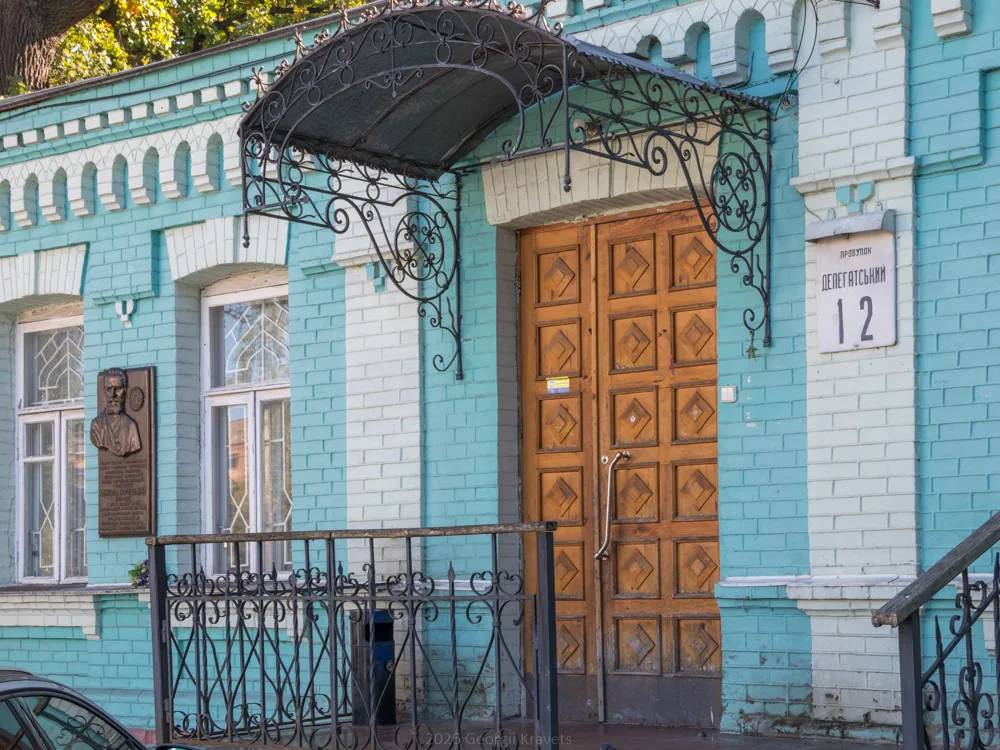
The mansion where Metropolitan Mykola (Boretskyi) lived between 1927 and 1930, 12 Delehatskyi Lane
His predecessor on the throne, Vasyl (Lypkivskyi) – the celebrated apostle of the Ukrainian religious and national revival – was shot in Lukianivka in November 1937, by the decision, again, of a troika. Thus he repeated the fate of the head of the Kyiv see of the Russian Orthodox Church, Exarch Kostiantyn (Diakov), who had been destroyed here, in the same prison, a few days earlier. Given the background of the early Soviet Union described above, let us pay somewhat closer attention to the fate of yet another creative Ukrainian family. Whose path also crossed with Lukianivka.
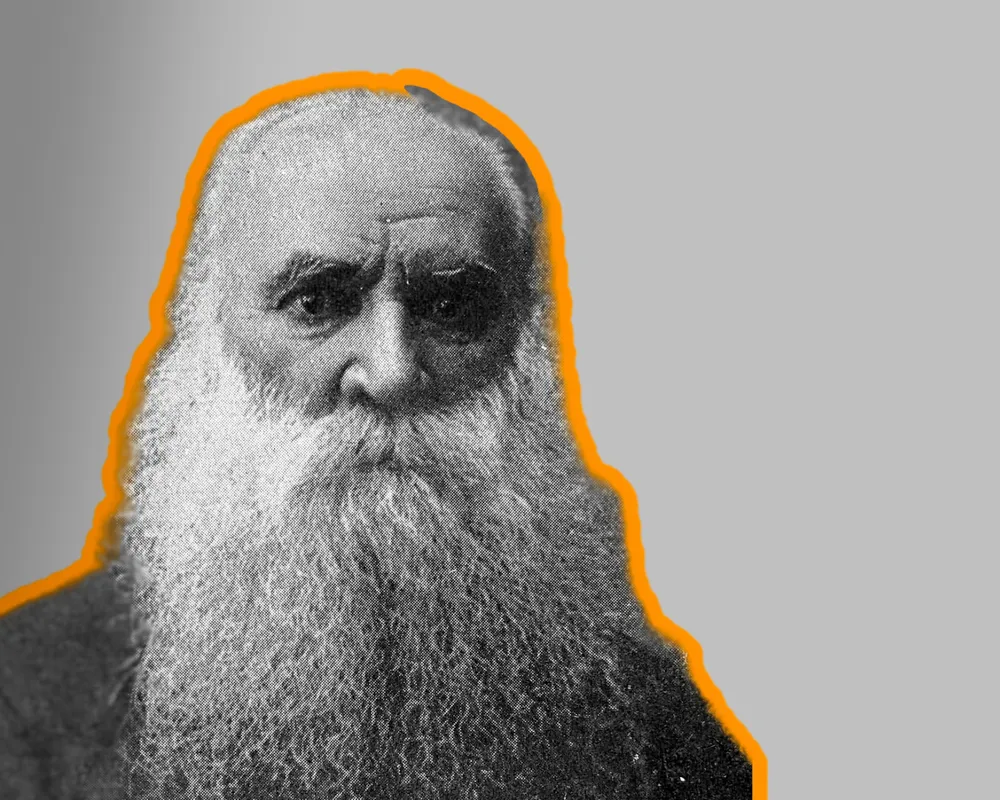
Metropolitan Vasyl (Lypkivskyi), photo from the turn of the 1920s and 1930s
Katrusia Krychevska was three when in 1929 her father and mother moved to a small house that stood on the site of today’s vestibule of Lukianivska metro station – then at 5 Melnykova Street.
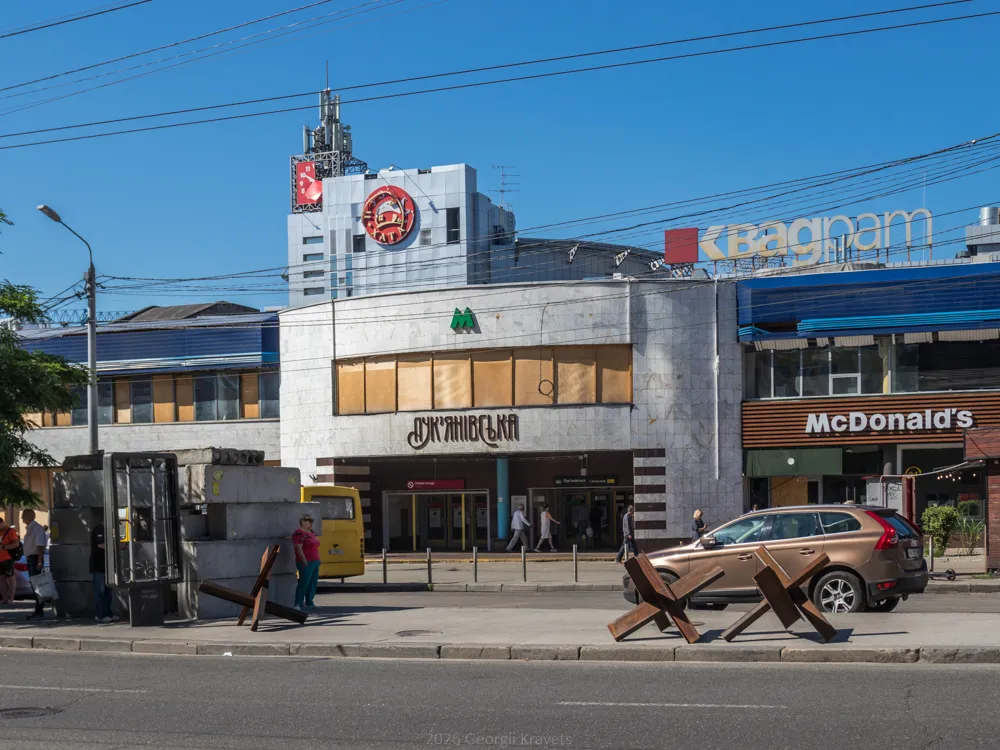
80.1
Vestibule of Lukianivska metro station
The girl’s grandfather, Vasyl Krychevskyi the Elder, is a titanic figure in Ukrainian art. He initiated and established Ukrainian architectural Art Nouveau as a great style. And then for another half-century he determined the directions of all processes in Ukrainian art. His son, also Vasyl, Katerina’s father, took Olena Kolomiiets as his wife. Both were artists and worked at the Odesa and Kyiv film studios. Krychevskyi the Younger, for example, designed Oleksandr Dovzhenko’s film “Earth”, and his wife the film “Mine” starring Natalia Uzhvii.
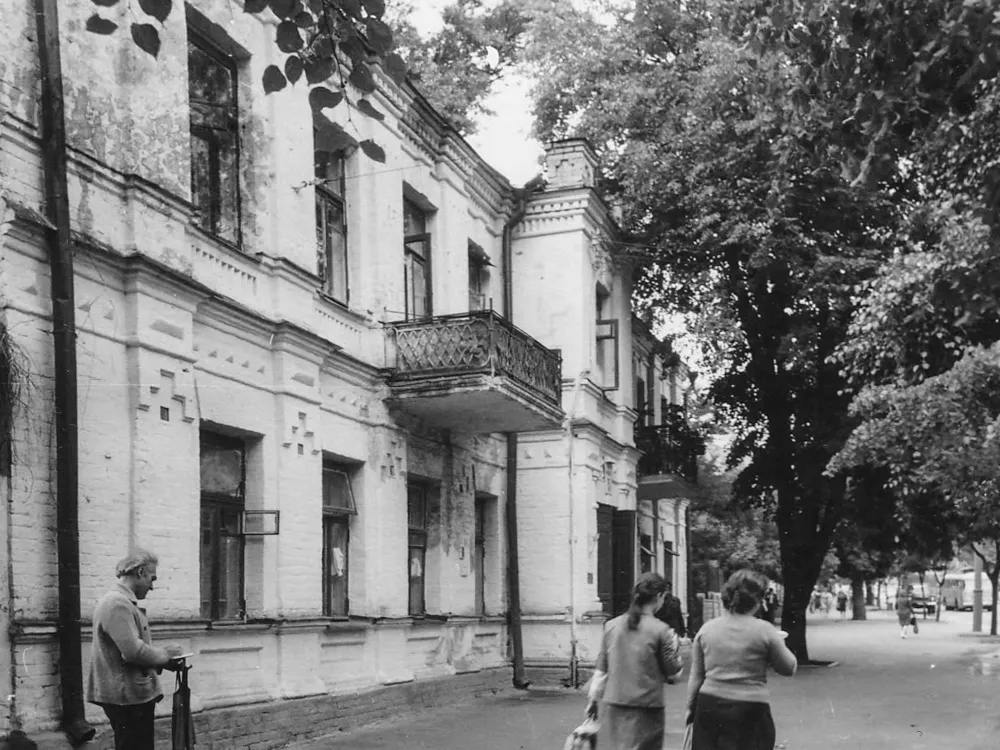
Building on the site of the vestibule of Lukianivska metro station, now 5 Yuriia Illienka Street
Art historian Oksana Pidsukha, head of the Council of the Ukrainian Diaspora Museum in Kyiv, gives the following picture of the family’s life at that time:
- Evidently, Katrusia’s early childhood was happy and her environment stimulating. However, it cannot be called cloudless and carefree. The family protected their daughter from the tragic reality of the 1930s as best they could, but from the window of her room the girl saw with her own eyes people falling and dying of hunger. In their family, too, there was not always enough food: on the worst days they cooked kandior from potato peelings, and once her father dragged in a piece of horse meat that he had cut from an animal that died in the street. In the house a fear of a possible arrest was also growing. Sometimes Katrusia woke at night and saw her parents standing at the window, straining to see whether the sinister “black raven” was turning in towards them.
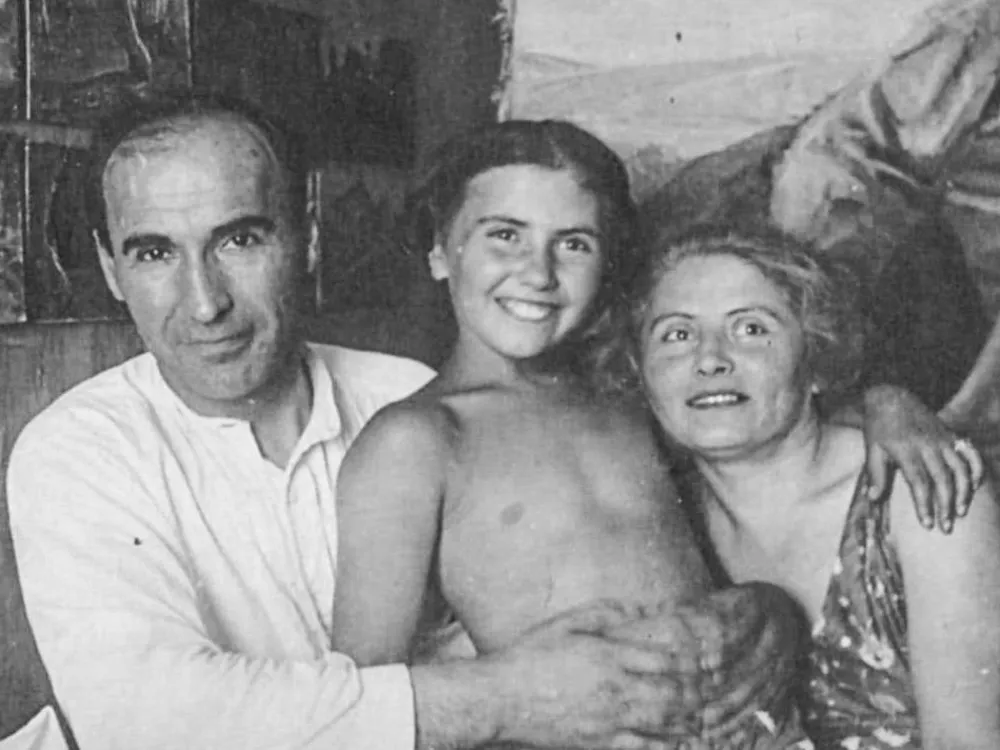
Vasyl, Katerina and Olena Krychevskyi, Kyiv, 1937
Black ravens. Searches. Arrests. Karaganda and Sandarmokh. Abuse and torture. Logging. Camps. Torment in torture chambers. Endless executions. The Holodomor. The murals of the Boichukists in the Lutsk Barracks scraped down to nothing… Such were the everyday days of the country of victorious socialism. So it seems no wonder that when the Germans entered Kyiv in autumn 1941, many representatives of the Ukrainian cultural elite decided not to flee from them. Instead, they stayed in the city and tried somehow to settle in. And when two years later the Hitlerites were retreating, then with them, among others, all the Krychevskyis and the Kosach sisters with their families went west. Those who had uniquely been lucky enough to survive the Stalinist terror.
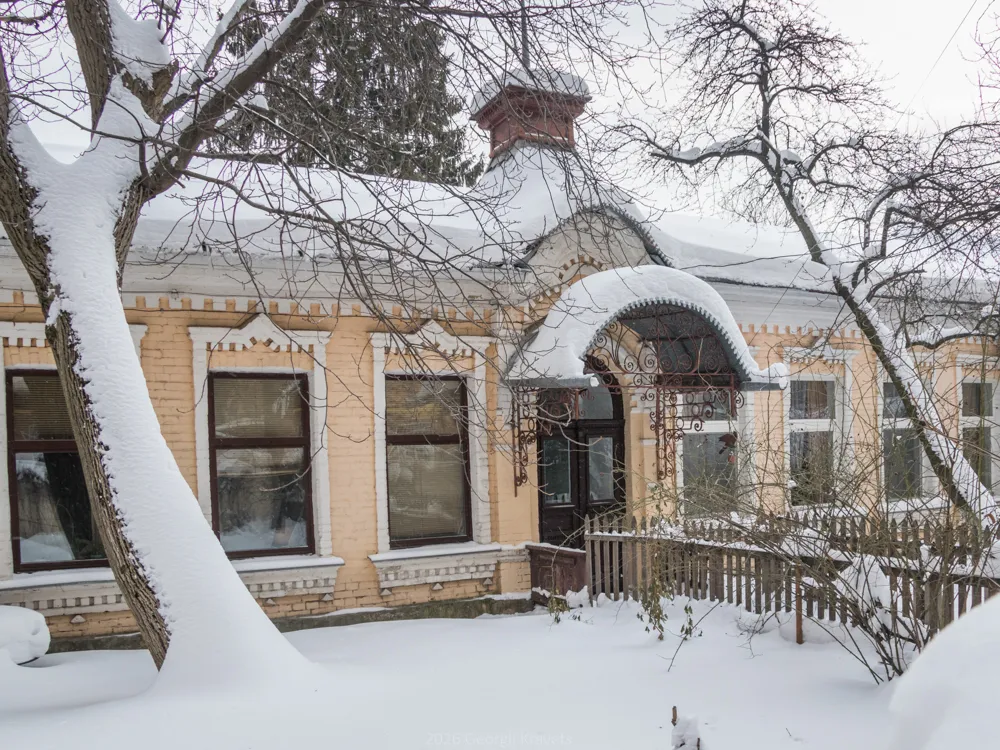
“Sydorenko House”, early 20th-century mansion, 6 Akademika Romodanova Street
Before the evacuation Lesya Ukrainka’s relatives left a collection of her memorial items, as well as rare editions and paintings, with their close friend and neighbour in the district, Natalia Sydorenko. An outstanding physician and biologist, she lived with her husband Havrylo, also a well-known doctor, in the former mansion of the merchant Mykhailo Morzhanov. Remarkably, this small, elegant house still stands – hidden behind a new building at 6 Romodanova Street. The preserved artefacts of Lesya the Sydorenkos later handed over to the poet’s literary memorial museum in Kyiv.
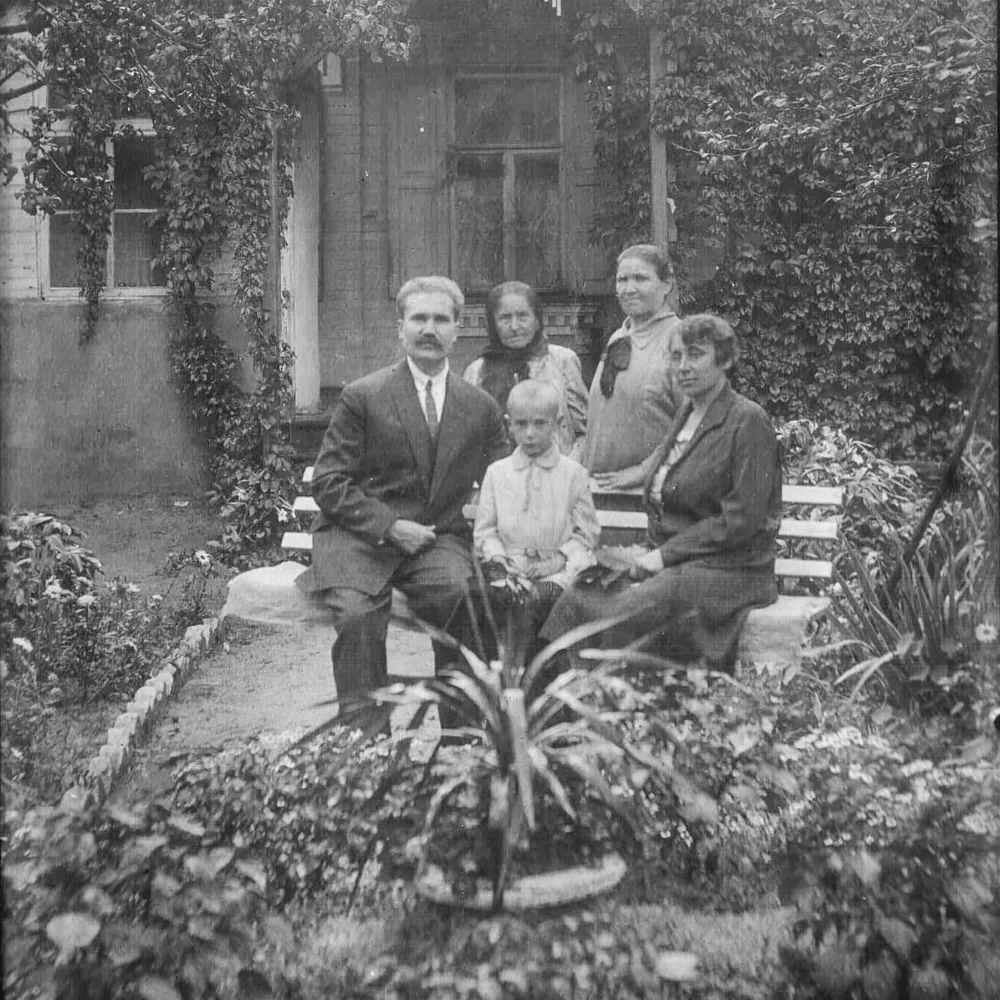
Havrylo, Pavlo and Natalia Sydorenko in the garden of the house, now at 6 Akademika Romodanova Street, photo from the archive of literary scholar Alla Dyba
The street landscape of Lukianivka familiar to us today was formed mostly in the late Soviet era. When the heavy-industry giants concentrated in the district began en masse to order from the state the construction nearby, in place of the old pre-revolutionary homesteads, of complex departmental housing. Typical blocks of five-storey Khrushchev-era buildings and Brezhnev-era panel blocks deformed the space – levelling it to a common denominator of gloomy uniformity. And in this pervasive ordinariness the memory of the recent terrible events seemed to dissolve, events witnessed by the old local mansions and cooperative houses, garages and fences, parks and oak groves, tracts and… ravines.
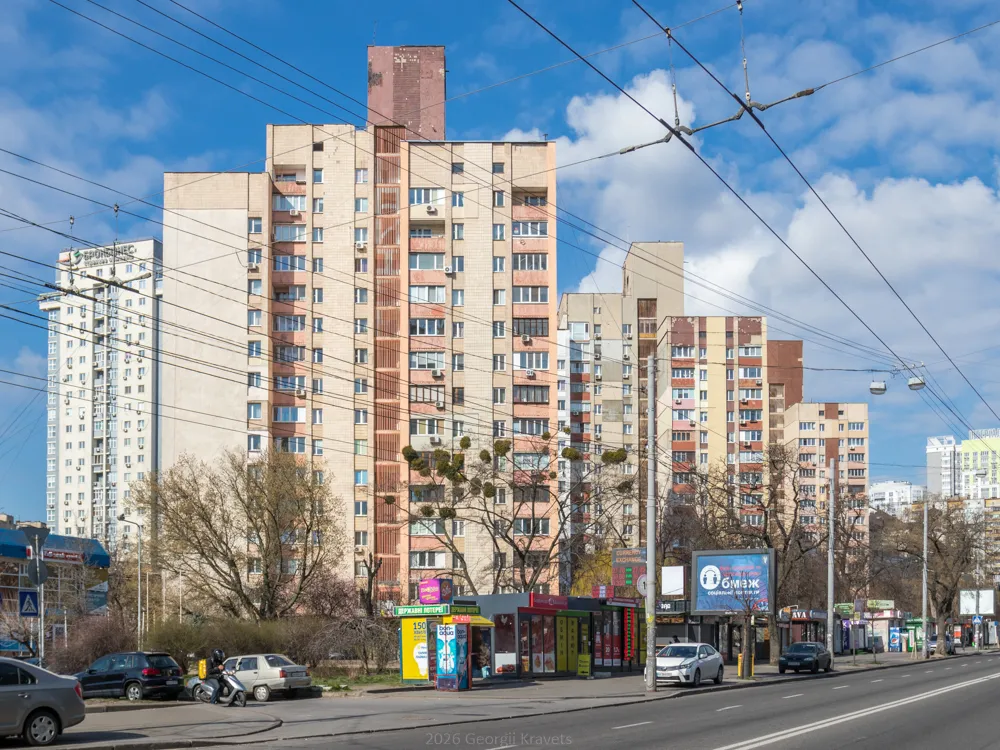
Buildings at the beginning of Yuriia Illienka Street
As for the calamities of the Second World War, Lukianivka appears here in two guises – as the place of one of the main Kyiv myths of the war, and as a witness to its most famous tragedy in the world.
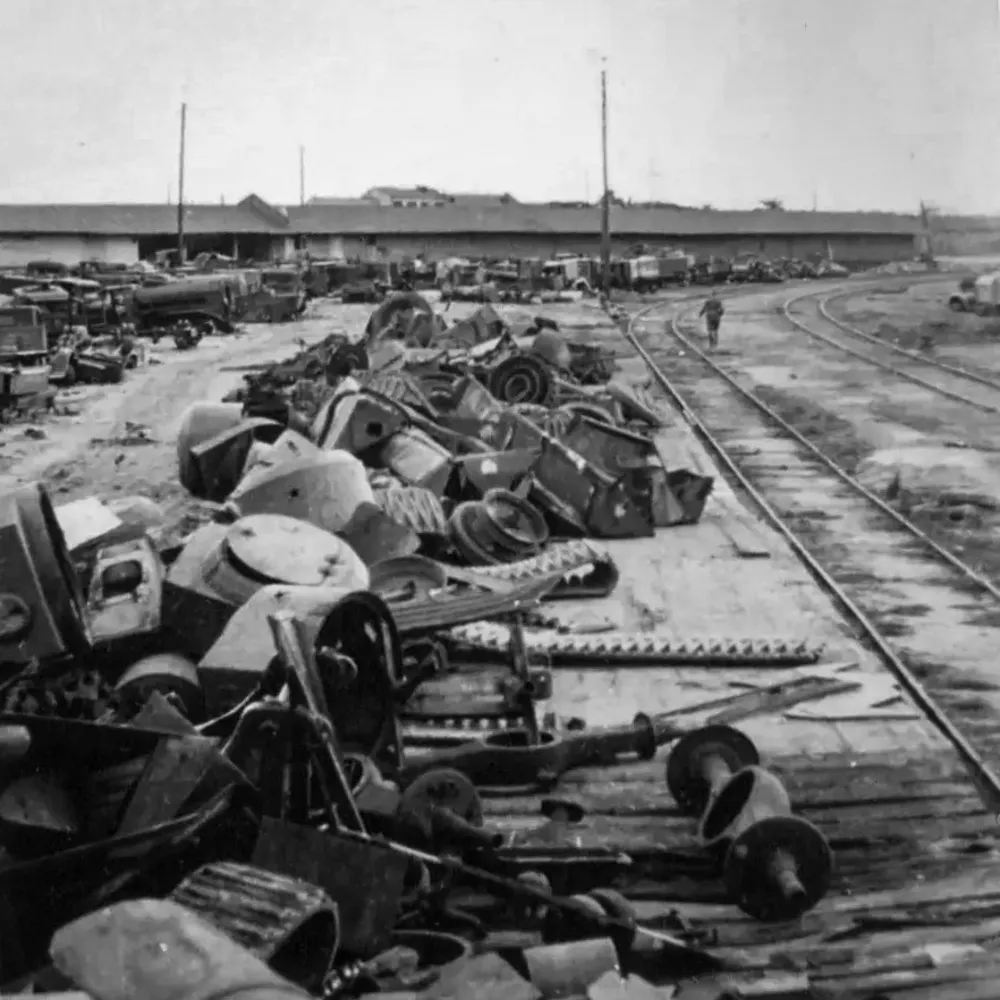
Lukianivka freight station, collection of equipment looted by the Germans, autumn 1941
The Zenit stadium at the corner of today’s Rostyslavska and Sholudenka streets was set up in the mid-1930s as a departmental one, at the Petrovskyi defence plant. On 9 August 1942 a match took place there between the teams Start and Flakelf. The first included players of the pre-war city football clubs Dynamo and Lokomotyv. The second – amateur footballers from German Luftwaffe units and anti-aircraft gunners. As in all nine previous games, the Kyivans won again. And because of this the enraged Wehrmacht command allegedly ordered all the brazen Kyivans to be shot.
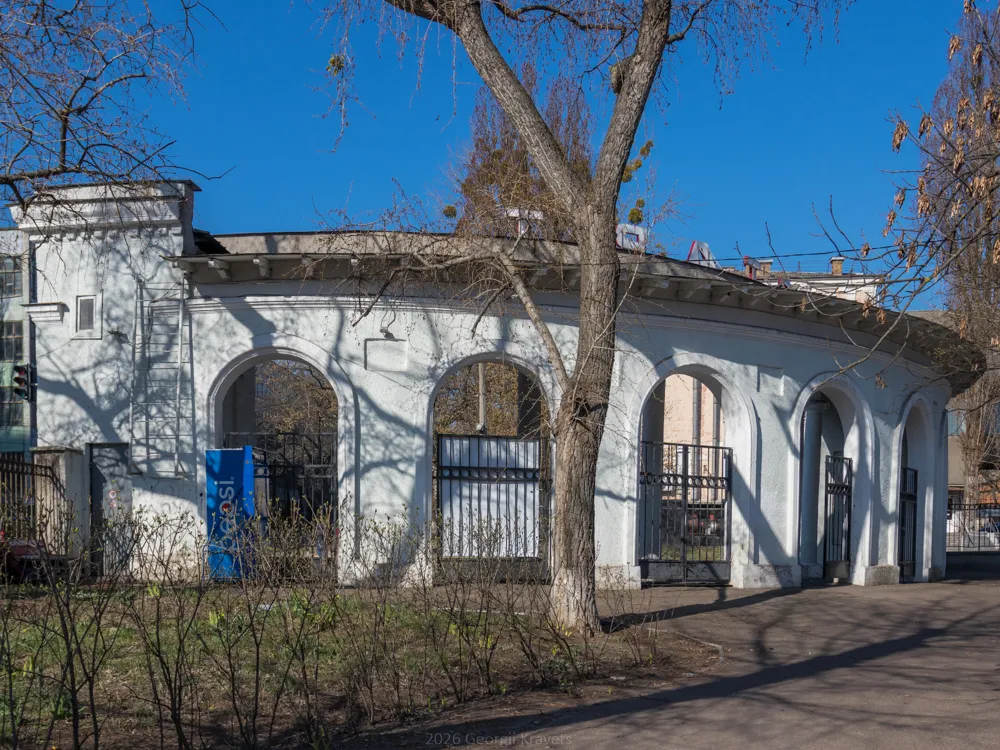
Arcade of the Zenit stadium, now Start
This story in this connotation became popular in the era of Brezhnev’s stagnation. The Zenit stadium, which from the end of the war until 1981 was called Avanhard, in honour of the Soviet hero-footballers killed by the Fascists, was renamed Start. In honour of the Match of Death, a hefty sculptural and architectural composition was then also installed on it. Executed, to be honest, purely in the aesthetics of Leni Riefenstahl’s films and the 1936 Berlin Olympics.
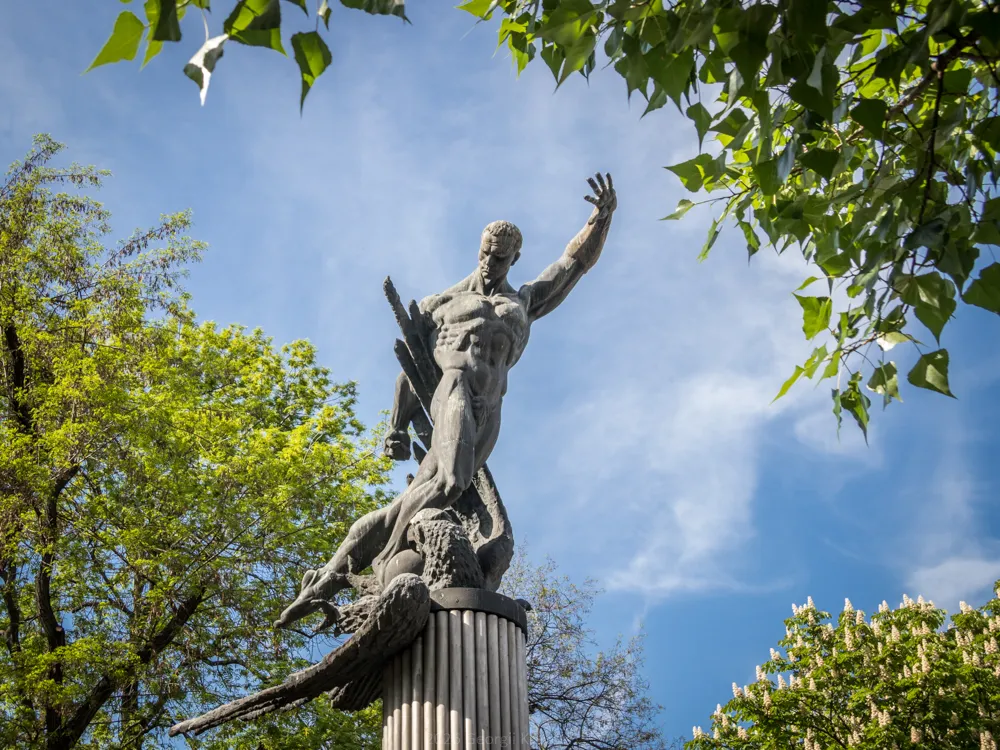
Monument to the footballers of Kyiv Dynamo – participants of the “Match of Death”, sculptor A. M. Kharechko, architect A. F. Ihnashchenko, Start stadium, Sholudenka Street
If we set aside the propaganda narrative, we must take the following into account. Among the Start players former Dynamo players predominated, who from the beginning of the occupation of Kyiv worked voluntarily at Bread Factory No. 4. After the August match in question the Germans did indeed stop games in the city. Most likely because of significant complications of the situation for them at the front. However, none of the footballers was executed right after the game. Some of the Start players were detained later, in separate punitive raids that the occupiers carried out regularly in the controlled territories. Several athlete-hostages – in particular Oleksii Klymenko, Mykola Trusevych and Ivan Kuzmenko – were shot on 4 February 1943. As a demonstrative measure, in response to the arson by Kyiv underground fighters, a few days earlier, of the Sport mechanical plant.
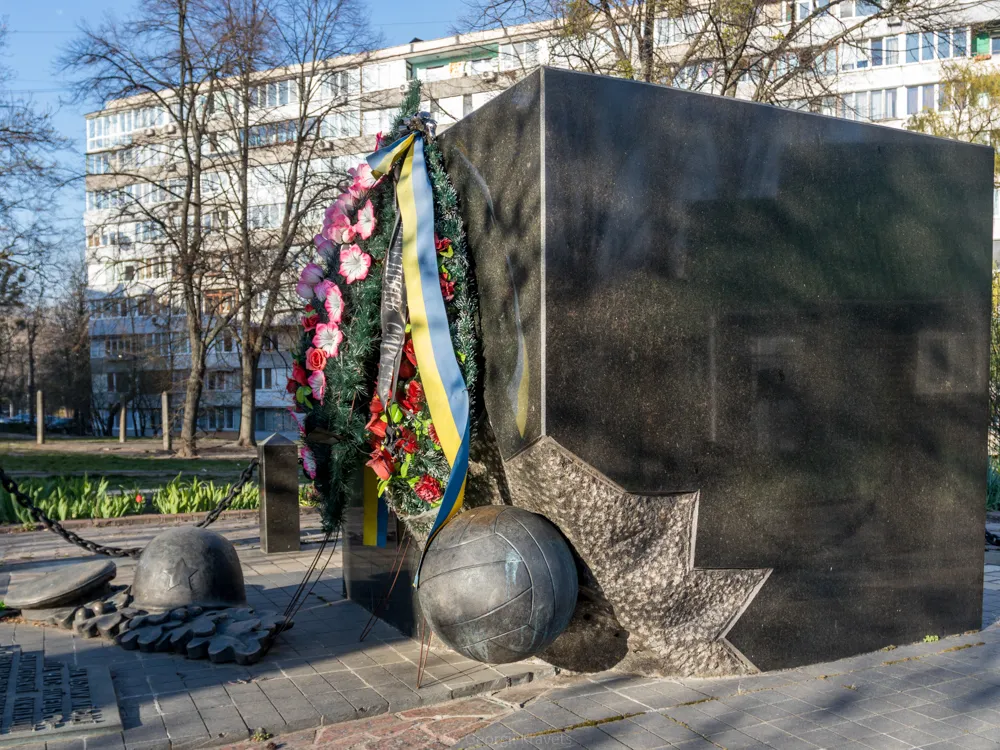
Monument to the shot prisoners of war and footballers on the site of the Syrets concentration camp in the square at 20 Rodyny Hlaholievykh Street, sculptor Yurii Bahalyka, architect Ruslan Kukharenko, 1999
Inscription on the monument:
- On this spot during the German-fascist occupation of the city of Kyiv in 1941–1943 prisoners of war, footballers of Kyiv “Dynamo” and civilians of Ukraine were shot. Eternal memory and glory to them.
Along today’s Rostyslavska Street the original fence of the former Zenit has survived. Yes, it can be seen in the photographs of the German military photographer Johannes Hähle. He served in the 637th Propaganda Company, part of the German 6th Army. At the turn of September and October 1941 Hähle shot on AGFA film a series of colour photographs of occupied Kyiv. In several of them we see a cluster of women by that stadium fence. They are evidently trying to find out something about the fates of their husbands, who were quartered in the barracks farther along the street and had fallen under Nazi judgement. Order is overseen by auxiliary policemen.
We see that the trees are still green. In the clear blue sky the bright autumn sun shines, making those who face it squint.
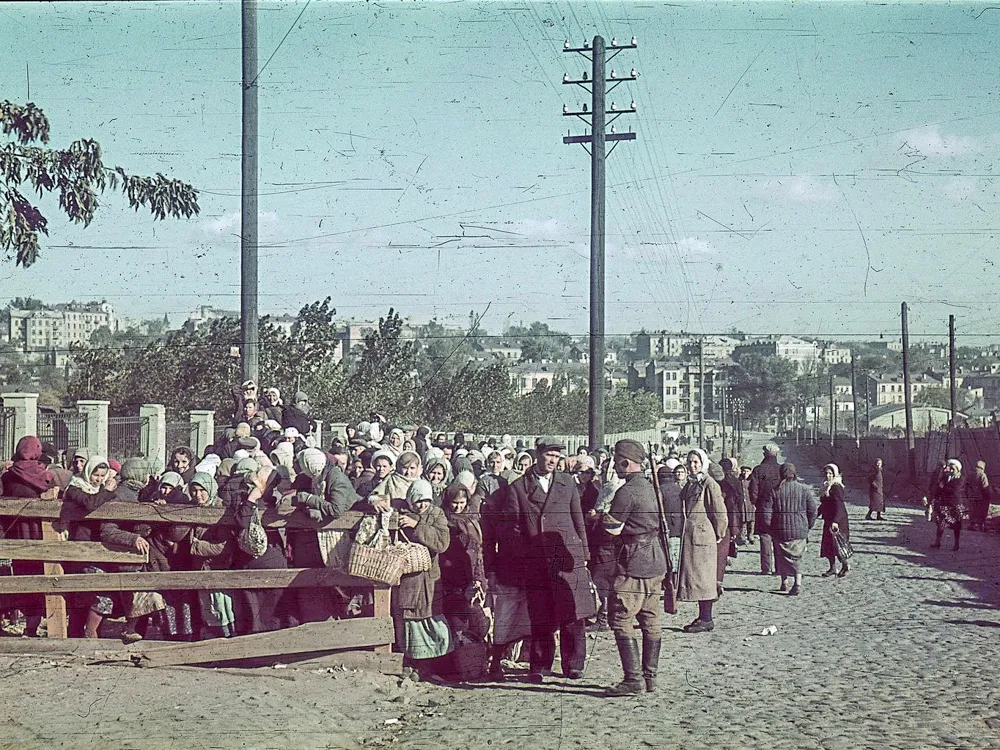
Women by the fence of the Zenit stadium, photo by Johannes Hähle, last days of September – early October 1941
From early morning the city was bustling that day. People set out from all the outskirts. Mostly the poor. Old people, young men, women, children, some men. With their small belongings they flowed into Lukianivka. They supposed they were going to the freight railway station, to be evacuated somewhere farther. Perhaps even to Palestine!
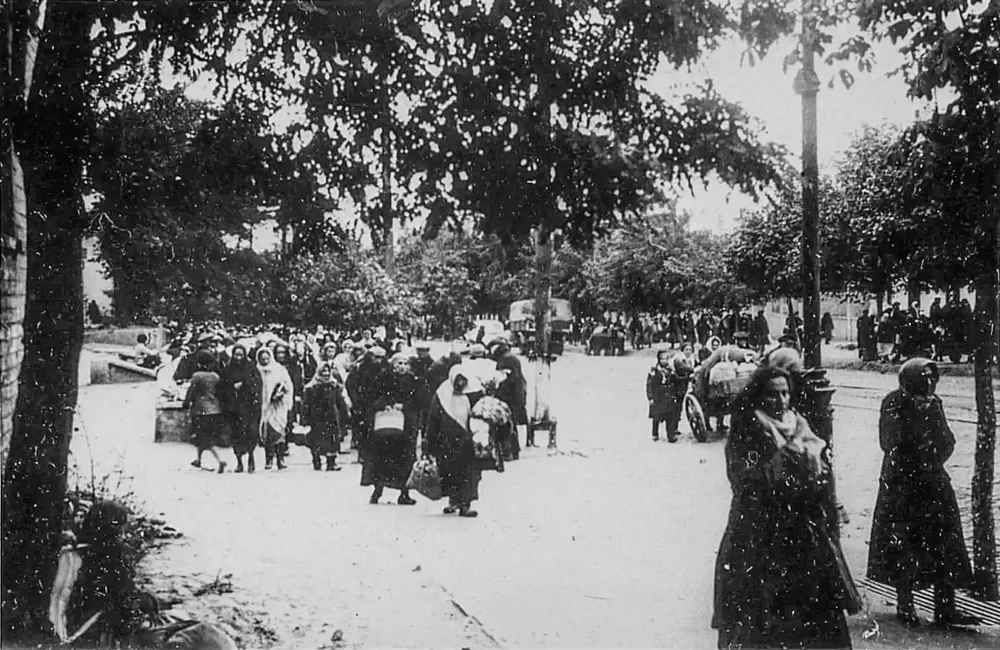
Intersection of today’s Yuriia Illienka and Herzen streets, photo taken on 29 or 30 September 1941
For the day before they had been informed:
- All Jews of the city of Kyiv and its surroundings are ordered to assemble on Monday, 29 September 1941, by 8 o’clock in the morning at Melnyk – Doktiarivska Street (near the cemetery). Everyone must take with them documents, money, linen and other things. Whoever does not comply with this order will be shot.
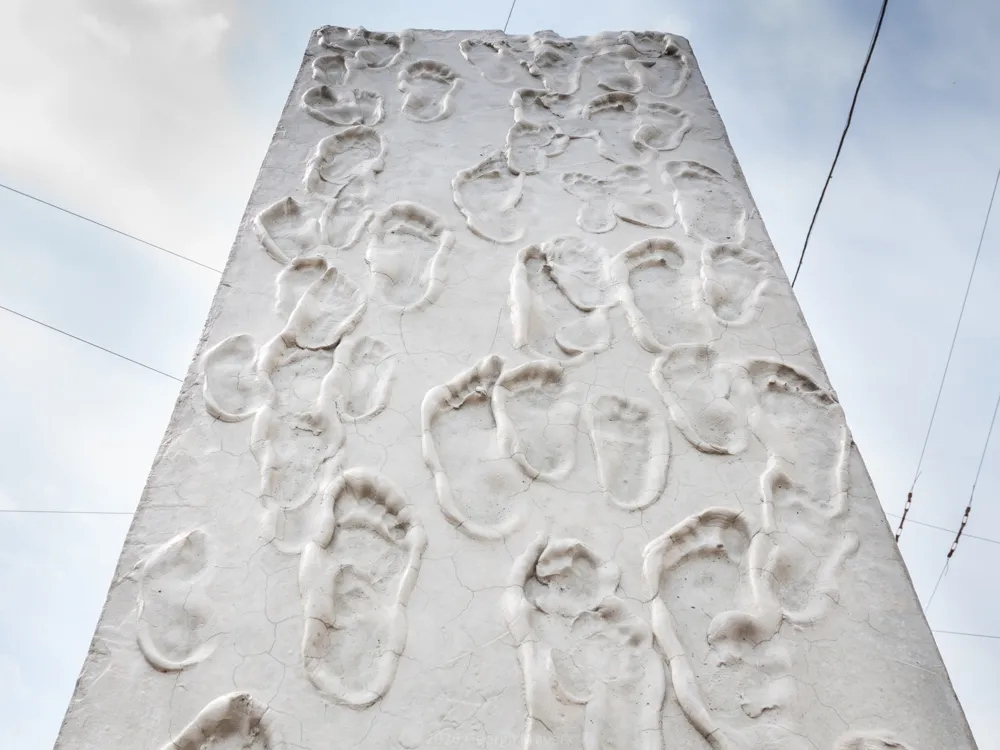
“Road of Death” memorial sign, intersection of Dorohozhytska and Yuriia Illienka streets
Today at the corner of Illienka and Dorohozhytska streets stands a memorial sign in the form of a concrete block with symbolic imprints of human feet. On the stone next to it is an inscription – “Here began the ‘Road of Death’ along which on 29 September 1941 the Fascists drove Jews to Babyn Yar.” Thus the blocks of Lukianivka were for most of the doomed the last ordinary thing they saw in life.
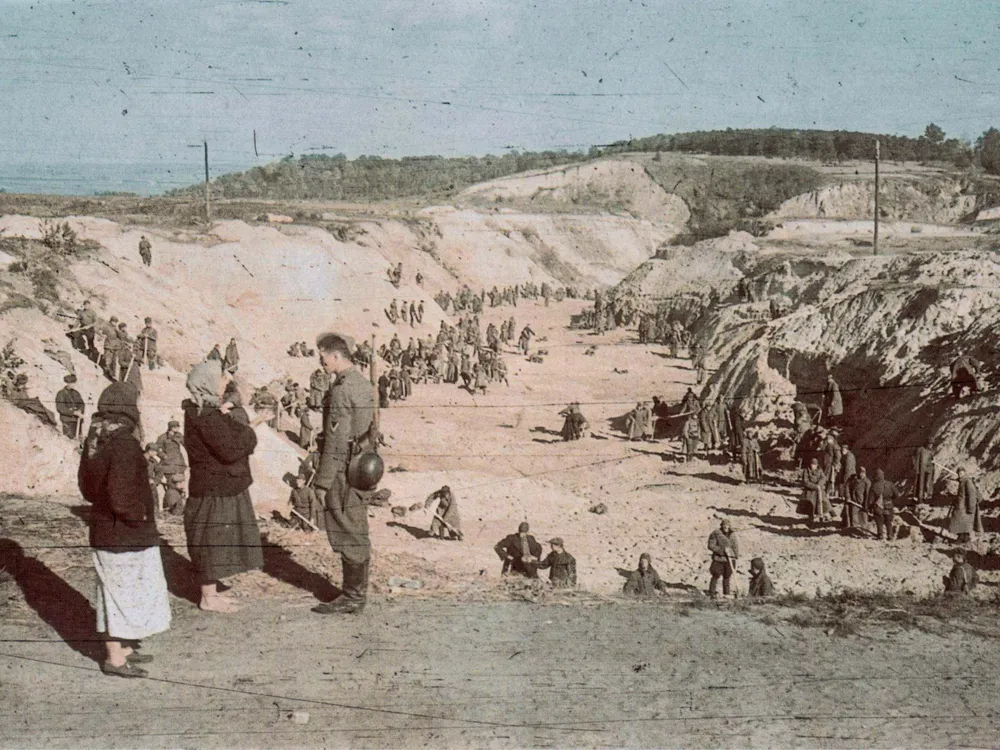
Soviet prisoners of war under SS guard cover the bodies of those shot in Babyn Yar, 1 October 1941, photo by Johannes Hähle
Near the military section of the Lukianivka Cemetery the Jews had their documents, money, linen and other things taken away. Then they were ordered to proceed to the south-eastern spur of Babyn Yar. There everyone was undressed. And after that – shot.
The mass execution lasted two days in a row. During that time 33,771 people were killed in the ravine.
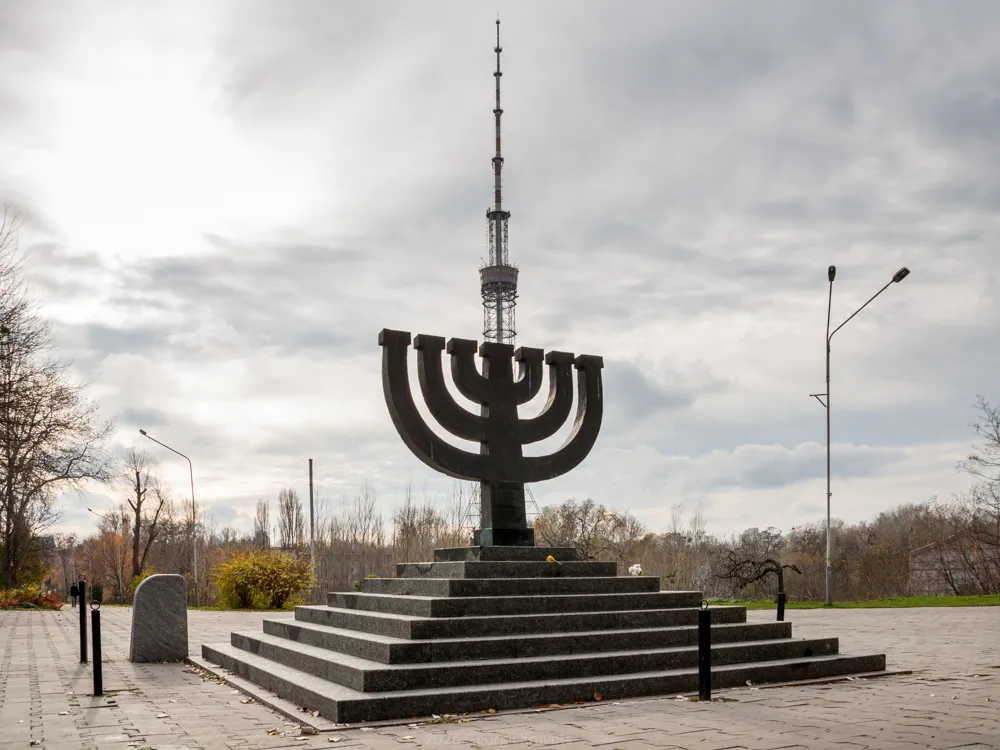
Menorah Monument at Babyn Yar, sculptors Akim and Oleksandr Levych, architect Yurii Paskevych, engineer Borys Hiller, 1991
The order for the assembly of Jews was issued on the instructions of the commandant of Kyiv, Major General Kurt Eberhard. The punitive action was directly led by the commanders of Einsatzgruppe C, Friedrich Jeckeln and Dr. Otto Rasch, as well as the head of Sonderkommando 4a, Paul Blobel.
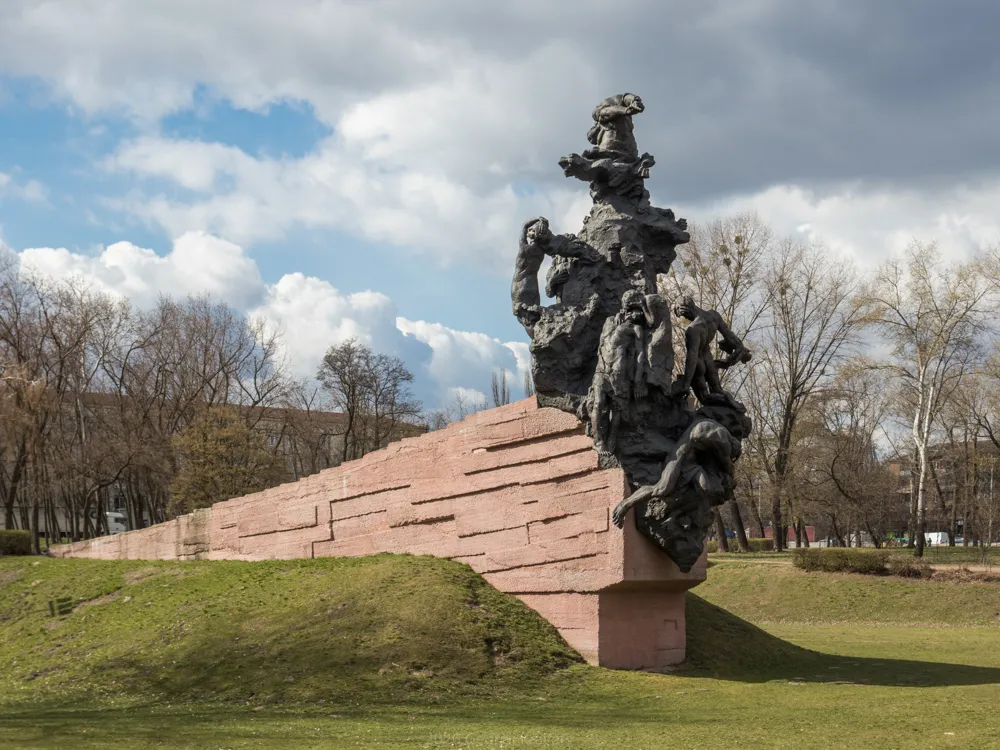
Monument to Soviet citizens and prisoners of war, soldiers and officers of the Soviet army, shot by the German Nazis at Babyn Yar, opened on 2 July 1976, sculptors Mykhailo Lysenko, Oleksandr Vitryk, Viktor Sukhenko, architects Anatolii Ihnashchenko, L. Ivanchenko, V. Ivanchenkov
In general, Babyn Yar became a mass grave for more than a hundred thousand people. Between 1941 and 1943, besides Jews, the Nazis shot here: some five camps of Roma, more than seven hundred patients of the Kyrylivska Psychiatric Hospital, about a hundred sailors of the Pinsk Flotilla, six hundred and twenty-one OUN activists, and many more Soviet prisoners of war, underground fighters and partisans.
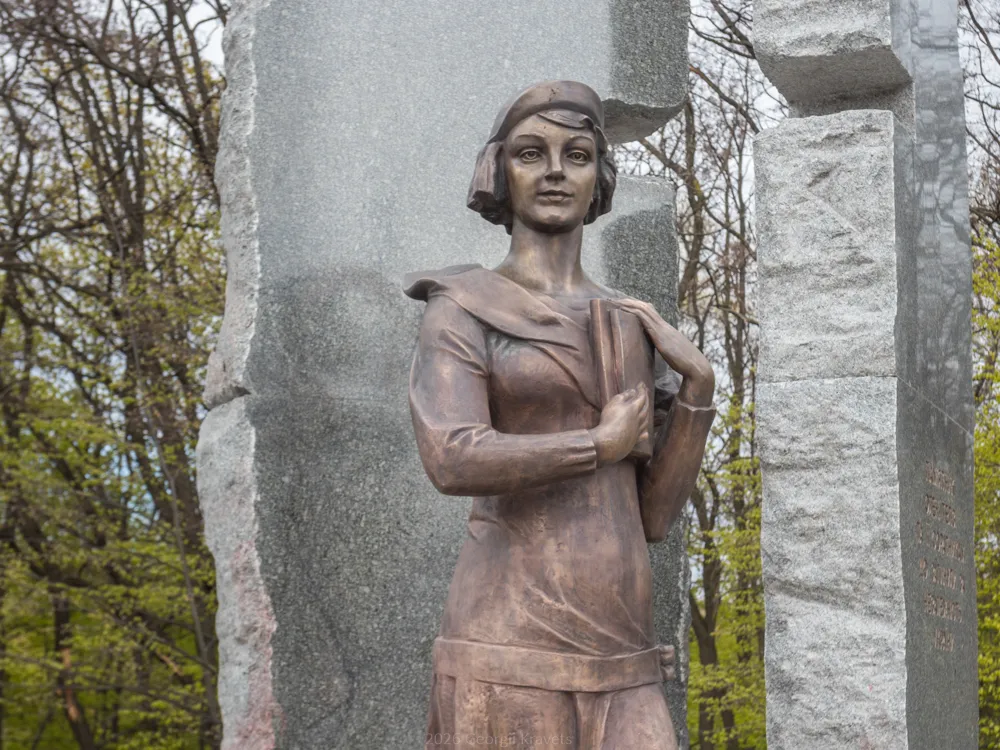
Monument to Olena Teliha and her comrades who died for the independence of Ukraine, in the square near the memorial at Babyn Yar
After the war the Communist authorities treated the site of mass executions with great cynicism. It was decided to set up a Park of Recreation here. To create a convenient flat relief, from the early 1950s Babyn Yar began to be filled with waste from brick factories. And for the entire following decade the pulp with water accumulating in it was held back only by a temporary earthen dam. On 13 March 1961 it broke. A mudflow some fifteen metres high covered the Kurenivka district in the lowland. According to moderate estimates, about one and a half thousand Kyivans died.
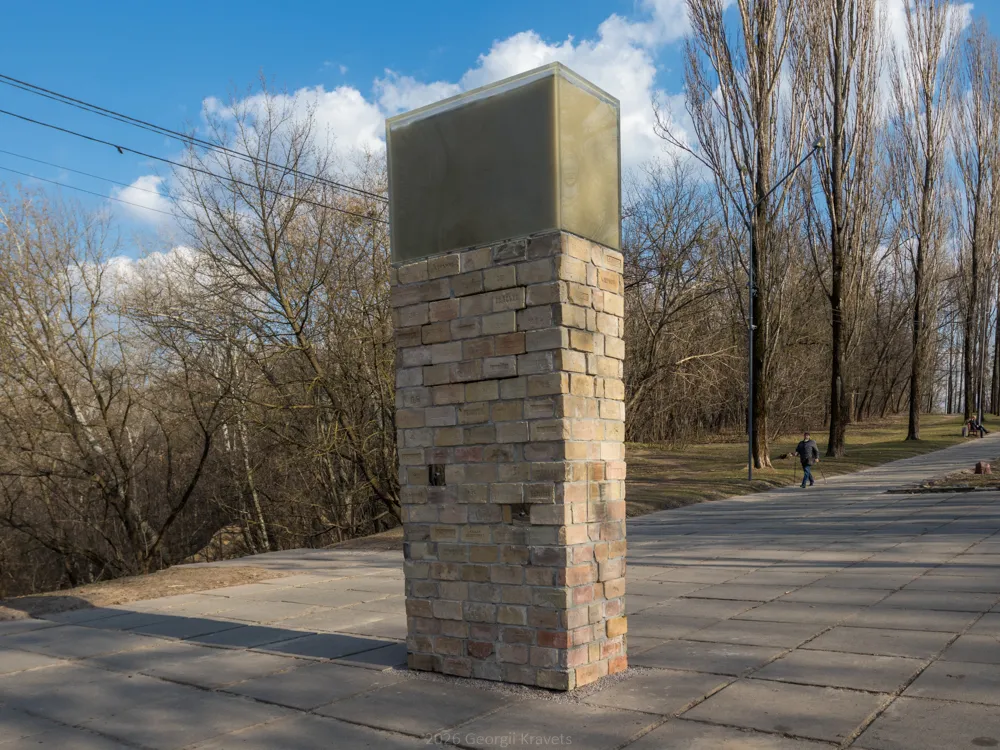
Installation “A Look into the Past”, placed at the site of the dam breach for the 60th anniversary of the Kurenivka tragedy, Babyn Yar Park
There are probably few points on our whole planet where so much grief was layered at once. And it was this gloomy and ill-starred place that the Soviet officials chose for the tallest structure in the country. Between 1968 and 1973, on the former edge of Babyn Yar, between cemeteries, the 380-metre Kyiv TV Tower was built. As a lattice free-standing structure, it was for some time after completion the world record holder in height. In Ukraine the tower remains taller than all other structures to this day. Visible from everywhere for tens of kilometres from afar, like a syringe it marks the infamous capital toponyms on the skyline.
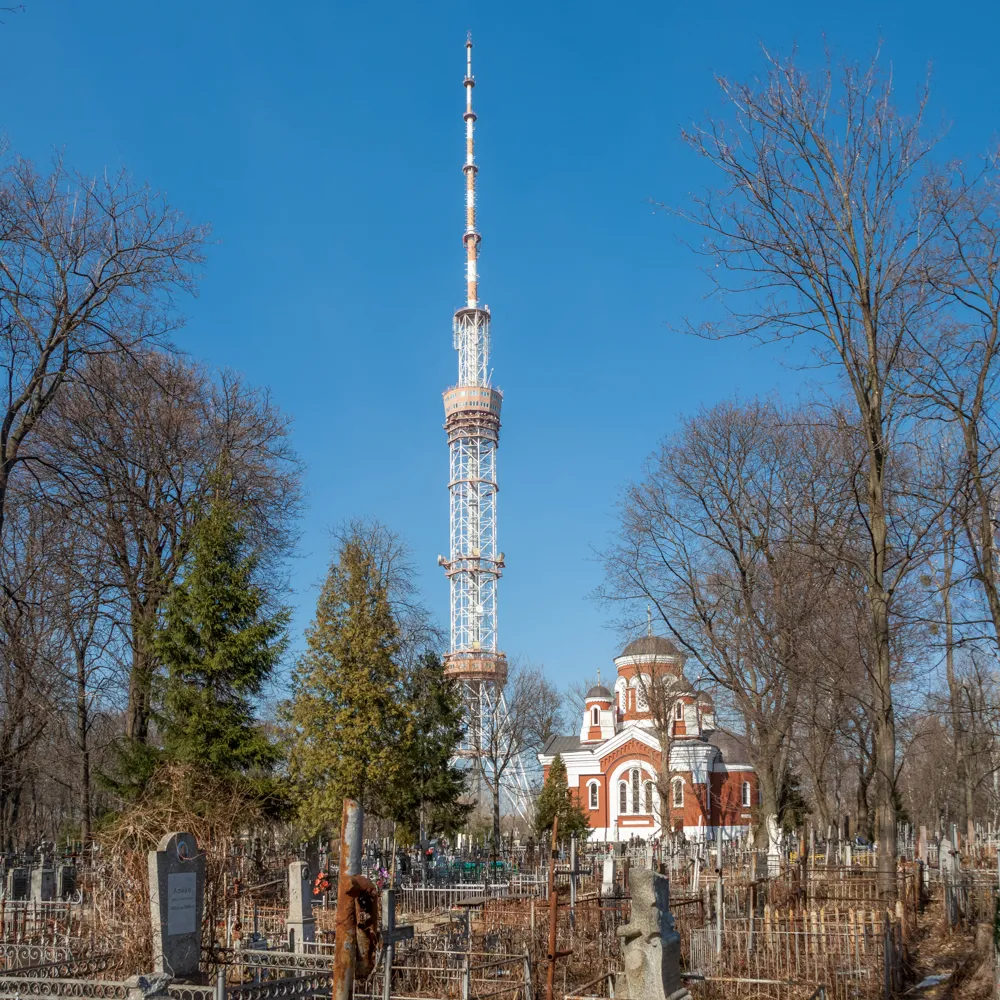
Kyiv TV Tower, view from the cemetery, 2012
Across the road from the TV tower, on the territory of the previously destroyed Jewish cemetery, construction of the Kyiv Television Centre began in 1983. Also a giant, 97 metres high. Thanks to its characteristic silhouette and the structure of its façades, this building of Brutalist character earned among the people the name the Pencil. It was built as a backup, in case the Ostankino television centre in Moscow failed. Therefore it received a large underground shelter for work in an emergency and even its own fire station. However, the complex has still not been finally completed – on the Illienka Street side only a cluttered foundation remains of the concert studio building planned from the start.
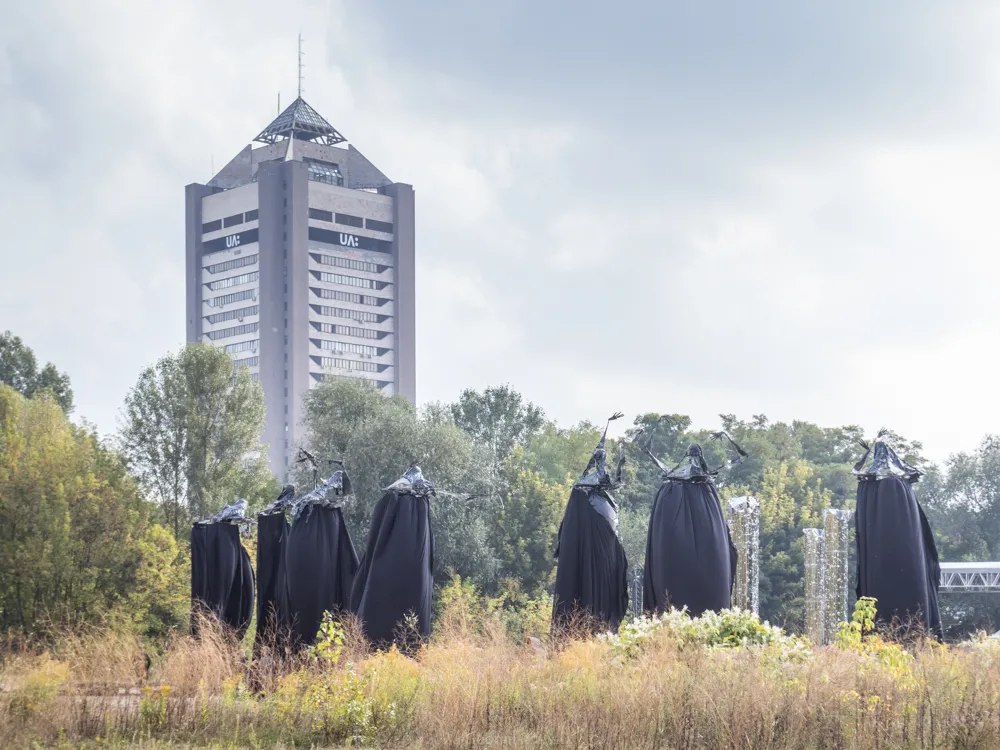
Kyiv Television Centre – the technical and studio complex of the National Television Company of Ukraine, 42 Yuriia Illienka Street, view from Babyn Yar
Among the scientific and industrial novelties of post-war Lukianivka it is hard not to note the appearance of:
- The Elektroprylad plant, which had been created back in 1931 at the Ukrainian Grain Research Institute to develop instruments and electrical equipment for the automation of production processes at enterprises of the USSR People’s Commissariat of Procurement, and in 1949 moved to the building of the former flour-milling and grain-elevator machinery plant at 17 Hlybochytska Street, where it works to this day;
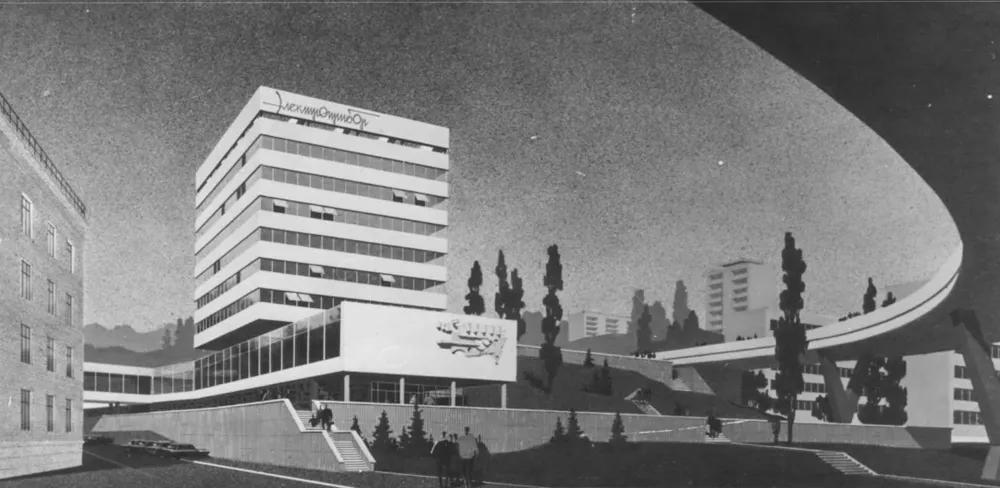
Design for the new building of the Elektroprylad plant, 1970s
- The Hazprylad plant, which from the 1950s operated in workshops on Sholudenka Street, and whose efforts provided for the large-scale gasification of Soviet Ukraine;
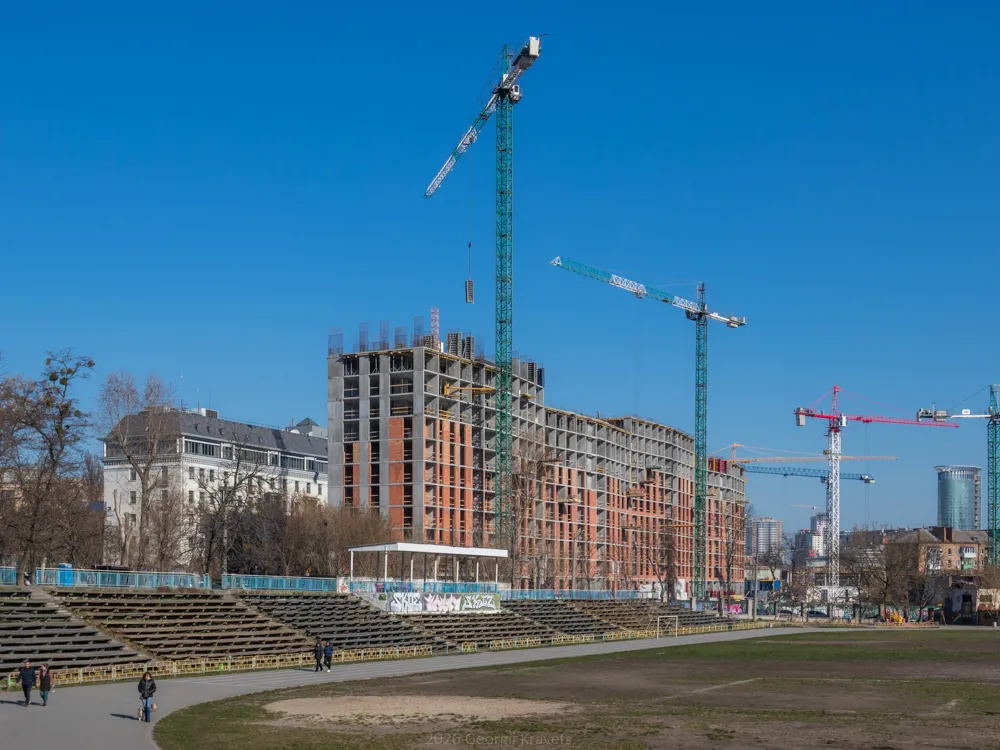
Construction of the Start residential complex on the site of the demolished Hazprylad plant, 2020
- The Kyiv Institute of Automation, founded in 1957, which still deals with the creation, certification and implementation of systems and means of automation of technological processes and production, and of organizational and office systems – from the start located in a conspicuous Stalinist building at 22 Nahirna Street;
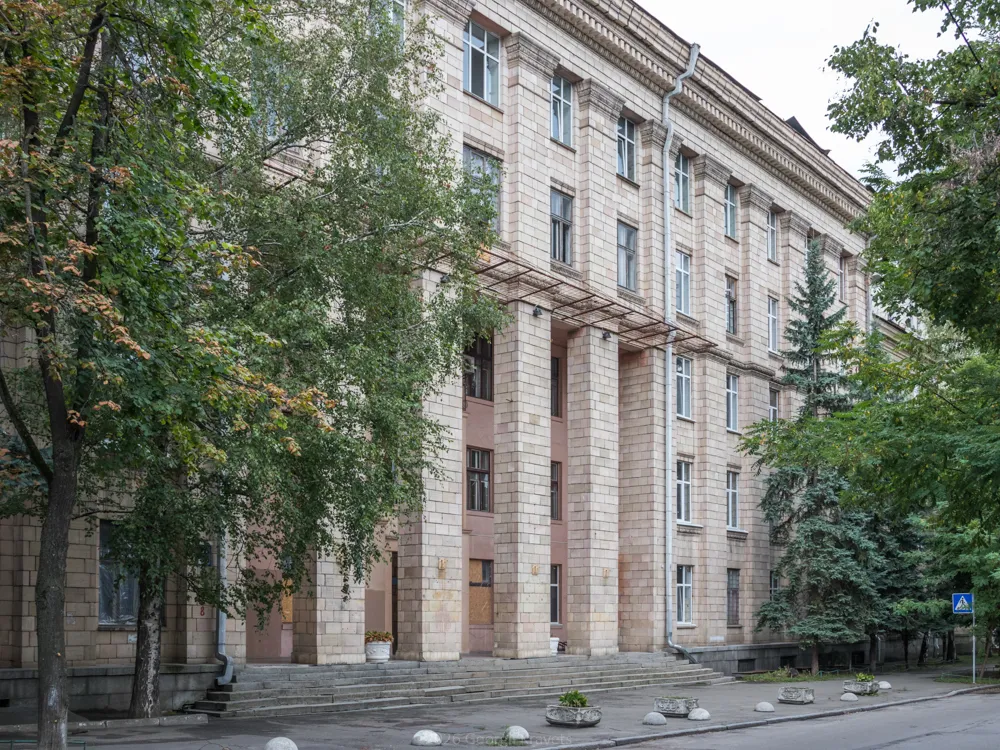
Building of the Kyiv Institute of Automation, 22 Nahirna Street
- The Molod printing complex, founded at 38–44 Dehtiarivska Street in 1979 and in 1992 repurposed as the famous Ukraina Printing Complex.
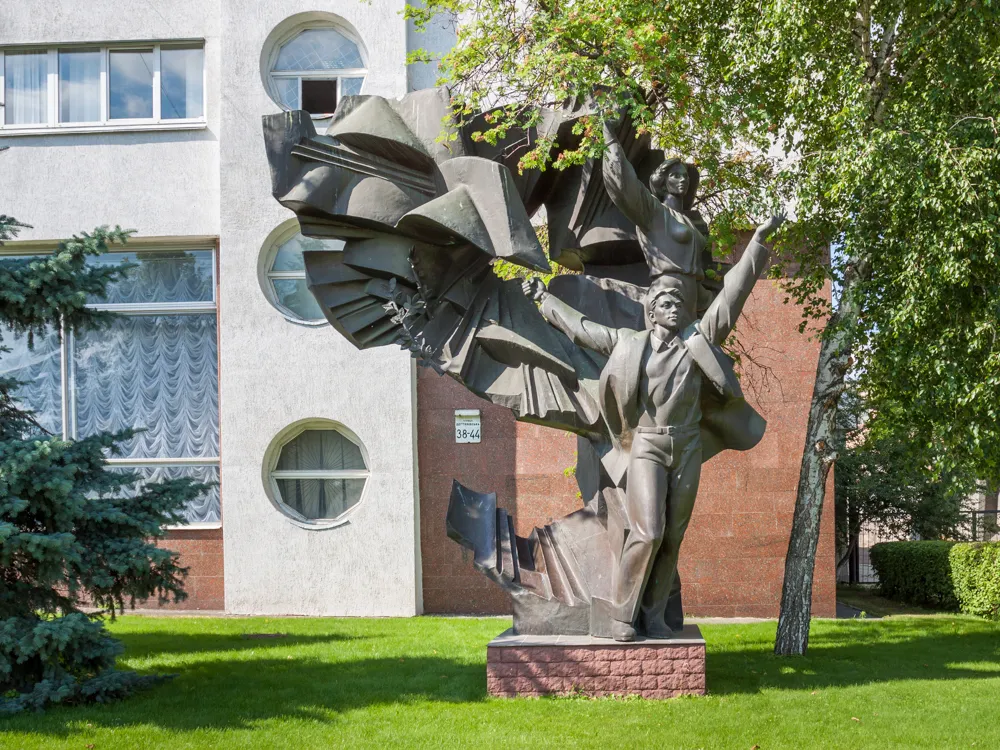
Sculpture of a Komsomol member near the Ukraina Printing Complex, 38–44 Dehtiarivska Street, 2015
The Kyiv Motorcycle Plant deserves separate attention. For it, in September 1945, the surviving capacities of armoured-vehicle repair plant No. 8 on what was then still Kahatna Street were converted. The first motorcycle model – the K-1B Kievlianin – was made here using documentation and equipment taken from Germany as reparations.
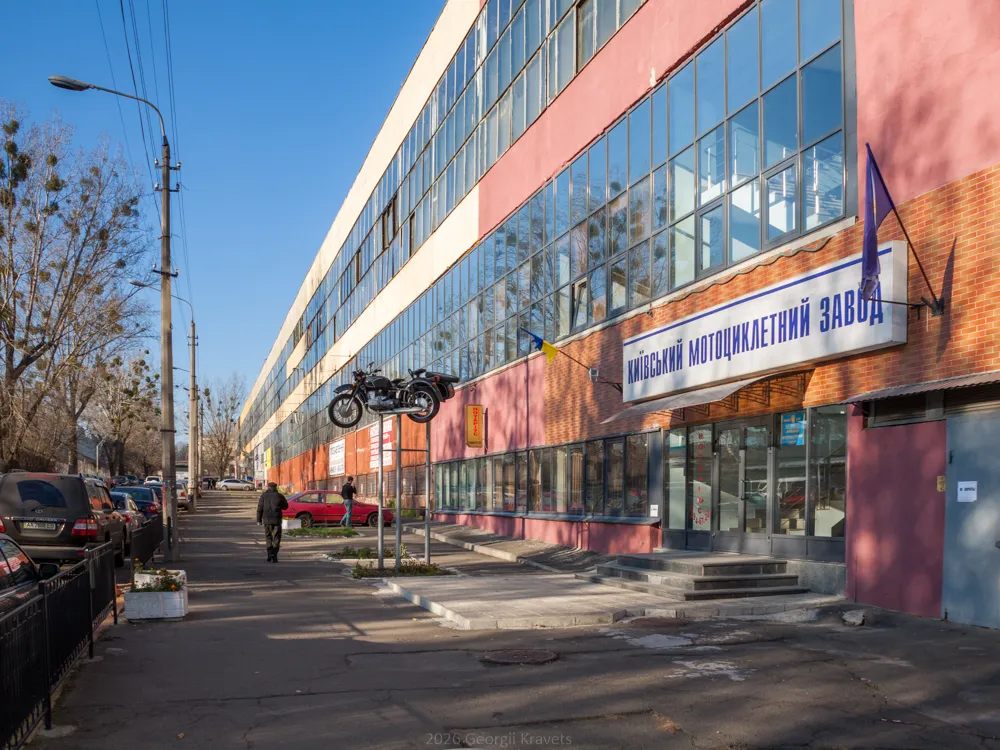
Building of the Kyiv Motorcycle Plant, 8 Gareth Jones Street, 2012
In the mid-1970s the enterprise reached its peak of development, and even developed, specially for the needs of the Party leadership in the Kremlin, the MT-14/9 escort motorcycles, which thanks to special tyres could travel in winter at speeds of up to 130 km/h.
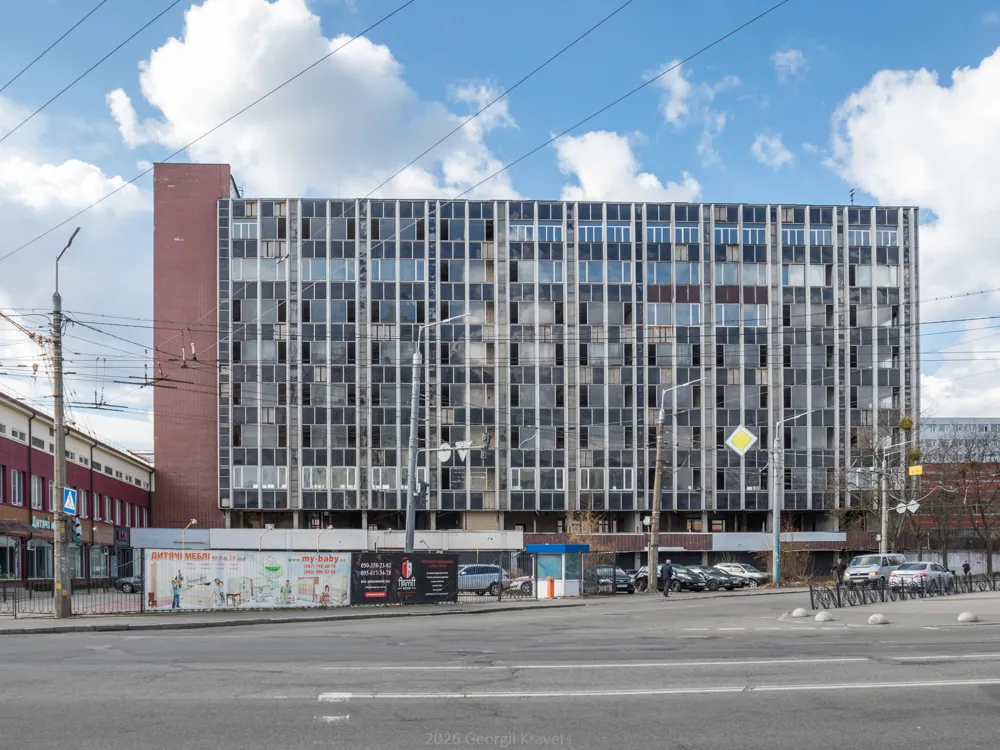
Former design bureau of the Kyiv Motorcycle Plant, 83 Dorohozhytska Street
In 1947 a project appeared to rebuild Lukianivska Square in a pompous Stalinist spirit. In the manner of an ancient Roman forum, with a pseudo-classicist ensemble of structures traditional for the time and even underground car tunnels. Neither the market nor solid historic buildings were, of course, provided for in that plan. However, it was not carried out.
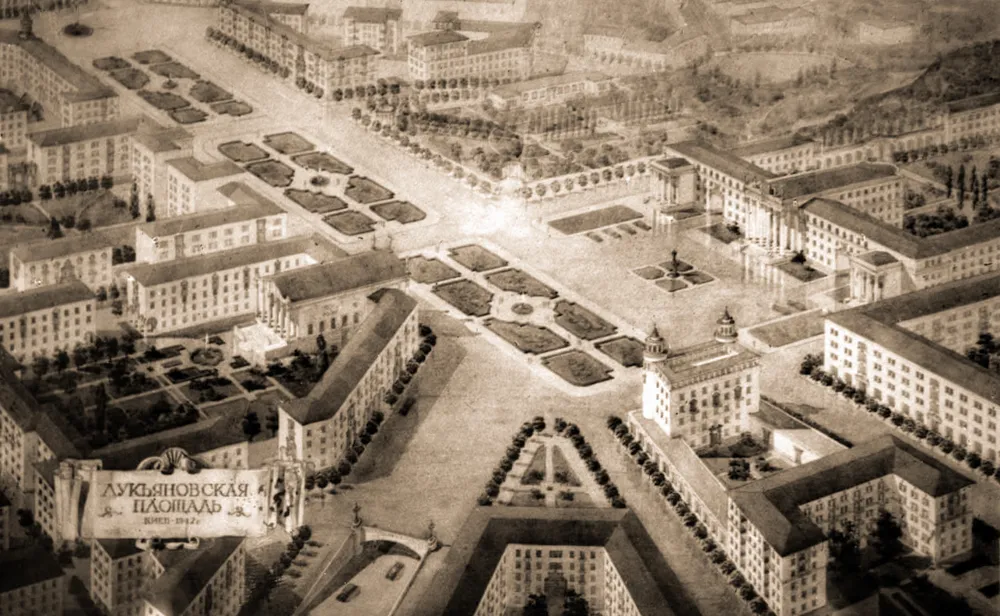
Design for Lukianivska Square, 1947
The only more or less noticeable example of such architecture in the district is the former dormitory of the construction technical school, by Anatolii Dobrovolskyi, at today’s 31 Illienka Street. The office of the energy company YASNO is now located here.
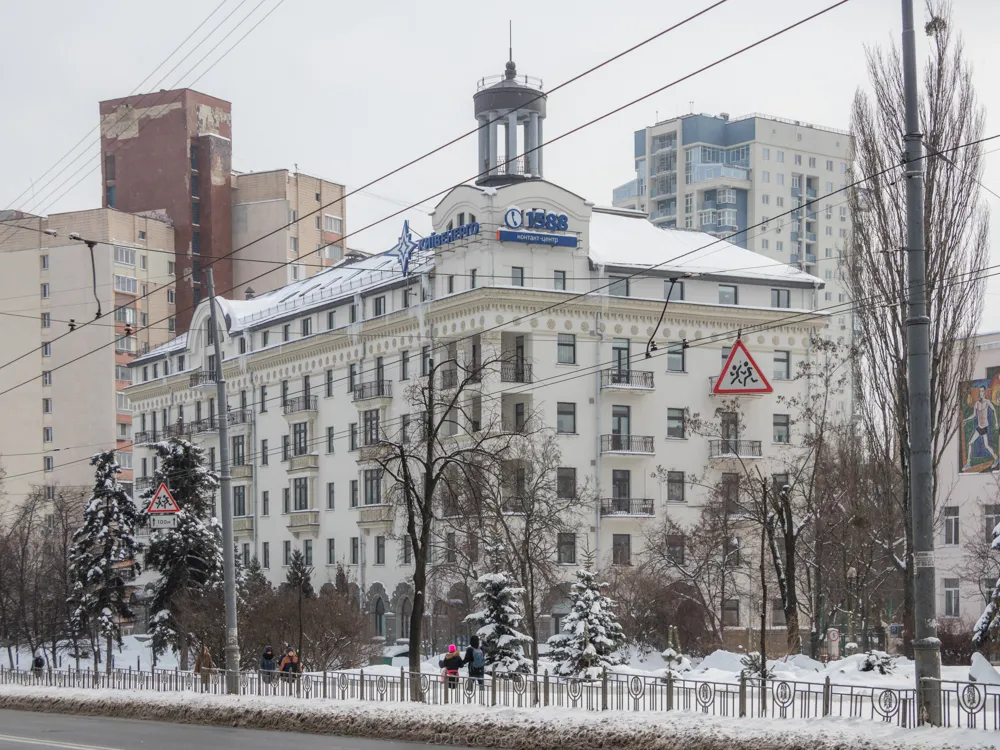
Former dormitory of the construction technical school, now the office of YASNO company, 31 Yuriia Illienka Street
The general fabric of Lukianivka’s residential development changed beyond all recognition in the 1970s. Almost totally, in that late Soviet decade, all the older private homesteads here were wiped out. Many decent income houses and cosy mansions fell then too.
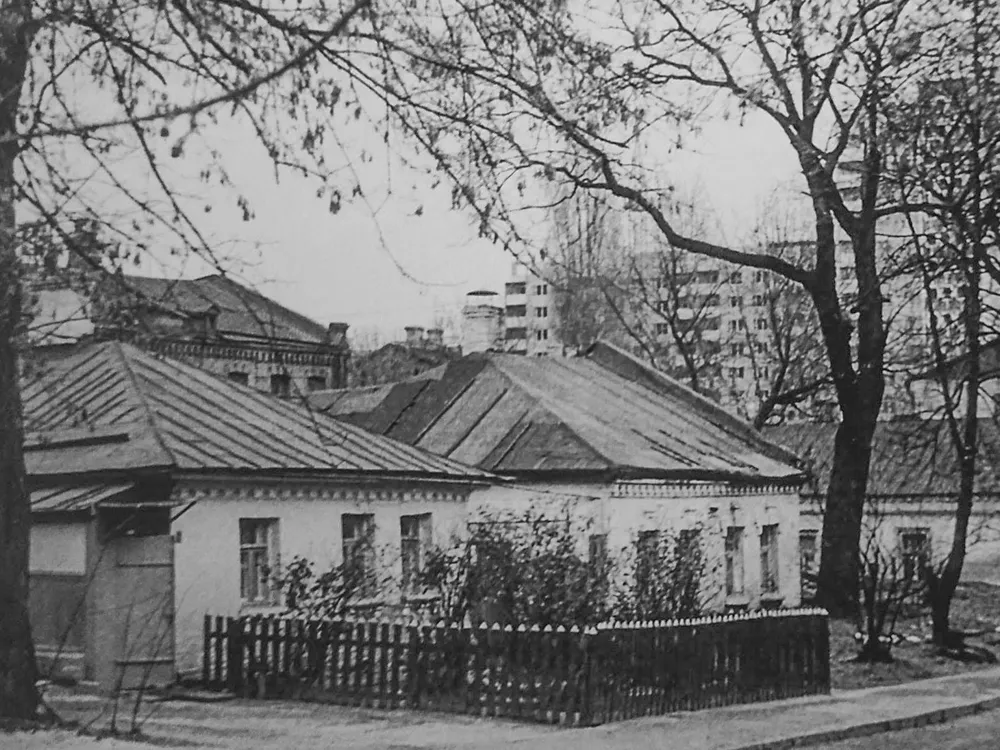
Lost buildings of Wilhelm Kotarbinskyi Street, 1980s
(the photographer could not be identified, probably Vasyl Halaiba)
One might consider lucky the former estate of the nobles Yulii and Yefrosyniia Semenkevych, which now stands alone at the edge of Kotliarevskyi Park. It was reconstructed to a design by the architect Iryna Klymenko in the mid-1980s for the House of Children’s Technical Creativity. Combining brick-style façades with the broken lines of new loggias and little turrets of Modernism.
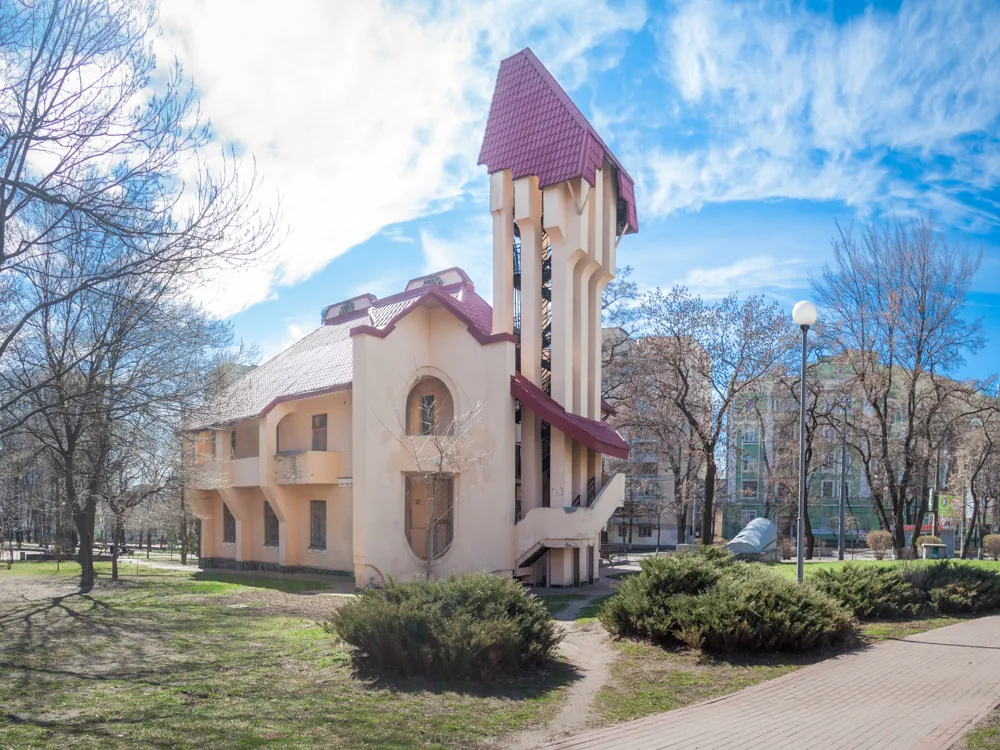
Former House of Children’s Technical Creativity, now the Kyiv City Centre for Work with Women, 20 Yuriia Illienka Street
But even more Modernism came to the block between today’s Viacheslava Chornovola and Leonida Hlibova streets. In 1983 architects from the Kyivproekt institute prepared a reconstruction plan under which the whole patch of the land in question was to be occupied by experimental high-rises of complex configuration – based on the “T” series. And the comprehensive approach tested here was later to be applied to the entire centre of the capital. Kyiv was probably extremely lucky that when in 1988 only the first of those buildings had been realized, Mykola Zharikov became the city’s chief architect and recognized the inappropriateness of the mass appearance of similar panel blocks throughout the whole historic centre.
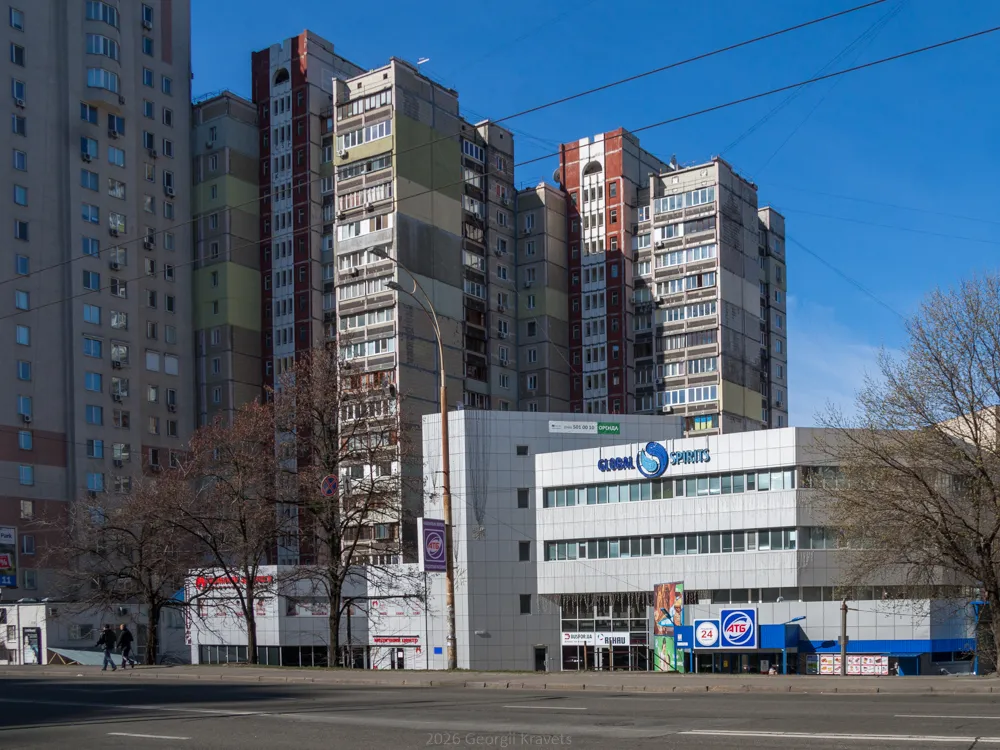
“T” series buildings and a business centre, Viacheslava Chornovola Street
Development of Viacheslava Chornovola and Leonida Hlibova streets
A noticeable manifestation of Brezhnev-style gigantomania in Lukianivka was the replacement of the building of the main local cinema – the old small Komunar – with the stocky Kyivska Rus. The structure, nicknamed by Kyivans “the dump truck”, was rushed in a fever for the celebrations in 1982 of the newly discovered 1,500th anniversary of Kyiv. The new cinema, with halls of more than a thousand seats, was at first considered one of the largest in Europe. And even now its main screen, 26 metres long and 11 high, is reportedly the largest by area in Ukraine.
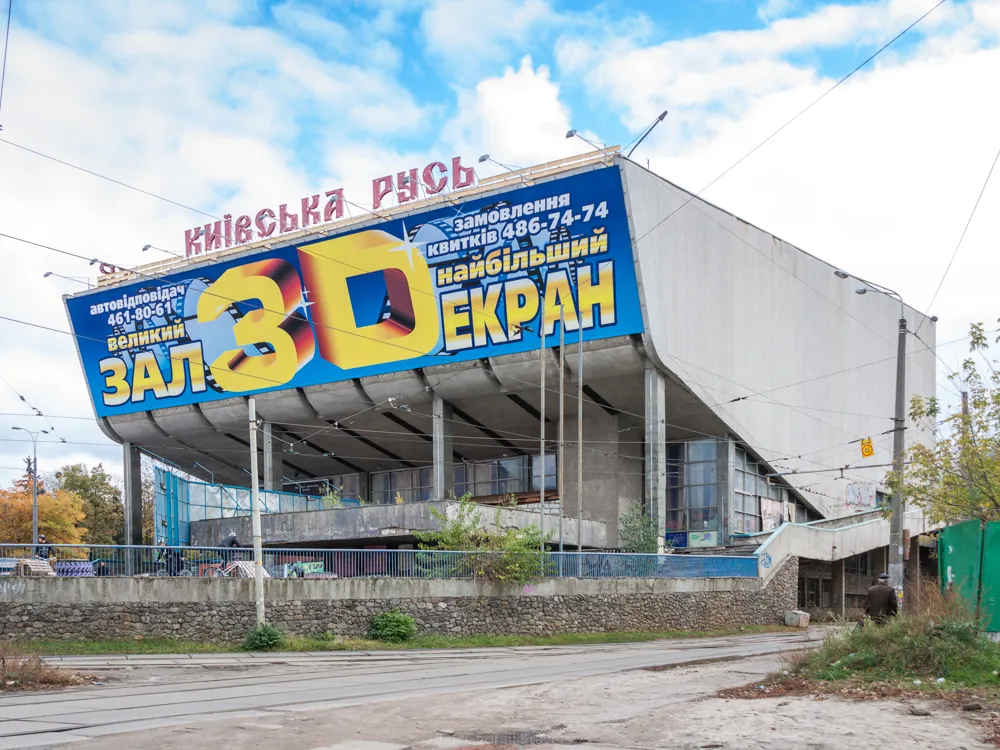
Kyivska Rus cinema, 2011
It turned out symbolic that Kyivska Rus actually stands at the beginning of the royal road, the Via Regia, and that it was precisely there that, during her first official visit to Ukraine (still Soviet, admittedly), a real representative of the British royal house once called. In 1990 the cinema hosted the Film and Television festival, as part of the Days of Great Britain in the USSR. And among its guests, besides such stars as the director Lindsay Anderson and the actor Malcolm McDowell, Princess Anne of Windsor, daughter of Queen Elizabeth II, was also present.
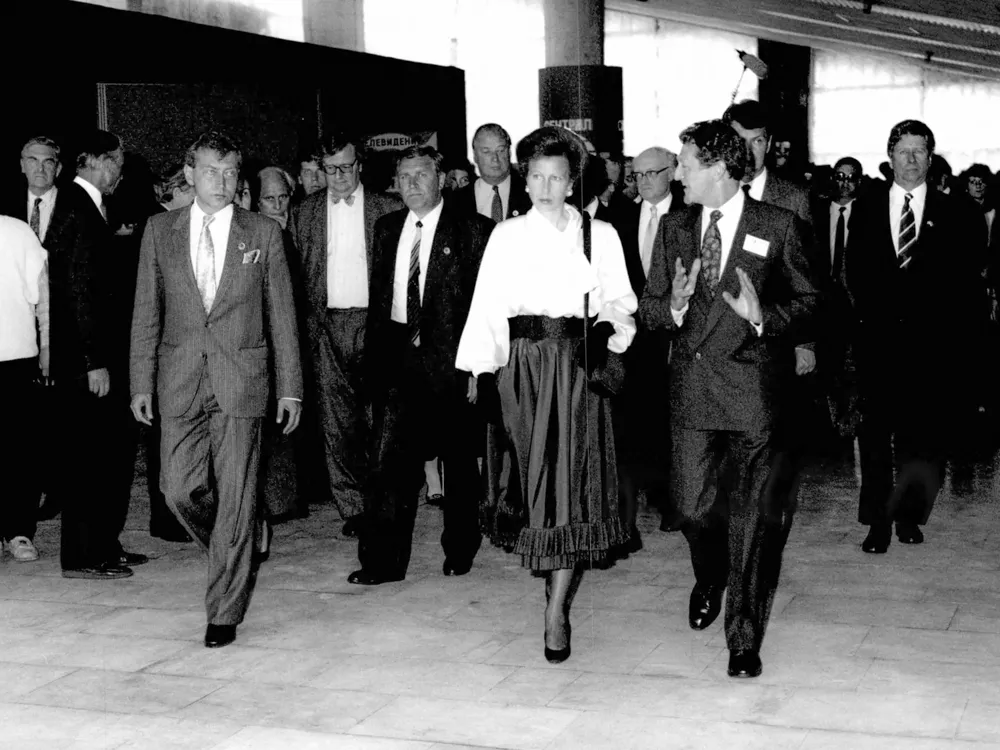
Princess Anne at the Kyivska Rus cinema at the Film and Television festival, as part of the Days of Great Britain in the USSR, BAFTA photo, 1990
The fall of the Soviet empire in August 1991 radically changed almost the entire former way of life in Lukianivka. Of the multitude of monstrous enterprises previously maintained by the state plan, only a few managed the transition to market rails. The considerable areas freed up in factory and plant workshops were swiftly taken over by commerce in recent decades. As across Kyiv, the quantity of its offerings usually far outstripped the quality of the accompanying infrastructure. And this at a time when the district had functionally turned from a near outskirt into practically a part of the large city centre. Assessing the present is always difficult. Are the new buildings that arose in place of the enterprises good? Was it right to remove the tram depot for a shopping centre? Is it expedient to fill the streets with ghetto-like residential complexes? And moreover to build only skyscraper high-rises? What to do with the prison? And what development concept to adopt for Babyn Yar? And for the reconstruction of Kyivska Rus? And for the Start stadium? Kyivans ought now to be seeking answers to all these questions and many, many others. But instead, for almost five years in a row now we have faced challenges, alas, of a quite different order…
In Chornobyl year 1986, on the site of Kashchenko’s acclimatization garden, the main building of the Kyiv Higher Party School under the Central Committee of the CPU was completed. But not many Communist nomenklatura members were stamped out within its walls. Already under Gorbachev’s perestroika entirely different educational institutions began to operate here. In which the national elite of independent Ukraine soon began to be forged. And not only that.
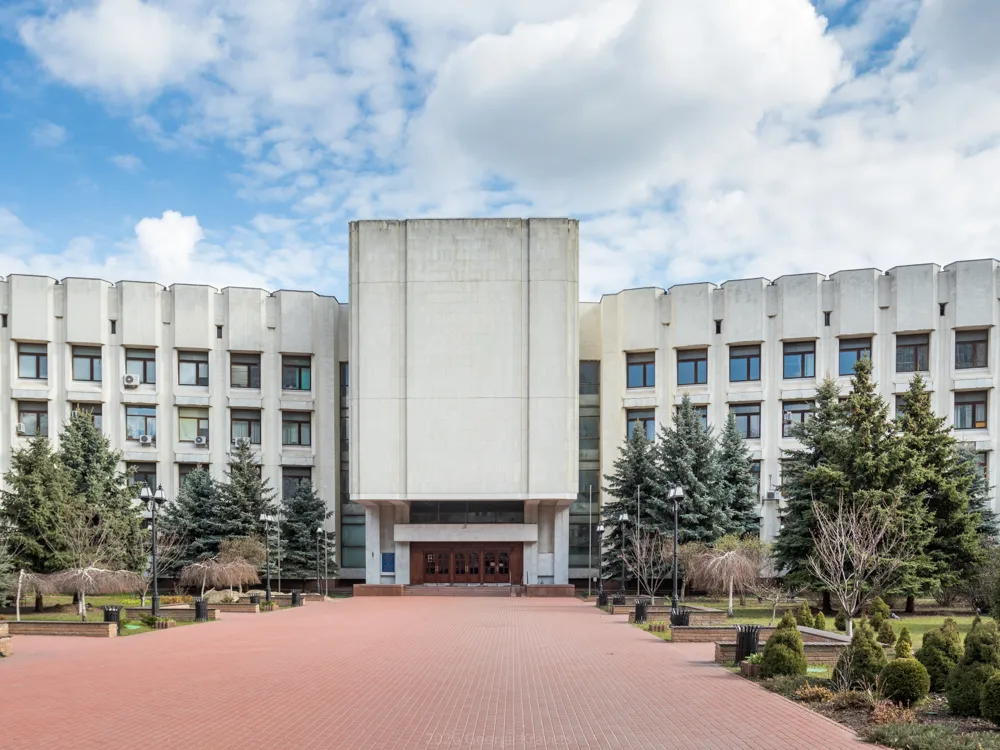
Academic building of the Institute of International Relations and the Institute of Journalism of Taras Shevchenko National University of Kyiv, 36/1 Yuriia Illienka Street
We are speaking, of course, of the present-day Institutes of International Relations and of Journalism of Taras Shevchenko National University of Kyiv. Among the graduates of these institutions are such politicians and diplomats as:
- the fifth President of Ukraine Petro Poroshenko;
- the fourteenth Chairman of the Verkhovna Rada of Ukraine Dmytro Razumkov;
- multiple-time Minister of Justice of Ukraine and judge of the Constitutional Court Serhii Holovatyi;
- multiple-time Minister of Foreign Affairs of Ukraine Borys Tarasiuk;
- the eighth Minister of Foreign Affairs of Ukraine Volodymyr Ohryzko;
- the fourteenth Minister of Foreign Affairs of Ukraine Dmytro Kuleba;
- former Vice Prime Minister for European and Euro-Atlantic Integration of Ukraine Ivanna Klympush-Tsintsadze;
- former Permanent Representative of Ukraine to the UN Serhii Kyslytsia;
- former Chairman of the Central Election Commission of Ukraine Mykhailo Okhendovskyi;
- businessman and co-founder of the mobile internet bank Monobank Dmytro Dubilet;
- the third President of Georgia Mikheil Saakashvili;
- former Minister first of Defence and then of Foreign Affairs of Georgia Gela Bezhuashvili;
- former Minister of Foreign Affairs of Azerbaijan Elmar Mammadyarov;
- former Minister of Foreign Affairs and now of Education of Kenya Amina Mohamed;
- the current Minister of Foreign Affairs of Angola Téte António;
And also famous Ukrainian journalists and media figures – Yulia Mostova, Roman Skrypin, Yurii Butusov, Ihor Pelykh, Andrii Shevchenko, Serhii Leshchenko, Kostiantyn Stohnii, Oleksandr Tkachenko, Volodymyr Arieiv and others.

Collage – some well-known graduates of the Institutes of International Relations and of Journalism of Taras Shevchenko National University of Kyiv. Photos from open sources.
Educational institutions of nationwide standing have in recent decades also occupied several of Lukianivka’s main historic buildings. Thus the premises of the former Sixth Boys’ Gymnasium now house buildings of Vadym Hetman Kyiv National Economic University, and the church teachers’ seminary on Romodanova Street houses the Educational and Scientific Institute of Public Administration and Civil Service of Kyiv University.
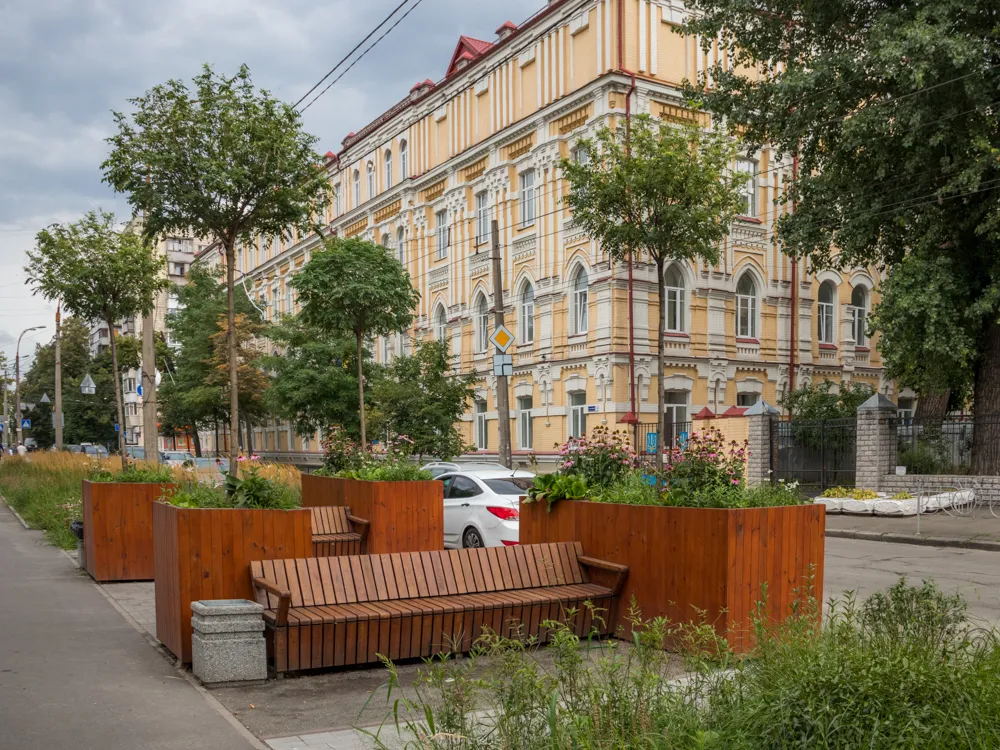
Former Church Teachers’ Seminary, now the Educational and Scientific Institute of Public Administration and Civil Service of Kyiv University, 12/2 Akademika Romodanova Street
The fate of the Alexander Orphanage, which now has the address 13 Derevlianska Street, turned out unusual. From 1992 a College of Catholic Theology founded by the Order of Preachers began to operate in this building. At the beginning of the 21st century it became a branch of the Angelicum, the Pontifical University of St. Thomas Aquinas in Rome, and in 2003 passed into the ownership of the Dominicans, who soon opened here the Higher Institute of Religious Sciences and the Monastery of the Most Holy Mother of God. Besides invited lecturers from the Shevchenko and Drahomanov universities, lectures are also given here by the Dominican fathers.
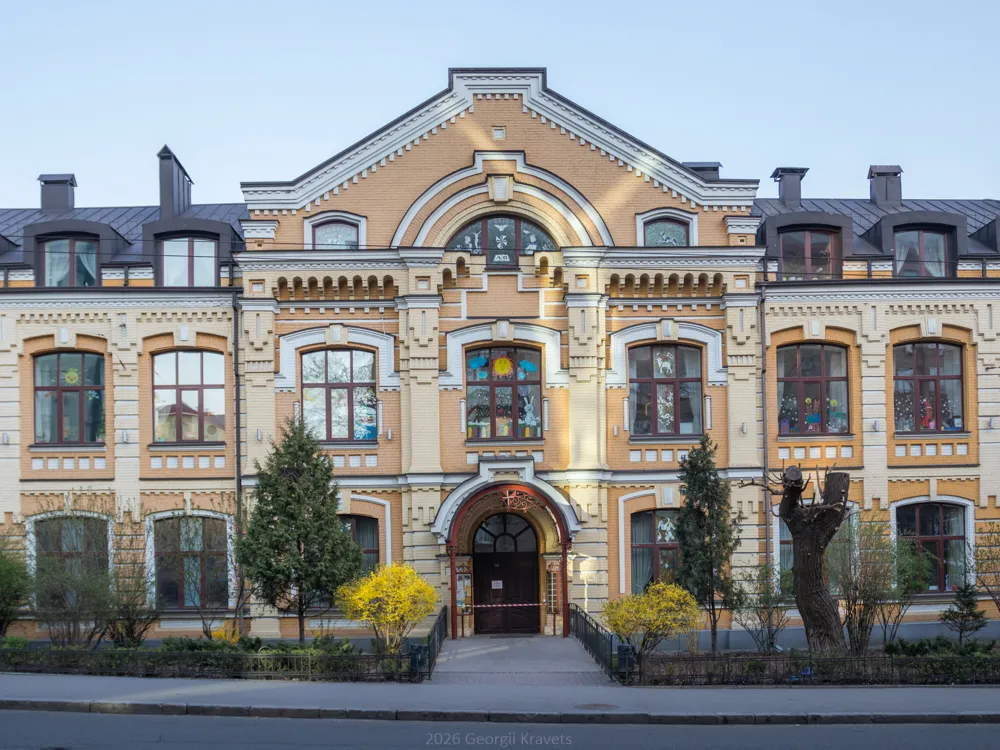
St. Thomas Aquinas Higher Institute of Religious Sciences, the former Alexander Orphanage for the children of soldiers of the tsarist army, 13 Derevlianska Street
In general, modern Lukianivka is a true mosaic of religious diversity. Larger and smaller Orthodox churches of the Ukrainian denominations operate at various institutions. Such as the Church of St. George at the Ministry of Internal Affairs medical centre, the Church of the Transfiguration at the penitentiary service, or the Church of St. Barbara at the regional clinical hospital.
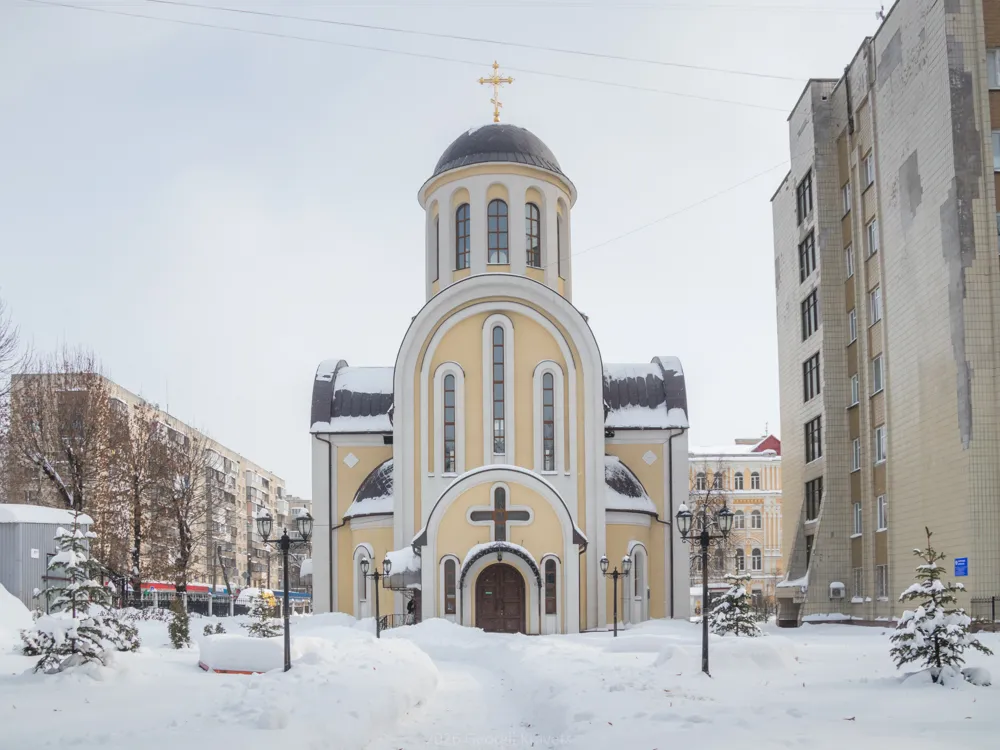
Church of St. Barbara the Great Martyr on the grounds of Kyiv Regional Clinical Hospital No. 1, 1 Zahorivska Street
St. Catherine’s Church at the Lukianivka Cemetery has also been restored, and there is constant talk of rebuilding the old St. Theodore’s Church at the corner of Ovruchska and Zahorivska streets. In the former clergy house of the church a parish already exists, at which a pilgrimage and missionary centre, Kyiv Jerusalem, and an Orthodox book centre have been founded.
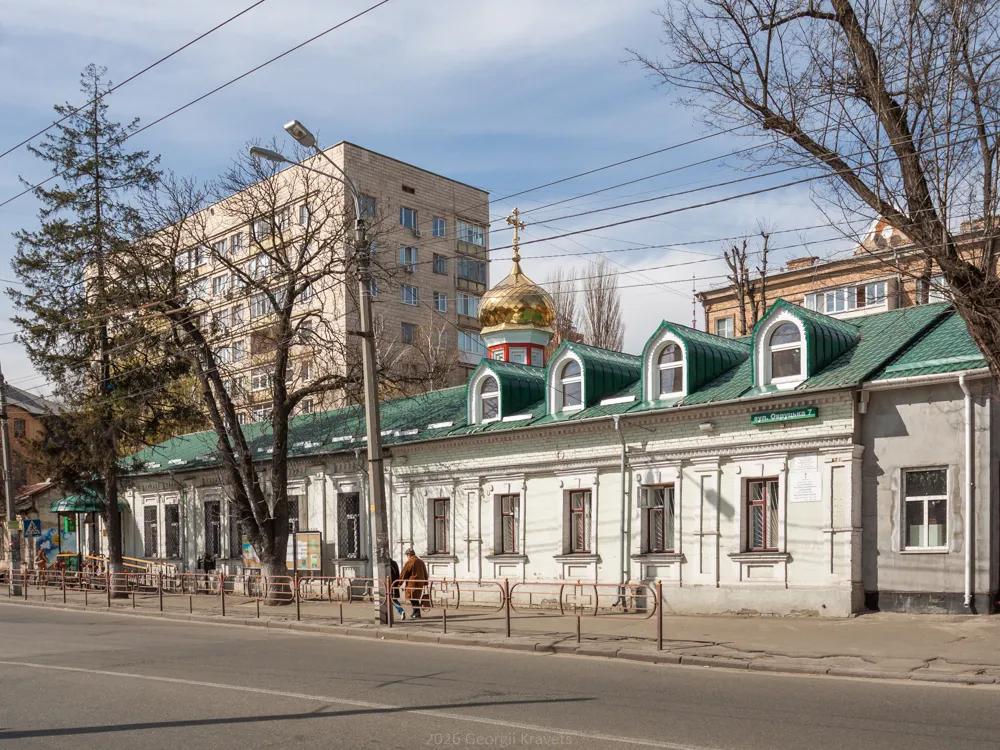
Clergy house of the parish of St. Theodore the Sanctified, 7 Ovruchska Street
In 1996 Hieromonk Alexei (Pergamentsev) founded, on the grounds of his own estate – in a former Art Nouveau mansion at 18 Kvituchyi Lane – a monastery in honour of St. John (Maximovich), Archbishop of Shanghai and San Francisco. This monastery now represents the Russian Orthodox Church Outside of Russia in Kyiv.
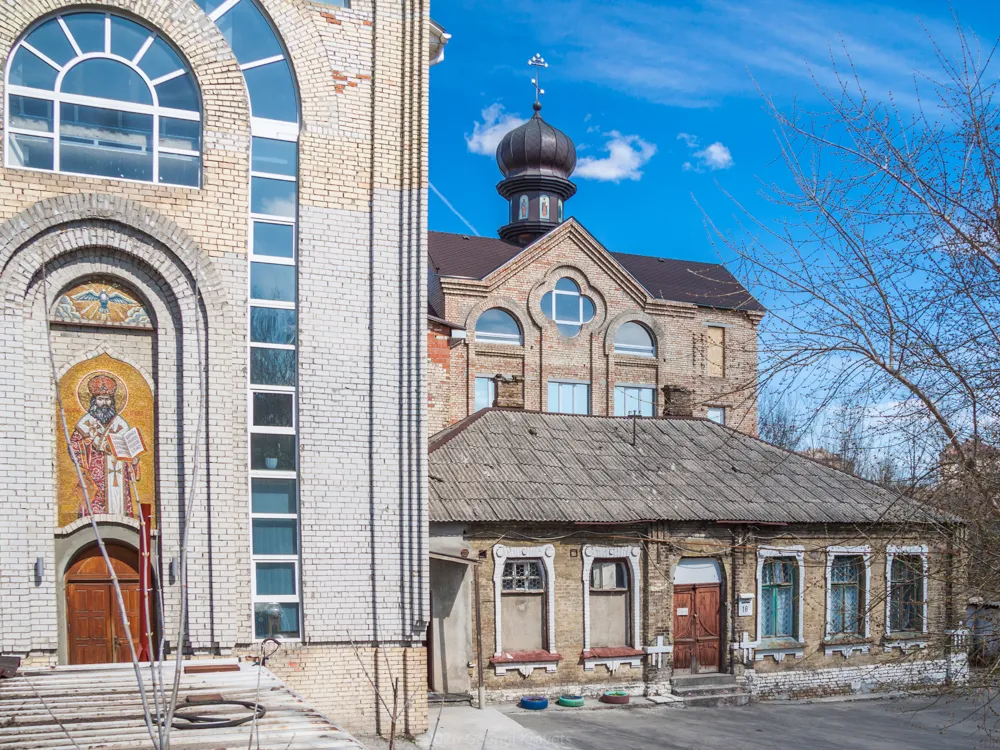
Monastery of St. John, 18 Kvituchyi Lane
The largest mosque in the capital, Ar-Rahma, was completed in 2011 at 46 Lukianivska Street, practically on the very summit of Shchekavytsia hill. True, this is rather already Tatarka. Directly in the area described, at 25A Dehtiarivska Street, the Kyiv Islamic Cultural Centre had opened its doors to the faithful ten years earlier. Today it contains:
- a mosque, with a men’s prayer hall for 800 people and a women’s for 400;
- a library;
- a madrasa;
- the gymnasium Our Future;
- the office of the Spiritual Administration of Muslims of Ukraine Umma;
- the office of the association of public organizations VAGO Alraid;
- the Sharia fatwa committee;
- the Ukrainian Centre for Islamic Studies;
- the human rights organization Together with the Law;
- the Alraid halal research and certification centre;
- a conference hall for 100 people;
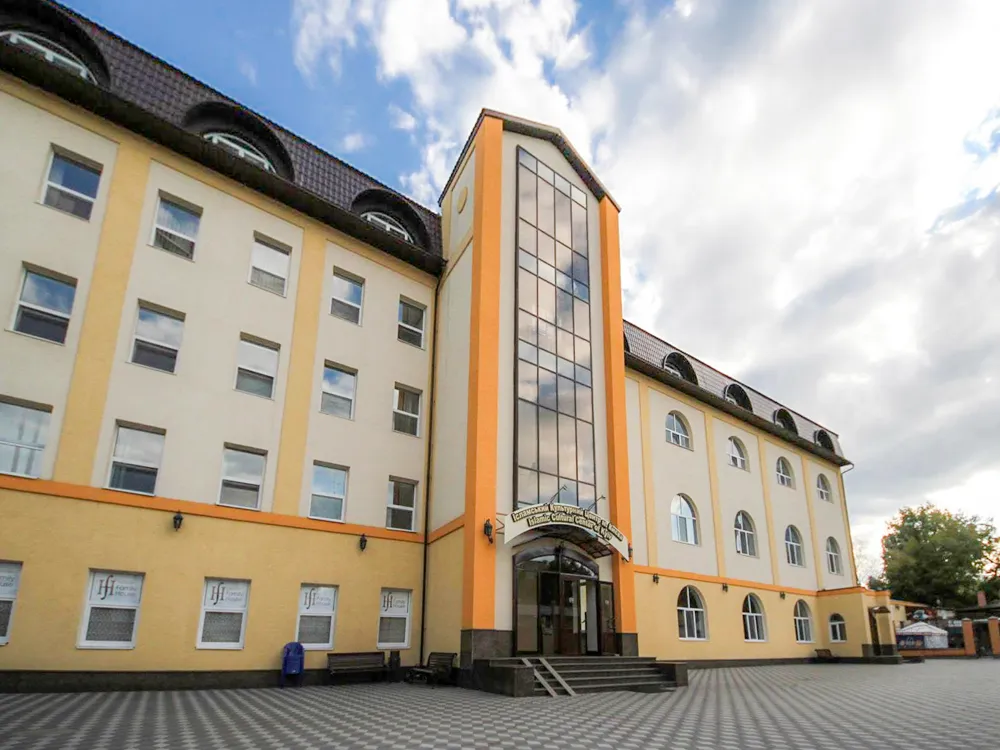
Kyiv Islamic Cultural Centre, photo from the Facebook page of the Mosque, Islamic Cultural Centre
In spring 2021, for the eightieth anniversary of the Babyn Yar tragedy, the construction of a synagogue was completed here in the tract, on a height at the edge of the precipice. The first in Kyiv since Soviet times. The symbolic building is constructed of wood in the shape of a book. It can fold into a seemingly monolithic cabinet and unfold into a picturesque altar open to the sky. The place of worship has a contextual name – Place for Reflection.
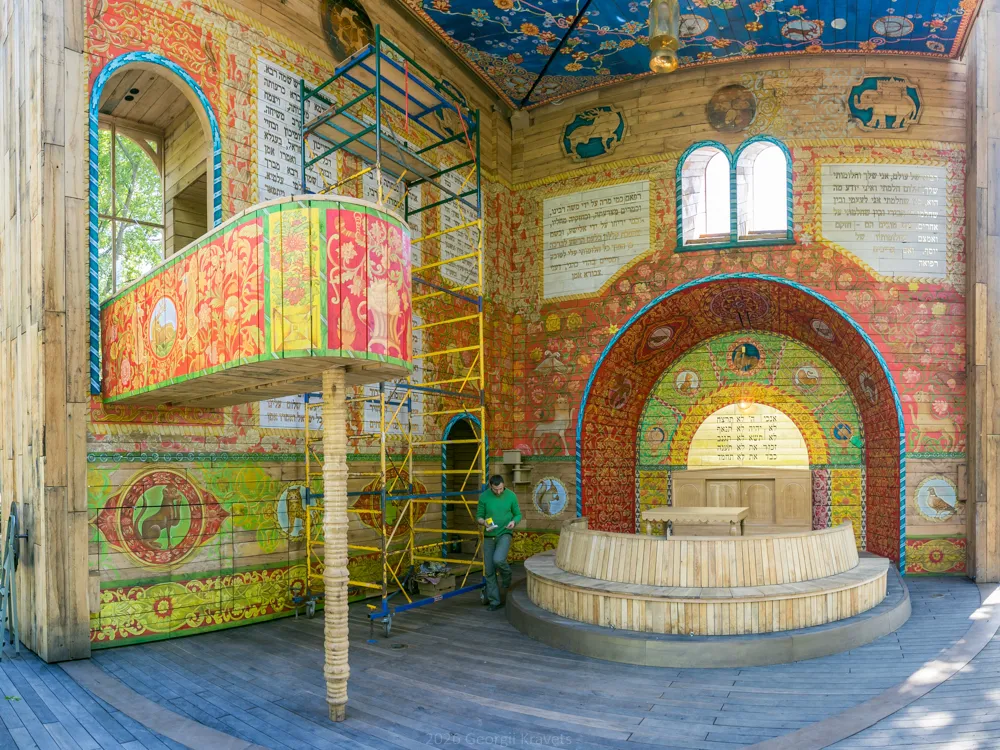
Synagogue “Place for Reflection”, Babyn Yar
And one more thing about contexts. The last decade of the 20th century passed in the world under the sign of globalization. And its best-known, perhaps, pop symbol – the fast-food restaurant McDonald’s – first found a place in Ukraine also in Lukianivka. It opened on Kyiv Day, 24 May 1997. On the first floor of the above-ground vestibule of the new, thirty-eighth, station of the Kyiv Metro.
McDonald’s in the building of the above-ground vestibule of Lukianivska metro station, 2026
In fact, McDonald’s largely sponsored the construction of Lukianivska station. As journalists rumoured, since the city hall then wished to extend the rails as far as possible, and the foreigners financed the fitting out of only one stop, the previously planned Lvivska Brama was therefore skipped.
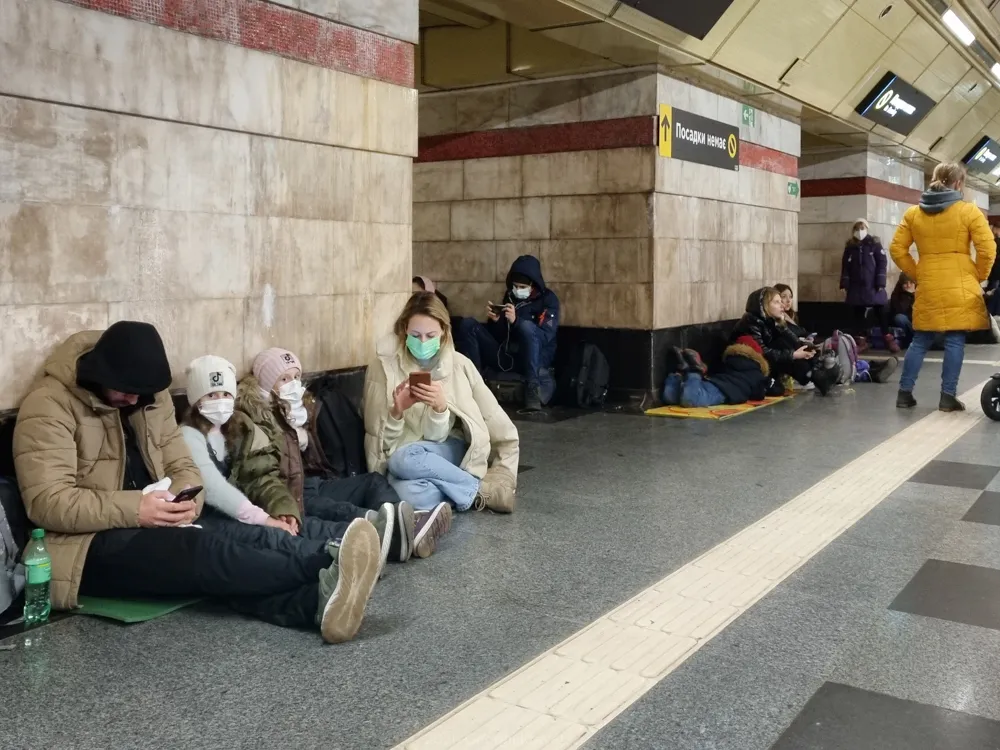
Lukianivska metro station, 24 February 2022
A similar story happened with the unrealized Zahorivska station (which also appeared under the name Herzen). Its exit in the late 1990s was planned for the back yard of the Kyiv Institute of International Relations. A terminal stop for trolleybus No. 6 was also to be set up here, on the dead-end section of Herzen Street.
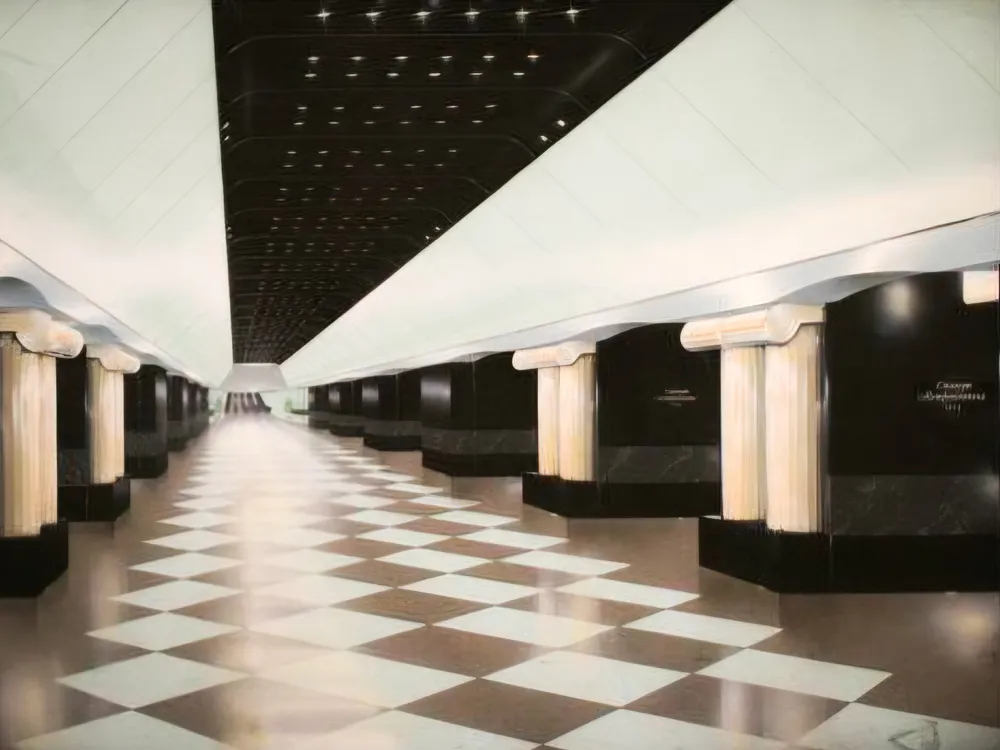
Design for Zahorivska (Herzen) metro station
However, the city authorities, again chasing savings, in 2000 pushed the metro line straight through to today’s Dorohozhychi, creating one more ghost stop in the tunnels.
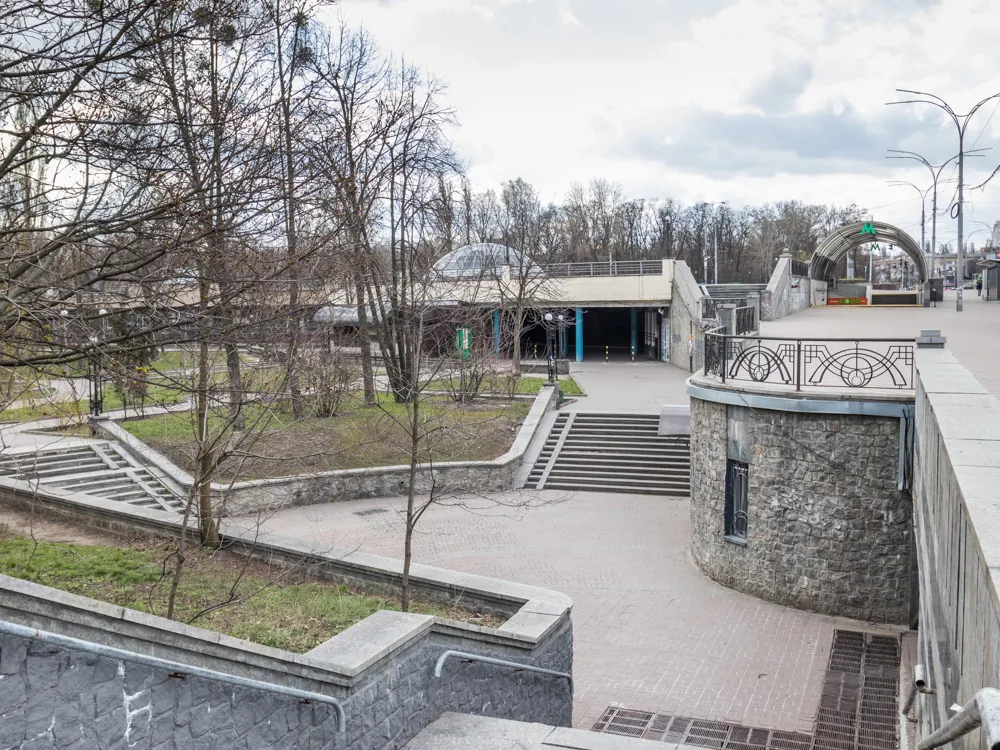
Above-ground vestibule of Dorohozhychi metro station, Oleny Telihy Street
As for the architectural face of Lukianivka, in the last three-plus decades it has been changing rapidly. Only the bulky Socialist-era unfinished buildings scattered here and there across the district remain as lasting reminders of the collapse of the late USSR. The stalled finishing of the Television Centre’s concert hall has already been mentioned. Not far from it, near the university campus on Illienka, stand the unfinished frames of buildings for the state archive and an academic sports complex. In the thickets of the Repiakhiv Ravine hides the ghost of an abandoned building of the institute of social and forensic psychiatry and narcology, and in the lowland of the Kmytiv Ravine – the polyclinic building of the Institute of Neurosurgery, never brought to completion.
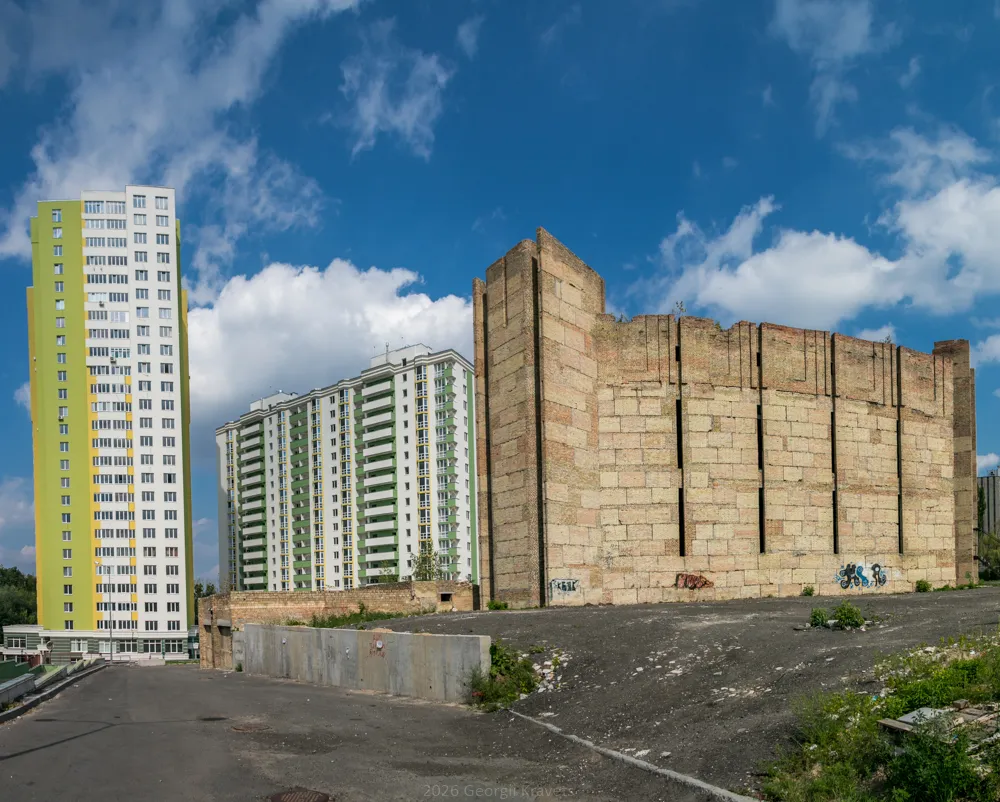
Unfinished building of the state archive, 40 Yuriia Illienka Street, against the background of the Herzen Park residential complex
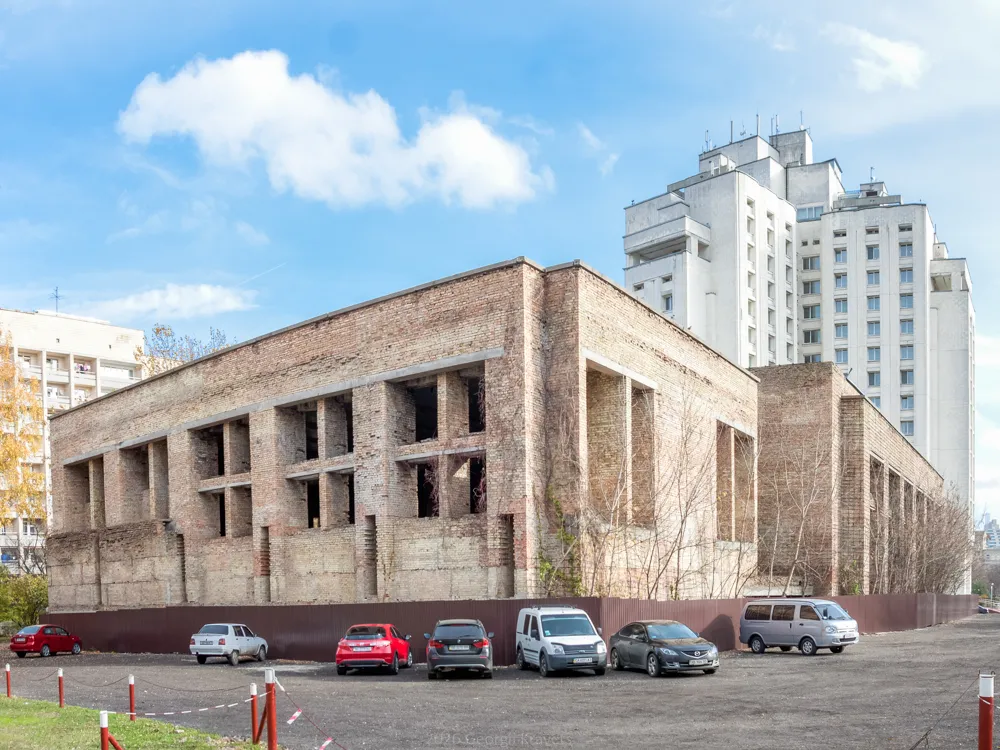
Unfinished sports complex of the Higher Party School under the Central Committee of the CPU, 36/1 Yuriia Illienka Street
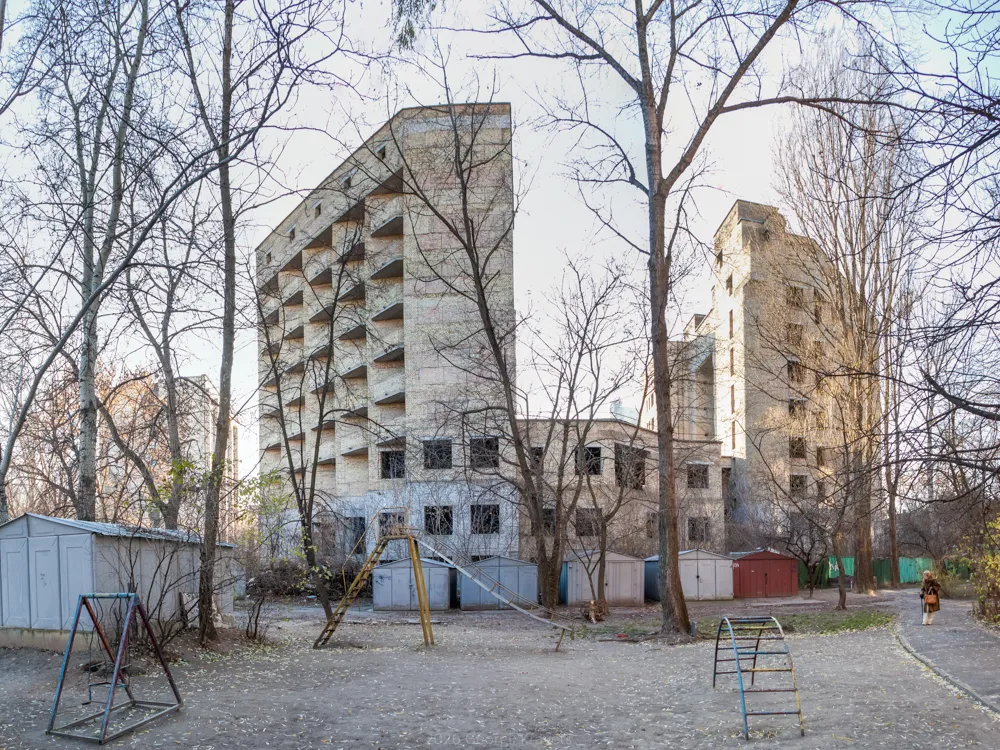
Unfinished polyclinic building of the Institute of Neurosurgery, 32 Platona Maiborody Street
Practically all the unwieldy Soviet industrial enterprises have by now been eaten by the killer whales of capitalism – residential, business and shopping complexes. Only a few of the defence enterprises named earlier have stayed afloat.
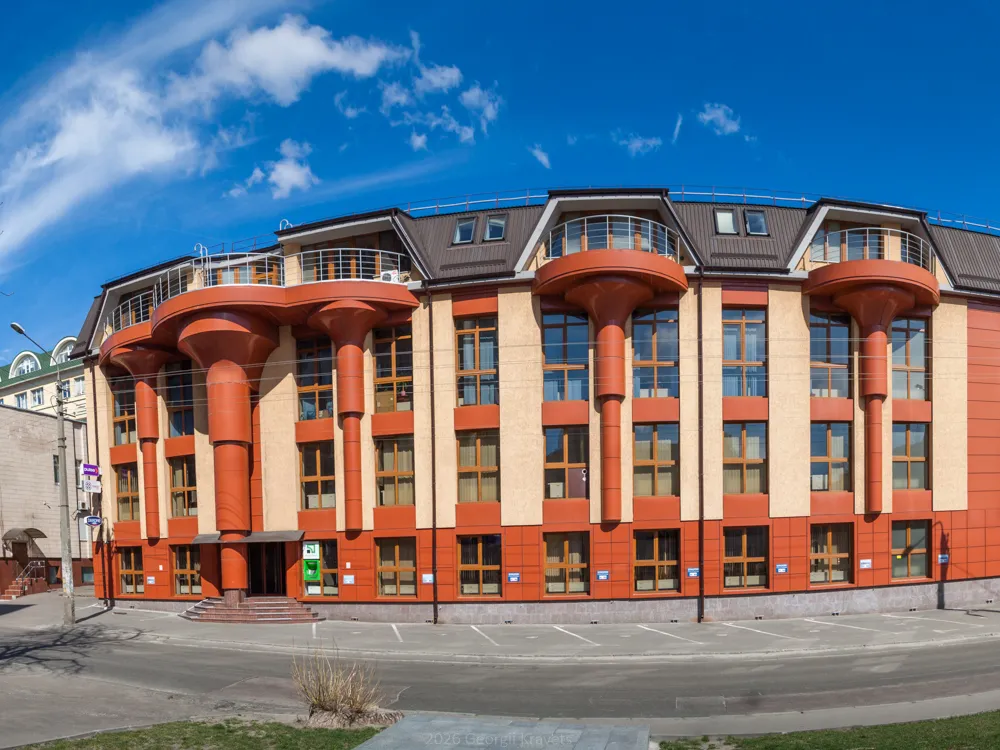
Orange Building of the PULS business centre on the grounds of the Ukrkabel plant, 17/21 Zahorivska Street
Thus the Ukrkabel buildings were repurposed by their shareholders as early as 2007 for retail, office and hotel infrastructure. In particular, in the unfinished large new workshop the Promenada Centre shopping mall now languishes.
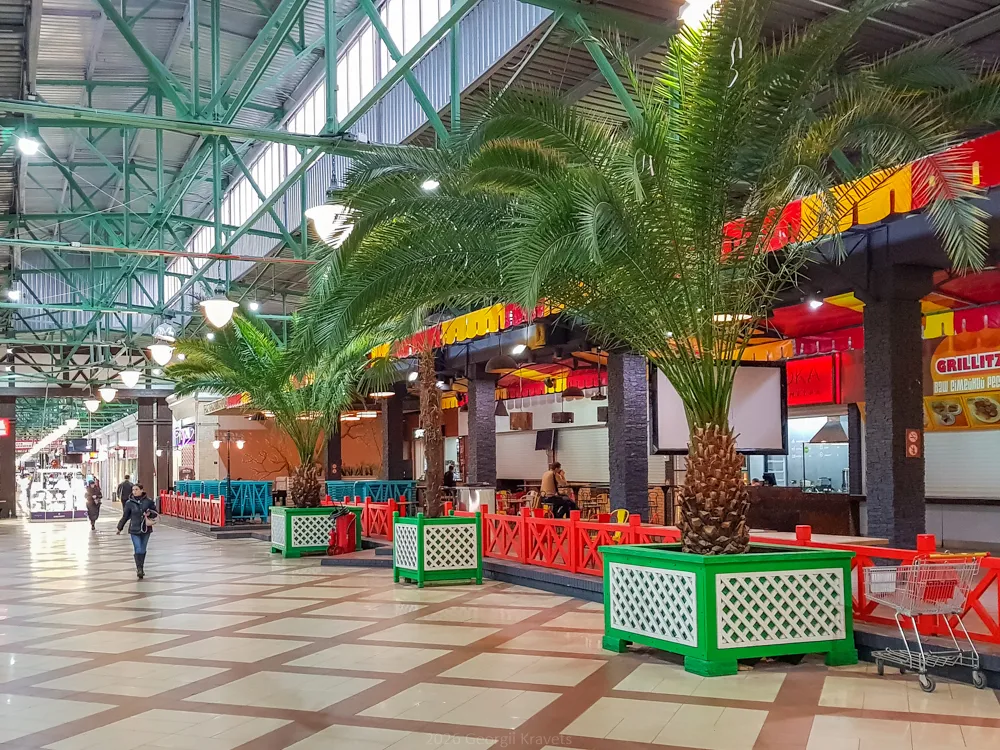
Interior of the Promenada Centre shopping mall, the unfinished workshop of the Ukrkabel plant, 18 Ovruchska Street
The Start residential complex has been built in place of Hazprylad on Sholudenka; Creator City in place of the fourth bread factory and Budshliakhmash on Dehtiarivska. Neighbouring parts of the industrial zone here are also slowly being taken over by the high-rise complexes Cosmopolitan and Poetica. Notably, Kyiv’s first multistorey commercial building, at the very beginning of the 1990s, also arose nearby – the Enran housing cooperative at 14–14/1 Dovzhenka Street.
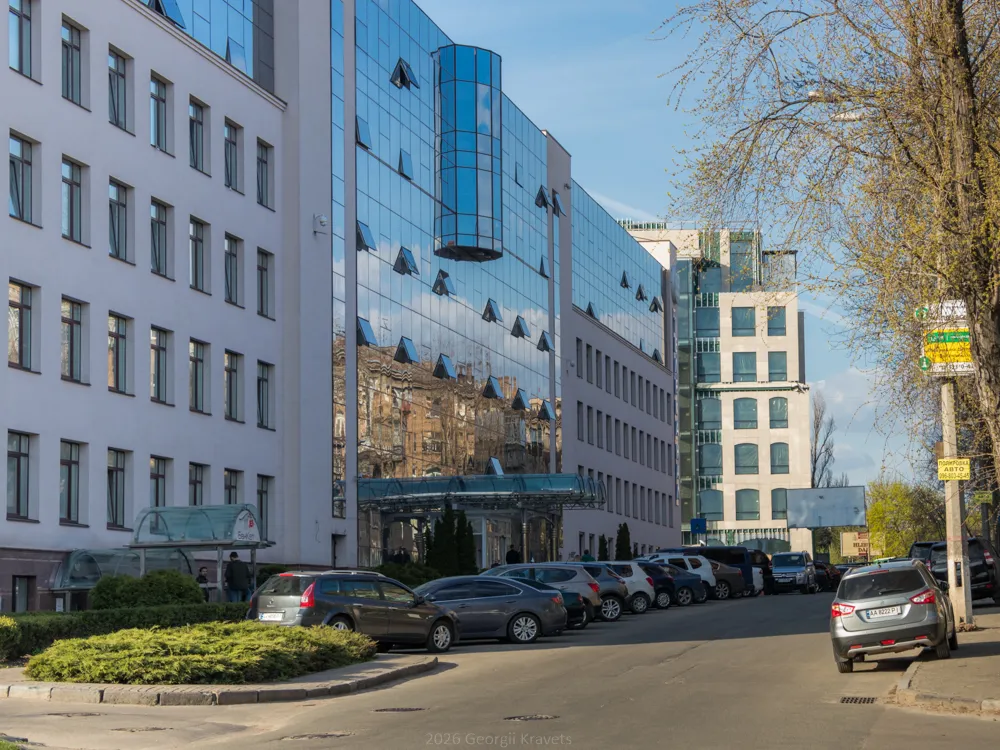
Former administrative building of the Budshliakhmash plant, converted into an office centre, 21H Dehtiarivska Street
One of the most ambitious development projects is now being carried out on the former grounds of the Kyiv Motorcycle Plant. The enterprise tried to stay afloat to the last – in 1998 at a motor show it even demonstrated a sample of the Chumak touring machine, and then tried to think up something else… But from 2021 the huge industrial block between Gareth Jones, Dorohozhytska and Illienka streets began to be consistently transformed into modern infrastructure. Here, probably, before our eyes arises the most spectacular architectural legacy of our time – the futuristic buildings of the UNIT.City innovation park and the UNIT.Home residences.
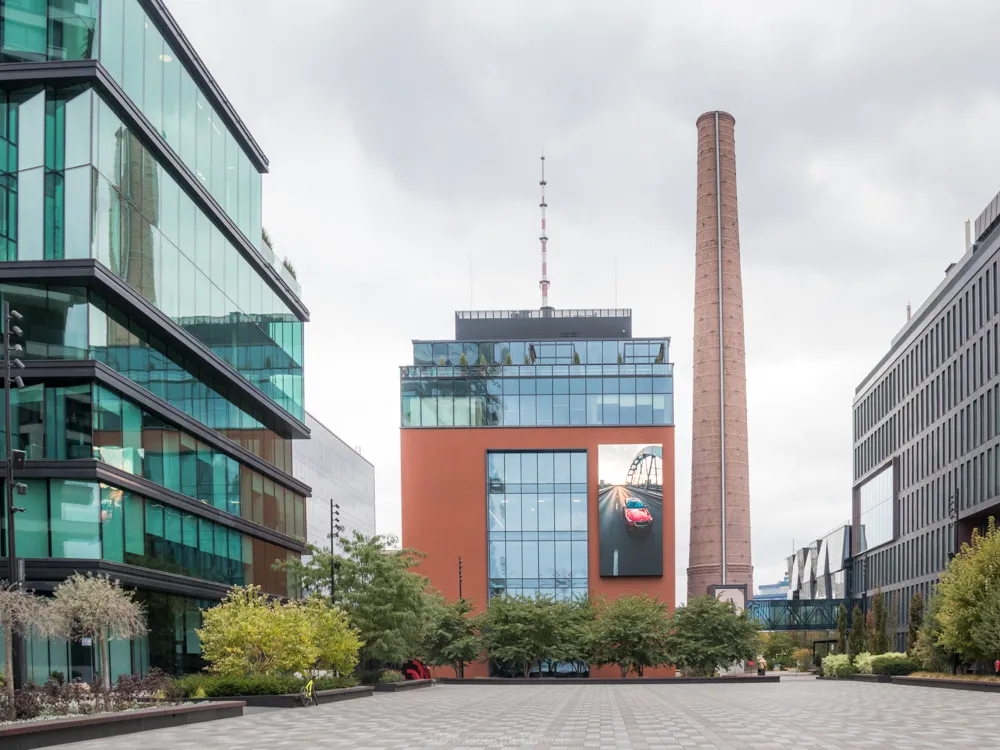
UNIT.City innovation park, 3 Dorohozhytska Street
Among the new buildings of acceptable aesthetics one can also include:
- the UBI Fashion Center, designed by the German studio Schmitt Ladenbau GmbH, at 8 Dorohozhytska Street;
- the laconic M-House business centre at 16A Illienka Street;
- a business centre of similar character, FORUM West Side, on the grounds of the former scientific restoration design, construction and production enterprise Ukrrestavratsiia;
- the Orange Building of the PULS business centre, with a postmodern façade, at 17/21 Zahorivska;
- the elite high-rise of the Parus residential complex, of a soaring silhouette, rising above a garage cooperative in Zarudnoho Lane.
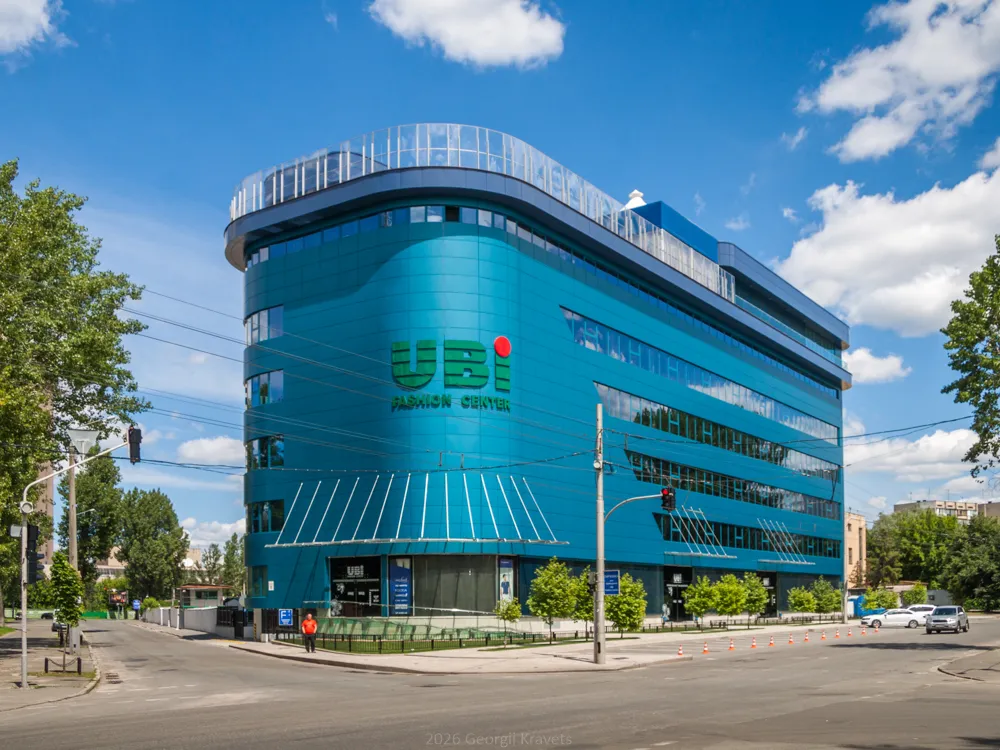
UBI Fashion Center, grounds of the former Kyiv Motorcycle Plant, 8 Dorohozhytska Street
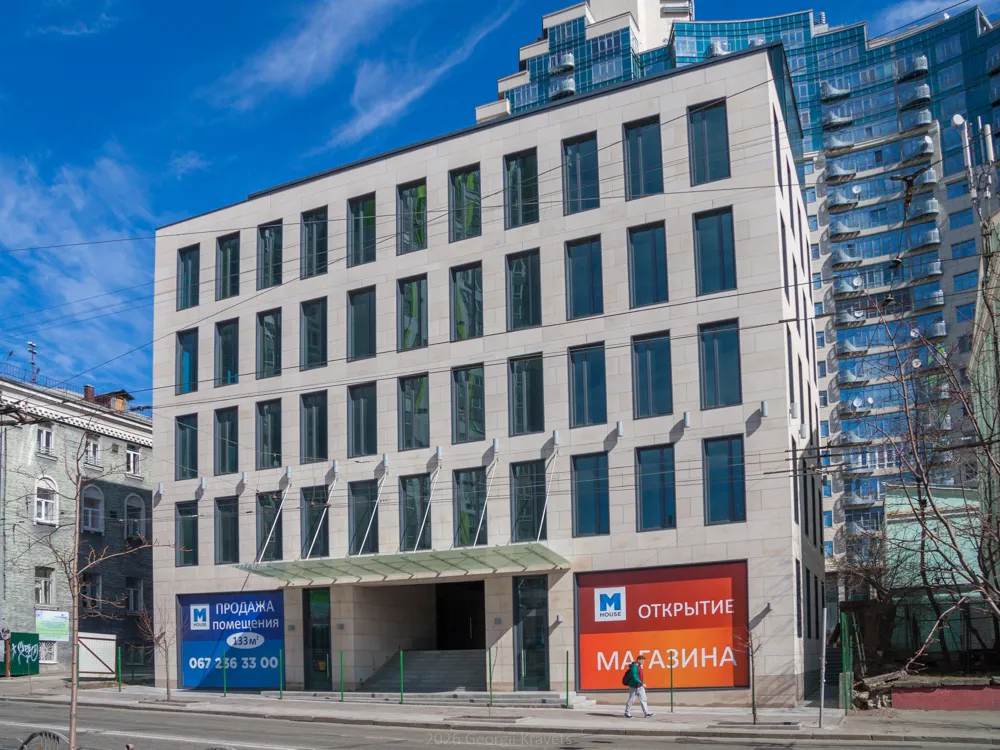
M-House business centre, 16A Yuriia Illienka Street
With the rest of the new buildings things are much worse. Faceless and characterless masses of clutter – all these Herzen Park, Silver Towers, Lukianivka Cascades, Baggovutivski and the like. With their immoderate volumes they crush everything around. Both the natural landscape and any previous development.
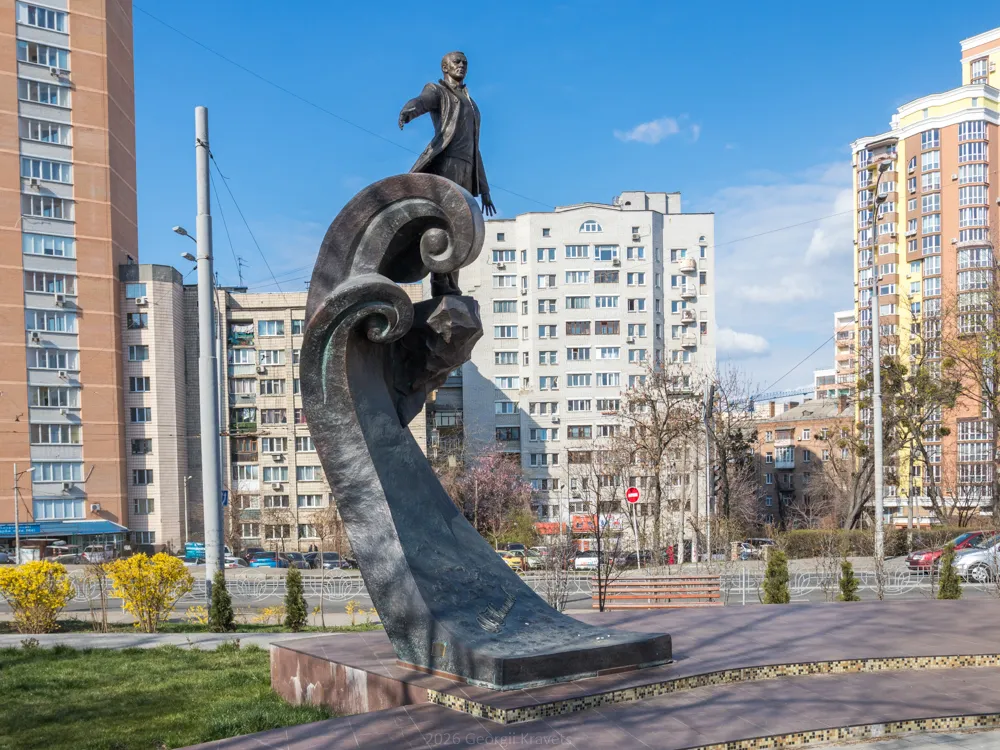
Monument to Muslim Magomayev against the background of modern development on Hlibova and Chornovola streets
It is especially telling how the talentless giants from Kyivmiskbud on Kopernyka Street squeezed between them the only surviving old manor in that block. House No. 7 had stood here since 1913. After the appearance of its immoderately massive neighbours its walls cracked. Now this mansion is sometimes called the Cossack one, hinting at its present owner, Yurii Ruhol – head of the public organization Academy of Cultural Heritage of the Ukrainian Cossacks. Until recently peacocks lived in the owners’ yard, but in recent years they are no longer seen here.
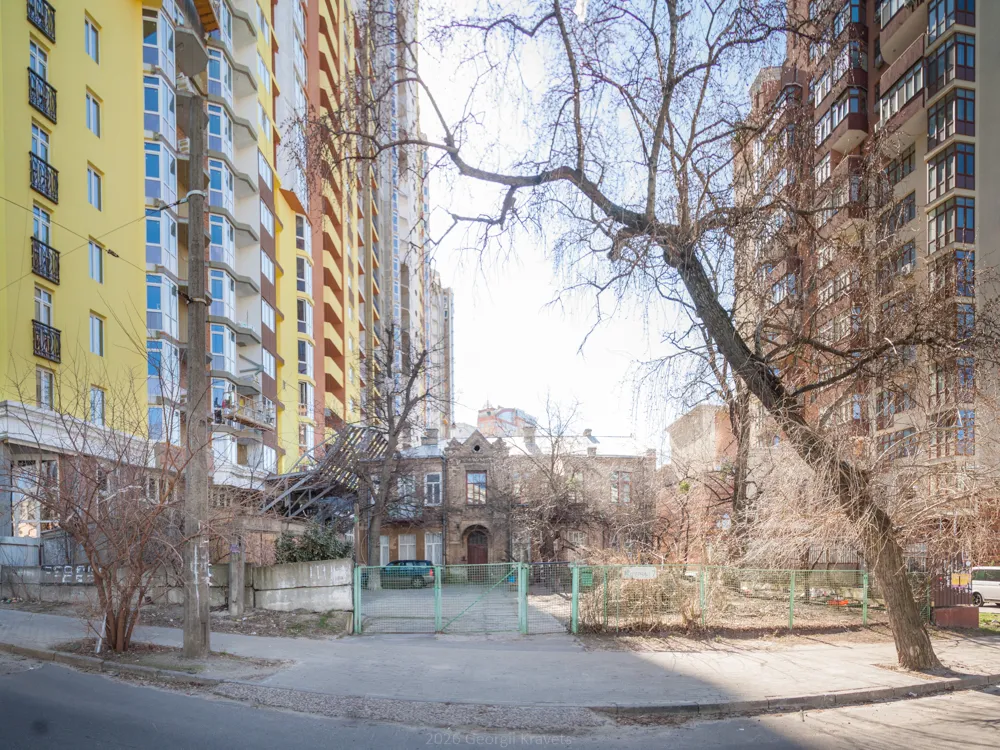
“Cossack House”, 7 Kopernyka Street
The first echo in Lukianivka of the military aggression against Ukraine launched by the Russians in the second decade of the 21st century was the appearance of a symbolic thing. In March 2016 a monument was installed on the building at 22 Biloruska Street to, in fact, Belarusians… who died in the fight for our country. Its author was the sculptor Hlib Hrzhabovskyi, whose son was killed by the invaders defending Donetsk Airport.
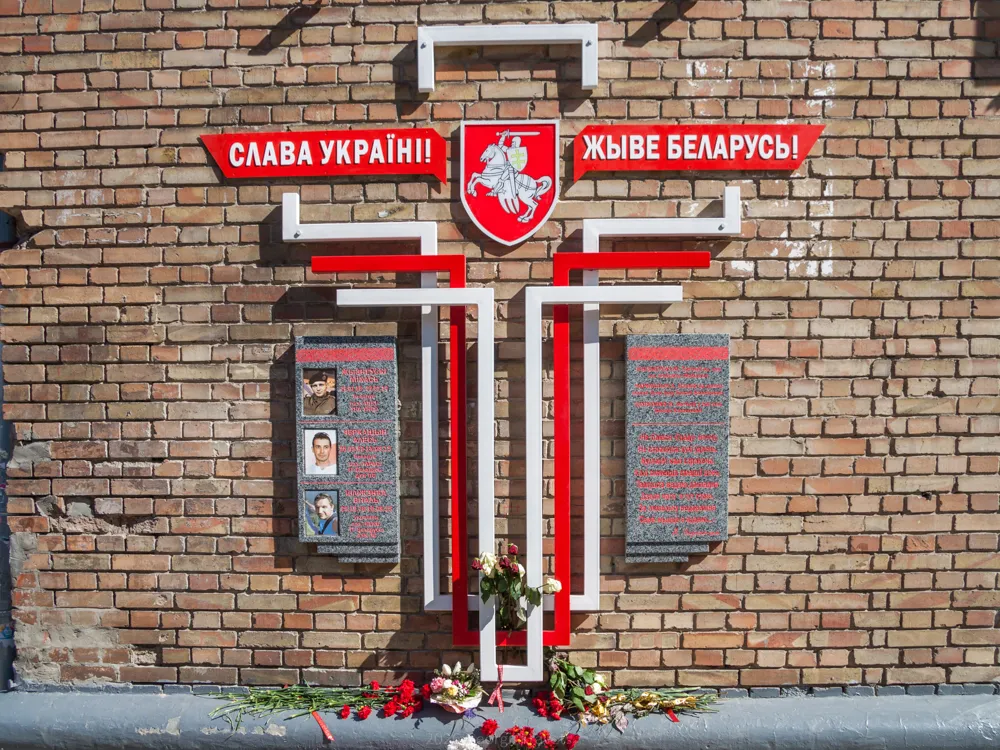
Monument to Belarusians who died for Ukraine, 22 Biloruska Street
Since 24 February 2022, as is well known, the district has been subjected to regular and merciless bombardment by the army of the Russian Federation. And although now and then isolated hits on industrial or military objects occur, for the most part enemy shells destroy the homes of Kyivans and civilian infrastructure. Indicative was an incident that occurred in the first week of the full-scale invasion. Russian missiles were launched at the Kyiv TV tower. One of them hit the equipment room, killing an employee of the RRT concern, the second fell nearby, taking the lives of several random passers-by. Among them a child. Yet did such an attack have any sense beyond intimidation? Hardly, since according to open records the television centre complex had been immediately mothballed.
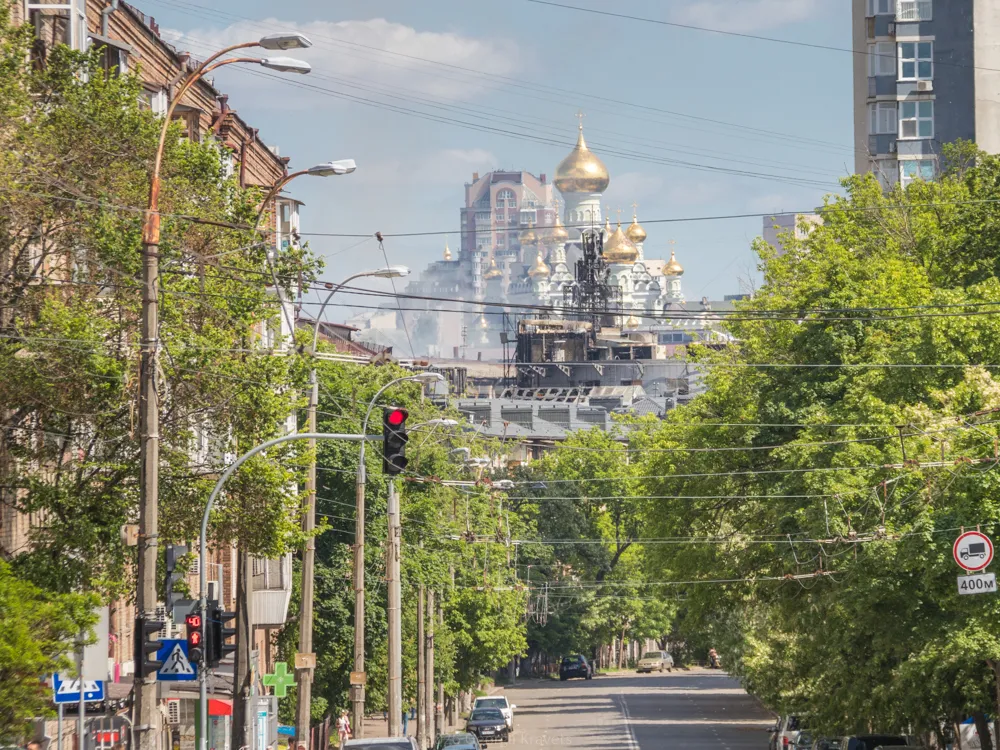
The burnt-out tower of the Kvadrat shopping and entertainment centre on Lukianivska Square, with Biloruska Street in the perspective, against the background of the domes of the St. Nicholas Cathedral of the Pokrovskyi Monastery, 26 May 2026
As for the future of Lukianivka, at present it seems highly ambiguous. Because of the high risks many projects are on hold. For example, the Lukianivka Mall shopping centre is not being built on the site of the former tram depot. And that was to be the main hub in forming the district’s socio-cultural core. It is unknown when and how the numerous residential complexes on Dehtiarivska Street will now be completed. What will happen to the transport network? Will the state dare to leave defence industry and various military institutions in dense urban development? And the like…
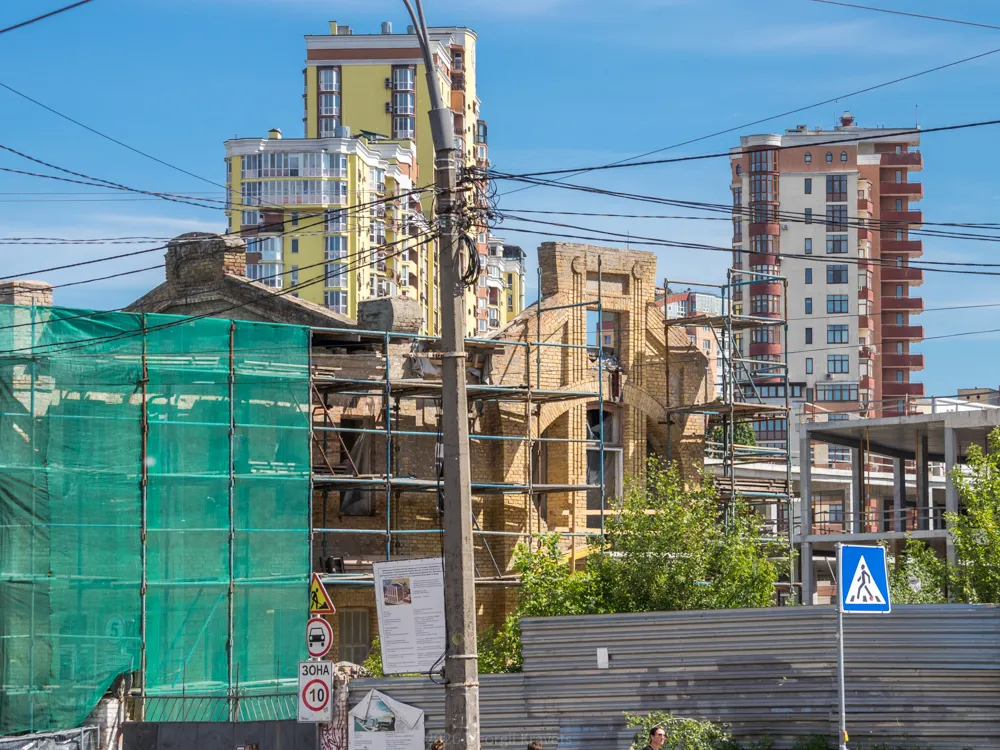
Former office building of the Lukianivka depot, which was to be integrated into the Lukianivka Mall shopping centre complex
If we turn to the existing proposals, say, for Lukianivska Square, quite interesting seem the ideas developed by students of the Urbanyna urban school in 2021. According to them most of the space was allotted to pedestrian zones. Variants of tram movement and so on were thought out.
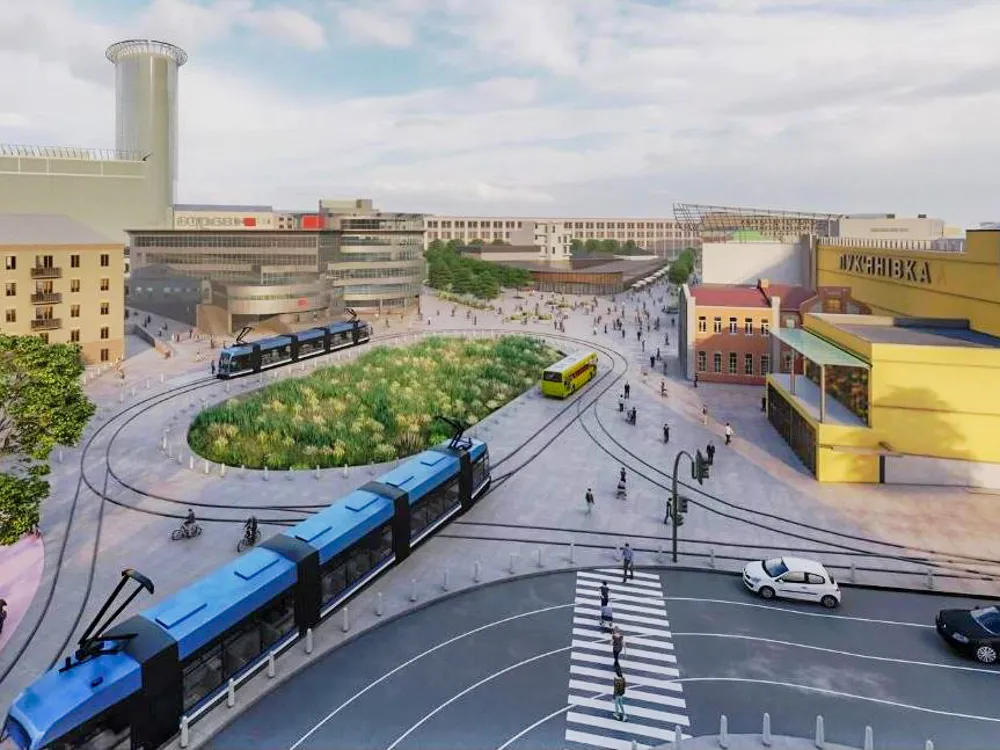
Conceptual proposal for the reconstruction of Lukianivska Square, Urbanyna urban school, 2021
But to conclude our narrative, let us recall something unburdened by great ambitions or large-scale plans. I mean footwear! Yes, yes, little shoes. That is, boots! The Insurance Agent’s Shoes – a sculpture by Petro and Andrii Oziumenko, installed in March 2011 near the office of an insurance company at the beginning of Biloruska Street. These bronze boots are size 92. Each weighs about 90 kilograms. And the right one is slightly more worn than the left. Well, because that is how the insurers run. Who would doubt it, and to make the news occasion even more inflated, upon installation these huge shoes were also ceremoniously entered in the Book of Records of Ukraine – as the largest shoes that can be tried on. May we all return as soon as possible to news about Lukianivka of precisely this kind…
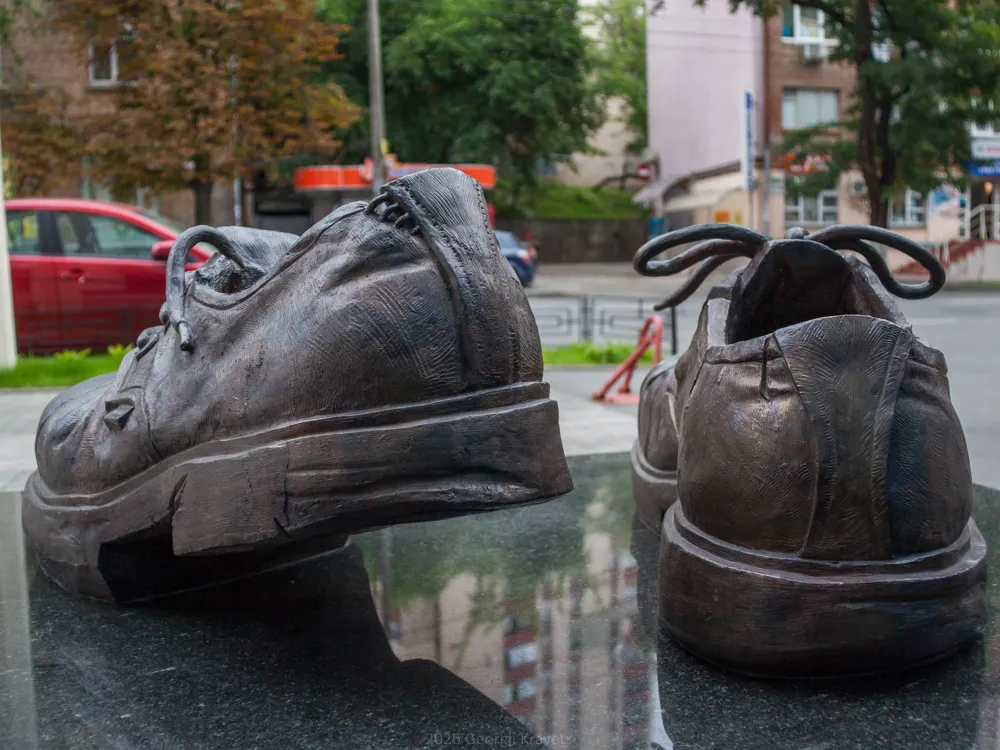
Sculpture “The Insurance Agent’s Shoes”, worn out by him in search of clients, 3 Biloruska Street, 2011
5 October 2026. Yehor Kravets


