Nalyvaiko uprising
Nalyvaiko is a surname fairly well known among ordinary Ukrainians, probably because it sticks in the memory so easily. It sounds almost comical. But who was this Nalyvaiko? Having ploughed through a heap of historical literature (even fiction), I still could not work out who he really was. Rebel, traitor, bandit, vagabond – whatever he was called. Soviet literature turned him into a genuine revolutionary, but was he one? Why did he need campaigns in Moldavia and Belarus? Why did he burn towns and villages? Why did he gather around himself several thousand cutthroats who in the end betrayed him? Could he really have done all this out of revenge for his father? Is there a single uprising in Ukrainian history that did not grow out of the personal, often selfish desires of its leaders? Kosynskyi had Rokytne taken from him and half of Ukraine went up in flames; Khmelnytskyi had Subotiv destroyed – and all of Ukraine went up in flames. Oh, those Poles – could they not have been a little more careful, a little more cunning (like Russia, for example, in the future)?
A more tangled uprising would be hard to find. Picture hetman Loboda killed in a drunken brawl, and colonel Shaula with his arm torn off. Picture Moldavians, Romanians, Hungarians, Turks, Tatars, Belarusians and Lithuanians – all these peoples became players in a convoluted thriller called “The Nalyvaiko Uprising”. Picture the Holy Roman Emperor, Pope Clement VIII, Sultan Mehmed III and the Polish king Sigismund III – in one way or another they all influenced the course of the uprising (what is the insignificant figure of Kalynovskyi beside them, who so rashly “patched up the ribs” of Nalyvaiko’s father). Picture the burning of Iași, Bratslav, Bar, Lutsk, Slutsk and Mohyliv, and the camp near Solonytsia, strewn with hundreds of rotting corpses and demoralized by cannon fire… I find it hard to picture all these events too, just as I cannot picture Nalyvaiko on a red-hot iron horse with a crown on his head (though, truth be told, I cannot picture him even without the horse).
Between empires, or the strange prudence of the Cossacks
In the second half of the 16th century the great Ottoman Empire began to lose its positions in Europe. The once invincible armies of the Porte ceased to be so after the naval Battle of Lepanto in 1571 (when the huge Turkish fleet was routed by the combined forces of Spain and Venice). The new sultan Murad III decided to restore imperial might, and that required new conquests. The front for these conquests became the lands of Persia (first of all the Caucasus). But hopes for a short victorious war did not come true – it dragged on for a long 15 years (1574 – 1590). Having finished the war with Persia, Murad turned his gaze towards Europe. But in January 1595 Murad III died, and his place was taken by Mehmed III.
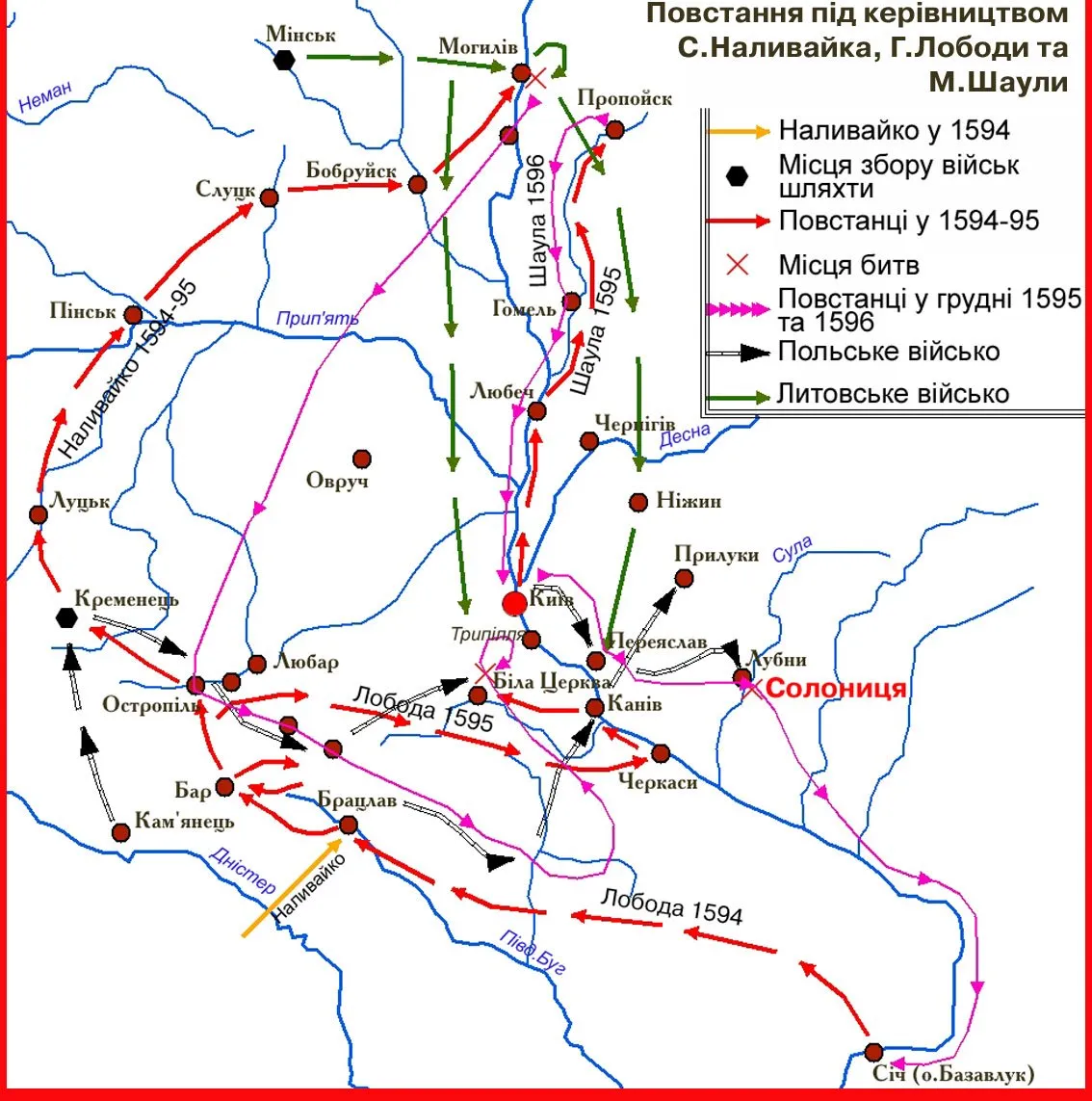
Scheme of the Nalyvaiko uprising
Given the Porte’s preoccupation with the war against Persia, the Europeans lived relatively quietly for a time, but when the war ended it became clear that Turkey’s next target was Europe. Frightened European rulers decided to create an anti-Turkish league, uniting all interested states in it. The initiators of this league were the Holy Roman Emperor Rudolf II (a Habsburg) and Pope Clement VIII. The Polish–Lithuanian Commonwealth supposedly joined the league as well, but the specifics of government in Poland did not allow hopes of a swift mobilization of the army – the nobility did not want to pay soldiers, although it feared an invasion by the Turks and their vassals, the Tatars. Another member of the league was to be the Muscovite tsardom.
To defend against the Turks and their numerous vassals, the European leaders needed to quickly mobilize substantial military forces on the Turkish borders. The path of the Turkish army had to be blocked. But where to find troops? Especially given the sluggishness of the Poles. And a way out, it seemed, was found. They decided to ask for help from the Turks’ lifelong adversaries, the Cossacks.
Pope Clement VIII sent an envoy to the Cossacks – the Croatian priest Komulović – with a large sum of money. But Komulović could not find the way to the Zaporozhian Sich. Where exactly he wandered is unknown, but he returned empty-handed. Emperor Rudolf also sent his diplomat to the Sich – Erich Lassota. Lassota was luckier, and in the summer of 1594 he arrived at the Sich. The Zaporozhians received as a gift the insignia of imperial authority: banners and silver trumpets, as well as a kind of advance payment – 8 thousand zlotys.
The Zaporozhian free host was just getting on its feet. Masses of people were streaming into the Sich. Mostly they were fugitives from the arbitrary rule of the lords, stirred up by the Kosynskyi uprising. But there were also vagabonds and robbers. This whole mass was called the “siroma” (the officers still used the term “chern”, the rabble). The siroma craved quick spoils, but at the same time burned with hatred for the Polish nobility. It was rather difficult for the Sich officers to command such a motley crowd – it had to be directed to war (to keep the army in constant shape, constant war was needed). And just then, as if on cue, the imperial envoy turned up with his gifts. The Zaporozhians accepted the gifts, but first refused the emperor’s terms, citing the lack of any guarantees in the coming war (they did not want to be mere cannon fodder) and the small amount of pay.
At the same time there was also an envoy at the Sich from the Muscovite tsar, who likewise brought a large sum of money and the tsar’s request to go to war against the Tatars.
The Zaporozhian army took a wait-and-see position. They could be understood – they were not eager to go on their own against the considerable military might of the Ottoman Porte (and that is how it would have turned out). Support was needed. Besides, the Zaporozhians still remembered well the time of the Kosynskyi uprising, which had shown that the road to the lords’ treasuries could be much shorter and simpler than to the Crimean and Turkish ones. This was the opinion of the siroma. The Cossack officers held a different opinion, but against the decision of the siroma the officers had no power.
On the whole, the Zaporozhian army inclined to the view that it was better to attack the Crimean settlements than to go to Wallachia (modern Romania), where the imperial envoy invited them.
Nalyvaiko, Moldavia and the Wallachians
Through spies the nobility learned that the Tatars stationed in Moldavia and Bessarabia (at that time Turkish lands) were preparing a campaign into Hungary, but planned to turn aside into Podillia on the way to the Magyars. An army had to be raised quickly to protect the Podillian estates of the lords. But Poland had no such army in Podillia, and there was no way to assemble one quickly. Meeting no resistance, the Tatars could ravage not only Podillia but also Volhynia and Galicia. This frightened the Poles terribly. But a man was found who promised to solve the nobility’s problems. It was Severyn Nalyvaiko, a captain of the household militia of Prince Konstantyn Ostrozkyi. He undertook to gather an army to defend against the Tatars and the Turks.
Earlier still, an incident had occurred that turned Nalyvaiko away from service to Prince Ostrozkyi and from the Poles in general. The Polish magnate Kalynovskyi, owner of the town of Husiatyn, where Severyn came from, punished Severyn’s father for something – “patched up his ribs for no reason and thereby deprived him of life”. Probably it was this event that spurred Nalyvaiko to revenge. But revenge required power and an army. So he decided to acquire them.
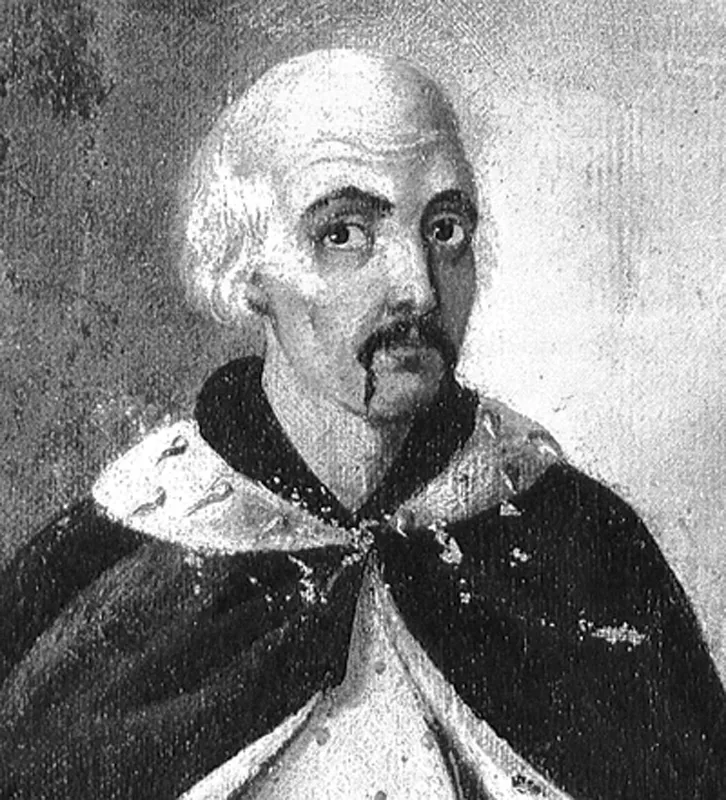
This is how Severyn Nalyvaiko was depicted in the 18th century. The artist is unknown
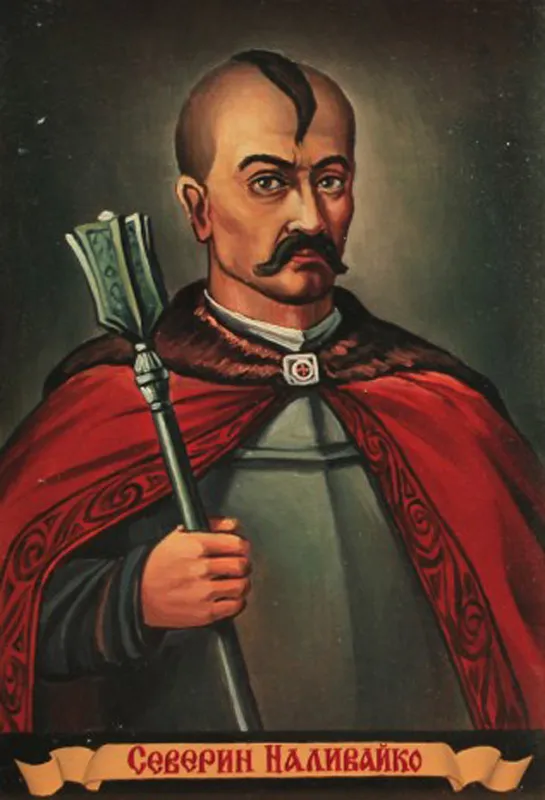
This is how modern artists see him
Recruitment went very fast. Many volunteers, often criminals and vagabonds, joined Nalyvaiko’s band. The army grew rapidly and by the end of spring 1594 numbered up to three thousand men (and possibly more). People eager to wave a sabre flocked to Nalyvaiko’s detachments from everywhere.
Nalyvaiko quartered his army in the estates of the nobility in the Bratslav region, for it was here that the main Tatar blow was expected. The nobility did not like this, but had to put up with it – the Tatars were far more terrible than Nalyvaiko’s hangers-on.
In summer Nalyvaiko’s army set out for Moldavia and Bessarabia. Passing between Bilhorod and Tehynia (modern Bender), Nalyvaiko’s men plundered and burned many Tatar settlements, but on learning of a large Tatar-Turkish army standing near Ochakiv that was to march into Hungary against the lands of the Holy Roman Empire, they retreated back to the nobles’ estates in the Bratslav region.
At the end of summer 1594 the Tatars, crossing over to Hungary, tried to invade Podillia, but, meeting Nalyvaiko’s detachments, turned back to Moldavia. Pursuing the Tatars, Nalyvaiko’s men also crossed the border and entered the sultan’s domain. For some time the Cossacks chased the Tatars, who in their flight abandoned much property, including a huge herd (4 thousand head) of horses that became the Cossacks’ spoils. According to the demands of Poland and other countries of the anti-Turkish coalition, which officially supported the campaign, Nalyvaiko’s men were to prevent the Tatars from entering Hungary, the lands of Emperor Rudolf II. But the Tatars managed to escape from Nalyvaiko. They passed through Pokuttia into Hungary.
Even before the campaign Nalyvaiko had sent envoys to the Sich. On behalf of their leader and the Cossacks, they were to persuade the Zaporozhians to join Nalyvaiko’s army. As a gift to the Sich men the envoys drove along fifteen hundred horses. Remembering that Nalyvaiko had served in Ostrozkyi’s army and had supposedly taken part in suppressing the Kosynskyi uprising, the Zaporozhians did not agree to support him at once. A considerable part of the Cossacks considered Severyn a traitor and did not want to fight alongside him. But the envoys managed to convince the Zaporozhians. They assured them that Nalyvaiko had not fought against the Cossacks but, on the contrary, had urged Ostrozkyi not to punish the rebels (perhaps this was so, for at P’iatka the prince did not destroy the defeated Cossacks but signed an agreement with them and released them). Perhaps not all the Zaporozhians believed Nalyvaiko’s men, but the army was sent all the same. At the head of the Sich force stood the koshovyi otaman (in effect the Zaporozhian hetman) Hryhorii Loboda.
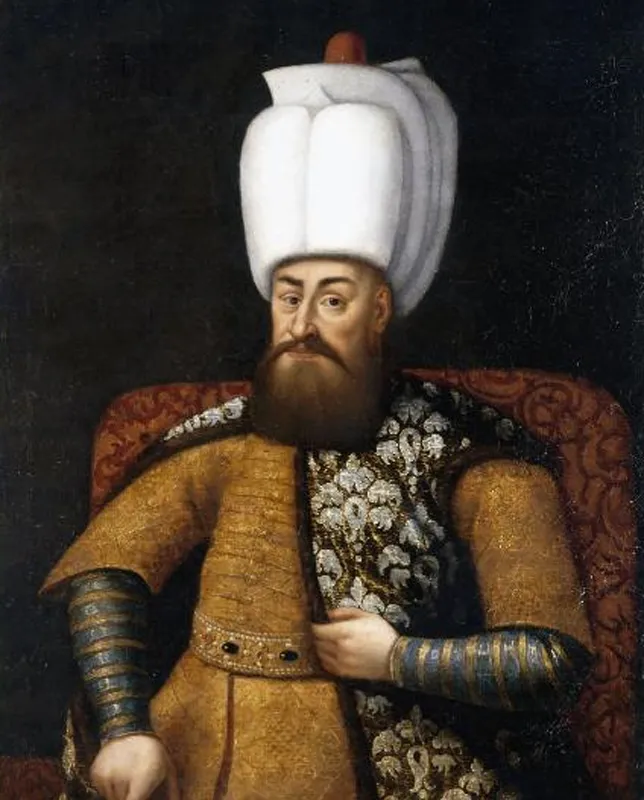
Turkish sultan Murad III
The Cossack forces united near Bratslav. But there was no real unity between them. Nalyvaiko’s men continued to obey their otaman, while the Zaporozhians carried out Loboda’s orders. Though officially Loboda was considered the leader of the army. In all the army then numbered about 12 thousand Cossacks. In autumn 1594 it set out for Moldavia.
Near Soroka the Cossacks crossed the Dniester and began to devastate the Moldavian lands. Soon they defeated the army of the Moldavian voivode Aaron and seized his capital, Iași (now a city in Romania). The voivode was forced to renounce Turkish suzerainty and swear allegiance to Emperor Rudolf II. At that same time Aaron established contacts with the Wallachian voivode Michael, who also went over to Rudolf II’s side after a while. Meanwhile, the rule of the Wallachian voivode proved short-lived – in 1595 the Poles installed in his place their own protégé, the Moldavian boyar Ieremia Movilă.
Meanwhile the Poles learned that the Tatar army, returning to Crimea after the war in Hungary, was planning to attack Galicia and Volhynia. This time the Poles assembled a crown army (Yavornytskyi states that it numbered 15,000 men) and set out for the Carpathian foothills to guard the routes to Galicia and Volhynia against the Tatars. It was commanded by crown hetman Jan Zamoyski. His assistant was field hetman Stanisław Żółkiewski – one of the best Polish commanders of the time.
At the end of autumn 1594 the Cossacks received an order from the Polish authorities to leave the Wallachian and Moldavian settlements alone and set out on a campaign against the Tatars. The army returned to the Bratslav region. Nalyvaiko settled not far from Bratslav, and Loboda took up quarters in Bar, which was then the centre of the starostvo. In view of the will of the crown authorities, the Podillian lords refused to supply the Cossack army with fodder and provisions. The Cossacks demanded “stacje” (a tax for the upkeep of quartered troops) from the nobility, but, upon being refused, began to take of their own accord everything they considered necessary, committing robbery and causing damage. The estates of lord Kalynovskyi, Nalyvaiko’s blood enemy, suffered especially.
This was the time of the judicial “years” (courts at which the local nobility gathered). The nobility assembled in Bratslav, but on learning that Nalyvaiko’s army was stationed nearby, hastily left the town. Soon, however, the Poles returned. The reason was disinformation that Nalyvaiko’s army was very small, because a large part of the Cossacks had died in Moldavia. The Poles decided to rein in the Cossacks. But…
On 5 October 1594 the Cossack army, supported by the townspeople of Bratslav, defeated the nobles in Bratslav. Loboda, who was stationed with the “lower” army in Bar, at first tried to maintain peaceful relations with the local nobility. He even corresponded with voivode Konstantyn Ostrozkyi. But in November 1594 Nalyvaiko came to Bar. The Cossacks surrounded the town, and the officers gathered in Bar Castle and began to deliberate. The result of this council was a decision to raise an uprising.
To pull the wool over the Poles’ eyes, Loboda and Nalyvaiko sent out part of the army to collect “stacje”, supposedly needed for the coming campaign into Wallachia.
Until the end of 1594 the united Cossack army sat in Bar, fleecing the local nobility. The nobles constantly complained about the Cossacks to King Sigismund III, and he ordered the Cossack army to leave Podillia and head for the Lower Dnipro. But who was listening to him by then? The Cossacks calmly lorded it over Podillia, and hetman Loboda even managed to get married. They did not fear the Poles, for their crown army was at that time in Wallachia, where, together with Wallachian, Moldavian, Transylvanian and Hungarian forces, it was preparing for war with the Turks.
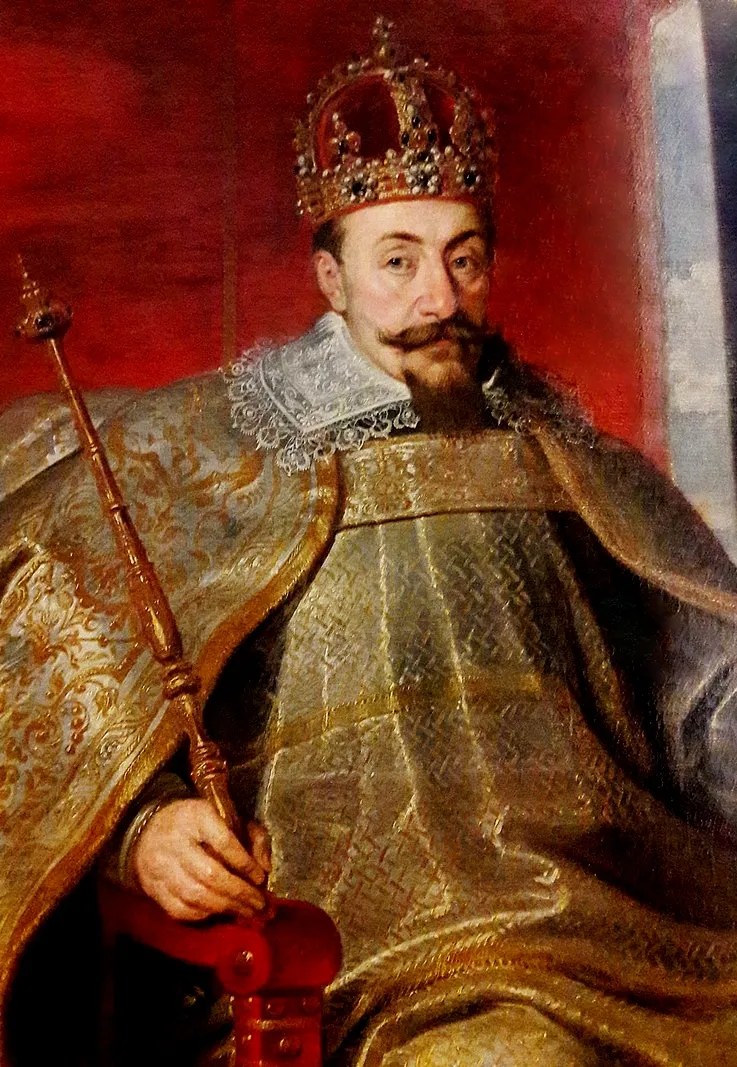
Polish king Sigismund III Vasa
At the beginning of 1595 the Poles learned that a large Tatar army was gathering in Crimea to march into Wallachia. Fearing for their estates, the nobility began to placate Loboda and call him to help. To Nalyvaiko the Poles did not even turn. Loboda accepted the Poles’ invitation and on 21 February set out with his part of the Cossacks to help the crown army. But already on 23 February he learned that the army of the Moldavian voivode had defeated the Tatars. Loboda, however, paid no attention to this news. He entered Moldavia and began to ravage the environs of Tehynia (Bender) – territory that already belonged to Emperor Rudolf II. On learning of this, Jan Zamoyski, commander of the crown army, then stationed on the Prut, ordered Loboda to leave Moldavia and threatened him with the Polish army. Loboda seemingly obeyed Zamoyski. He left Moldavia and headed first to Ovruch (Loboda had an estate in Polissia) and then to the Dnipro region.
Nalyvaiko, who categorically refused to help the Poles, set out in March 1595 with about 1,000 soldiers for the estates of Prince Konstantyn Ostrozkyi and stopped in Ostropil. Ostrozkyi was at that time at another of his estates, in Turiv. He assessed the arrival of his former captain at Ostropil negatively. In one of his letters to his son-in-law, Krzysztof Radziwiłł, he called Nalyvaiko a “scoundrel” and a “new Kosynskyi”.
In August Severyn’s army left Ostropil and headed through the Principality of Transylvania into Hungary, to help Archduke Maximilian (brother of Emperor Rudolf II). Nalyvaiko remained in Hungary until mid-autumn. There they plundered local settlements more than they helped the Germans, so the Germans, not wanting such help, asked the Cossacks to leave their lands. In October Nalyvaiko’s army returned to Ukraine with rich booty. Severyn no longer intended to go abroad.
Express: Lutsk – Bila Tserkva (via Belarus)
Loboda meanwhile returned to the Sich, but after a short stay there set out with three thousand Cossacks for the Kyiv region. Here he collected “stacje” for the army and quietly fleeced the estates of the nobility. Nalyvaiko, meanwhile, came from the Moldavian border to Lutsk – one of the main centres of the Union. The Uniate bishop Cyril Terletskyi (formerly an Orthodox bishop) gathered a considerable sum of money and, going out of the town, tried to buy off Nalyvaiko’s men. Severyn accepted the ransom but entered the town all the same (a big fair was being held in Lutsk at that time) and collected tribute from the nobility, the Catholic churches and the Karaite merchants, carrying out a real pogrom in the process. But in a letter to King Sigismund he described the attack on Lutsk as an ordinary collection of property and funds for the upkeep of the army.
Next Nalyvaiko’s army entered Belarus. First the Cossacks seized the small town of Petrykau (now a town in the Gomel Region of Belarus), then, in mid-November, approached the town of Slutsk (now a town in the Minsk Region of Belarus), which had a well-fortified fortress. Slutsk was then held by the Vilnius starosta Jeronim Chodkiewicz, but he was not in the town at the time. Belarusian sources claim that the capture of such a fortress by a relatively small force (Severyn had about 2 thousand Cossacks) is a real mystery. Most likely there were traitors in the fortress who opened the gates to Nalyvaiko. Having taken Slutsk, Severyn sent a detachment of Cossacks led by colonel Martynko to the small town of Kopyl (now a town in the Minsk Region of Belarus). But the detachment ran into the haiduks of Jeronim Chodkiewicz and was almost entirely destroyed. At this time word reached Nalyvaiko that the Lithuanian army of Krzysztof Radziwiłł had set out against him and was already approaching Slutsk. Taking the entire city arsenal (12 cannons, 80 hackbuts and 700 muskets), as well as 5 thousand Lithuanian kopas of money, Nalyvaiko set off in the direction of Mohyliv (now a regional centre in Belarus), avoiding a clash with Radziwiłł’s army.
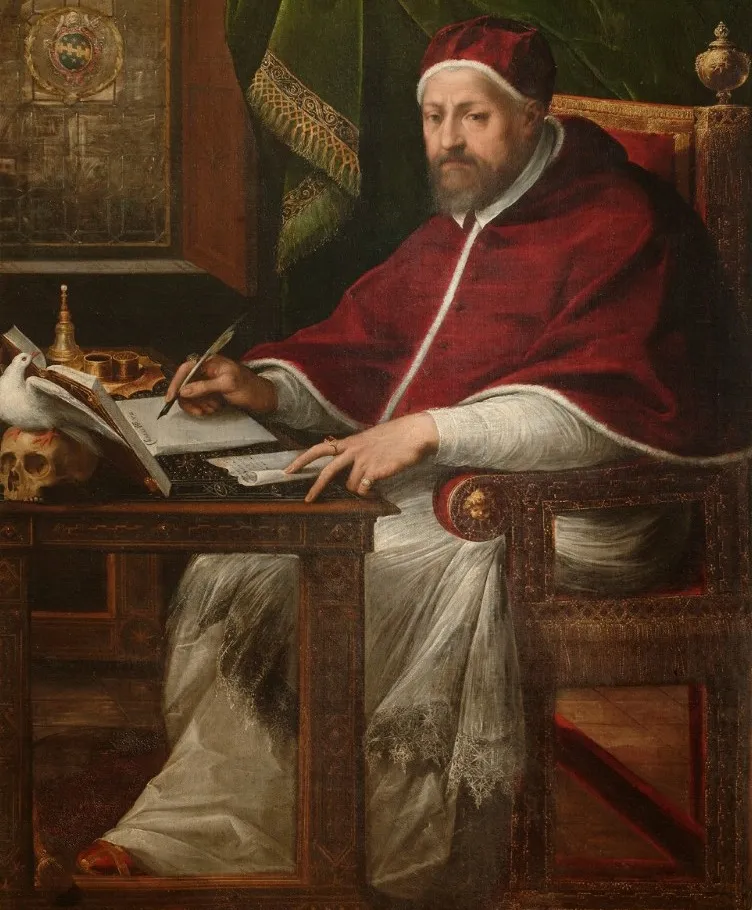
Pope Clement VIII
Meeting considerable resistance from the townspeople of Mohyliv, the Cossacks took the town by storm. Nalyvaiko stayed in Mohyliv for two weeks. During this time he completely ruined it, burning the shops and 500 houses of the nobility. When Radziwiłł’s large army (14 thousand Lithuanians and 4 thousand Tatars) approached the town, the Cossacks entrenched themselves in the castle and prepared for defence. The Lithuanian army began to bombard the castle. In addition, Mohyliv townspeople came to the aid of the Lithuanians and set the castle on fire. Nalyvaiko was forced to leave the town and camp nearby on the Buinychi field. It was here that the battle known as the Battle of Buinychi took place. Skilfully ringing the camp with cannons (Severyn had, after all, once been a successful gunner), the Cossacks fought off the attacks of the Lithuanians and Tatars with cannon and firearm volleys relatively easily all day, and at nightfall began to retreat. The Lithuanians sent a small detachment to bar the Cossacks’ way, but this detachment was defeated.
Nalyvaiko’s army moved very fast, so Radziwiłł could not catch up with it, although the Lithuanian advance detachments pursued the Cossacks for a long time. Skilfully fighting off their pursuers, Nalyvaiko’s men reached first Rahachou and then Rechytsa (now towns in the Gomel Region of Belarus on the Dnipro). Near Rechytsa the pursuit stopped and Nalyvaiko was able to halt here for a while. From here, in January 1596, he wrote a letter to the Polish king, in which he justified his actions and proposed a system of autonomous government for a Cossack state. This state was to lie between Tehynia and Ochakiv, and a new city was to appear not far from Bratslav – the centre of the Cossack state. Nalyvaiko himself was to become the ruler of this autonomous state. Naturally, the king treated this letter with irony and scepticism and gave no reply.
It should be noted that the size of Nalyvaiko’s army constantly changed: part of the Cossacks died in battles, part went home, but the army was replenished by Belarusians. Belarusian sources claim that when the Cossack army withdrew to Ukraine, almost a thousand people left with the Cossack detachments. These were mostly poor peasants, fugitives from their lords.
Meanwhile Loboda’s army was in charge in the Kyiv region. The Cossacks collected “stacje”, but treated the nobility relatively leniently, especially the estates of Prince Ostrozkyi. In correspondence with Ostrozkyi, Loboda stated that he had nothing in common with Nalyvaiko, but whether that was true – who knows. Had Loboda behaved more actively and joined forces with Nalyvaiko, a huge territory would have ended up in the Cossacks’ hands. But having a fairly large army, Loboda was wary of openly opposing the Poles and Lithuanians.
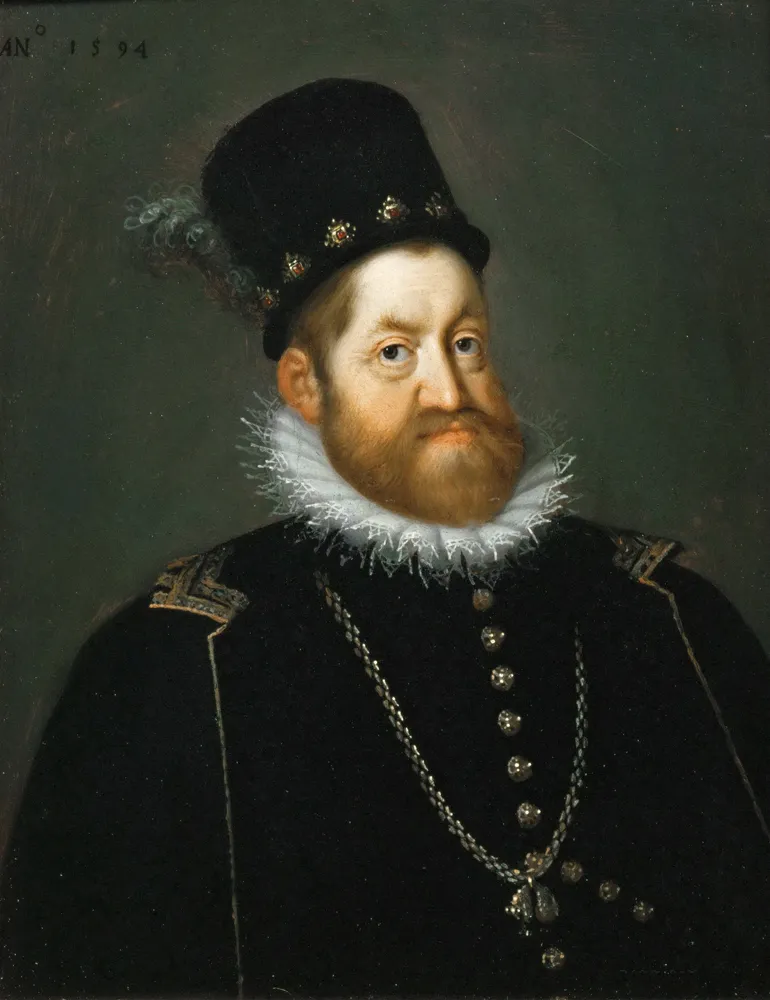
Holy Roman Emperor Rudolf II
Far from all the Cossacks were satisfied with Loboda’s policy. So in late autumn 1595 a large detachment led by the well-known otaman Matvii Shaula split off from the Zaporozhian army. Shaula took all the Zaporozhian artillery and set off north along the Dnipro to join Nalyvaiko. Through Liubech (now a village in Ripky district of Chernihiv Oblast) the Cossacks reached Prapoisk (now the town of Slavgorod in the Mogilev Region of Belarus). Here Shaula’s army, a little short of Mohyliv, stayed to winter.
The Polish crown army, meanwhile, defeated near Iași the army of Răzvan, a protégé of the Transylvanian voivode (a Turkish vassal) Sigismund Báthory, and placed Ieremia Movilă on the Moldavian throne. Now the Poles could throw their main forces against the Cossacks, who until then had felt quite at ease, knowing that the Poles were somewhere in Wallachia. King Sigismund ordered the hetmans (crown and field) to send a substantial part of the crown army against the Cossacks. At the same time the king sent out a universal asking the Polish and Lithuanian nobility to gather their own detachments and join the crown army. The crown army that set out to suppress the uprising was headed by field hetman Stanisław Żółkiewski. The hetman called on the forces of the Volhynian and Kyiv voivodes for help. Kremenets was appointed as the assembly point. It was in this town that Żółkiewski’s crown army (3 thousand trained, select soldiers with strong artillery) halted.
Meanwhile Nalyvaiko set out for Volhynia, but on learning of the Poles’ muster, with only 1.3 thousand Cossacks, Severyn decided not to clash with Żółkiewski but to turn to Podillia. In the Bratslav region Nalyvaiko’s men halted in the small town of Labun (now a village in Shepetivka district of Khmelnytskyi Oblast). From here part of the army was sent to villages and farmsteads to collect food and fodder.
Żółkiewski tracked the Cossacks’ movements and, when they came to the Bratslav region, decided, without waiting for the voivodes’ forces, to strike the rebels suddenly. But the element of surprise did not work. From the Polish camp a certain lord Płoski went over to Nalyvaiko – one of the mercenaries dissatisfied with Polish pay, who commanded a small detachment. He warned Nalyvaiko of the danger. Severyn immediately raised the army and decided to head for the Dnipro region to join Loboda. First he went to Ostropil, but here Żółkiewski’s vanguard detachments caught up with him. A terrible chase began. Nalyvaiko turned to Pyky (now a village in Kalynivka district of Vinnytsia Oblast) and did not halt his army either day or night. It is hard to picture these large-scale manoeuvres – a little over a thousand Cossacks, and behind them several thousand Polish cavalry moving at a speed frantic for those times in the direction of Bratslav.
Żółkiewski entered Pyky only two hours after Nalyvaiko had left it, and near the small town of Pryluka (now a village in Lypovets district of Vinnytsia Oblast) he practically caught up with him. But Nalyvaiko’s men retreated not in panic but in almost exemplary battle order. Severyn even ordered the gunners to be chained to their cannons so that they had no way to retreat. So even having caught up with the Cossacks, Żółkiewski could not stop their retreat, for the retreating men constantly kept up artillery fire. Then, knowing that Nalyvaiko expected help from the townspeople of Bratslav, the Polish commander decided not to let the rebels into Bratslav. Leaving behind excess baggage, he sped up the pursuit and caught up with Nalyvaiko near the Vilshanka river (the territory of today’s Kirovohrad Oblast). A skirmish began, but the night and the dense forest did not allow it to grow into a battle.
From the Vilshanka Nalyvaiko’s men turned at night towards Syni Vody. Having still some supplies, they were not afraid to enter the uninhabited, waterless and hungry Wild Fields. Żółkiewski’s army, however, did not dare to do this – hunger frightened the Poles. Near the Uman forest the crown army, exhausted by the long march, ended the chase and halted.
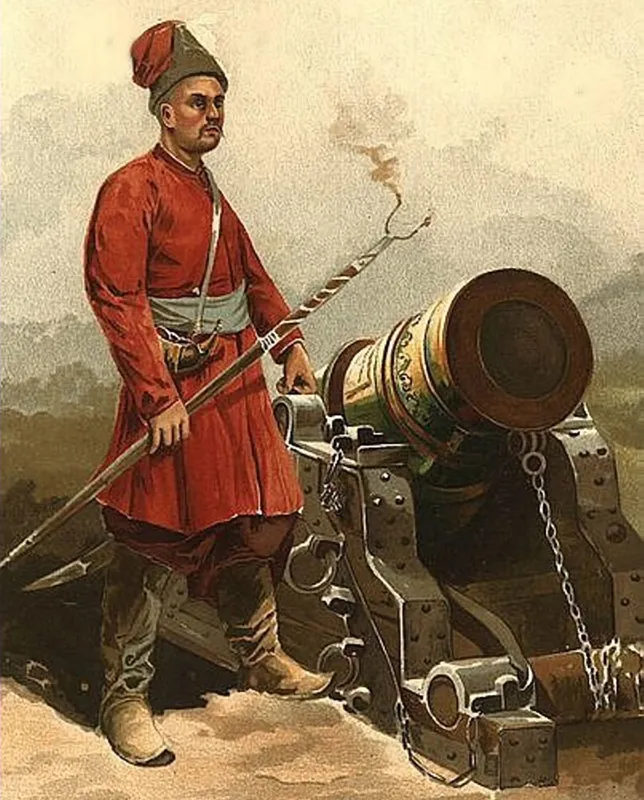
A Cossack gunner. Artist Serhii Vasylkivskyi
Nalyvaiko, seeing the superiority of the Polish army over his own, by now rather small force, decided to make peace with Żółkiewski. Halting at a safe distance from the Poles, he began negotiations through envoys. Severyn promised to disband his army and end the uprising. Żółkiewski seemingly agreed to sign an agreement, but on condition that the rebels hand over the cannons and military banners received from Archduke Maximilian. But Nalyvaiko did not agree to do this; he did not believe in Żółkiewski’s sincerity and decided to direct his soldiers to the Kyiv region to join Loboda’s army. He was also pushed to this by numerous complaints in the rebels’ ranks about the leadership, about hunger and about heavy losses. Nalyvaiko even feared for his life because of this. So Severyn sent messengers to Loboda to arrange the union of the armies, for Nalyvaiko was not a hundred percent sure that Loboda would support him (the Zaporozhian officers continued to dislike Nalyvaiko, who had earlier served Ostrozkyi, and his band).
Loboda, meanwhile, was stationed in Bila Tserkva. Some family troubles overtook him here, and, taking seven hundred Cossacks, he headed for the town of Bar. But on the way, near Pohrebyshche, Loboda narrowly missed a clash with the vanguard of the Polish army, which was already heading towards Bila Tserkva to prevent the rebels from uniting. But the hetman managed to avoid the clash and returned safely to Bila Tserkva. At this time Żółkiewski sent Loboda a letter urging him to go to Zaporizhzhia and not to have dealings with Nalyvaiko. But Loboda gave no reply to the letter; instead he agreed to unite with Nalyvaiko. Evidently the Cossack hetman forgot for a time his dislike of Nalyvaiko and decided to act together with him. Given that the Cossack army had considerable forces, Loboda was not afraid of a clash with the crown army, but only after Shaula returned with the cannons.
Nalyvaiko, having received a positive reply, left his hiding place near Syni Vody and in March 1596 moved up to Korsun. Here Severyn halted, awaiting a suitable opportunity to unite with Loboda. At the same time he began recruiting new volunteers for his army.
Nalyvaiko’s men, fleeing from Żółkiewski, had sunk most of their cannons, so the rebel army that was to unite was left practically without artillery. Loboda waited hopefully for Shaula’s detachments to return, following their movements. Shaula, meanwhile, was already approaching Kyiv. On learning of this, Loboda led his army out of Bila Tserkva – one of Poland’s most important strongholds – and took it to Trypillia to join Shaula’s army.
Żółkiewski very much did not want the Cossacks to unite, so he sent a detachment of five hundred horsemen to cut off Shaula’s Cossacks. Prince Kyryk Ruzhynskyi was put in command of this detachment; he had once been acting hetman of the Zaporozhian Host, but now burned with fierce hatred of the Cossacks because of several ruined estates. The Cossacks considered Ruzhynskyi a traitor, so Shaula sent a large detachment under colonel Sasko against him. But Ruzhynskyi did not engage Sasko and turned off to Bila Tserkva.
Bila Tserkva Castle was at that time one of the strongest in the whole Polish–Lithuanian Commonwealth, since it stood right on the Black (Tatar) Trail. With a good garrison and fairly competent command, it was practically impregnable. So Ruzhynskyi did not fear an attack by the Cossacks and could boldly await the approach of the crown army.
Meanwhile all three Cossack armies came together near Bila Tserkva. The total number of Cossacks reached eight thousand (according to D. Yavornytskyi). A council was held at once, at which Loboda was deprived of the hetmancy. Shaula was elected the new leader (the exact date of Shaula’s election as hetman is unknown; it is known only that it happened in March 1596). But Shaula did not dare to storm the castle at once. He pitched camp around Bila Tserkva and began to wait for a suitable opportunity. Perhaps Shaula hoped that Ruzhynskyi, being of a somewhat unbalanced and hot-tempered character, would not endure sitting long behind the walls and would begin hostilities himself – then he could be caught in a mistake. That is almost what happened, but the mistake (practically fatal for the whole uprising) was made by the Cossacks themselves.
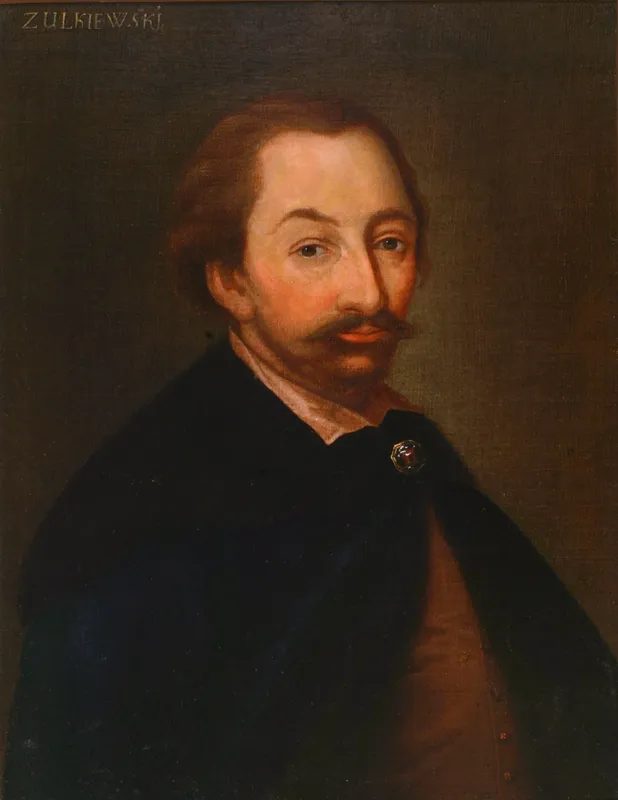
Stanisław Żółkiewski
Ruzhynskyi really could not sit idle. Gathering almost all his soldiers, he decided to make a night sortie. Leaving a small detachment in the castle, Ruzhynskyi’s cavalrymen attacked the Cossack camp on a dark night. That same night the Cossacks decided to carry out a cunning manoeuvre too. Nalyvaiko went around the town and got into the castle through the back gate (how he managed this is unknown; perhaps the townspeople opened the gate). Cutting down all the guards, Nalyvaiko’s Cossacks, not wondering at the small number of defenders, began to plunder the castle. But at that moment they heard shots in their own camp…
Ruzhynskyi burst into the Cossack camp. The Cossacks, who did not expect an attack, took fright at once and began to flee. But, recovering, they turned against the Poles and drove them towards the castle. At the same moment Nalyvaiko was heading from the castle to meet the nobles. The Poles found themselves caught in a vice, but by some miracle broke through the encirclement (losing more than a hundred men killed) and returned to the castle. This was precisely the Cossacks’ miscalculation. Why did they let Ruzhynskyi go and how did it happen? Had the Cossack army then taken Bila Tserkva, perhaps the uprising would have taken a different course. With a considerable number of soldiers and an impregnable castle, there would have been no need to fear the approach of Żółkiewski with the crown army. Besides, Bila Tserkva could have served as a good assembly point to which reinforcements would flow from all over Ukraine. But…
And Żółkiewski, who had for some time been stationed in Pyky, gathering his army and tending the horses crippled during the frantic chase after Nalyvaiko, set out towards Bila Tserkva without having fully healed them. Knowing Ruzhynskyi’s character, he feared that the latter would not obey the order to stay behind the castle walls and would do something foolish. And he turned out to be completely right. Already standing in Trushky (ten kilometres from Bila Tserkva Castle), Żółkiewski heard cannon fire and hurried to Ruzhynskyi’s aid.
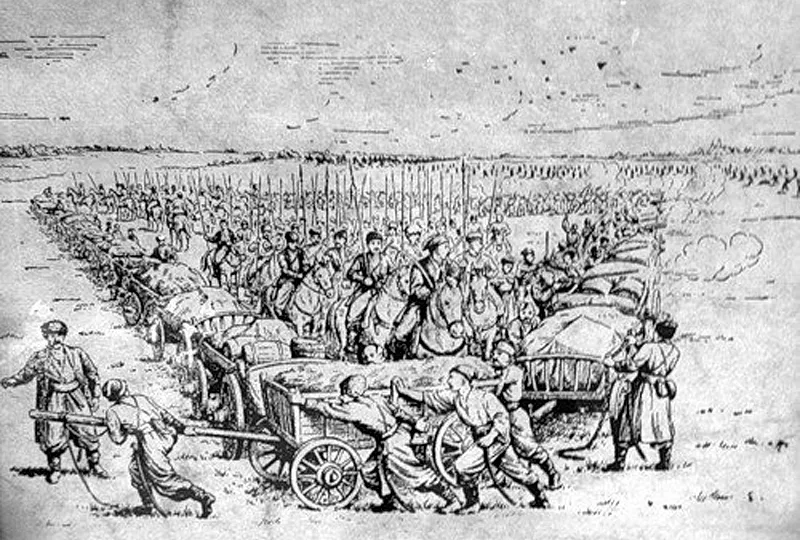
The Cossacks, learning of the close proximity of the crown army, hastily left their positions and headed in the direction of Trypillia. But having moved a short distance away, the Cossacks halted near the Hostryi Kamin tract and pitched camp. The point was that the Cossack army consisted mostly of infantry; retreating for a long time from the far more mobile Poles, they would only waste their strength, so it was decided to stop and make camp. The camp was surrounded by wagons set in five rows and chained together. Cannons were placed on the wagons (according to Yavornytskyi the Cossacks had 24) and they prepared to repel an attack.
In the Cossack camp things were very uneasy. The Cossacks grumbled against the leadership, which had in effect ineptly handed Bila Tserkva Castle over to the Poles. Nalyvaiko’s men and the Zaporozhians did not get along with each other. All this did not help the Cossacks’ fighting spirit.
Żółkiewski, having entered Bila Tserkva, pondered his future actions for a while. He had two options: to stay in the castle and wait for reinforcements coming from Moldavia under Potocki and from Lithuania under Radziwiłł, or to attack the Cossack camp immediately. But on receiving word of the turmoil among the Cossacks, the Polish commander inclined to the second option. This decision was also helped by the sudden snow and frost (though it was the middle of spring). Over the frozen ground, not fearing to get stuck in the mud, the Polish army set out for Hostryi Kamin.
The course of the battle is attested only by Polish sources, according to which the Poles could not break through the Cossack camp but acted very skilfully, inflicting enormous losses on the Cossacks (according to Polish sources several thousand Cossacks died against several dozen Poles killed). This is hard to believe. If the Poles really had such an advantage, they would not have let the Cossacks calmly leave the camp and cross the Dnipro in the Trypillia area, nor would they themselves have retreated back to Bila Tserkva and waited for help behind the castle walls. So one may assume (as most Ukrainian historians do) that the advantage was actually on the Cossacks’ side, but, lacking cavalry, they could not develop their success and were forced to retreat.
How the Battle of Hostryi Kamin (23–24 March 1596) really went is not known for certain; it is known only that it was very bloody. The Cossacks suffered heavy losses (the Poles probably no fewer). Several Cossack leaders were killed (among them colonel Sasko), and hetman Shaula had an arm torn off by a cannonball. Nalyvaiko was wounded too.
After the battle Loboda was elected hetman again in place of the maimed Shaula. Having crossed the Dnipro in the Trypillia area, the Cossacks burned all their boats so that they would not fall to the Poles and set off in the direction of Pereiaslav. Reinforcements were due to arrive here – a regiment of Zaporozhians under Krzysztof Krempski. But Krempski was delayed at the Dnipro crossing at Kaniv. Learning of this, Żółkiewski sent a detachment led by Chodkiewicz to Kaniv. The Cossacks, who did not expect an attack at all, were of course unprepared for defence. In an “emergency” fashion they began to cross the Dnipro. During this crossing Chodkiewicz drowned many Cossacks, but some nevertheless got over to the left bank and set off to join the main forces.
Żółkiewski, meanwhile, ordered boats to be brought to Kyiv from the Pripyat and the Teteriv. In Kyiv itself the building of new boats began. But the Cossacks, who were watching the Poles’ actions, decided to hinder their crossing to the left bank of the Dnipro. To do so they sent the main army to Kyiv to burn the boats. But Żółkiewski was not asleep either. Learning of the Cossacks’ actions, he also set off for Kyiv and arrived in the city a little earlier. At Vasylkiv Potocki’s army joined him. The Poles camped next to Pechersk and began active boat building. The Cossacks, who had no boats, stood opposite the Polish camp but could do nothing to hinder the work of the Polish soldiers. One thing remained for them – to wait for help from Zaporizhzhia.
And help was already on its way. From the Sich, in early spring, as soon as the ice broke, a large detachment of Sich men headed by Kasper Pidvysotskyi set out in chaikas (Cossack boats). But he was not destined to reach Kyiv, for the cunning Żółkiewski set an ambush below Kyiv – a large number of cannons aimed with their muzzles downward. The “upper” headwind that hindered the Cossacks in steering their boats also played into the Poles’ hands. Żółkiewski opened merciless fire, sank several boats, and the rest turned back, having lost hope of joining the main army.
Loboda, seeing the unenviable position of the rebel army, began negotiations with the Poles through envoys. He wanted a “peace”. Żółkiewski was not against it either. He announced the terms: the surrender of Nalyvaiko and the other leaders of the uprising, the handing over of the cannons, the handing over of the banners and documents received from the emperor. The Cossacks did not accept such terms – they refused to hand over people and banners, but decided to continue negotiations. Loboda and Nalyvaiko personally got into a boat and set out to meet Żółkiewski, but the crown hetman did not come out to them, sending instead the starosta of Bratslav, Jerzy Strus. Thus the negotiations ended in nothing. Nalyvaiko and Loboda returned to the Cossack camp, broke it up and set off in the direction of Pereiaslav, opening the way for the Poles to the left bank.
After some time the Cossacks gathered in Pereiaslav. The number of people in their camp reached 12 thousand, but about half of them were women and children whom the rebels had taken with them. In Pereiaslav a heated dispute began over further action. There were three opinions: to stay in Pereiaslav and defend themselves, to retreat deep into the Left Bank, or to make peace with the Poles by accepting their terms. In the end the Cossacks inclined to the second option. It was decided to head in the direction of Lubny, cross the Sula, burn the bridge behind them and withdraw into the steppe, which the Poles feared in a panic. So the Cossack army left Pereiaslav and went along the planned route.
Żółkiewski, having entered Pereiaslav, learned of the Cossacks’ intentions and decided to thwart them. To do so he dispatched a large cavalry detachment under Jerzy Strus to go around the Cossack army and stop it at the crossing of the Sula. For this Strus had to ford the Sula 20 kilometres below Lubny. Strus’s main task was to prevent the Cossacks from withdrawing into the steppe and to burn the bridge over the river. To Lubny the crown hetman sent another detachment, considerably smaller (500 hussars), commanded by Biletskyi. This detachment was to serve as Strus’s reserve. Meanwhile a large Lithuanian army headed by Prince Bohdan Ogiński arrived in Pereiaslav. And almost at once, calmly, the main forces of the Poles and Lithuanians left Pereiaslav and followed in the footsteps of the rebel army.
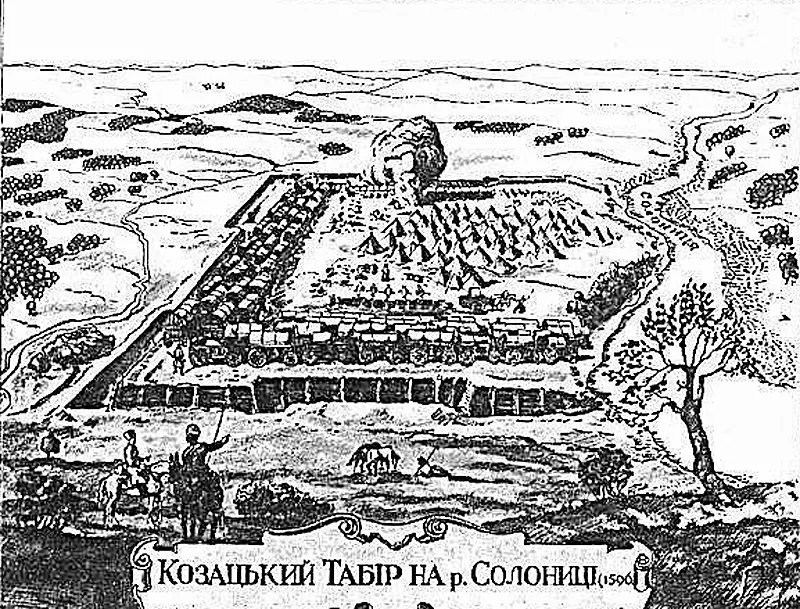
The Cossacks reached the town of Lubny relatively quickly. Here they were met by the town castellan Pretwicz, who had been ordered to detain the rebels. He entered into negotiations with them and offered them lodging in the town on favourable terms. The Cossacks, not suspecting a ruse and hoping that the Polish army would advance along the main Lubny road, posted no sentries. So it is no wonder that Strus reached Horoshyn relatively calmly and unnoticed, ferried the artillery across the Sula by fishing boats and rafts, and sent the cavalry across by swimming. Biletskyi meanwhile approached Lubny with his detachment. The rebels, noticing the Poles, decided it was the main army, so they hastily left Lubny and hurried to the bridge over the Sula.
The crossing of the Sula began. Biletskyi, seeing this, tried to hinder the Cossack army. But he could not. The rebels crossed to the left bank of the Sula, set fire to the bridge and moved on into the steppe. But Biletskyi managed to put out the bridge and at once set about repairing it. And just at this time Żółkiewski’s army approached Lubny. From the other side the Cossacks noticed a cloud of dust, but, not suspecting an ambush, decided it was Tatars wandering in the steppe. So Strus calmly approached the Cossack camp and took an advantageous position. The first cannon shot told the rebels that the road to the steppe was cut off for them.
Solonytsia
It was the second half of May (the Battle of Solonytsia began on 16 May 1596). A strong heat prevailed. So the rebel army did not dare to go into the waterless steppe. The rebels set up camp beyond the Sula, five kilometres from Lubny, in a tract called Solonytsia. Around the camp they made a ring of four rows of wagons and chained them together. Behind the rows of wagons the Cossacks dug a ditch, along which they heaped a high rampart (higher than the wagons). In the centre of the camp they placed log frames filled with earth, on which cannons were mounted. One side of the Cossack camp faced the steppe, the other the impassable marshes of the Sula.
Given the relative advantage of the Cossack camp’s position and the Cossacks’ skill at defending themselves in such a camp, the Poles again resorted to cunning. Strus entered into negotiations with the Cossacks, whose sole purpose was to gain time. What Strus promised the rebels is unknown, but they again fell for the ruse and let Żółkiewski’s army approach almost right up to the camp. In this way the rebel army found itself encircled in a ring and cut off from water and pastures.
According to Polish sources, the Poles had 3,500 soldiers, whereas the Cossacks, not counting women and children, had 8,000 men. But a peculiarity of Polish sources is that they almost always understated the size of their own army and exaggerated the number of enemies. Besides, the Poles counted only the szlachta (nobles) who made up the military banners, but every noble had with him several men of non-noble birth who were rank-and-file soldiers or servants included in the ranks of the banner. As for the number of rebels, the Poles could only guess, since they had no way to count it. So now we have only approximate figures for the size of the armies that took part in the Battle of Solonytsia on both sides.
The Cossacks almost immediately felt the discomfort of their position, for a shortage of drinking water and food, and a complete absence of salt, very quickly began to be felt in the camp. But the real catastrophe was the lack of fodder for the horses, of which there were very many in the camp, and for the cattle. To feed so many horses, large pastures were needed, from which the rebels found themselves cut off. The rebels’ situation was made worse by the fact that there were very many women and children in the camp.
For some time the Cossacks managed, at considerable cost, to obtain a small amount of fodder. For this they used the tactic of small skirmishes – “hertsi” (duels). The strongest Cossacks distracted the Polish and Lithuanian soldiers, while the others in the meantime rode out into the steppe, where they gathered a little fodder.
The rebels constantly made “sorties” into the Polish camp. They were especially intense at nightfall, for the Cossacks were masters of night raids. Such attacks did considerable damage to the Poles.
But with every day the Cossacks’ position grew harder. For lack of food people began to die of hunger. A plague broke out among the herds of horses. The terrible heat contributed to the rapid decay of corpses, as a result of which diseases spread. A terrible stench hung over the camp.
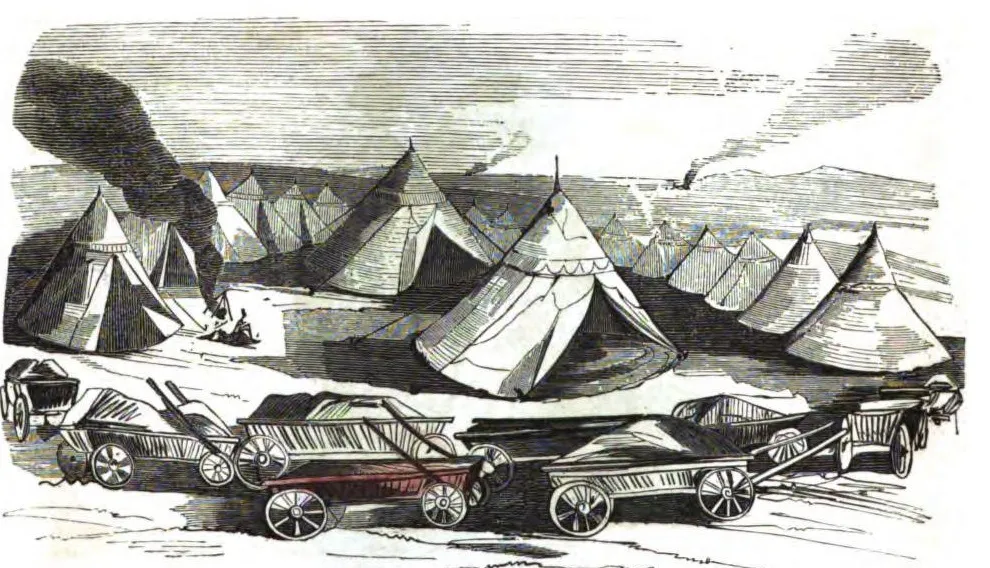
After only two weeks of such “standing” panic and quarrels began among the rebels. Unbearable conditions drove people to flee the camp. The quarrels among the Cossacks were often provoked by the Poles, who constantly kept in touch with Loboda and offered him to surrender. Żółkiewski sent letters to Loboda, while Nalyvaiko he ignored. Perhaps for that reason, at one of the Cossack councils (and councils took place several times a day and even at night) Nalyvaiko’s supporters accused Loboda of treason. A fight broke out between them and Loboda’s supporters. In this fight Hryhorii Loboda was killed. But in Loboda’s place they elected not Nalyvaiko but Krzysztof Krempski, who, though of noble birth, had at that time the greatest popularity among the Cossacks (especially among the non-registered ones). According to Polish sources this happened on 28 May.
After Loboda’s death and the election of Krempski as hetman, discipline in the rebel camp was restored for a time. On the wagons and ramparts they made special ambush posts, “dolky”, from which the best Cossack marksmen fired accurately at the Poles, not letting them near their entrenchments. Sorties resumed, and became much more effective. Horsemen who disregarded any danger often burst into the Polish camp. Legends began to circulate in the Polish camp about these horsemen, according to one of which they had nine lives and died after the tenth death. Sometimes the Cossacks rode up to the Polish camp in broad daylight and, seizing several lords, fled. Almost at once, before the Poles’ eyes, these lords were impaled or quartered.
Such actions by the Cossacks forced the Polish army to remain in a state of constant battle readiness and not to dismount. The bulk of the Poles and Lithuanians felt a shortage of provisions, for they were brought from very far away (Lubny was no longer able to supply the army with food) and cost very dear. There was also a shortage of water: there was water, but it was murky and warm (mostly from the river and the marsh). Fresh water was practically nonexistent.
So, even taking into account all the advantages of the Polish army over the rebel one, the Poles could not overcome the Cossack camp. Żółkiewski had almost no long-range field guns with which the rebels’ camp could be bombarded. The Polish commander sent a detachment to Kyiv for such guns. Besides, there was very little infantry, and therefore no possibility of storming the fortified Cossack camp. So the only thing Żółkiewski could do was to wait for the cannons from Kyiv and keep the Cossacks in the camp, not giving them the chance to retreat into the steppe.
At the beginning of June reinforcements arrived for the Poles – 300 horsemen led by Prince Zasławski, and after some time the cannons arrived too. On 4 June the Poles began a massive bombardment of the Cossack camp, which they did not stop for two days.
Fires broke out in the Cossack camp. Hundreds of people and cattle died from cannonballs. Food had almost run out. Quarrels began again. Nalyvaiko, who with his regiment had several times tried unsuccessfully to break through the Polish camp, supposedly proposed that the whole army try to break through into the steppe, but was not supported. Panic began among the rebels. If only they had known that not far from Solonytsia, at the mouth of the Sula, help was already coming to them by boat – several fresh Zaporozhian regiments led by Kasper Pidvysotskyi. But the rebels, cut off from the world, did not know of the close help. Unfortunately, Żółkiewski knew about it well. Besides, he knew that if Pidvysotskyi reached the Cossack camp, the Poles would be in trouble. So the cunning Polish hetman stepped up the bombardment still more and began to prepare for a decisive assault. For this he even made the horsemen dismount, thus considerably increasing the number of infantry. At the same time he sent into the Cossack camp a “final demand” in which he called on the rebels to lay down their arms and hand over their leaders, promising life and freedom to the rest.
The exhausted rebels, surrounded by heaps of stinking corpses and with half-dead women and children before their eyes, on learning that the Poles were preparing an assault, decided to accept the Polish terms. Beating the kettledrums and marching drums, they announced their capitulation to the Poles. At once the rebels rushed at Nalyvaiko. Nalyvaiko’s men tried to defend their leader, but were fairly quickly subdued. This happened on 7 June. The next day the rebels handed Nalyvaiko, Shaula, Shostak and some other leaders over to Żółkiewski. At the same time the Poles, who had by then surrounded the camp in a tight ring, received all the cannons, flags and banners. Immediately after this Żółkiewski, evidently under pressure from the nobility, put forward one more demand: all Polish lords had the right to enter the Cossack camp and take from it people in whom they recognized their own subjects. But the rebels could in no way agree to this demand, which contradicted the earlier arrangements. Then the crown army burst into the rebel camp…
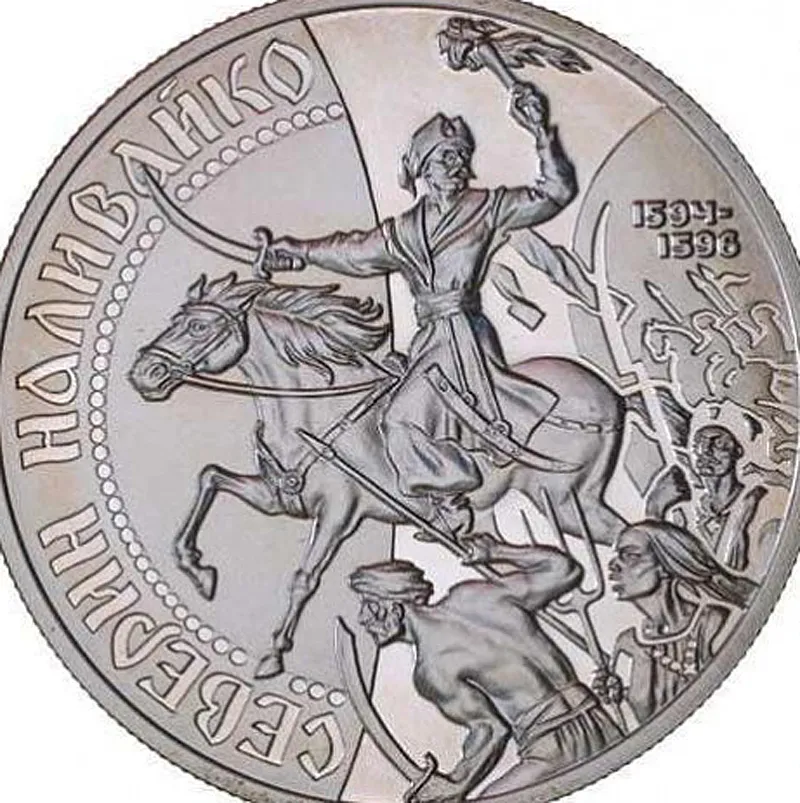
Commemorative coin with a face value of 20 hryvnias, issued 400 years after the death of Severyn Nalyvaiko
The Solonytsia massacre was terrible. According to the Polish historian Joachim Bielski, “…they were hacked down so mercilessly that for a mile and more corpse lay upon corpse”. Only a thousand and a half Cossacks, led by Krempski, broke out of the camp into the steppe and headed for the Lower Dnipro. The rest of the participants in the uprising perished. The same Bielski gives the number of dead as 8,000, but it seems incredible that by the end of the Battle of Solonytsia there were that many people in the rebel camp.
Some Polish historians deny the massacre at Solonytsia, saying that after the rebels handed over their leaders and cannons, Żółkiewski kept his promise and let the rebels go, but to us this version seems merely an attempt to clear Żółkiewski in the eyes of posterity of disgrace and to lift from him the guilt for the murder of thousands of practically unarmed people.
Pidvysotskyi’s army, learning of the rebels’ final defeat, returned to the Sich, Krempski also arrived there, but the fate of Nalyvaiko and the other leaders seized by the Poles was quite different. Together with the military trophies they were taken to Warsaw. Here all the leaders except Nalyvaiko were executed at once. Severyn himself was held in prison for a long time, terribly tortured. Nalyvaiko’s imprisonment lasted almost 10 months. What caused such a long delay in the execution is unknown. Some even suspected that Severyn had some sympathizers among the Polish elite. But however that may be, on 7 April 1597 Severyn Nalyvaiko was publicly quartered.
Several legends arose in Ukraine about Nalyvaiko’s torment and execution. According to one, he was roasted in a copper bull; according to another, he was seated on a red-hot iron horse and a glowing crown was put on his head: “You wanted to reign – reign.”
Afterword
I do not want to draw any conclusions of my own except one – by their bloody reprisal against the rebels the Poles programmed the Ukrainians for hatred and revenge. And 50 years after Solonytsia the fury of the Ukrainian people poured out in the Great Uprising. And Polish blood began to flow. With Ukraine, Poland was a mighty empire, but by turning the Ukrainians against itself it received, instead of prosperity, a two-hundred-year war, decline and oblivion. After Nalyvaiko, Loboda and Shaula, for a long time no one in Ukraine raised an armed hand against the Poles. At first the Cossacks were restrained by fear, then the great Sahaidachnyi temporarily reconciled the Ukrainians with the Poles and in effect created an autonomy. He became a kind of oil that, poured on a stormy sea, temporarily calms the waves, but then they begin to rage with even greater force.
Kosynskyi, Nalyvaiko, Loboda, Shaula, Zhmailo, Pavliuk, Sulyma, Triasylo, Ostrianytsia, Hunia and other Cossack leaders raised great uprisings against the Poles. Then came Khmelnytskyi… After Khmelnytskyi came the period of the Ruin. Then Palii, Verlan, Zalizniak and Honta. And then Poland as a state disappeared…
Author Roman Malenkov