Churches of Podil: Florivskyi Monastery
This monastery may not be the most conspicuous or best known in Kyiv, but it is perhaps the most telling example of how an Orthodox monastery can function harmoniously within a large city. Why Orthodox? Because, for example, Lviv has plenty of monasteries that blend harmoniously into the city panorama, but those are Catholic monasteries. Orthodox monasteries, by contrast, always draw more attention and function on the principle of a city within a city. Like the Kyiv Pechersk Lavra, or St. Sophia of Kyiv, or the Trinity-Elijah Monastery in Chernihiv. There are countless such examples. I am not saying this is bad, I just draw attention to the harmony of the urban environment and want to note that in this harmony monasteries should be noticeable and unnoticeable at the same time. (There are unnoticeable Orthodox monasteries too, for example in Odesa, but that is an excess in the other direction, when they simply merge into the urban environment).
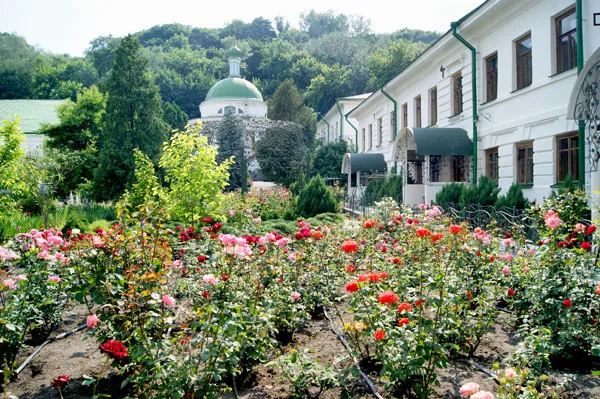
Holy Ascension Florivskyi Monastery
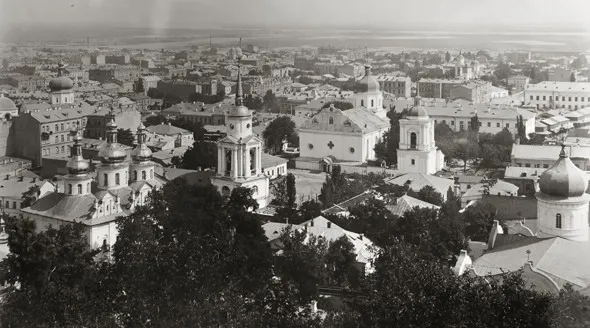
The monastery in the early 20th century (the pear-shaped domes of the Ascension Cathedral are visible)
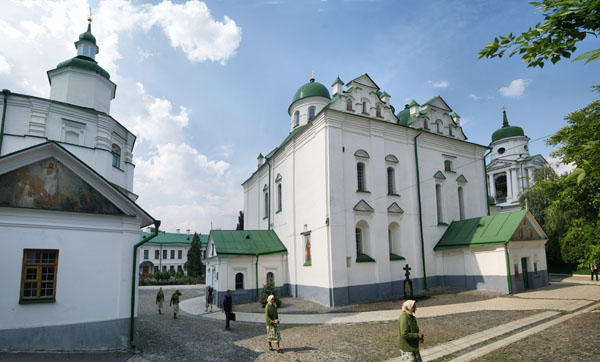
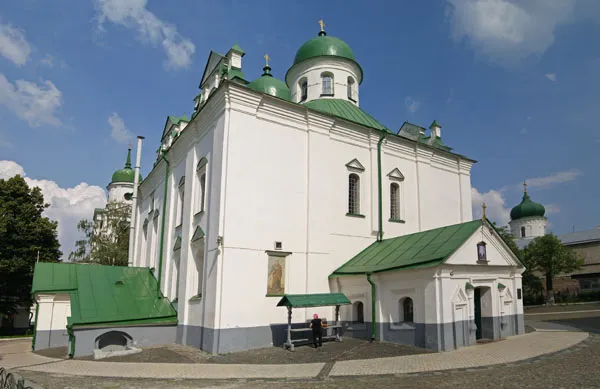
The Ascension Cathedral (left) with helmet-shaped domes (the photo is clickable)
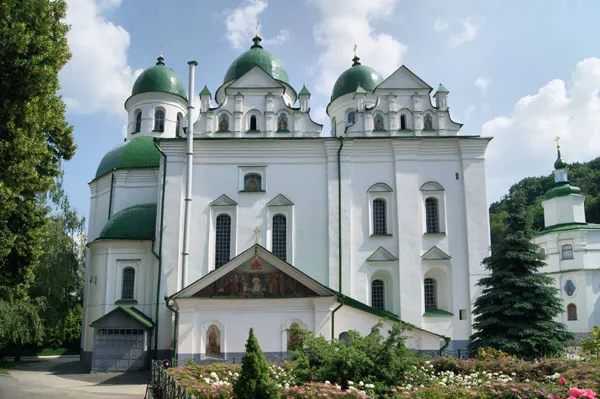
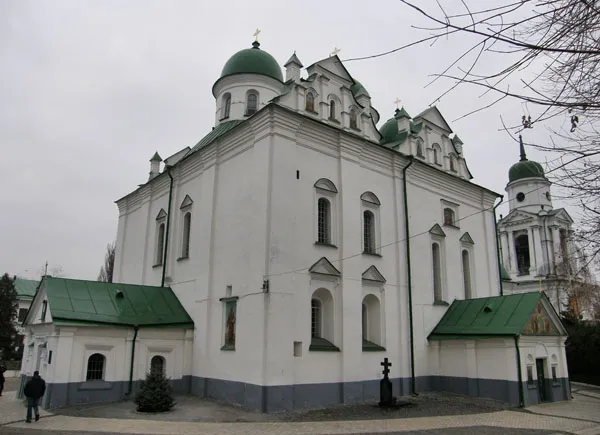
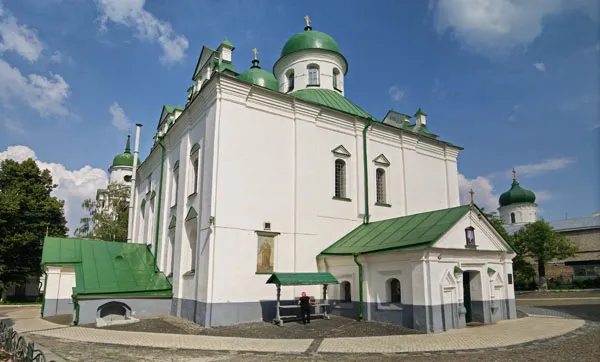
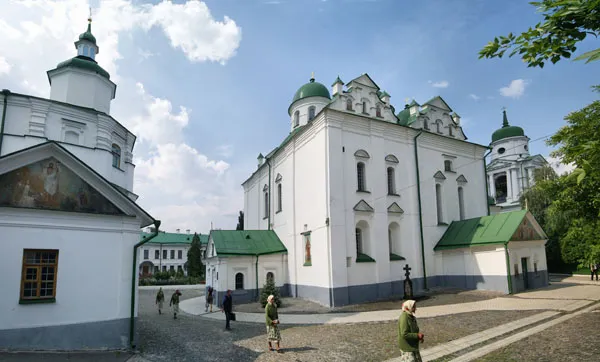
There are quite a few churches in Podil. Quite a few monasteries too (former and currently active). The Florivskyi Ascension Monastery is one of the oldest, largest and most interesting. It is an integral part of the Podil skyline, yet at the same time it is one of the most compact and coziest large monastic complexes in Ukraine (that is, when more than one church and more than one block of cells are skilfully fitted into a limited space). Here there is a large cathedral, a large bell tower, three auxiliary churches and large blocks of cells. And all this functions in the limited space of a lively business district of the city, with constant traffic jams and hundreds (or thousands) of typical office workers.
When the monastery in honour of Saints Florus and Laurus was founded in Kyiv is not known for certain. According to some historical documents, it already existed in 1441. Then it fell into decline and was restored by the Kyiv archpriest Iakiv Hulkevych, who received the monastery’s lands in lifelong ownership from the Polish king Sigismund II in 1566. The monastery was by then already a women’s one. In 1632 Hulkevych’s grandson renounced his rights to the monastery lands and handed them over to the abbess Ahafiia Humenytska. From then on the convent existed as a separate monastery subordinate to the Kyiv Metropolis and the Ecumenical (Constantinople) Patriarchate. But after Kyiv was annexed to Muscovy, the metropolis was almost forcibly subordinated to the Moscow Patriarchate. We will not discuss subordination further…
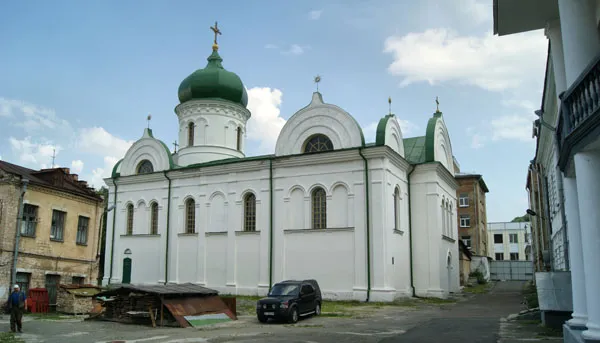
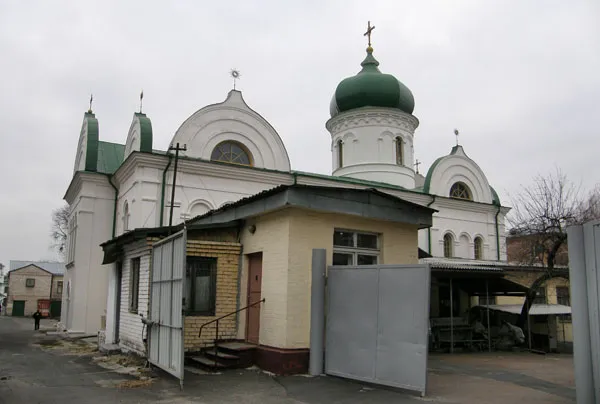
Church of Our Lady of Kazan
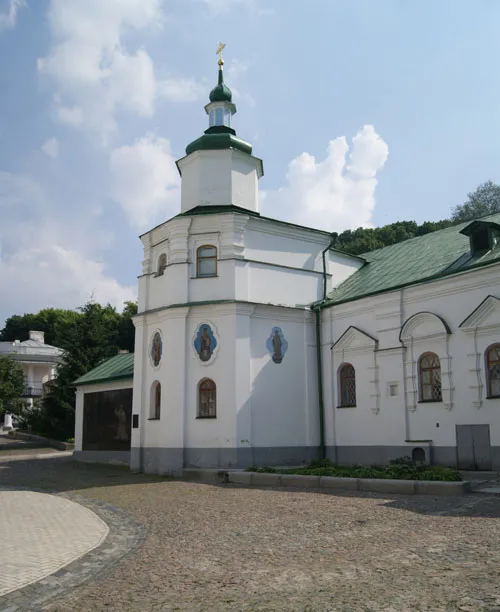
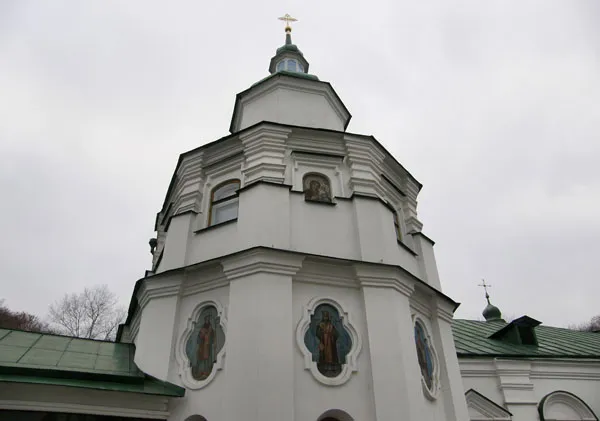
Refectory church
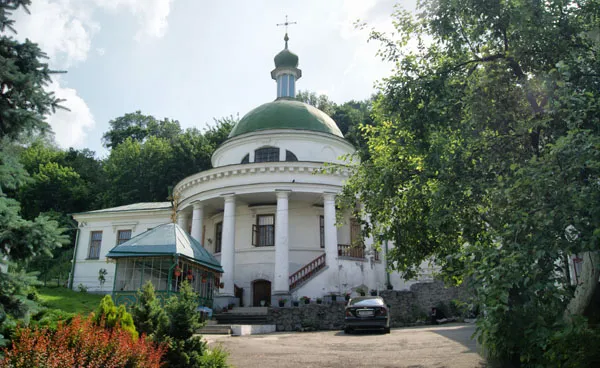
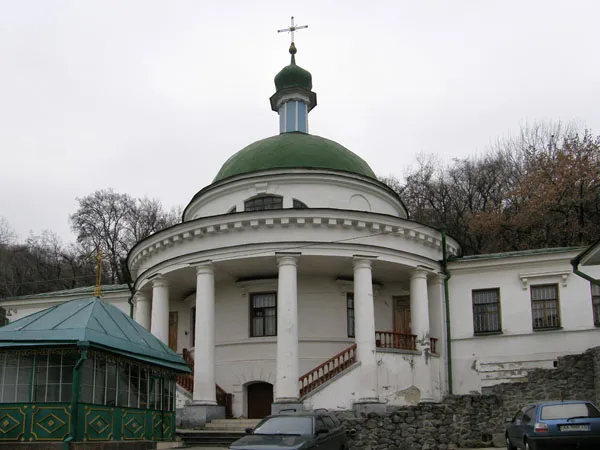
Resurrection Church
At first all the buildings of the monastery (which was very poor) were wooden, and therefore suffered greatly from frequent fires. Only at the end of the 17th century did the convent get its first masonry building, the abbess’s house.
Its heyday began in 1711, after Peter I closed the Ascension Convent (the oldest women’s monastery in Kyiv) and transferred its nuns to the Florivskyi convent. A city arsenal was later built on the site of the Ascension Convent.
The Ascension Convent was considered the most elite women’s monastery in Kyiv. Most of the nuns here came from princely and noble families. As the well-known French engineer Beauplan (who long served the Polish crown) noted, the nuns (seen by the engineer on their walks) had exceptionally beautiful faces.
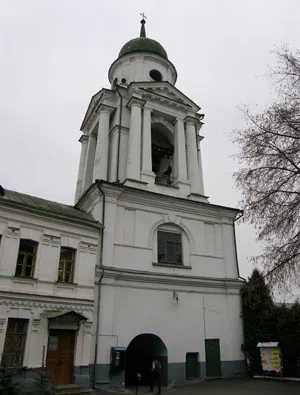
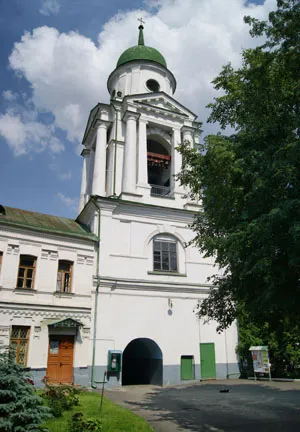
The bell tower
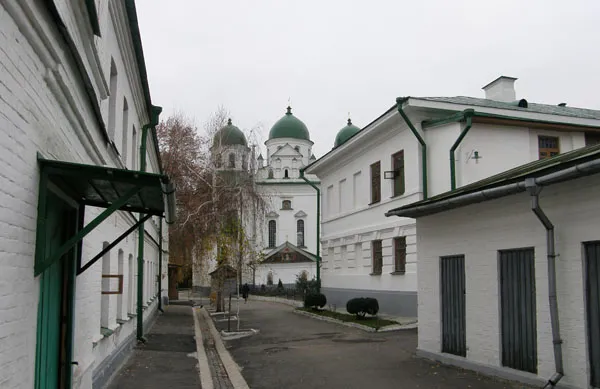
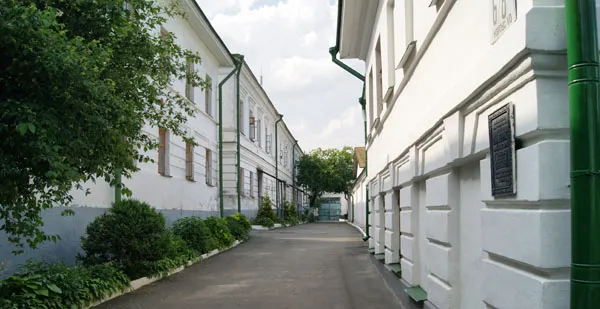
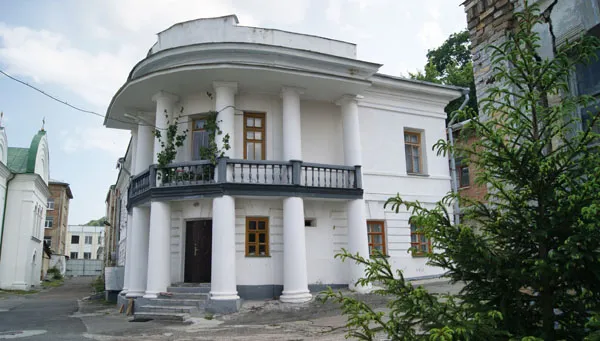
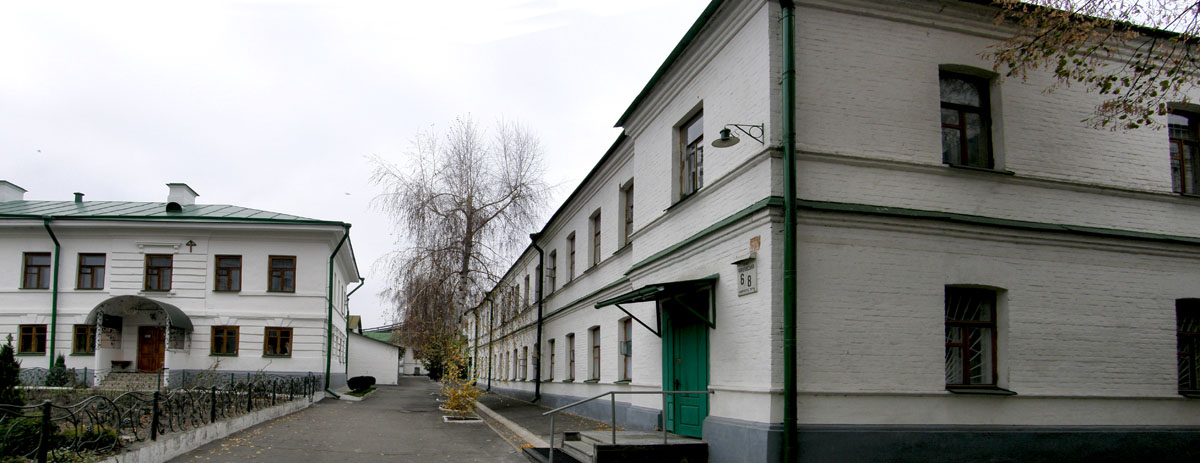
The monastery buildings (the last photo is clickable)
In 1683, after Maria-Magdalena Mazepa (Mokiievska), the mother of the future hetman, was appointed abbess of the Ascension Convent, the convent’s flourishing began. It became the main centre of liturgical embroidery, and expanded and was built up. But Emperor Peter closed the “Mazepa” convent. Its masonry churches and buildings were later dismantled, and the nuns were moved to the Florivskyi Monastery.
The Ascension Convent’s numerous estates also passed to the Florivskyi Monastery. From one of the poorest it became one of the richest. From 1732 it was called the Holy Ascension Florivskyi Monastery. This happened after the completion of the Holy Ascension Cathedral, the main church of the convent.
The cathedral was built in the Ukrainian Baroque style. Interestingly, in church circles this style was later described as “an archaistic form corresponding to the folk building tradition”. It was restored several times after fires. In 1811 a fire destroyed almost all the murals in the church. The restoration was led by Kyiv’s chief architect Andrii Melenskyi. On his initiative the original pear-shaped domes of the cathedral, characteristic of Ukrainian Baroque, were restored. But the Soviet “restorers”, after the domes were destroyed in 1941–43 (during the occupation), did not restore their shape, putting incomprehensible helmet-shaped tops on the drums. The cathedral lost some of its beauty then. But even so it remains one of the most majestic churches of Podil. The interior is especially impressive (I was not allowed to photograph it: it is not blessed).
In 1759 the monastery’s first masonry building (the abbess’s house) was converted into a refectory church (now the Church of Our Lady of Tikhvin). Somewhat earlier (in 1740) a three-tier bell tower was built, with the two upper tiers made of wood.
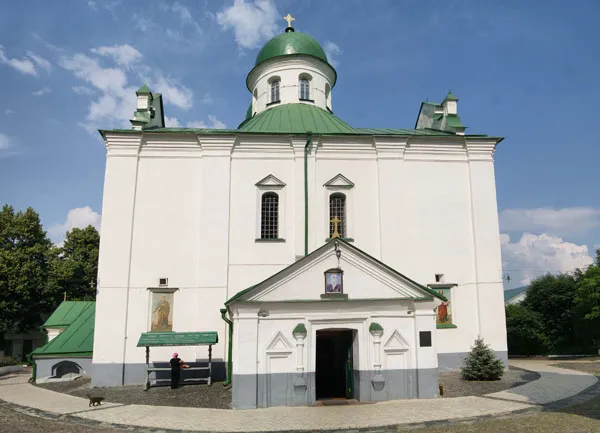
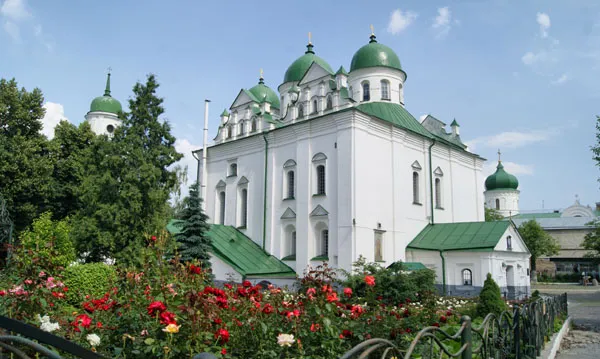
Until the end of the 18th century most buildings of the Florivskyi Monastery remained wooden, so the huge fire of 1811 destroyed them. It also destroyed the upper tiers of the bell tower. Under Melenskyi’s direction the monastery was thoroughly rebuilt. New blocks of cells were erected. The bell tower was completed with two masonry tiers in the Empire style (it had a tall spire, distorted by Soviet restorers). In the same style, in 1824, the Resurrection Church-rotunda was built (now considered one of the finest Empire-style buildings in Kyiv).
In 1840–44 the Church of Our Lady of Kazan was built. Its design is attributed to Pavlo Sparro. The church is a mixture of classicism and historicism (a classicist building supplemented with elements of Russo-Byzantine architecture).
In 1929 the monastery was closed. The Trinity Church, which stood in the monastery cemetery, was destroyed, and the buildings were handed out to various institutions. Thus a workshop of a prosthetics factory was housed in the Church of Our Lady of Kazan, the workshops of “Ukrproektrestavratsiia” in the Ascension Cathedral and the Resurrection Church, and a housing cooperative in the blocks of cells… And so on.
During the German occupation the monastery was reopened, and in the future it was not closed again (officially), although most of the buildings were returned to the nuns only in the 1990s.
Today the convent can be said to be flourishing, even though restoration work continues in many buildings. It is a significant tourist site, included in most tour programmes of Podil. We recommend visiting this cozy corner in the midst of a noisy city. You will not regret it.
Text and photos by Roman Malenkov