

Great Ukrainians were ignored in the renaming of Kyiv streets

· 6 min read
Great Ukrainians were ignored in the renaming of Kyiv streets. And there is no reason to rejoice too much: the current renaming showed that we managed to destroy russian markers (though not all of them) but displayed a total inability to create our own.
The expert commission headed by Oleksandr Alfiorov (whose video blog I enjoy watching on YouTube) for some reason ignored the pan-European rules of street naming and paid no attention to the Great Ukrainians… The strangest thing is that these figures, who influenced the formation of the nation, who were its ideologues, creators and victors, are often closely connected with Kyiv. It looks like nonsense to me that the historians who took part in the naming commission simply did not pay attention to these Great ones. I hope the commission had reasons for this and that it is not a lack of qualification at all.
“Yes, not all figures are honoured, but from now on the whole history of Ukraine and Kyiv is honoured in city names,” writes Oleksandr Alfiorov. The whole history of Ukraine and Kyiv without… Without whom? Whom did they forget? Whom did they ignore?
Ivan Semenovych Nechuy-Levytskyi is one of the main authors of Ukrainian prose, in whose language almost all Ukrainian writers of the 20th century wrote. A man who expanded the boundaries of national literature to world standards, both in genre and in the description of the strata of society. A nationalist who wrote “On the uselessness of Great Russian literature for Ukraine and for the Slavic world,” for which the ruzzkiy mir almost destroyed him… His oeuvre runs to more than 10 volumes, and quite a few works are about Kyiv: he is perhaps the greatest literary chronicler of 19th-century Kyiv, and it was he who described the process of the city’s russification. He is the “father” of Pronia Prokopivna and Holokhvostyi, whose monument stands on the Uzviz. He lived 33 years in Kyiv, 21 of them on Pushkinska Street… Some will google it and say that there is a Nechuy-Levytskyi Street in Kyiv: a tiny, very neglected street in the private sector near Baikove Cemetery. It is like mockery of the Great Nechuy. Can you imagine London honouring Dickens this way?
Vasyl Symyrenko is the greatest patron of Kyiv in all its history. “The most outstanding, most sincere Ukrainian among the so-called bourgeois, who was devoted to the Ukrainian cause not only to the depths of his sincere soul but also to the depths of his pocket”: these are the words of Yevhen Chykalenko about Vasyl Symyrenko. A whole book would not be enough to list everything Vasyl did for Kyiv and Ukraine. A millionaire who defended our history and language, published Shevchenko, the first Ukrainian-language newspapers and periodicals (imagine that before Symyrenko there were none at all), created the first Ukrainian scientific society and bought a building for it in Lviv, funded a significant part of Ukrainian creators and artists, including Lysenko’s choir and Drahomanov’s printing house… After his death he bequeathed everything to Ukraine: an unprecedented sum, over 10 million gold roubles, and also the manor that now houses the British embassy. Kyiv has a Levko Symyrenko Street (for the plant breeder), but not Vasyl’s.
Ivan Bohun: you all know this outstanding commander, a companion of Khmelnytskyi, who refused to swear allegiance to moscow. Victor in many battles. One of the brightest representatives of the Ukrainian Cossacks. Where is his street? In Bortnychi.
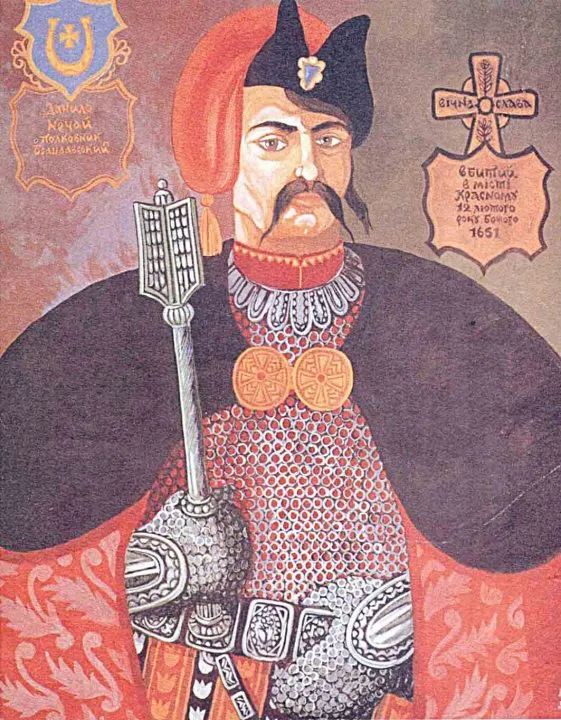
Danylo Nechai was an incredible commander, a companion of Bohdan, who led not only a regiment but also the Kyiv garrison. “Nechai, colonel of Bratslav, one of the foremost rebels, to whom the Cossacks themselves gave first place after Khmelnytskyi”: this is how the Poles wrote about Nechai. Researchers call Nechai one of the greatest Cossack colonels in history and the chief ideologue of Khmelnytskyi’s state. There is no Nechai Street in Kyiv.
Stanislav-Nestor Morozenko: “…oh Moroz, Morozenko…” hardly anyone has not heard the words of this song about the heroic Cossack colonel. One of the best-educated leaders of the Cossack army, Stanisław Mrozowicki studied at the universities of Kraków and Padua. A victor. A symbol. A model. An excellent candidate for an equestrian monument, of which the capital has as many as two (not counting Shchors), yet he has no street in Kyiv. But Lviv has one, and so do Ternopil and Rivne…
Martyn Nebaba was a legendary Cossack colonel who led the vanguard of the Ukrainian army in many battles and campaigns. Acting hetman of the Left-Bank regiments and one of the ideologues of the Khmelnytskyi Uprising. Struck by Nebaba’s courage, the Polish-Lithuanian hetman Janusz Radziwiłł, the colonel’s enemy, ordered a high burial mound to be heaped over his grave. Nebaba Street exists in Chernihiv.
Ivan Chornota was the general quartermaster in Bohdan’s time, the second man in the state, and acting hetman at Zbarazh. A victorious commander. He came from the noble family of Chornota-Diamentowski and was well educated. Celebrated in literature, notably in Starytskyi’s brilliant trilogy, but forgotten in Kyiv.
Kindrat Burlii, Mykhailo Krychevskyi, Fylon Harkusha, Ivan Zolotarenko, Samiilo Zarudnyi: the closest associates of Bohdan Khmelnytskyi. Victorious heroes.
Lavrin Kapusta was the head of Khmelnytskyi’s counterintelligence. In all military campaigns (except Okhmativ in January 1655) the Hetman’s reconnaissance patrols always managed to establish promptly and accurately the enemy’s route of advance and location. According to repeated claims by researchers, Bohdan Khmelnytskyi created one of the best intelligence and counterintelligence services in Europe of that time, and it was headed by Lavrin Kapusta.
Fylon Dzhalalii was a Crimean Tatar who won distinction at the Sich, commanded Cossack regiments and was one of the outstanding commanders of the War of Liberation. Khmelnytskyi’s chief of staff and acting hetman at Berestechko. In 1654 he refused to swear allegiance to moscow.
Tuhai Bey was an outstanding Crimean Tatar commander and political figure. A sworn brother of Khmelnytskyi and his repeated ally with a Tatar army. Co-author of many Cossack victories.
Of course, these are far from all the Great ones forgotten in Kyiv’s streets. I am not a historian, I do not know or remember everything, but it is surprising why the historians showed such forgetfulness. As with geographical names, where they did not forget Bolhrad, Mohyliv-Podilskyi, Przemyśl, Olbia, Supii, Lutsk, Pochaiv, Svaliava and so on, they forgot Bila Tserkva. Nonsense. A city that was founded as a shield of Kyiv, that has defended Kyiv for almost a thousand years, and even now: remember where the 72nd Brigade is based. And in general this is a city that played an outstanding role in the history of Ukraine, was a regimental city under Khmelnytskyi and a gathering place for troops, where the first Cossack uprising (of Krzysztof Kosiński) began, and where the Directorate of the UNR was formed. How could one forget this city?
And one more thing. Oleksandr Dal Street was renamed Volodymyr Dal Street. Let me remind you that it was the latter who wrote the Explanatory Dictionary of the Living Great Russian Language, burying the Great Russian dialect. He also served in the russian army, took part in the russo-Turkish war and in the suppression of the Polish uprising of 1831. As for the war with the Turks I will keep silent, but for the bloody suppression of the uprising in Poland Dal received the Order of St. Vladimir. Why should he have a street in Kyiv? Some freak…
I hope the work of renaming Kyiv streets is not finished and that it will be done truly professionally. And we (Ukraine Incognita) will try to join in.
Roman Malenkov


