

Kulishivka and its mammoth

· 2 min read
In 1839 an extraordinary event occurred. On the outskirts of the village of Kulishivka (now the Nedryhailiv district of Sumy region), while digging a pit for the foundation of a distillery that Count Yurii Holovkin, the owner of the village and of the neighbouring town of Kostiantyniv, had decided to build here, workers came across the skeletons of unknown animals that astonished with their size. Count Holovkin, having convinced himself of the importance of the find, and being a trustee of Kharkiv University, reported it to his good friend, a professor of medicine at the same institution, Ivan Yosypovych Kalenychenko.
The scholar, without thinking long, sent an expedition to the site of the find. The excavations lasted ten days and were halted only because of flooding by groundwater.
But in that time they managed to dig up two complete mammoth skeletons, as well as other prehistoric animals of the Ice Age: a rhinoceros, a deer and the ancestors of modern horses. One mammoth specimen ended up in the Kharkiv Historical Museum; the fate of the other finds remained unknown.
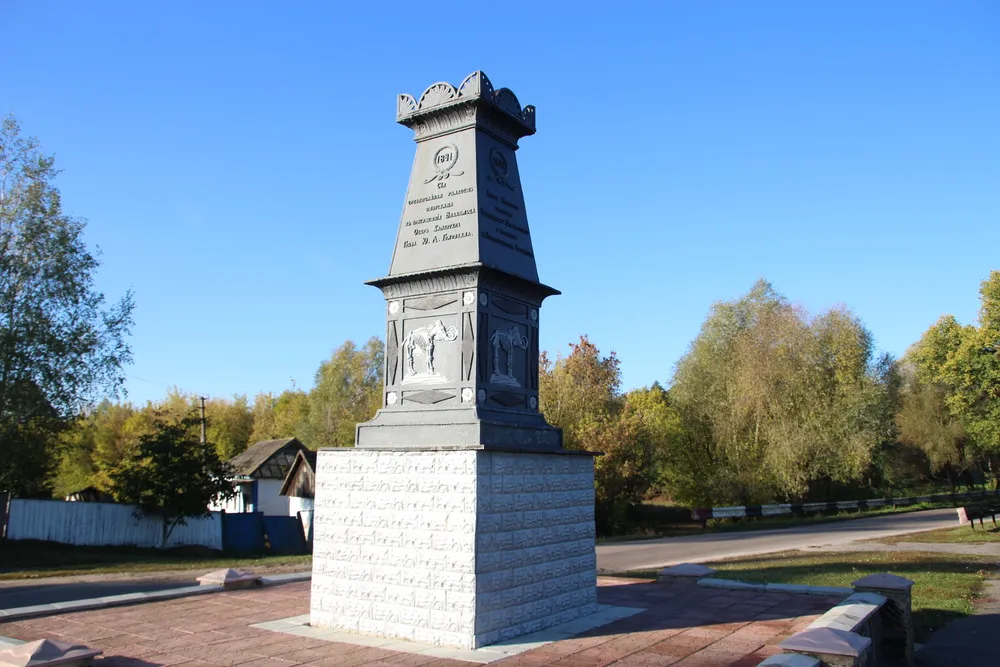
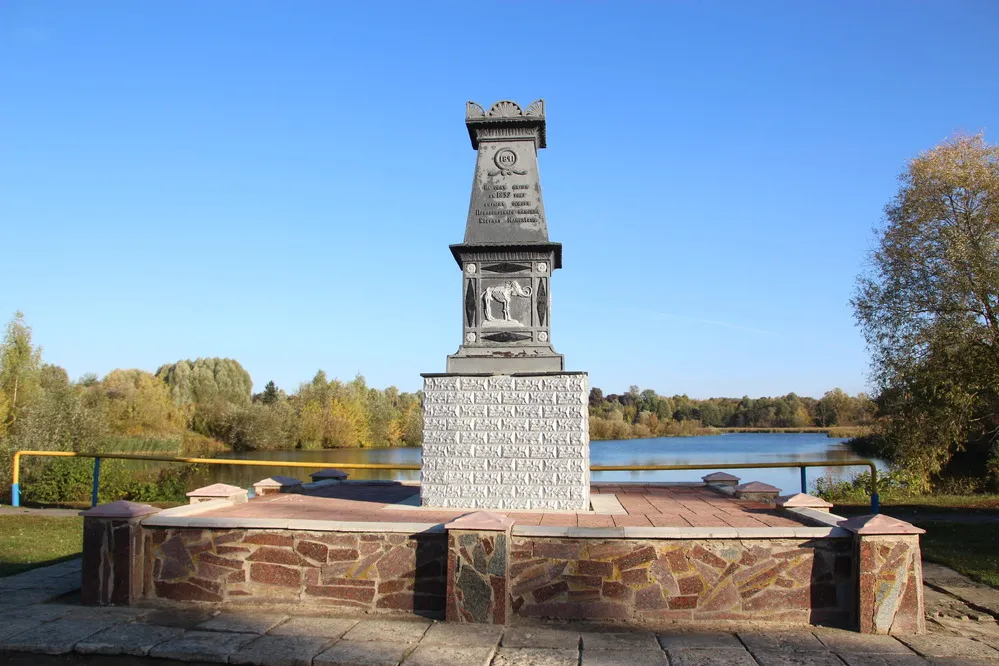
To commemorate this event, in 1841, at the expense of Count Holovkin and to a design by Professor Kalenychenko, an original monument was erected on the site of the find. On its different sides the following information is given:
“This extraordinary rarity was found in the presence of the owner, Chief Chamberlain Count Yu. A. Holovkin”, “The mammoth’s bones were left to Kharkiv University and are kept in the Zoological Cabinet”.
There is also this inscription:
“This place was the border between Poland and Russia”.
Indeed, from 1569 to the middle of the 17th century a frontier ran through the lands where Kulishivka now is, separating the Polish–Lithuanian Commonwealth from tsarist Muscovy. This is also attested by the name of one of the forests near Kulishivka, namely Poluliakh, since half of the forest was under Moscow’s rule and the other half under Poland’s.
As for the monument, it was the very first and for a long time the only monument to a mammoth in the world. Others appeared only later, in Yakutsk, Salekhard and Khanty-Mansiysk.
The monument is absolutely apolitical, so let us hope it will stand for a very long time, at least no less than the mammoth lay in the ground).
As for the name of the village of Kulishivka, there is a version that it came from the founder of the settlement, Kulish, a sotnyk of the Sumy Regiment.
Text and photos by Ihor Dorozhko, Oleh Hoda and Maksym Nazarenko.


