Mosaics of Holosiivskyi district of Kyiv

· 8 min read
Mosaics by Halyna Zubchenko and Hryhorii Pryshedko
Among the mosaics that are freely accessible for viewing, the best known and most valuable in Holosiivskyi district are the panels made by the outstanding masters Halyna Zubchenko and Hryhorii Pryshedko. The works of these artists are generally counted among the brightest Kyiv monuments of monumental and decorative art created in the Soviet period – they celebrate the triumph of science.
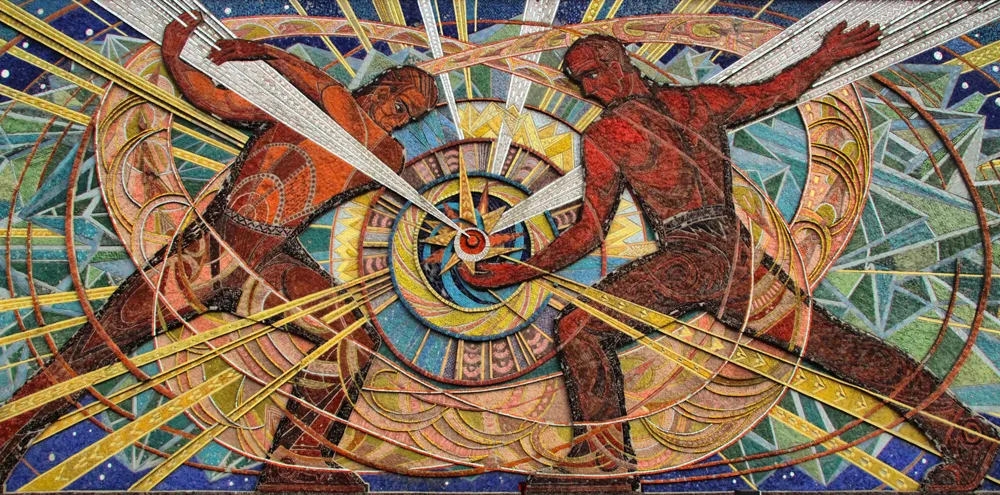
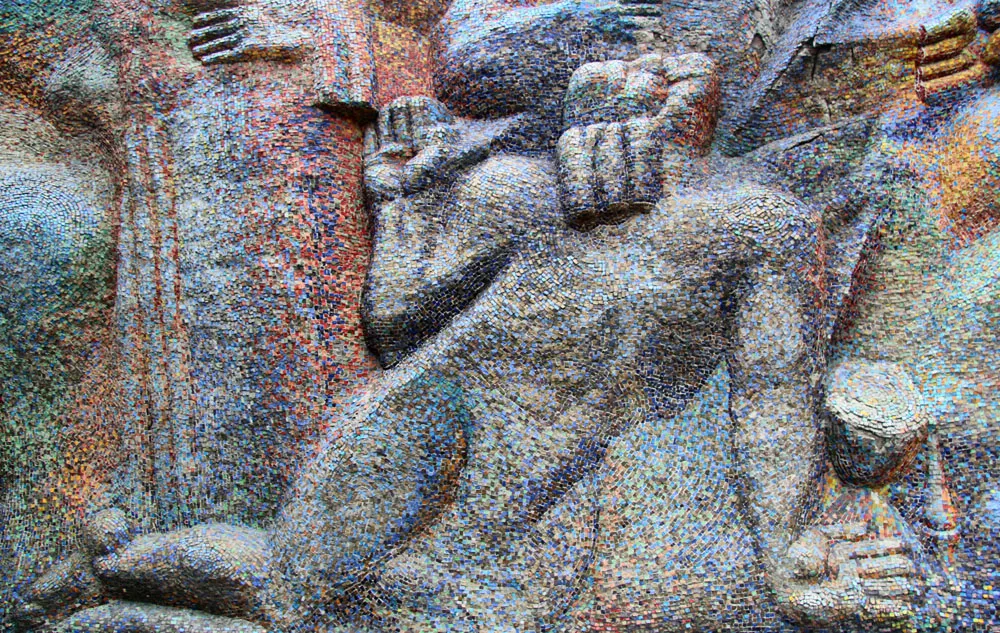
The mosaic panel “Blacksmiths of Modernity” was created by Halyna Zubchenko and Hryhorii Pryshedko in 1972–1974 on the wall of the Institute for Nuclear Research of the National Academy of Sciences of Ukraine (47 Nauky Ave.). The mosaic is dedicated to the conquest of the “peaceful atom”.
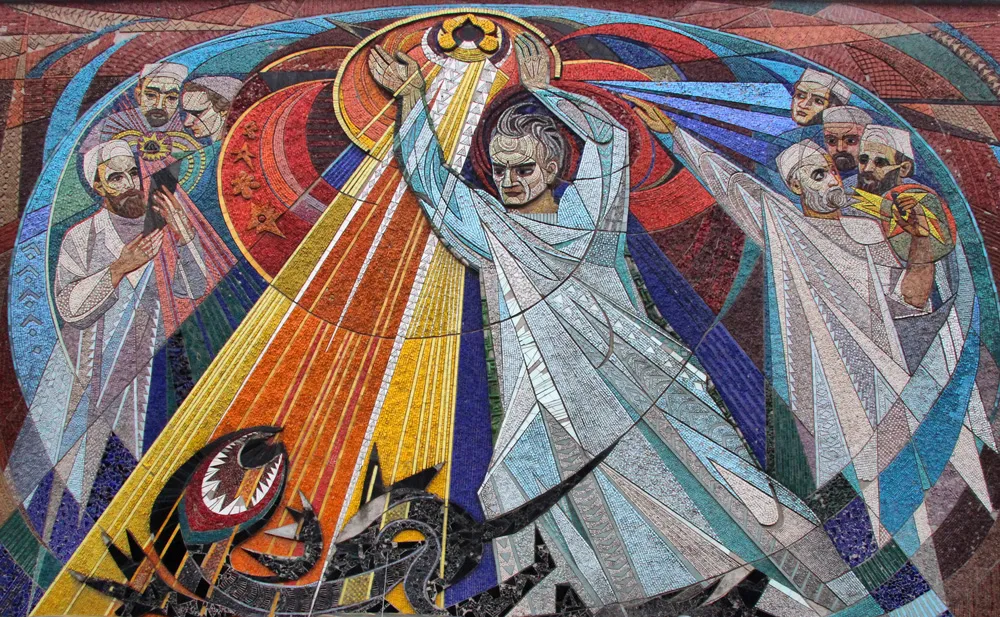
The mosaic panel “Victory” was created by Halyna Zubchenko and Hryhorii Pryshedko on the wall of the administrative and laboratory building of the Institute of Oncology and Radiology (33/43 Yulii Zdanovska St.). The work took place in 1970–1971. The mosaic, measuring 9 by 12.7 metres, was made of smalti and ceramics. The “Victory” panel depicts well-known medical scientists who, in the opinion of the Soviet nomenklatura elite, made a significant contribution to the fight against disease.
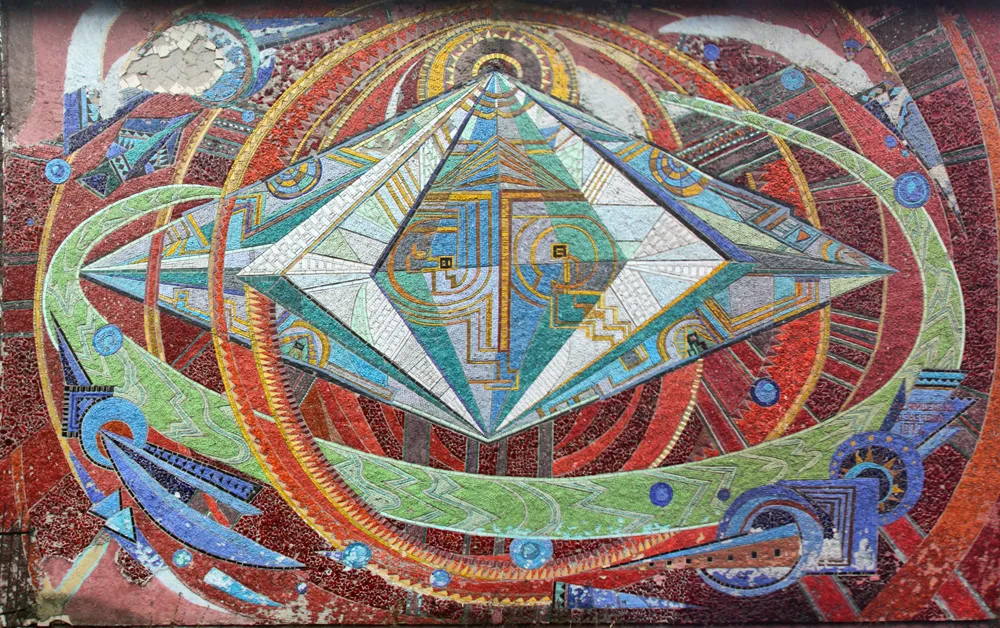
The mosaic “Triumph of the Cyberneticists” is located on the wall of the Institute of Cybernetics (40 Hlushkova Ave.). Zubchenko and Pryshedko created it in 1970. The mosaic covers 96 square metres. The panel is made of smalti, ceramic tiles, slag glass and coloured glass.
Mosaics and panels of the Institute of Theoretical Physics of the National Academy of Sciences of Ukraine. Ivan Marchuk and Mykola Storozhenko
Who would have thought that the building of the academic Institute of Theoretical Physics, erected in 1970 (14-b Metrolohichna St., Kyiv), holds a whole collection of true masterpieces. There are three works by Ivan Marchuk, two by Mykola Storozhenko and one by the married couple Anatolii Haidamaka and Larysa Mishchenko. These are huge mosaics and panels with a Ukraine-centred outlook.
At one time the Soviet management of the institute was dissatisfied with these creations; it is fortunate that they were not dismantled altogether. The artists were accused of not fully developing the theme of friendship and equality of the peoples of the USSR.
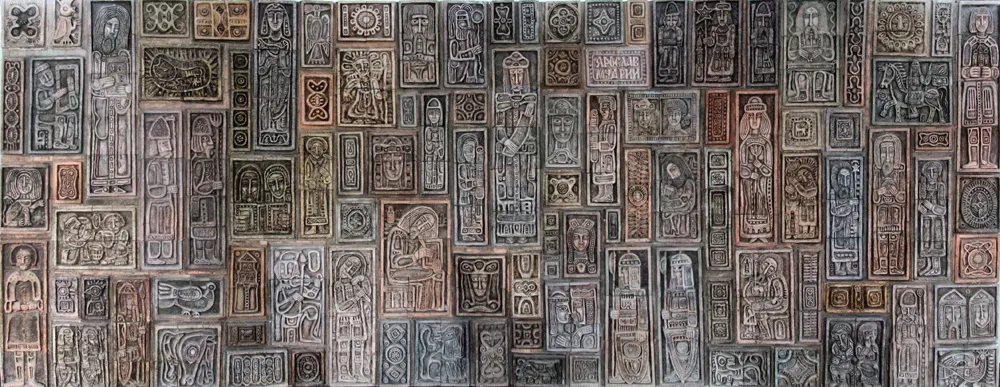
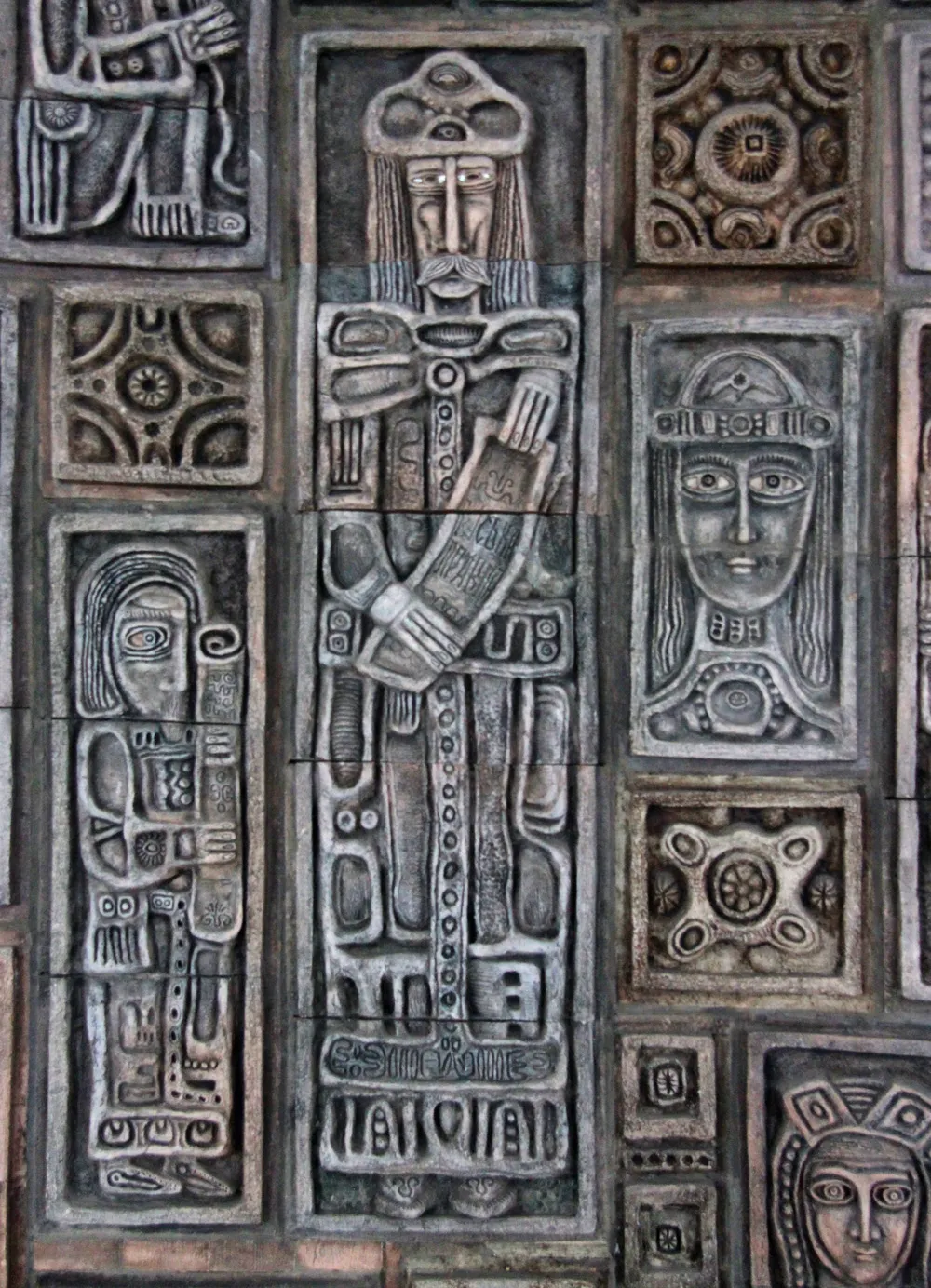
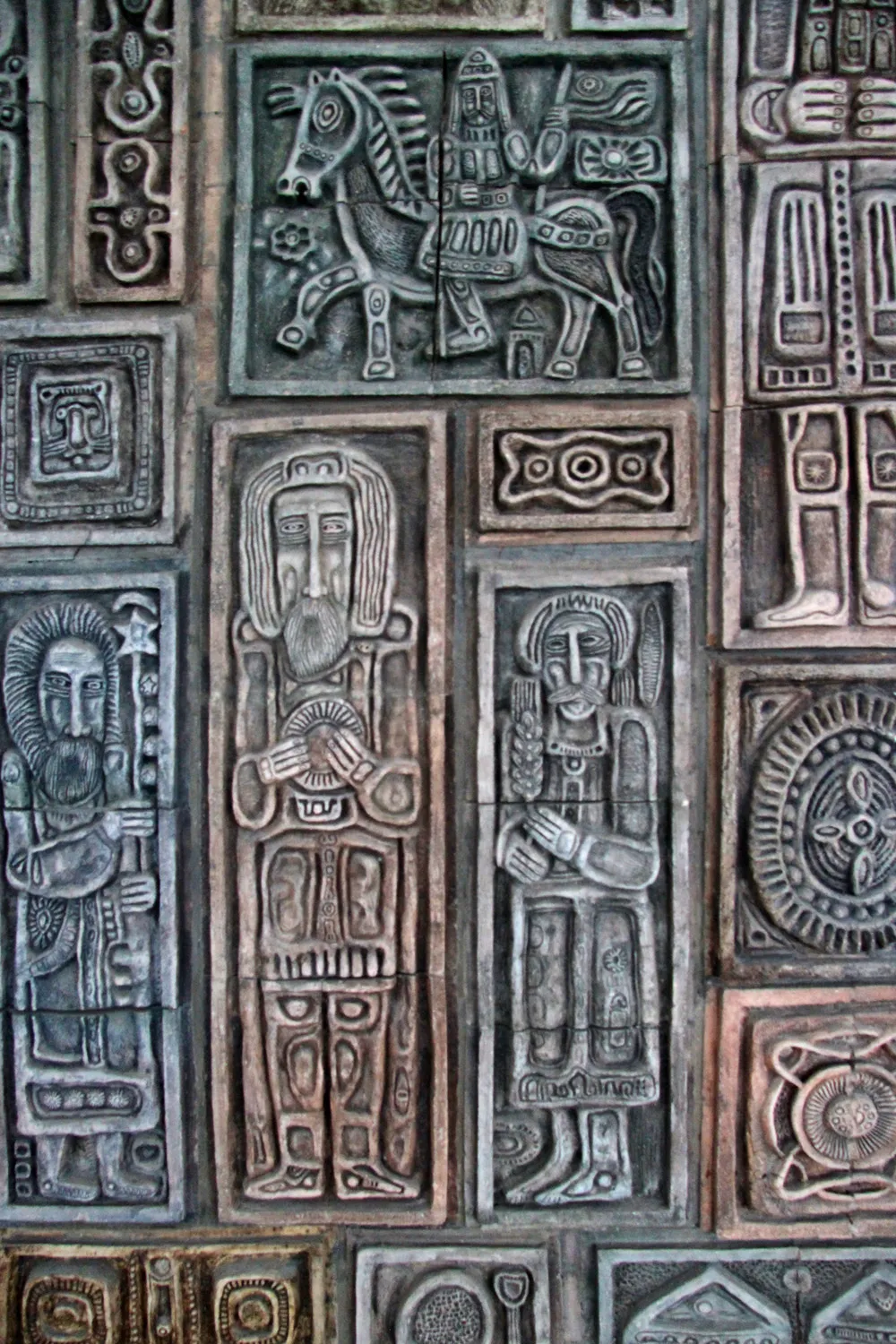
The most valuable is considered to be Ivan Marchuk’s ceramic panel “Yaroslav the Wise”. Here is how the author himself recalled the work:
“Once Petro Shelest, who was then First Secretary of the Central Committee of the Communist Party of Ukraine, came to the Institute of Theoretical Physics, where the slabs of the future panel “Yaroslav the Wise” were laid out in piles. The acting director of the Institute, his son Vitalii Shelest, a scientist and physicist, picked up one of the slabs and showed it to his father. And he turned to me: ‘Ivan, how do you do this, that it comes out looking so old?’ I say: ‘Oh, Petro Yukhymovych, that is a secret. I cannot reveal it.’ Shelest laughed and said: ‘Don’t worry, Ivan. I won’t do it.’ Did he keep his word? Although my ceramics influenced the work of Halyna Seviuk, Mykola Storozhenko and, to some extent, Olha Rapai, as they themselves recalled.
I, however, was always more drawn to painting. It was painting that won out over ceramics.”
The panel “Yaroslav the Wise” is located in the institute’s second-floor hall. Its area is 32 square metres. The composition has 100 fragments, each with its own subject. The panel depicts historical figures of the 11th century and floral ornaments.
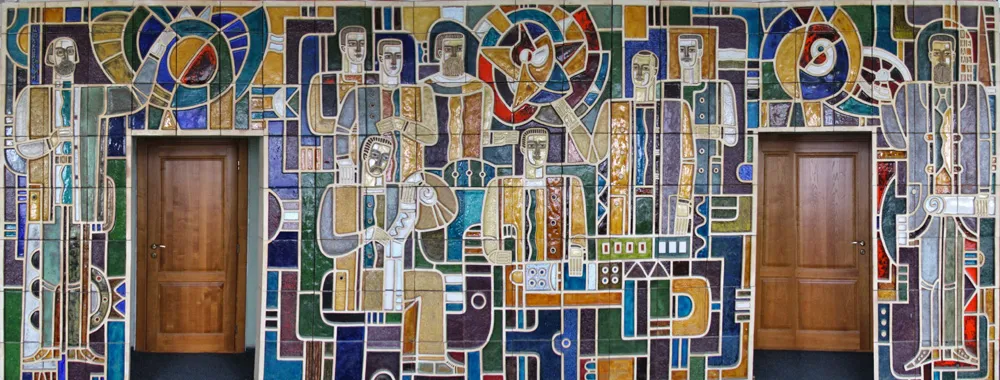
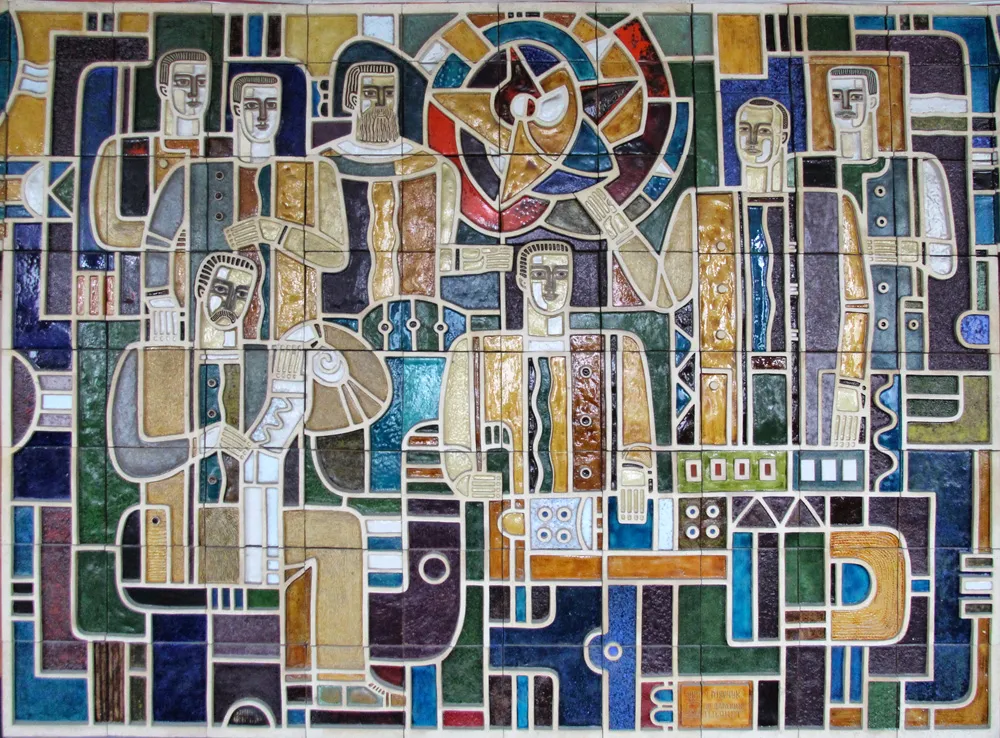
On the top floor is Ivan Marchuk’s panel “Physicists”, made of ceramics and smalti. It covers 22 square metres and depicts real scientists-physicists (contemporary in 1970).
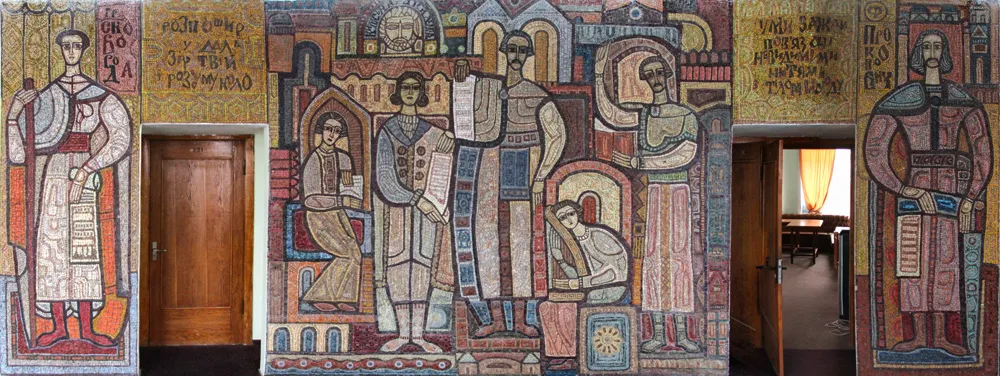
Mykola Storozhenko, “Kyiv Academy”
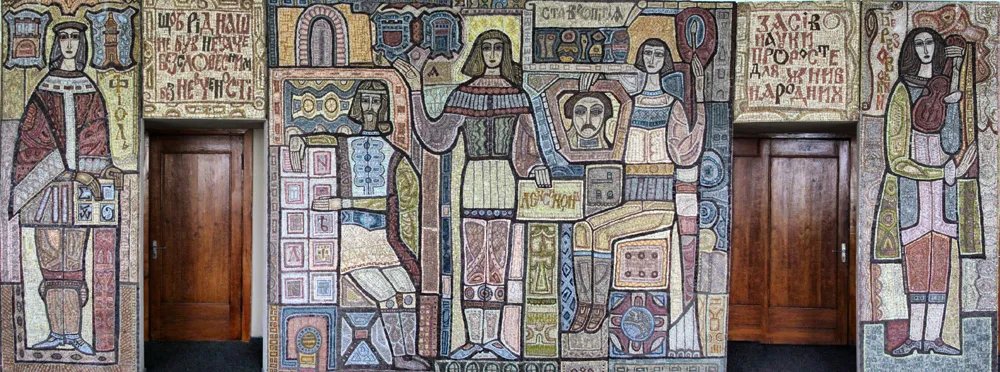
Mykola Storozhenko, “Science and Culture of the 16th–18th Centuries. Lviv Stauropegion Brotherhood”
The third and fourth floors are decorated with mosaics by Mykola Storozhenko – “Kyiv Academy” and “Lviv Stauropegion Brotherhood” (full title “Science and Culture of the 16th–18th Centuries. Lviv Stauropegion Brotherhood”). It is a wonder the artist was not sent to prison for these mosaics as a nationalist and dissident.
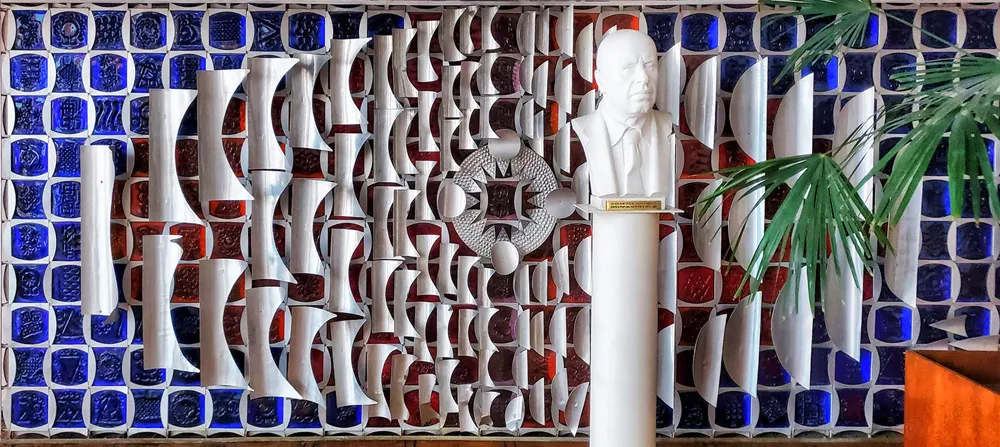
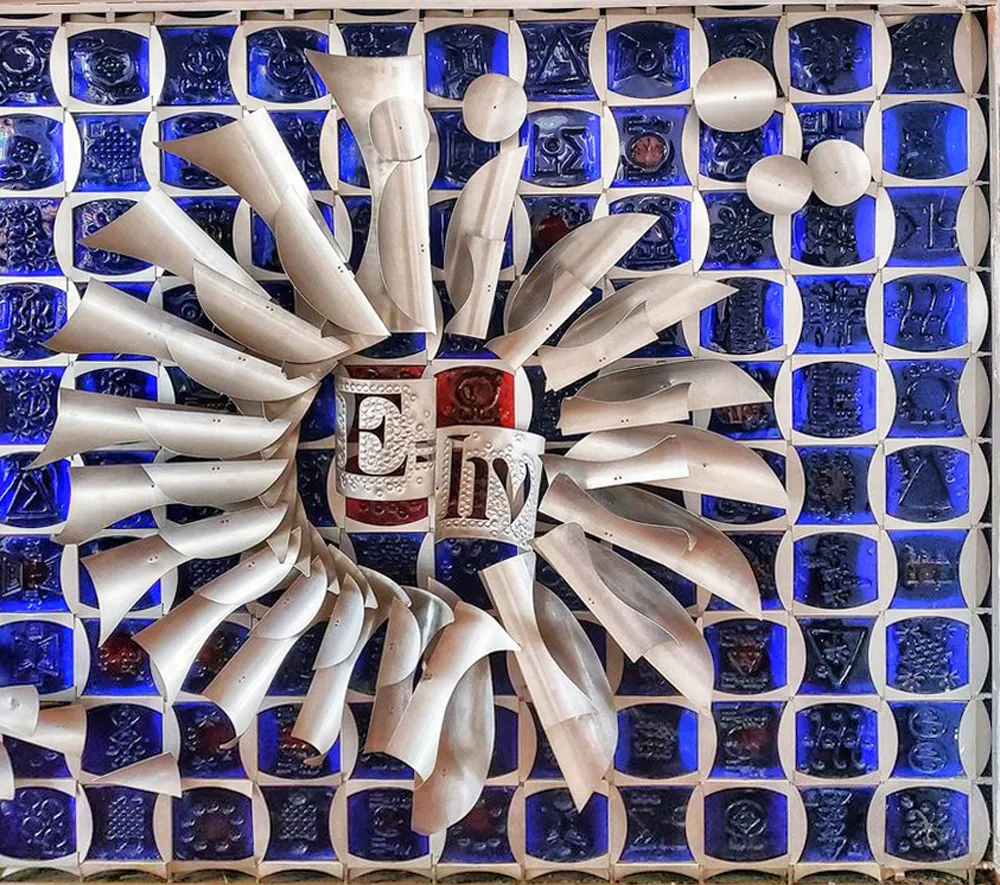
In the vestibule on the first floor is the stained-glass window “Splitting of the Atom” by Anatolii Haidamaka and Larysa Mishchenko. Its area is 17 square metres. The composition symbolises physical processes and is made of glass and metal.
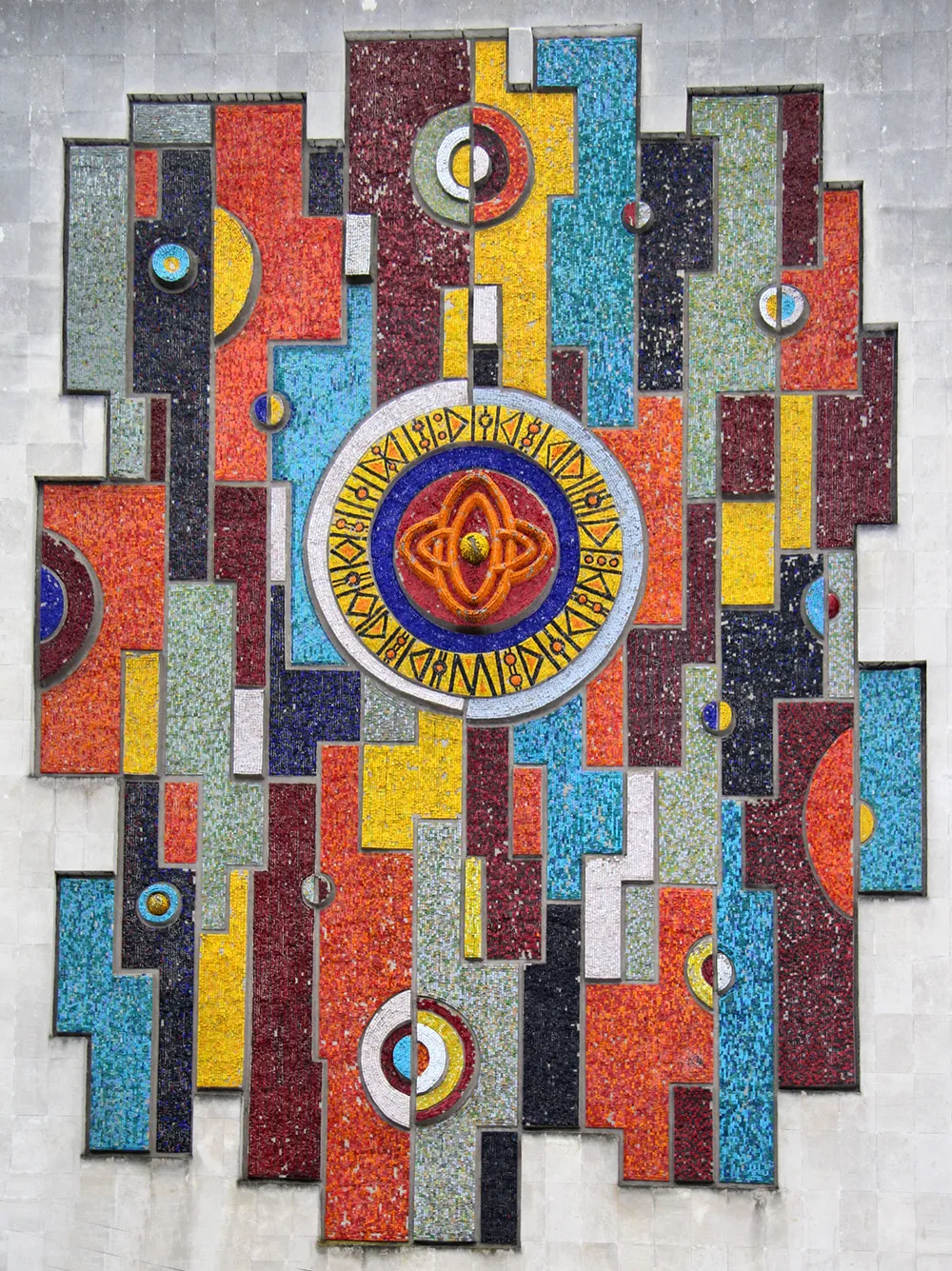
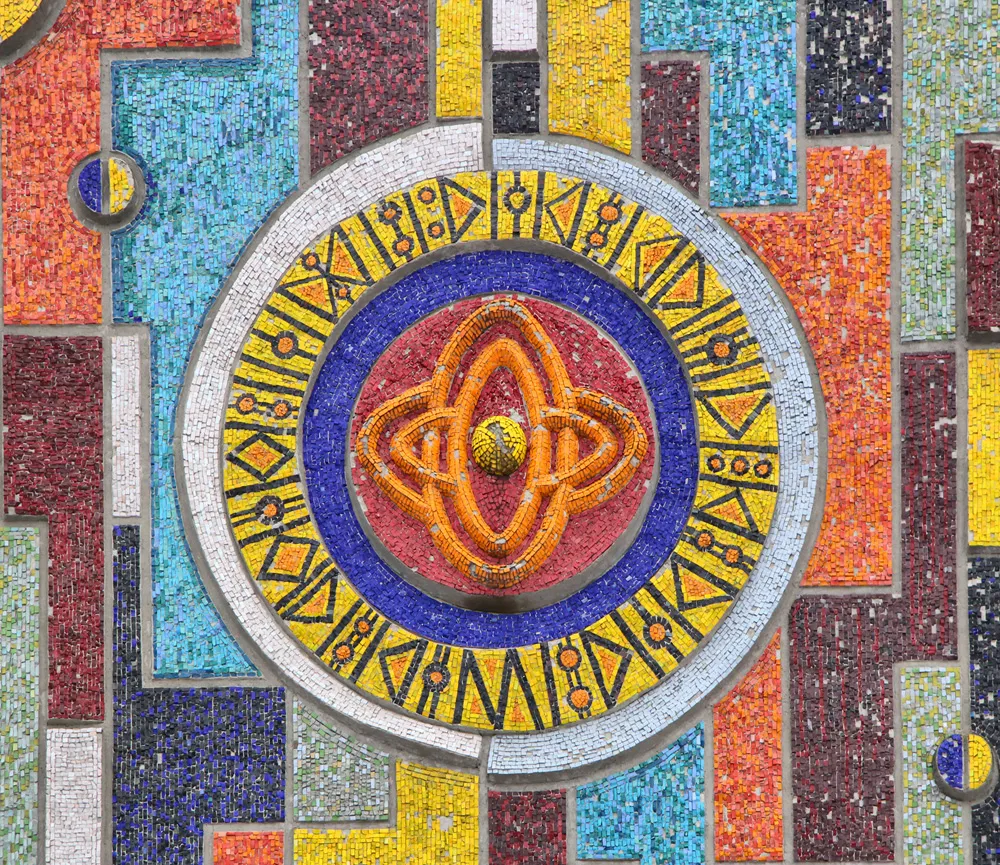
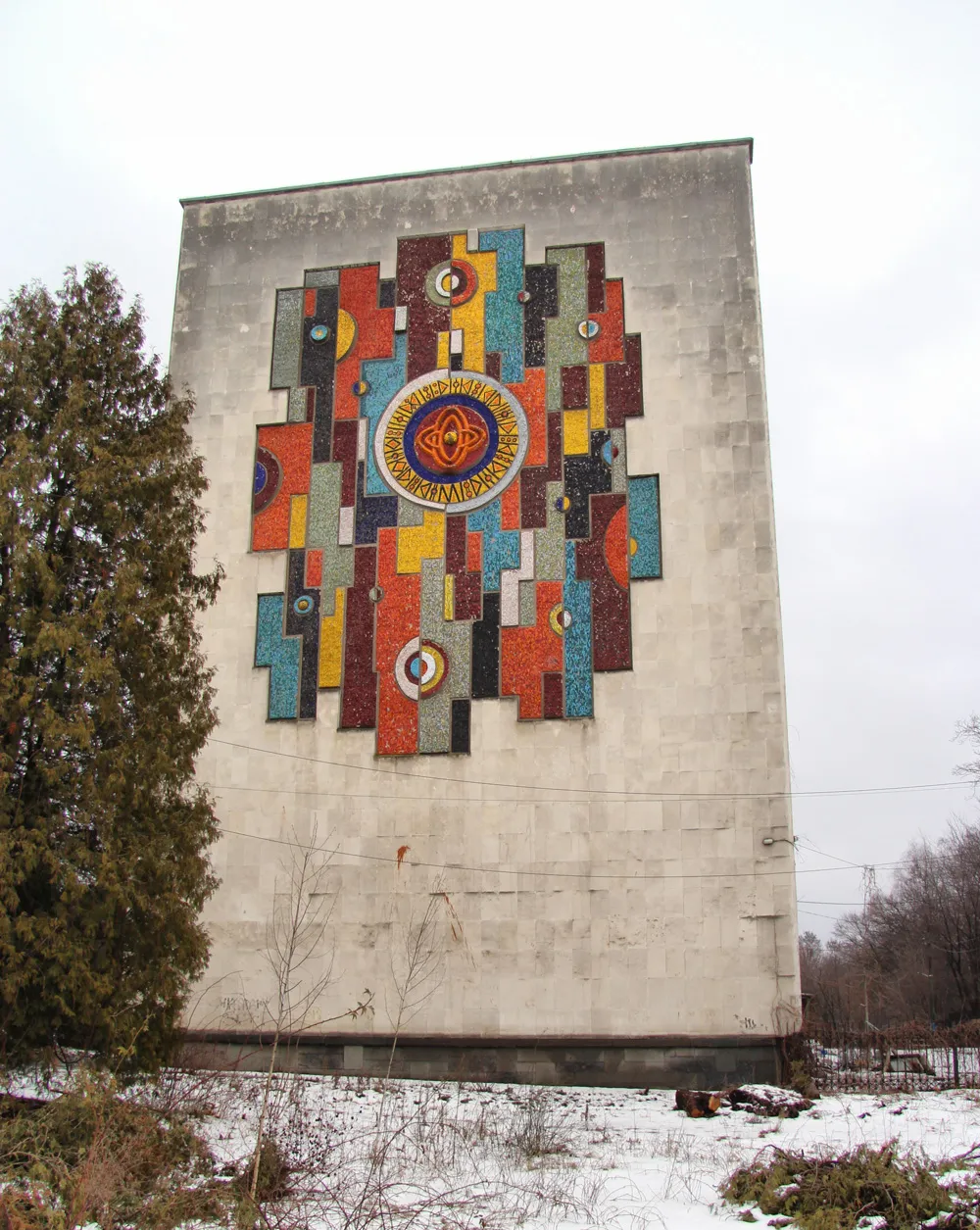
The end wall of the building is decorated with a huge mosaic by Ivan Marchuk, “Plakhta”. Drawing on folk art motifs, the artist shows the symbolic structure of the Universe. This mosaic was often called the symbol of the institute.
See photos of the mosaics and panels of the Institute of Theoretical Physics in our photo gallery.
Restaurant “Budmo” (formerly “Vinnychchanka”). Mosaics and panels
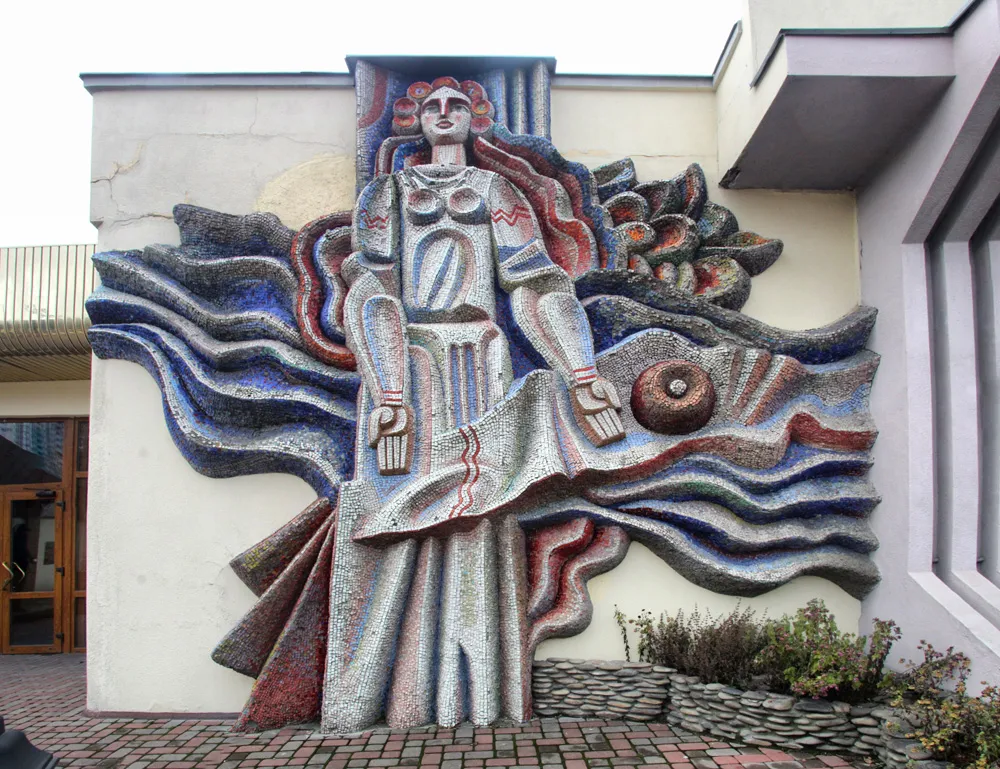
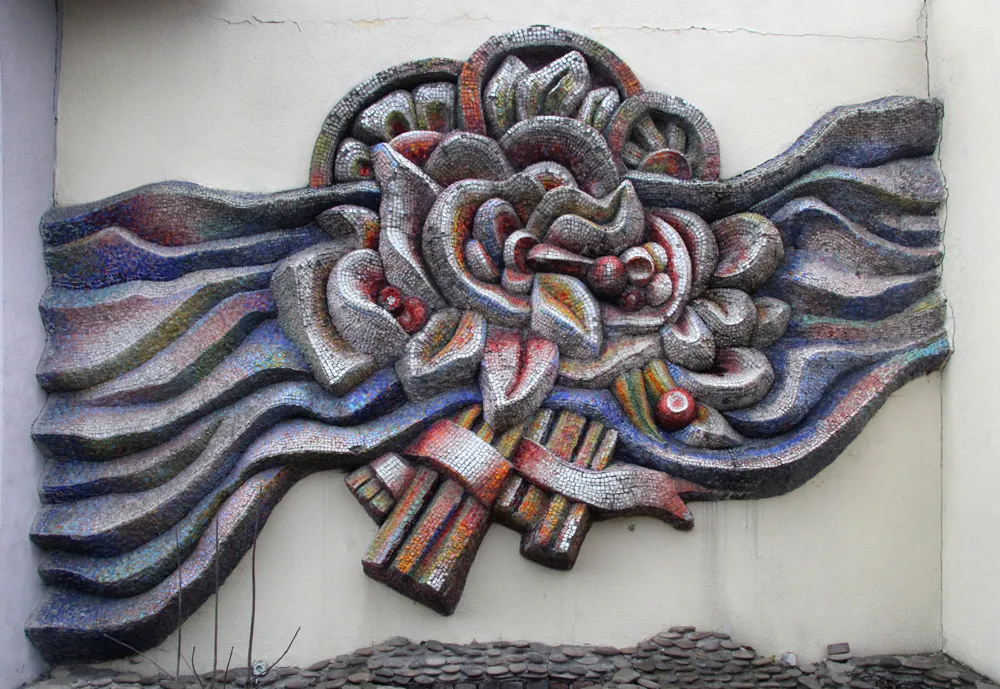
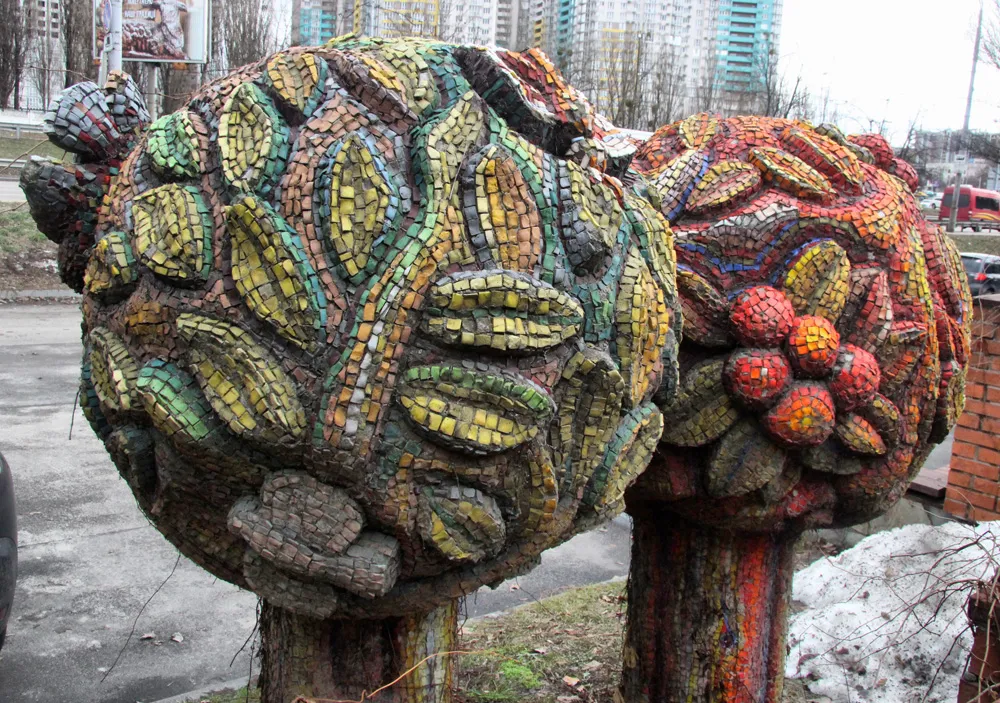
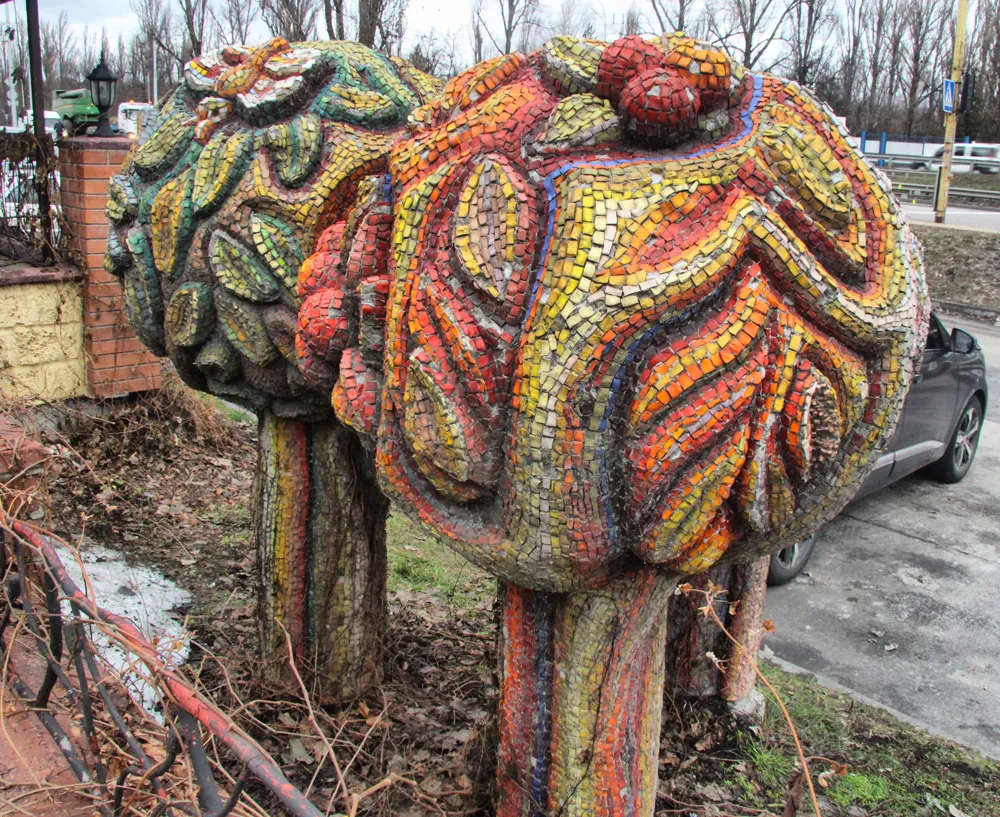
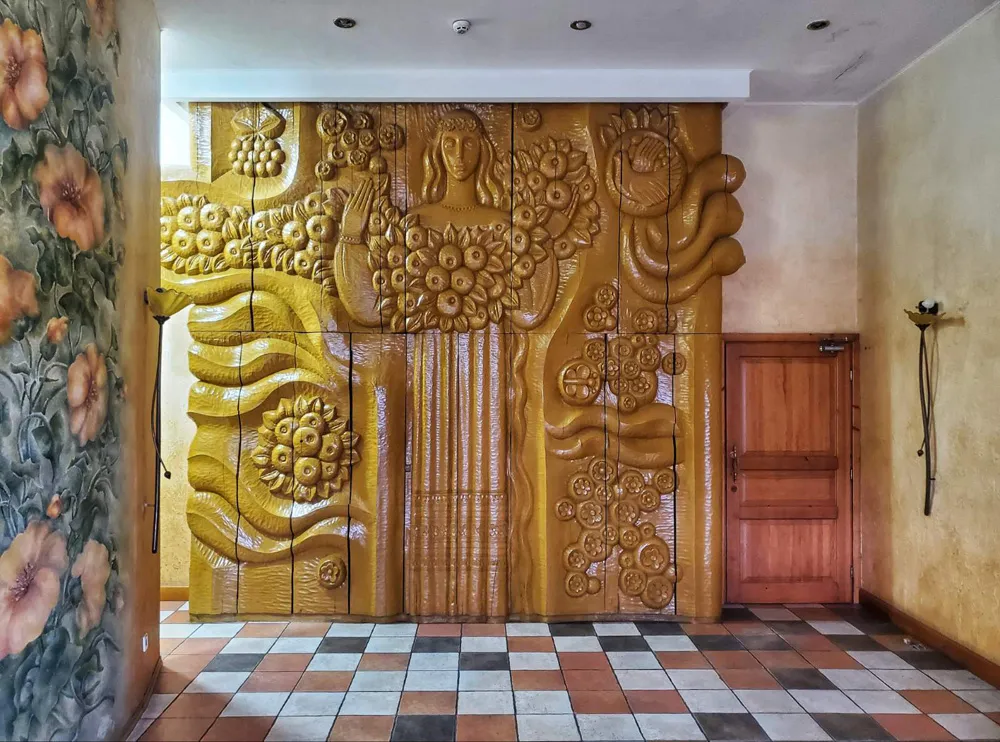
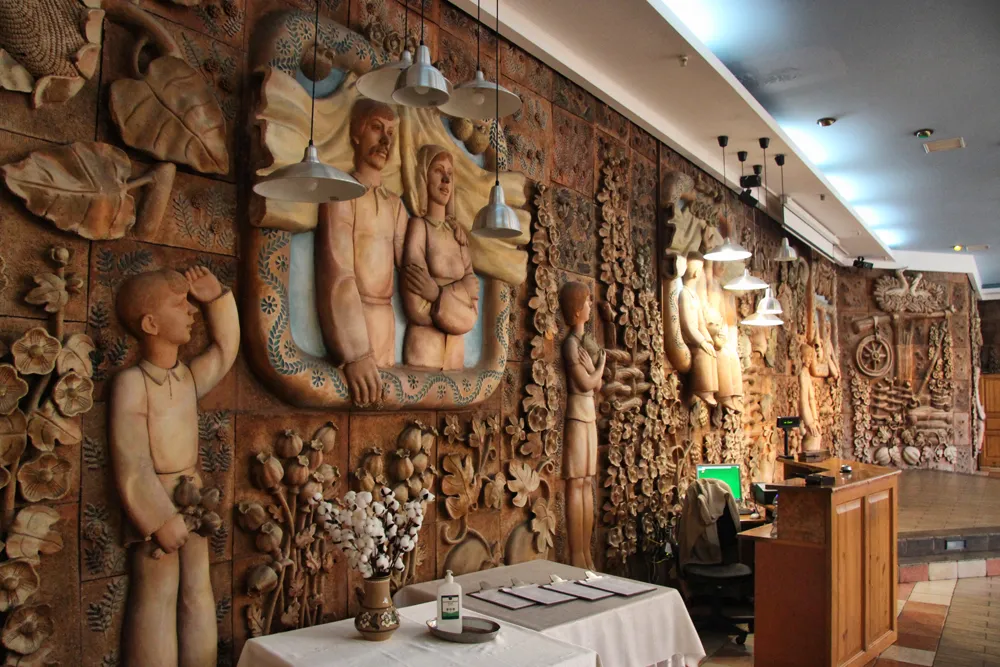
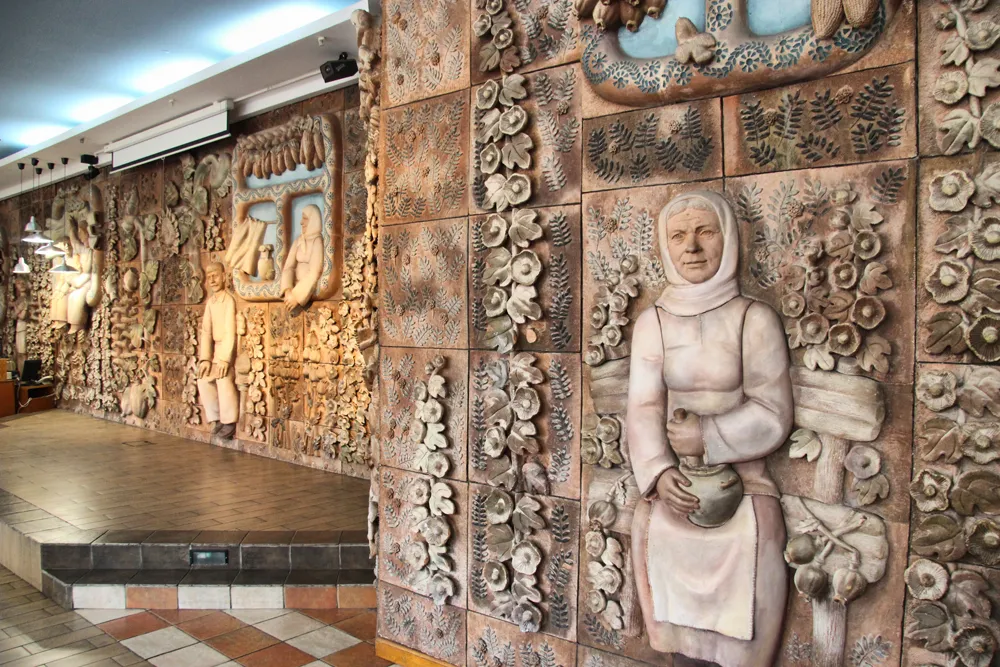
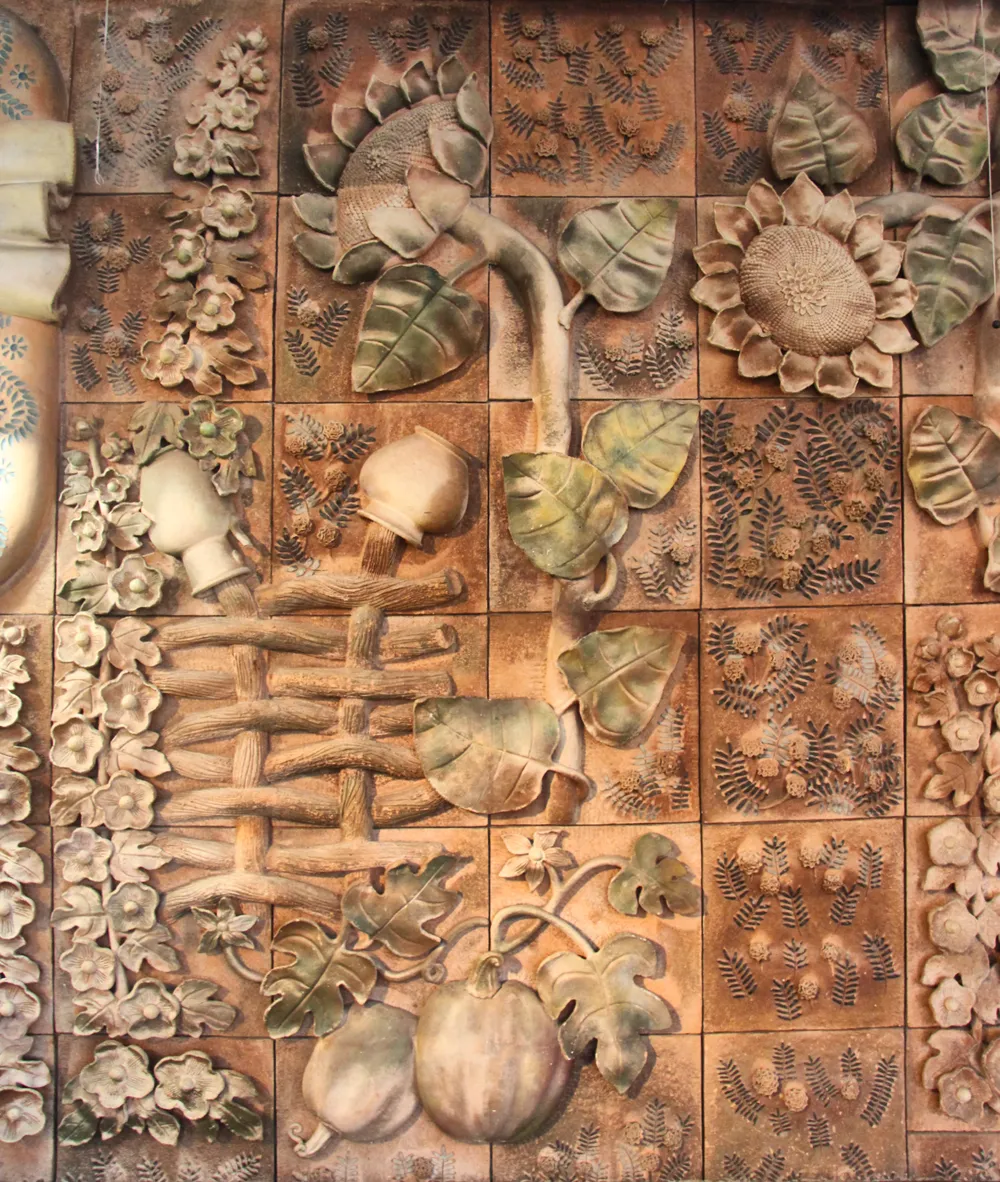
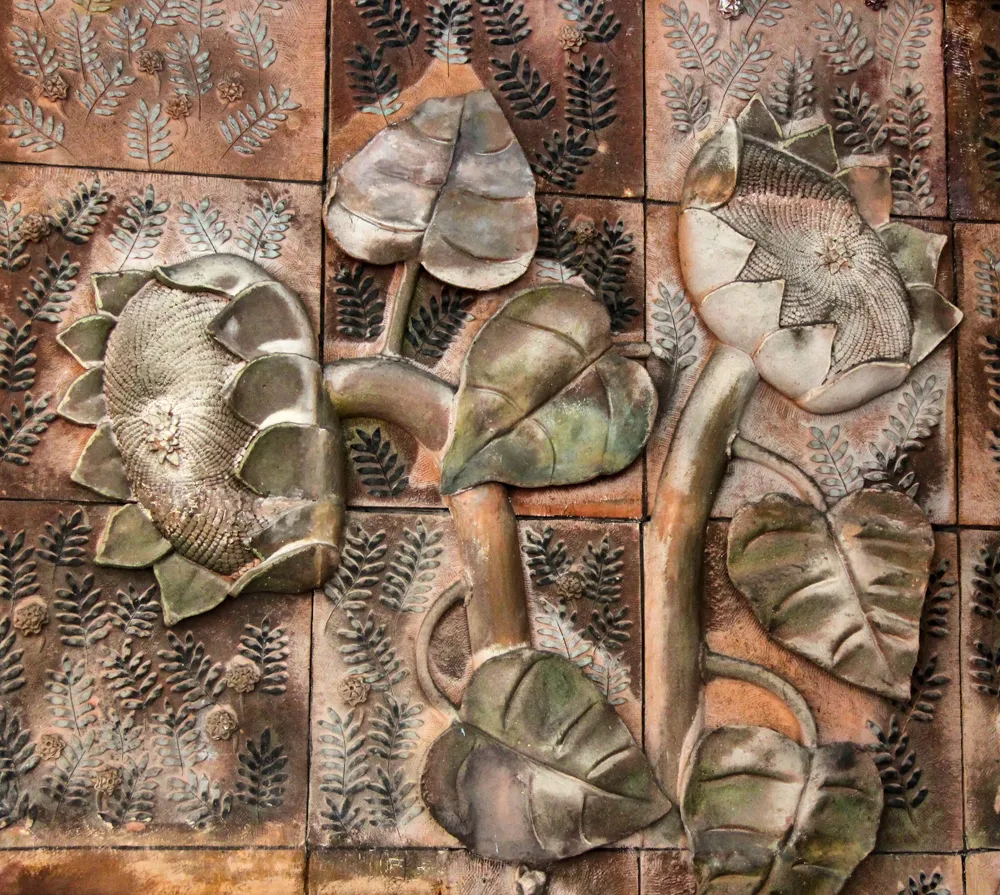
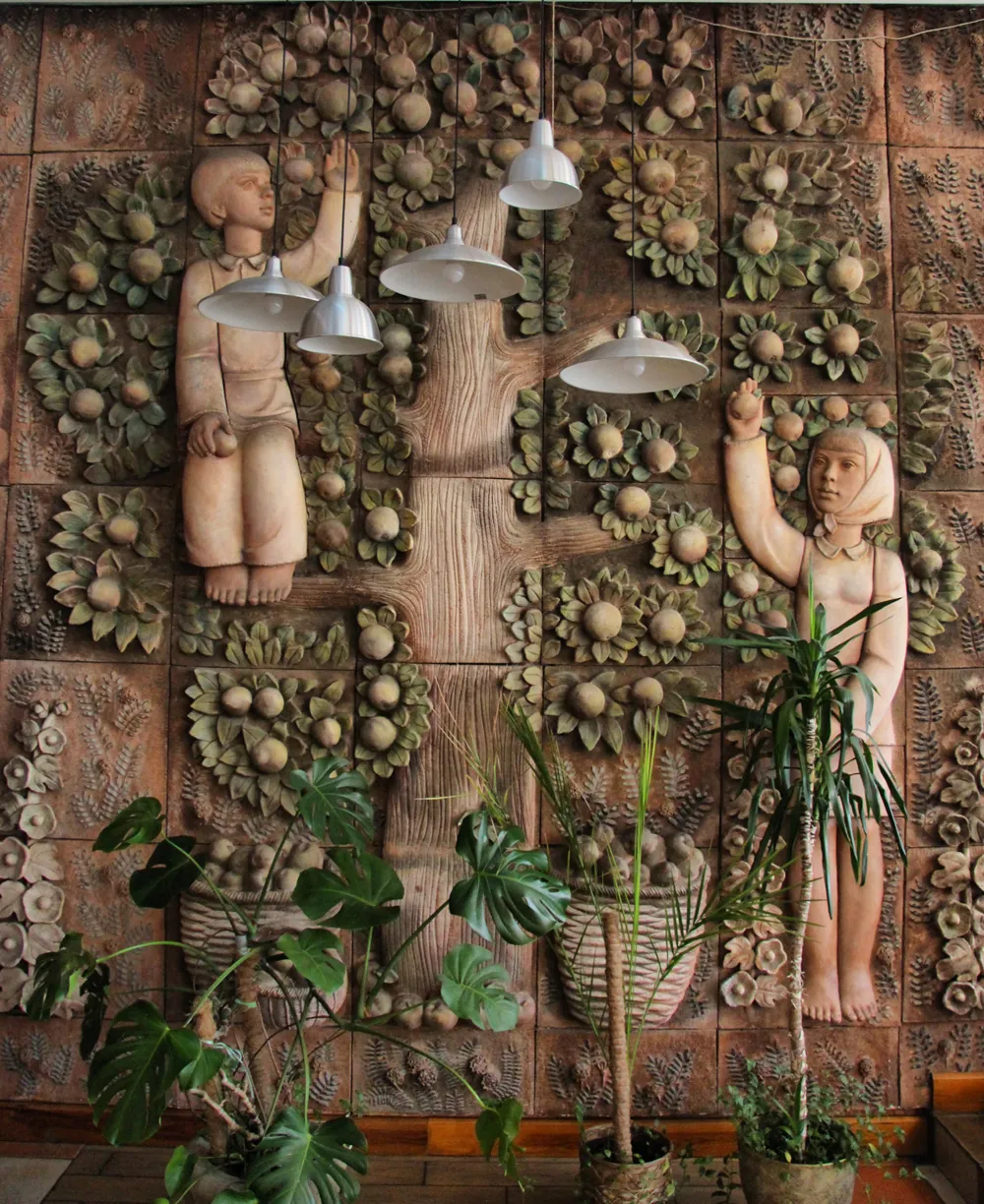
Mosaics and decoration of the restaurant “Budmo” (138 Zabolotnoho St.). The restaurant used to be called “Vinnychchanka”. It was built in 1982 for the 1,500th anniversary of Kyiv. The restaurant was decorated by masters from Vinnytsia Oblast.
In front of the restaurant entrance stand sculptures of flowers covered with mosaic décor. Mosaics adorn the façade wall. In the vestibule there is a panel on the wall, but special attention is deserved by the huge ceramic panel that decorates two walls of the restaurant hall. At present (2024) the restaurant operates by order only.
The panel “Wind” and the restaurant “Windmill”
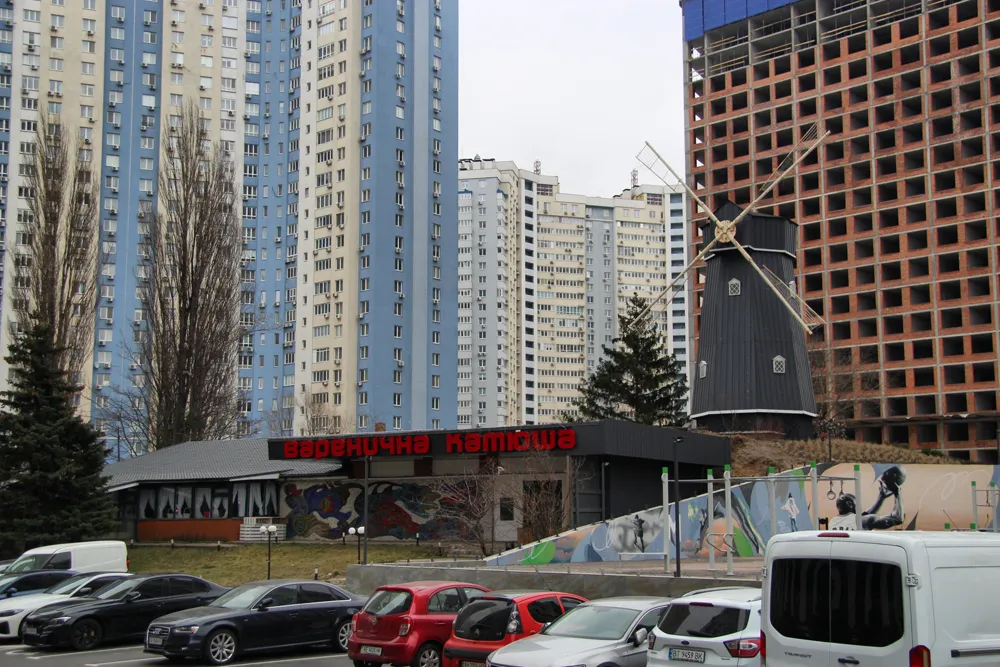
The restaurant “Windmill” with the mosaic panel “Wind” is now an item in the Register of Immovable Monuments. It is a monument of local significance. It is located in Kyiv at 11 Hlushkova Avenue. Not so long ago this restaurant, designed by the architect Anatolii Dobrovolskyi and built in the 1960s, was the architectural dominant of the area, next to Holosiivskyi Park. Today this Modernist interpretation of folk art is hidden among the huge, clumsy high-rises of a new residential complex. It is not even easy to approach the building, since the residential complex is fenced and there is a passage on only one side.
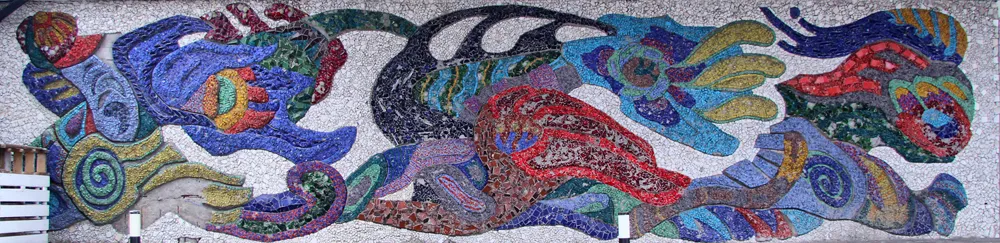
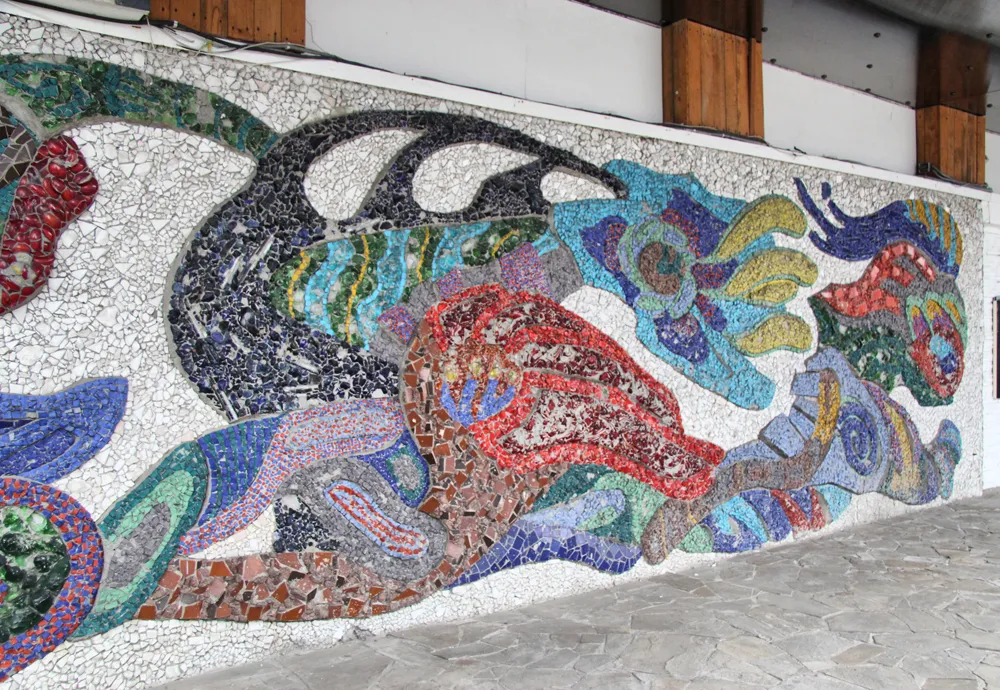
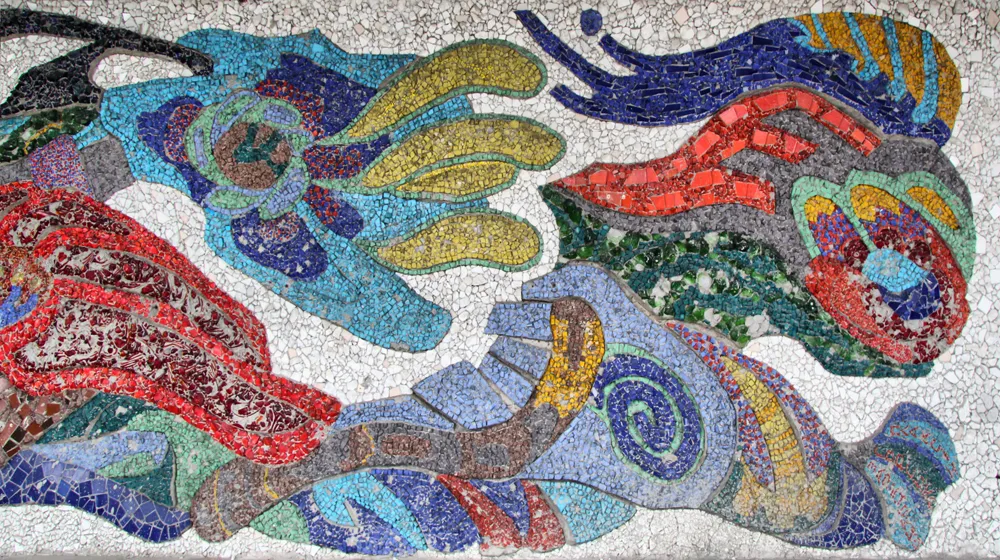
The restaurant “Windmill” is known not only for its colour but also for the mosaic panel “Wind”, created by the artists Alla Horska, Viktor Zaretskyi and Borys Plaksii. Incidentally, it is the only work of this group of outstanding artists that has survived in Kyiv.
The panel is considered a modern stylisation of folk art. It contains Ukrainian avant-garde, Boichukism and the naive colour palette of the artist Hanna Sobachko-Shostak. An incredible synthesis.
Since the 1990s the restaurant “Windmill” has changed owners many times. The panel was covered with wooden boarding, and later with signs and banners. The work was threatened with destruction, and this outraged the public, art historians most of all. At their request (made by the IZOLYATSIA foundation) the Ministry of Culture granted monument status to this outstanding site. This happened in December 2016. Later the panel was uncovered… Now there is a restaurant here called “Varenychna Katyusha” (an ugly name – they might as well have added “the apple and pear trees bloomed”), but it is not operating. Google says it is permanently closed. And you can read much more about the history and fate of the “Windmill” and the “Wind” on Wikipedia.
Mosaics of the Central Bus Station
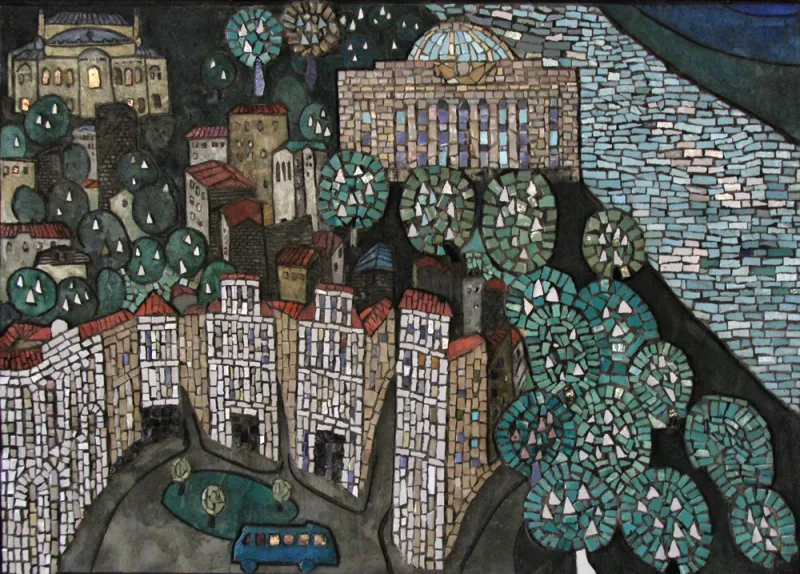
The bus station building was erected in 1957–1961 to a design by the architects Avraam Miletskyi and Eduard Bilskyi. The interior was entrusted to the artists Ada Rybachuk and Volodymyr Melnychenko. It was the first joint work of this well-known married couple. They worked on the mosaics and panels for two years, 1960–1961.
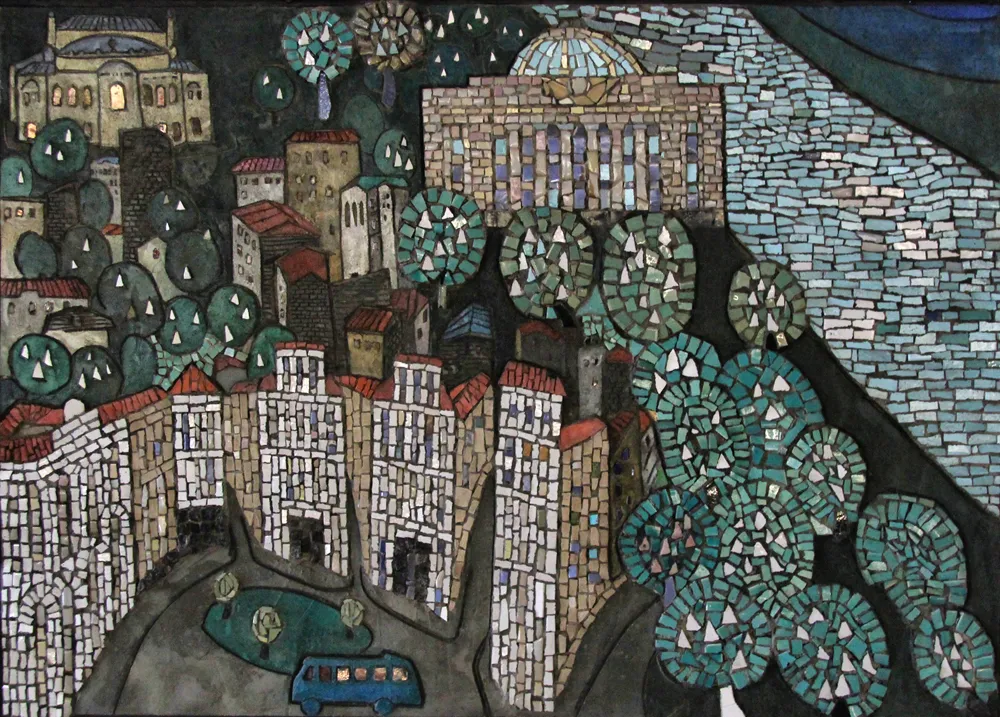
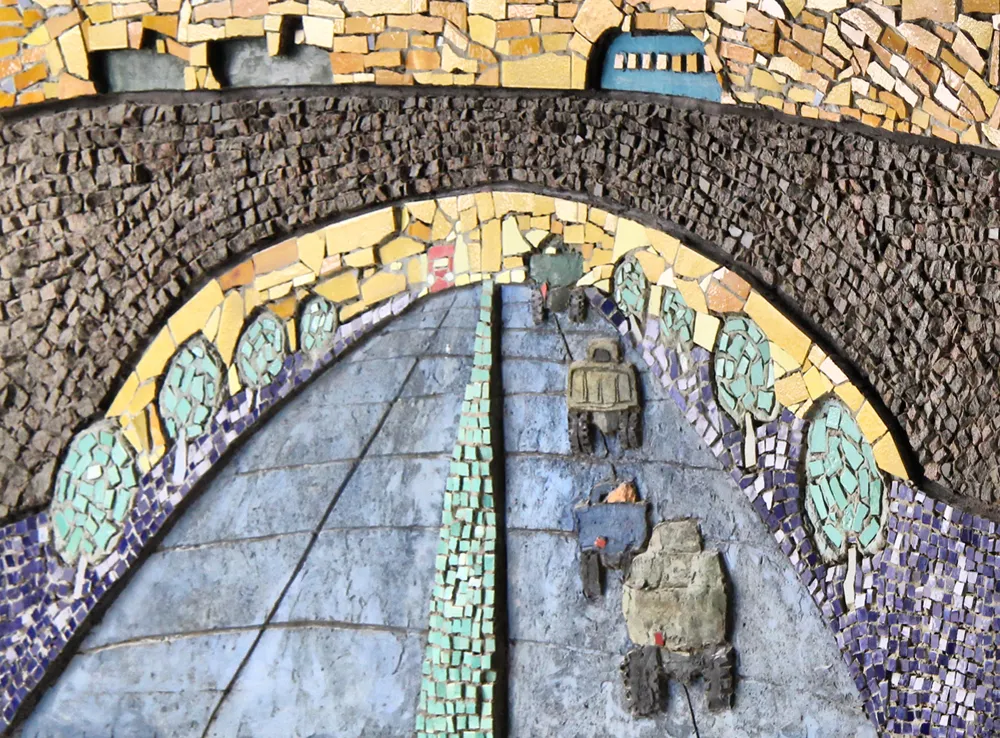
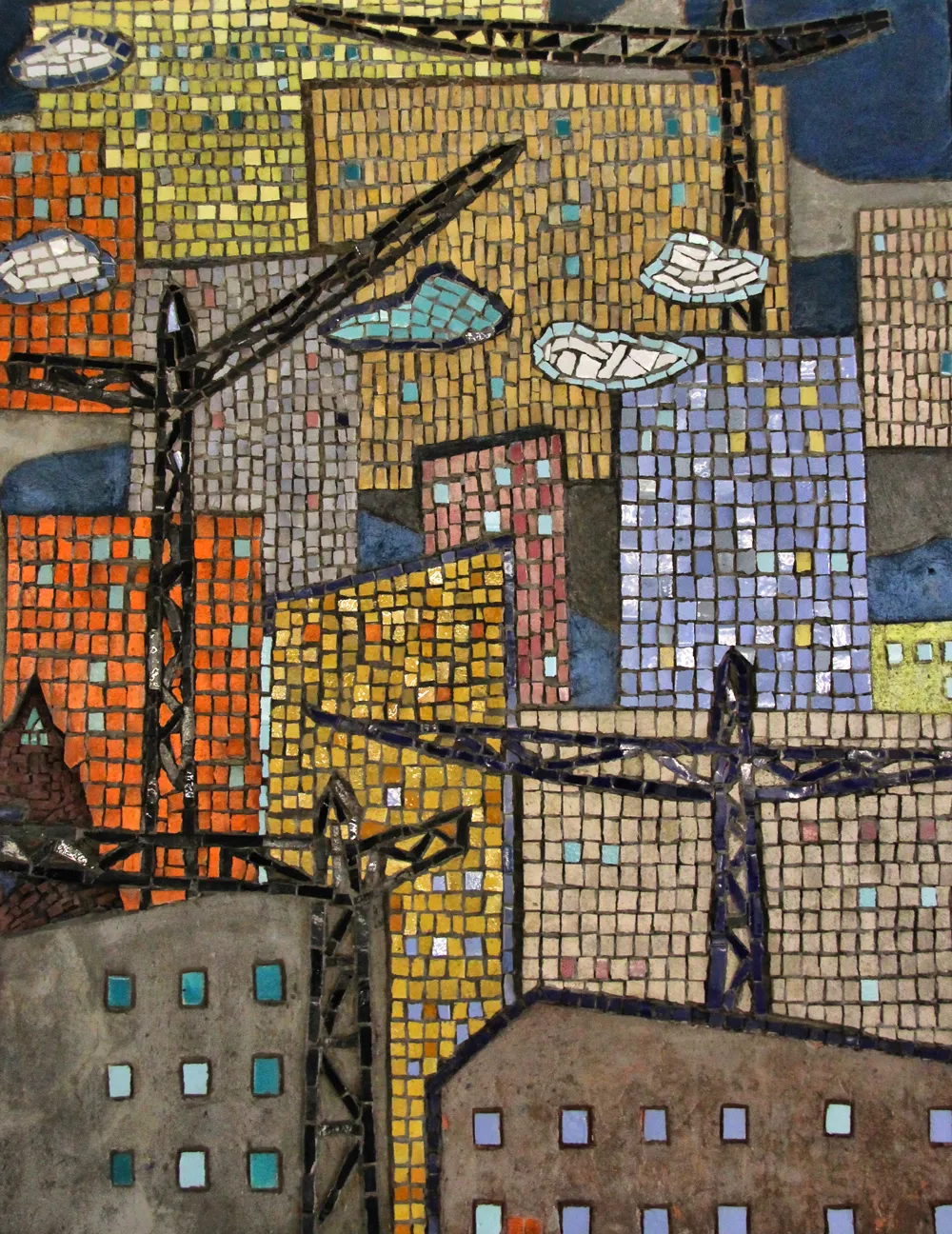
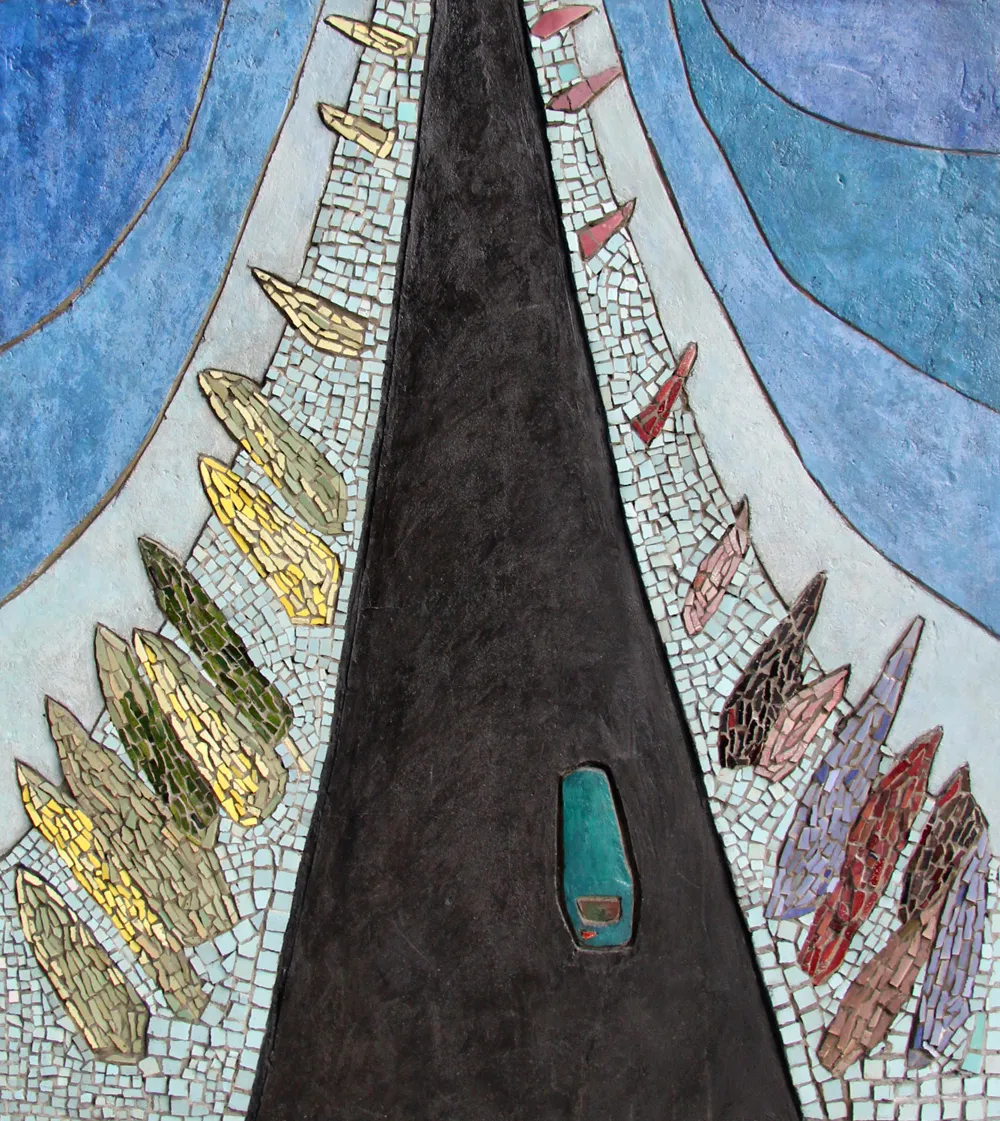
The sketches for the mosaics were created, in their words, in the cheerful aesthetic of a child’s drawing. One can recognise Kyiv landscapes, highways and bridges in them. The hero of the mosaics is a blue bus travelling around Kyiv and the USSR.
After the station’s reconstruction in 2015 the mosaics were preserved and even restored.
Read more text and see photos of the bus station’s mosaics and panels here.
Transfiguration Cathedral. Fairytale mosaics. Kyiv. Teremky
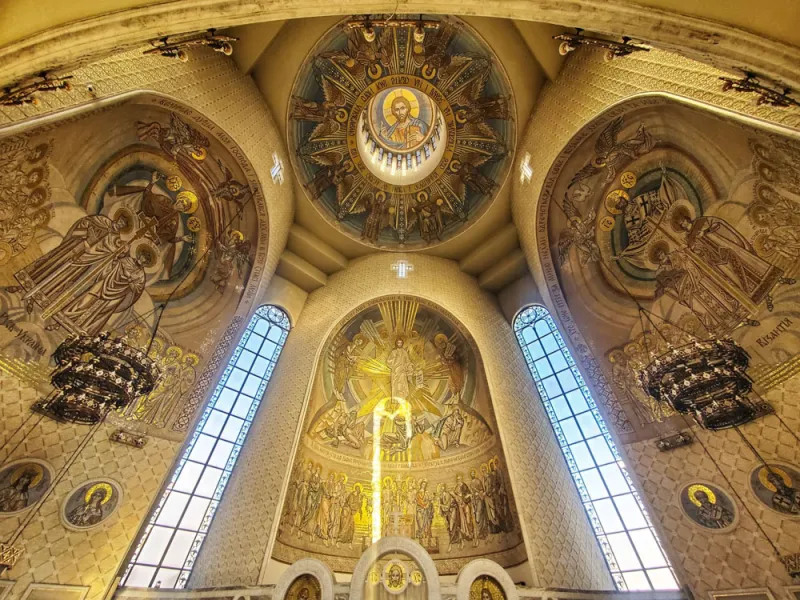
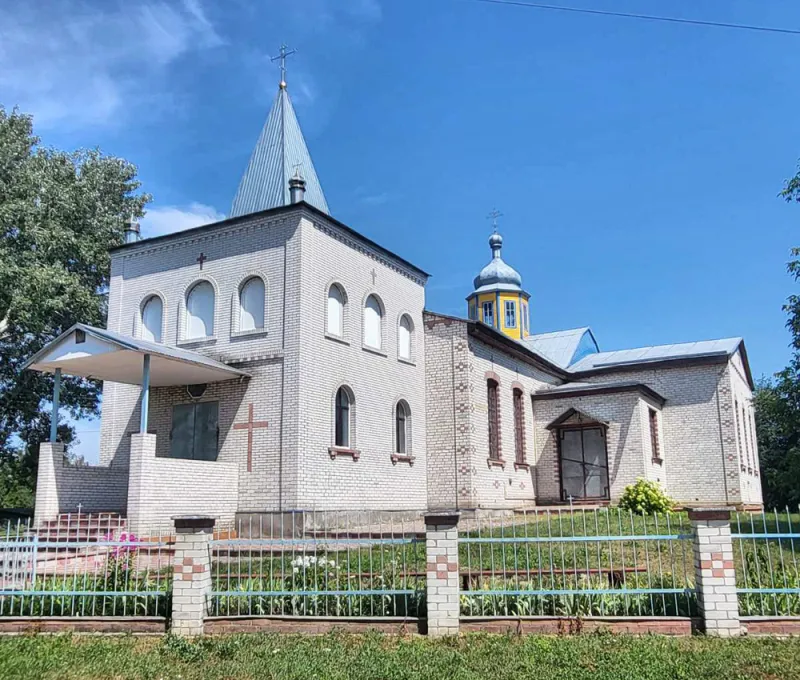
One of the best modern churches in Ukraine is the Transfiguration Cathedral in Teremky, Kyiv. It is a feast of mosaics – their area here is the largest in Kyiv and probably in the country. The mosaics were made by the artist Yurii Levchenko – they are incredible. The author of the cathedral’s design is Vadym Zhezherin, and the chair of the Parish Council is Ihor Lysov, who helped bring the building into being.
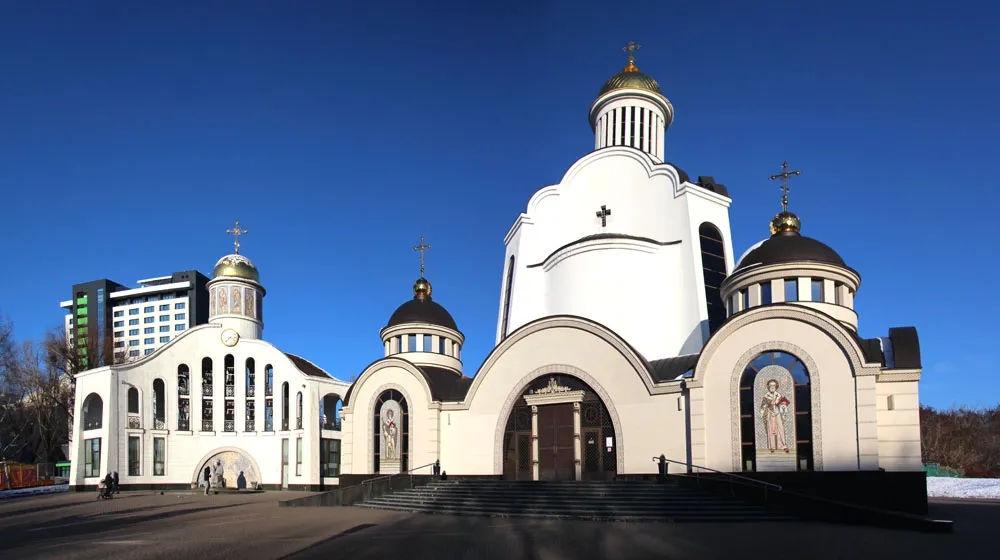
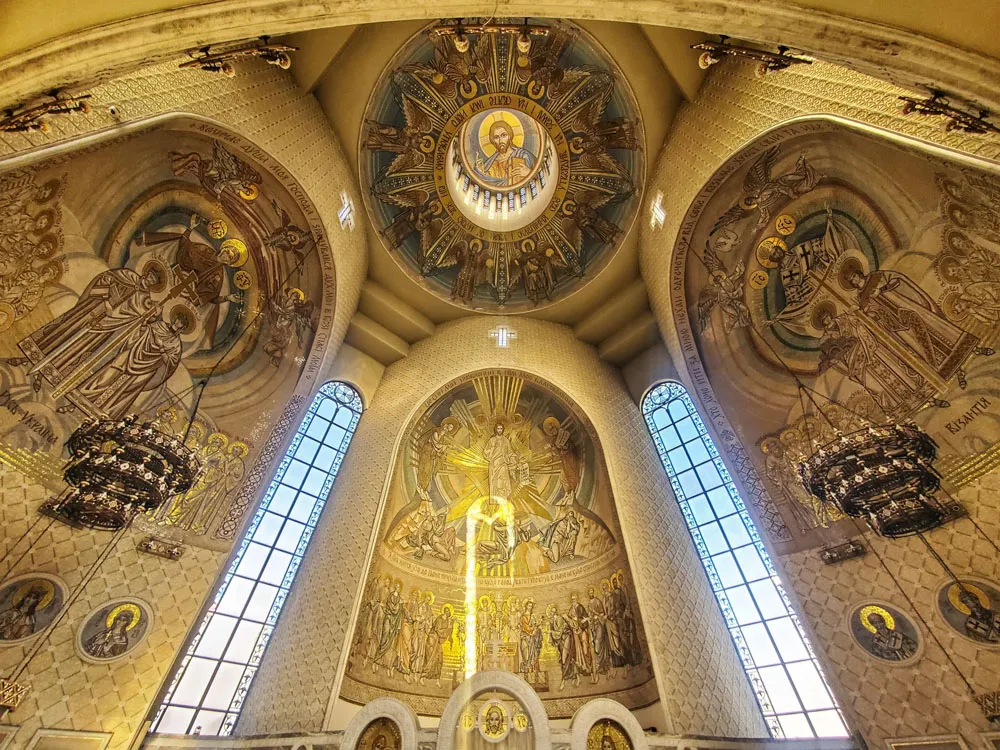
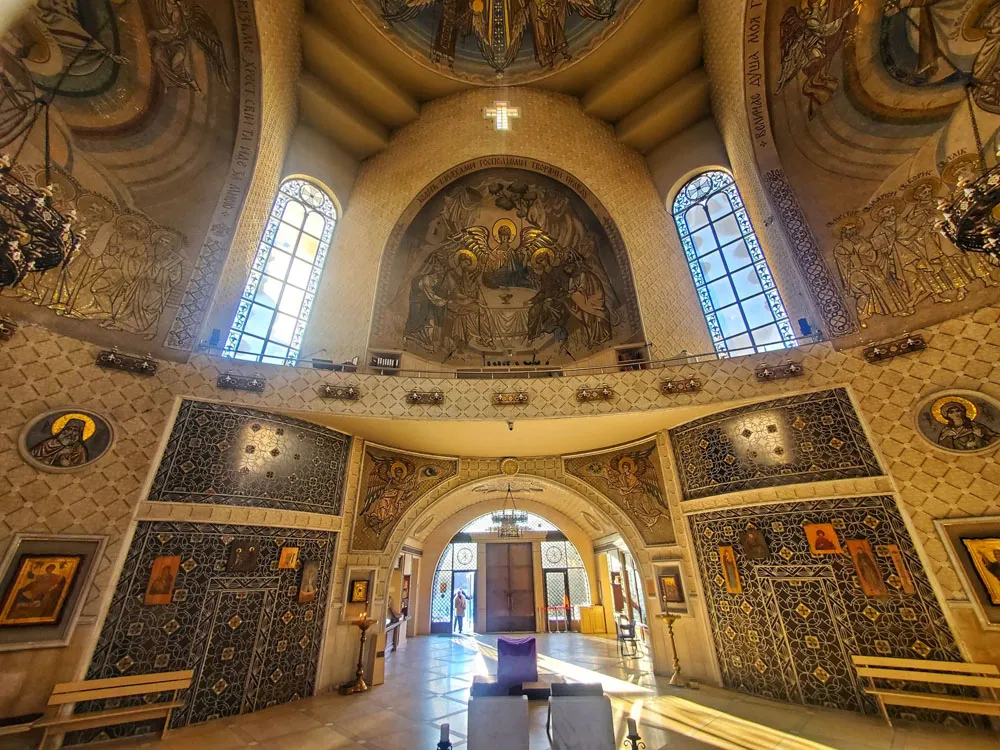
The church’s history is astonishing. It was built for the UAOC and consecrated in 2010 for the UOC-MP, the consecration being performed by Metropolitan Volodymyr (Sabodan) himself – his museum is now in the cathedral’s bell tower. In 2018 it passed to the OCU, probably on the initiative of Archbishop Oleksandr (Drabynko), who is now a metropolitan of the OCU and officially heads the Transfiguration Cathedral.
The design of the church, which is 41.5 m high, employs modernised motifs of Old Rus architecture. The interior walls are decorated with monumental mosaic compositions; there are no murals here at all. All the biblical texts in the interior décor are written in Ukrainian. A fantastic church.
Others
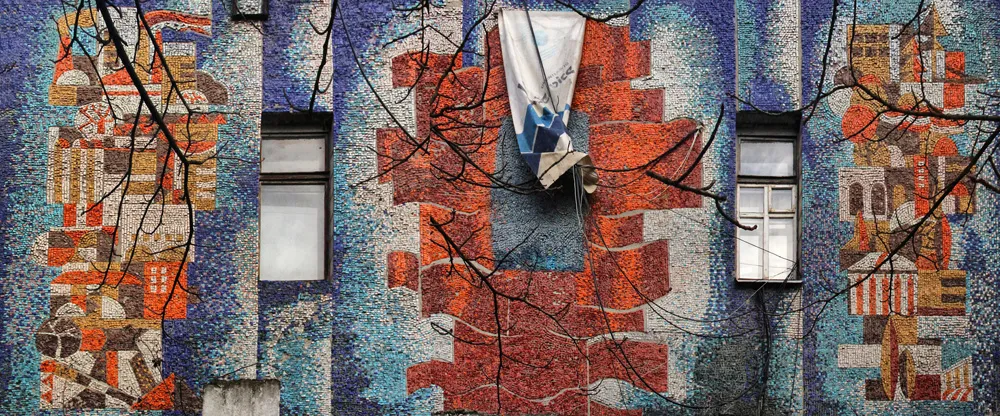
On Nauky Avenue (No. 57) there is a strange mosaic, a strange synthesis of different colours and shapeless objects. It turns out that it used to be the mosaic “Ilich”, but in the course of decommunisation the image of Lenin in the centre of the mosaic was removed. The authors of this mosaic are unknown to us.
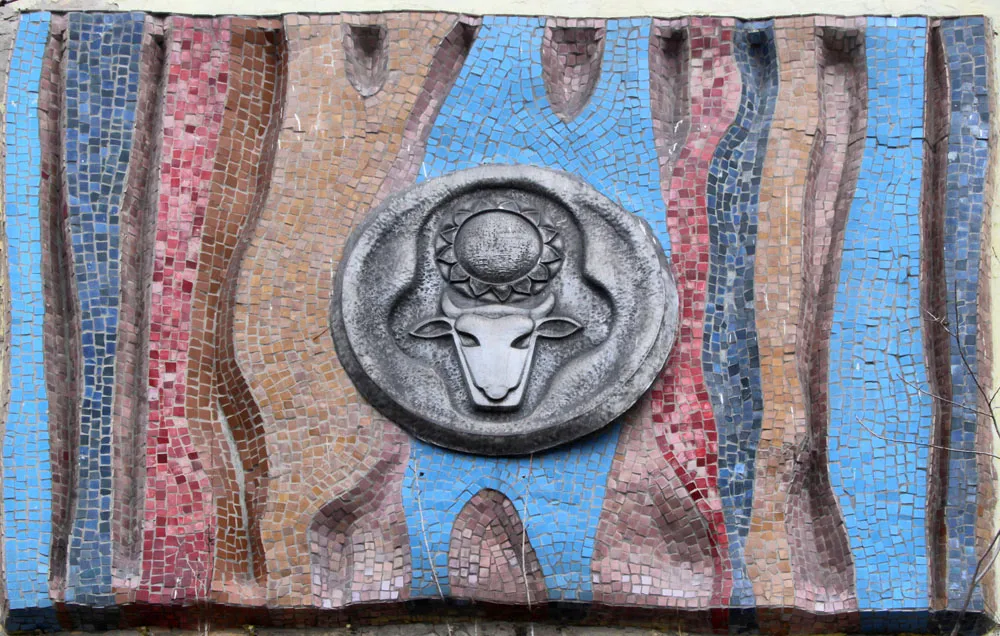
Mosaic on the wall of the margarine factory. 3 Nauky Avenue.
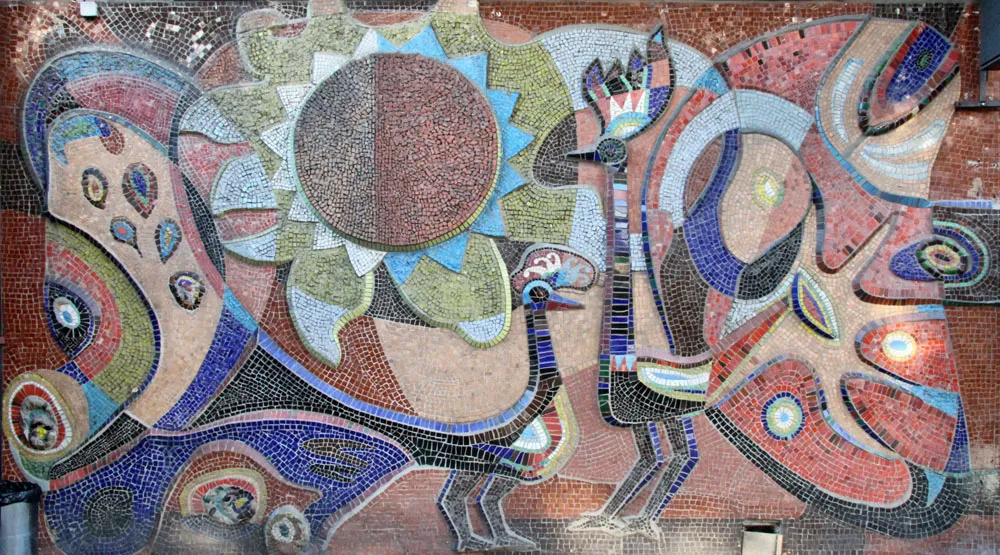
The mosaic “Fairy Tale” on the wall of a residential building in Kyiv. 112 Velyka Vasylkivska Street.
The mosaic was created in the 1970s. Author: Iryna Perova.
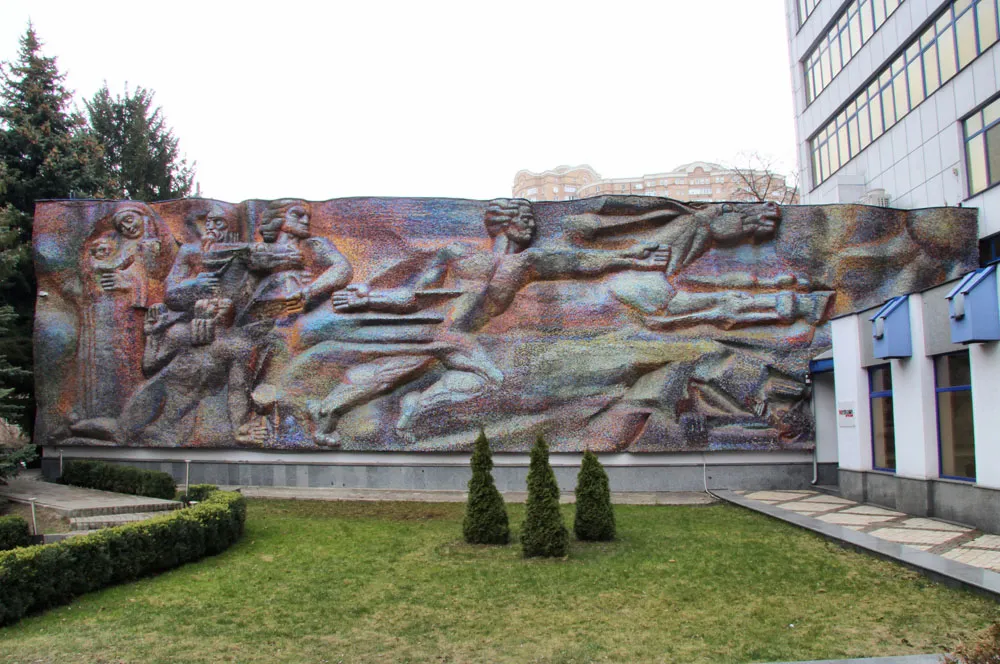
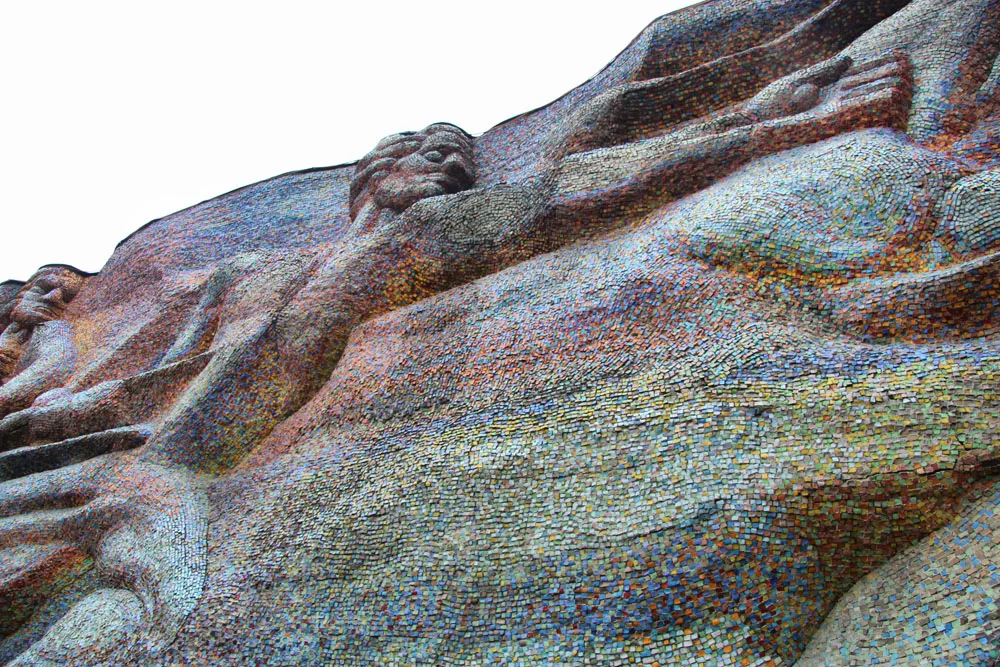
The mosaic panel “Perpetual Motion” decorates the Kyiv Jewellery Factory, or more precisely the “Morion” business centre at this factory. Authors: Mykola Kutniakhov, Serhii Zhydel, Arsen Rustamov, Yurii Levchenko. 1978–1980.
Text and photos by Roman Malenkov