Pergamon (Pergamum)
· 10 min read
Located on the top of a hill, it attracts from afar – all the way from Berlin! But what does Germany have to do with Asia Minor? you will ask. Patience.
Ancient Pergamon was founded in the 12th century BC by the Greeks. According to legend, at the end of the Trojan War Hector’s wife Andromache, together with Hector’s brother and part-time second Trojan prophet Helenus, fell to Achilles’ son Neoptolemus. Since the son of Achilles himself married the daughter of Helen of Troy, it is clear that a long peaceful life was not destined for him. So after his death the free Andromache and Helenus married. Andromache and her son Pergamus, after his father’s death, moved to Asia Minor. There they founded a city named after him – Pergamon – and built a mausoleum for Andromache.
All that is left of Pergamon is about 100 km north of Izmir in Turkish Bergama (Google keeps wanting to replace it with the Italian Bergamo). Dry-minded scholars derive its name from the Luwian language: “high place”, “tower”, “fortress”. Perge, located near Antalya, has the same origin. But here we return to Troy again. There is a widespread opinion that it was Luwian that was spoken by the inhabitants of high, broad-streeted, well-horsed, high-gated Troy (which lies some 200 km from Pergamon).
Pergamon is apparently first mentioned in chapter 8 of book 7 of Xenophon’s “Anabasis”, who was here “received in a friendly way by the lady Hellas”. What happened next is not so important until the small but ambitious Pergamene kingdom, sometime in the third century BC, began to lay claim to a piece of the huge but short-lived empire of Alexander the Great. Like the Arab states of the Persian Gulf today, the Pergamene kings also used art to build up their international prestige. Pergamon became an architectural wonder of its time – one of the greatest cultural centres of the Hellenistic world.
The library of Pergamon was second only to that of Alexandria. It numbered 200,000 scrolls. In Pergamon parchment began to be used for the first time instead of papyrus – the dressed skin of calves and of young sheep and goats. In making parchment the skins were not tanned but stretched, thoroughly cleaned, scraped and dried, yielding sheets of thin, strong skin of a white or yellowish colour. Although it was expensive, the step was forced. According to the historian Pliny, the Egyptian rulers, wishing to maintain the prestige of the Library of Alexandria, banned in the 2nd century BC the export of papyrus beyond Egypt. So the Pergamon library had to develop an alternative way of producing writing material.
Thus parchment became an alternative to papyrus not only in Pergamon but throughout the Mediterranean. Later it became the main material for books in the Middle Ages. The invention of parchment is usually associated with the name of the king of Pergamon Eumenes II (197–159 BC). I can just see the king taking off his chiton and starting to scrape the hide free of wool and fat.
And now, at last, about Berlin, where the Pergamon Museum is located. It was built to house a full-size Pergamon Altar, dedicated to Zeus in honour of the Pergamenes’ victory over the Galatians, that is, the Celts. It reproduces scenes from the myth of the Gigantomachy – the struggle of the Olympian gods against the Galatian giants. Sadly, in the Pergamon Museum in Berlin the hall containing the Pergamon Altar has long been closed for reconstruction and will remain closed until at least 2024. Incidentally, the Market Gate of Miletus is in the same museum.
How did what was practically a building end up in Germany? As the “German legend” tells it, at the end of the 19th century the engineer Carl Humann came to work on the construction of a railway from Turkish Pergamon to the coast. There he undertook to “rescue” the walls and sculptures of the altar, which local Turks were sending to the kiln to make lime. For 8 years an expedition under his direction dug up the remains of the once mighty kingdom, so that the newborn German nation could proudly say Scheiße while looking at the London museums and the Louvre. And Berlin received the title “Athens on the Spree” – Spree-Athen.
Incidentally, the sculpture Galata morente, “The Dying Gaul”, in the Capitoline Museums in Rome is a Roman copy of a Pergamene bronze original. King Attalus I of Pergamon commissioned it in memory of his victory over the Celts, known in Asia Minor as the Galatians. The Greek original was set up in the sanctuary of Athena, and the Roman copy became a model for sculptors all over Europe, who copied it in thousands of replicas. Strangely, in my head this Gaul lay in the same pigeonhole as Julius Caesar and his Gallia est omnis divisa in partes tres…
For 150 years Pergamon flourished, until its last king, Attalus III, bequeathed his kingdom to Rome. Thus one story ended and the era of the Roman province of Asia began.
By the way, the popular and for many dear city of Antalya was founded by the Pergamene king Attalus II and was originally called Attalia.
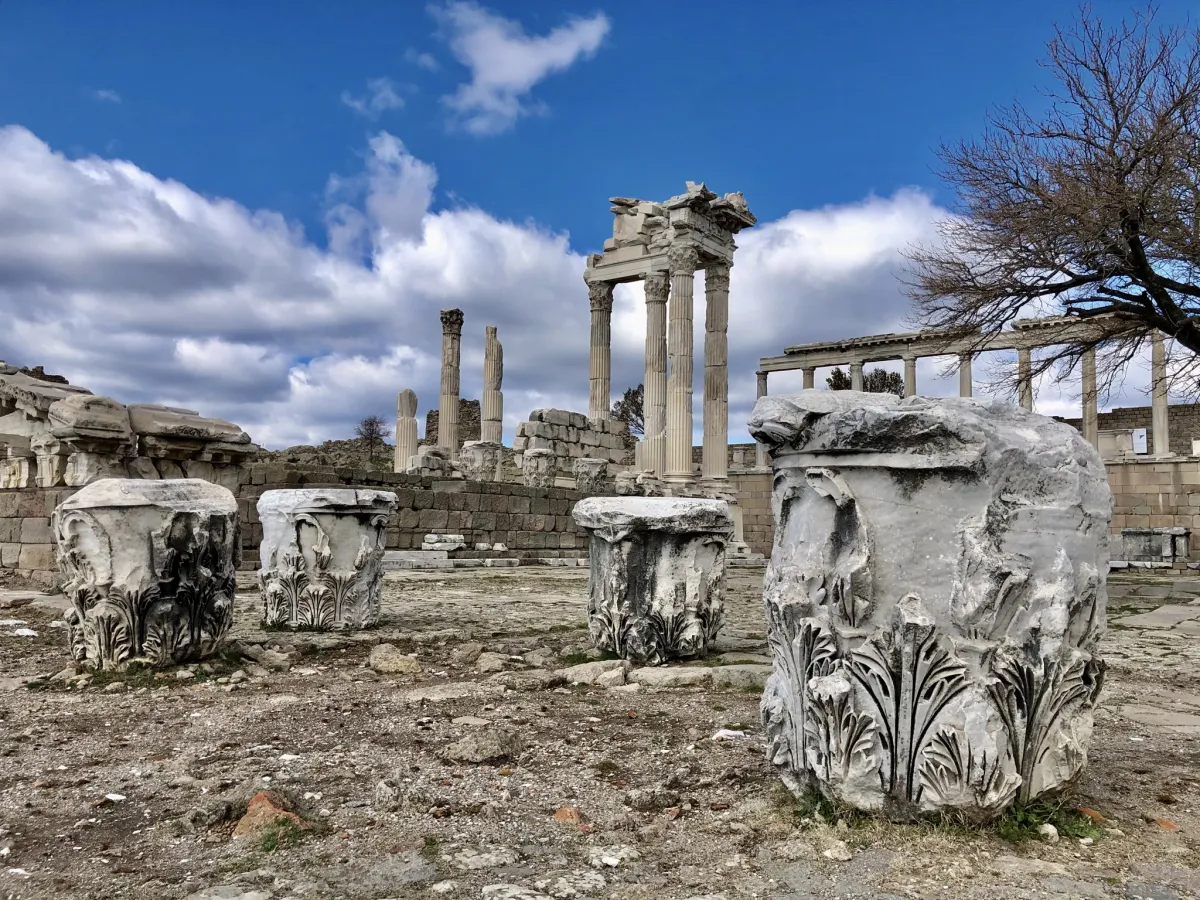
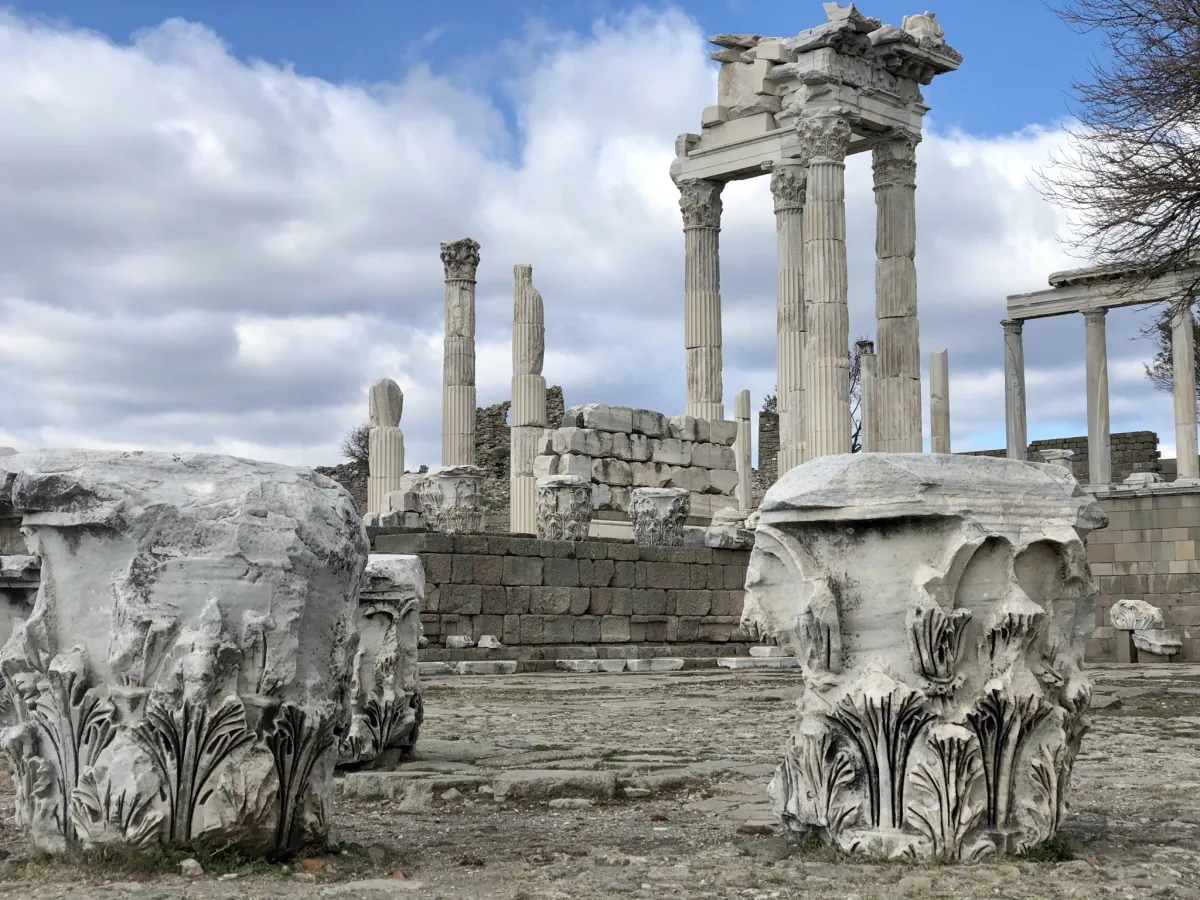
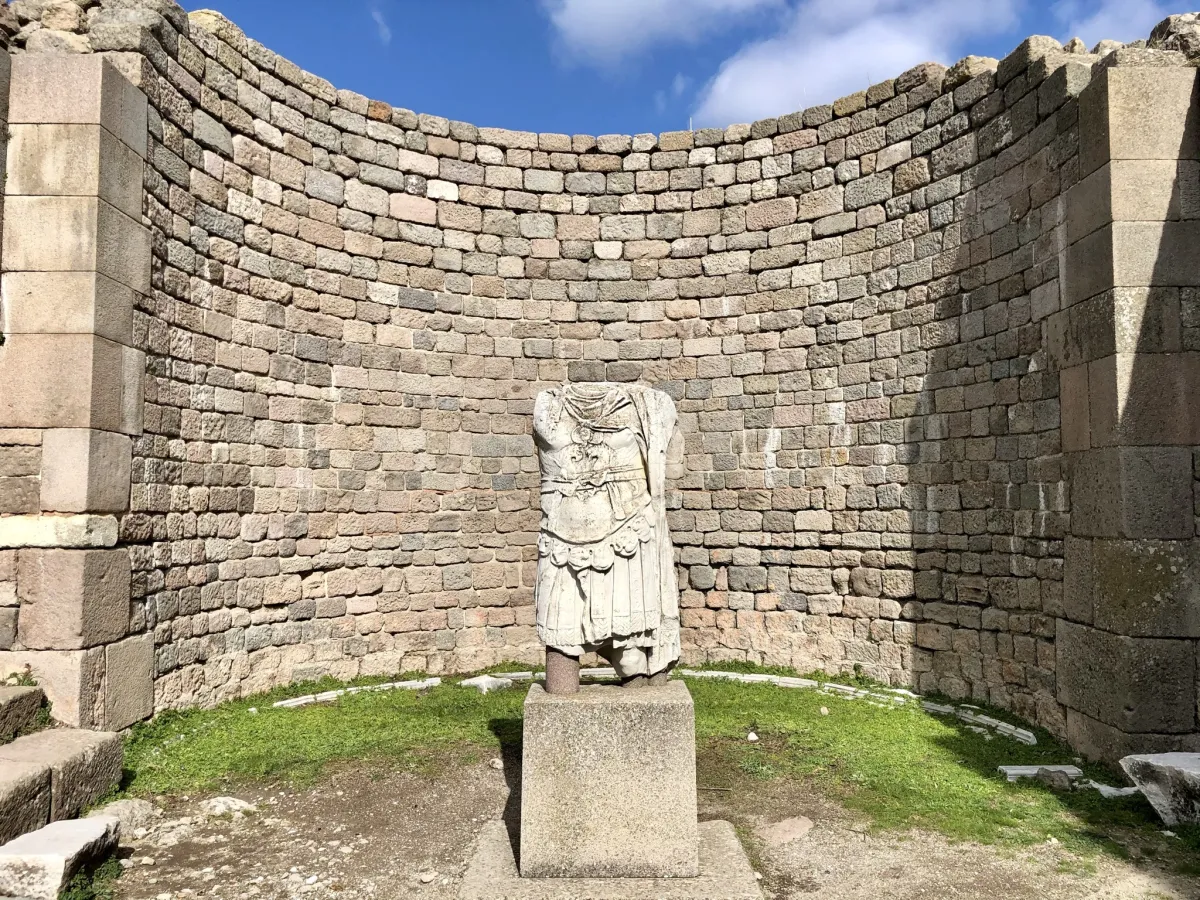
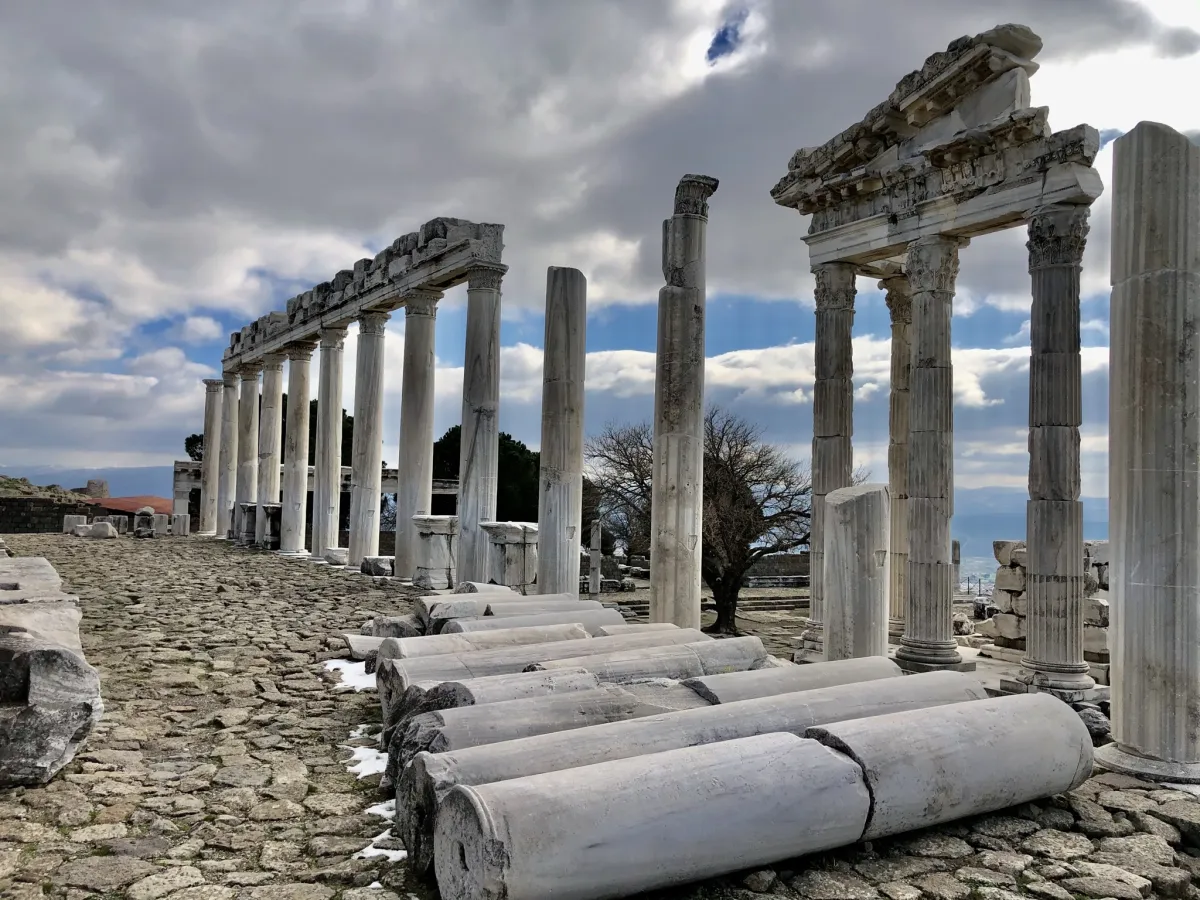
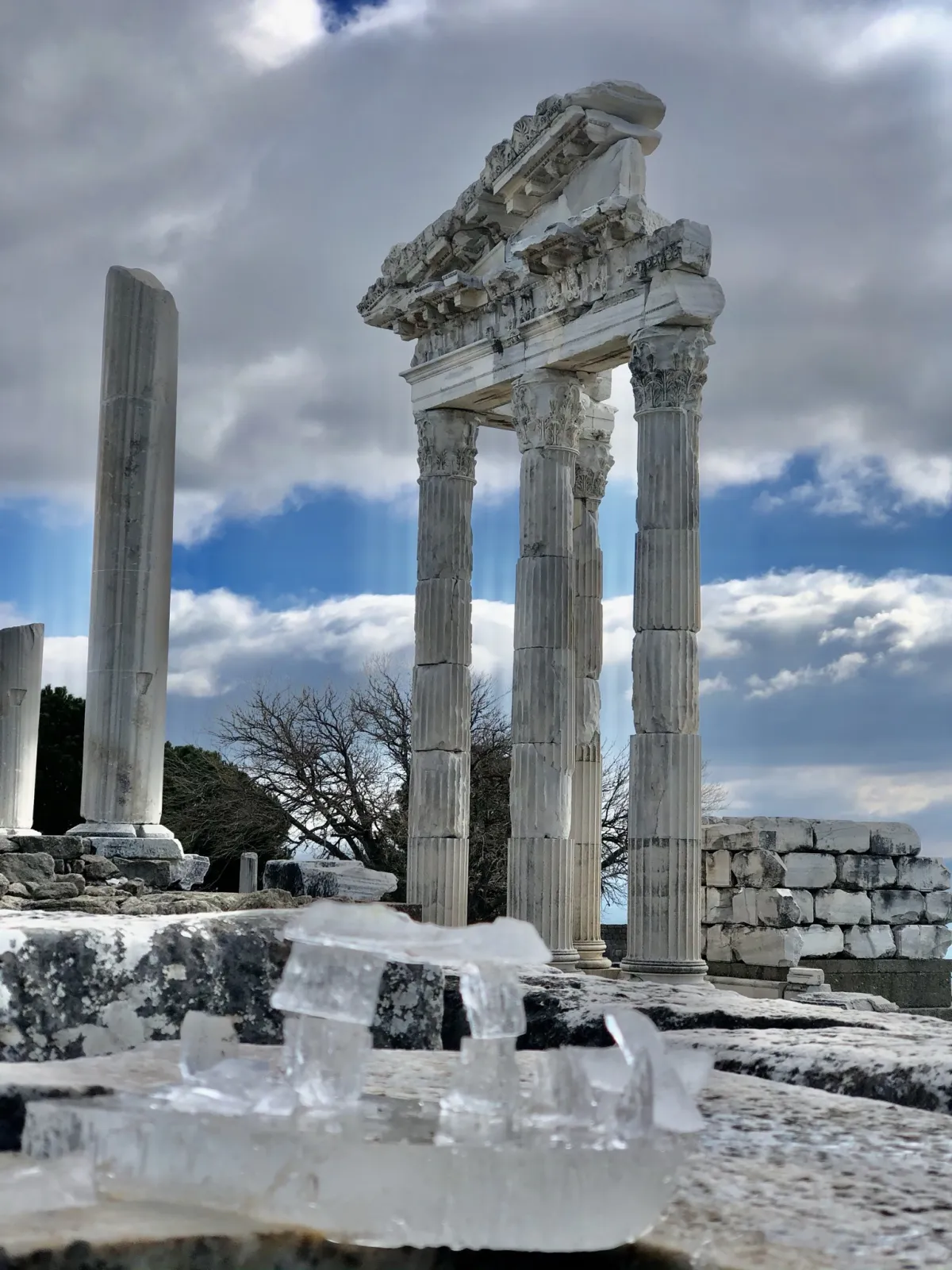
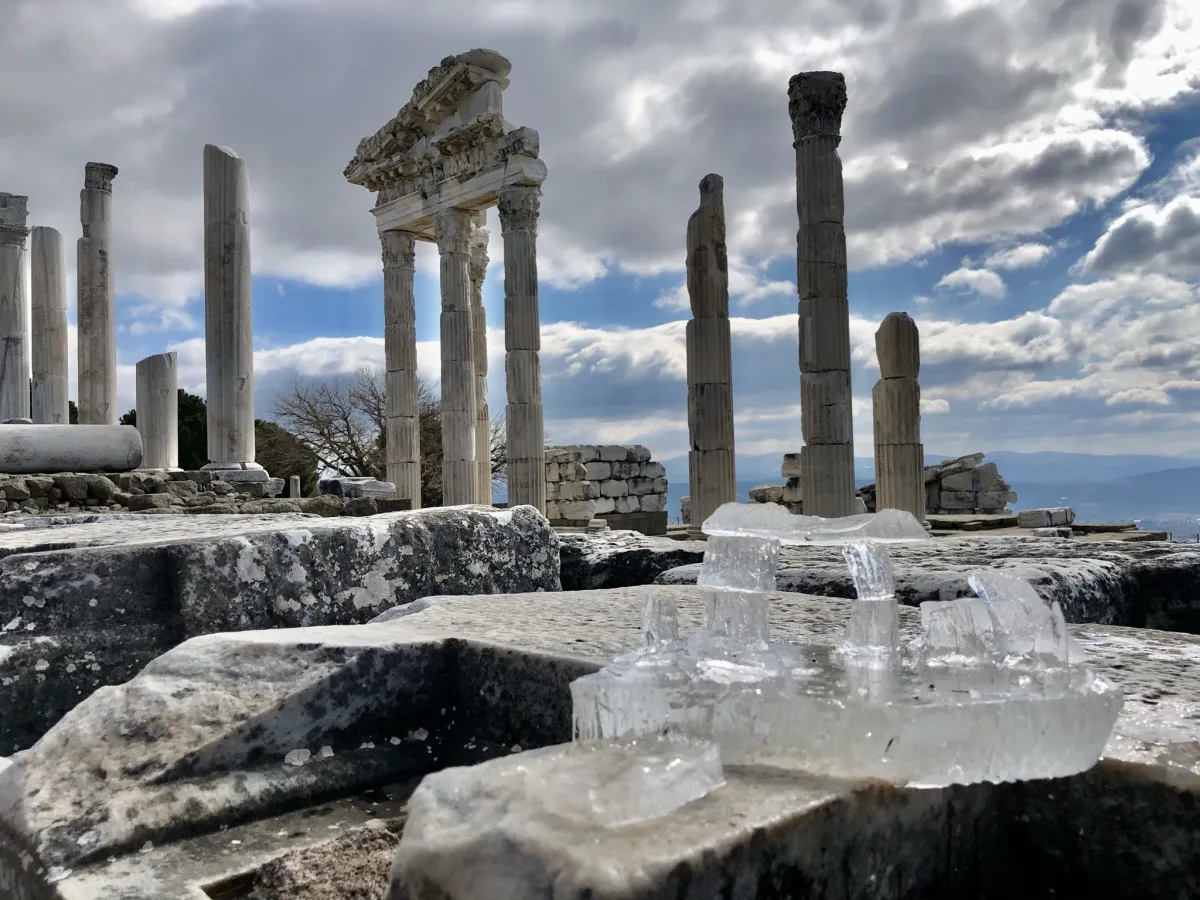
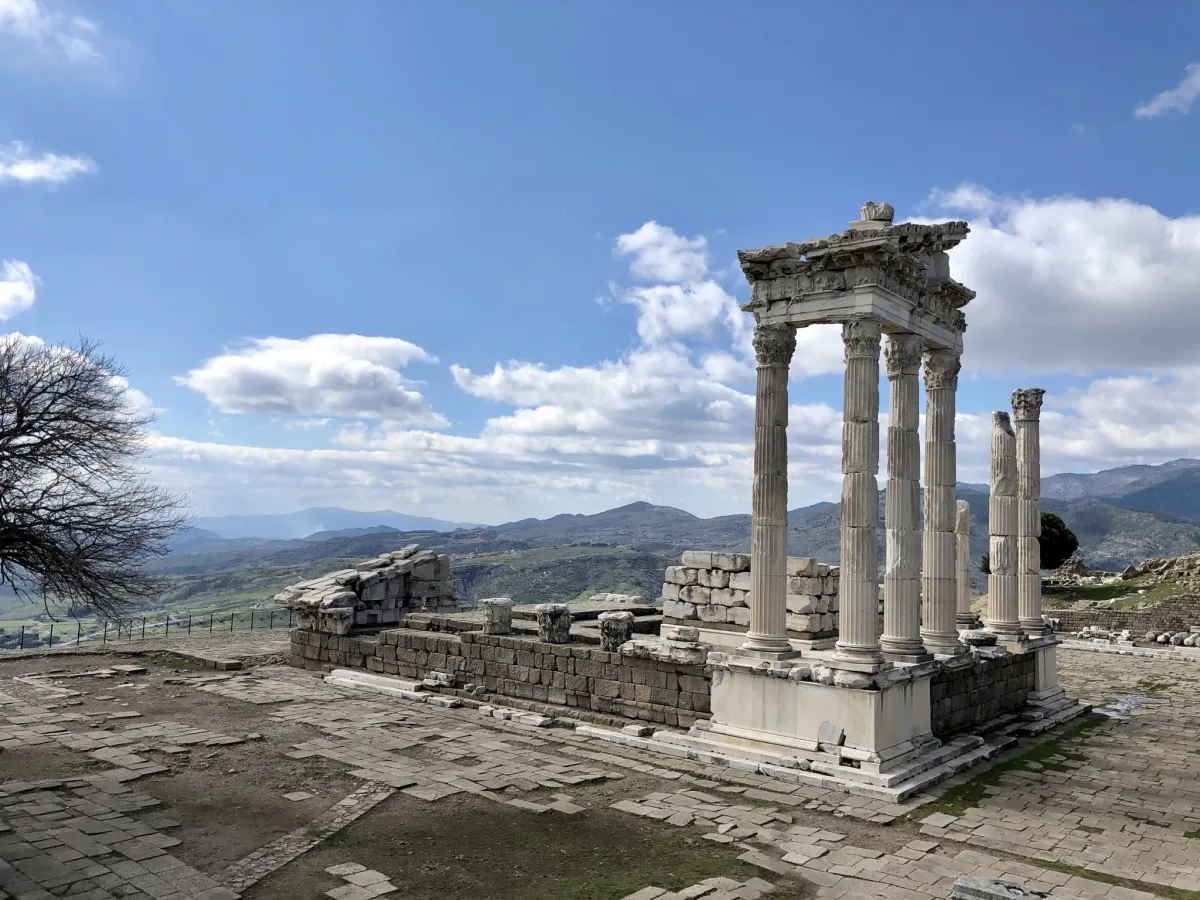
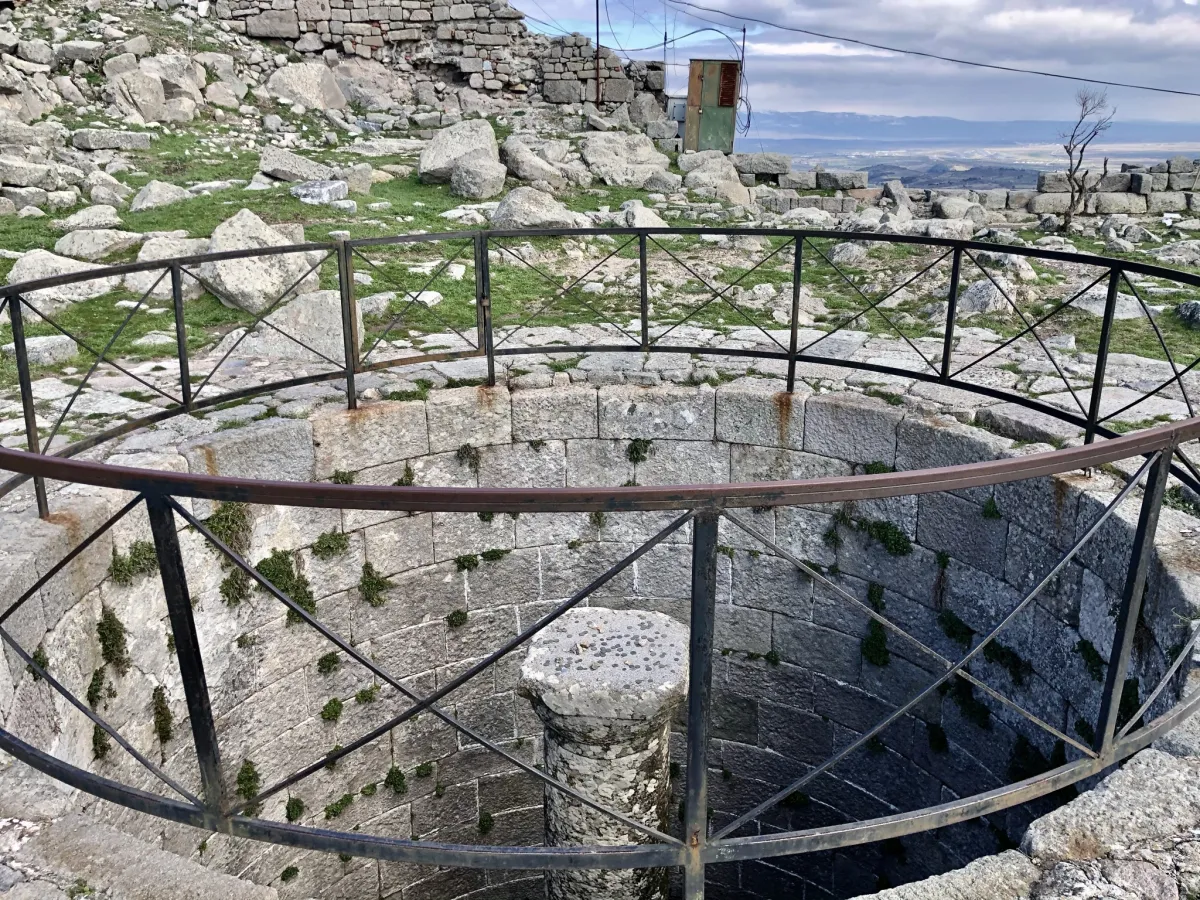
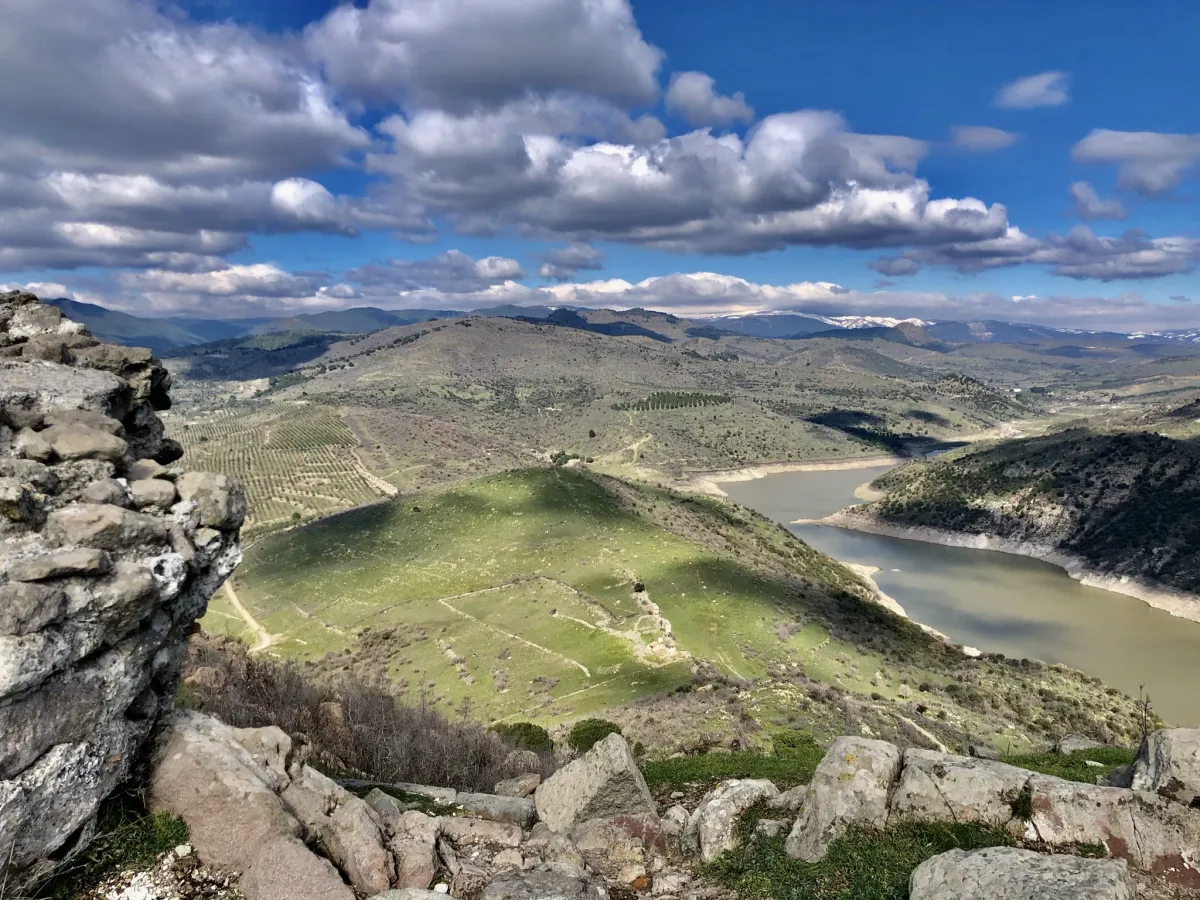
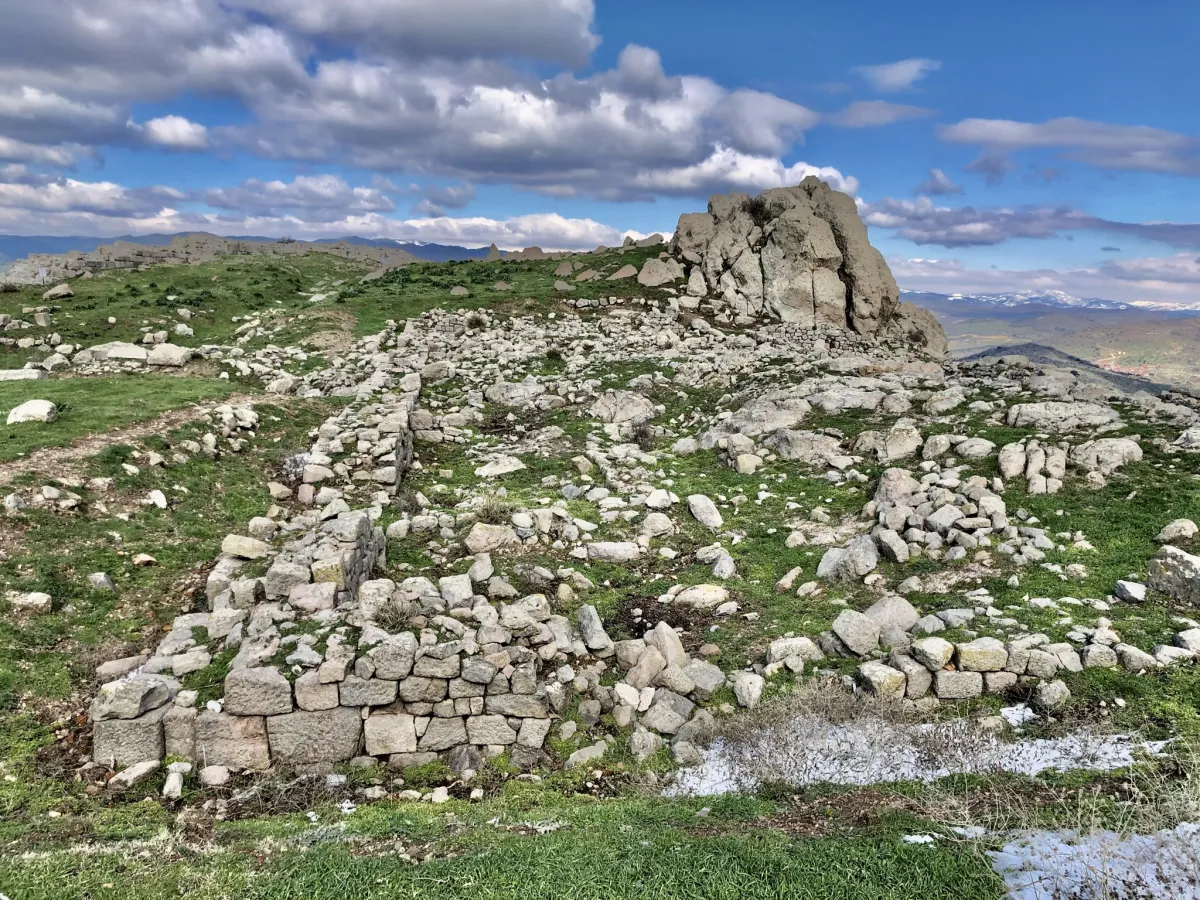
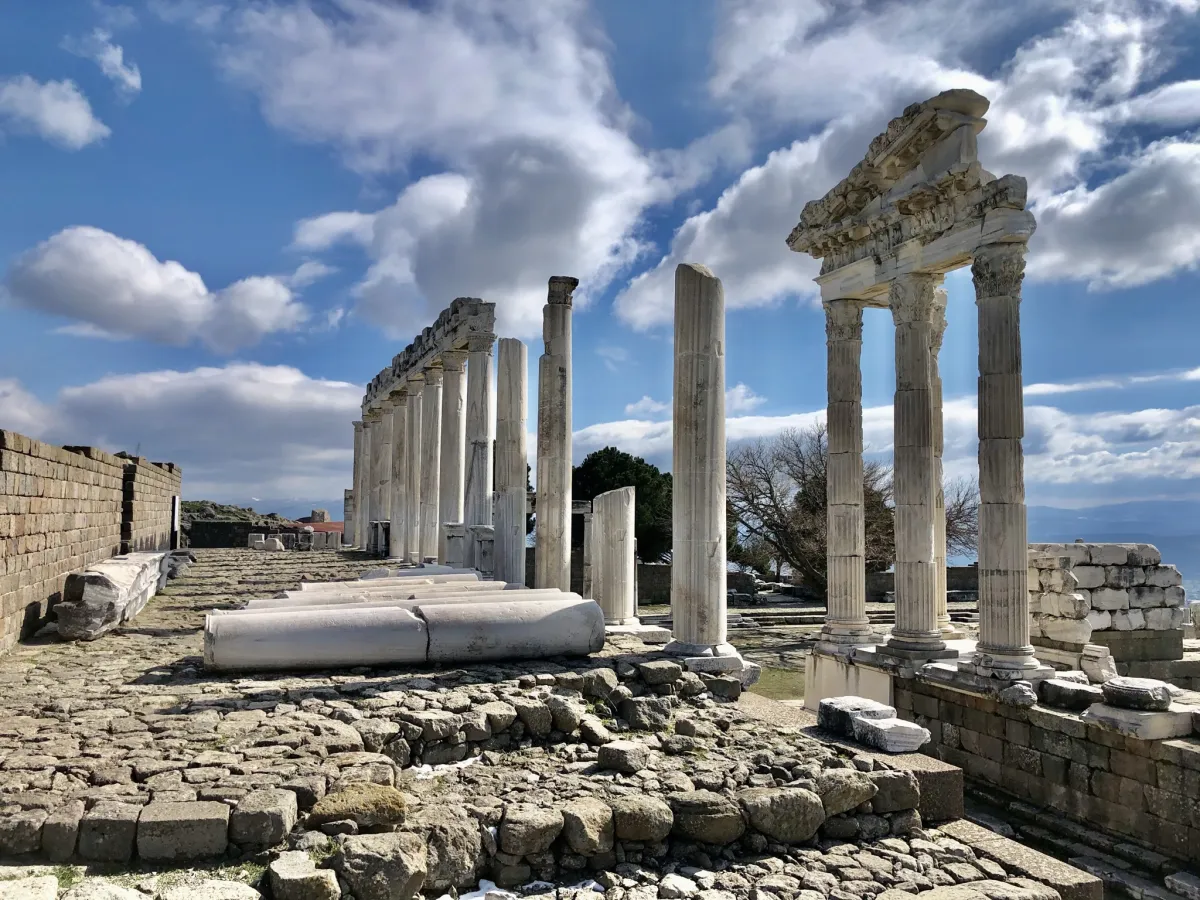
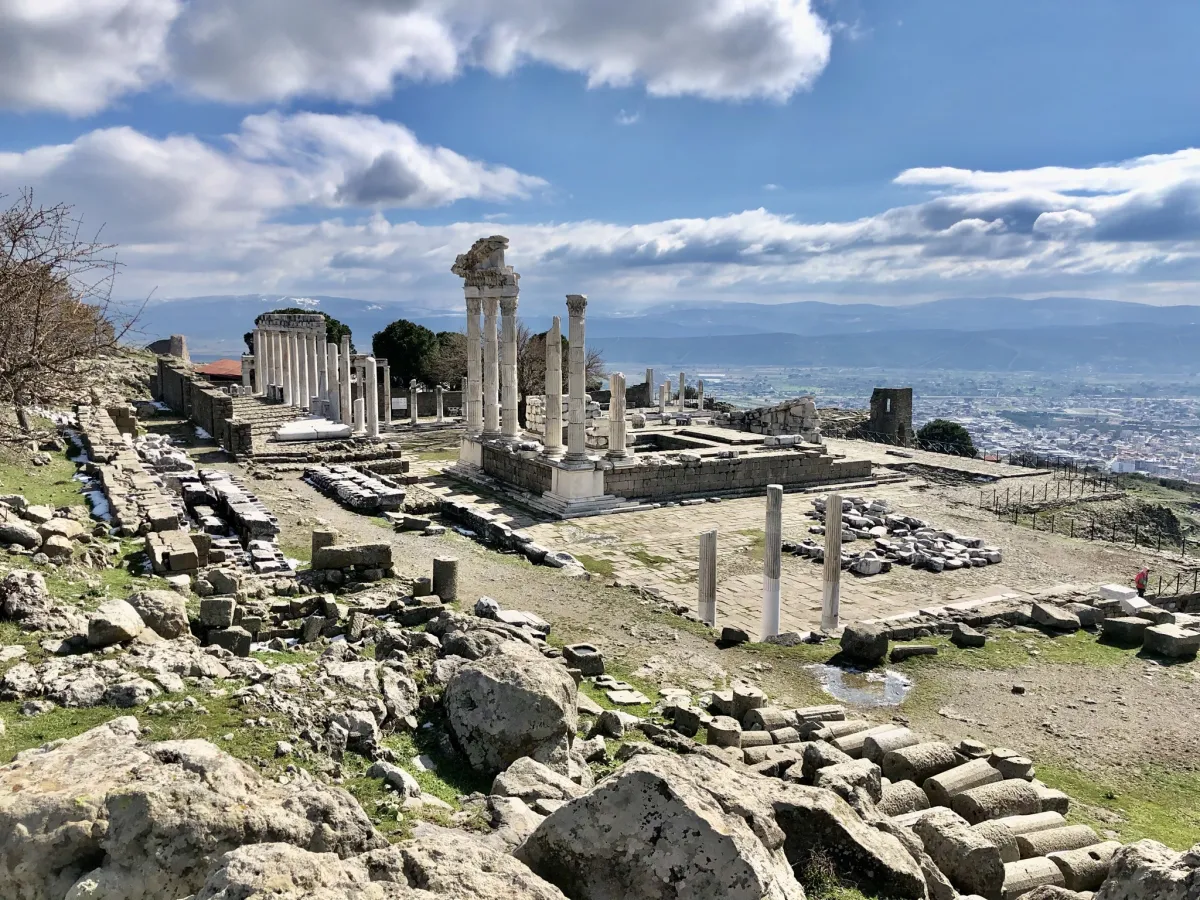
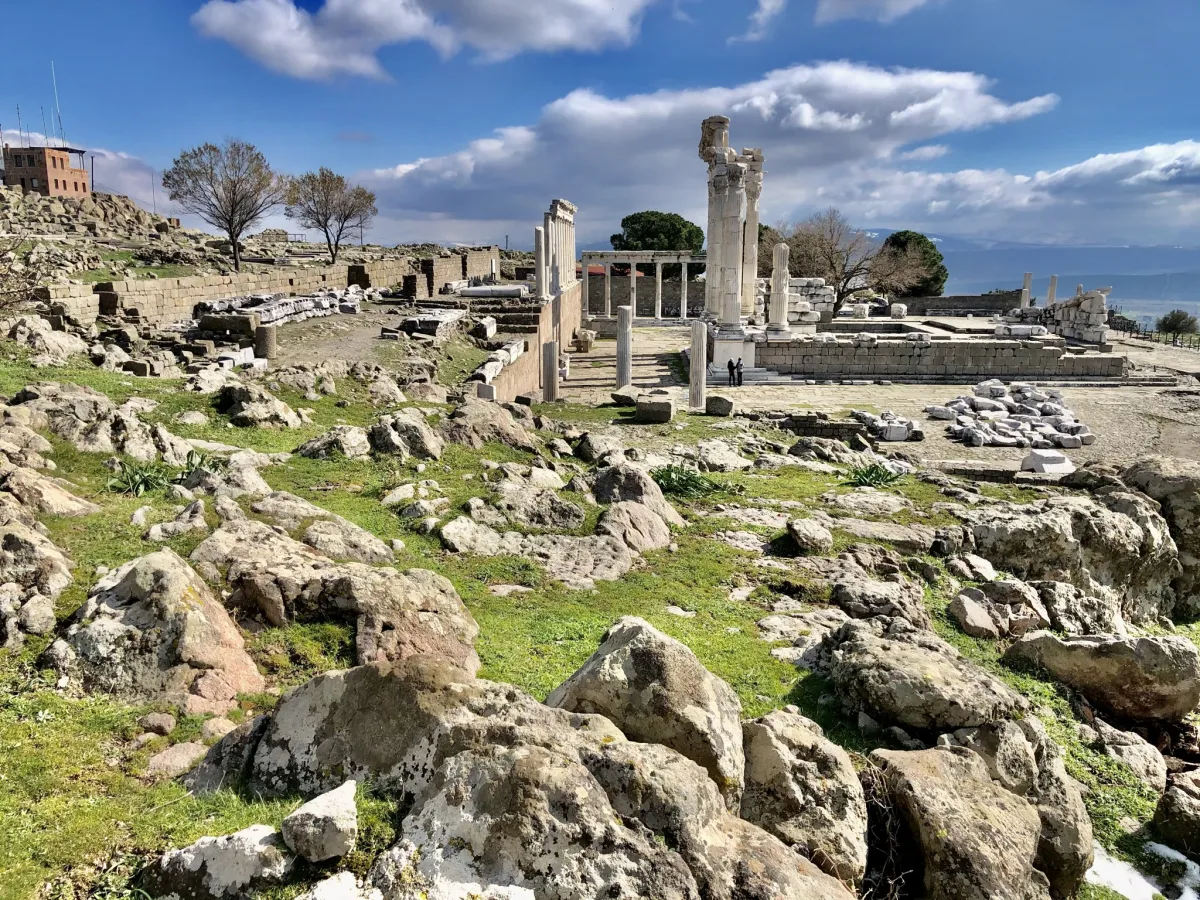
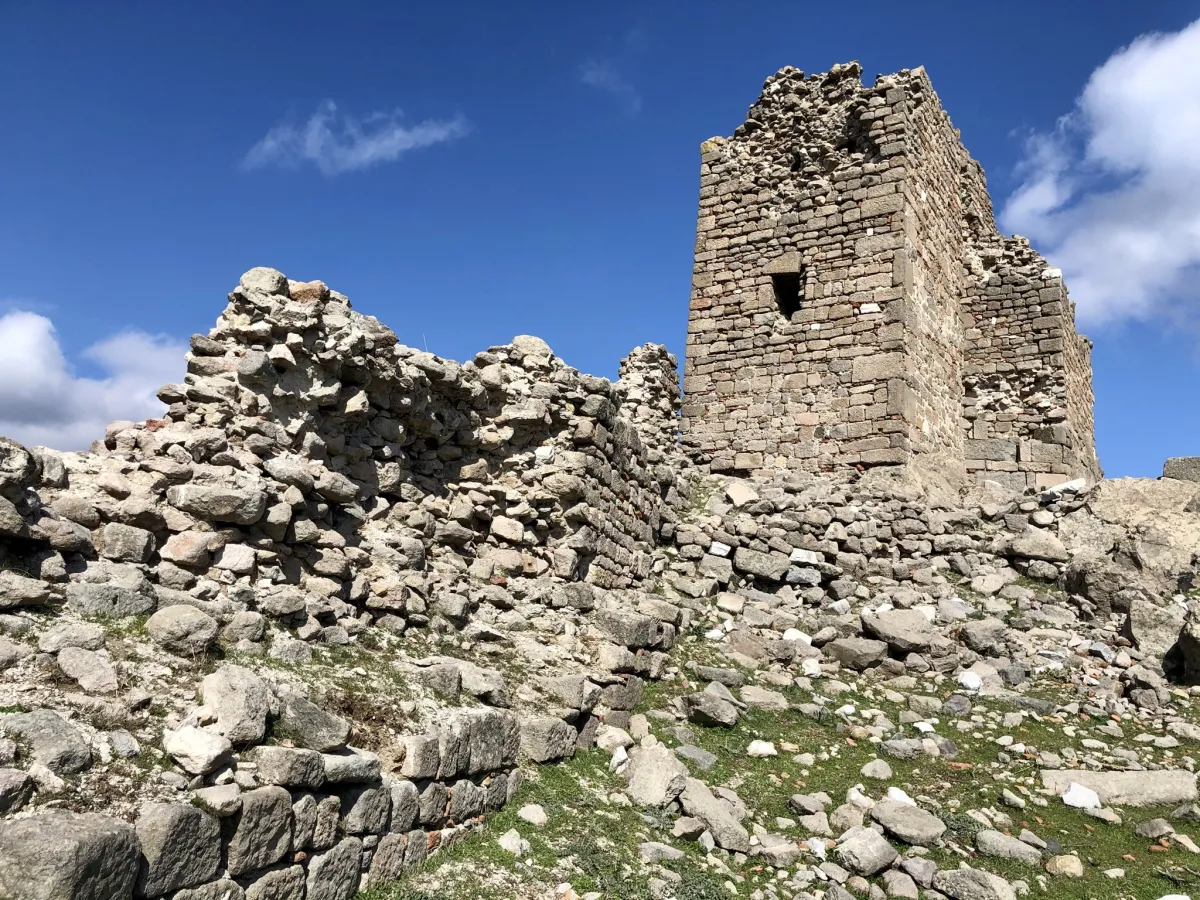
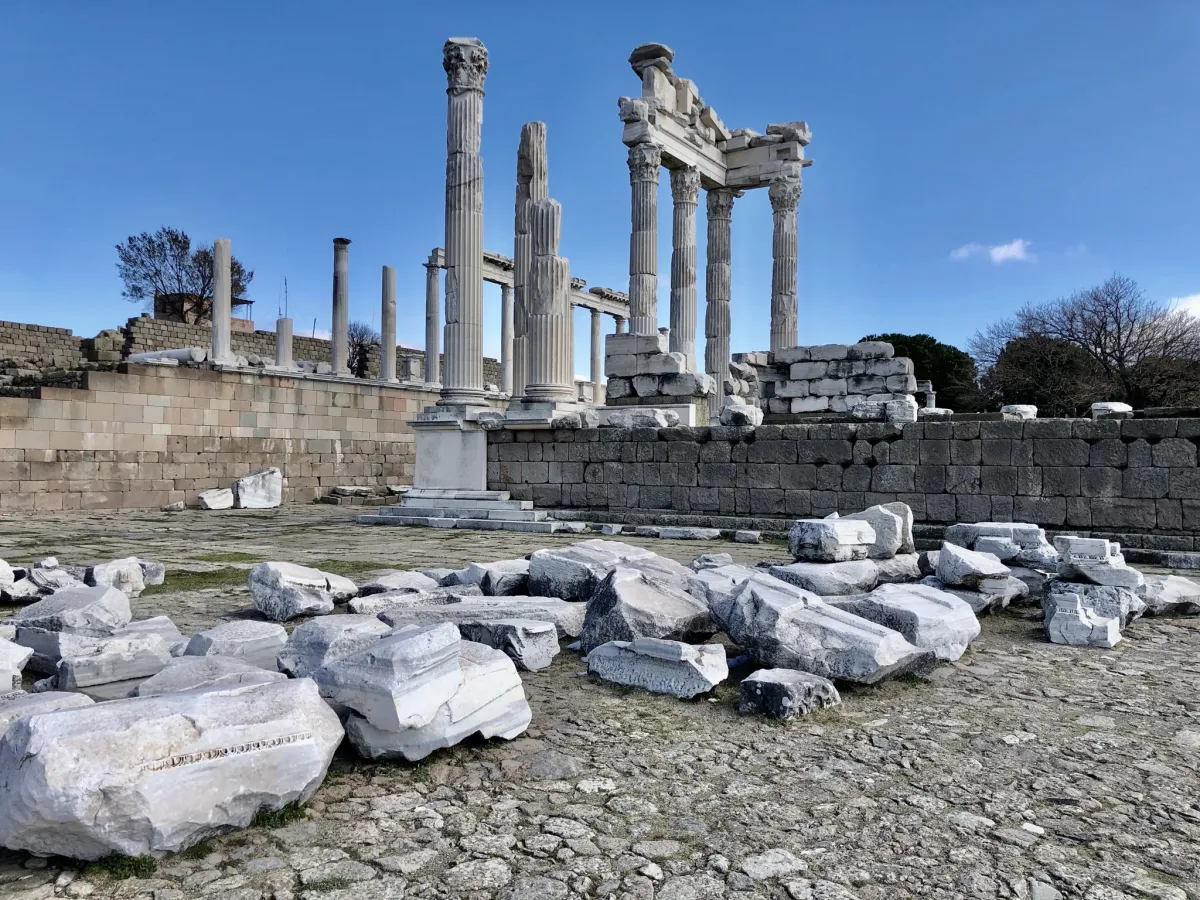
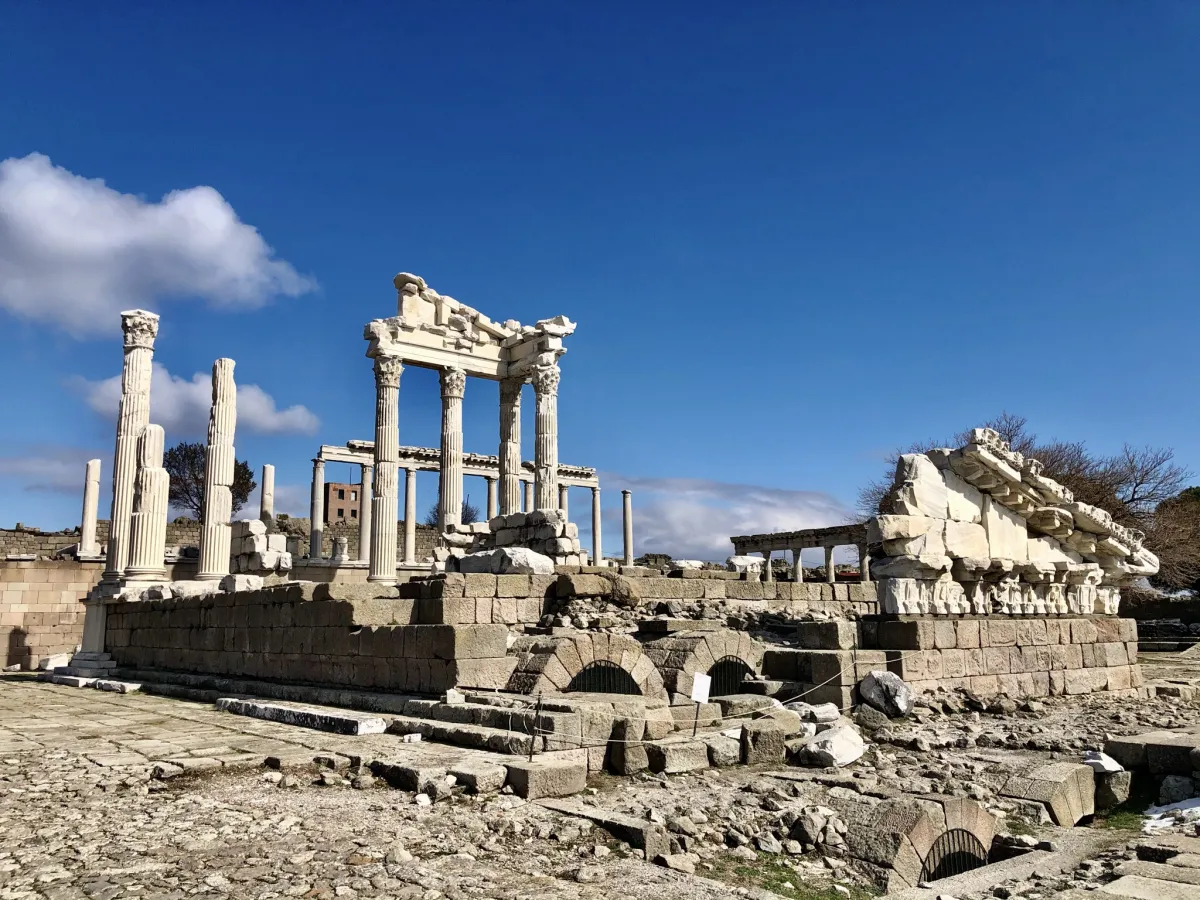
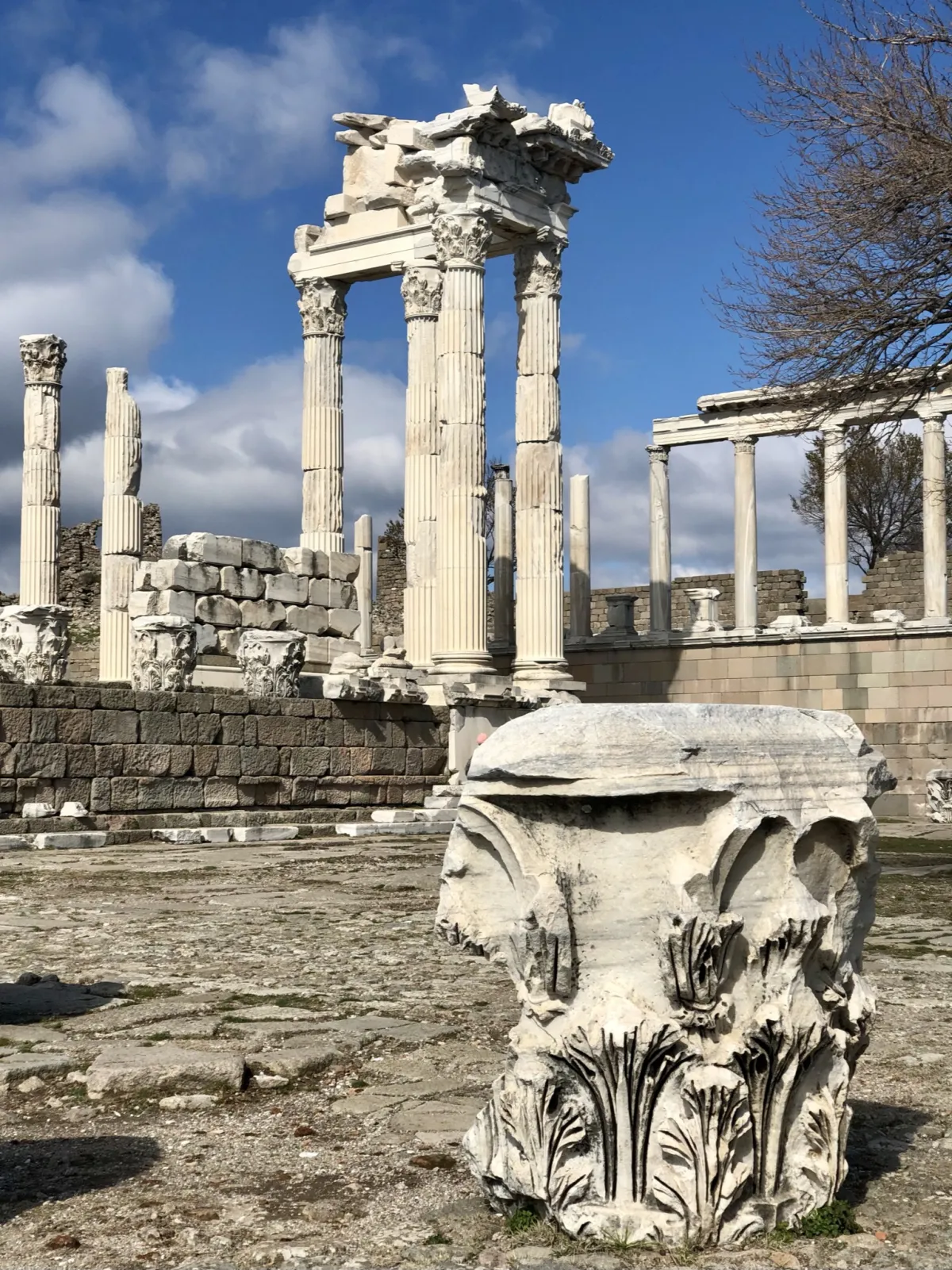
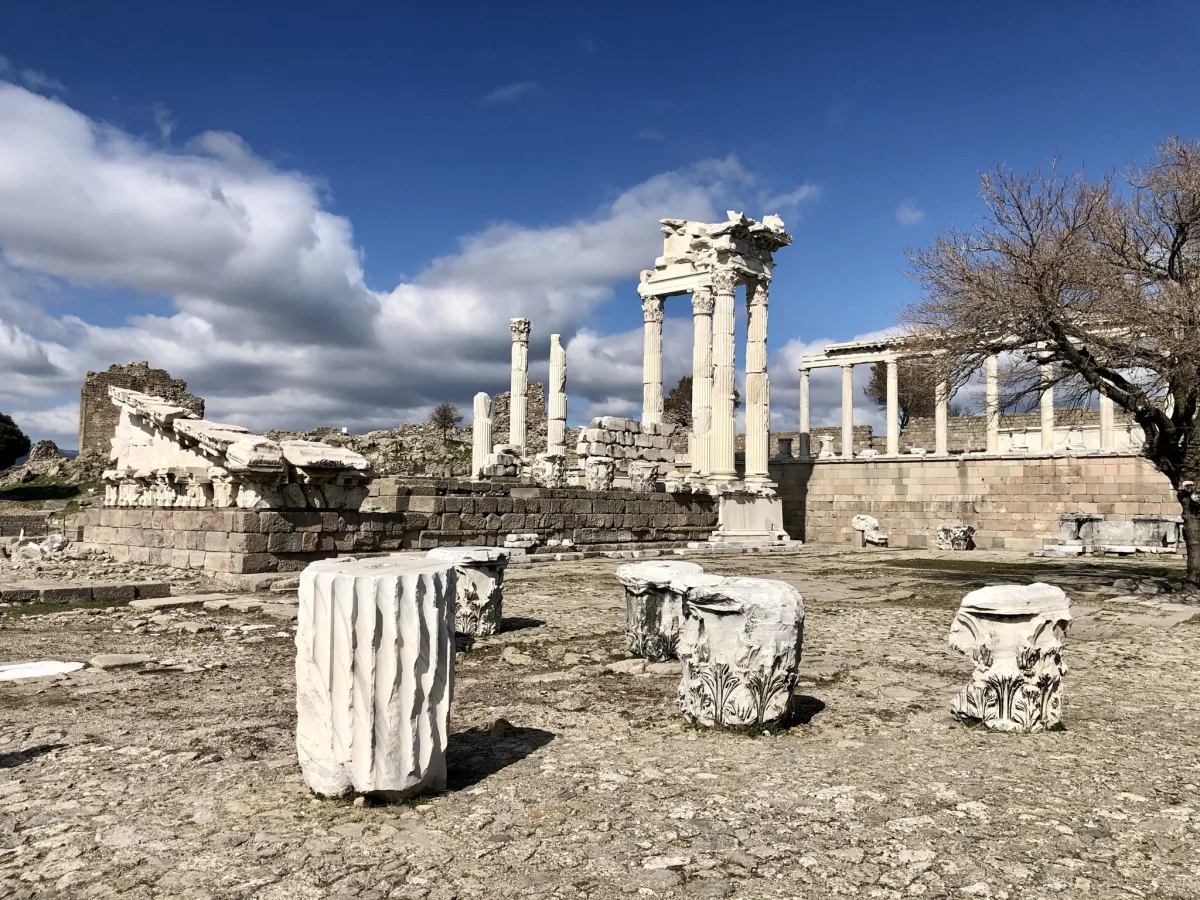
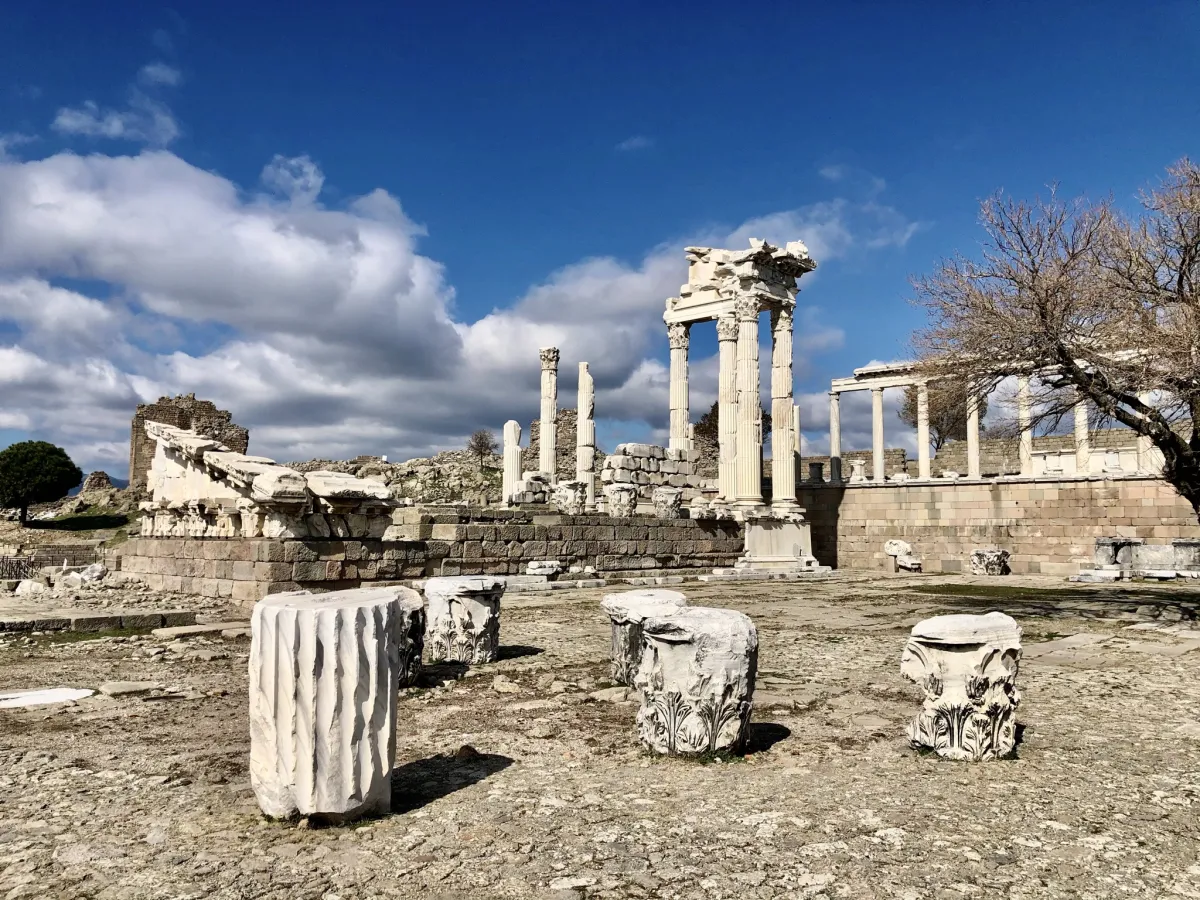
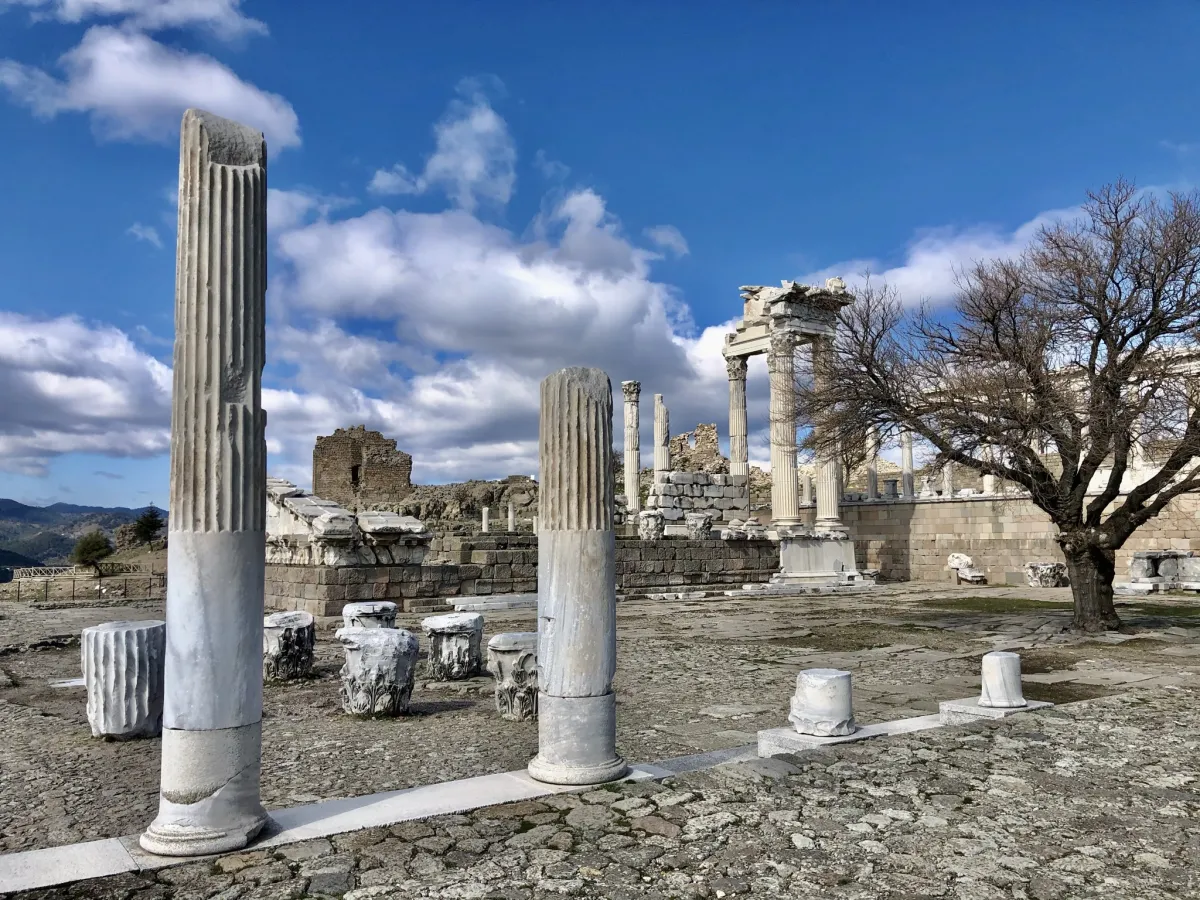
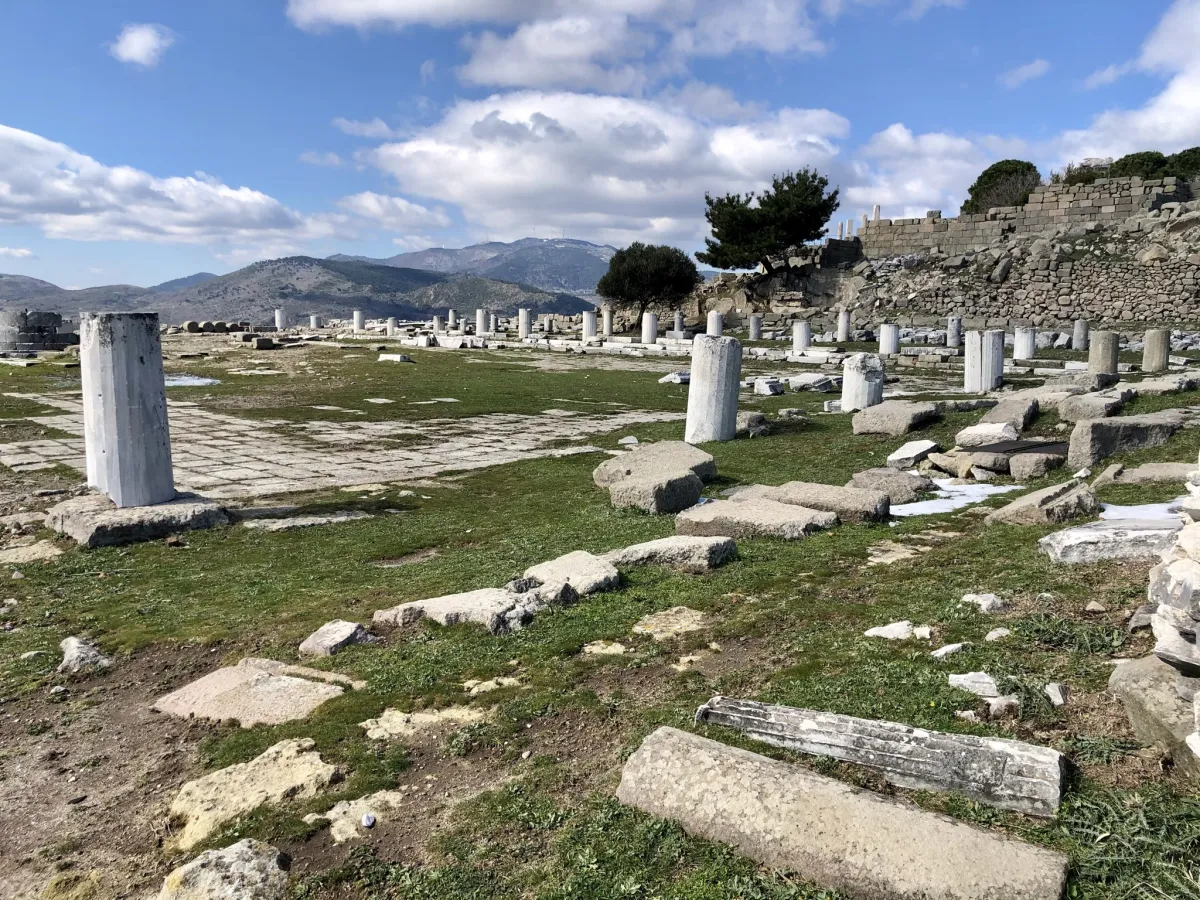
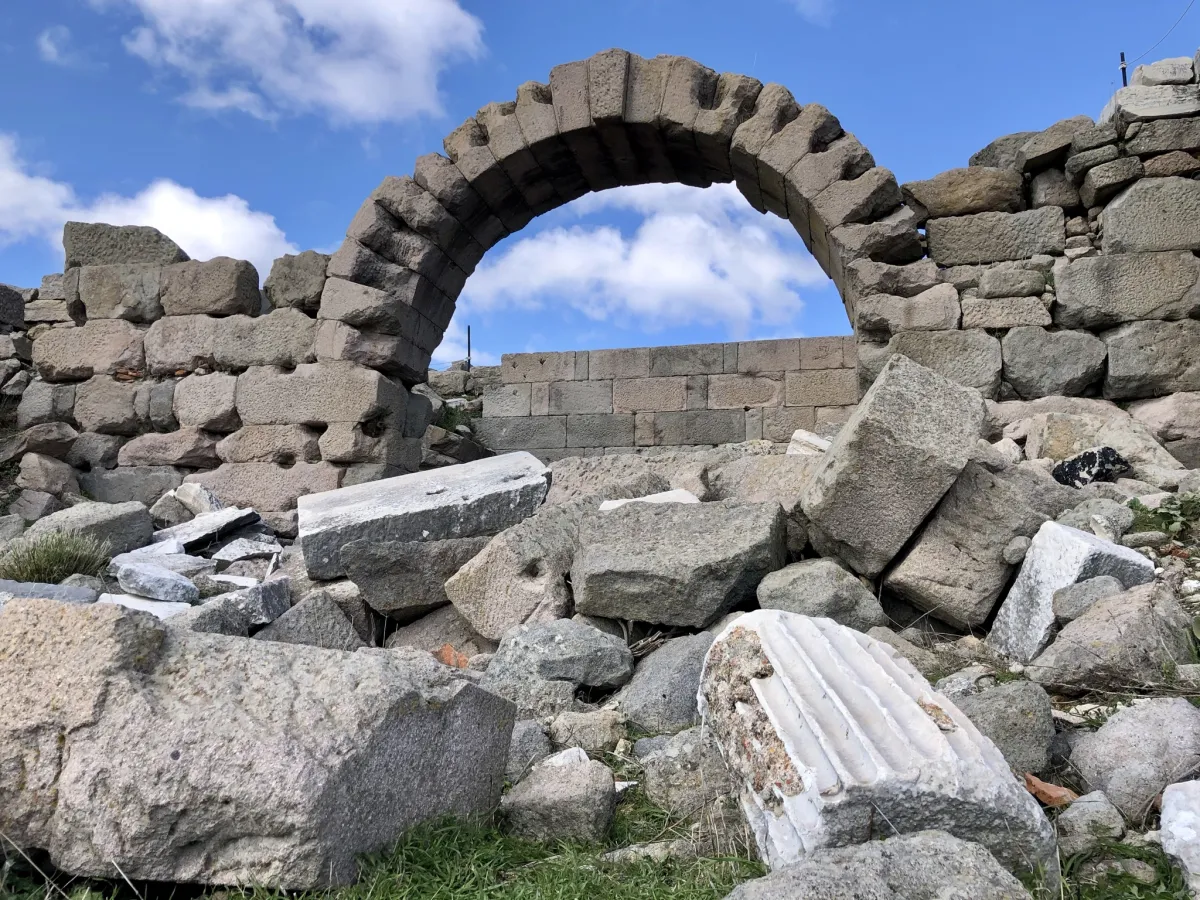
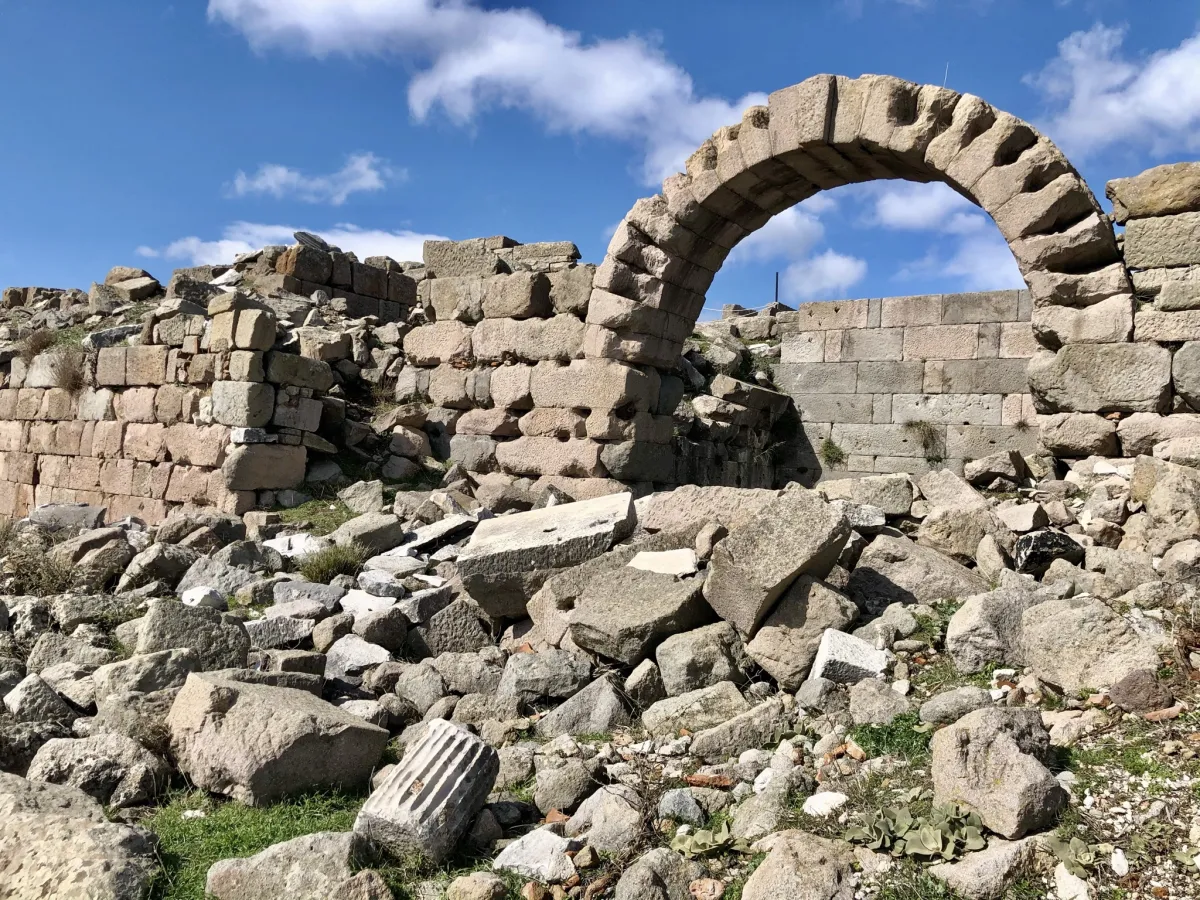
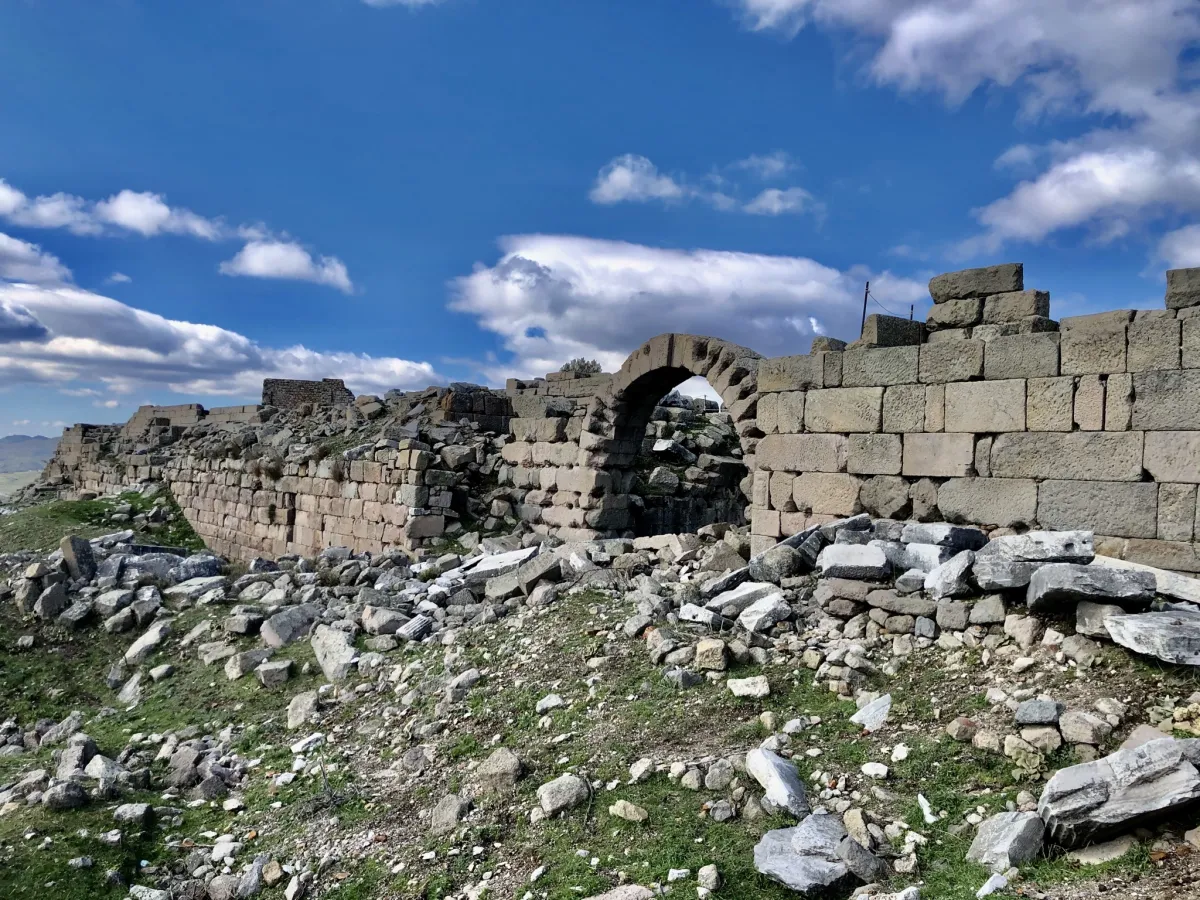
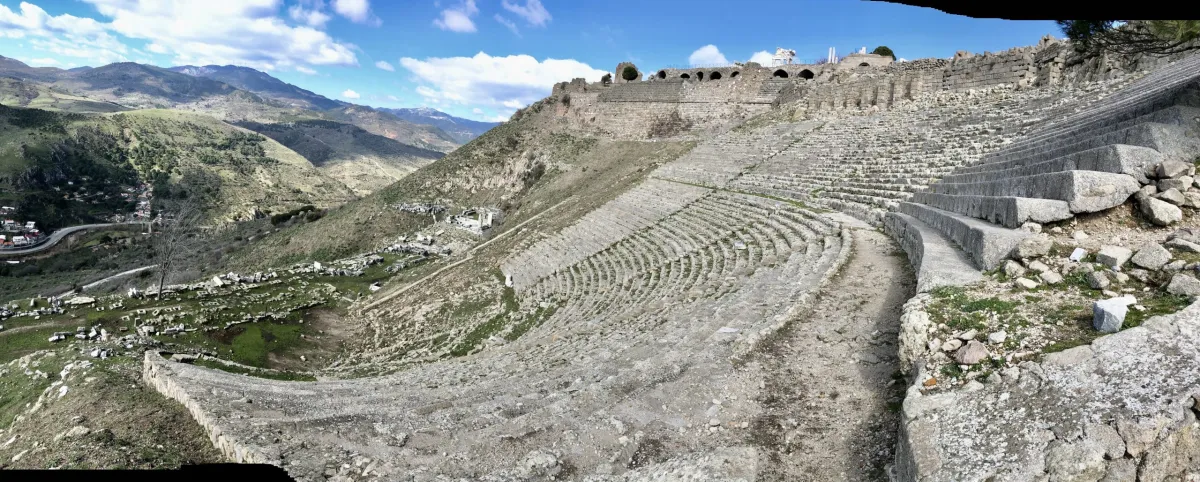
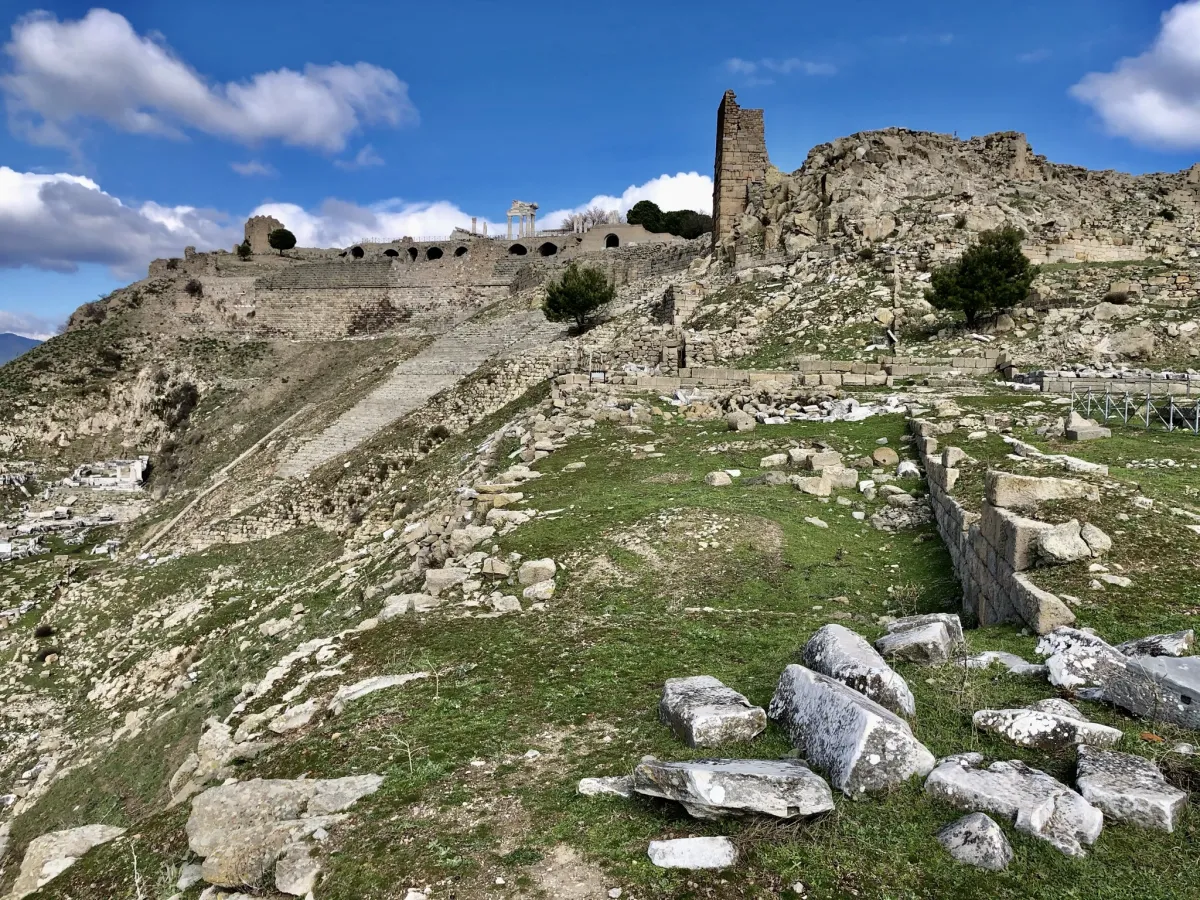
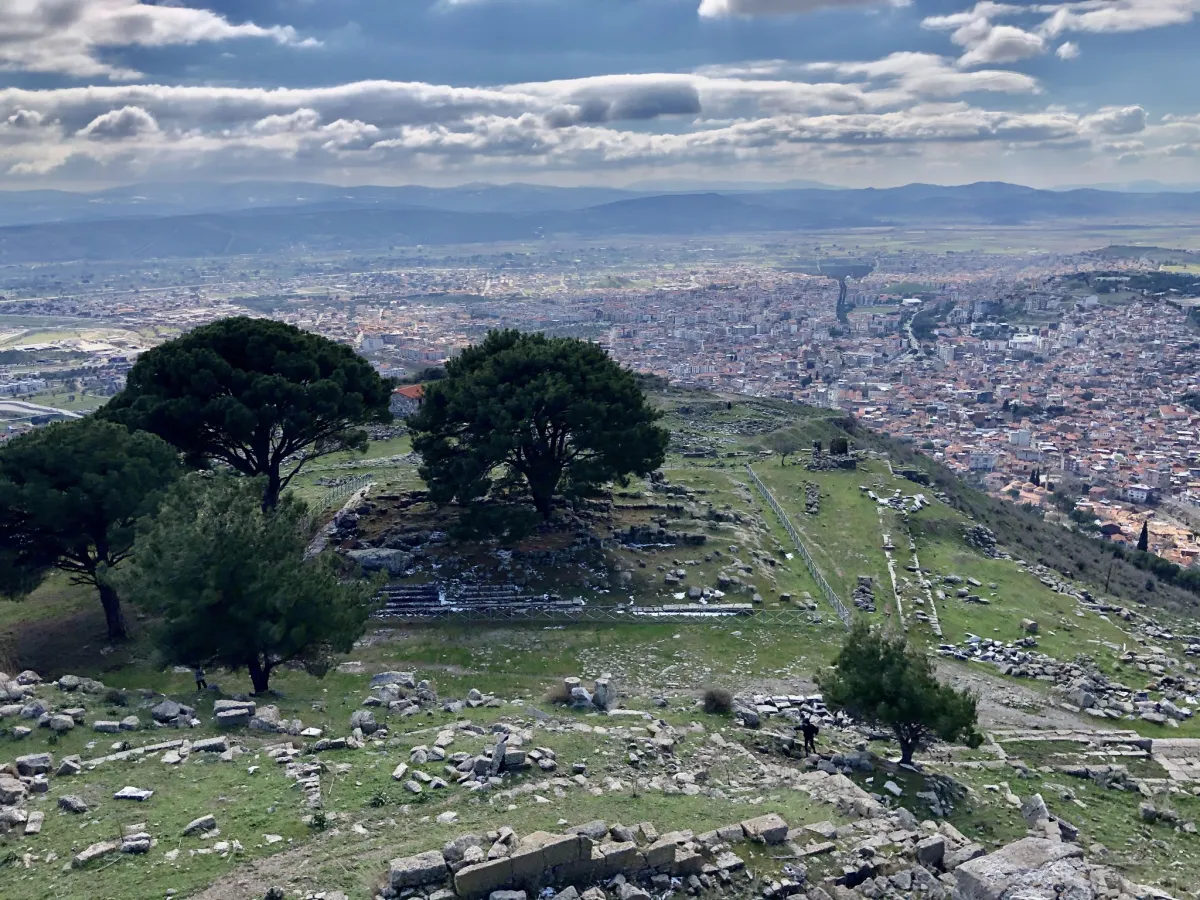
What to see in Pergamon in Turkey, rather than in Berlin or Rome. Let us start with the acropolis – the heart of any Greek city. You can get here on foot, by car, or go up by funicular. As I already mentioned, here lie the foundations of both the Temple of Zeus (Hallo Berlin!) and the sanctuary of Athena (Saluto Roma!). The majestic entrance to the sacred precinct surrounding the temple was also reconstructed in the Pergamon Museum (Hallo Berlin!).
A heap of stones and remains of columns is all that is left of the library (Ave Caesar!). Here modern Europeans are not to blame. According to Plutarch, the existence of the Pergamon library was ended by Mark Antony. He decided that the scrolls from Pergamon would be the best wedding gift for Cleopatra’s library in Alexandria. A neat solution: he both replenished the library and got rid of a competitor. Just shortly before, many thousands of Alexandrian scrolls had been “read” in fire during Caesar’s siege of Alexandria.
A great deal of brick and marble is all that remains of the palaces of the Pergamene kings. Guess where their mosaics are? Right, on display in Berlin. In general, just think how much was created here and scattered across the world.
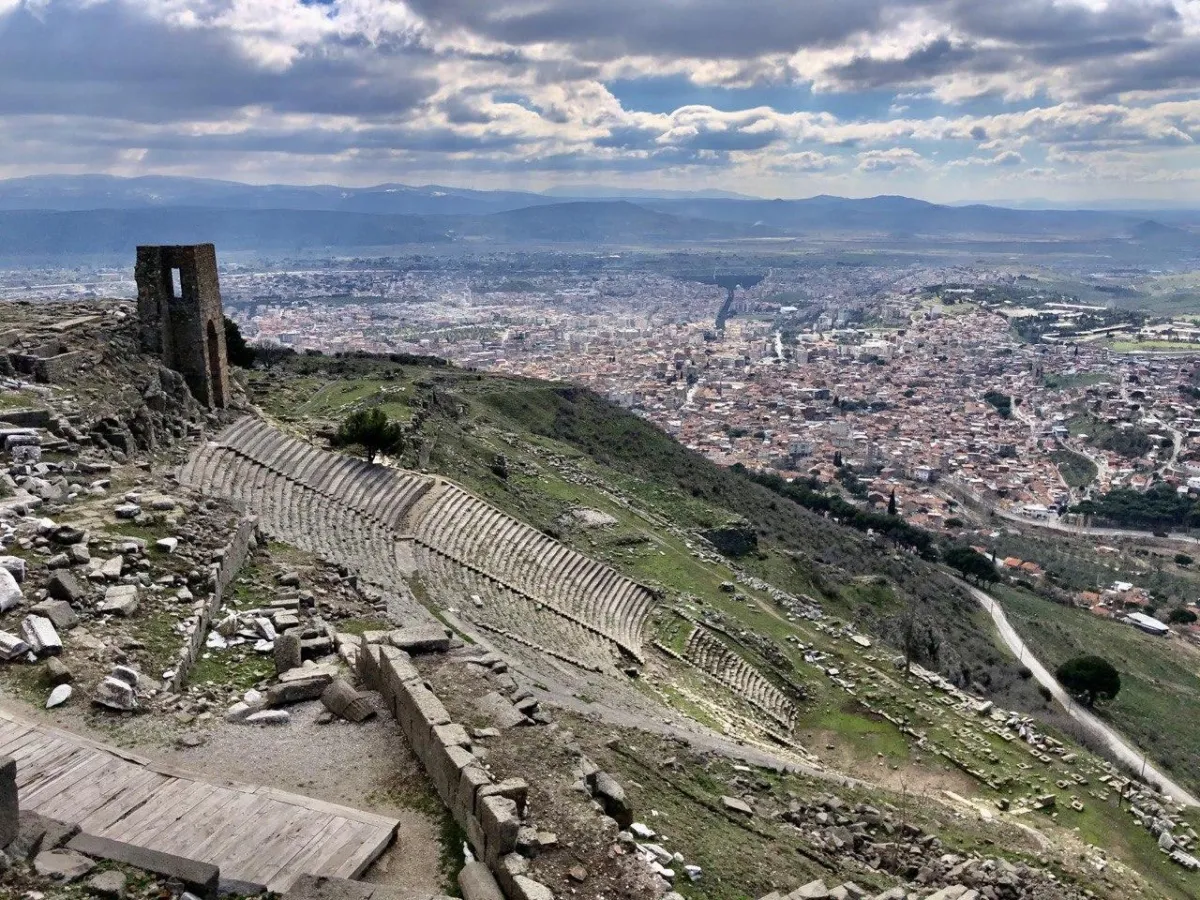
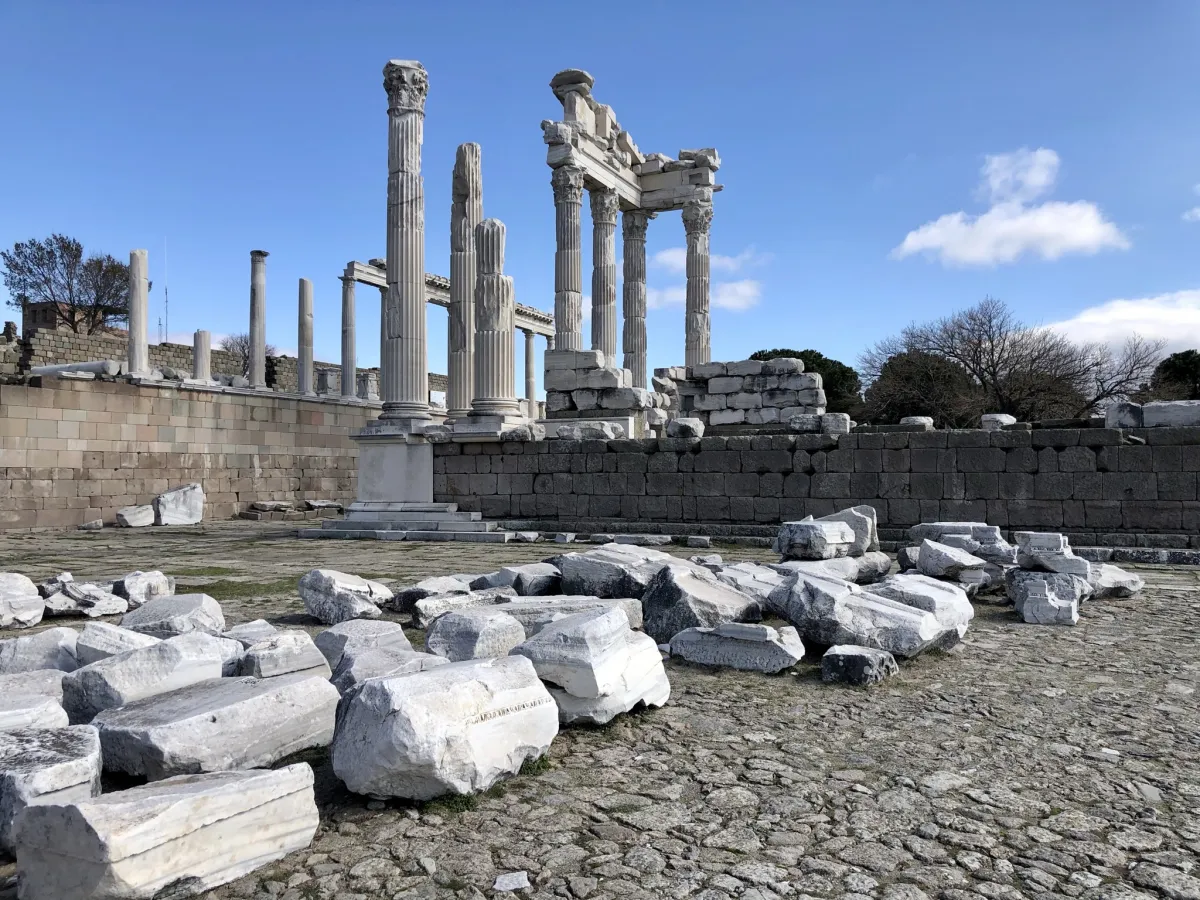
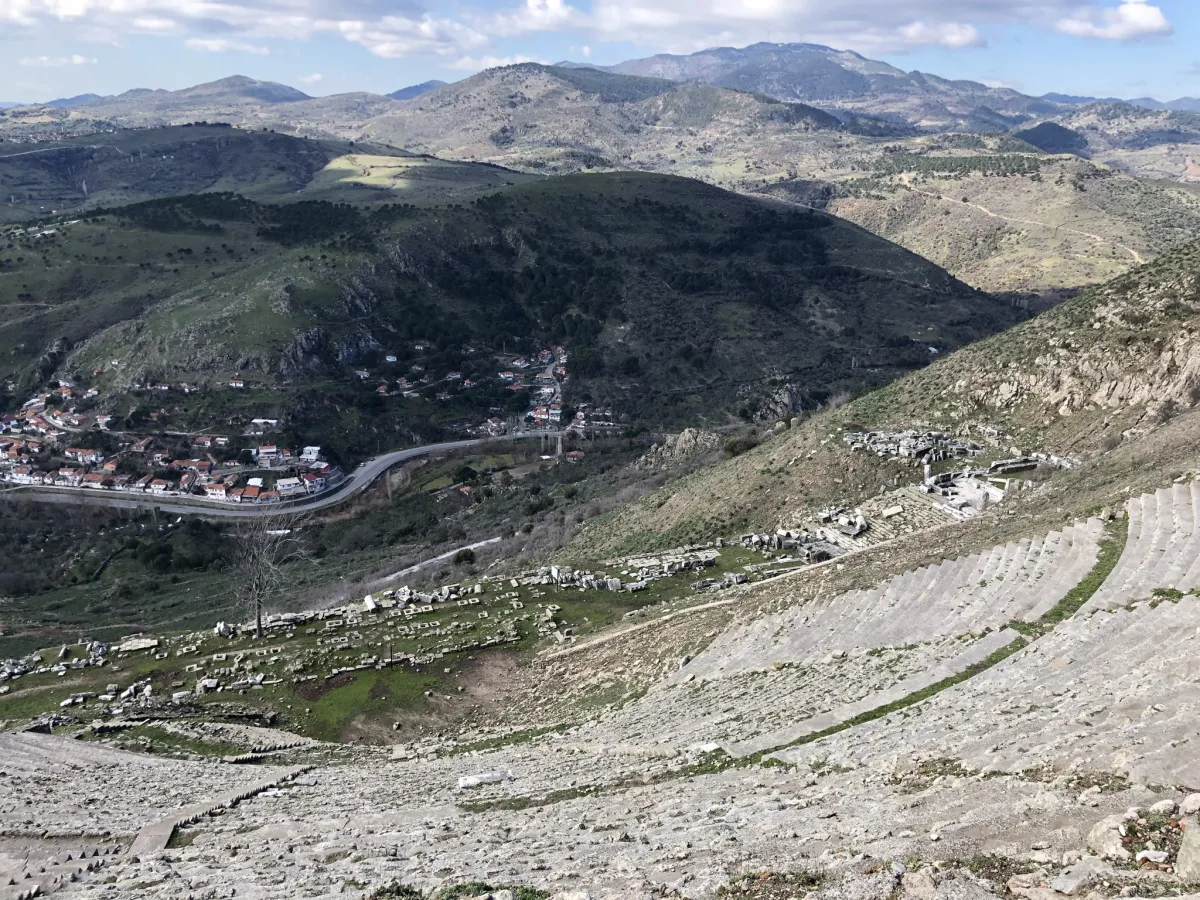
The remains of the Temple of Trajan are neatly stacked and quite photogenic. From here there is a wonderful view of the theatre of Pergamon. Not the largest, but certainly the steepest theatre in the world, incidentally. Quite literally – it is also called the vertical theatre. The rows go down so steeply that it simply takes your breath away. A real giant of a theatre. Incidentally, it could hold 10,000 spectators.
From above you can admire the ruins of ancient Pergamon, modern Bergama and a sea of water. Although it is man-made and modern. Turks love to create artificial reservoirs.
Hellenistic Pergamon was surrounded by a powerful wall with the Gate of Eumenes, and some interesting ruins survive below. The monuments of Pergamon are not limited to the acropolis.
The Red Basilica
Although most of the buildings of the lower city have collapsed and now lie beneath modern Bergama, some gigantic brick walls have withstood the onslaught of time. Their appearance and thickness recall the Baths of Caracalla. Now the main building is called Kızıl Avlu (Red Courtyard), a temple, a basilica because of its colour.
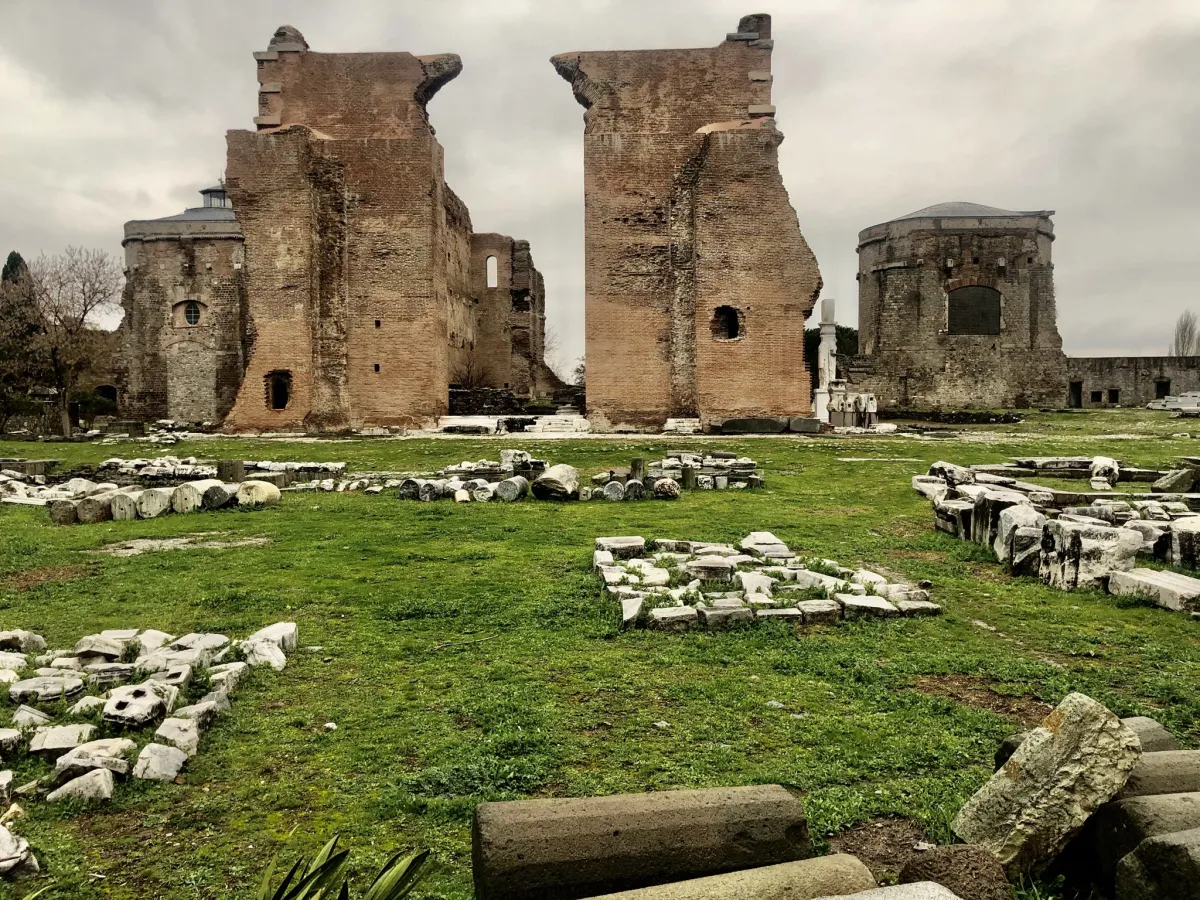
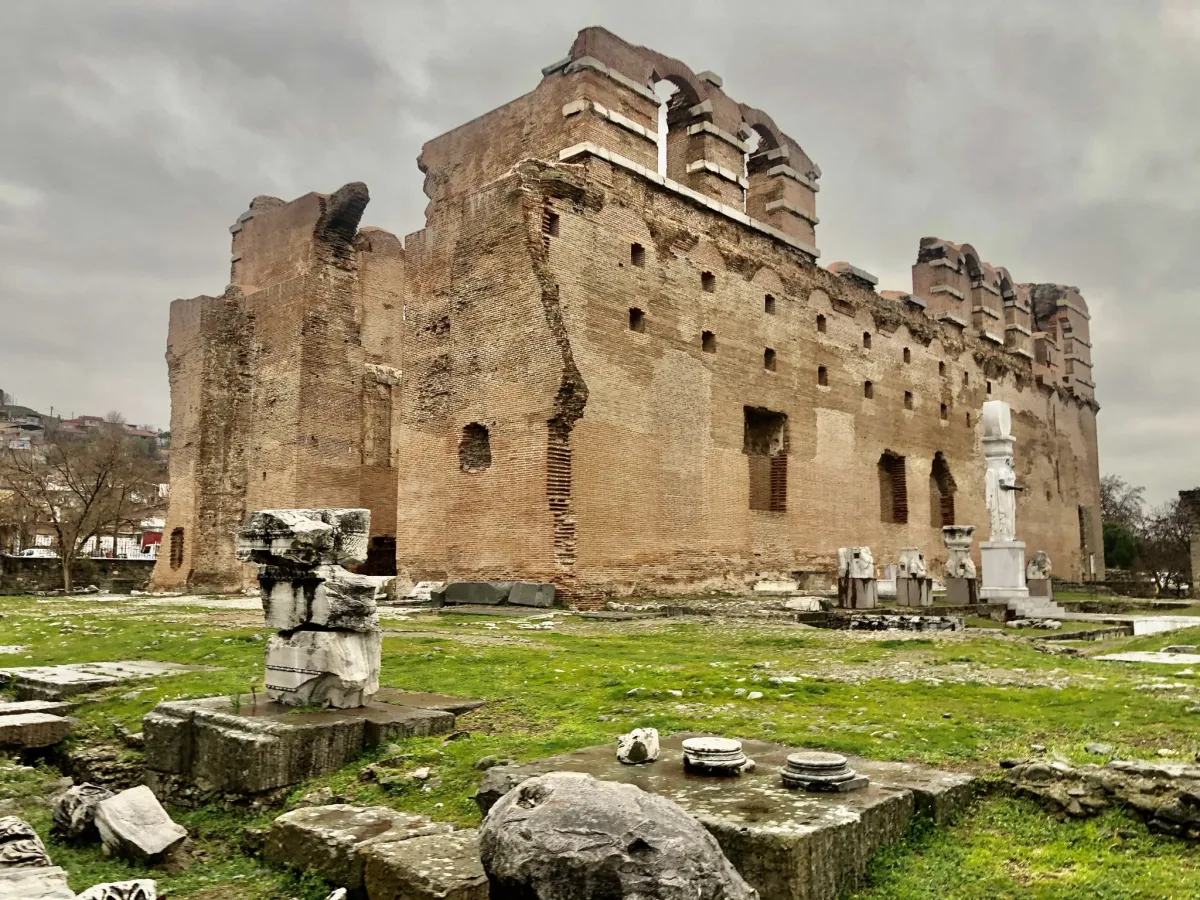
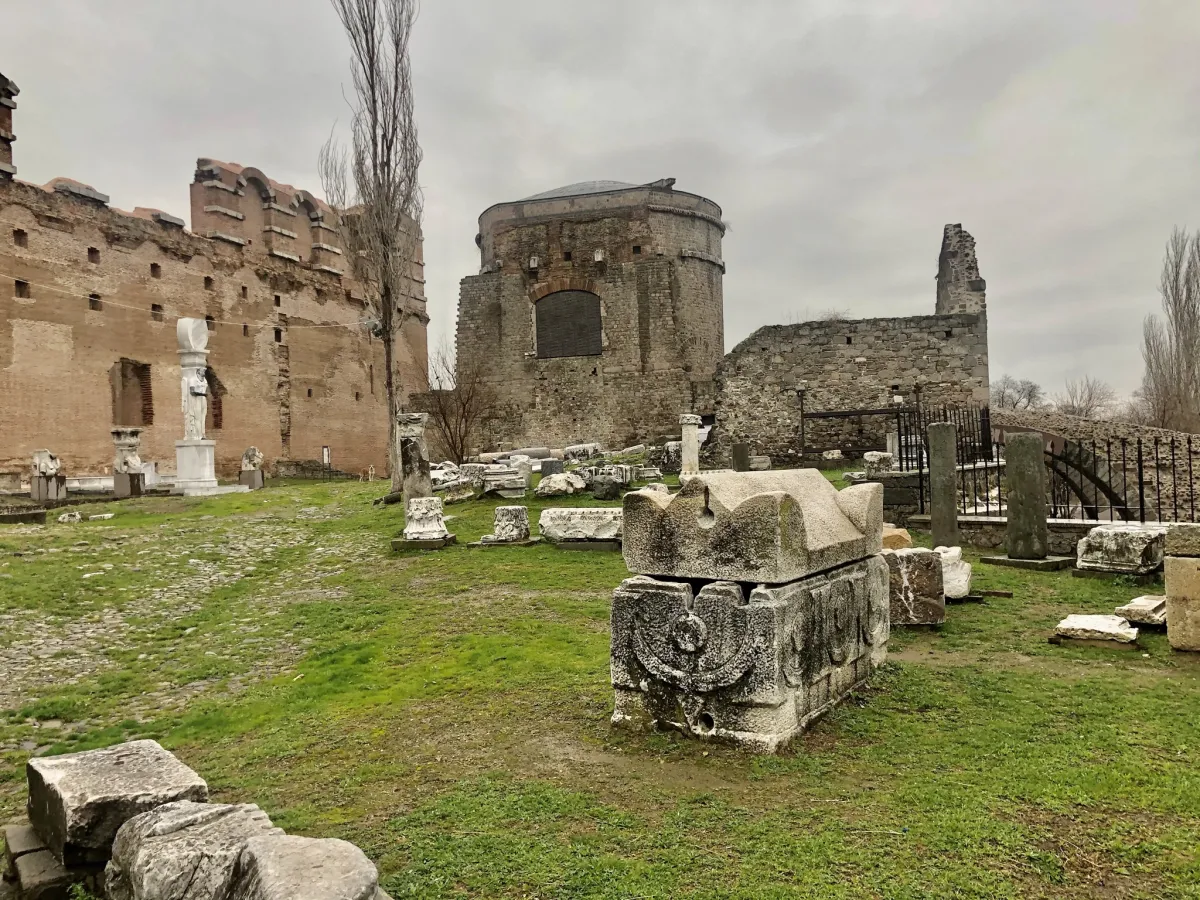
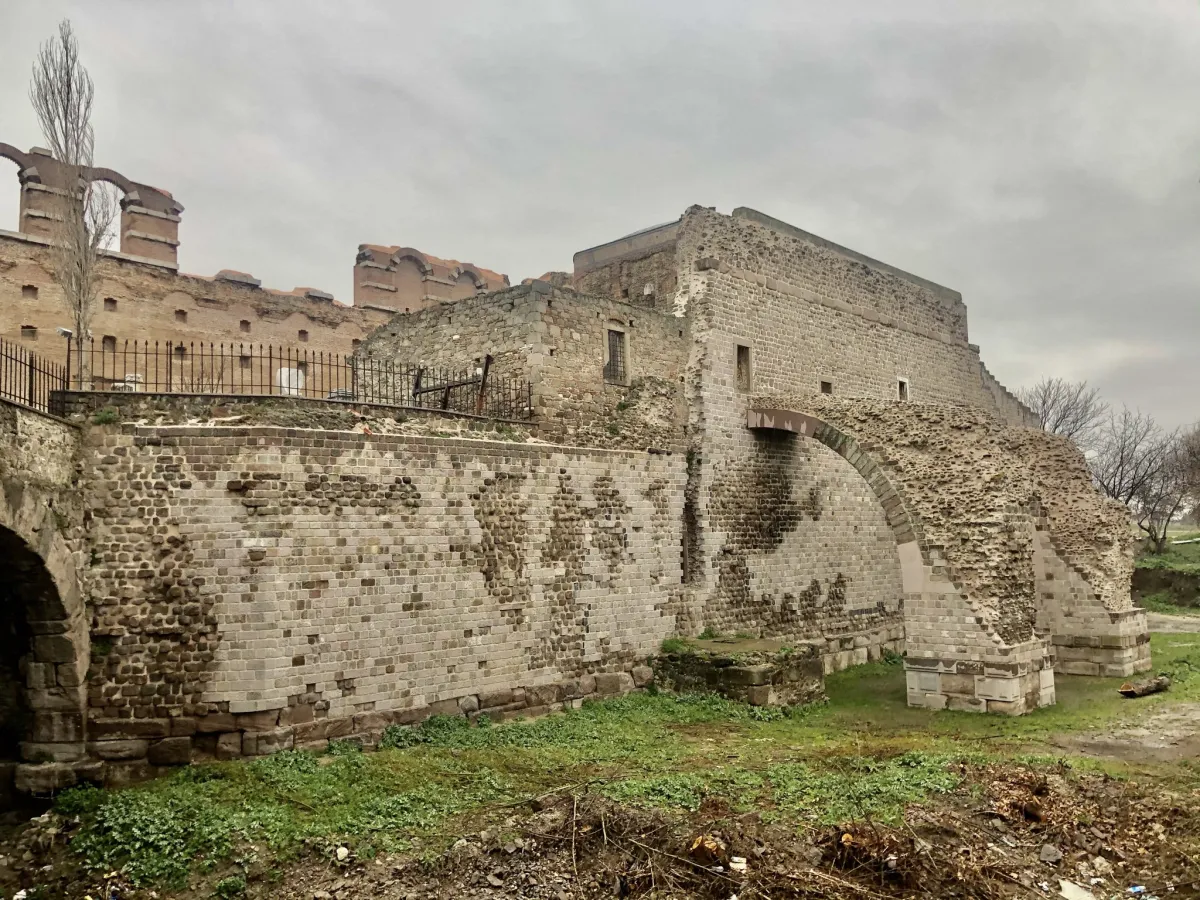
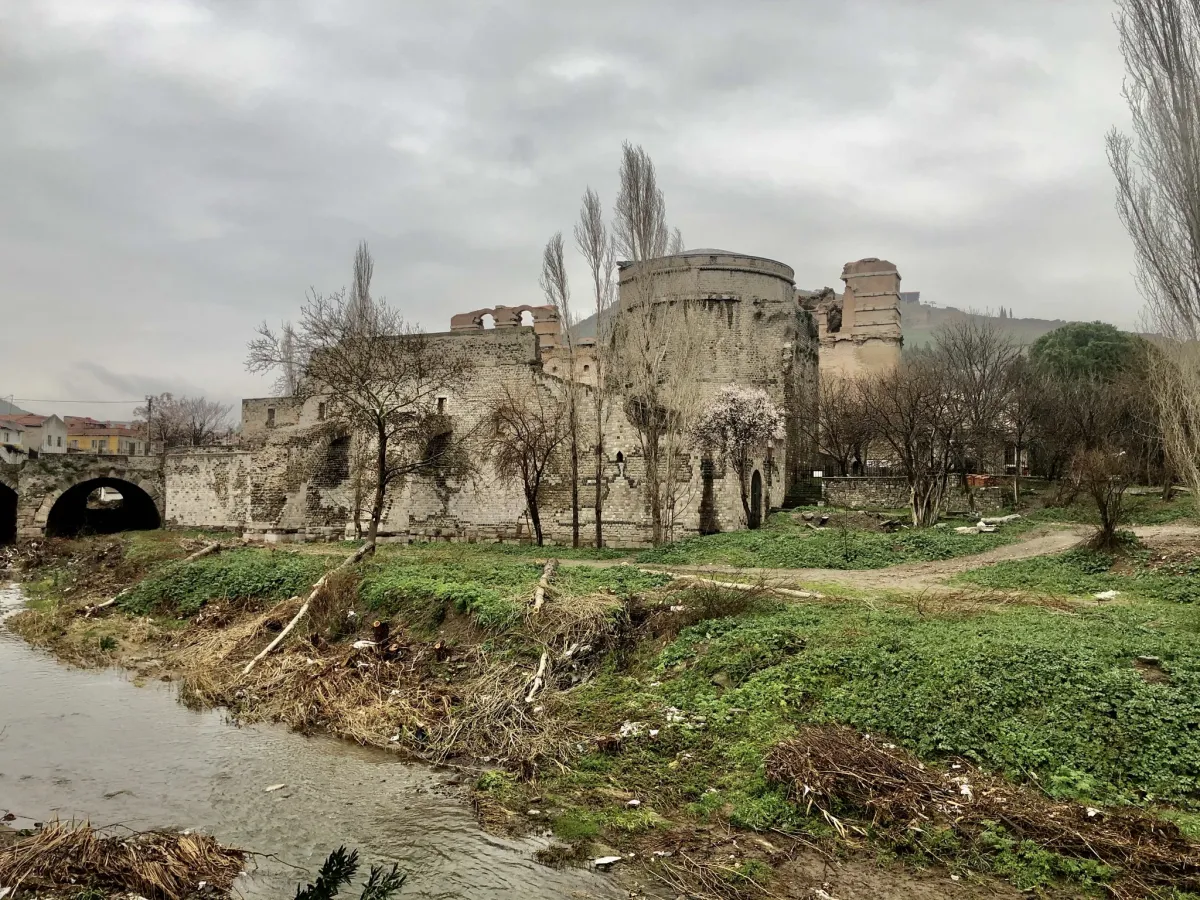
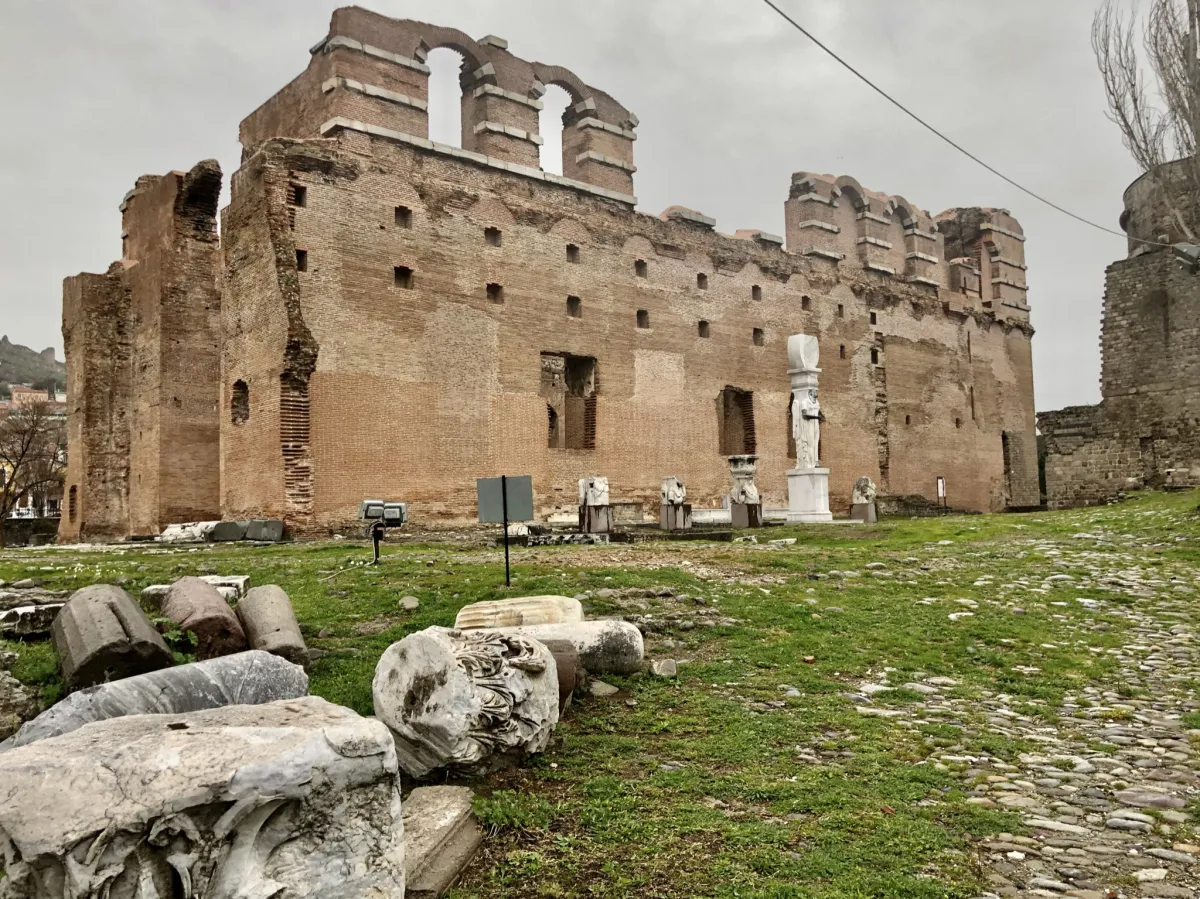
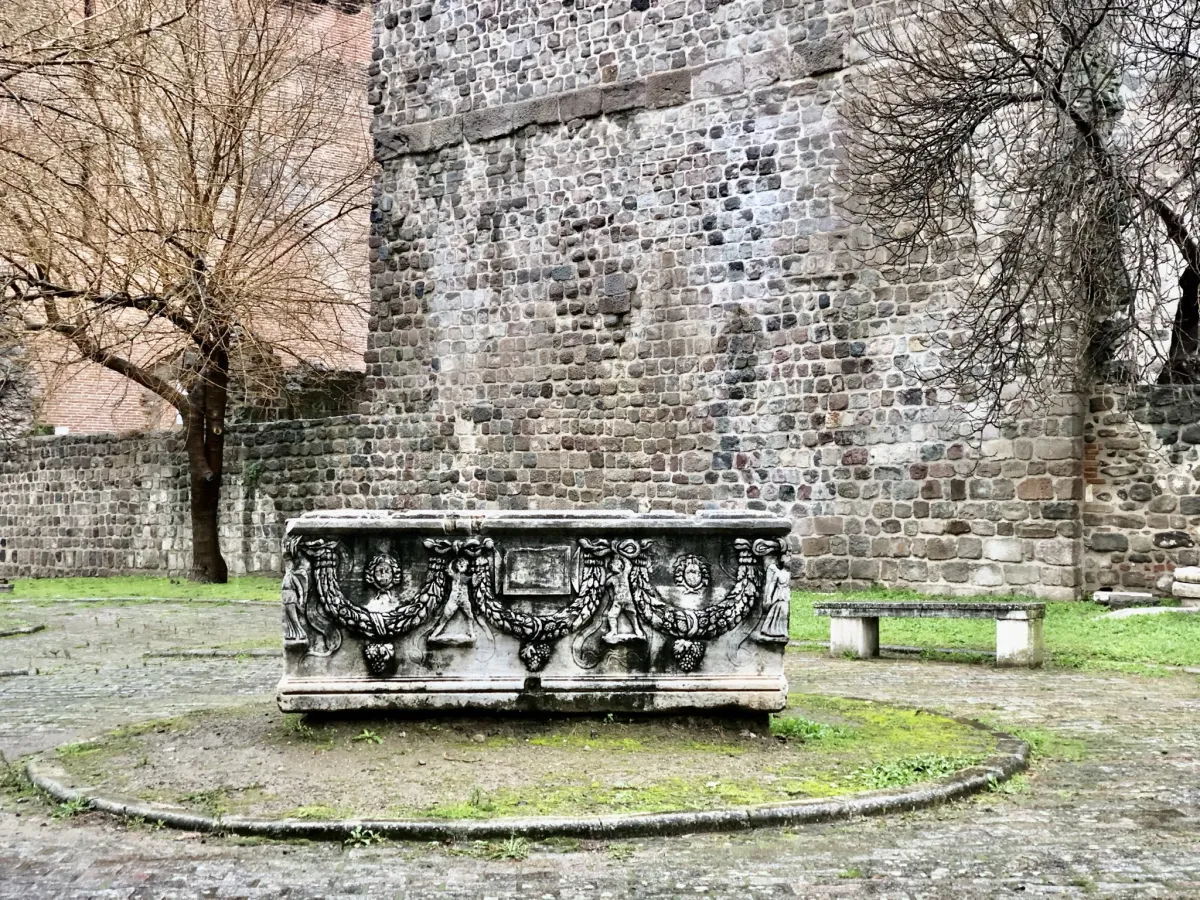
It is flanked by two round towers whose purpose is unclear. The gigantic structure stands on a wide terrace above the river that crosses the Lower City. This was most likely done deliberately, since the water was meant to play the role of the Nile. Archaeologists believe the temple was dedicated to Serapis. This god, whose worship was first introduced by the Greek Ptolemies in order to combine the Egyptian religion with the Greek one. Serapis had features of both Zeus and Osiris.
The temple was probably built by Hadrian. There is hardly an ancient city in western Turkey without a monument or structure with which he had no connection. Wandering around the fenced territory around the temple, you can see interesting sarcophagi and reliefs of the Roman period, and also find evidence of its use as a Christian Byzantine church, as a Jewish cemetery and as a mosque.
“And to the angel of the church in Pergamum write: These things says He who has the sharp two-edged sword:
I know your works, and where you dwell, where Satan’s throne is. And you hold fast to My name, and did not deny My faith even in the days in which Antipas was killed among you, where Satan dwells, My faithful witness.
But I have a few things against you, because you have there those who hold the doctrine of Balaam, who taught Balak to put a stumbling block before the sons of Israel, to eat things sacrificed to idols and to commit sexual immorality.
Thus you also have those who hold the doctrine of the Nicolaitans, likewise.
Repent! Or else I will come to you quickly and will fight against them with the sword of My mouth.
He who has an ear, let him hear what the Spirit says to the churches: To him who overcomes I will give to eat of the hidden manna, and I will give him a white stone, and on the stone a new name written which no one knows except him who receives it.”
So you understood what John the Evangelist meant in his address to the church in Pergamum, and so we travel on.
Compared with the chic Asclepieion and the luxurious Acropolis, the basilica looks like some big Lego set made of fragments of columns, remains of gravestones and statues, thrown down by giants.
The Asclepieion. We are used to a Greek city having a theatre. It turns out the asclepieion is also an almost obligatory public building – a sort of city hospital. According to Greek myths, Asclepius learned the art of healing both from his father Apollo and from the centaur Chiron.
Long forgetting his native herd,
He grew used to healing and the strings of the lyre,
To human words and Phoebus’s laurel;
Attuned to the musical key,
He overcame the centaur’s bestial lust,
Friend of mortals and gods, the centaur Chiron.
Mykola Zerov
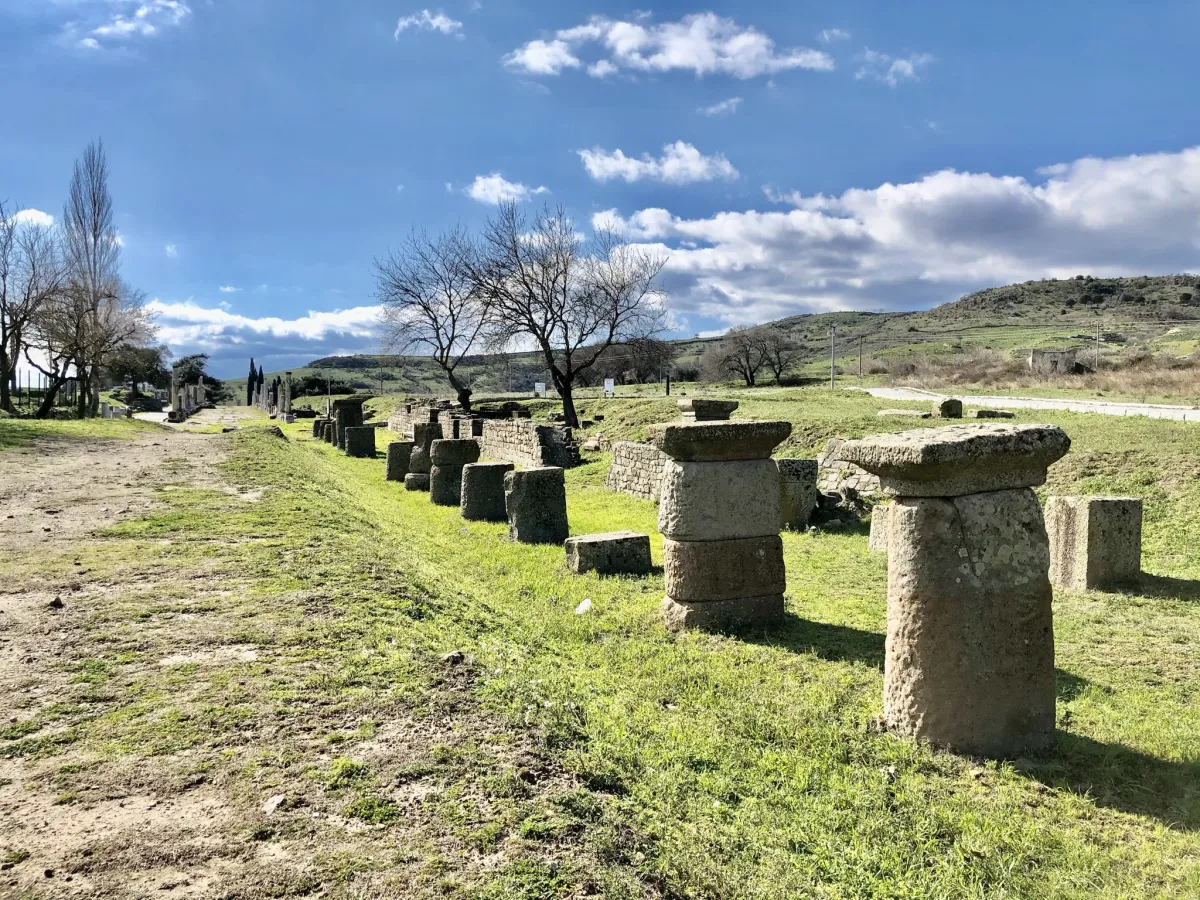
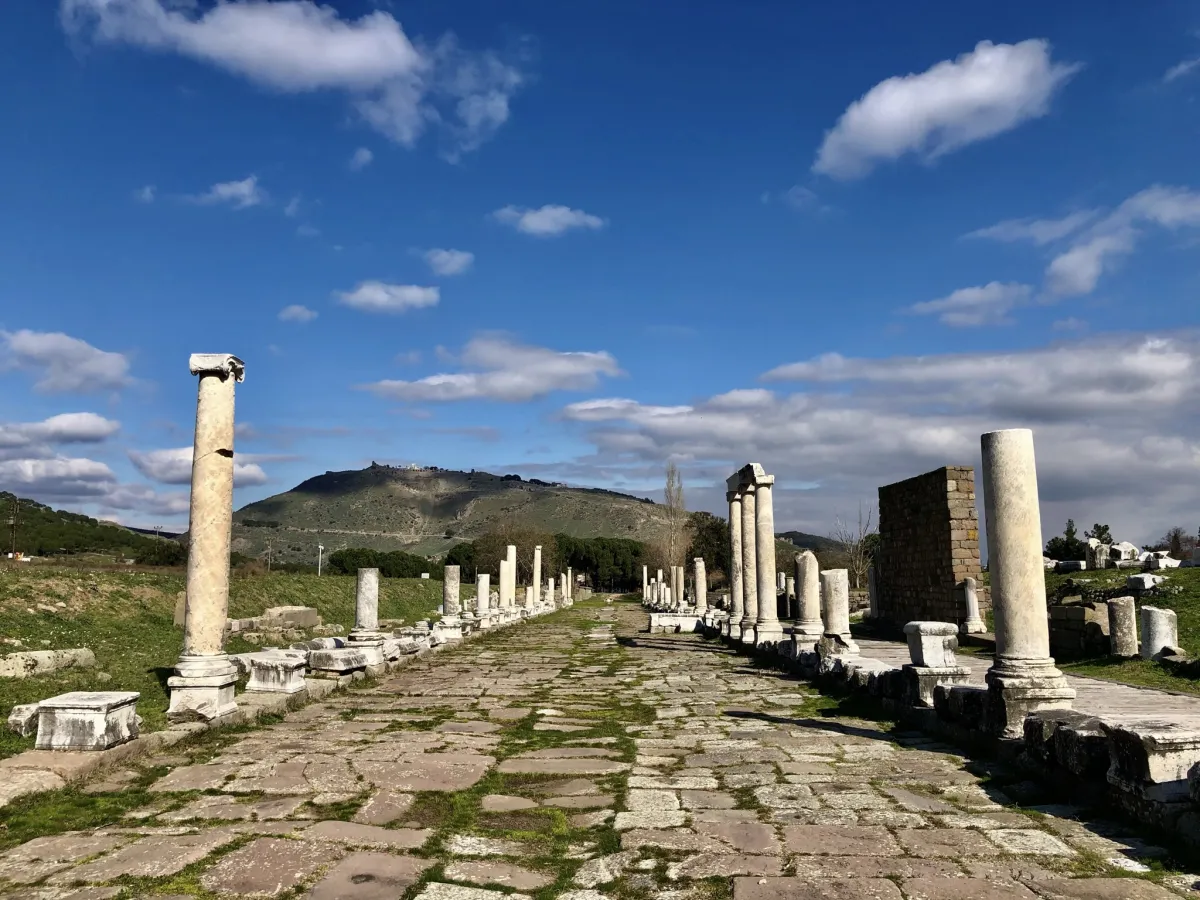
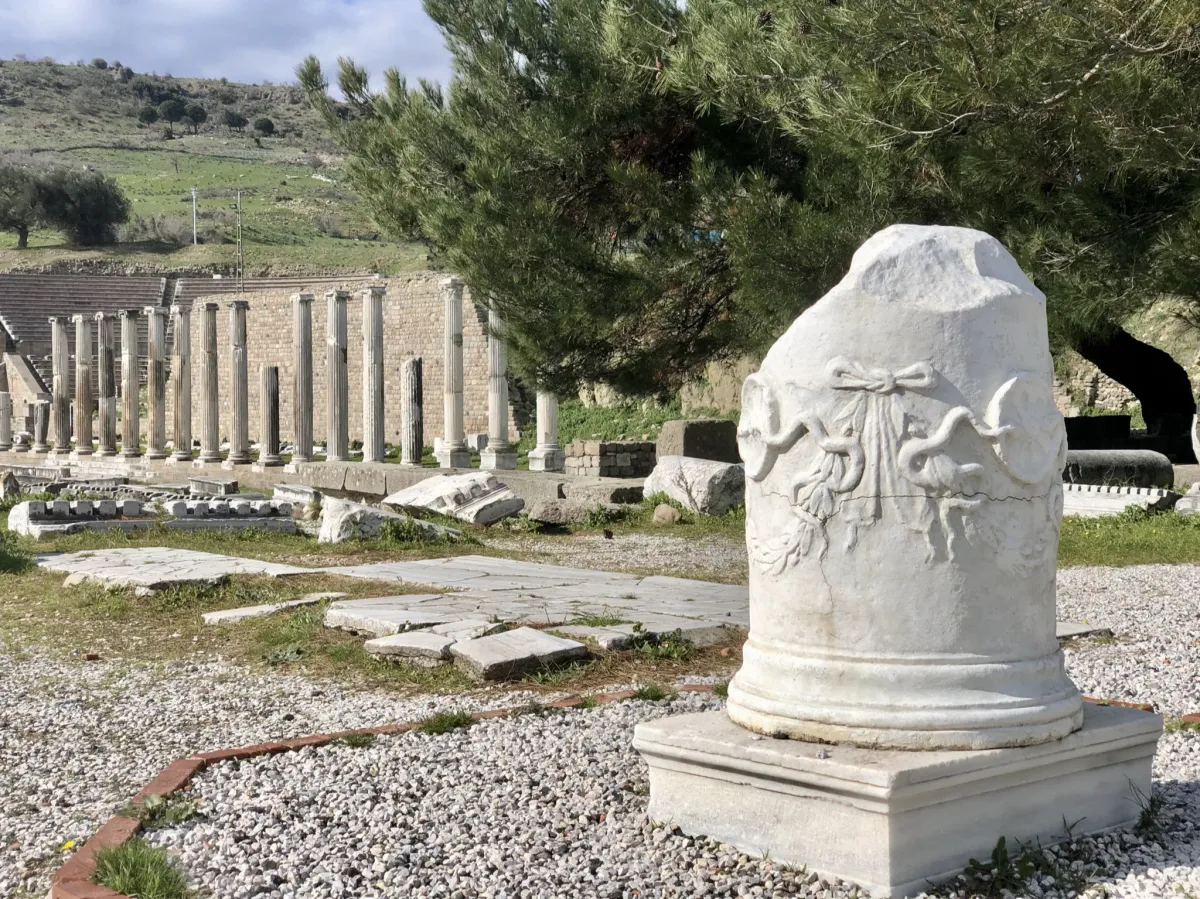
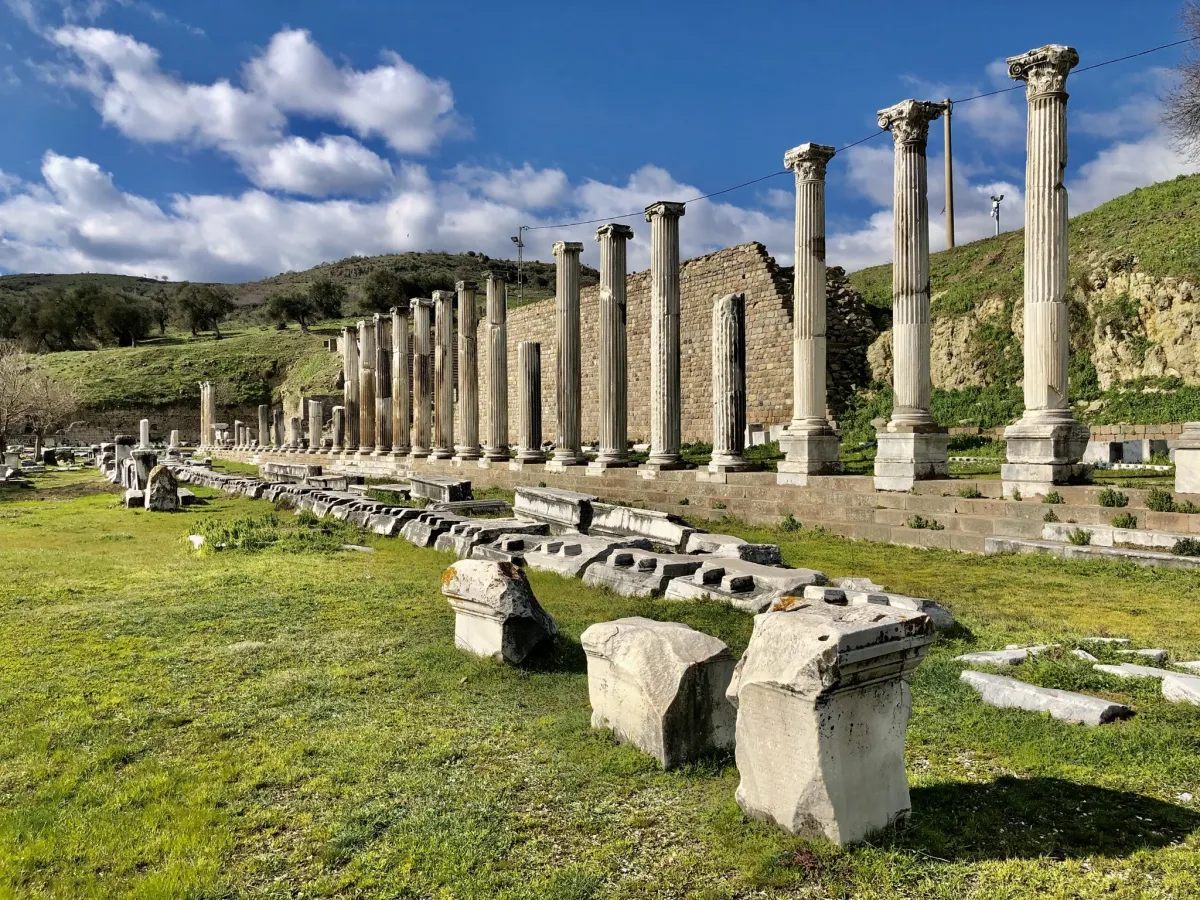
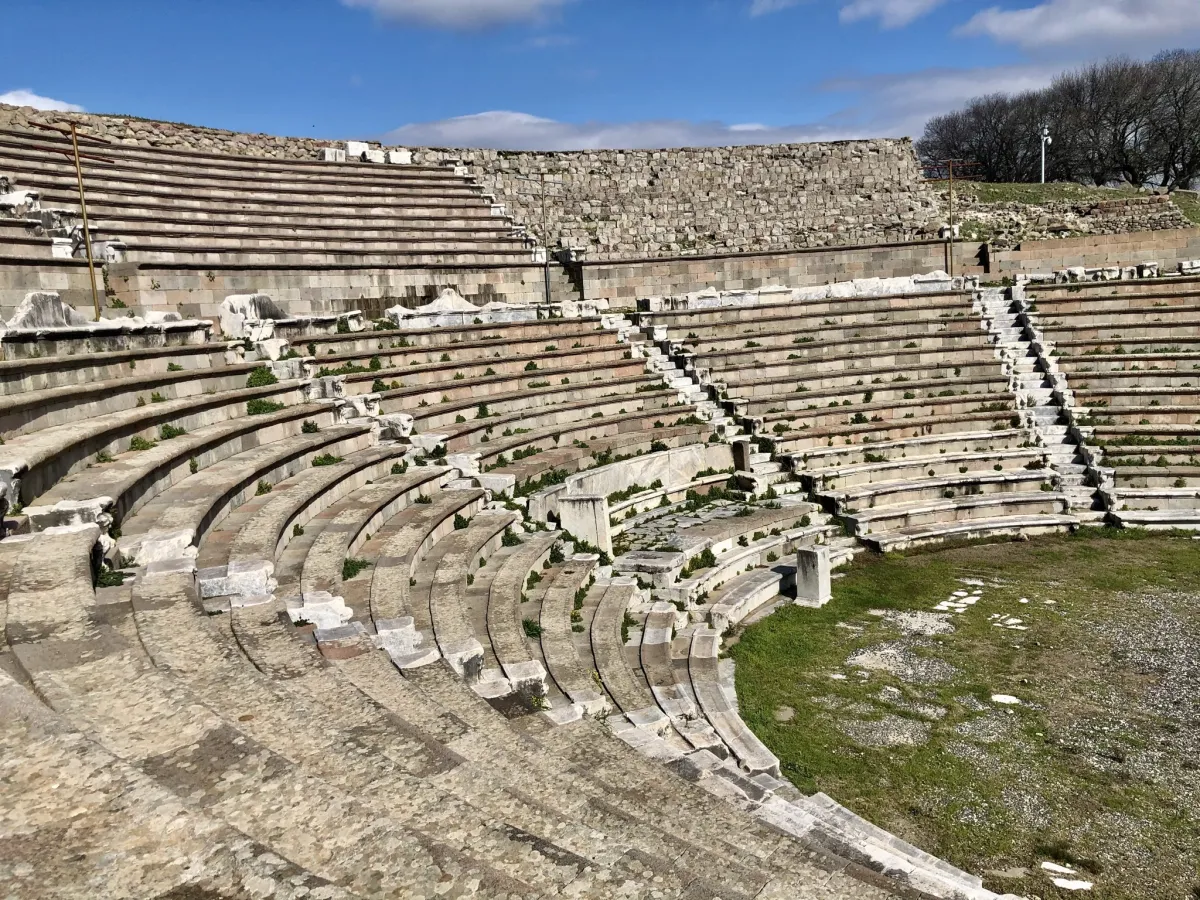
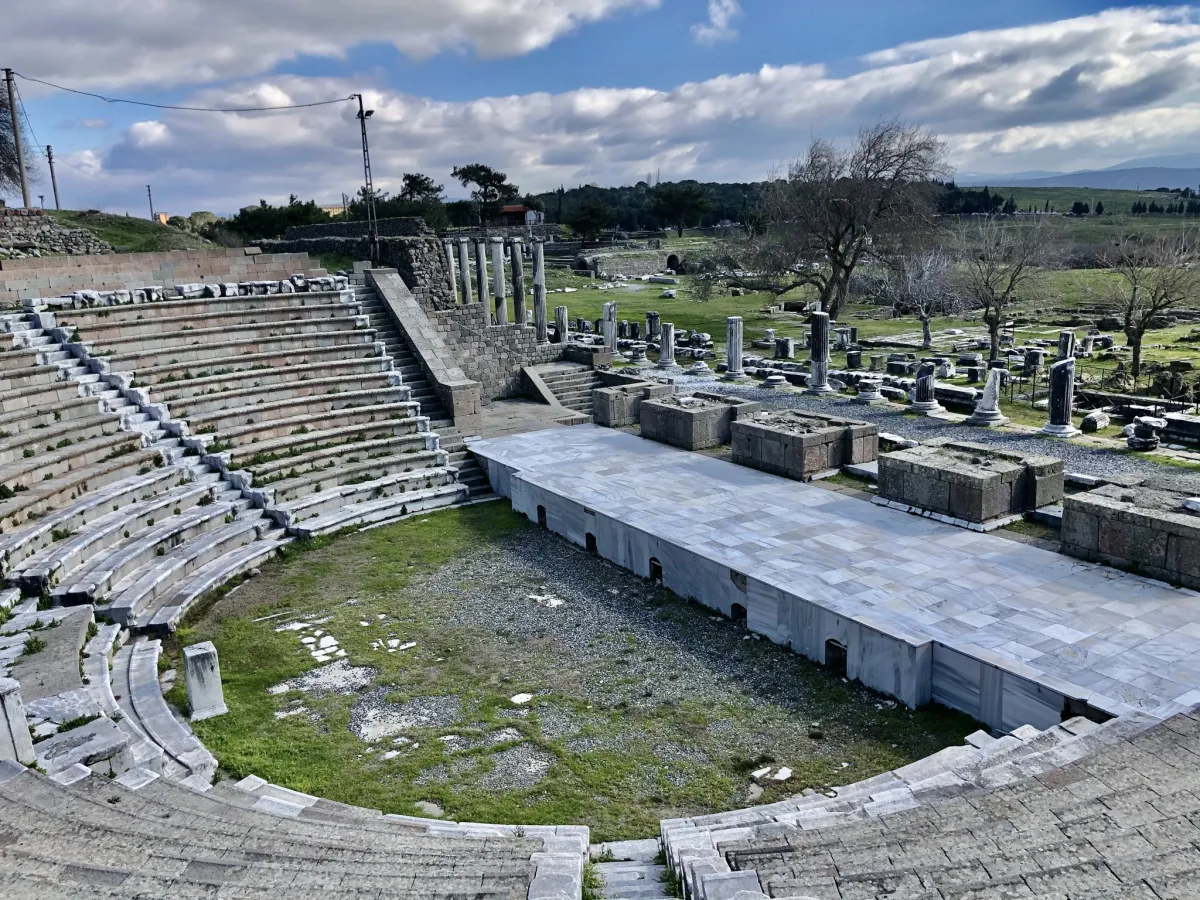
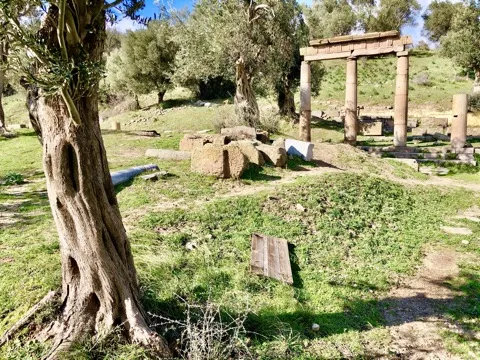
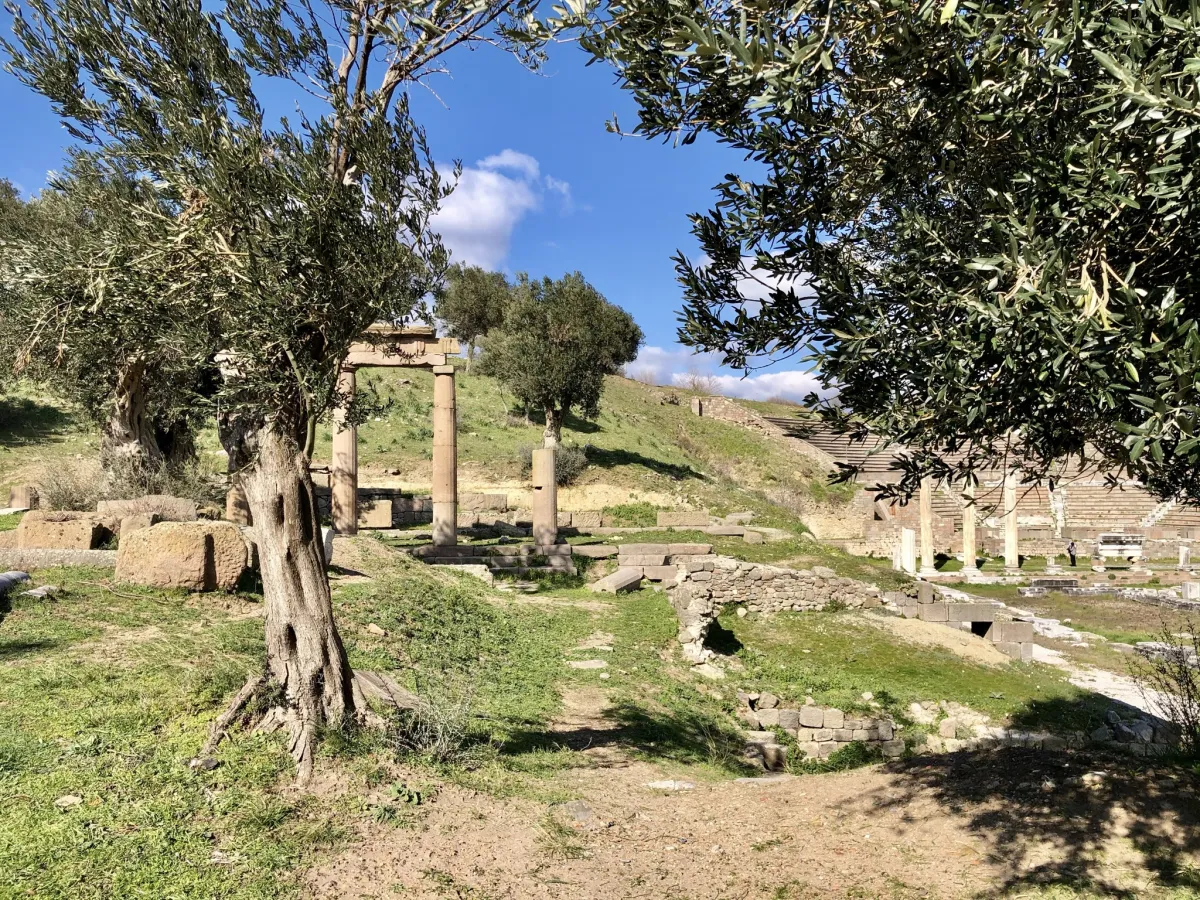
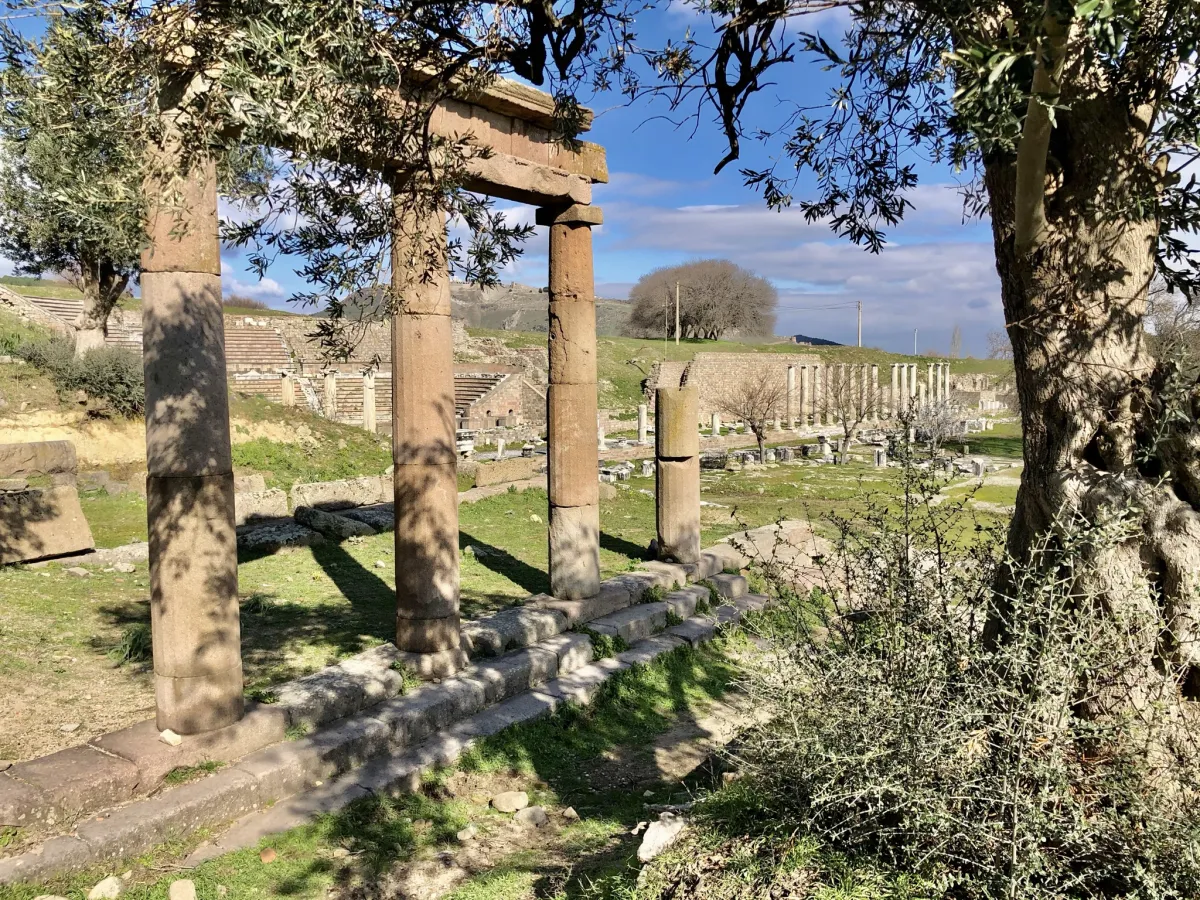
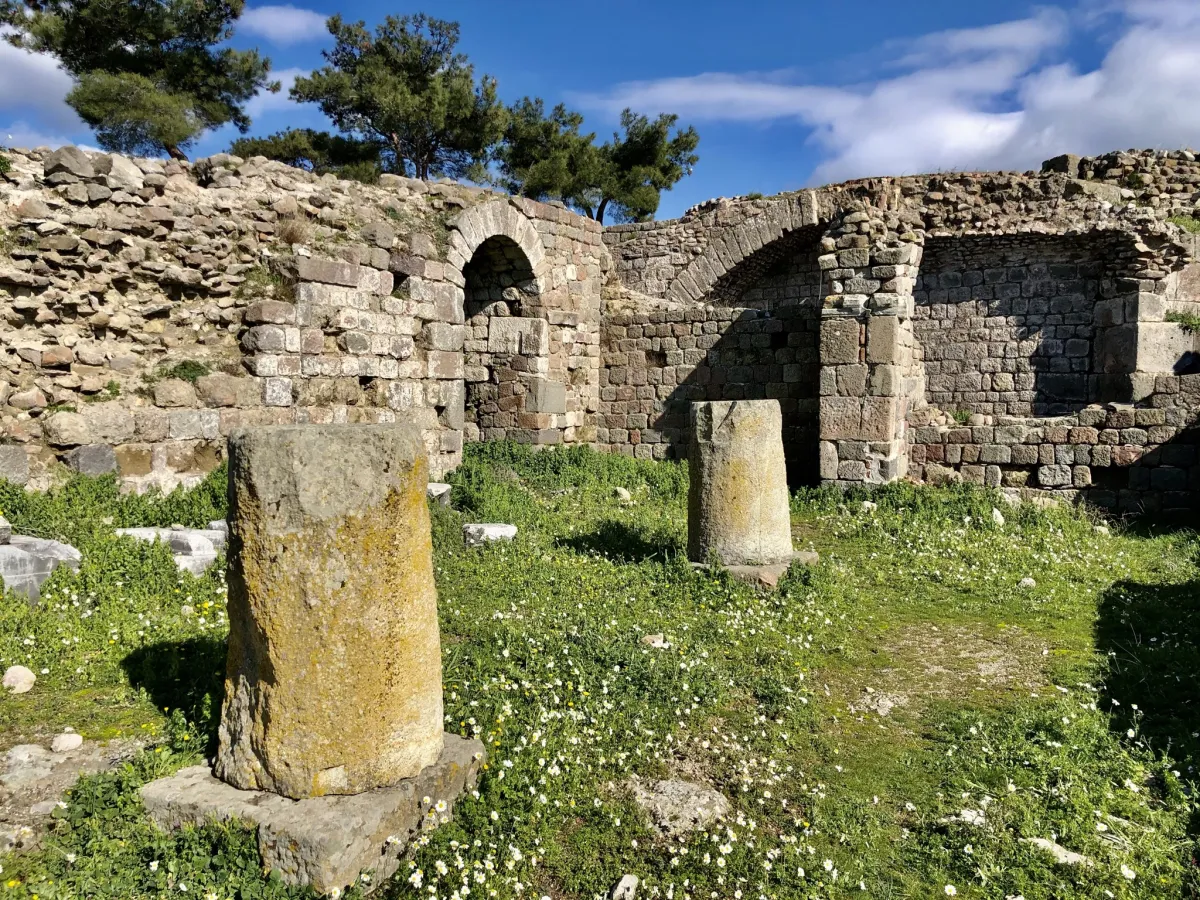
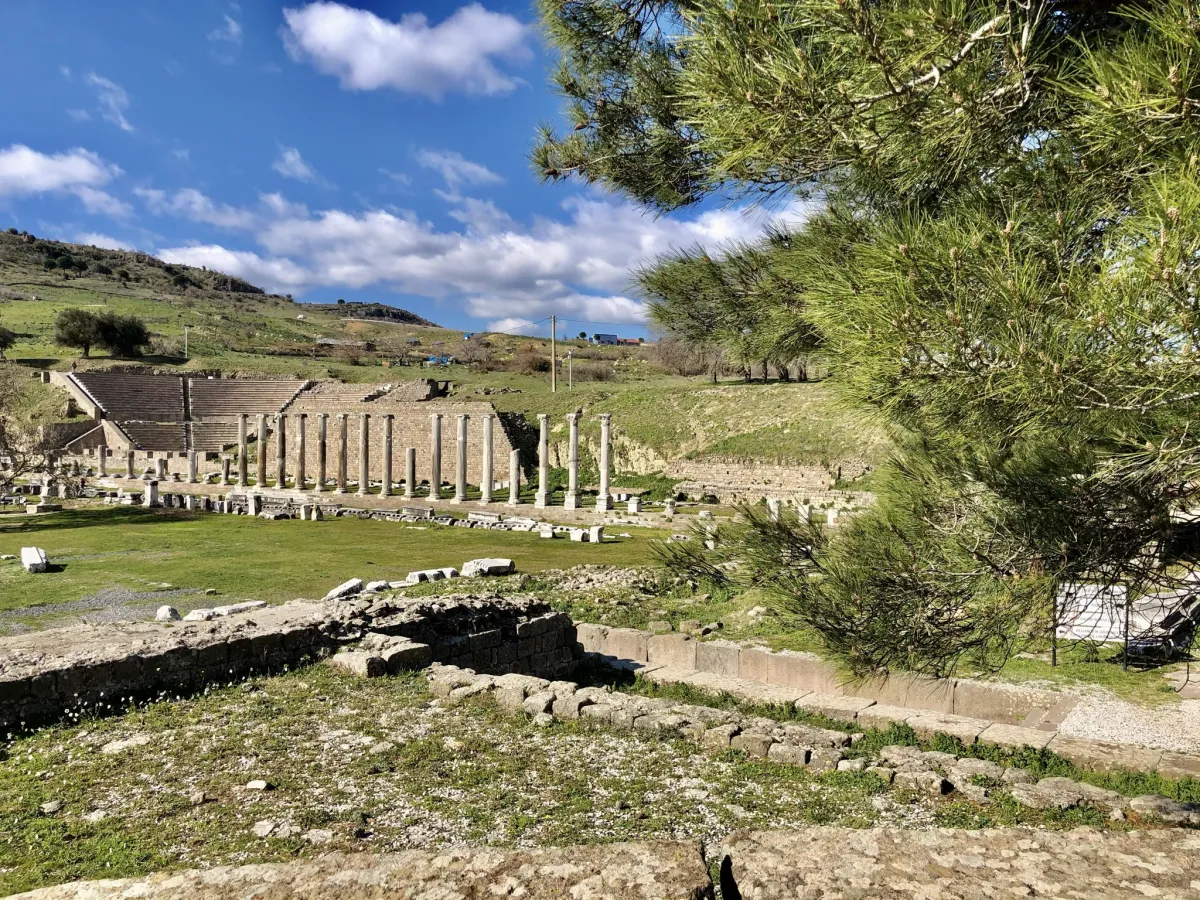
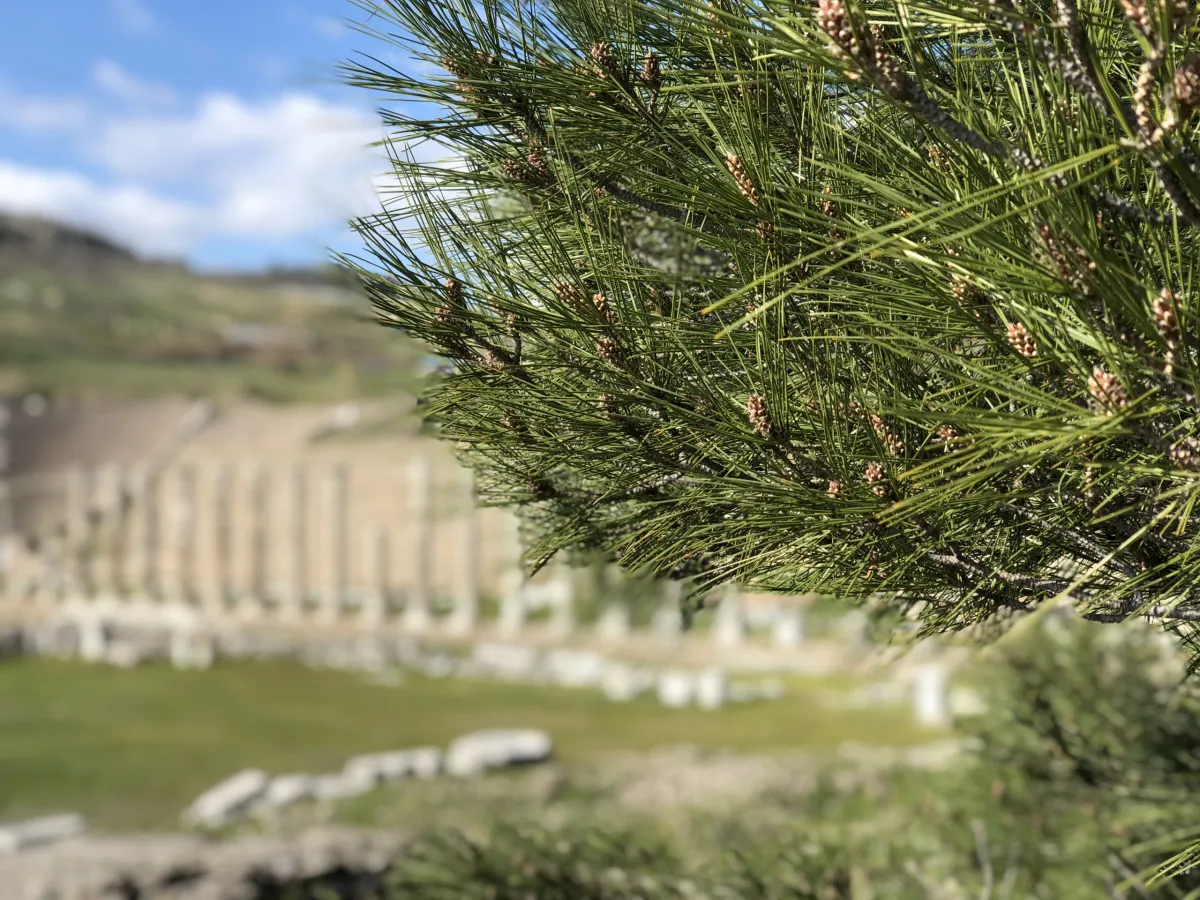 In Pergamon the Asclepieion is a whole medical complex with a library, baths, temples, springs and a theatre. The sacred road Via Tecta connected the Acropolis, the upper city, with the Asclepieion. The main building was the temple of Telesphorus, who was the son of Asclepius and the god of recovery. An interesting architectural solution of the temple in the Asclepieion: although the main building was at almost the same level as the central courtyard, an underground passage led to it, so that patients descended a short flight of steps into a tunnel in order to enter a circular gallery. Here patients could walk in an endless procession round in a circle. Pillars supporting the vault of the gallery divided the space into separate bathing tubs. Sleeping cubicles were located along the sides of the gallery. Yes, in the main temple the patients… slept. The doctors were left only to interpret successfully the dream, which contained the method of treatment. Well, a nice idea. If you were not cured, it was your own fault: you should not have dreamed nonsense.
Galen was born here, lived long and worked here, treating the maimed and dissecting the corpses of gladiators and athletes – a man whose medical works and superstitions were regarded as unshakeable authorities until the 16th century.
About forty aqueducts provided Pergamon with a large supply of water even up to the acropolis, which stood on the top of an isolated hill. Roman engineers managed to create such pressure conditions that the water reached a cistern located at the highest point of the acropolis. Sections of the aqueducts and of the amphitheatre can be seen in the countryside just beyond the Lower City.
Turkish Bergama
In Turkish Bergama there are three more huge burial mounds in the middle of the old town.
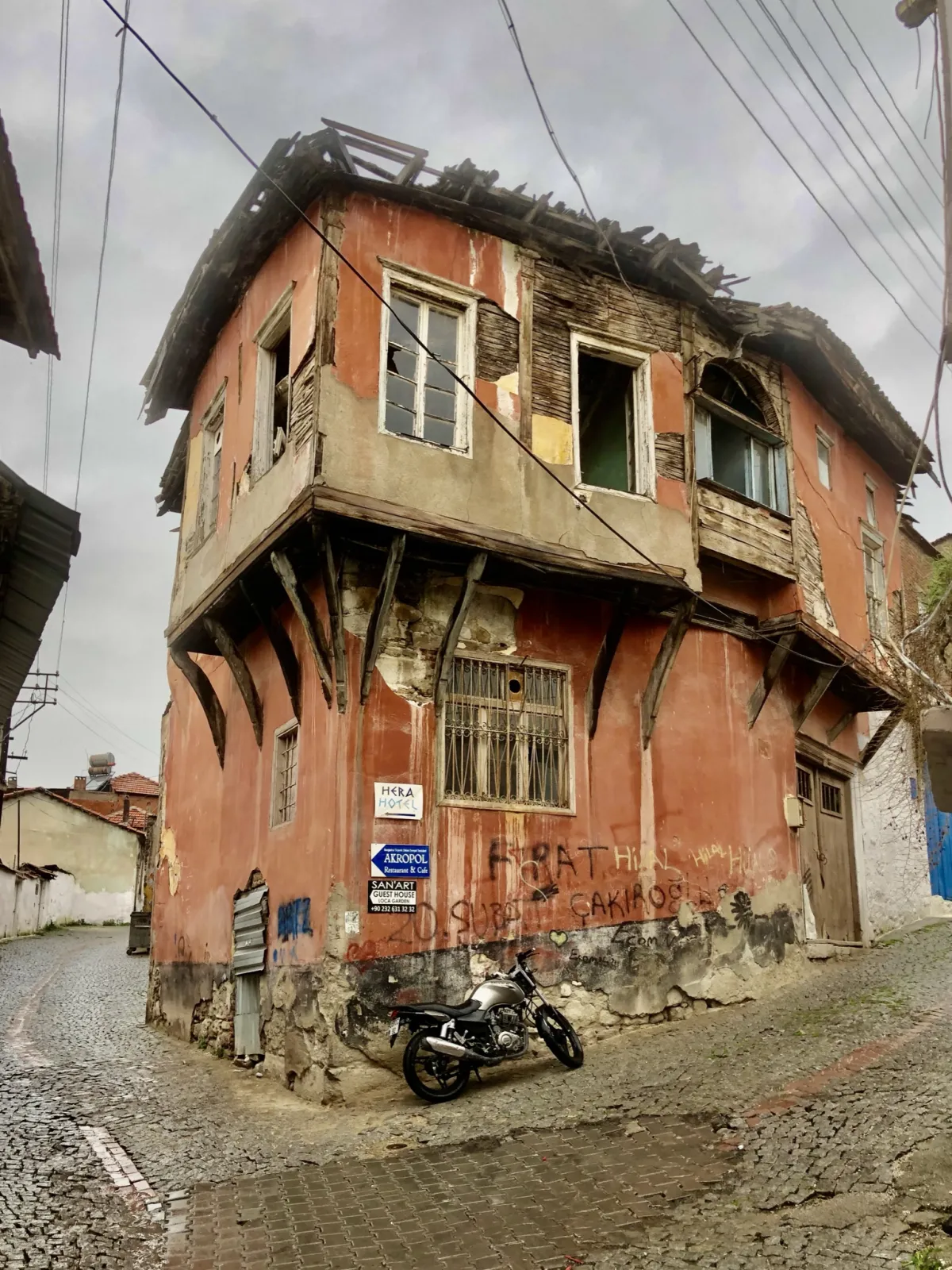
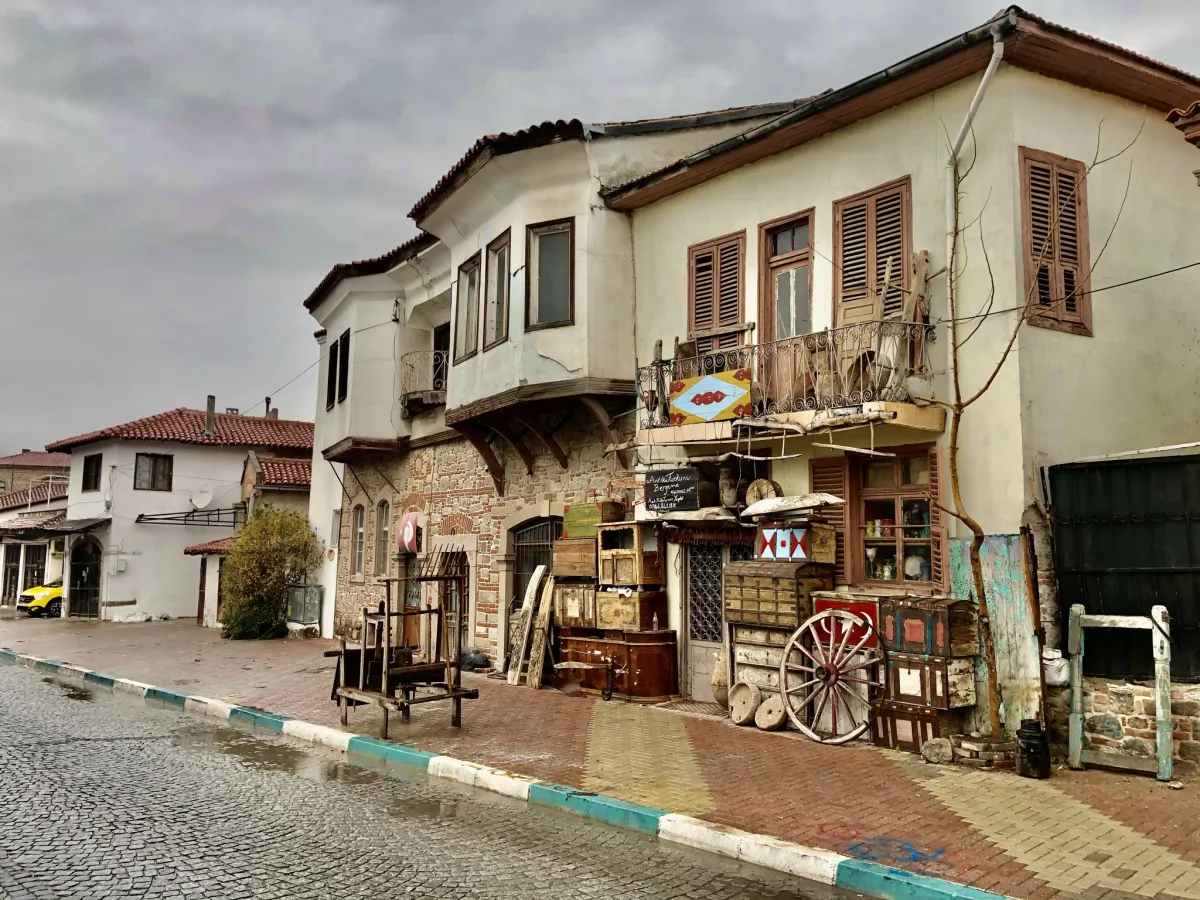
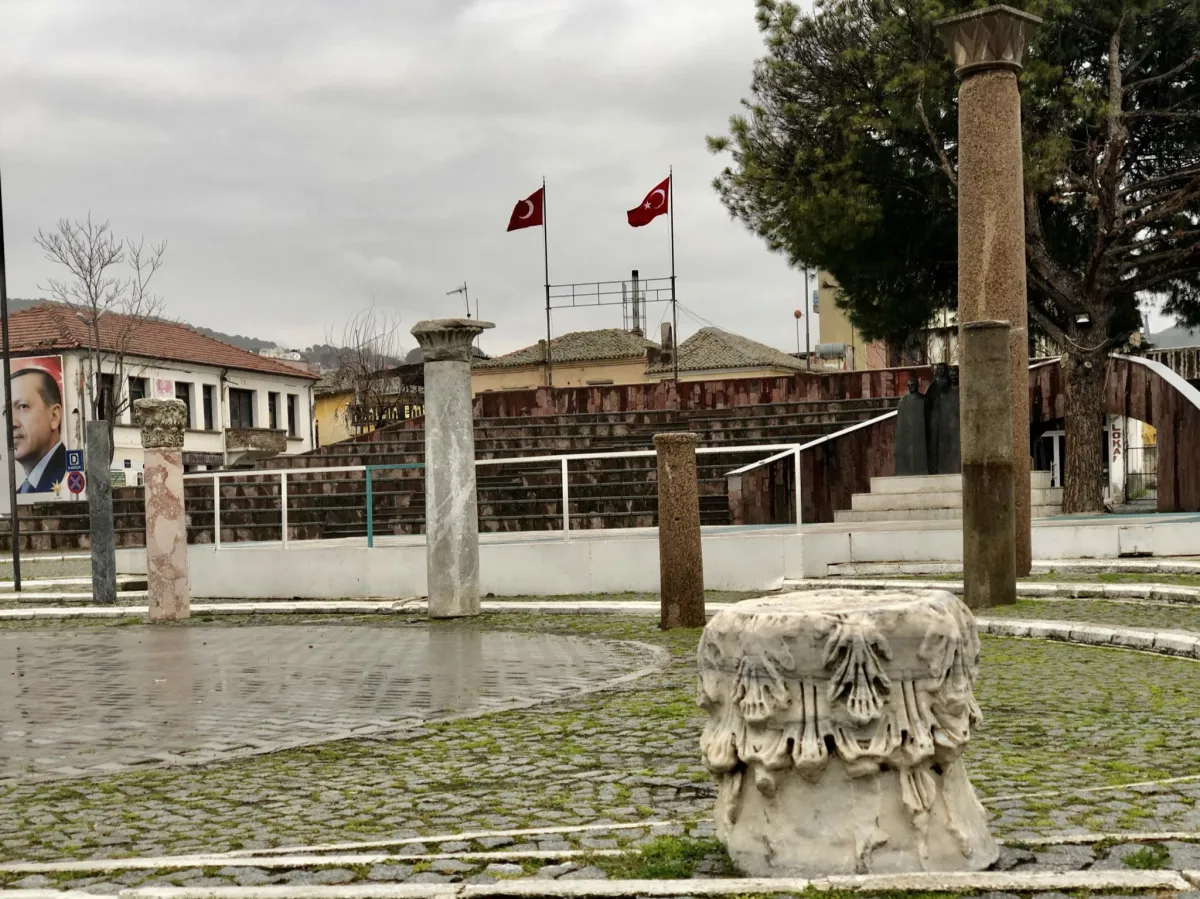
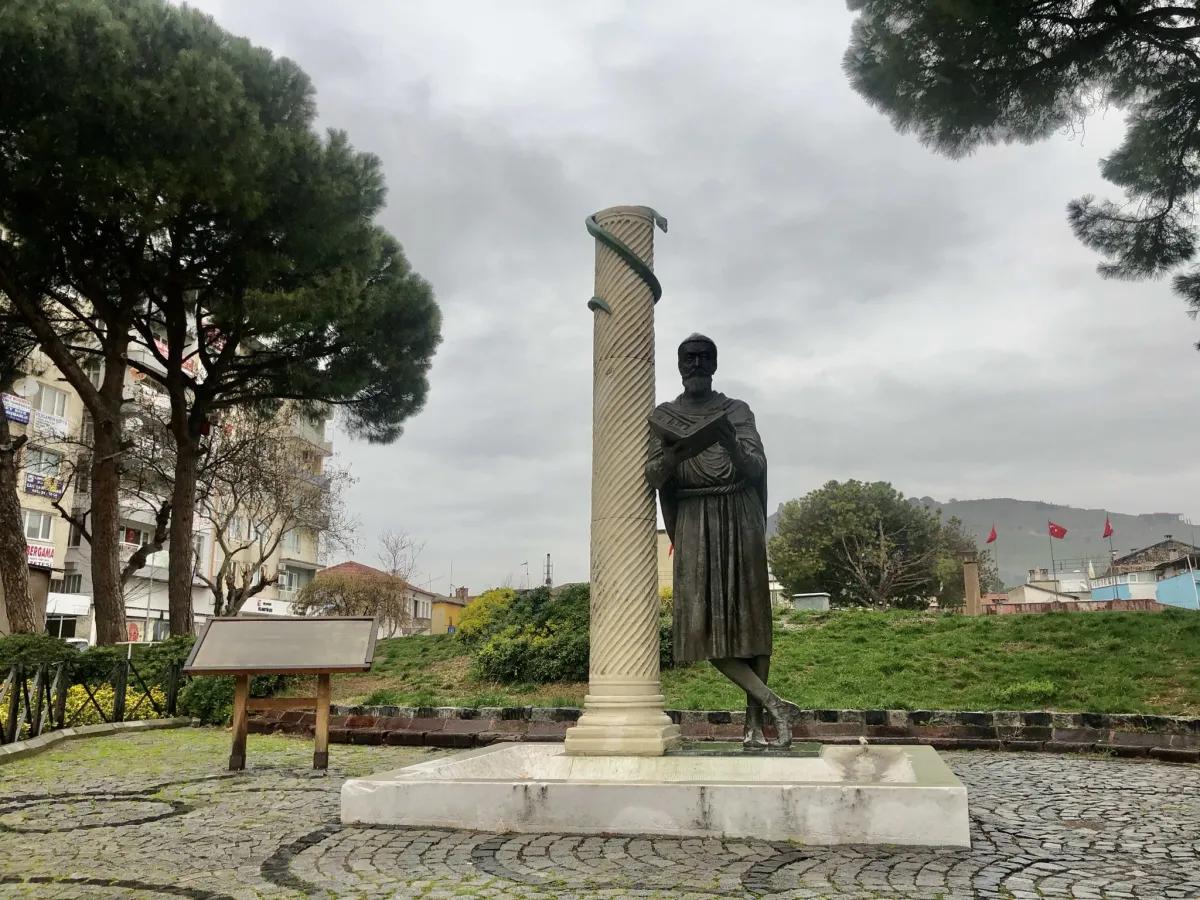
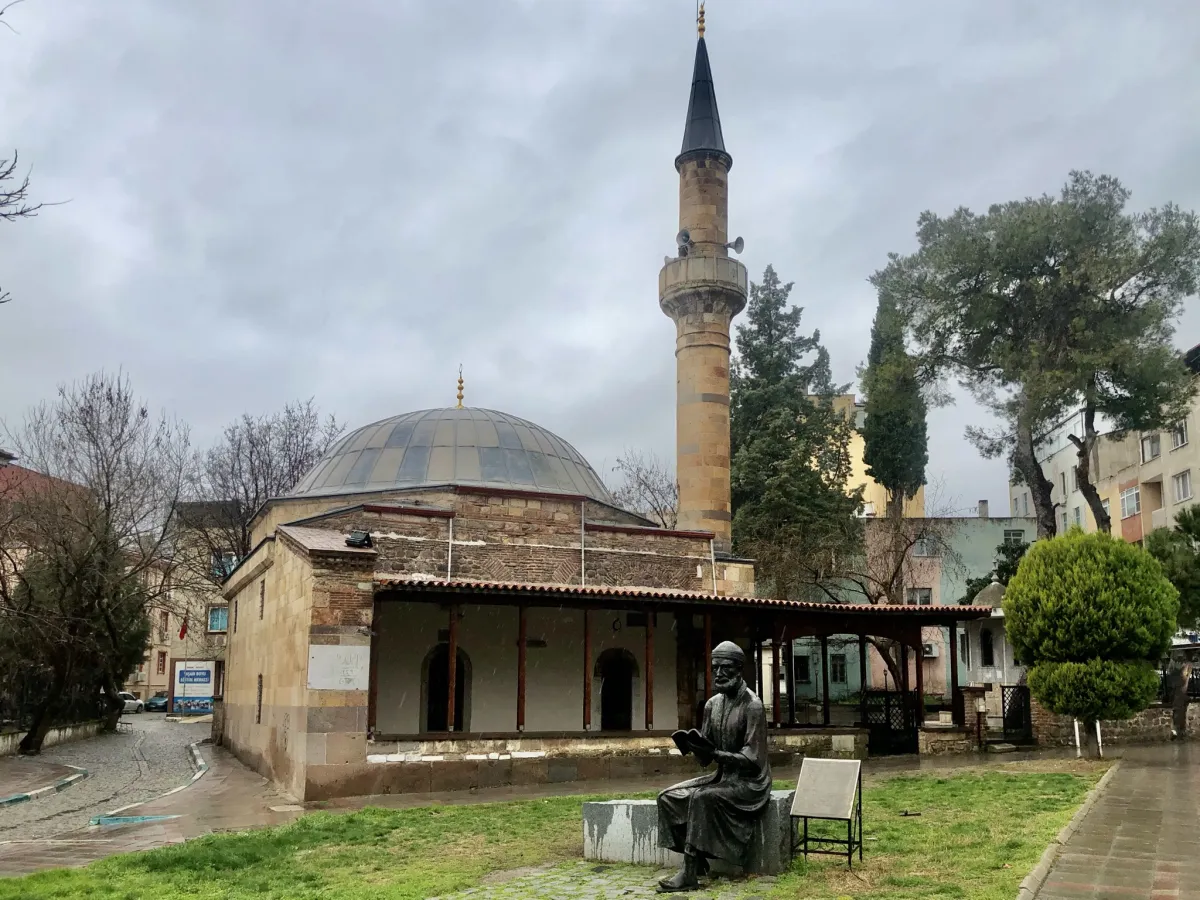
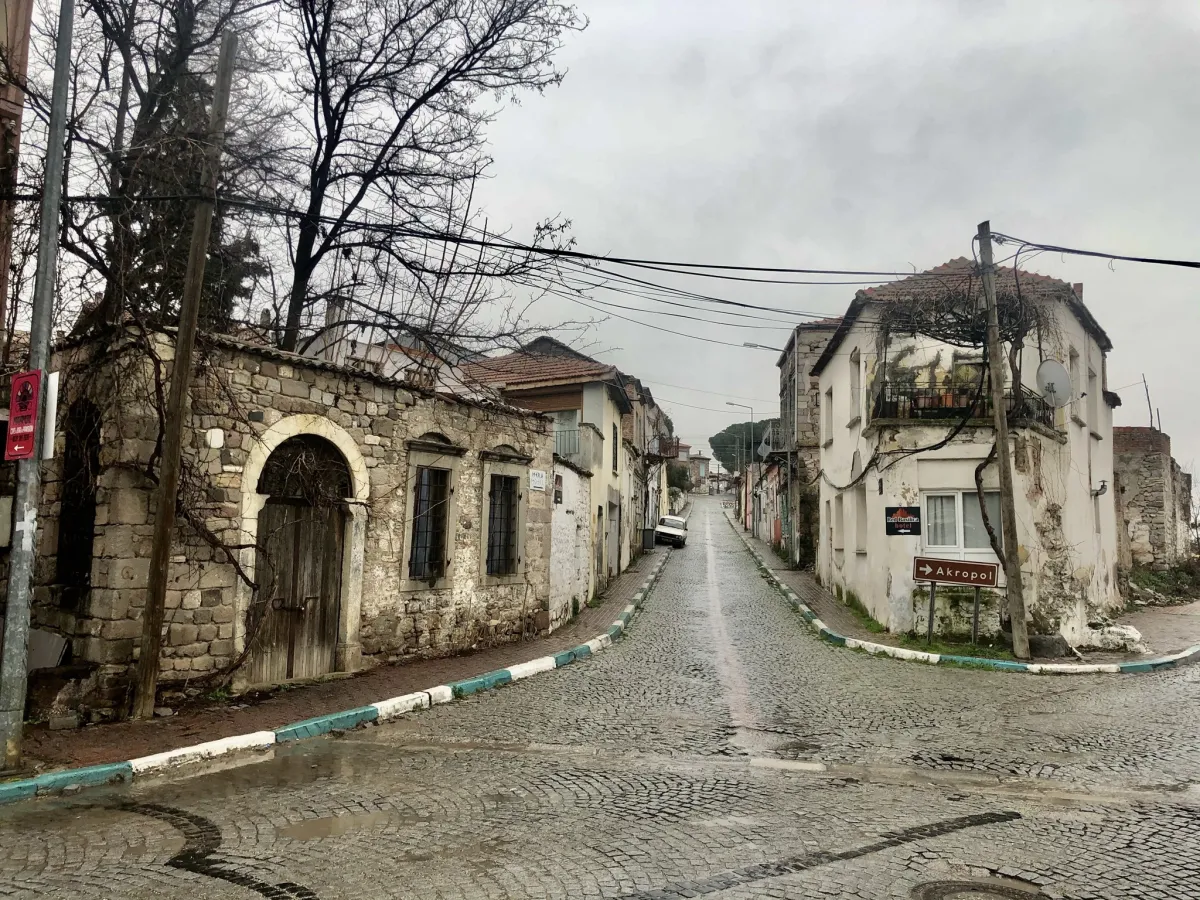
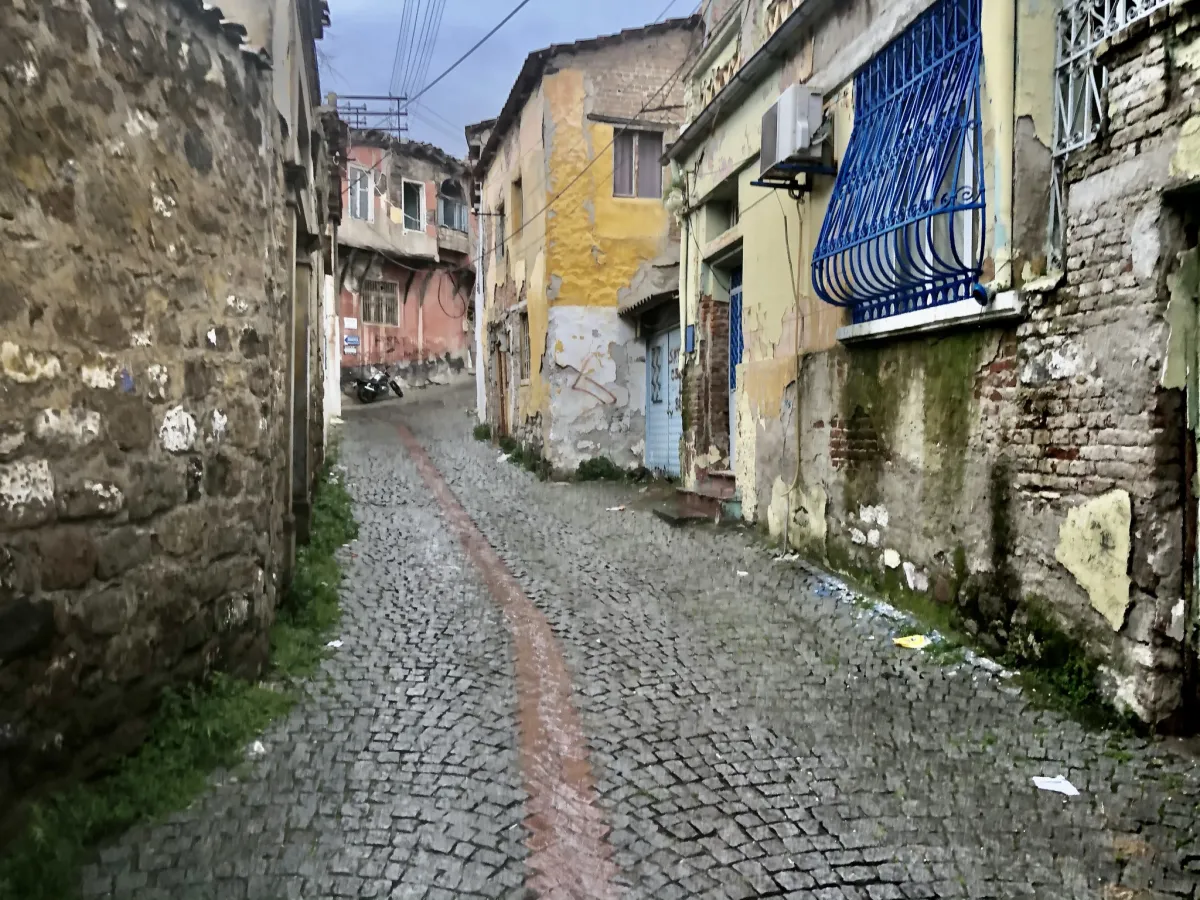
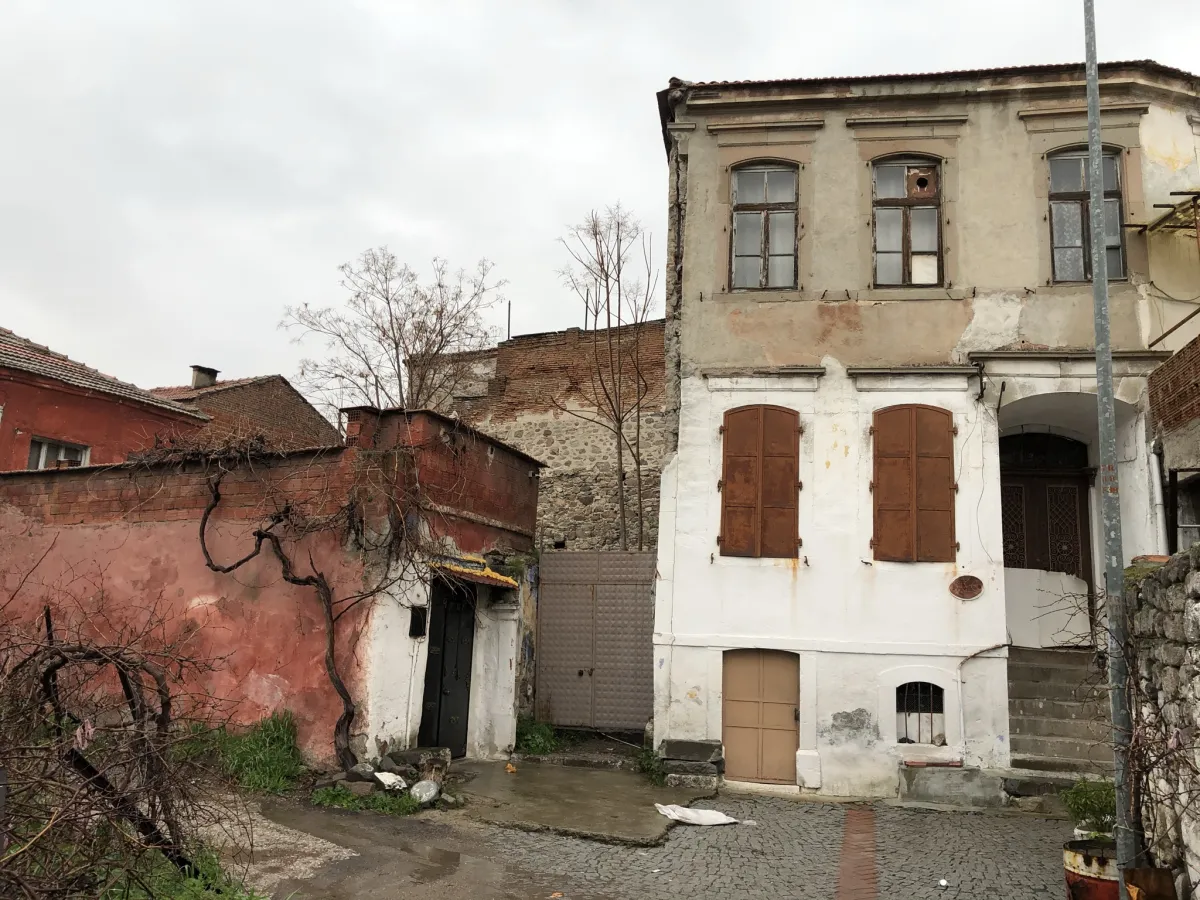
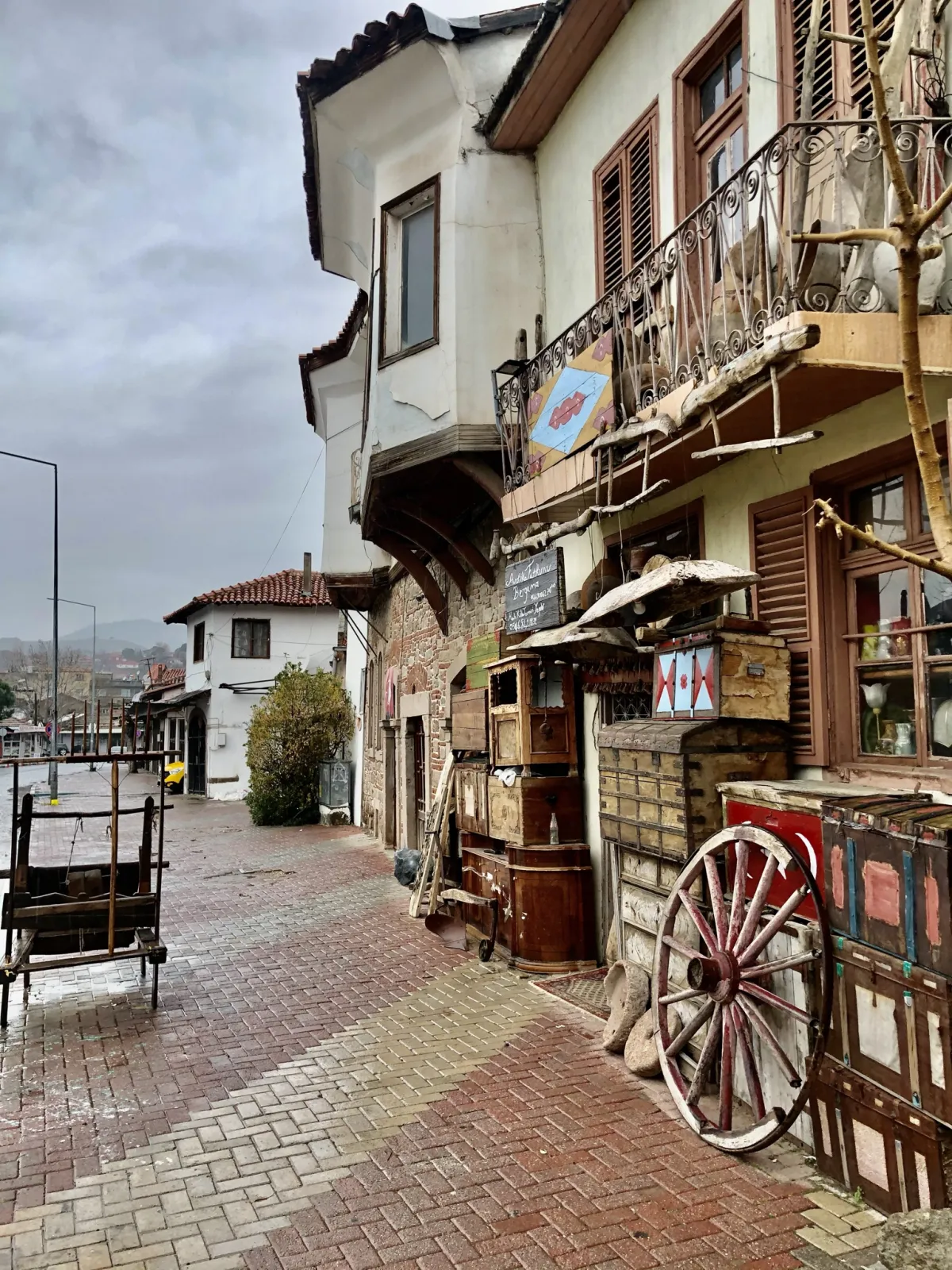
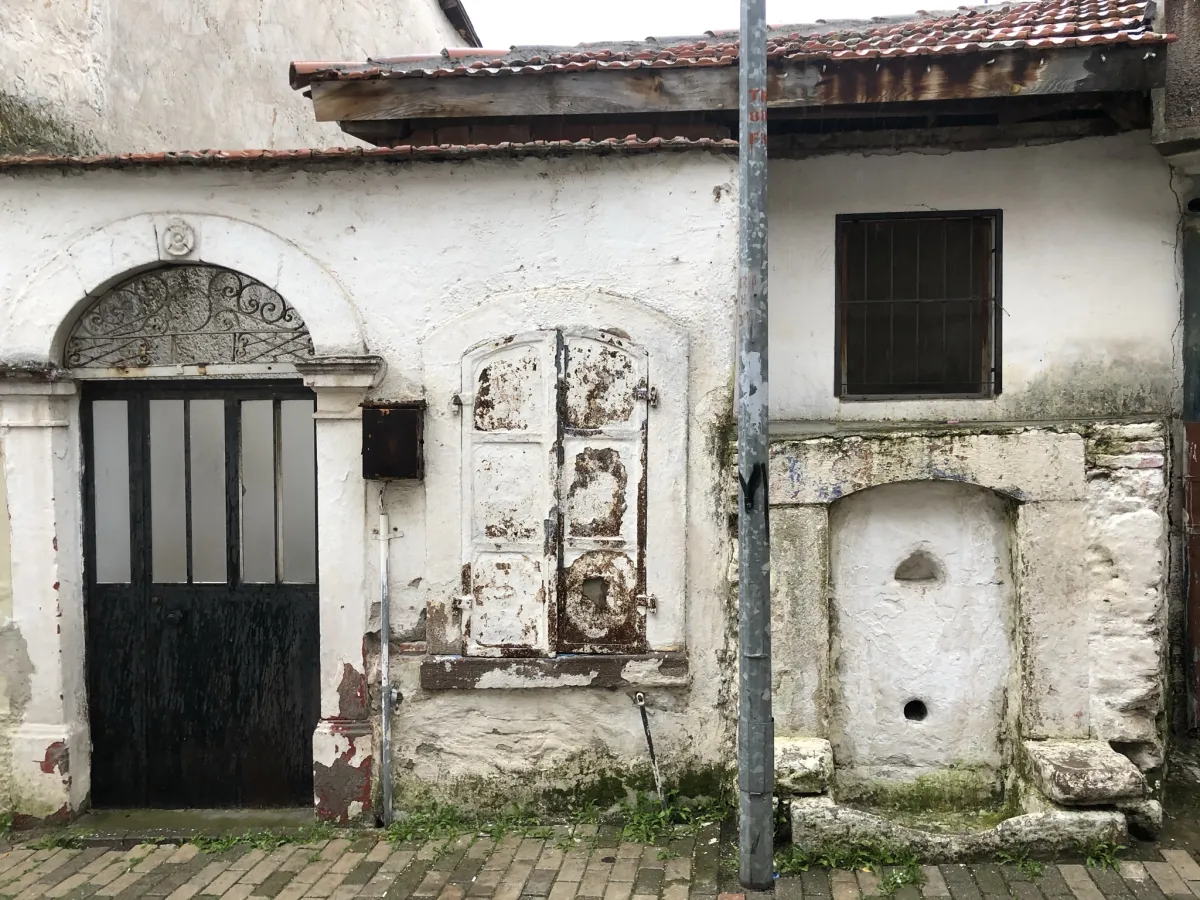
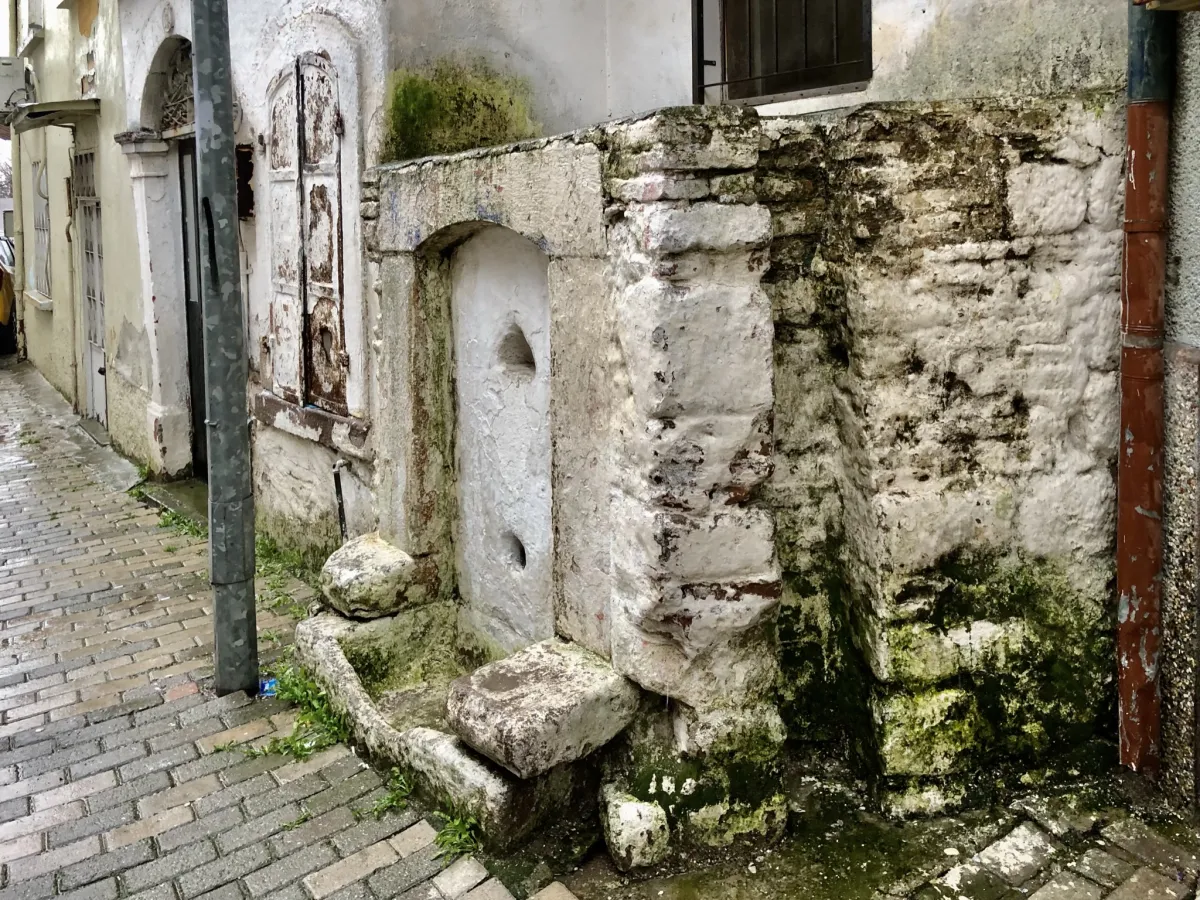
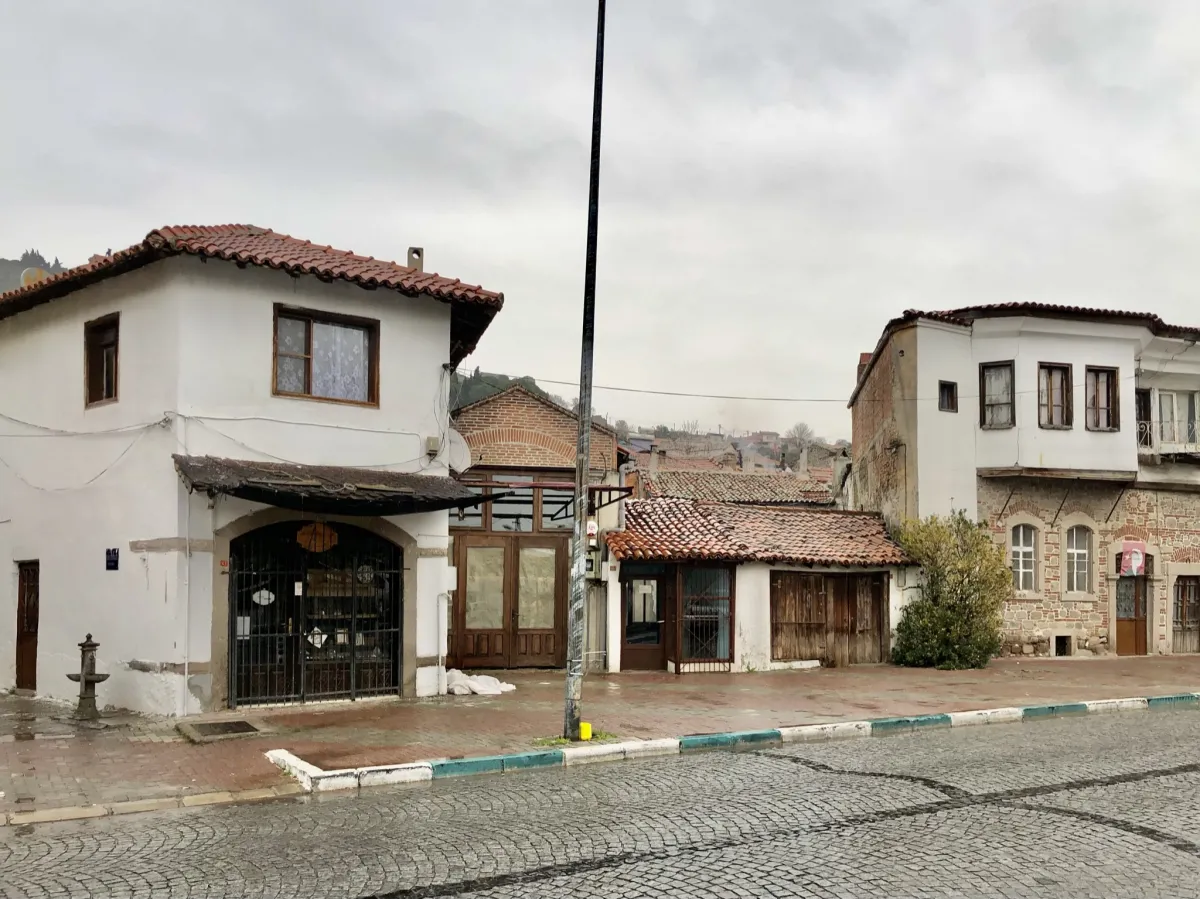
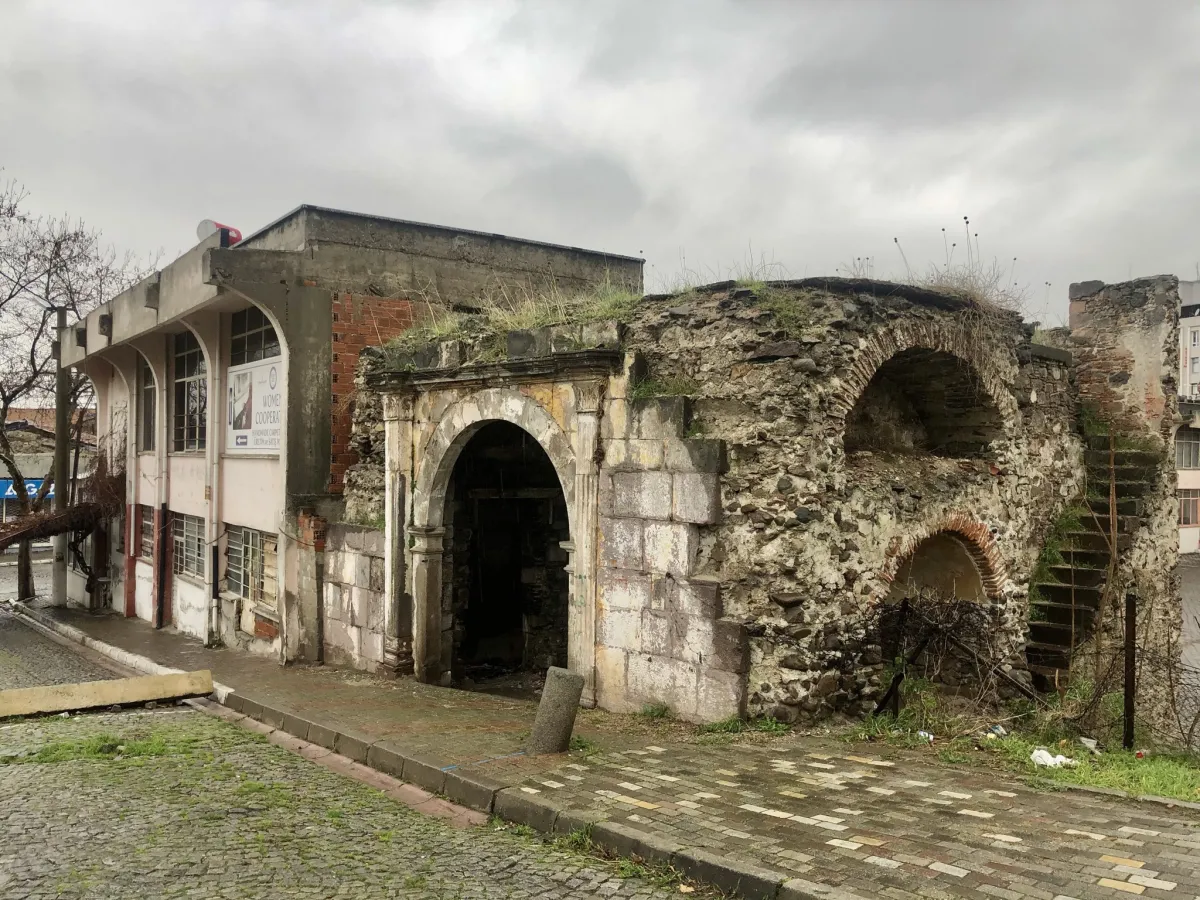
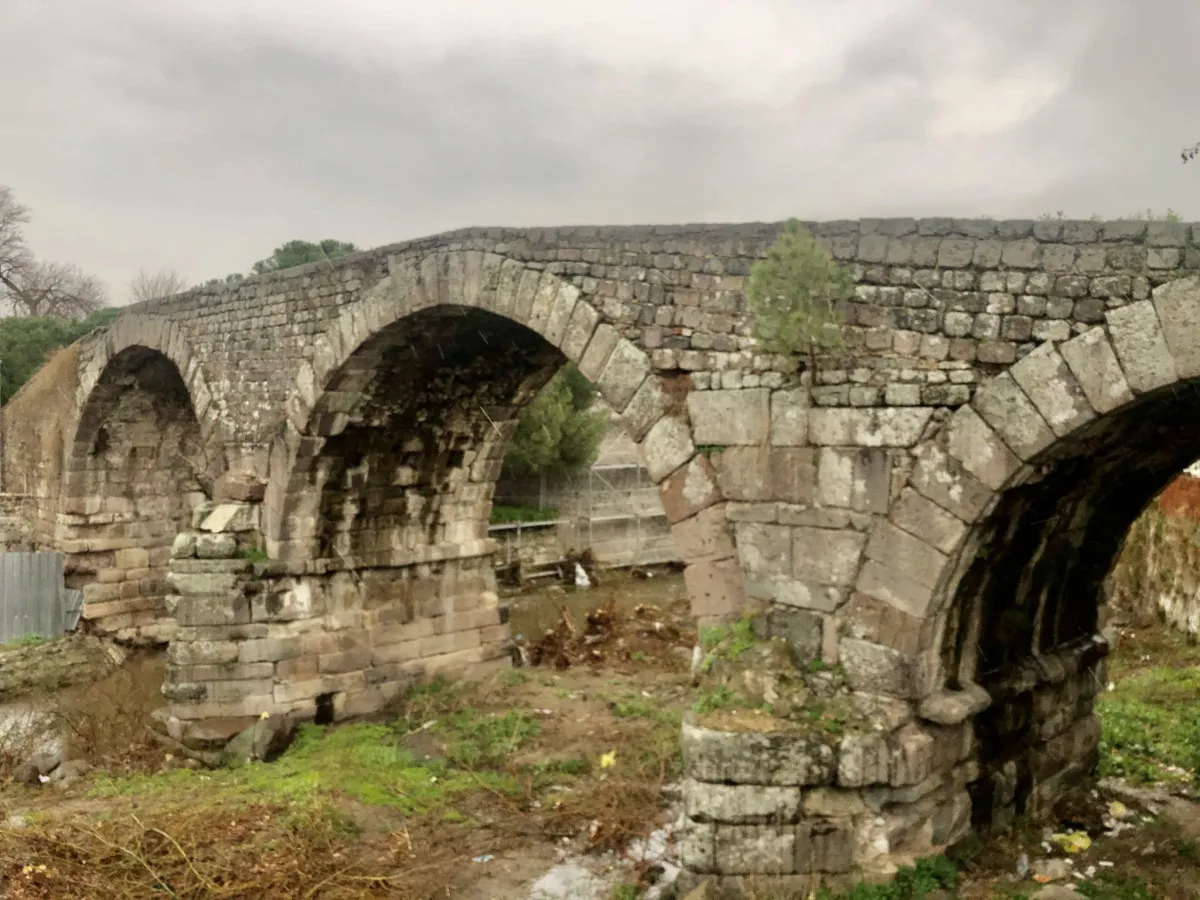 The area between the river and the Acropolis is built up with old Ottoman houses, small mosques, and shops selling carpets and copperware.
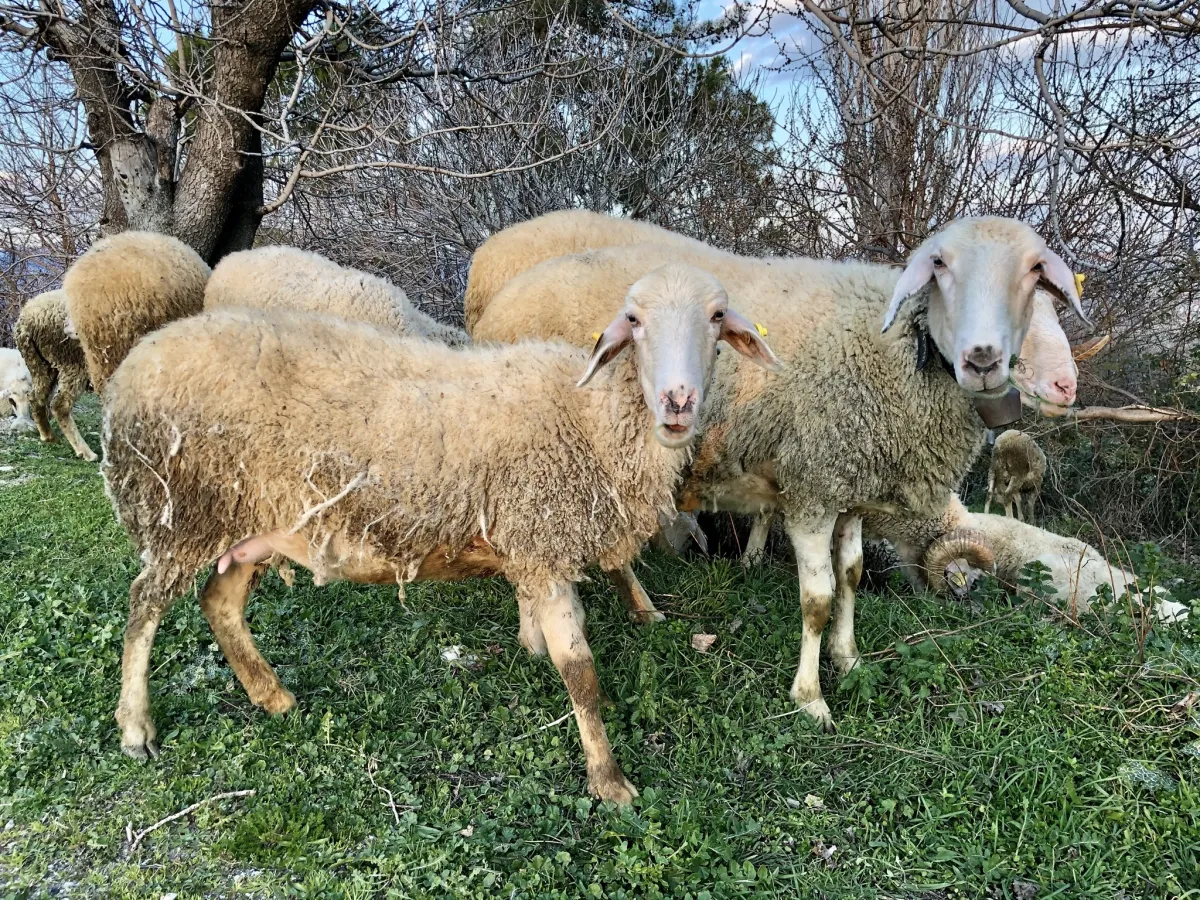
There wanders a source of resources for parchment, but rather for köfte.
Text and photos by Serhii Shcherbii