Kuşadası, or Bird Island
· 25 min read
The name is truthful: a small islet, now connected to the shore by a causeway to the delight of tourists, and there are birds of all kinds, living, stone, concrete and metal. Within an easy drive: Ephesus, the House of the Virgin Mary, Izmir, Pamukkale, Şirince, Miletus, Didyma and another dozen or so ancient ruins.
Kuşadası lies on the shore of the Aegean Sea on the west coast of Turkey. This place differs somewhat from the south coast of Turkey, where Antalya and Alanya are. So what are the differences? The Aegean Sea is very picturesque. It is full of large and small islands, mostly belonging to Greece. The Greek island of Samos, the homeland of Pythagoras, is right next door, but we are not expected there at the moment. The coastline itself is also very indented, with many small bays and peninsulas. Divers say that the turquoise water is very clear and practically not inferior in transparency to the water of the Red Sea. On the Aegean Sea the sunset is very beautiful: the sun sets straight into the sea, beyond the horizon, colouring the water, sky, islands and mountains in reddish shades. The resorts of the south coast of Turkey face south, where the sun hides behind the mountains.
As in any piece of land in Asia Minor, everyone has managed to be here. The port and town of Kuşadası flourished after the decline of Ephesus in late antiquity and the early Middle Ages. Until the 15th century the town was a trading centre of the Genoese republic, until it was captured by the Ottoman Empire.
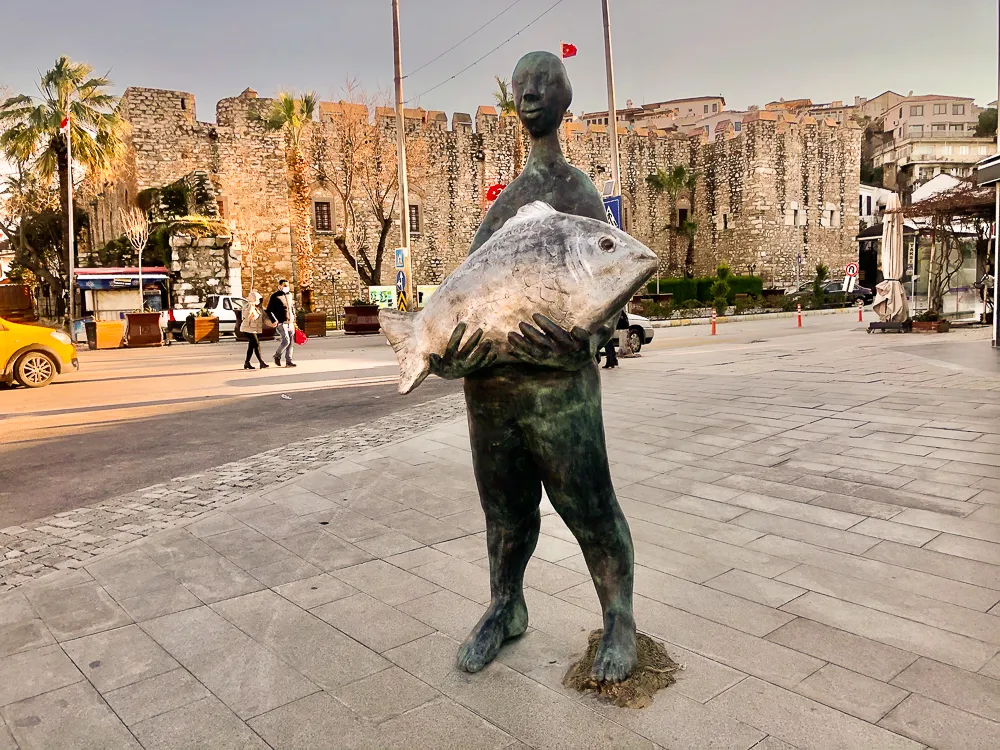
There is a small caravanserai, Öküz Mehmet Paşa Kervansarayı, which, as is typical of these buildings, resembles a fortress for protecting merchants and their goods from robbers, with high walls with loopholes and sharp merlons at the top. This building was built at the beginning of the 17th century in the centre of the town, as one can guess from the name, by Mehmet Pasha, when the town was a large port on the shore of the Aegean Sea. Inside the caravanserai has two floors. On the second floor the guests themselves lived, on the lower one livestock and goods were kept. The inner courtyard, like modern hotels, has a fountain and lush greenery. There are two entrances, one from the sea side, the other from the pedestrian zone of Barbaros Boulevard, to which we will return. The Kuşadası caravanserai lost its significance and fell into disrepair. The city authorities fully restored it in the middle of the 20th century and opened a hotel here, in which US President Jimmy Carter stayed during his trip to ancient Ephesus.
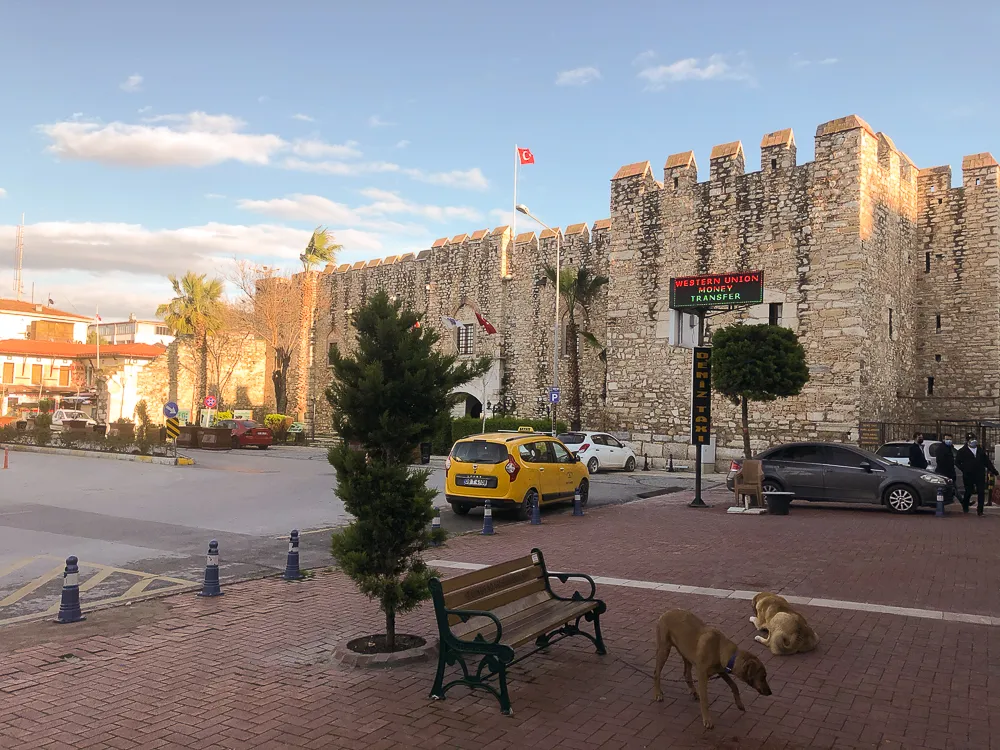
The pedestrian quarter of the old town has been preserved in the city, beginning at the embankment of the Sea Cruise Port and the fish market and extending into the town.
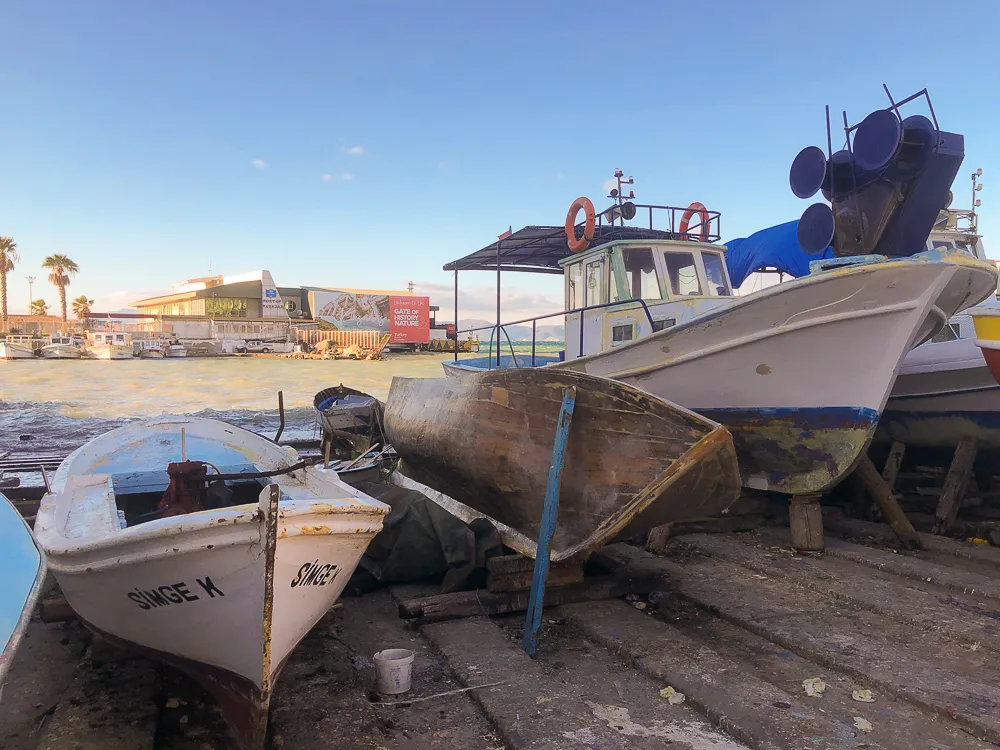
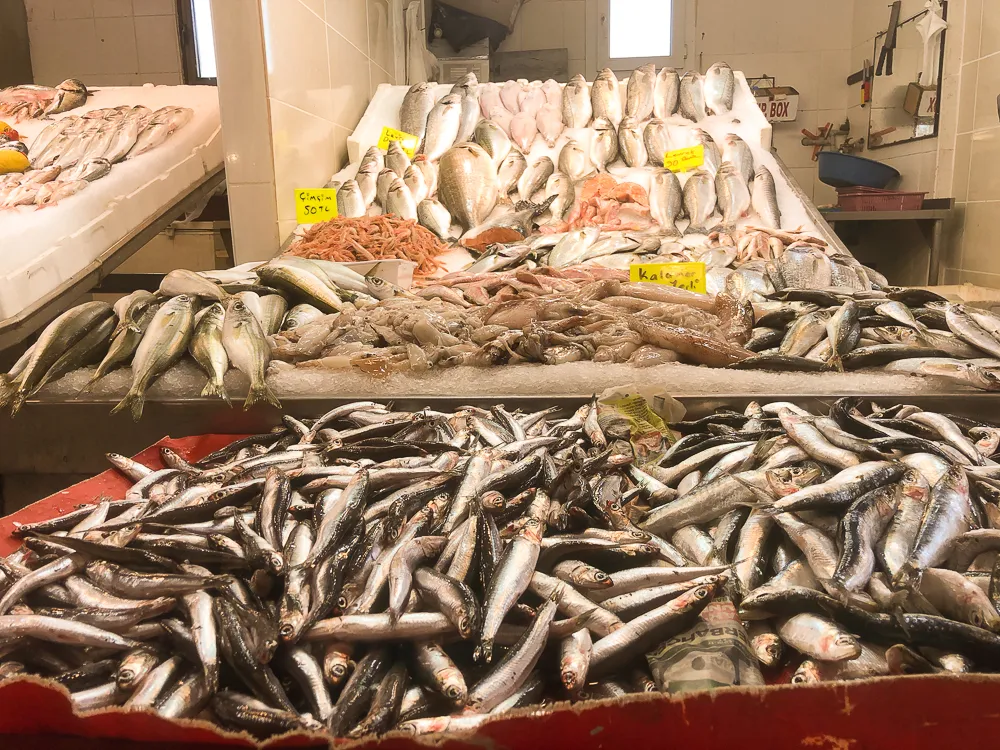
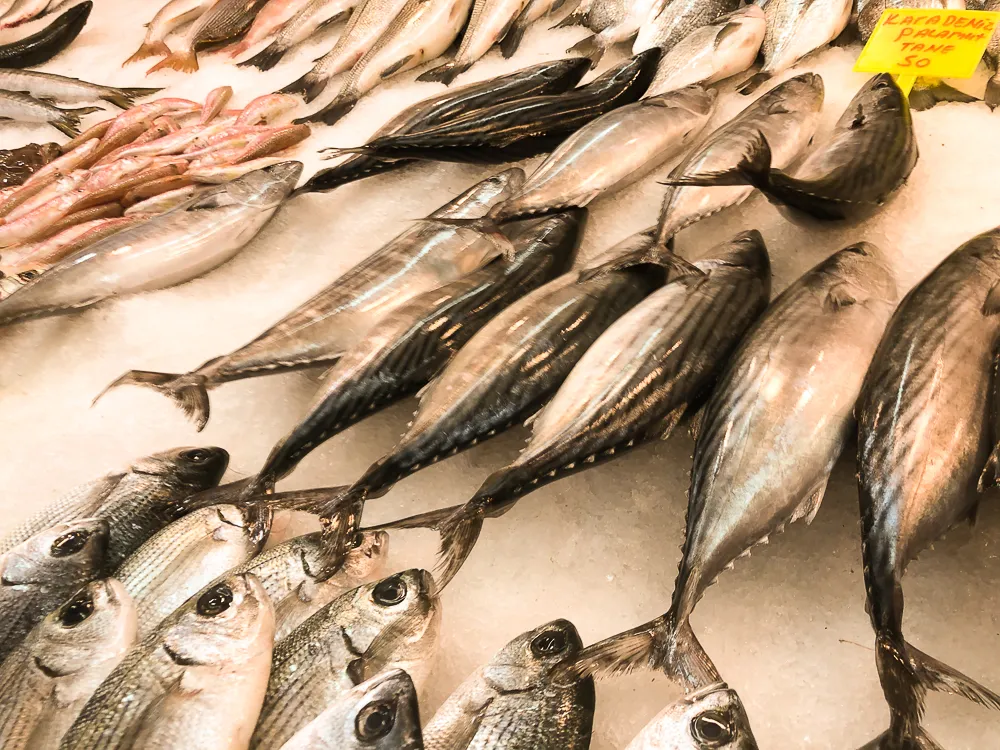
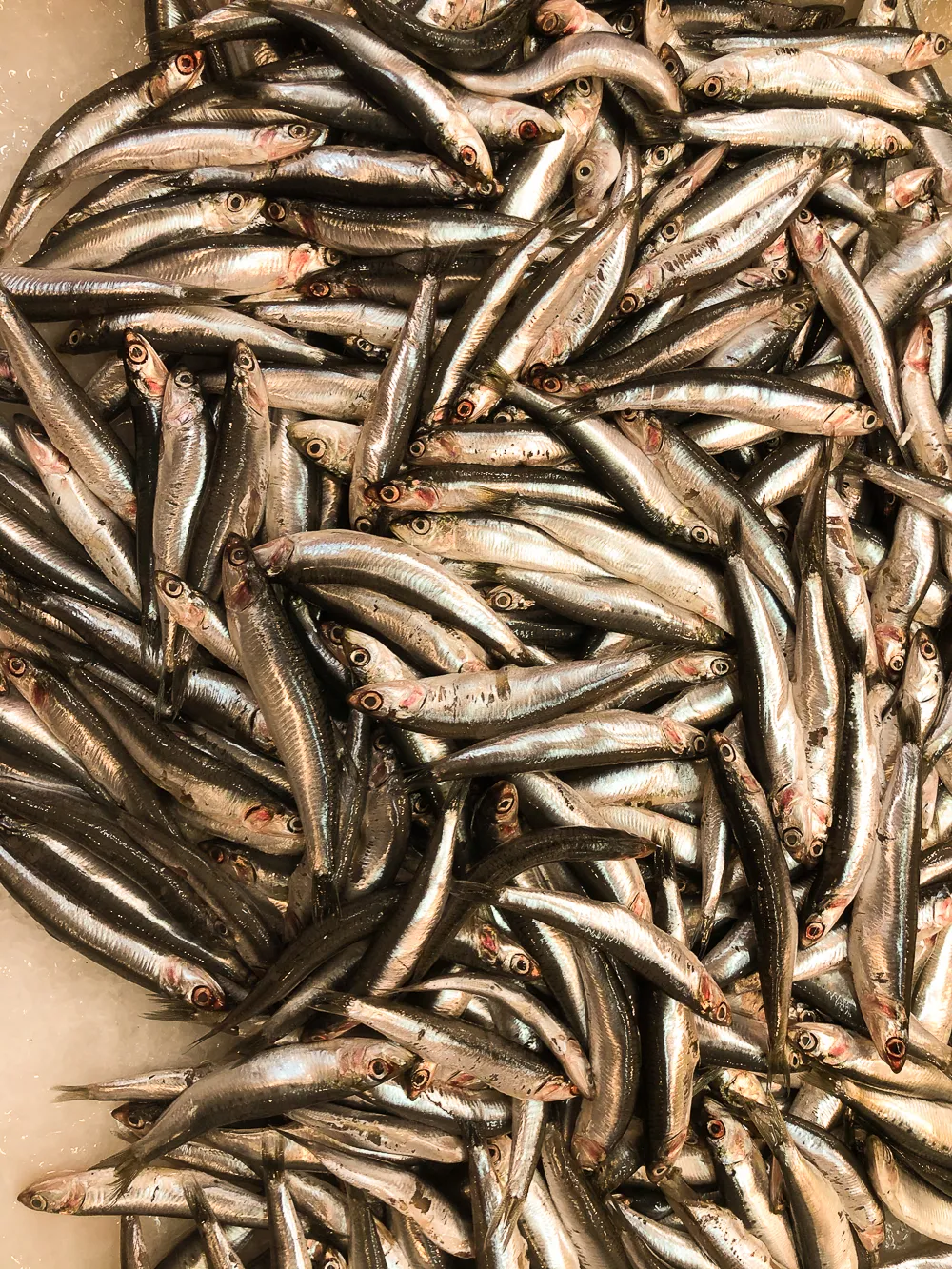
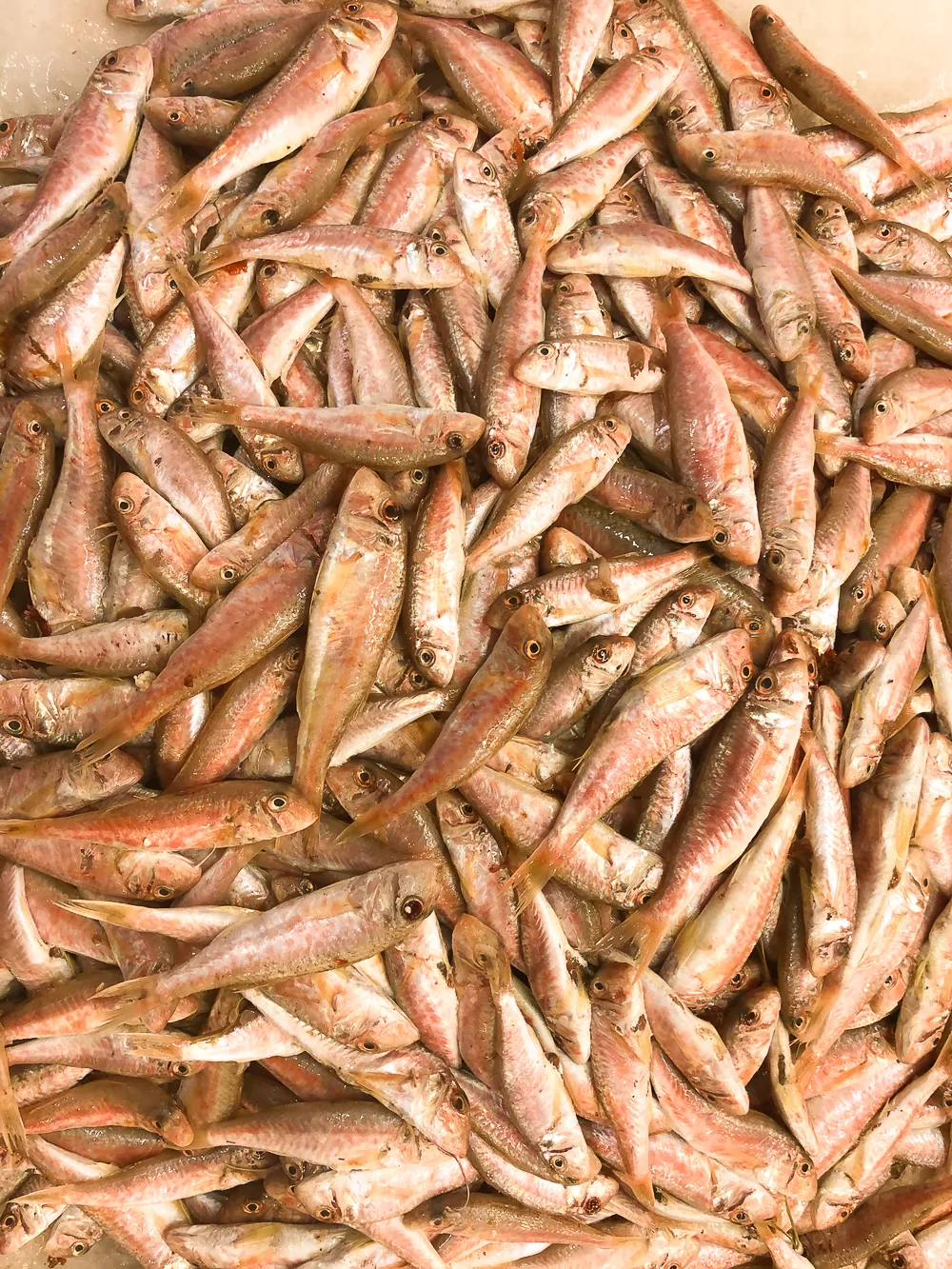
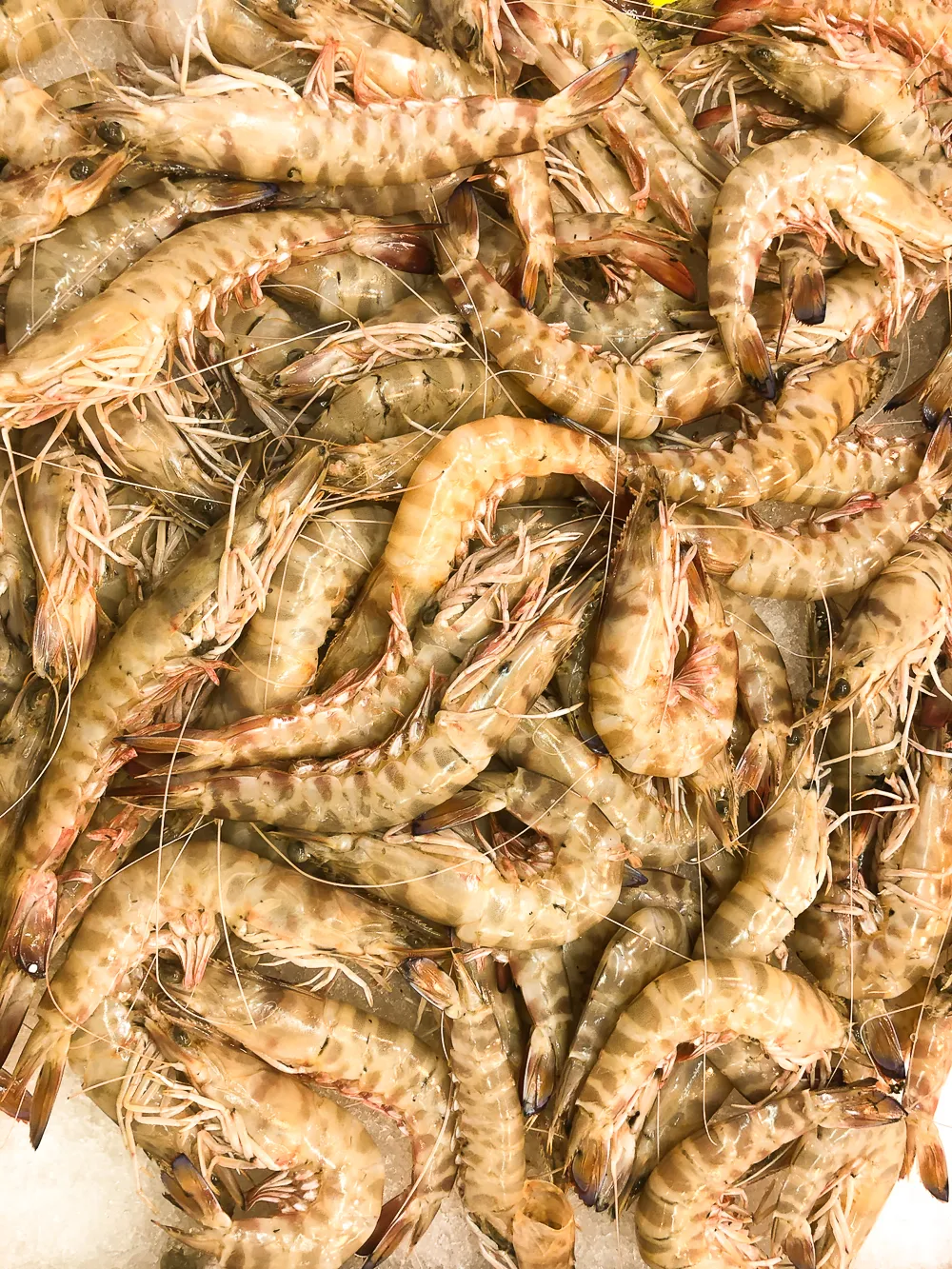 Here are wide streets with many shops, restaurants and cafés and several mosques. It is effectively one big bazaar. For such a small town the embankment is not small: something like 2 kilometres. The embankment ends at the foot of Mount Kese, at the top of which there is a wonderful viewing platform with a panorama of Kuşadası. So that you do not forget where you are, the name of the resort is laid out in large letters on the slope. I would recommend looking at the old non-touristy districts of the town, which lie to the right of the caravanserai and the Grand Bazaar: the old town buildings on the slopes of Mount Kese with multicoloured houses and stairs and narrow, rather steep streets leading up Mount Kese. It is interesting to walk along Yıldırım Street. Here you can see one- and two-storey white houses in the traditional Turkish-Greek style. It begins at the pedestrian zone of the Grand Bazaar and runs, as it were, along the mountain.
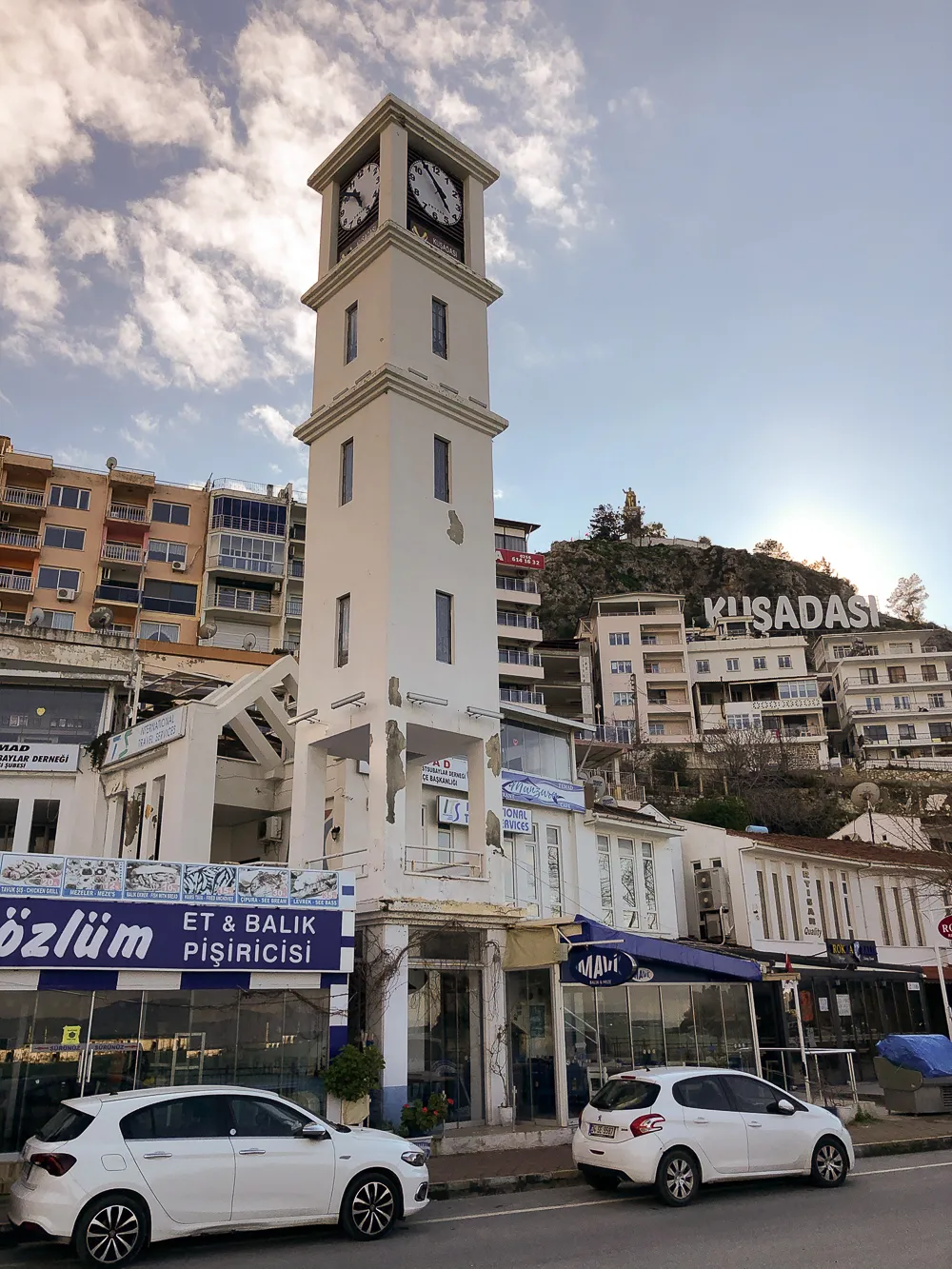
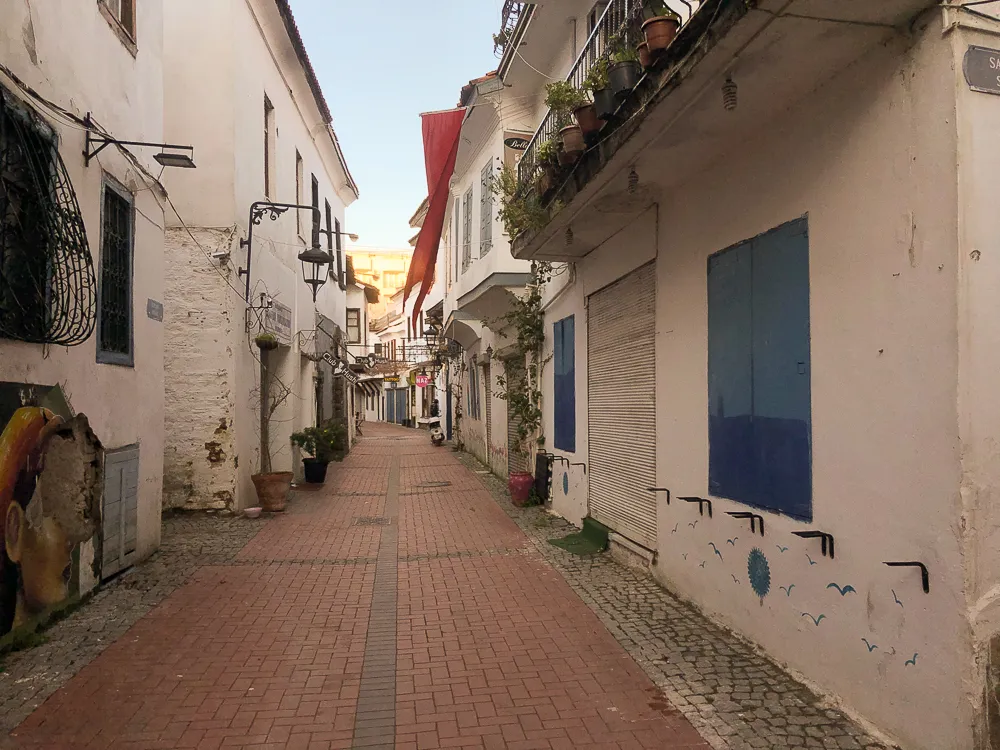
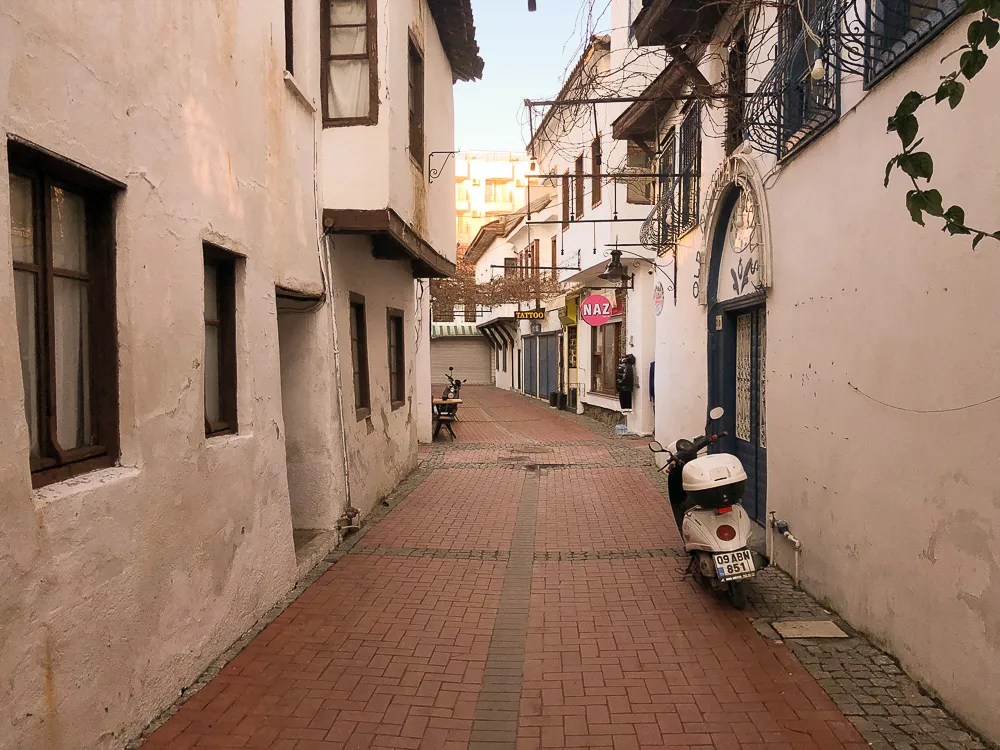
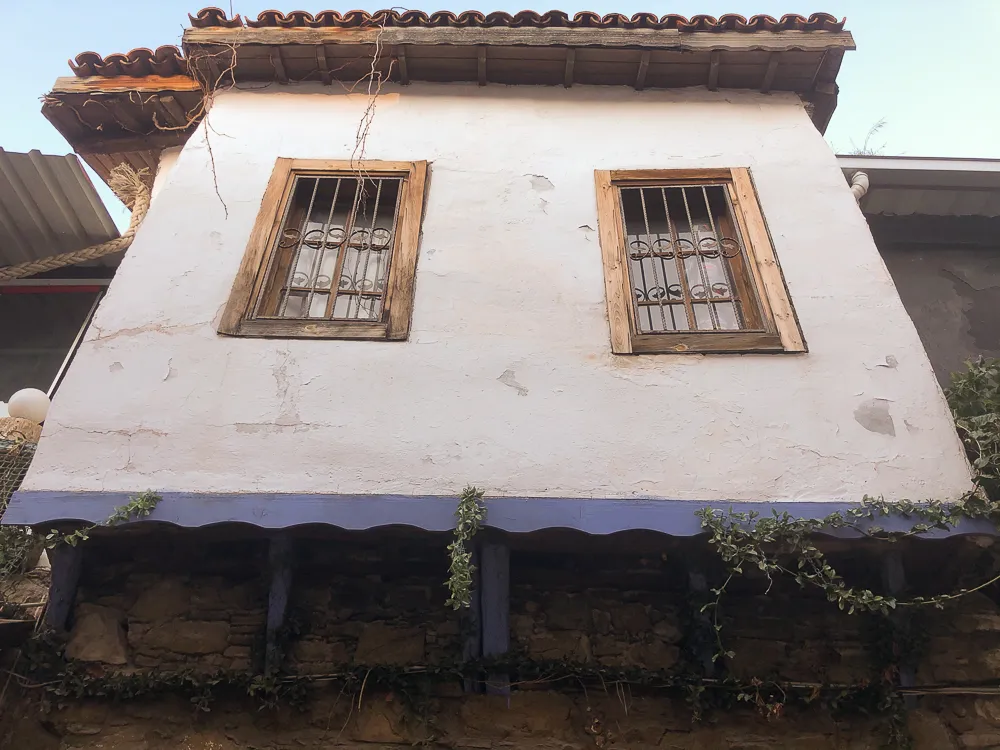
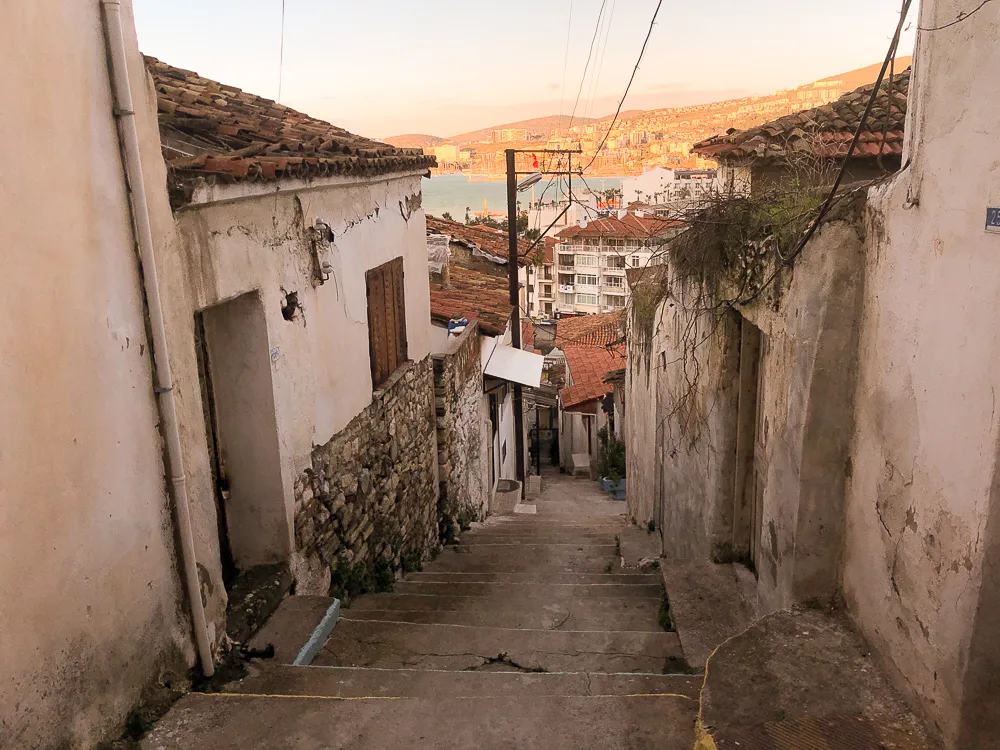
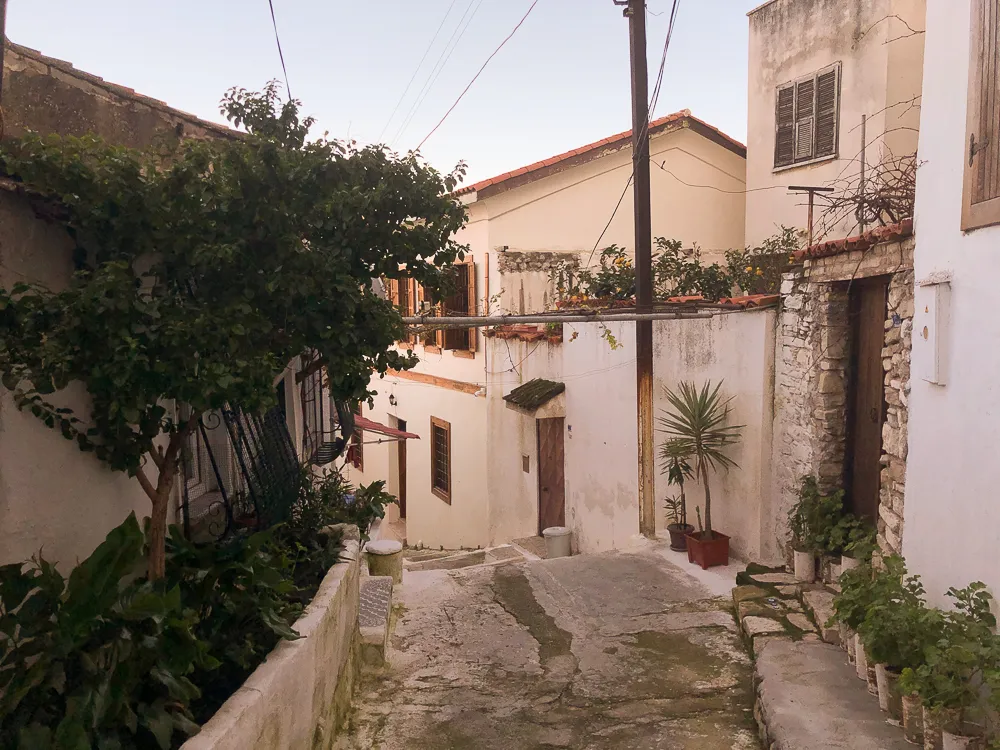
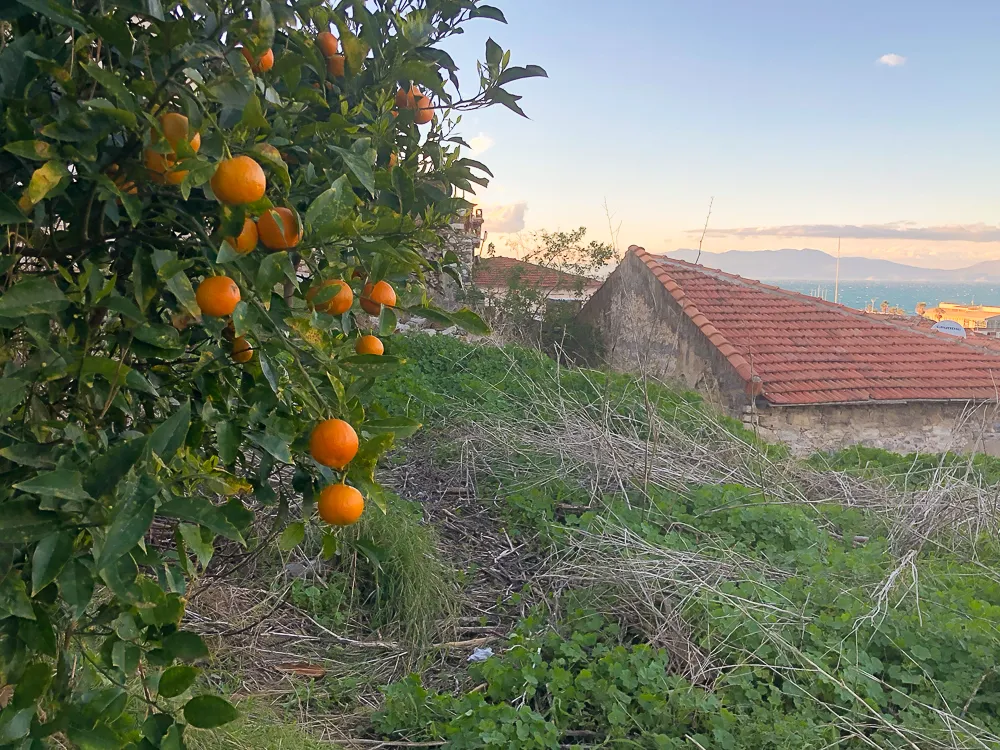
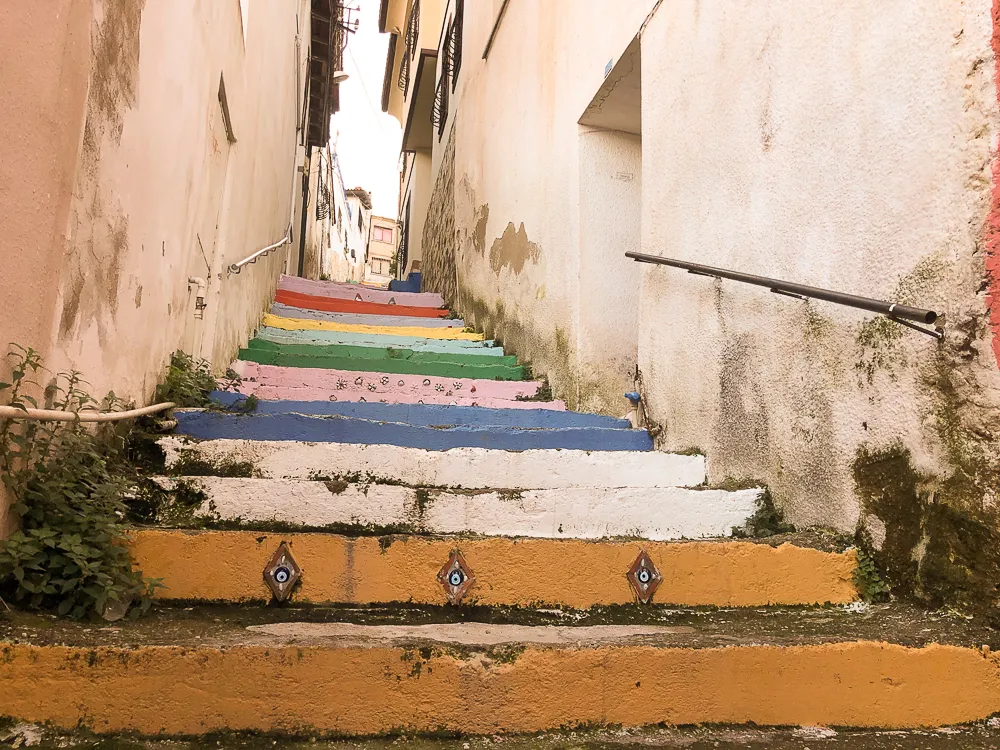
If you keep going straight along this street, you can reach Ladies Beach with fine yellow sand and clear water. The strange name is explained by the fact that in Ottoman times only women were admitted to this beach. Today Ladies Beach is the most popular, but it is probably strange for a man to relax there.
Below the mountain lies the fortress of Pigeon Island, Güvercinada Kalesi, which protected the port at the mouth of the Kuşadası bay. This island used to be called “Kuşadası”, that is, Bird Island, because many birds nested here. After the town had arisen near the island, the name Kuşadası passed to it. And the island came to be called Güvercinada, which from Turkish translates as Pigeon Island. Enough ornithology.
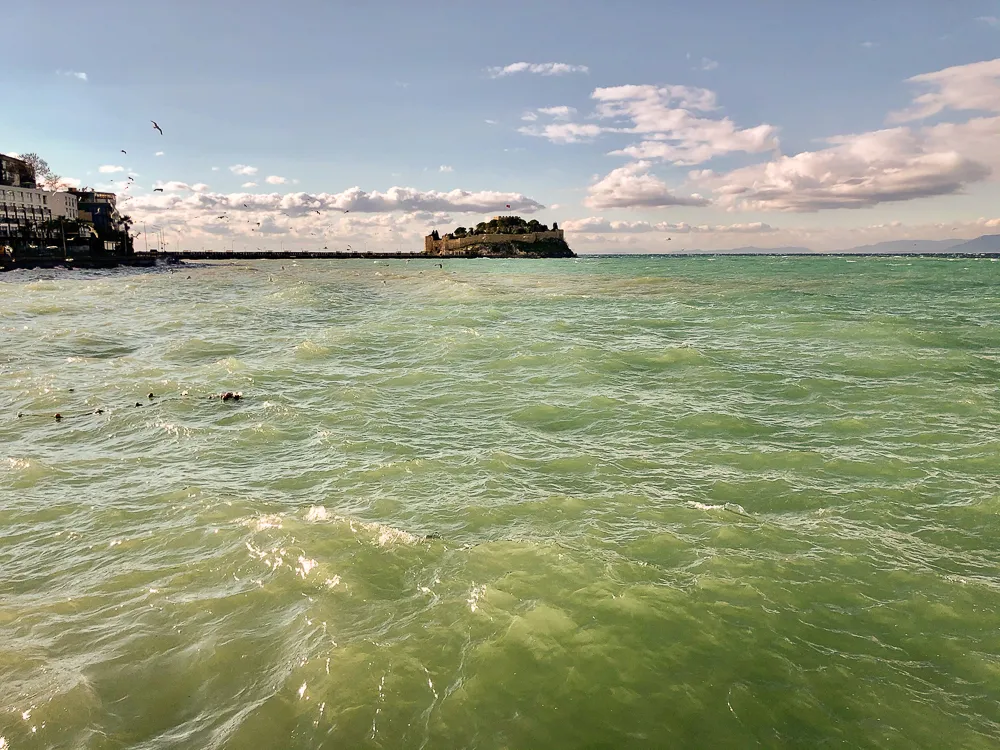
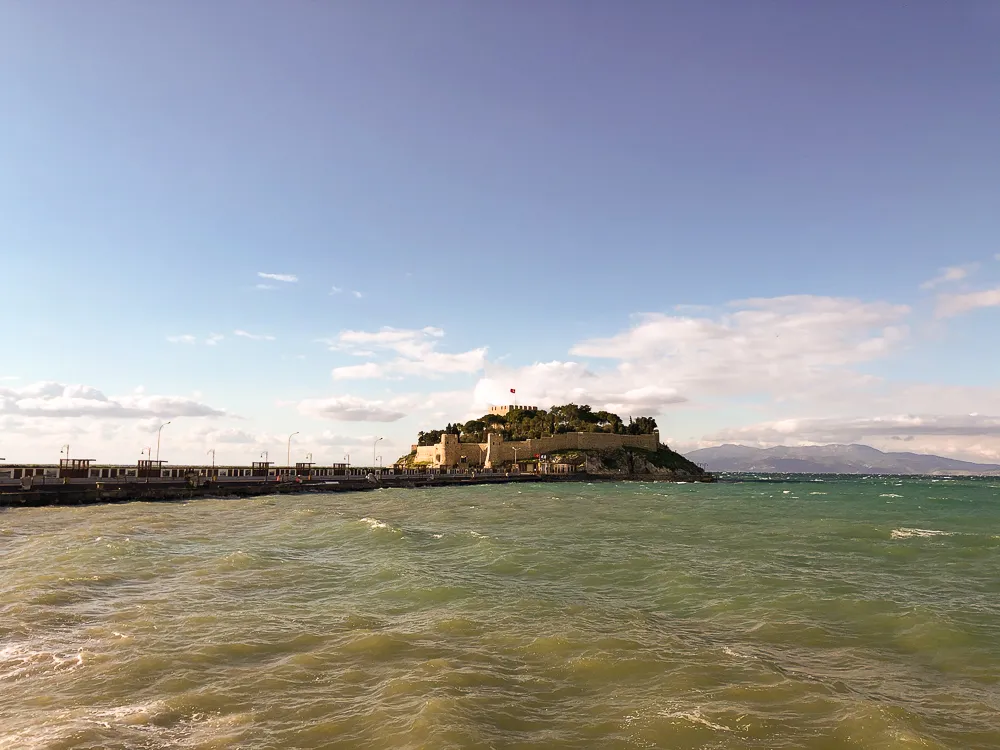
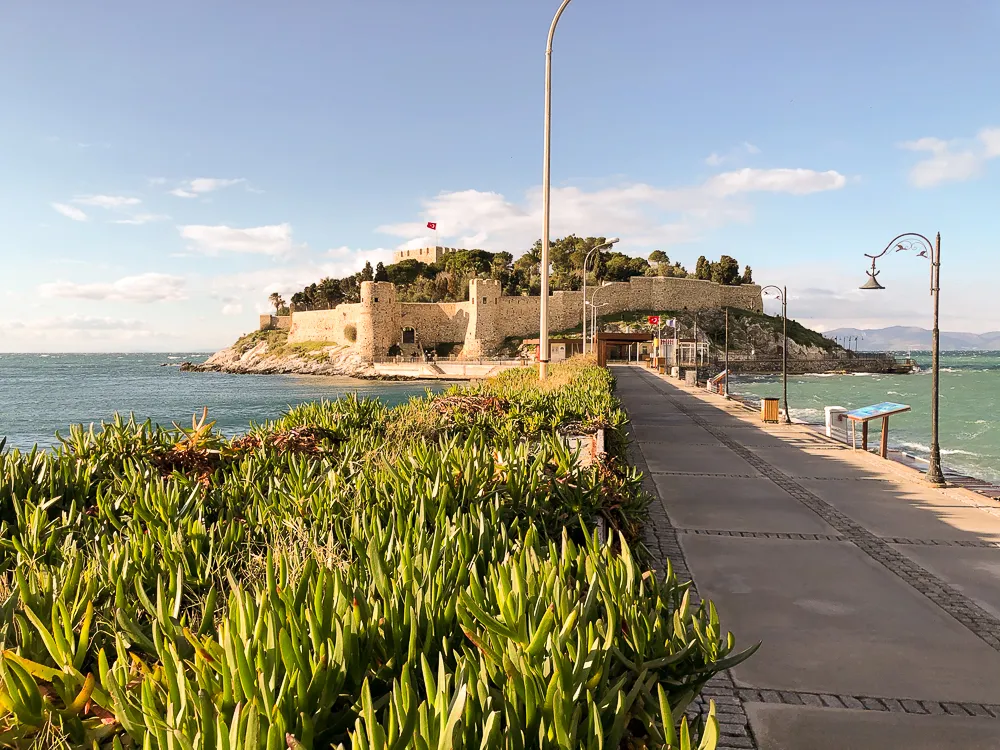
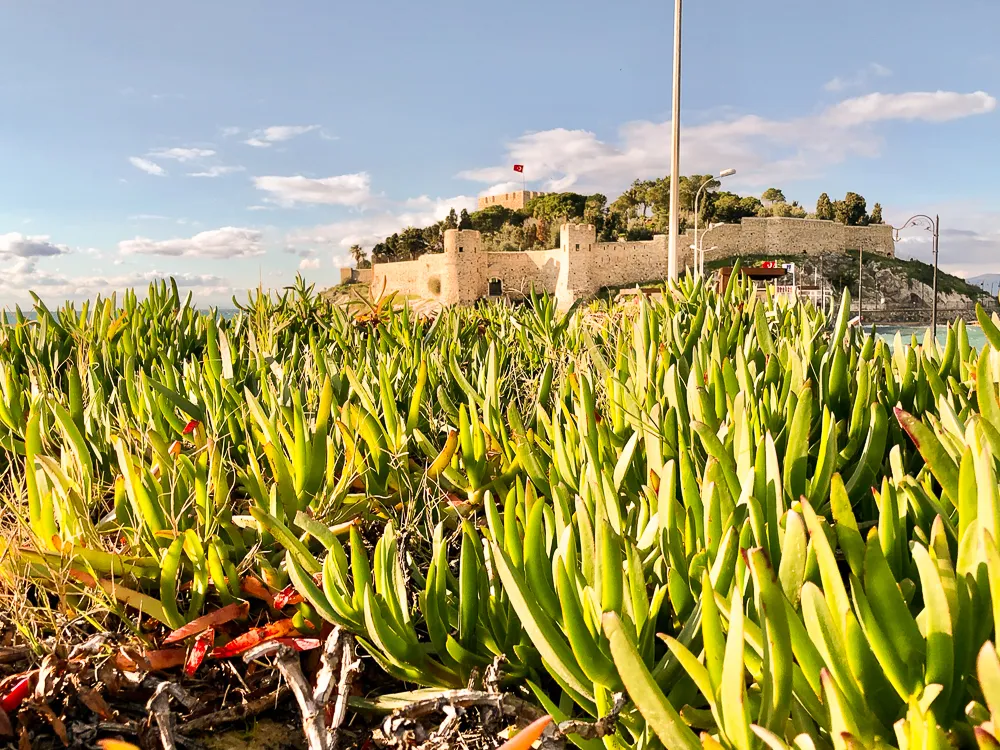
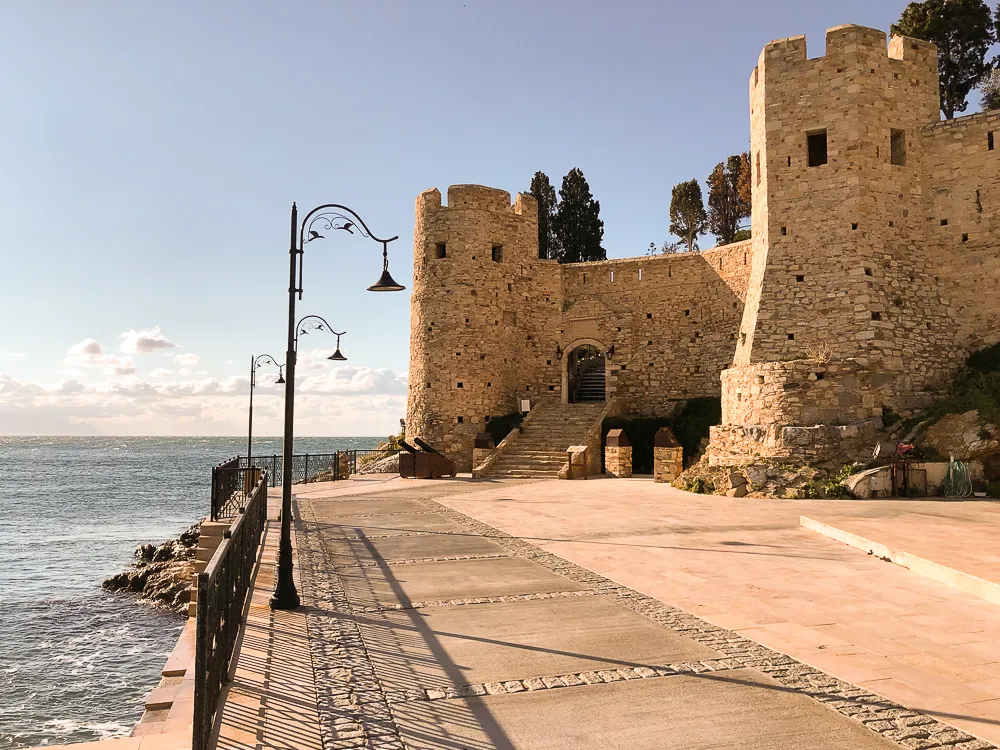
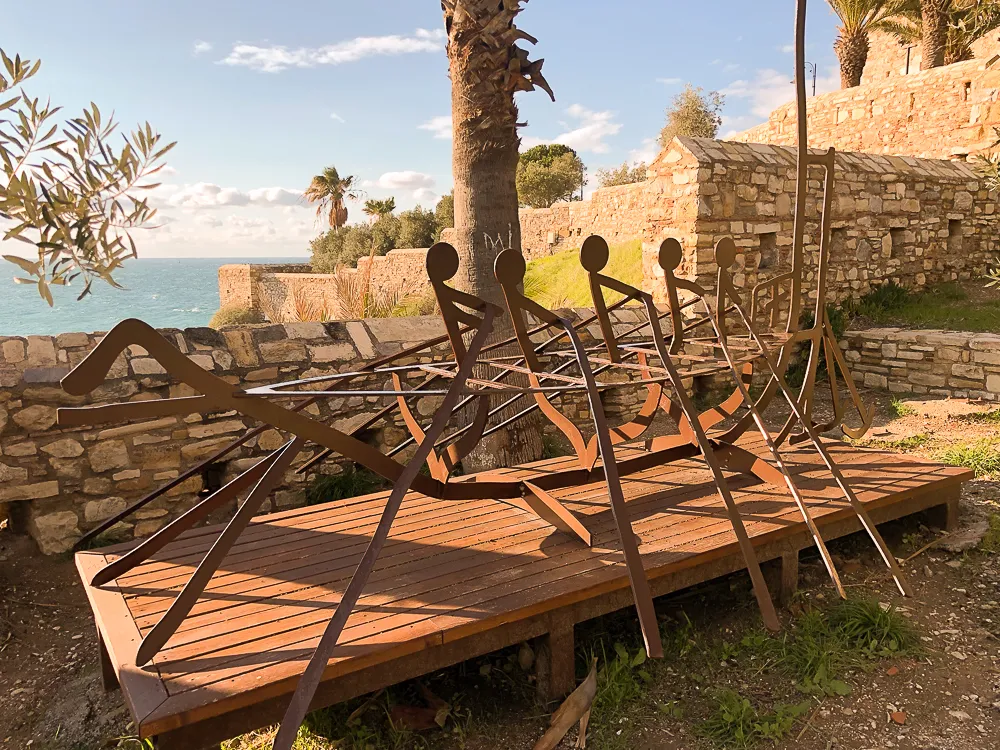
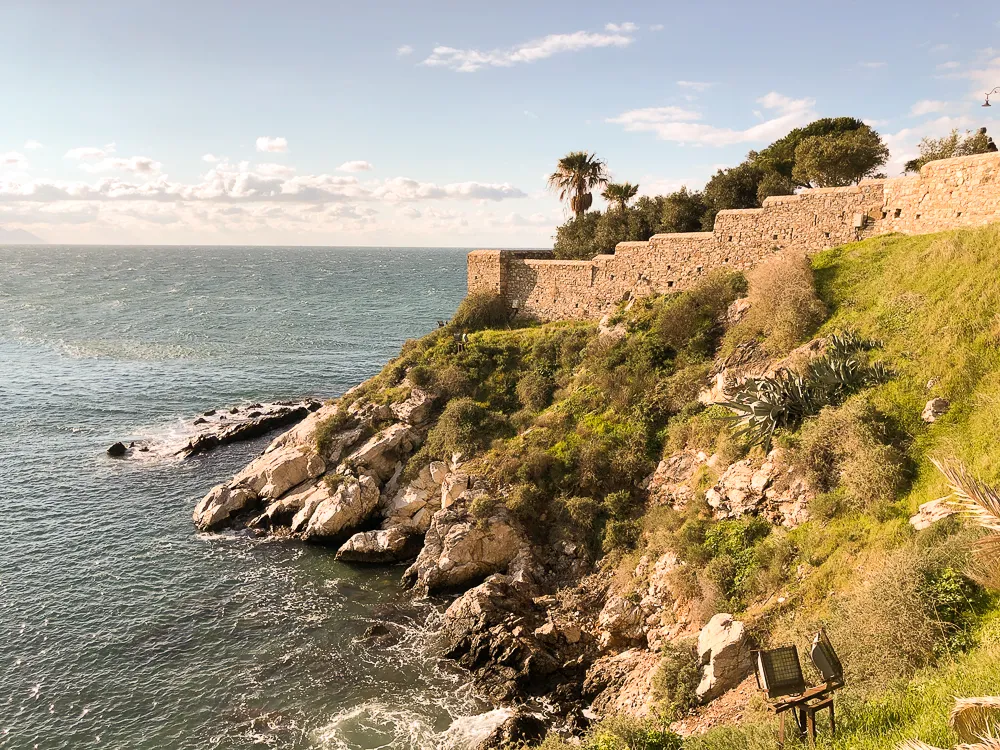
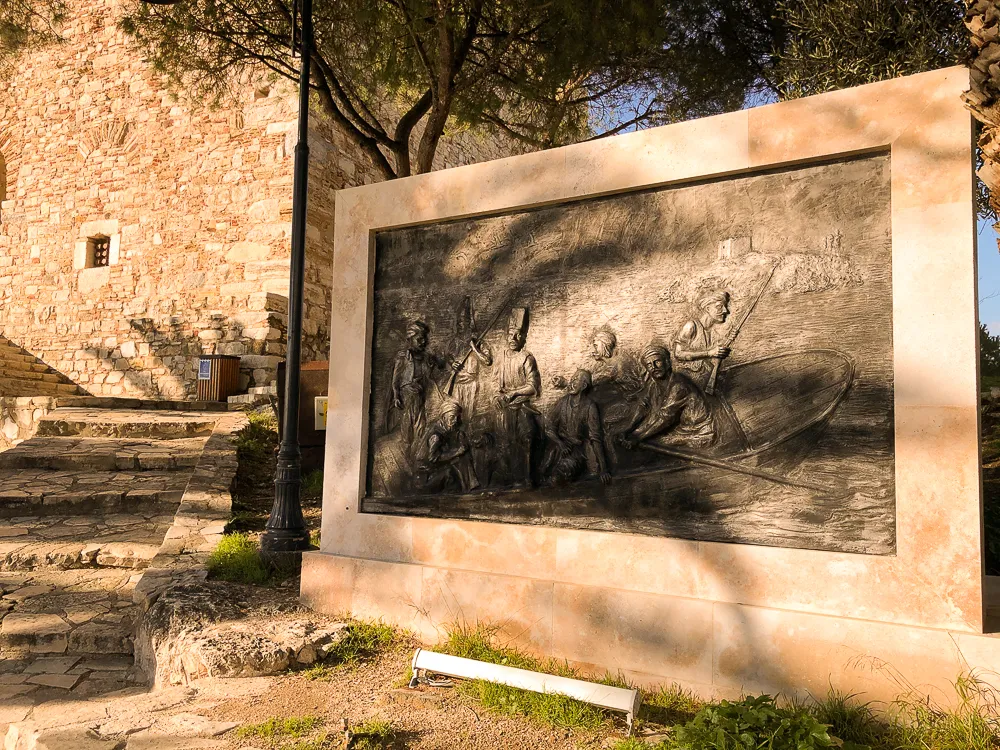
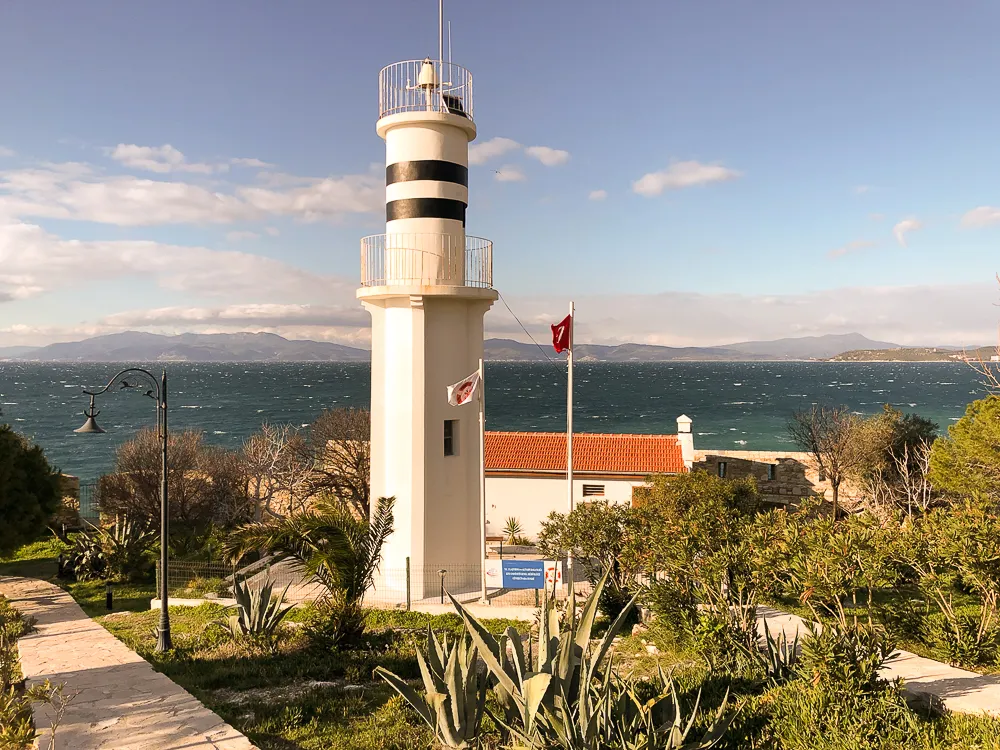
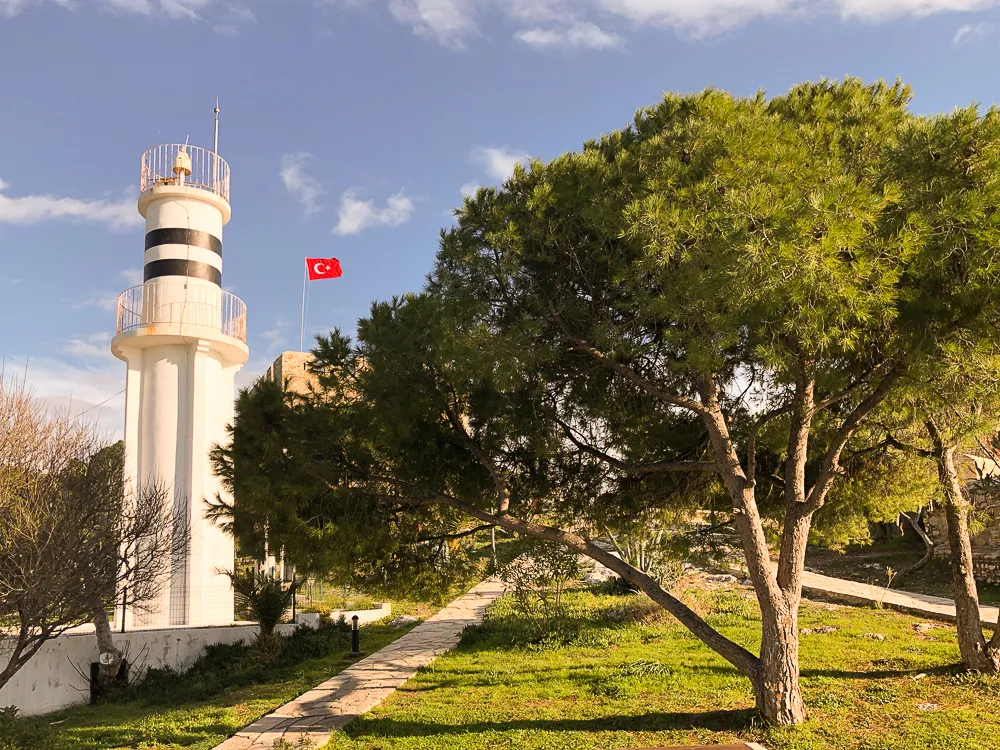
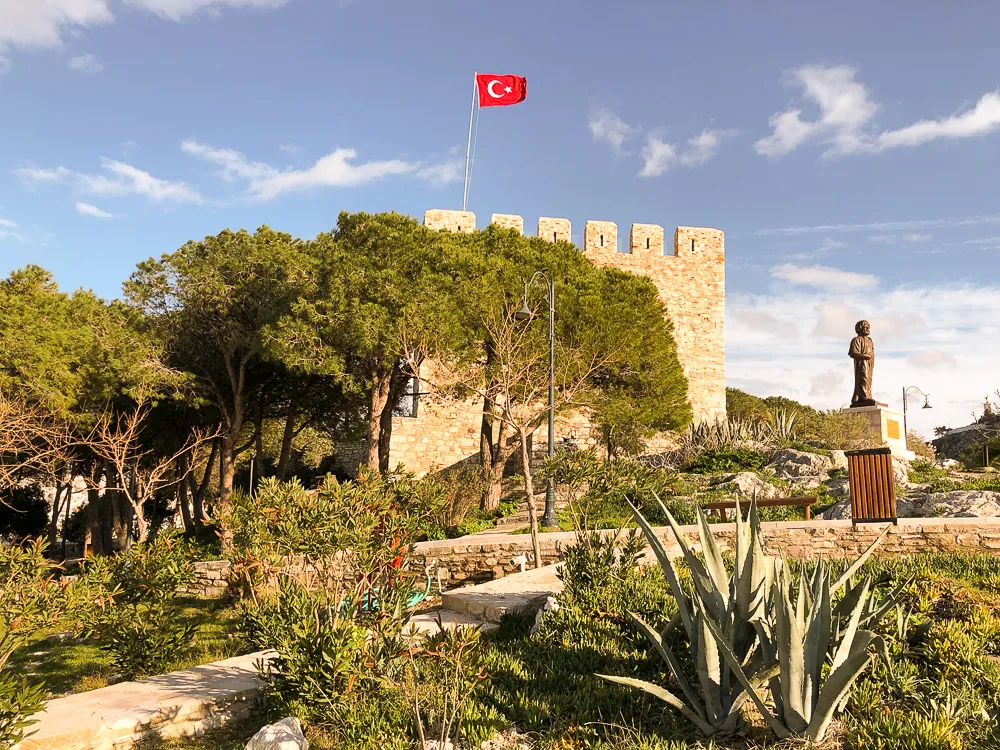
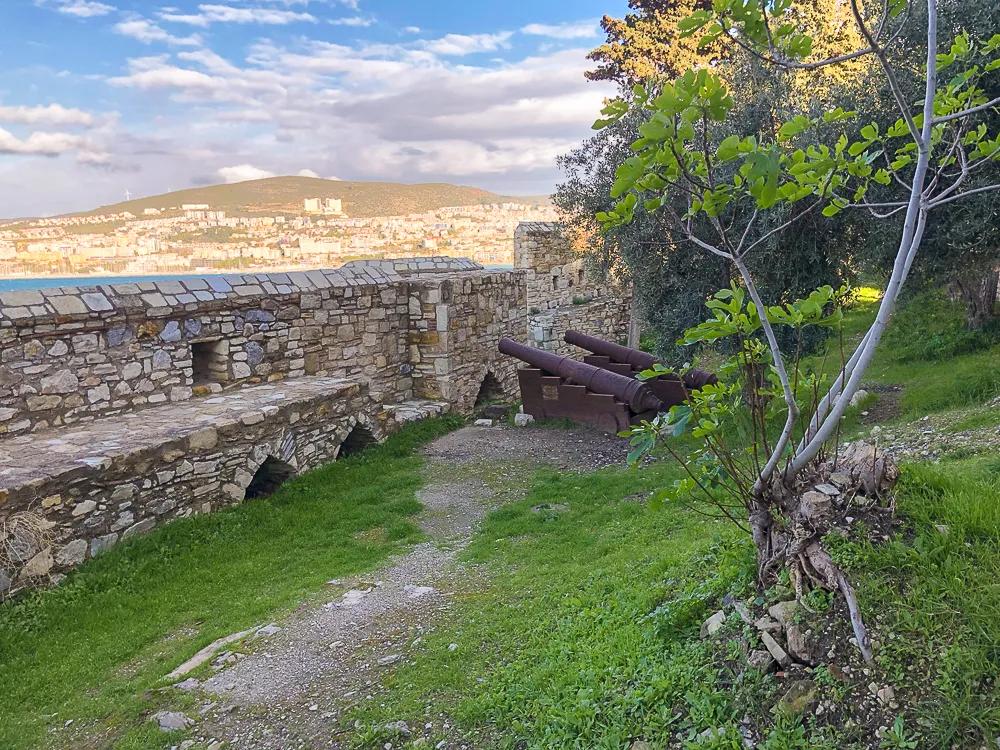
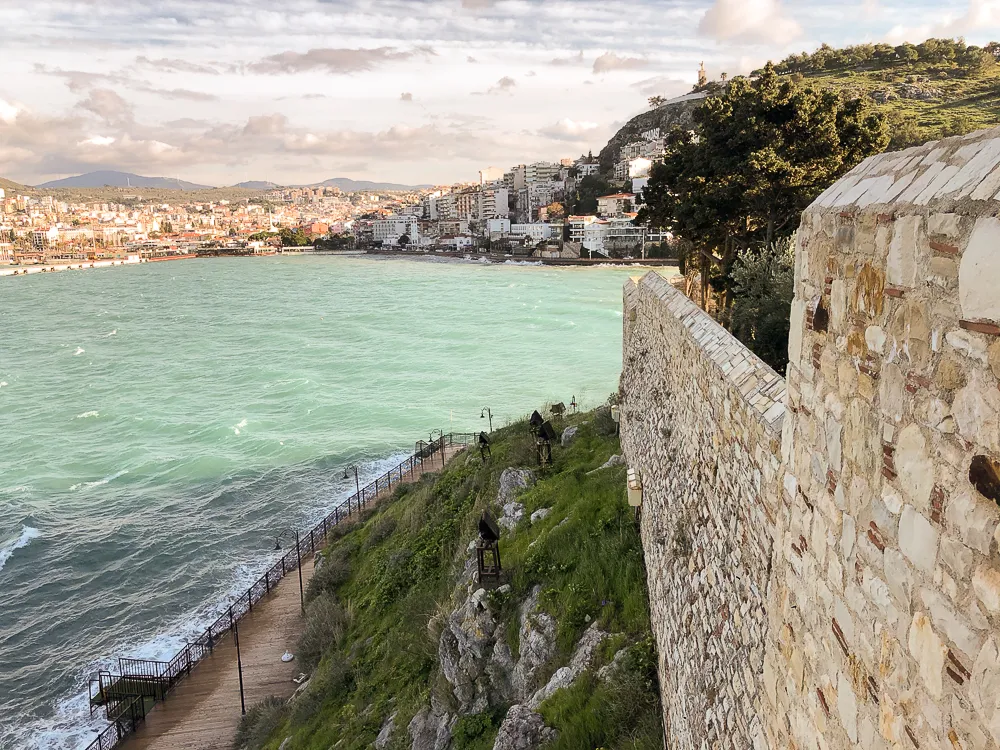
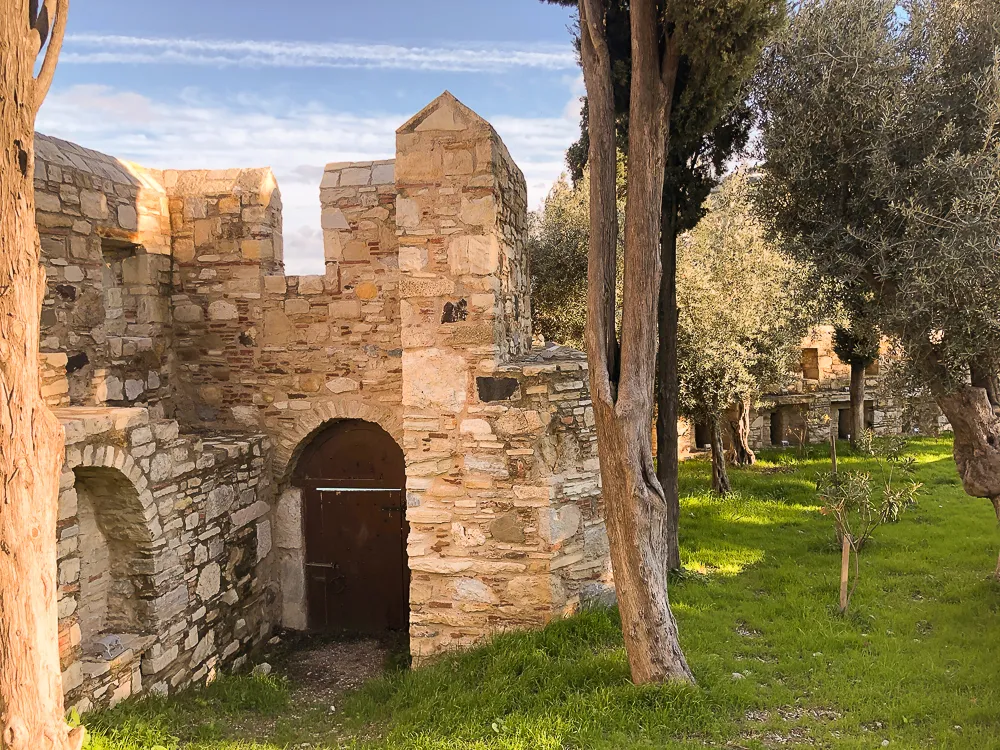
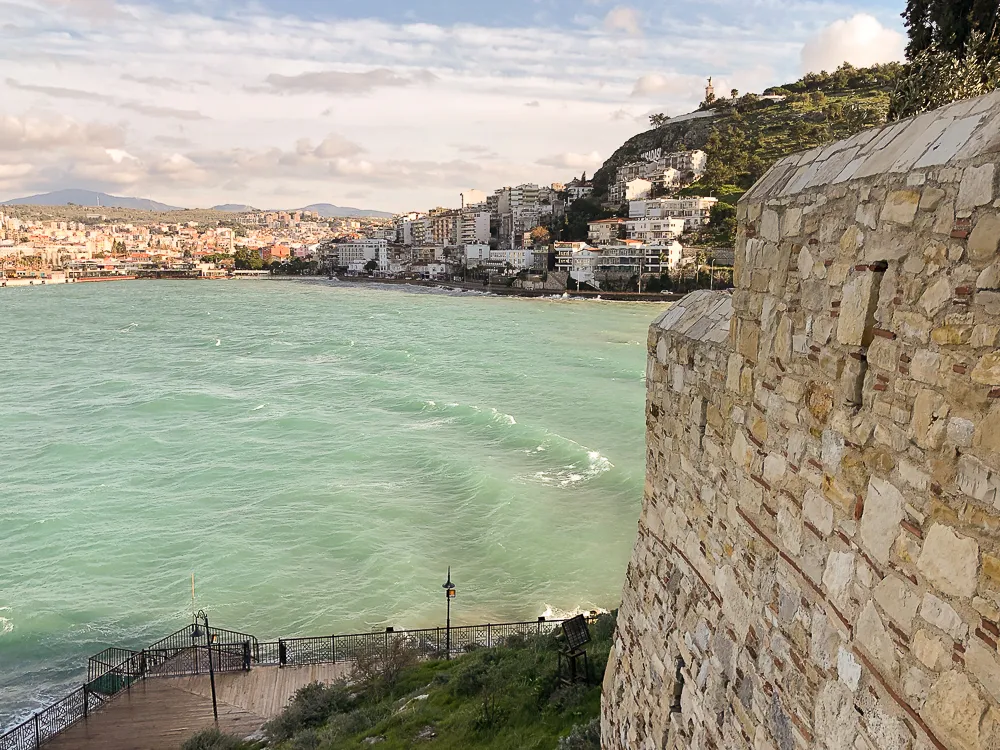
The fortress is included in the UNESCO World Heritage Tentative List as “Fortresses and walled settlements on the Genoese trade route from the Mediterranean to the Black Sea”. The Genoese came to Kuşadası at the end of the 13th or the beginning of the 14th century, and the Turks, after capturing it, considerably rebuilt the fortress. As I have already said, the Kuşadası fortress used to be an island. Now it is connected to the land by an embankment where pleasure yachts stand, taking tourists on sea excursions.
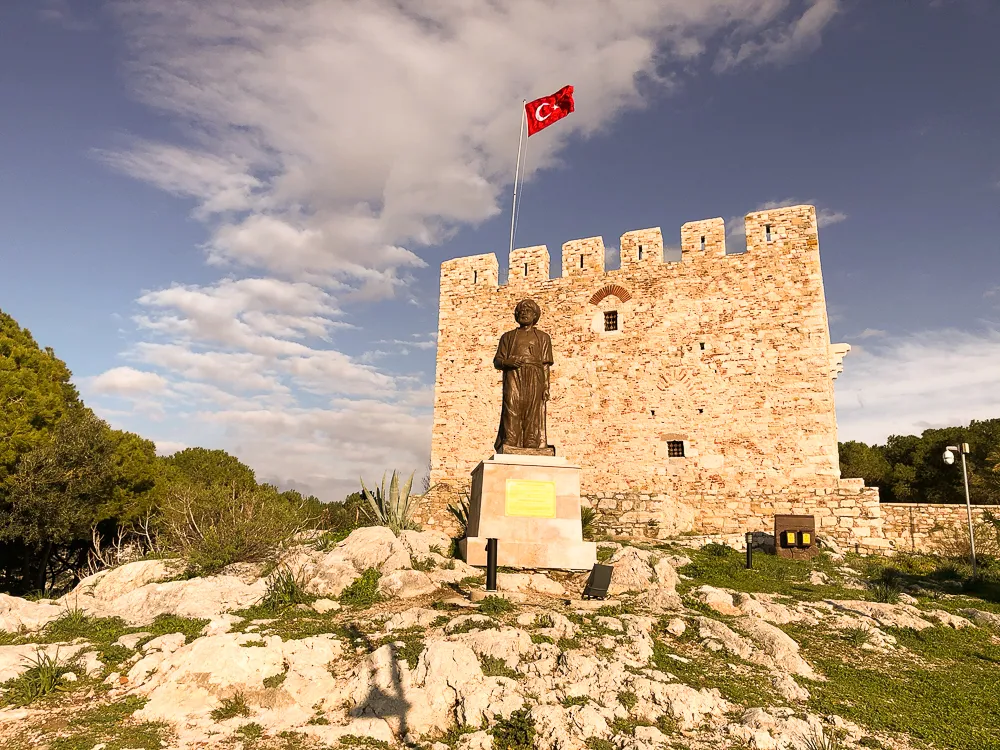
The construction was supervised by the Ottoman admiral Hayreddin Barbarossa. The fortress became one of his bases. It had powerful walls surrounding it on all sides, which were meant to protect the Turks from attack. The fortress walls stand along the perimeter of the island, about 3 metres high. The entrance gate of the fortress faces the land and is protected by two towers, a pentagonal one and a cylindrical one. In the centre of the fortress stands a tower-castle of Genoese construction, although some write that it was built by the Turkish admiral. The sculpture of Hayreddin Barbarossa, Barbaros Hayreddin Paşa or Hızır Hayreddin Paşa, seems sometimes to wink at the unarmed cruise ships approaching the shore. In the town the central street also bears his name.
The most successful Turkish admiral, who at the mention in any European language becomes a pirate. Strange. Although Europeans also have the concept of corsair, privateer. Complete injustice, or, let us be frank, envy and an attempt to belittle. So, pirate or admiral?
The monument and mausoleum of Hayreddin Barbarossa, designed by the great architect Sinan, are in the Istanbul district of Beşiktaş next to the Naval Museum. The district itself was once founded by Barbarossa himself, who laid five stones (“beş” means “five”, “taş” means “stone”) for his ships, which could not moor at the shore.
On the pedestal stands a sculpture of Barbarossa himself and two sailors, and behind them the flag of the Ottoman Empire flutters. On the back of the monument are carved the lines of Barbarossa’s march, created on the basis of a poem written by the Turkish poet Yahya Kemal Beyatlı:
“Whence comes this roar on the sea horizon?
Perhaps Barbarossa is returning now
From Tunis or Algiers, or from the islands?
Two hundred ships sail over the waves,
Arriving from the land of the rising Crescent:
O blessed ships, from which seas have you come?”
Ships of the Turkish Navy, sailing past them, have a tradition of saluting Hayreddin Pasha.
He was called the Lion of the Mediterranean in what was truly a magnificent (a fitting title for a TV series) 16th century for Turkey, in which there were many magnificent figures. It was a time of great geographical discoveries and a time of another flourishing of piracy in the basin of the Mediterranean and other seas.
The previous holder in history of the nickname Barbarossa, “red-bearded” or “red beard”, the Emperor of the Holy Roman Empire of the German Nation Frederick Barbarossa, was brought death by water during the Third Crusade. He drowned. In my view the Turkish Barbarossa was much more successful on water than the German one on the battlefields.
In fact there were originally two Turkish Barbarossas. The brothers’ real names were Oruç Reis and Hızır Reis. Only later would Sultan Selim I give the younger the honorary name Hayreddin, “Khayreddin”, “Gayreddin”, meaning “best in faith”. The third Barbarossa was Hayreddin’s son.
Natives of the island of Lesbos, with as much Greek blood as Turkish or Albanian, they are both known by the nickname “Barbarossa”, Red Beard. The elder brother was also called Baba Oruç, Father Oruç. He got this name because he helped Muslim refugees fleeing from the Spaniards in Andalusia. He transported them to North Africa with his fleet.
It was Oruç who became famous first: as a teenager he joined an Ottoman military ship, was captured by the Hospitallers and taken by them to Rhodes, but managed to escape. He must have had extraordinary abilities, because he quickly became captain of a small galliot. He set up his base in Tunis in exchange for a percentage of the captured spoils.
In 1504 Oruç captured two war galleys of Pope Julius II one after the other. Before that no galliot, which was half the size and weaker, had captured galleys. Oruç’s crew took the first ship by storm, and then, stripping the captives and driving them into the hold to the oars, dressed in the clothes taken from them. Then they all moved to the papal galley and took their own vessel in tow. Thus it appeared that the papal soldiers had won. The second galley approached the ship without fear and was captured without much effort.
Thanks to incredible courage and luck Barbarossa soon became a hero of the whole coast. With each year his successes and fame grew louder. Not even five years had passed, and Oruç commanded up to ten fine ships, helped by his two brothers. The port of Tunis no longer fully satisfied his needs. He “leased” the tourist island of Djerba, now widely known for its snow-white beaches and clear waters, which had many places suitable for anchorage. Besides devastating coasts and capturing ships, Oruç decided to conquer some “real estate”.
During an unsuccessful attempt to storm Bejaia in present-day Algeria, Oruç lost an arm, but some skilled craftsman made a silver prosthesis for him with a multitude of moving parts. Oruç returned home to recover from his wound, while his brother Hayreddin got into trouble.
True, he was late. The Genoese, having learned of the capture of the galliot after the failed assault, sent Andrea Doria, who was soon destined to become the greatest Christian admiral of his time, with 12 galleys. He landed near La Goulette and forced Hayreddin to flee to Tunis. The fortress was plundered, and half of Barbarossa’s ships were driven to Genoa. Thus ended the first meeting of Hayreddin and Doria.
After such a humiliation Hayreddin, who knew his brother’s fierce temper, did not risk meeting him face to face and went to Djerba to build ships. The next assault on the fortress of Bugia (1514) again brought no success. Oruç understood that he could not appear in Tunis or on Djerba with his tail between his legs and found a new refuge on an impregnable rock with a wonderful bay. It was Jijel, whose inhabitants welcomed such a famous warrior as Barbarossa.
In 1516 the sheikh of Algiers asked for his help in capturing the Spanish fortress of the Peñón, which controlled the city of Algiers. The fortress could not be taken, but Oruç became the sheikh of Algiers… having drowned his ally in a bath in time. Having proclaimed himself Emir of Algiers, Barbarossa I, Oruç prudently recognized the authority of the Ottoman sultan Selim I the Grim, the father of Suleiman. Perhaps treacherous, but on the other hand Oruç was brave and even noble to his own men. Successful at sea, he held the fortress of Algiers, but the exit to the sea from it was controlled as before by the Spaniards from the island of the Peñón. In 1518 Oruç captured another city, Tlemcen, and came to rule the territory of almost all of present-day Algeria. The Spaniards decided to put an end to the new scourge once and for all. As he retreated from Tlemcen, his detachment was overtaken near a river. Oruç had already crossed with part of his warriors to the other bank, but did not abandon his comrades in trouble. He crossed the fateful river again and threw himself into battle. They fought to the last.
“According to those who remembered him, Oruç Barbarossa was about 44 years old at the time of his death. He was not very tall, but well built and strong. His hair and beard were bright red, he had good eyesight, his eyes always shone and his gaze was lively. He had an aquiline or Roman nose, and his complexion was of medium colour, not quite fair but not swarthy. Oruç was a man of exceptional courage, unshakable, bold, noble, enterprising, a freethinker, in no way bloodthirsty except on the battlefield, and not cruel except when he was not obeyed. He was sincerely loved, feared and respected by soldiers and servants, who mourned his death and regretted it more than anyone else. He left behind neither sons nor daughters. Oruç lived in Barbary for 14 years,
His head was sent to Spain, and in the 20th century in Turkey a class of submarines was named after him: “Oruç Reis”.
The Spaniards decided that the job was done and that the remaining sailors would disperse of themselves without a leader. But they rejoiced only briefly, because the younger brother Hızır was alive and well, and all power over Algiers and the fleet passed to him. He proclaimed himself a vassal of Turkey, Sultan of Algiers, Barbarossa II. Selim I recognized him as ruler of the whole province and sent two thousand Janissaries with artillery, and then another 4,000 volunteers, who took the privileged position of Janissaries. The country was effectively turning into an Ottoman vassal possession. Shortly before this they had conquered Egypt, and Algiers was the next step in the conquest of the north of Africa. Hayreddin himself was appointed beylerbey of Algiers by Sultan Selim I.
Hızır was famed for courage, but multiplied by prudence and caution. Contemporaries noted Barbarossa’s unusual physical strength despite his medium height. An interesting portrait of Hayreddin is given in the history of the French fleet: “… he had shaggy eyebrows, a thick beard and a thick nose. His thick lower lip protruded contemptuously. He was of medium height but had heroic strength. He could hold a two-year-old sheep at arm’s length until it died. His admirers explain the truly extraordinary influence he exerted on his commanders and ordinary pirates by this man’s enormous courage and dexterity, and by the fact that even his most desperate enterprises always ended in success. Intelligence and courage in attack, foresight and valour in defence, enormous capacity for work, invincibility: all these praiseworthy qualities were overshadowed by surges of implacable and cold cruelty. His courage, dexterity, skill and knowledge of the laws of the sea helped him to carry out the most desperate enterprises successfully. However, intelligence, determination, courage and capacity for work were combined in him with implacable and cold cruelty. Unlike his brother, he was aware of the strength of the Spaniards and did not rely on his own strength in dealing with them.”
Barbarossa was lucky. Some would say superstitious: he wore around his neck an amulet in the shape of an eye, a gift from the sultan, and never took women on deck. When he received from the sultan the honorary title Hayreddin (“Protector of the Faith”), he also became very pious, observed all Muslim rites and demanded the same of his subordinates. He believed that such zealous service to Allah helped him win victories.
Barbarossa’s flag is interesting: it is green. At the top is painted the first sura of the Quran, below it the symbol of the Trinity, on the left the print of the hand of God, and below it a six-pointed Star of David. All this, in crescents along the edges, also contains the names of the first caliphs. Although the meanings of the symbols and their belonging to religions are very changeable, in battles even the forces of nature really did “help” him.
Hayreddin took power in hard times: the Spaniards immediately besieged Algiers. But a strong storm scattered the Spanish ships and flung them onto the coastal rocks. The hurricane lasted until the whole shore was strewn with ship wreckage. It was a catastrophe for the Spanish fleet. So ended the first attempt to deal with Hayreddin. The ports and fortresses of central Barbary, the North African lands that are now the territory of Morocco, Algeria and Tunisia, passed one after another under the pirate’s rule. Once or twice a year he took his personal fleet to sea, and everyone on the coast wanted to support the brave and, above all, lucky seafarer.
In 1520, after the death of Selim I, his son Suleiman became at 26 the sultan of a vast empire (“the Lawgiver” for the Turks, “the Magnificent” for Europeans). By then Barbarossa was already 45 years old and the Algerian ships sailed all over the Mediterranean, disturbing the inhabitants of Sicily, Sardinia, the Balearic Islands and the coast of Spain, and passing through the straits to intercept galleons returning with cargoes of gold and jewels. So began the great “Beating of the Christians”, because of which all the inhabitants of Europe lived for three centuries in a state of constant anxiety.
However, the lack of a port at Algiers was very painful. Returning to the port of Algiers was impossible without capturing the fortress on the islet of the Peñón. He had to drag his ships onto the beach a mile to the west and haul them along the shore, and storms endangered the “business” if he had to anchor east of the city. Hayreddin decided that he must have his own port in Algiers.
A handful of heroic defenders led by Don Martín de Vargas successfully repelled over the following ten years more than a hundred attacks by Barbarossa. Even the defeat in 1519 of the imperial fleet, consisting of fifty ships sailing to the fortress’s rescue, did not help. At last the Algerian pasha Barbarossa II managed to concentrate a huge number of guns and ammunition against the fort and bring all this might down on the exhausted defenders. In 1529, after a bombardment that continued without a break for sixteen days and nights, the Spanish resistance was finally broken and they invaded the fortress, where they found only the dead and wounded.
The heroic defender of the Peñón island, Don Martín de Vargas, despite his advanced age and the wounds he had received, was stripped to the waist in the presence of Barbarossa, to the roar of an enraged crowd, and flogged with rods.
Barbarossa was not content with pursuing the defenders of the Peñón but decided to punish and destroy the island itself and the fortress. The very next day thousands of Christian captives began to build of stone a gigantic mole, which to this day connects the former island of the Peñón to the mainland. The port of Algiers has since become the main refuge of pirate flotillas. Two weeks later nine transport ships appeared on the horizon, full of people and loaded with equipment, sent to reinforce the garrison of the Peñón. While they were looking for the fortress they had come to help, Barbarossa captured the whole convoy, taking 2,700 Christians prisoner and gaining a large amount of weapons and provisions.
It seemed as if everything Hayreddin took in his hands turned to gold. The size of his fleet grew to four dozen ships, the spoils were countless. He freed and transported from Spanish oppression up to 70,000 Moriscos. The desert lands of Africa were now populated by hardworking peasants and craftsmen whom the Spanish kings had failed to find a use for. He built shipyards and foundry manufactories and designed ships himself. Thousands of Christian slaves were engaged in building defensive structures in the harbour, and every attempt by the emperor to rescue them and put an end to Barbarossa ended in catastrophic failure.
Barbarossa valued people for their business and fighting qualities; nationality and origin did not interest him. All his associates were intelligent and talented people. They were Turks, Albanians, Italians, Greeks, Danes and Norwegians. But what struck me most was that he had no slaves on his galleys. Barbarossa believed that only free men can fight well!
In 1532 Sultan Suleiman invited Barbarossa to his capital to make him commander of the entire Turkish fleet. Hayreddin arrived in Istanbul with his own fleet. His ships were splendidly decorated and loaded with gifts for the sultan. Barbarossa promised the sultan to defeat his main enemy at sea, Andrea Doria. A new large fleet was needed to defend the eastern part of the Mediterranean. Barbarossa vowed to put to sea with a full squadron of eighty-four ships. The admiral received permission to build new ships in the Golden Horn bay and began re-equipping the fleet. He not only put new vessels into service but also turned former peasants and shepherds into sailors. The newly minted admiral established strict rules of conduct on ships. From now on it was forbidden on board to consume excess alcohol and to play cards and dice for money. Special attention was paid to keeping weapons clean and in order. For slight disobedience a sailor lost his share of the plundered wealth.
Suleiman knew how to choose people correctly, and this no longer young, 57-year-old favourite of fortune brilliantly carried out all the ruler’s plans. The winter that Hayreddin spent at the shipyards should be considered the beginning of the era of Turkish supremacy at sea. It was Suleiman and Hayreddin who made Turkey the leading maritime power of the Mediterranean.
The first to feel the strength of the new Ottoman fleet, in the spring of 1534, were the inhabitants of the southern and northern coasts of Italy. In the north Barbarossa reached Civitavecchia and anchored near Rome. Then he attacked Corsica and Sardinia. Inspired by the successful raid, the Turks directed all their forces at the main goal of the campaign, which was nothing less than the capture of Tunis.
In the spring of 1535 Andrea Doria came out with a counterstrike. The emperor himself took part in the campaign. Doria shut his old rival up in Tunis. He defended his stronghold as long as he could, after which the Turkish leader went west and crossed the scorching desert, where, fortunately, he left some of his ships.
Emperor Charles considered himself a crusader and a knight errant. However, the joy of victory was overshadowed by the deeds of Hayreddin. While everyone thought that he was finished, he, at the head of the remnants of his ships, attacked Menorca. Having reached the island, he ordered flags in the colours of Spain and other European states to be raised, because of which the locals decided that they were looking at part of the emperor’s armada. He headed straight for the port, captured rich ships, plundered the town and, taking with him thousands of captives and great spoils, went back to Algiers, and from there to Istanbul.
Overloaded with “live” goods and gold, Barbarossa arrived in Istanbul. The sultan appointed him commander of the entire Turkish fleet and beylerbey of Africa.
The following year Barbarossa ravaged Elba, the Lipari Islands and the island of Corfu. Thousands of prisoners became his prey.
In February 1536 a Franco-Turkish treaty was concluded, under which Sultan Suleiman the Magnificent sent Barbarossa’s fleet to help the king. Barbarossa was solemnly received in Marseille, and afterwards the king had to pay a great deal before he managed to get rid of the Turkish flotilla, which was also ravaging French villages and towns. In the following years the actions of the Turkish fleet under Barbarossa’s command were again successful.
After the growth of the power of the Ottoman Empire in the Mediterranean Sea, which was to become an “Ottoman lake”, Pope Paul III in 1538 organized a naval crusade against the chief Ottoman admiral. The experienced admiral Andrea Doria commanded 250 galleys from Venice, Genoa, Spain, the Papal State and the Order of Malta. The famous “Invincible Armada” of 1588 for the conquest of England was less powerful than Doria’s squadron at Preveza. Among the ships of the Europeans were powerful carracks (galleons), which the enemy did not have. The allied fleet had a fivefold superiority in men. Hayreddin Pasha’s fleet had only 122 ships.
On 28 September 1538, near the small town of Preveza in the Greek province of Epirus, opposite Cape Actium, where Antony suffered his famous defeat, the Europeans shut the Ottoman fleet in the bay. Doria was good and at first did everything perfectly: he did not go into the gulf, where ships could get stuck on shoals, did not give in to the provocations and false manoeuvres of the Turks, and organized the ship formation correctly. On the other hand, Barbarossa was lucky again, since he turned out to be in the gulf first. The numerical advantage was on the enemy’s side, and in a battle on the open sea Barbarossa could have lost his entire fleet. Here, in a wide bay, next to a welcoming shore, protected by a natural obstacle that the enemy’s heavier ships could not overcome, he could wait for an opportunity to attack his enemies at a moment unfavourable to them.
Two outstanding admirals waited and assessed forces. It seems Doria’s nerves gave way. On the morning of 27 September the Turks could not believe their eyes: the entire Christian fleet, weighing anchor, was majestically and unhurriedly sailing away. Whether it was a trap or not, they gave chase to the enemy.
Early in the morning of 28 September the Turks saw the Christian ships standing at anchor because of a headwind. Again nature helped. The oars of the Turkish galleys proved better than sails. The Turkish fleet managed to destroy 13 enemy ships and capture 36. The sultan’s fleet did not lose a single ship. The triumph was complete: Hayreddin mastered the whole Mediterranean. After the enormous victory he went to Istanbul and was received by Suleiman the Magnificent in Topkapı Palace, where he received from the sultan the honorary title Hayreddin (“Protector of the Faith”) and the position of beylerbey of Ottoman North Africa and the governorship of Rhodes.
On 20 October 1541 more than five hundred ships of the Christian fleet under the flag of Andrea Doria approached Algiers. After the Algerians refused to surrender, on 23 October the Spaniards landed 25,000 men. However, a hurricane with a downpour that evening threw dozens of ships onto the rocks and scattered the tents of the camp, and in the morning an attack by Barbarossa’s pirates completed the rout. Only on 30 October could the remnants of the Spanish troops, fighting off their pursuers, reach the place where surviving ships took them aboard.
Soon the pirates recaptured Djerba, where they built a pyramid of the bones of the slaughtered Christians, defenders of the island.
In 1543 the sultan sent Barbarossa with a fleet to help the French king Francis I, who was fighting the emperor Charles V. Hayreddin appeared at Marseille at the head of powerful, well-organized forces that included 110 galleys. Following the sultan’s order to help his new ally Francis I break the Spanish blockade of Marseille, Barbarossa helped Francis quickly gain possession of Nice and wintered in French Toulon, frightening the Spaniards and making Genoa tremble, which was threatened with assault.
After the conclusion of peace in 1544, on the way back, Barbarossa plundered and devastated the islands and towns
Returning home, Barbarossa spread terror among the population of the coast of the Holy Roman Empire and returned to Istanbul with enormous trophies, where he lived out his last years in his own palace built on the shore of the Golden Horn bay. The German historian Johann Archenholz claims that some Jewish doctor advised the old admiral to treat his ailments with “the warmth of the bodies of young maidens”. The method was certainly very pleasant, but perhaps the “therapeutic dose” was exceeded. He died 2 years later, on 4 July 1546, at the age of 80. On the gravestone one can see an Arabic inscription: “Mat Reis al-Bahr”, which means: “Here rests the beylerbey of the sea”.
The admiral opened naval schools, trained good sailors and captains and left a plan for the development of the Ottoman fleet, which allowed the Turks to remain an invincible maritime power for another quarter of a century, until the famous Battle of Lepanto in 1571.
Many educational and cultural institutions, quarters, streets and mosques were named in his honour.
In the Hollywood film “Pirates of the Caribbean” one of the main characters is the pirate Hector Barbossa, an associate and rival of Jack Sparrow. However, the story of Hayreddin Barbarossa is more interesting than the cinematic one. Europeans remember the name of Hayreddin Barbarossa among pirates, yet he was ruler of Algiers, an admiral and creator of the fleet of the Ottoman Empire, and the author of an autobiographical work. He sailed only under the Turkish flag, received a salary from the Turkish treasury, and built ships in Turkish shipyards. Thanks to him the Turkish fleet gained dominion in the Mediterranean, Black and Red Seas, the Persian Gulf and the Indian Ocean.
Barbarossa’s chief opponent, Andrea Doria, is usually presented as an admiral of the Holy Roman Empire, although he changed his flags just as he changed his patrons. The imperial fleet included thirteen ships owned by Doria. A countless number of Muslim slaves worked the oars of his ships. He took part of the sea spoils for himself, as Barbarossa did too. Yet he is not a pirate? Incidentally, Johann Friedrich Schiller dedicated to him the play “The Conspiracy of Fiesco at Genoa” (1783), which became the source of the saying “The Moor has done his duty, the Moor can go”. And did you look for it in “Othello”?
Even a century after his death Turkish military and passenger ships, hotels, schools and streets are named after Barbarossa.
The Catalan writer Joan Pons wrote the novel Barba-rossa. If you find a link in Ukrainian, let me read it.
Text and photos by Serhii Shcherbii