Muscovy is Okraina. Where the real Okraina was (in Muscovy) and where Ukraine was

· 2 min read
I continue to introduce you to excerpts from the book “Treasures of the Swedish Archives”, to the writing of which I contributed.
The book has not yet been published. For known reasons. But it must certainly reach a wide readership (including outside Ukraine), because it explains the causes of this war.
For example, this map of Muscovy is interesting not only because in the lower left corner we find the neighbours of the Muscovites: Lithuania and Poland. And near Kyiv, Ovruch, Zhytomyr and Bratslav we also see Ukraine (Ukranie).
And not even for the inscription between Vyborg and Novgorod the Great, Ingrie (whose independence is heard of more and more today). And not even because the name of the town near Moscow is correctly given here, as it was written earlier, “Volodymyr” and not “Vladimir” (in honour of the Grand Prince of Kyiv Volodymyr Monomakh).
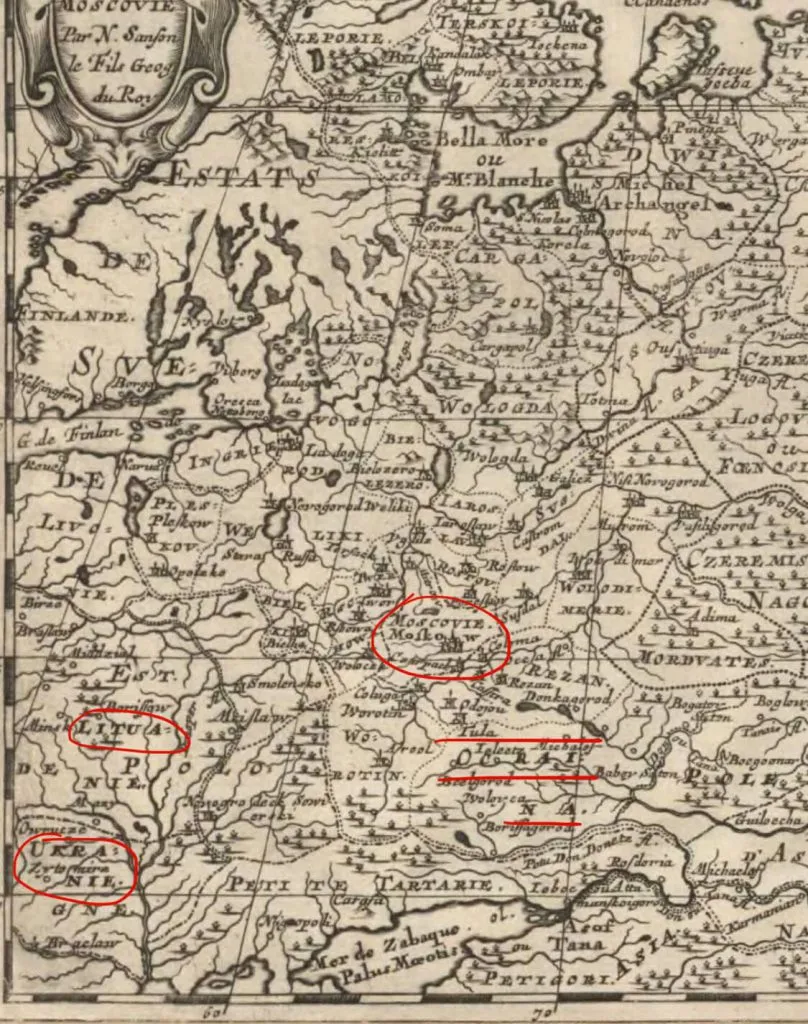
The most interesting thing on this map is the inscription near the town of Tula, where the so-called “Zasechnaya Cherta” (Abatis Line) ran, which indicates the location of that very Okraina (Ocraina). It was precisely along the “Zasechnaya Cherta” that this okraina ran.
Below is the inscription “Little Tartary”, which indicates the Crimean possessions and the nomadic peoples on our land.
Neither in Ukrainian nor in Polish is there such a word as “okraina”. We have “okolytsia”. But there is such a word in Russian. And we see its correct use in this map, which is a copy of an earlier work by Nicolas Sanson (1600-1667), where the names “Ukraine” and “Okraina” coexist without any misunderstanding and denote entirely different lands.
After all, both then and today, the lands of Ukraine are the centre. The centre of struggle, the heart of civilisation, education, principles, development and positive change.
Whereas Muscovy was at all times a province and the periphery of these processes.
In fact, all the Muscovites’ claims against Ukraine, Kyiv and Ukrainians are a wish to be closer to the centre, to civilisation.
A wish which, because it cannot be fulfilled, has for hundreds of years provoked in the Muscovites bestial envy, hatred and a burning desire to destroy, kill and ruin everything that does not fit their understanding and of which they can never be a part.
Author: Ihor Poluektov