

The Moscow church must vacate Ukrainian shrines in Pereiaslav and Kamianets-Podilskyi, Supreme Court rules
“Ukraine Incognita” has already reported on the legal wrangling between the MCIP and representatives of the so-called “UOC” (in reality the ROCiU) over Ukrainian shrines that, fairly or not, ended up in the use of the Ukrainian branch of the Russian Orthodox Church. Despite a series of court rulings, the faithful of the religious structure headed by Moscow Patriarch Gundiaev (aka “Patriarch Kirill”) did not want to leave the churches they had settled in and kept filing appeals.
A final full stop has at last been put to this wrangling.
As reported by the MCIP, on 10 April 2024 the Supreme Court, in a panel of the Cassation Commercial Court, upheld the decision of the Commercial Court of Kyiv Oblast and the ruling of the Northern Commercial Court of Appeal in case No. 911/638/23. The decision satisfied the claims of the Pereiaslav National Historical and Ethnographic Reserve and the MCIP against the Religious Community of the Ukrainian Orthodox Church regarding the removal of obstacles to the exercise of the right to use St. Michael’s Church.
The Supreme Court’s decision is final and not subject to appeal; the Religious Community of the UOC of the St. Michael’s parish in Pereiaslav must voluntarily vacate St. Michael’s Church and hand it over for use to the Pereiaslav National Historical and Ethnographic Reserve. Should it fail to meet its obligations, the Supreme Court’s decision will be enforced by compulsion, in the manner established by law.
In addition, today the Supreme Court also dismissed the cassation appeal of the Religious Community of the UOC in case 924/318/23, by which it had tried to overturn the decisions of the lower courts.
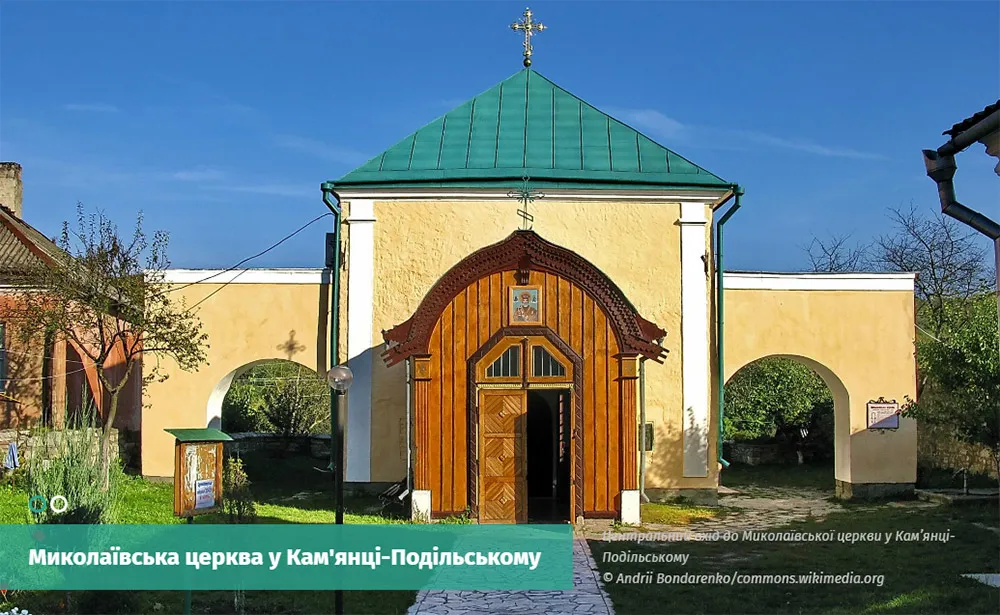
In sum, the Supreme Court fully clarified all the circumstances of the case and made a lawful and well-founded decision to dismiss the cassation appeal and leave the decisions of the courts of first and appellate instance unchanged, and obliged the religious organisation of the Kamianets-Podilskyi St. Nicholas parish of the Kamianets-Podilskyi Eparchy of the UOC in the city of Kamianets-Podilskyi, Khmelnytskyi Oblast, to vacate the church building and hand it over to the Kamianets National Historical and Architectural Reserve.
If enough has been said about St. Michael’s Church in Pereiaslav, less is known about St. Nicholas Church in Kamianets-Podilskyi.
We recall that this church is an architectural monument of the 14th century and belongs to the reserve.
The church was built thanks to a vow. In 1398 the Armenian settler Sinan Kotlubei fulfilled his vow and built a church in the name of St. Nicholas the Wonderworker.
For a long time the faithful of the UOC (ROCiU) used the church free of charge. In February 2023 the management of the Kamianets National Historical and Architectural Reserve sent a letter to the St. Nicholas parish of the UOC (ROCiU) saying that the reserve was declining to extend the standard agreement. It referred to the decision of the National Security and Defence Council “On certain aspects of the activities of religious organisations in Ukraine and the application of personal special economic and other restrictive measures (sanctions)” and to the conclusion of the religious-studies expert review of the Statute on the Governance of the UOC regarding the presence of a church-canonical link with the Moscow Patriarchate, approved by order of the State Service of Ukraine for Ethnopolitics and Freedom of Conscience of 27 January 2023.
The flock of Patriarch Kirill refused to hand the church over to the reserve. The reserve went to court. In addition, by a decision of the Kamianets-Podilskyi City Council session on 4 April, the religious organisation’s right to use the land plot on which St. Nicholas Church stands was terminated.
It is worth noting that during their tenure in this ancient Ukrainian shrine, representatives of the Moscow Patriarchate, spitting on Ukrainian law, disfigured the appearance of an ancient Ukrainian structure that is an architectural monument of national significance. In particular, they stuck onto it an annex crowned with a “kokoshnik”, designed in a typically Muscovite style. Probably so that it would be clear at once that it is the “Muscovite spirit” that rules the roost here, and that this church has nothing to do with Patriarch Kirill, whom they hate, and his ROC in Ukraine. It is possible that the tasteless, purely Muscovite decor had some other purpose, but it looks exactly like that.


