

Archaeologists find mysterious petroglyphs in a rock-cut cave complex in the Vinnytsia region
A unique rock-cut cave complex with ancient images has been discovered in the village of Sloboda Pidlisivska in the Yampil community of Vinnytsia Oblast. This was told to a correspondent of Ukrinform by Pavlo Nechytailo, senior researcher at the state enterprise Research Centre “Protective Archaeological Service of Ukraine”.
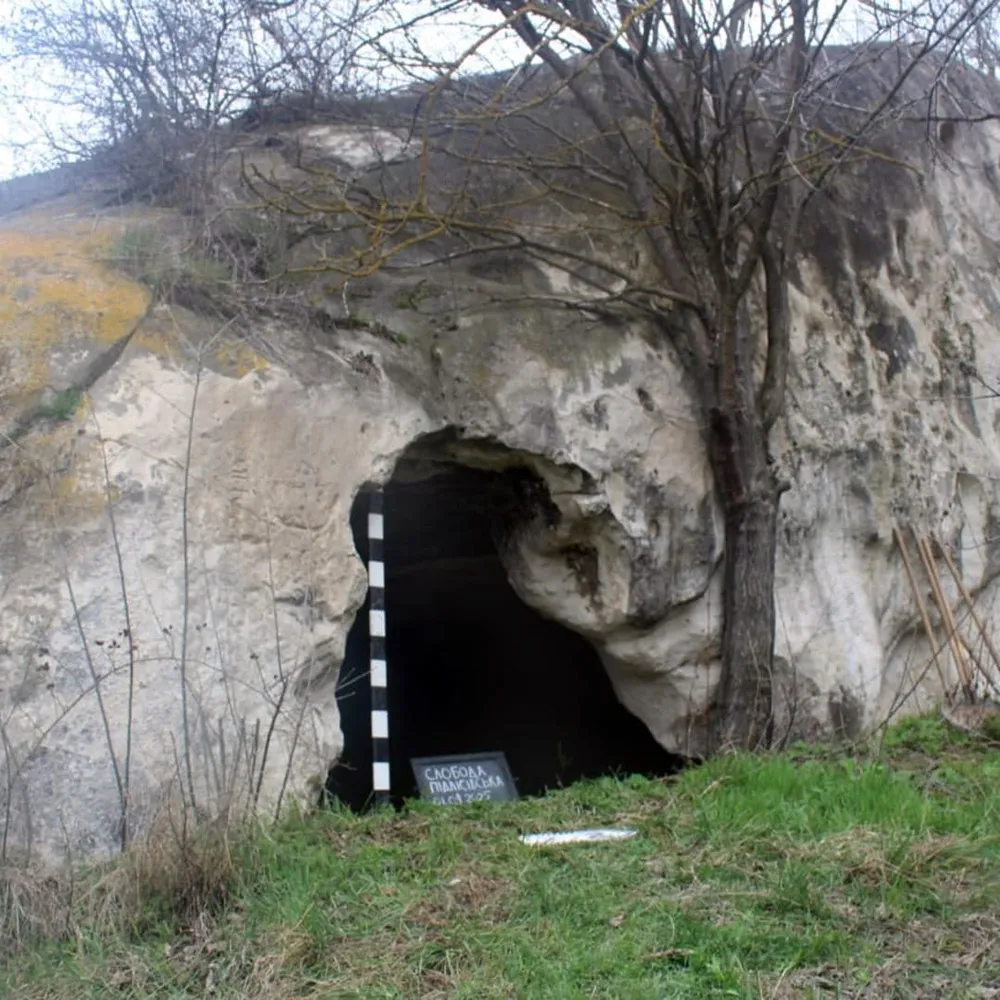
“The caves in Sloboda Pidlisivska are known from the general works of Viktor Guldman and Yukhym Sitsinsky published in 1901. They mention two caves used by shepherds. However, mentions of stone benches in one of the caves gave reason to hope that things were not so simple with them and that they might be interesting historically and archaeologically. After meeting the local resident and local historian Yurii Bilinsky, who showed us these caves in 2014, we saw that they were promising for research and contained ancient images. Thanks to the assistance of the Yampil city council and benefactors from Kyiv, the family of Valentyn and Olena Kutsykh, my colleagues and I surveyed these caves in early April,” Nechytailo noted.
The first cave looks like a rectangular room with sleeping benches carved along the walls. Its entrance contains grooves for installing a wooden door. At the entrance there is a carved image of a horseman, a personal identification symbol and another zoomorphic image. Inside the cave, despite considerable damage to the ancient surface by modern inscriptions and natural factors, interesting images have also survived.
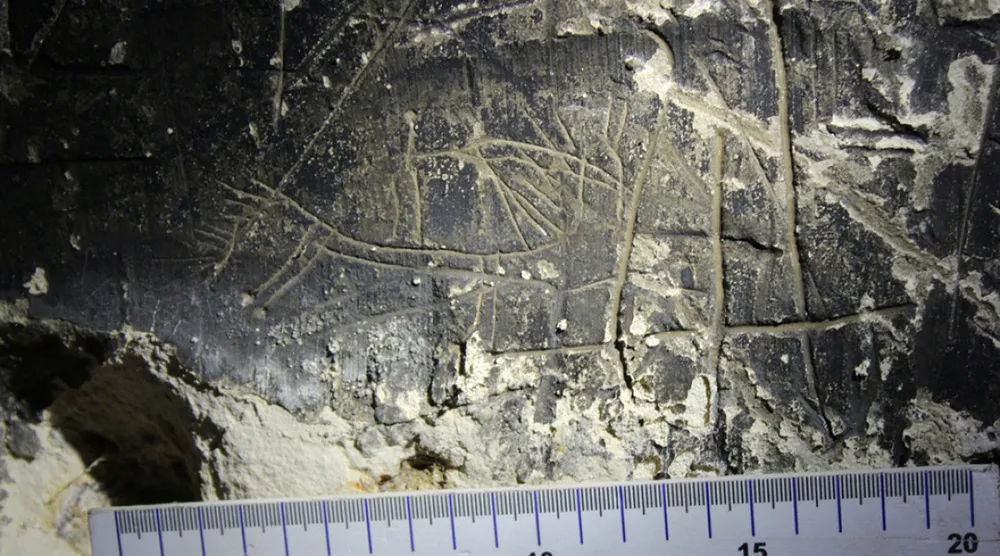
As the archaeologist noted, two images of horsemen deserve special mention, one of which is stylistically similar to the one carved at the entrance. One gets the impression that on both images the rider is not sitting on the horse’s back, but standing. A narrative image is extremely interesting. It depicts a winged figure with two more faces on either side. Complex signs based on a cross have also survived.
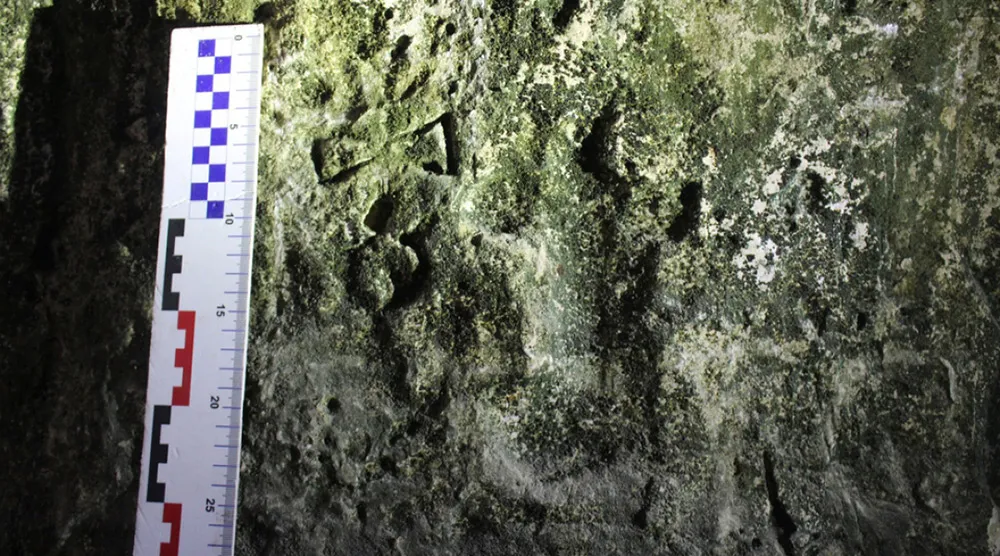
“The second, natural cave, with minor modifications, has an elongated shape more than 10 m long and about 6 m wide. The eastern side of this cave has preserved more than 20 ancient images, most of which are crosses. A cult niche in the eastern wall has also survived. Let me remind you that the eastern side is sacred in Christianity. The altars of churches face east; from the east we expect the coming of the Saviour. In a test pit near the large cave, remains of a cultural layer were found, consisting of charcoal and a fragment of pottery that can be dated to the second half of the 13th – first half of the 15th century,” added Nechytailo.
In addition, on the territory of the village, in the Mala Stinka tract, archaeologists found traces of another sacred Christian complex. Unfortunately, because of natural factors it is almost destroyed.
“Thus, a unique rock-cut cave complex with ancient images was discovered on the territory of the village of Sloboda Pidlisivska. Few similar monuments remain in Ukraine. In particular, in the upper Dniester basin in Ternopil and Ivano-Frankivsk oblasts. Although we know of similar monuments, they contain far fewer petroglyphs (ancient images on stone – ed.). In terms of number and attractiveness, the Yampil area takes first place in this respect. The images are very valuable for understanding the ideology and the ancient beliefs of the population of Ukraine. The emergence of such monuments is linked to radical ascetic manifestations of Eastern Church monasticism,” the archaeologist remarked.
He also said that scholars connect the existence of cave hermitages with the philosophical current and mystical practices of Hesychasm.
According to him, these are extremely powerful tourist sites, and it is gratifying to see how the community understands their value and helps in studying these remarkable monuments.
Note from “Ukraine Incognita”. In the Tovtry in the Khmelnytskyi region, during one of the expeditions, members of the NGO “Ukraine Incognita” found a previously unknown natural cave with petroglyphs in the form of crosses. Some black diggers had already tried to “explore” it, digging a small trench in front of the entrance. From the spoil heap we picked up several fragments of 17th-century pottery and hand-modelled pottery of roughly the 6th–7th centuries AD. Archaeological research of this site, which could potentially yield considerable discoveries (given its location, even Palaeolithic artifacts might be found here), requires not such a large sum. Of course the excavations would be carried out by professional archaeologists in compliance with all legal norms. The aforementioned Pavlo Nechytailo became very interested in this site, but organizing an expedition costs something. If there are people in the Khmelnytskyi region who want to finance this research — contact us. We are ready, on a volunteer basis, to act as intermediaries in organizing such an expedition.
Photos from Pavlo Nechytailo


