

In Volyn an attempt was made to illegally sell a unique historical monument from the time of Ancient Rus

· 2 min read
As the Office of the Prosecutor General reports, under the procedural supervision of the Lutsk District Prosecutor’s Office of Volyn Oblast, a criminal case is being investigated over the unlawful appropriation by a person of found property, or property of another that came into their possession by chance, or a treasure, of special historical, scientific, artistic or cultural value (Part 1, Article 193 of the Criminal Code of Ukraine).
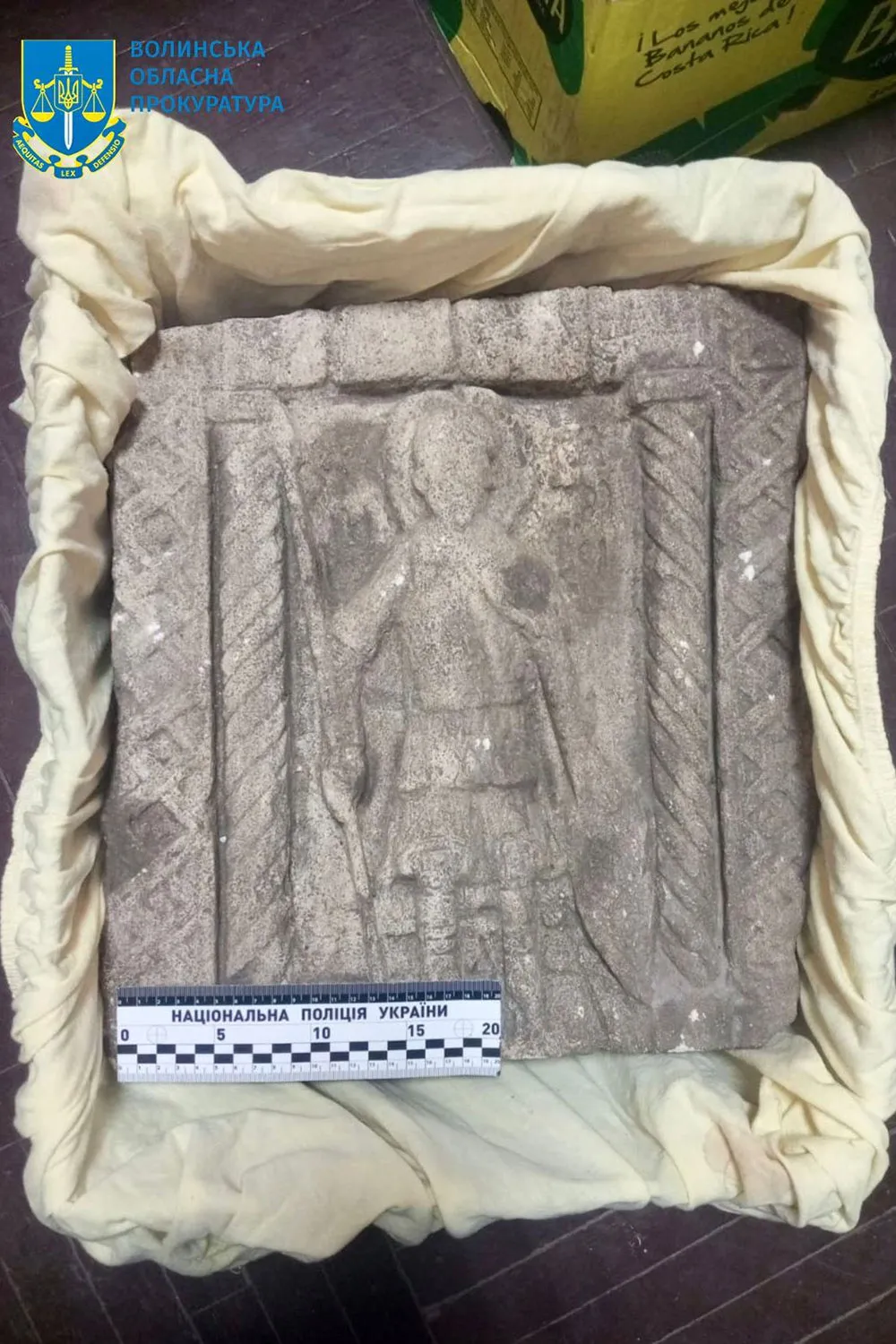
Thanks to the coordinated work of law enforcement bodies, the investigation managed to recover a unique monument – a carved stone slab of the 10th–13th centuries depicting a “Holy Warrior” of the Kyivan Rus’ period.
Unidentified persons tried to sell the historical monument illegally at an online auction.
According to Fedir Androshchuk, Director General of the National Museum of the History of Ukraine and Doctor of Historical Sciences, monuments of this level have not been found in our country for the past century.
The well-preserved stone slab depicting a “Holy Warrior”, probably St. Demetrius, may have adorned one of the churches of the Principality of Galicia-Volhynia.
The unique find will be transferred to the National Museum of the History of Ukraine for storage and study. Subsequently it will remain in the museum.
The pre-trial investigation is being conducted by the Lutsk District Police Department of the Main Directorate of the National Police in Volyn Oblast.
The archaeologist Maksym Levada, in a comment for “UP. Zhyttia”, explained that this slab may be the work of a Byzantine master, although such objects are more often found in Crimea or in Western Europe.
“Most likely it was made by craftsmen who served Christian churches that were only just beginning to be built. The limestone the slab is made of indicates that it was made precisely in the Principality of Galicia-Volhynia: in Halych, Volodymyr, Lutsk or some other princely city.
This slab is wonderfully preserved. It bears inscriptions in Greek. Such slabs were usually made for churches, but the size of this one may indicate that it was made for a chapel annexe dedicated to the saint,” the archaeologist said.
According to him, in the 13th century an ordinary person could not commission such an item. Such slabs were usually gifts, which were often built into walls.
As “Ukraine Incognita” reported earlier, in Kharkiv Oblast law enforcers seized a black digger’s “bribe”.


