

Ukraine’s oldest “plague cross” can be seen near Sataniv
Thanks to a partnership project of the NGO “Ukraine Incognita” and the Department of Culture, Nationalities, Religions and Tourism of the Horodok City Council (Khmelnytskyi Oblast), called “Graves of the Ancestors” we were lucky to discover the oldest “plague cross” in Ukraine. The cross itself has been known for a long time, but the fact that it is also a “plague” cross was only found out recently.
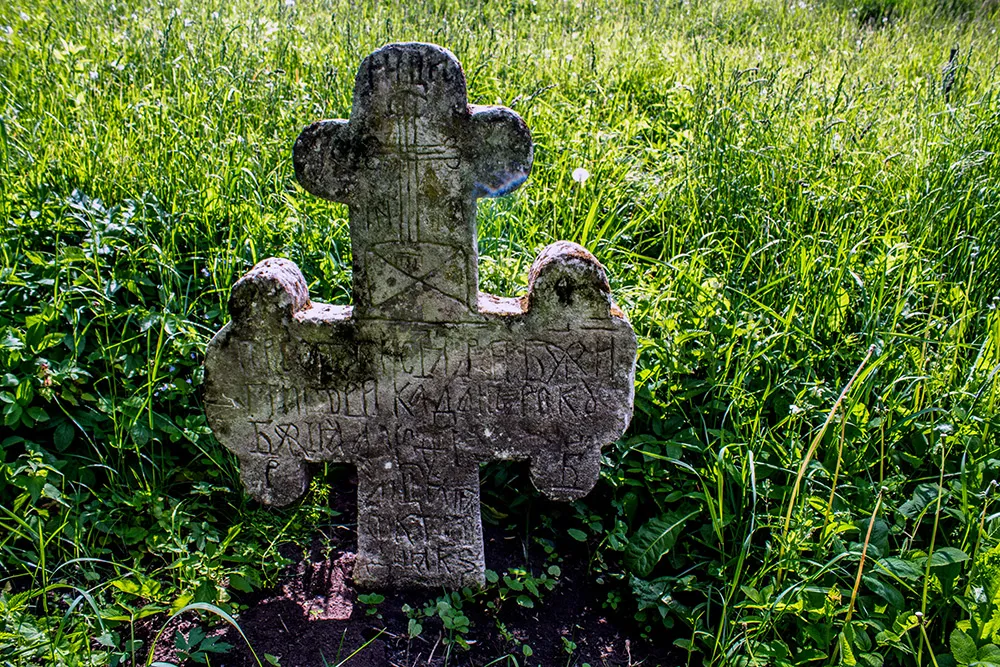
“Plague” crosses outside cemeteries are extremely rare monuments. At present historians know of only 13 such artefacts in Ukraine: 8 in the vicinity of Sataniv, 2 in Derazhnia, 1 in Lisovody (Horodok territorial community), 1 in the village of Horodyska (Dunaivtsi territorial community), all in Khmelnytskyi Oblast. One more cross is in the territory of Ternopil.
These burials are “outside cemeteries” because, in order not to spread the infection, the dead were often buried near the houses where they had lived.
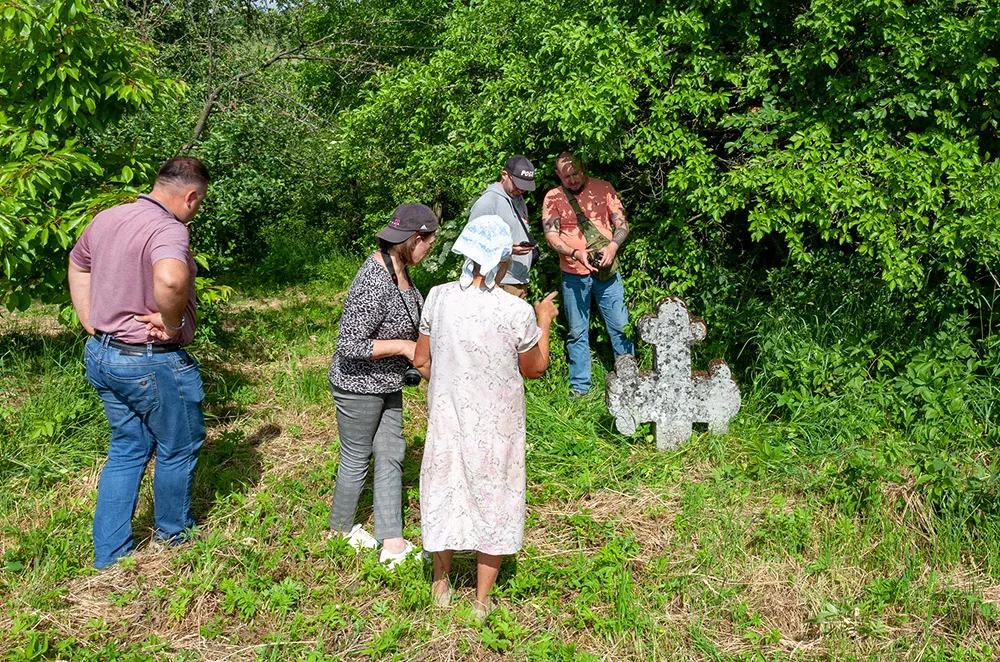
The oldest of the “plague crosses” discovered in Ukraine stands in a peasant farmstead in the village of Kamianka, a hamlet of Sataniv (Khmelnytskyi Oblast). It is a cross on the grave of a certain Hryhor Kadon, who died on 26 October 1719. Unfortunately, the local villagers, who for centuries looked after the grave, regularly cleaned and whitewashed the cross, which is carved from soft limestone. As a result, the considerable inscription on its reverse side has almost worn away. It was possible to make out “повѣтр…”, that is, “povitria” (“air”), meaning an epidemic.
The plague epidemic of 1719 first struck Zhvanets, a port town on the border with Turkey. The disease was fought radically there: infected houses were simply burnt together with the dead. But this did not help, and the pestilence of “djuma” (that is, plague) soon attacked Kamianets. At a meeting on 21 September 1719 the town’s nobility raised a considerable sum, 1,000 zlotys, for the urgent needs of fighting the “air”. Anyone who thinks that this money went to organizing quarantines, doctors’ needs or at least a timely burial of the victims is mistaken. These funds paid for Masses in all the churches of the town. Naturally, it did not help, and the disease spread across all of Podolia [1].
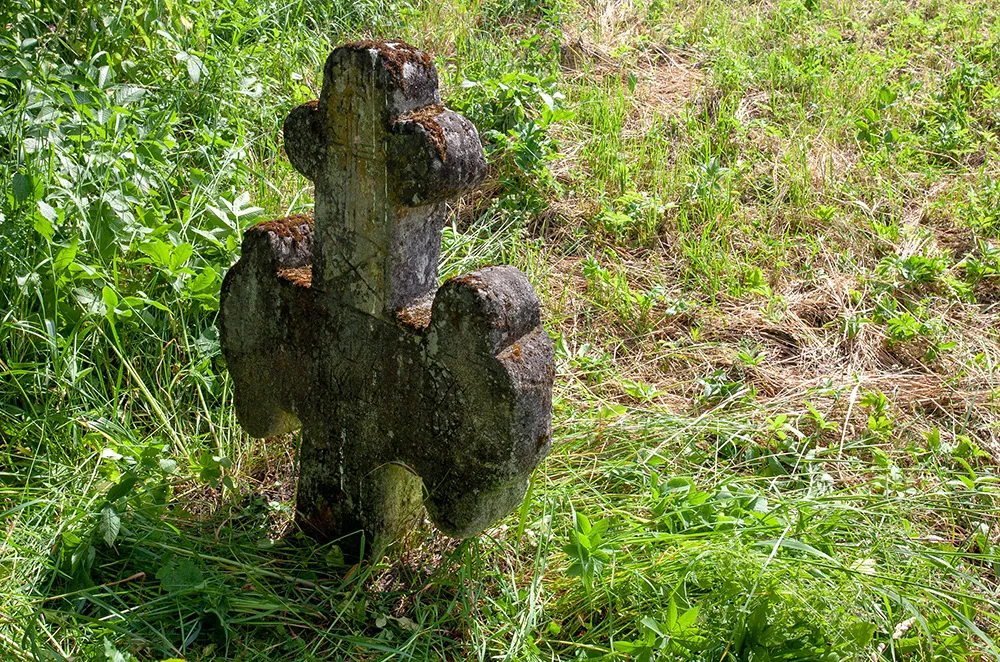
The discovery of Kadon’s grave, besides revealing a unique artefact, is also of great historical importance. In 1831 almost the entire archive of the Sataniv magistrate burned down, so we have extremely little written information about its history and past. While there is at least minimal evidence of the pestilence of 1770–1771 in the “Chronicle of the Sataniv Monastery”, until now there was no information about the epidemic of 1719 in Sataniv and the surrounding villages. Moreover, going by the date of Hryhor Kadon’s death, one can conclude that the disease covered the distance from Kamianets to Sataniv, more than 100 km, in just a month.
1. Iryna Pustynnikova. Epidemics and Kamianets. Podolianyn. Kamianets-Podilskyi, 20 March 2020


