

One of the oldest monuments to Taras Shevchenko cries out for help

· 4 min read
Interesting and important information is shared by the Facebook page “Drymba.com – tourism and local history of Ukraine”.
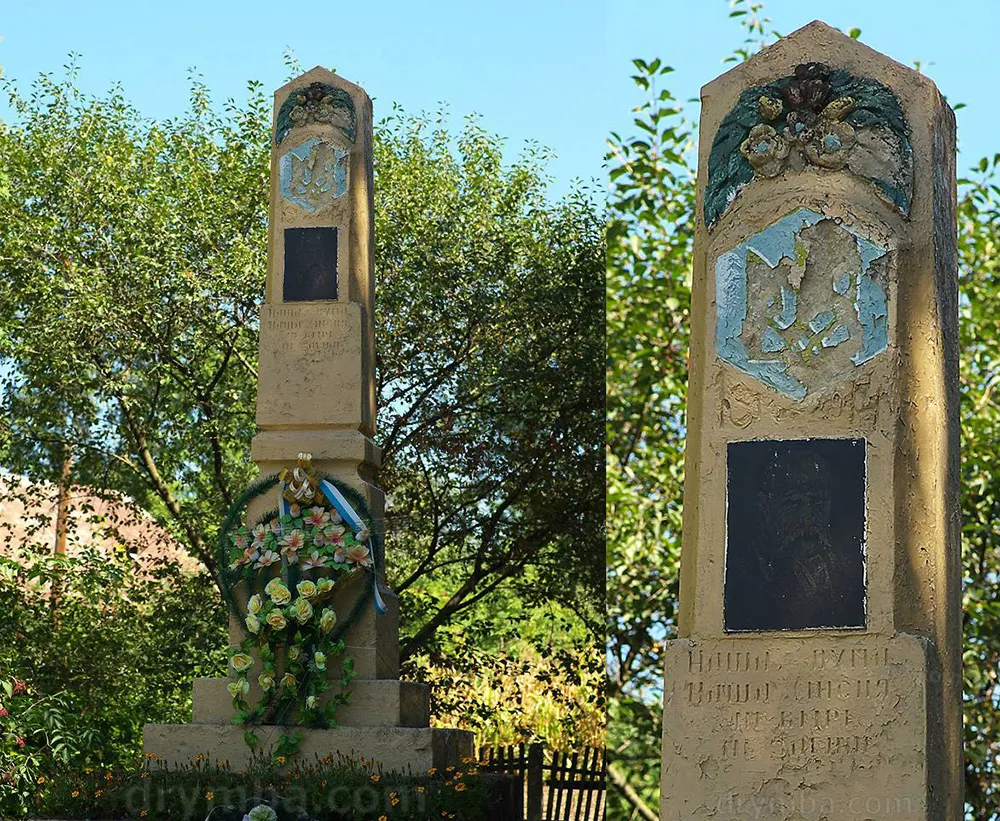
The monument to Taras Shevchenko in the village of Zalavie (Ternopil region). What is so special here, you may ask? It is not Mukachevo Castle or the Dniester Canyon. Nothing “Instagrammable”…
But in fact there is a lot that is special. For one thing, the monument was erected in 1914! Yes, indeed, it is one of the first monuments to the Great Kobzar in the world! It is made modestly, simply, in a folk style, with flowers and a tryzub. The detailed story (and it is an interesting one) is on the main page of our website (drymba.com).
The condition of the monument… well, you can see for yourself in the photo. Now it looks a little different (white), but not much better. Meanwhile, the 210th anniversary of Taras Shevchenko’s birth and the 110th anniversary of the monument itself are about to come.
The monument needs professional restoration; the stone is deteriorating both from natural factors and from “repairs”. Perhaps at least publicity and an “info wave” will get things moving from a dead end?!
The monument to Taras Shevchenko in the village of Zalavie in Ternopil Oblast was erected in 1914 at the expense of local residents. In its architectural design the monument is built in the form of a four-sided obelisk. A column about 3 m high stands on a small stepped pedestal. The upper part bears a small floral panel, below it is a tryzub in a hexagonal “cartouche”, and under it the dates 1814–1914. At the very bottom of the obelisk the masters carved a portrait of the poet and a fragment of the famous stanza “Our thought, our song will not die, will not perish” (from the poem “To Osnovianenko”).
History tells us that the monument was made by local stonemasons for the centenary of the Great Kobzar’s birth. It was the first monument in the Terebovlia county and the third in all of Ternopil region. Many guests came to the unveiling, and the event turned into a huge popular gathering. The monument was unveiled by a deputy of the Austrian parliament himself, Longin Tsehelskyi.
Under Poland the monument was damaged, and traces of this survive to this day. Polish gendarmes shot at this monument with a carbine as early as 1922, and scars remain where the bullets hit. The portrait of Taras Shevchenko, made of black stone, which now does not quite fit the overall composition, is not authentic but was added much later. The original portrait has not survived.
Later the obelisk was moved from the centre of the village to the place where it stands today. It now stands in the southern part of Zalavie, beside the local Church of the Holy Trinity and the main street, in the shade of trees. Nearby there is also a former Roman Catholic chapel, so one can say that the most interesting sights of the village are concentrated in one place. 500 metres to the south is the bridge over the Seret River, and beyond it the village of Pidhaichyky begins.
At the time of the photo documentation, in 2016, as you can see in the pictures, the monument was in unsatisfactory condition. The paint was peeling, and the stone itself is far from in the best state. The tryzub and the inscriptions are barely legible. In 2022 the monument was prepared for reconstruction, but because of the full-scale war the work was postponed indefinitely. So when exactly its restoration will take place is not known for certain.
The monument to Taras Shevchenko in the village of Zalavie in the Terebovlia area is one of the oldest monuments to the poet’s genius in the world and is an architectural and monumental art monument of local significance (protection number 800). Interestingly, the Terebovlia area is the location of two monuments to the Great Kobzar at once that are “silver medallists” by age. The memorial cross in the village of Loshniv is the same age as the monument in Zalavie (also 1914). The record holders in Ternopil region, however, are the memorial cross for the 50th anniversary of the poet’s death in the village of Burdiakivtsi, erected even earlier, in 1911 (!), and the bust in the village of Zhukiv in the Berezhany area (also 1911, reconstructed).


