

Russians are destroying archaeological sites in the occupied areas of Zaporizhzhia Oblast
The Russian army has built trenches on burial mounds in the Vasylivka district of Zaporizhzhia Oblast — as a result, practically half of the archaeological site “Lysovska Mohyla” has been destroyed. The archaeologist Oleh Tuboltsev told correspondents of Suspilne how the occupiers are destroying such sites.
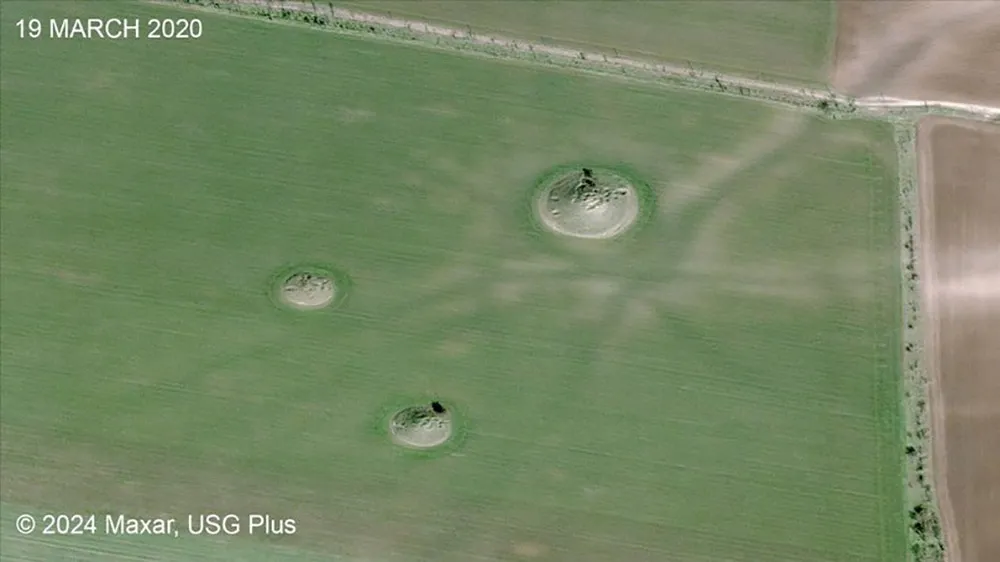
The group of burial mounds “Lysovska Mohyla,” satellite images of 19 March 2020. Facebook / Crimean Institute for Strategic Studies
Lysovska Mohyla is a group of burial mounds, ancient graves, located in the temporarily occupied territory of the Vasylivka district. Several thousand years ago, generations of people buried their dead on this land together with their most valuable possessions — now they are hidden beneath a thick layer of soil. Such an archaeological site is unique for the region:
“Each such mound may contain 50 burials, perhaps more, perhaps fewer. But they are there in all the layers. So as a whole, as monuments of history and archaeology, they are simply unique for us.”
According to Oleh Tuboltsev, the construction of the so-called “Surovikin line” — a Russian defensive line of trenches and dugouts — has damaged the archaeological site “Lysovska Mohyla”:
“Now there are trenches, foxholes and dugouts there. We are documenting this, but overall the condition is terrible. If it is a foxhole or a trench along the top, then of course part of the mound is simply destroyed completely. And most cases are like that. If a road was laid there or there was a fire, the top layer of soil is destroyed. And that already harms nature, since there are many unique plants there.”
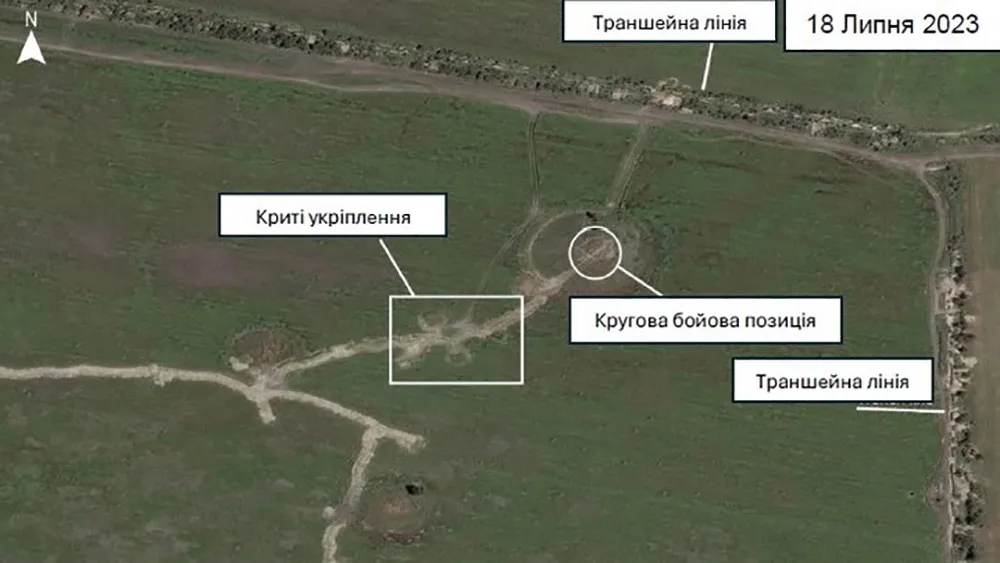
Defensive structures of the Russian army on the site of the partly destroyed group of burial mounds “Lysovka Mohyla,” satellite image of 18 July 2023. Koropetskyi D., F. Greenland, K. Harrell, K. Jasparro, S. Munevar and S. Hardy. Documenting Russian military activity near ancient Ukrainian burial mounds: fortification, destruction and possible looting. Conflict Observatory report (2024)
However, it is impossible to record the exact destruction of the unique archaeological site — satellite images show only the largest damage:
“The trouble is that satellite images let you see only large damage of this kind. Before the war the Lysovska Mohyla mound group was grassed over. Three mounds: a five-metre one, a three-metre one and another three-metre one. And this is what there is now: trenches, a dugout, trenches, trenches…,” the archaeologist noted.
During the occupation another historical complex was also damaged — the Russians looted the site “Kamiana Mohyla” (Stone Tomb):
“They merged Kamiana Mohyla, as a national reserve, with a Crimean structure, the national reserve of Chersonesos. The whole exhibition, as I understand it, was taken to Sevastopol. And we know who took it out, we know who received it. We see these exhibits at their exhibitions, we are documenting them.”
As Ukraine Incognita reported earlier, Russian “archaeologist” looters are conducting illegal excavations at Kamiana Mohyla.


