

Kuzmyn village: a fire in an old synagogue revealed an ancient mural (photos)
“Graves of the Ancestors” is a joint project of the NGO Ukraine Incognita and the Department of Culture, Ethnic Groups, Religions and Tourism of the Horodok City Council, carried out under the patronage of Mayor Neonila Andriichuk and launched last autumn. Its aim is to study all the old necropolises of the Horodok area (Ukrainian, Polish and Jewish) in order to show the multifaceted, multinational culture of Podillia. In that time the researchers have made a series of discoveries, including some that drew nationwide and international attention.
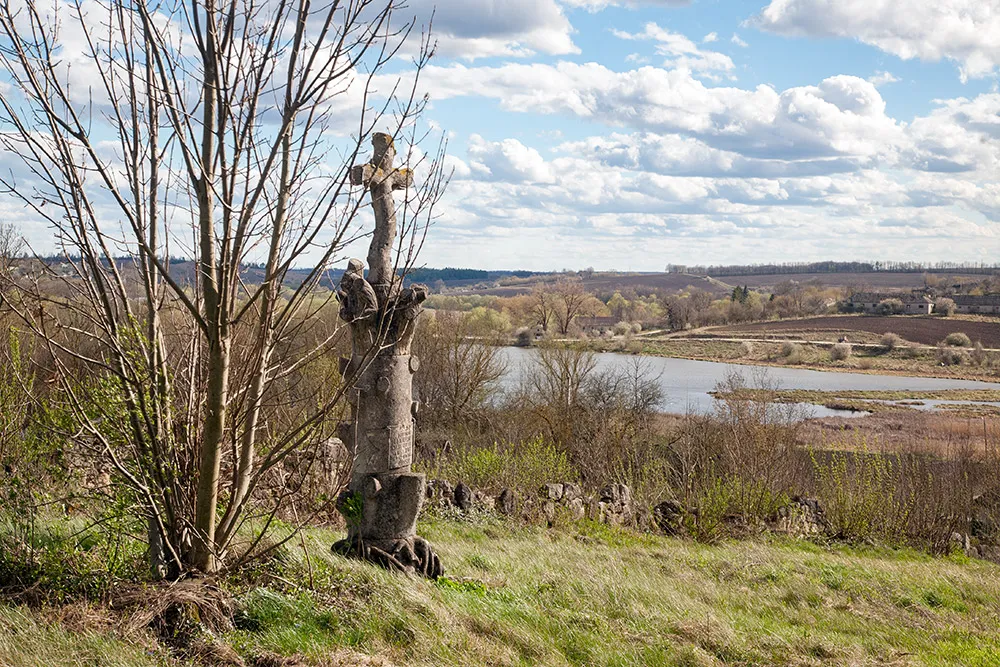
Kuzmyn spreads along the banks of a huge pond formed on the Smotrych River
Since April the project “Graves of the Ancestors” has focused on the village, once a small town, of Kuzmyn in the Horodok community.
The old Orthodox (Ukrainian) cemetery, despite its considerable size and venerable age (the oldest burials here date from the mid-19th century), unfortunately brought no great discoveries. We managed to find only half a dozen monuments of even slight interest.
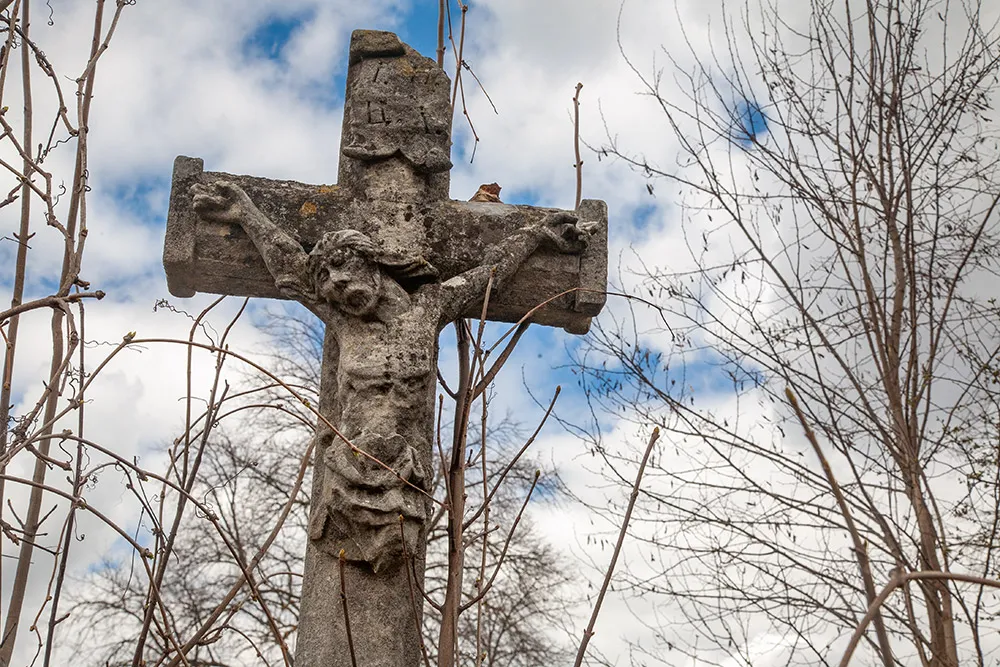
One of the most beautiful crosses in the old Ukrainian cemetery. Second half of the 19th century
The Jewish cemetery (in use from the beginning of the 18th century until the mid-19th century), by contrast, impressed with both its impenetrable thickets and its rather striking gravestones. Unfortunately, most of them are covered with a thick layer of emerald moss. This is very picturesque, but clearing and documenting it all would take a whole task force of several dozen volunteers and at least a full day of hard work. Among the discoveries is a very untypical gravestone in the form of a sarcophagus. Gravestones in the form of flat stelae or “boots” are common in this part of Podillia (Sataniv, Tarnoruda, Horodok, Kuzmyn, Smotrych, Sharivka, Kytaihorod and so on), whereas “sarcophagi” are found only in the old Jewish cemetery of Kamianets-Podilskyi. The researchers plan to return later to clear the epitaph more thoroughly and translate the inscription.
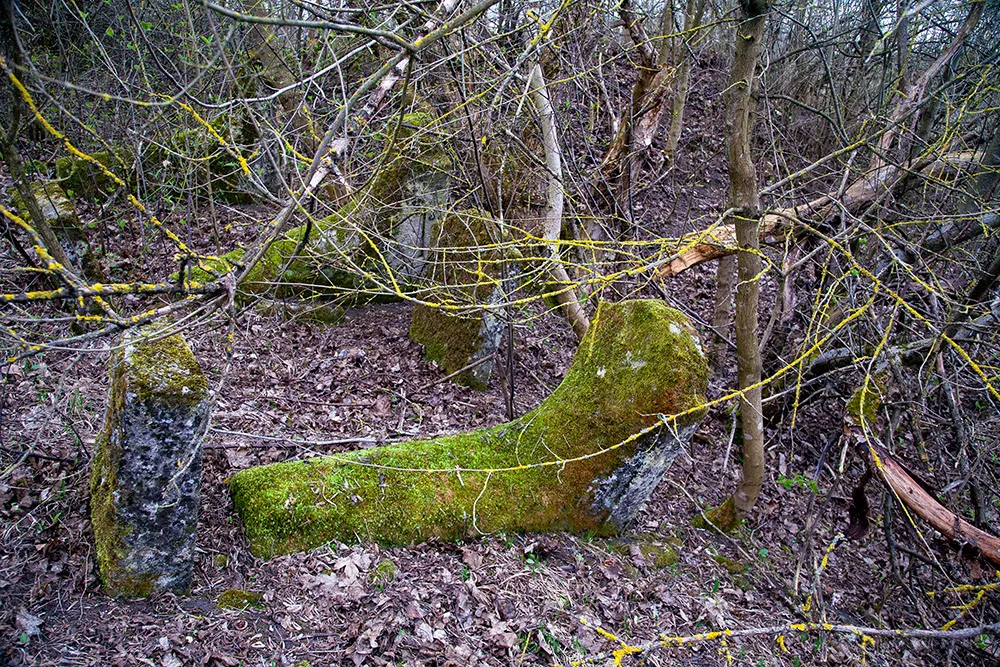
“Boots”
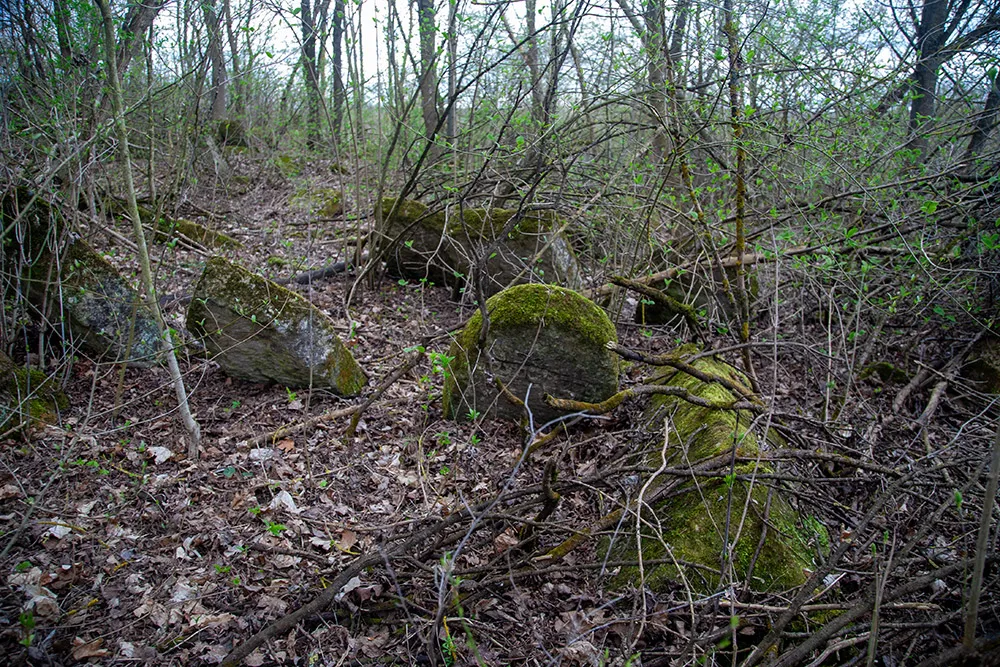
Gravestones covered with a thick layer of moss
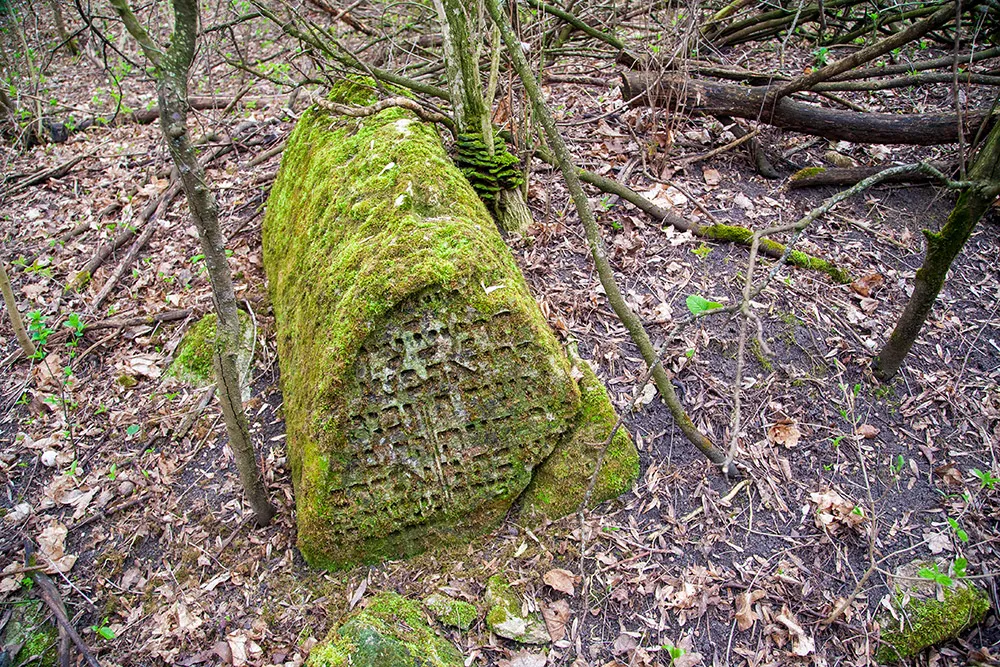
A “sarcophagus” gravestone
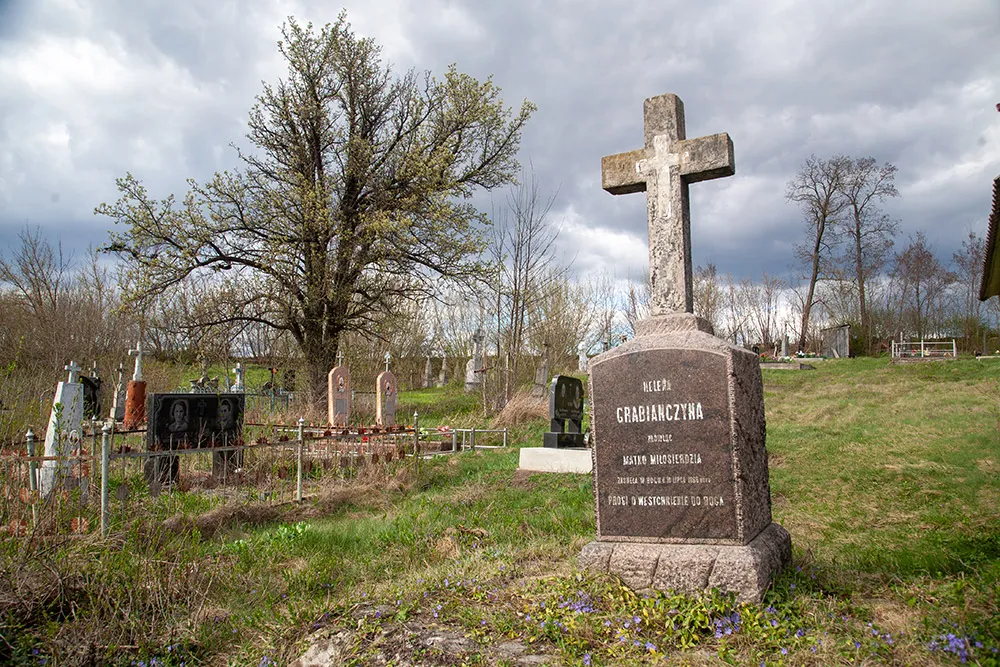
The Roman Catholic (Polish) cemetery delighted us with two remarkable gravestones. One is notable first of all for the person buried beneath it, Helena Hrabianchykha, who died in 1866. She was the wife of either one of the sons or one of the grandsons of the famous mystic and illuminatus Tadeusz Hrabianka. Whose wife exactly will become clear in the near future. By a striking coincidence, at this very time a print run of the book “Tadeusz Hrabianka: King of the Illuminati” was being printed, written by Dmytro Poliukhovych, a member of the Ukraine Incognita team and one of the participants of the “Graves of the Ancestors” project. This, we should note, is not the first mystical coincidence connected with this book.
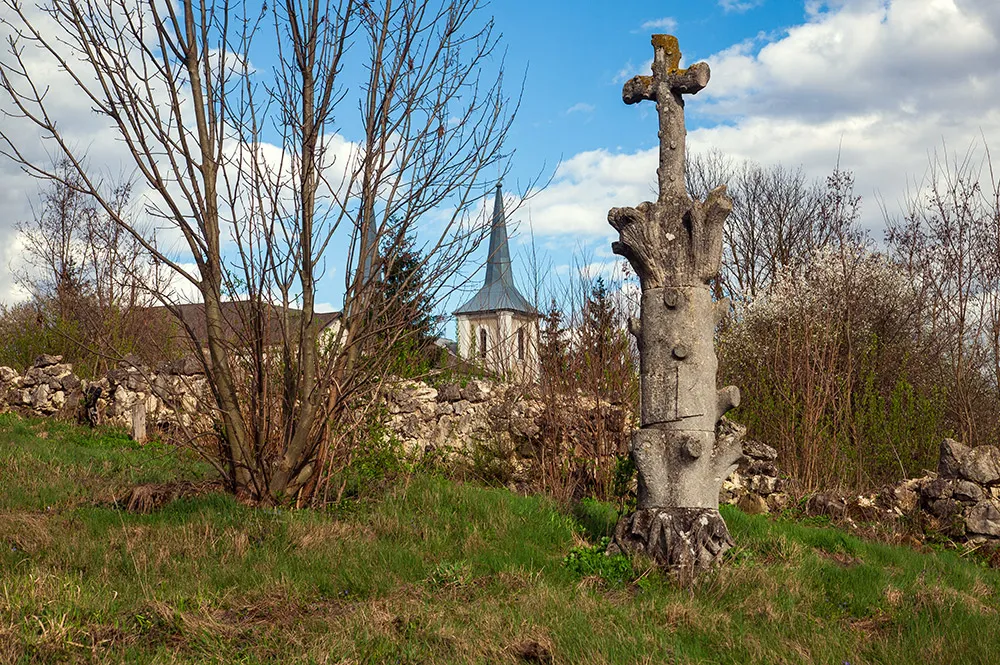
We were also struck by a huge stone cross more than three metres high. In general it is a gravestone of the “chopped tree” type, typical of the late 19th and mid-20th centuries, but here the master approached what was then a “fashionable” theme in a highly unconventional way. We have never seen anything like it.
During the expeditions of the “Graves of the Ancestors” project, researchers study not only necropolises but other monuments as well. A truly sensational discovery was made in the old (first half of the 19th century) masonry synagogue. In the 1930s the house of prayer was closed and turned into a warehouse. At that time new doors were cut through it to allow convenient access from the side of the town, while the original entrance, on the side of the Smotrych valley, was walled up.
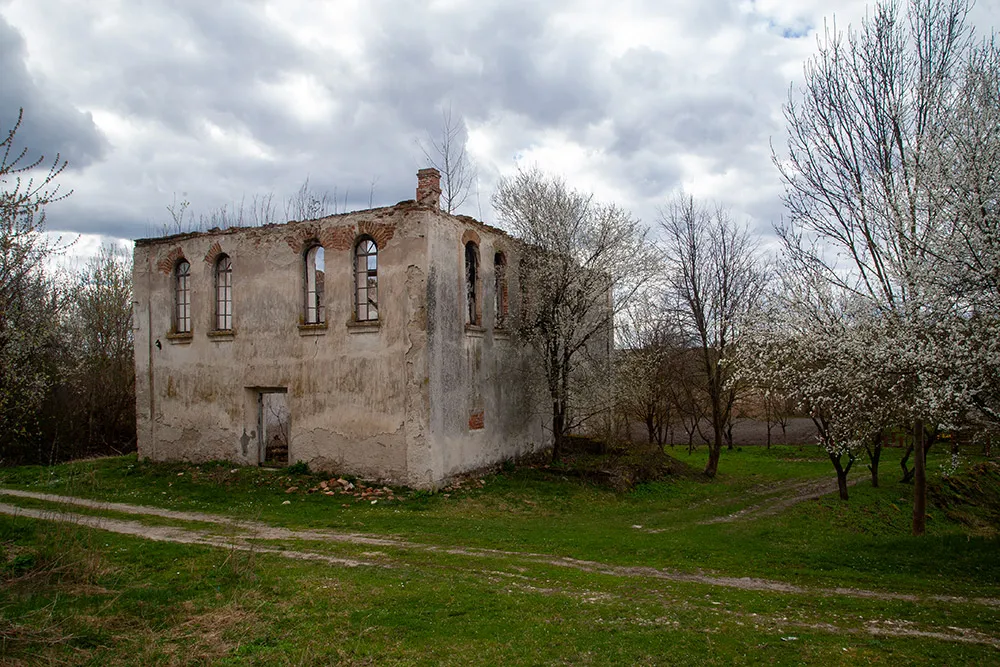
The synagogue after the fire
Where the new doors were cut, there once stood the aron kodesh, a decorated niche-cabinet in which the Torah scrolls were kept. In synagogues this place played the role that the iconostasis plays in Christian churches (a very rough comparison, admittedly, but roughly like that). The decoration of the aron kodesh also included the mural painting around it.
Later Soviet repairs whitewashed this mural over.
After a failed project to set up a collective-farm bakery here (sometime in the late 1970s), the building stood empty and, as often happens in such cases, turned into a dump. Six or seven years ago this rubbish caught fire. The walls survived, but the roof was destroyed completely. We have this fire to thank for a genuine and, without exaggeration, sensational discovery.
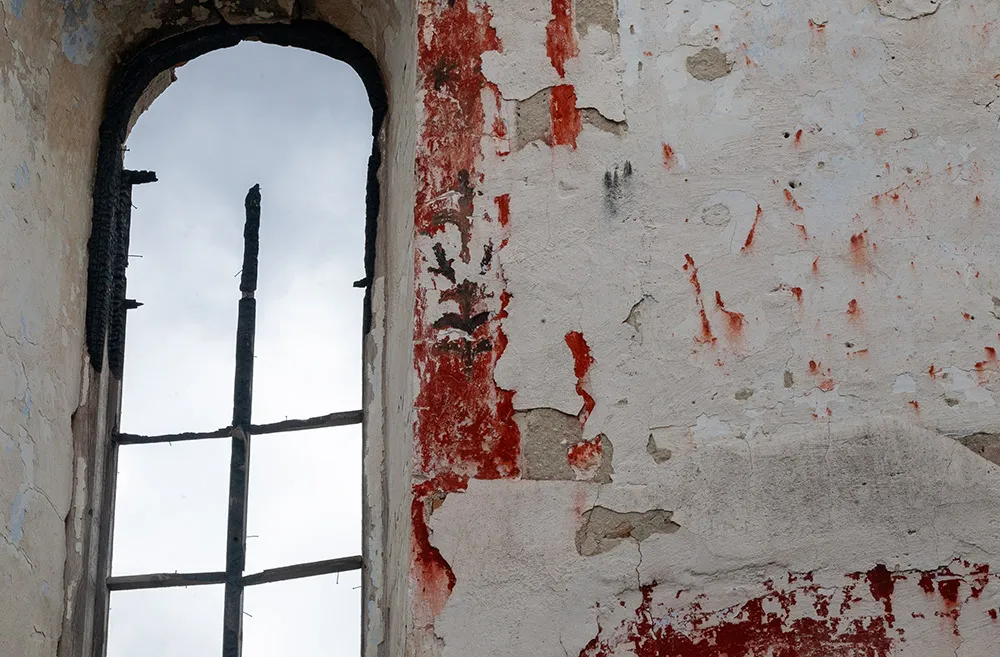
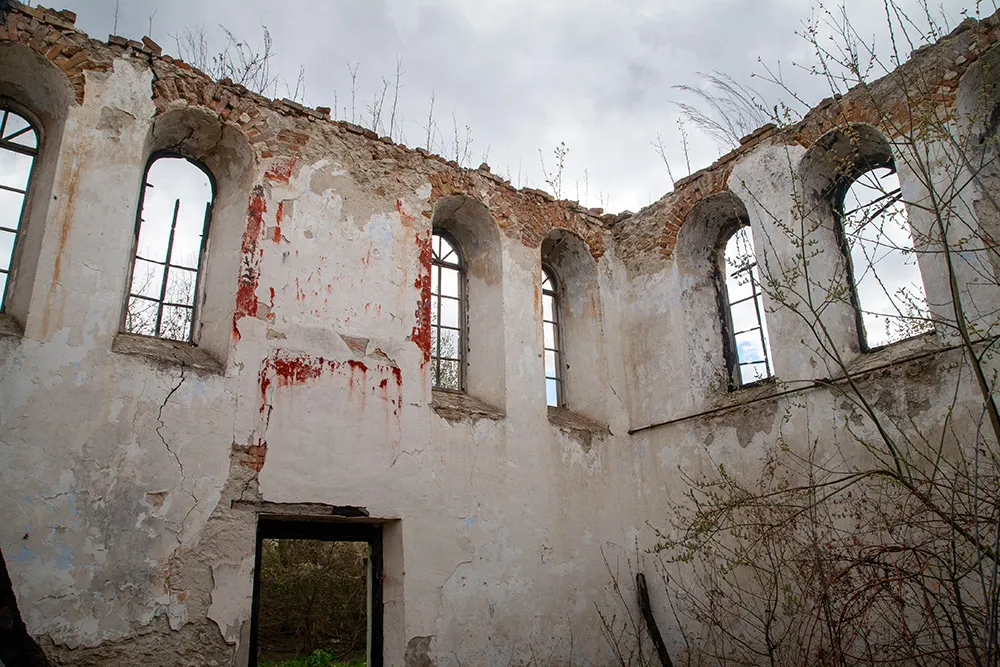
As the researchers found, the fire not only destroyed the ceiling and the roof but also removed part of the Soviet-era layers, revealing part of the mural that once decorated the aron kodesh. So far only fragments of some floral ornament are visible. Perhaps something more interesting is hidden beneath the surviving whitewash.
Vitalii Kamozin, Chief Operating Officer of the United Jewish Community of Ukraine and a researcher of Jewish heritage, commented on this for Ukraine Incognita:
“Only a handful of old synagogues in Ukraine have preserved their aron kodeshes, or at least their remains. The find in Kuzmyn is a genuine sensation and, without exaggeration, unique. After our Victory the UJCU will certainly return to this subject. The mural must be fully cleared and the paintings conserved.”


