

Another cultural heritage site in Crimea may fall victim to Russian developers
The construction of two gas pipelines to connect a new tourist cluster on the North Side of occupied Sevastopol to the networks threatens the physical preservation of the cultural heritage site “Settlement of the 8th–10th centuries, Ust-Belbek”. This is the conclusion of the state historical and cultural expertise report published on the website of “Sevnasledie”. This is reported by Voice of Crimea.
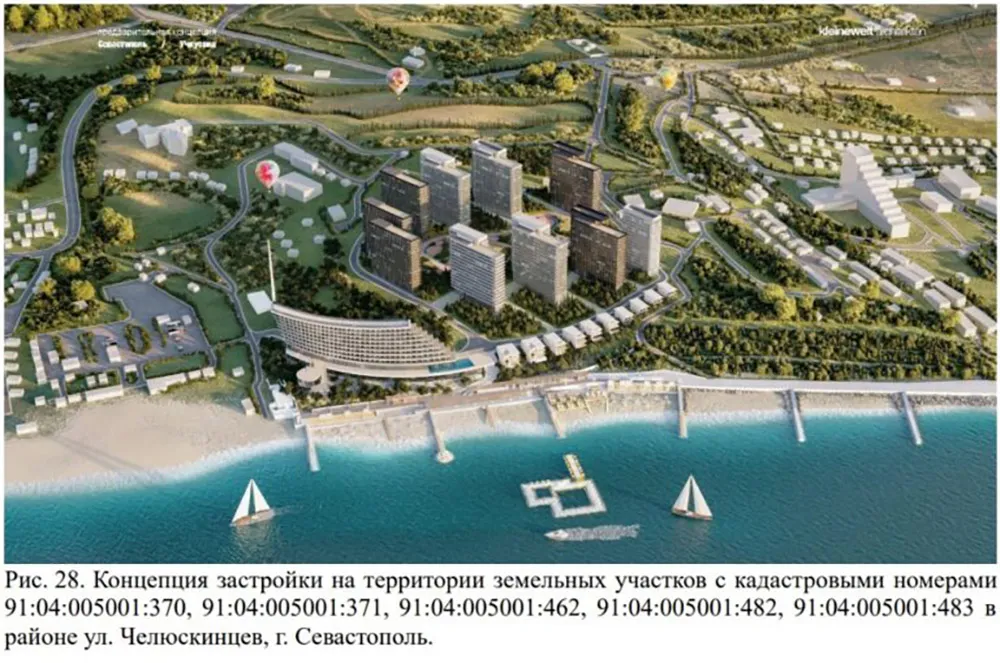
It became known in 2022 that a large recreational cluster was planned in occupied Sevastopol in the Liubymivka area. At that time, at the international economic forum in St. Petersburg, the “governor of Sevastopol”, Mykhailo Razvozhaiev, signed an agreement on implementing the project with Petro Fradkov, head of Promsviazbank, and Nail Izmailov, managing partner of the YUGA company.
“Recently, at the urban planning council, we made a decision on developing a significant stretch of the coast on the North Side as a recreational cluster. In many ways this decision started thanks to an investor who bought a plot of land and came forward with a proposal to create a five-star hotel and a complex of apart-hotels, together with comprehensive development of the area. The volume of investment is substantial – about 15 billion roubles,” Mykhailo Razvozhaiev said at the time.
The investor has declared that a world-class multifunctional complex and social facilities, including a rehabilitation centre for children, are planned in the area of the village of Liubymivka, along with landscaping of the beach and the creation of a single promenade line that stays accessible to all residents of Sevastopol. Financial support during construction will be provided by Promsviazbank.
However, in 2023 it emerged that the renovation of the beach in Liubymivka would bury beneath it an ancient pottery centre that existed here in the Middle Ages, probably from the 7th to the 10th century AD.
The fact that the cultural heritage site “Ust-Belbek Pottery Centre” would be razed and the plot used was stated in a historical and cultural expertise report published on the “Sevnasledie” website. It was prepared in connection with the construction by the YUGA company of a tourist cluster of about ten 15-storey buildings on the North Side of Sevastopol.
Most residents of Sevastopol did not even suspect that the hilly land near the salt “lake” is remarkable for anything other than its proximity to the sea. Scholars, however, know this place well: the first research in this area was begun back in 1901 by Mykola Pechonkin.
A new stage of archaeological research lasted from the 1960s to the 1990s. The State Historical Museum and the Chersonesos Taurica expedition, led by Oleh Savelia, worked here. The Ust-Belbek settlement and the pottery centre were localised.
Since then, however, no research has been carried out, and now, according to the expertise report, the pottery centre looks like “an area of ancient clay pits and, concentrated around them, parking lots, a municipal waste collection site, spontaneous dumps, dirt roads and abandoned sites for a souvenir market”.
And now the plot with a cultural heritage site that has not yet been fully studied is planned for development – and the pottery centre simply does not fit into the project.
“Ensuring the physical preservation of the ‘Ust-Belbek Pottery Centre’ is not possible <…> it is necessary to carry out salvage archaeological fieldwork (excavations) with full or partial removal of archaeological items before the work begins,” the expertise report said.
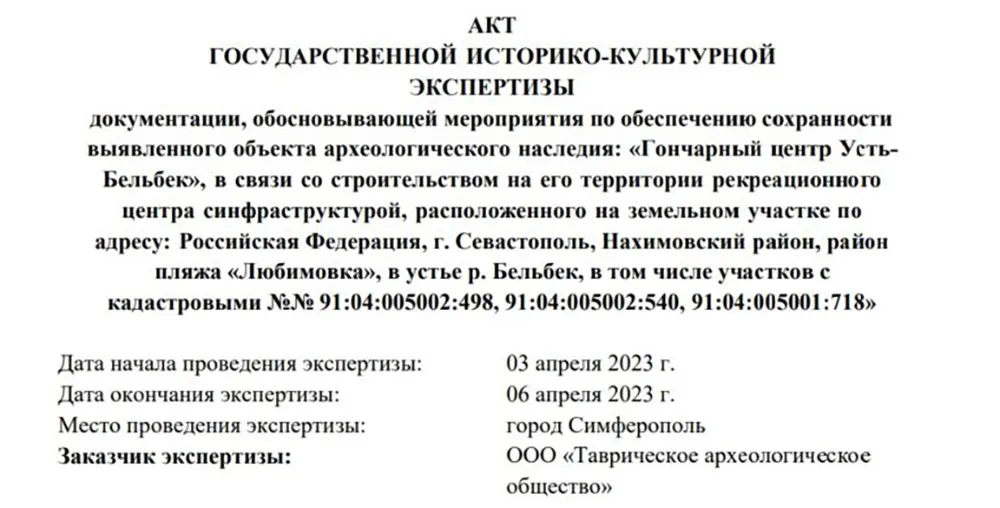
What exactly is to appear on this site, the report did not specify. Only the area of the salvage work was given – about half a hectare.
According to Crimean media, the cluster itself is planned to be built not directly on the cultural heritage site and the beach itself, but next door, beside the Albatros and Horizont holiday camps. As for the public beach and the adjacent area, their improvement was presented by the authorities and investors at the project presentation as a gift to the city.
True, the title of the expertise report suggests that the beach is now regarded as the grounds of the future apartments and hotel.
It has also been declared that the coastal area remains in state ownership as before, but the title of the document involuntarily makes one fear that one day the people of Sevastopol will find no place on the Liubymivka beach, or on some part of it. All the more so since the cluster plan includes a children’s rehabilitation centre, which, as a medical institution, has the right to a closed beach.
In November of this year it became known that a new historical and cultural expertise report, commissioned by the limited liability company “Sevastopol Budproiekt”, showed that the Ust-Belbek settlement is under threat.
According to the state historical and cultural expertise report, a trench for the two gas pipelines, 247.5 metres long, 0.8 metres wide and 1.2 metres deep, will run directly across the territory of the ancient settlement. It is planned to lay it along the western and south-western verge of the road.
“During the earthworks, physical preservation of the cultural heritage site’s territory in the area of the trench is impossible,” the expertise report states.
The fate of this archaeological monument has greatly interested the people of Sevastopol. Residents are used to large and small developments on the sites of archaeological objects in occupied Sevastopol being a common thing. Every metre of land here allows for very good earnings, especially on the coast.
In their opinion, one can look at this as the development of industry and tourism, as “development” and “investment”, but the flip side – the destruction of natural pristineness and historical values – cannot be ignored. A balance must be sought, since it is often quite possible, and well-equipped archaeological sites only increase the appeal of neighbouring residential and tourist facilities. Whether the local “officials” and “investors” in the construction of the resort cluster will heed their opinion is an open question.
As previously reported by “Ukraine Incognita”, the criminal activity of Russian developers threatens the existence of the Cembalo fortress near Balaklava.


