

Polish court approves extradition to Ukraine of Russian looter-archaeologist Alexander Butyagin
A court in Poland has approved the extradition to Ukraine of the Russian archaeologist Alexander Butyagin, who is suspected of conducting illegal excavations in occupied Crimea.
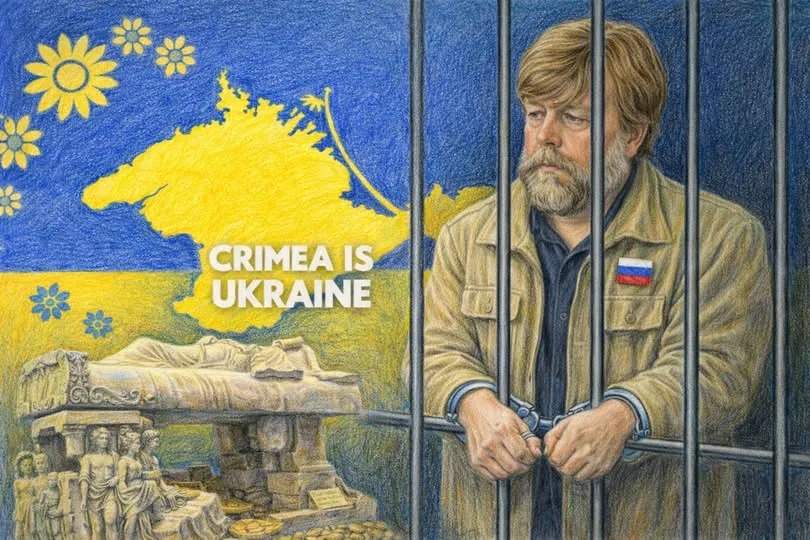
Butyagin is an employee of the Russian Hermitage Museum. For more than 20 years he carried out excavations in Crimea, including after its occupation by Russia. In December 2025 he was detained in Poland at Ukraine’s request.
Ukrainian law enforcement notes that since 2014 the archaeologist has received no permits from the competent Ukrainian authorities, so his excavations at a cultural heritage site in Crimea were illegal and “in effect, a legally protected site of national significance is being destroyed”.
Butyagin’s defence plans to appeal the decision to extradite him to Ukraine in the court of appeal.
As “Ukraine Incognita” reported back in December 2025, Hermitage researcher Alexander Butyagin was detained in Warsaw. Ukraine is seeking him for conducting illegal archaeological research in occupied Crimea.
The Ukrainian prosecutor’s office put Butyagin on the wanted list in November 2025. He is accused of leading, since 2014, as head of the ancient archaeology department of the Hermitage Museum, archaeological excavations in Russian-occupied Crimea. In particular, these were unauthorized exploratory works at the ancient city of Myrmekion in Kerch. His actions led to the partial destruction of a cultural heritage site. The damage from his activities is estimated at more than UAH 200 million.
This is, in fact, a story about how an occupation tries for years to pass itself off as normality. First, foreign territory is seized. Then it is declared one’s own. Next, officials, museum workers, archaeologists and cultural figures move in. Then all of it is presented as ordinary work, as if nothing had happened.
And it is precisely here that the most important part begins. Alexander Butyagin is no random person. He is a Hermitage employee and for many years led the excavations of ancient Myrmekion in Kerch. Until 2014, Russian archaeologists could indeed work legally in Ukrainian Crimea — with Ukrainian permits. But after the annexation everything changed.
This is exactly what many deliberately gloss over.
The problem is not that a “Russian archaeologist ended up in Crimea”. The problem is that after 2014 the excavations continued under Russian control and without Ukraine’s consent. That is, not within the former legal framework, but inside the occupation structure, where another’s heritage began to be treated as one’s own.
Now Poland has recognised the extradition of Butyagin to Ukraine as admissible. Yes, this is not yet the final point of the whole procedure. Yes, the defence will keep fighting. But the main political and legal signal has already been sent: Europe is beginning to show that for working on
Butyagin is on the sanctions lists of Ukraine’s National Security and Defence Council. In November 2024, the Prosecutor’s Office of the Autonomous Republic of Crimea and Sevastopol served him a notice of suspicion for illegal archaeological excavations at a cultural heritage site of Ukraine. The article of the Criminal Code provides for up to 5 years’ imprisonment.


