

An exhibition of portraits of fallen women defenders of Ukraine by Olena Bilozerska presented in Khmelnytskyi
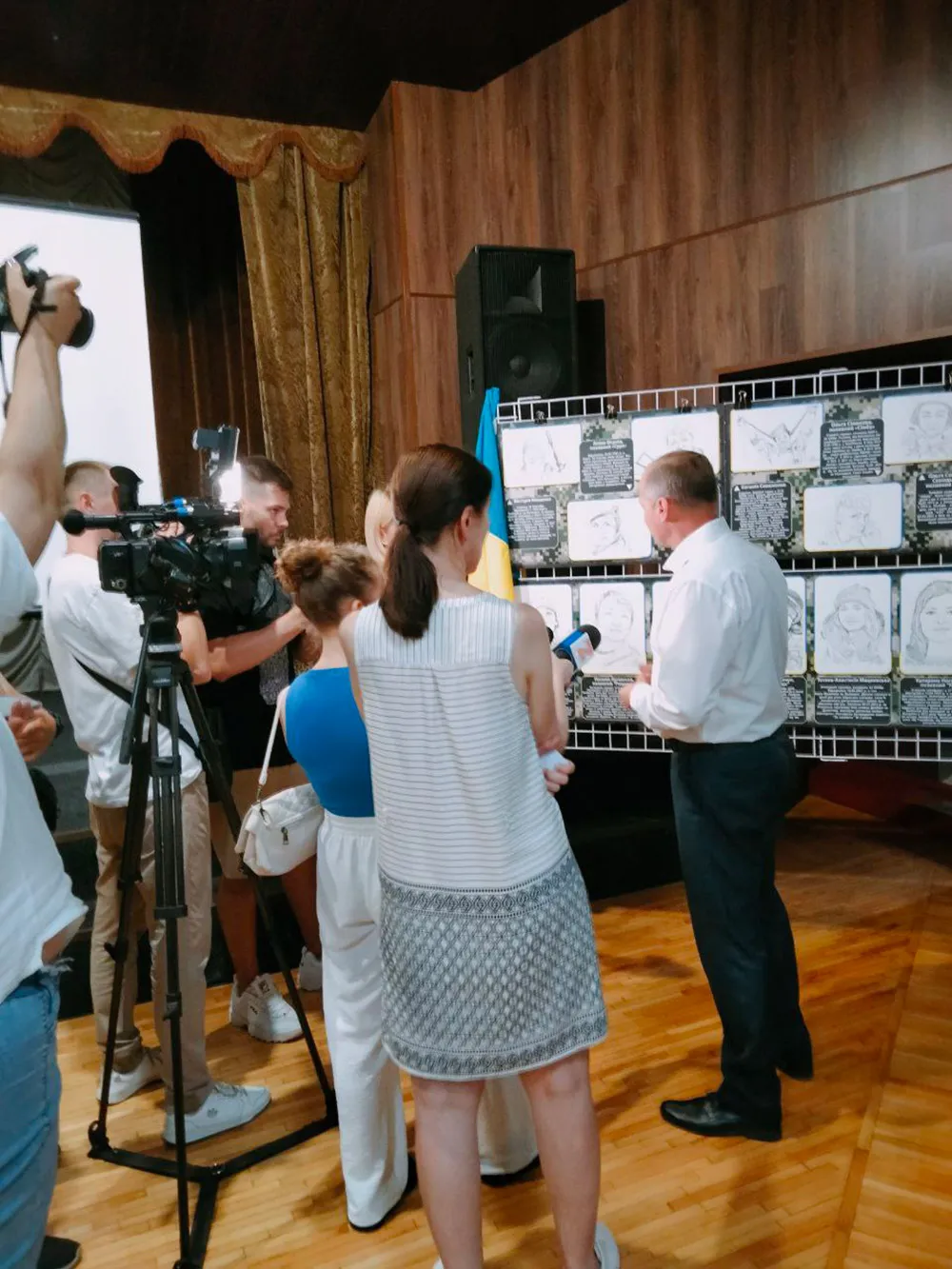
On 15 July, at the Regional Scientific and Methodological Centre of Culture and Arts in Khmelnytskyi, an exhibition of portraits, “Fallen Women Defenders of Ukraine”, opened to mark Ukrainian Statehood Day. Its author is the well-known journalist, blogger, poet and public figure, today an officer of the Armed Forces of Ukraine, Olena Bilozerska. The exhibition includes fifty-one portraits of Ukrainian women and girls who died in the war against the Russian invaders.
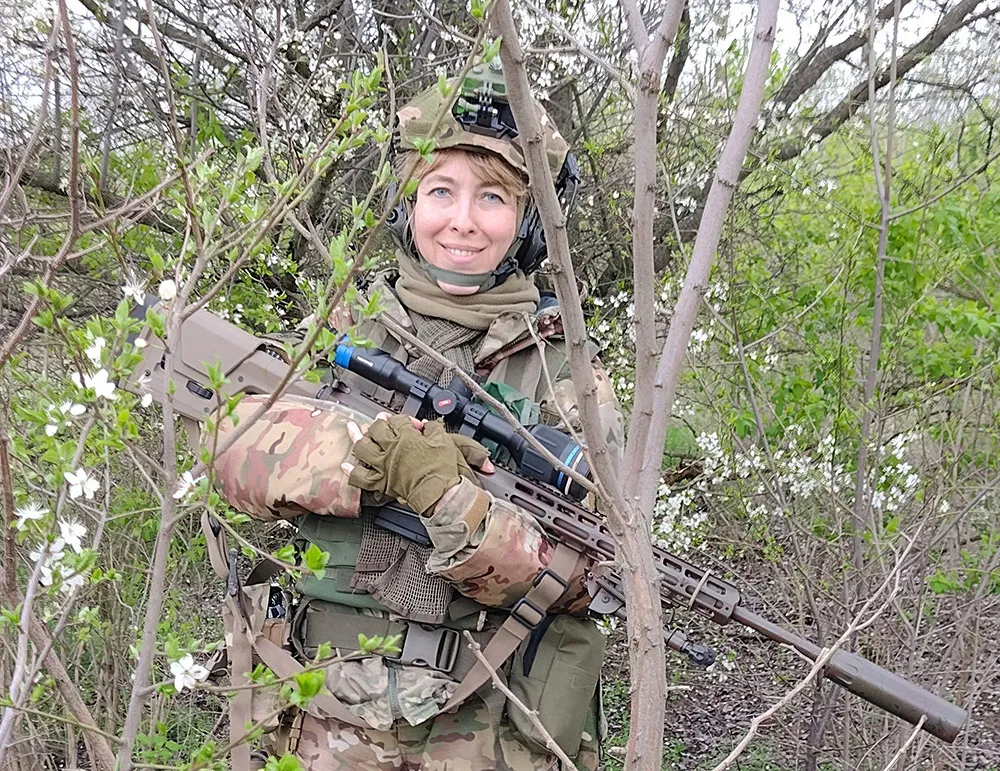
Olena Bilozerska
Ms Olena began drawing portraits of fallen women and men defenders spontaneously, because she had never studied drawing before: “Although I do have a gift for it: my father and grandfather drew well. As a child I drew no better than other children, perhaps that is why I never studied,” Ms Olena said. “In the 2000s I drew about a dozen portraits of well-known politicians and my acquaintances, and that was when something started to come out. The politicians put their autographs on them for me. Then I abandoned this for almost 20 years.
At the end of last year I had an important fundraiser. People who run fundraisers often raffle some souvenirs among donors, often handmade things. And then I remembered that I can draw a little,” Olena Bilozerska said.
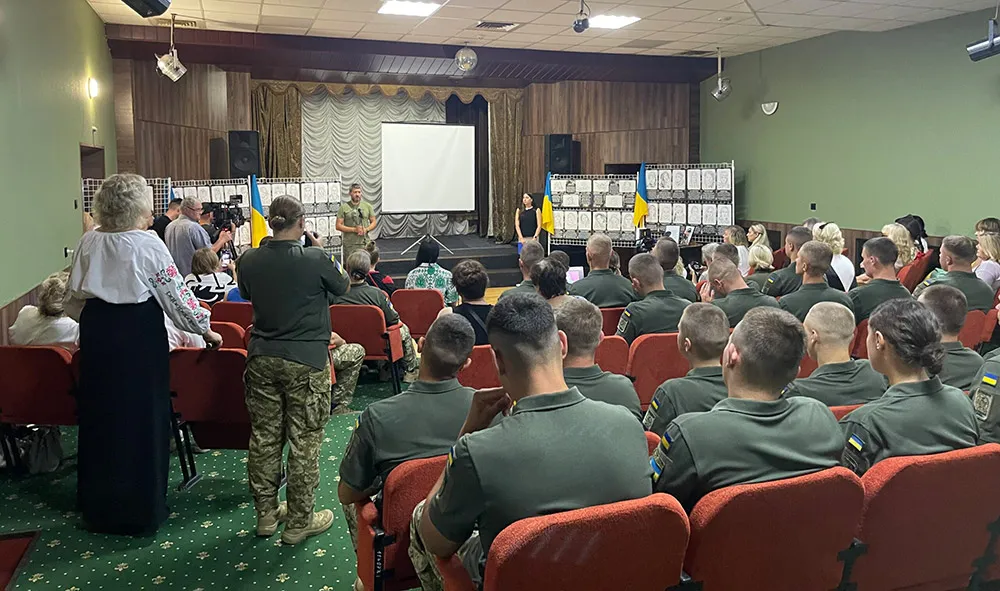
During the opening of the exhibition
After that she drew several well-known fallen heroes: Oleksandr Matsiievskyi, Tyhran Ohanesian and Dmytro “Da Vinci”.
“Then I thought that it is not only men who die in the war, but girls too. The first fallen heroine I drew was Daria Filipieva (Blyskavka). Then a comrade-in-arms of another fallen heroine, Yana Rykhlitska, asked me to draw her portrait as well. And then I fell ill and was treated for a couple of months, I had some free time, and I began to draw the girls,” says Bilozerska.
She admitted that she wants to draw absolutely all the women who have died in the war. “It is a kind of tribute, my personal contribution to making sure people do not forget them. Then to publish it as a separate book-photo album,” Ms Olena explained. She also admitted that it is emotionally hard for her to work on portraits of women soldiers: “You look into the faces of women and very young girls, read their stories, try to feel them as people and live their fates a little together with them”… she explains.
Ms Olena could not come to Khmelnytskyi for the opening of her exhibition. We recall that today she is a serviceperson, and duty is duty. Instead she recorded a short video address.
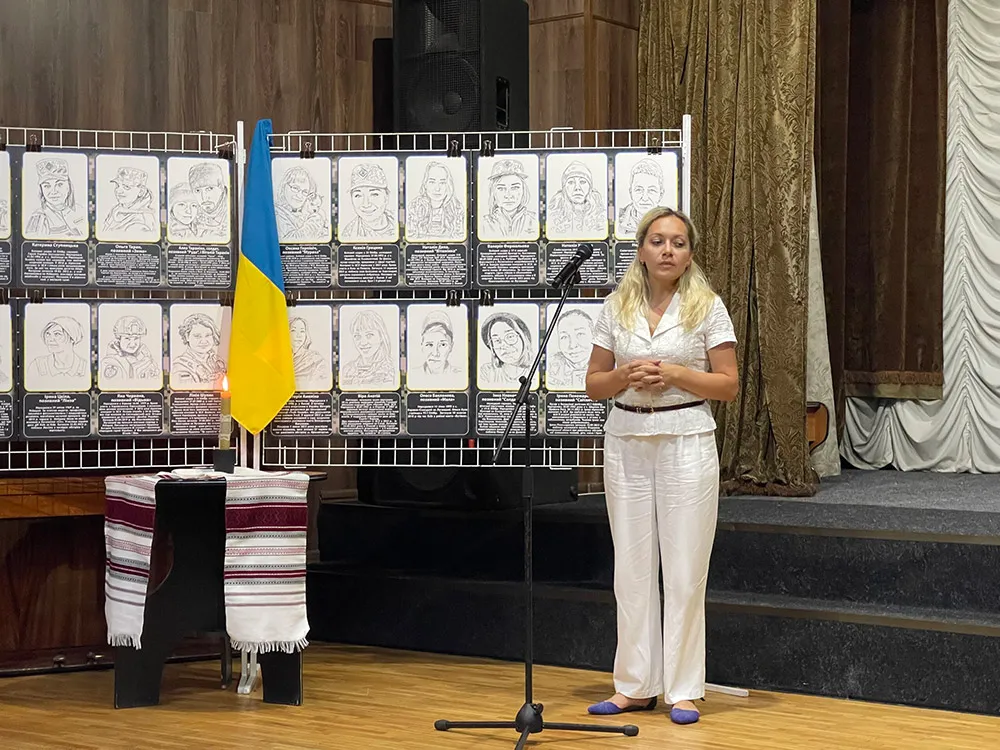
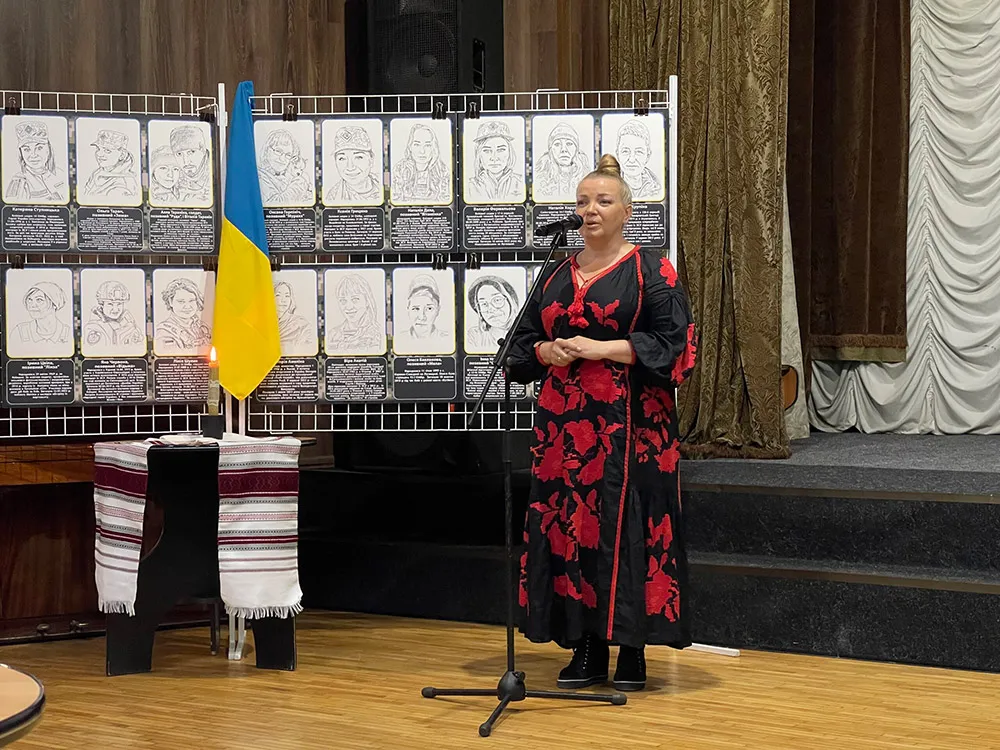
The director of the Khmelnytskyi Regional Scientific and Methodological Centre of Culture and Arts, Maya Onyshchuk, said the following about the exhibition: “The girls and women immortalized in the portraits could have calmly given birth to and raised children. They could have lived bright, peaceful lives… They could have fulfilled themselves in work, creativity, business and so on. But they voluntarily chose the role of defenders and gave their lives for Ukraine. This is an example to all of us, and especially to men, of how one should love the Motherland. That is why this exhibition has huge educational significance. It mobilizes.”
Tetiana Zelenko, deputy head of the executive apparatus of the regional council, noted: “Today we remember the Ukrainian women who stood up to defend our Ukraine, who gave the most precious thing, their lives, in a fierce struggle with the enemy. Each of us, in our own place, must do everything so that this great loss is not in vain, so that our children and the children of these women live in an independent, prospering Ukraine. We will certainly win!”
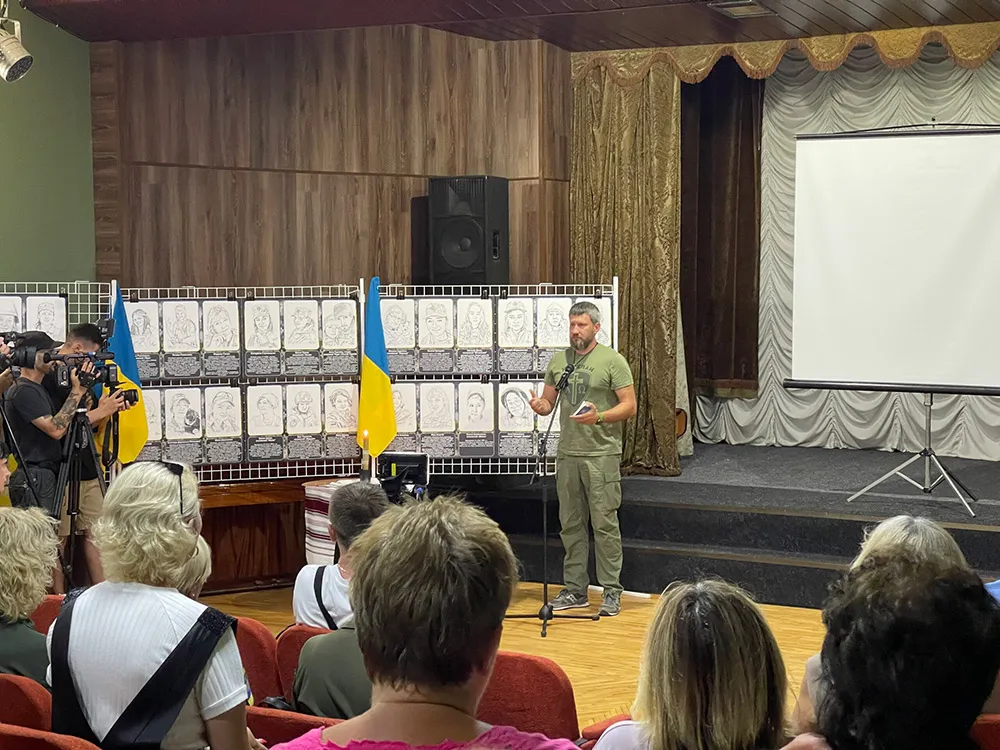
Military chaplain Vitalii Pievniev believes that such exhibitions should also be shown for the purposes of patriotic education of young people: “Our women defenders and heroines should be talked about in schools to senior pupils, and this information should be spread among girls and boys so that they understand the price being paid today for our freedom. As an ordinary citizen, I find it extremely hard to view this exhibition and look closely at these portraits, because they depict future wives, future mothers, and this is truly the flower of the nation,” Mr Vitalii concluded.
Representatives from the town of Horodok, where this exhibition was first presented to the general public, came to the opening. Symbolically, in Horodok it was shown in the bomb shelter of the local art school. A sizeable old cellar of an ancient pre-revolutionary mansion was adapted there as a shelter. During air raid alerts the children painted its gloomy walls with bright patterns. A large old niche that the young artists turned into a window opening onto a panorama of a sunlit, peaceful landscape looks especially touching.
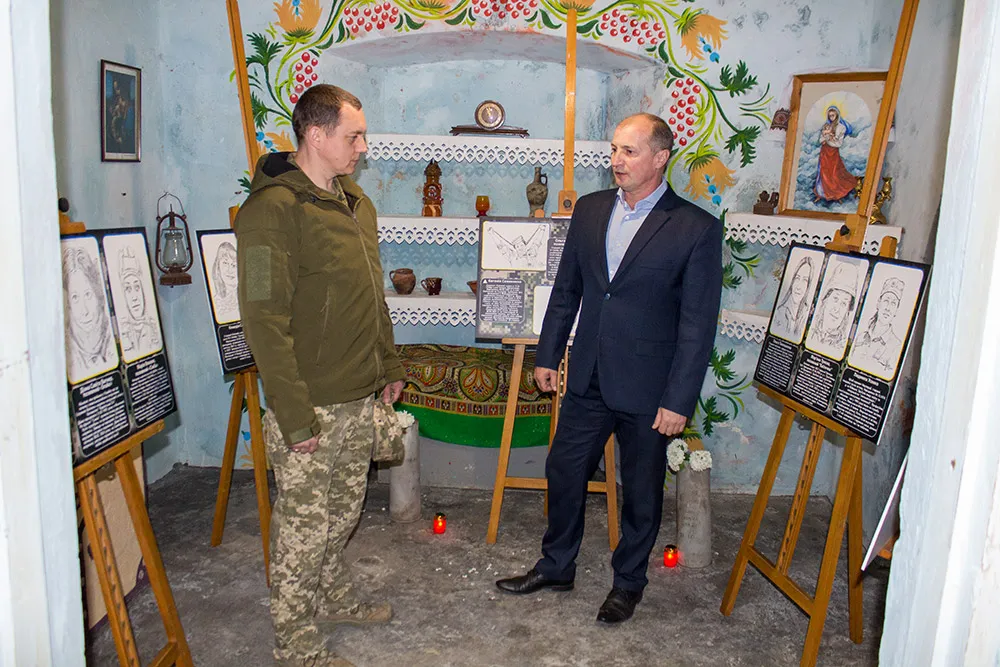
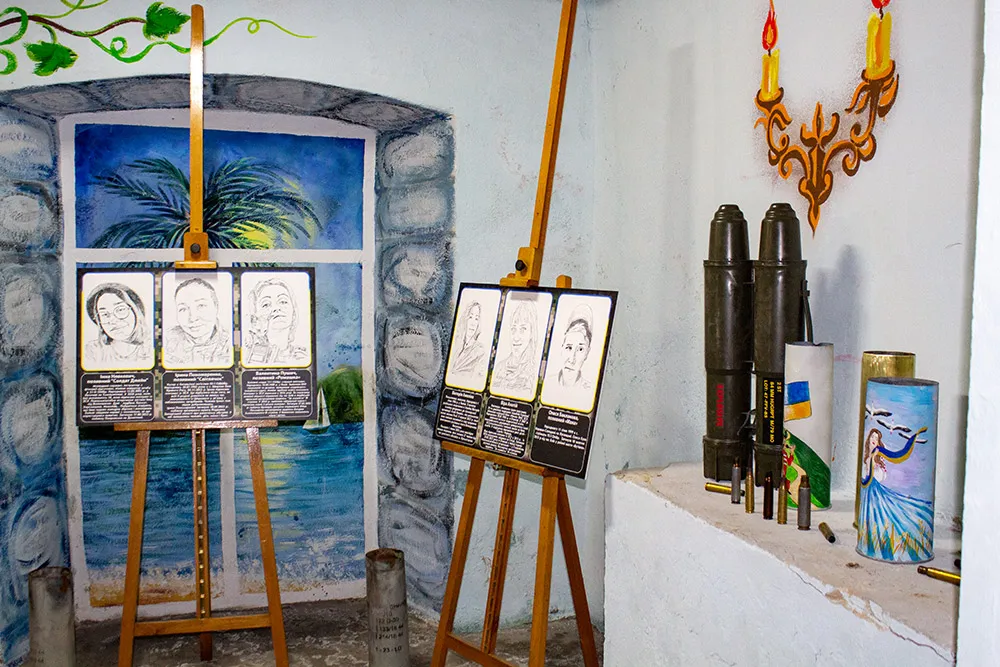
The exhibition in the bomb shelter. Horodok
To recall, the initiator of the exhibition was the department of cultures, nationalities, religions and tourism of the Horodok city council. Why and how this happened was told by its head, Oleh Fedorov:
“It is no secret that Ms Olena Bilozerska draws portraits of fallen women defenders of Ukraine,” Mr Oleh said. “There have been quite a few media publications about it. But these works have not been widely exhibited all together anywhere before. Yes, anyone can go to Ms Olena’s page on Facebook and see them, but it is not quite the same. The idea arose to organize a special exhibition, since such an event would have great educational, upbringing, cultural and ideological significance. The memory of the fallen is also an important lesson for the living, a lesson in how to love the Motherland. The idea was supported by the leaders of our community, who gave us considerable technical help. We approached Ms Olena. She gladly responded to our proposal and provided photocopies of her works. She also sent a number of originals, but after the exhibition in Horodok, by agreement with the author, we returned them to the artist at once.
An important and symbolic touch: a considerable sum for making the exhibition panels was allocated by the city house of culture. It was money collected at concerts by the children’s creative groups operating at the house of culture. That is, the exhibition saw the light also thanks to the talented children of the Horodok region!” stressed Oleh Fedorov.
As part of the opening, the amateur folk ensemble “Spivuche Dzherelo” of the Horodok city house of culture sang the songs “Zhuravli” (“Cranes”) and “Vse bude Ukraina” (“Everything will be Ukraine”) from the repertoire of the Ukrainian singer, Honoured Artist of Ukraine Olena Bilokon.
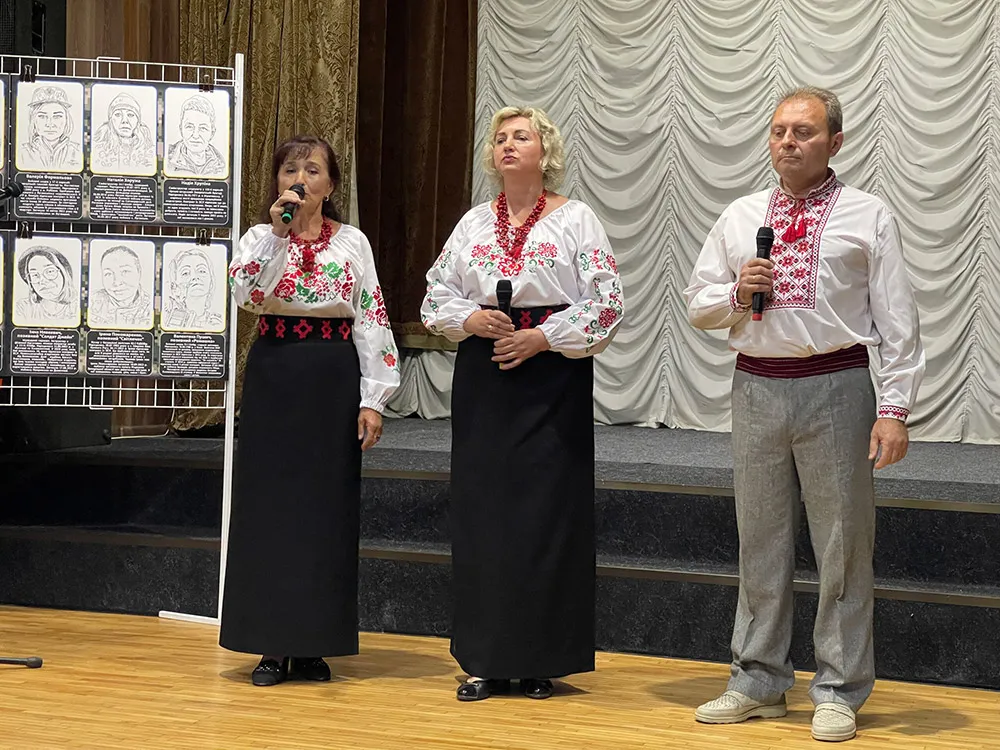
The opening was attended by representatives of the public and the regional authorities, women serving in the military, cadets of the National Academy of the State Border Guard Service, and war veterans.
A member of the “Ukraine Incognita” team, the journalist and local historian Dmytro Poliukhovych, also contributed to the creation of the exhibition.
“I was entrusted with a rather difficult area of work, technically and especially psychologically,” Dmytro says. “For each portrait Ms Olena Bilozerska had prepared an extensive biography of the heroine. That is from 3 to 10 thousand characters. But for an exhibition panel each had to be cut to a maximum of 5–6 sentences. Processing fifty biographies is a lot. But the main thing is that it was extremely hard psychologically. Behind each biography is a tragedy. The biographies of very young girls, some of whom were born as late as 2002, were especially hard…”
Speaking of preparing the exhibition, thanks are also due to the talented photographer from Horodok Ihor Motsnyi, who created the layouts of the panels. This too was a sizeable piece of work and he did it very well.
The exhibition at the Khmelnytskyi Regional Scientific and Methodological Centre of Culture and Arts (103 Volodymyrska Street, Khmelnytskyi) will run until 26 July.
Photos: Khmelnytskyi Regional Scientific and Methodological Centre of Culture and Arts


