

“Advocates” emerge for Odesa’s Russian colonial heritage
Cultural and artistic figures from Ukraine and other countries have written a letter to UNESCO Director-General Audrey Azoulay asking her to help postpone the decolonisation of Odesa until the end of the war.
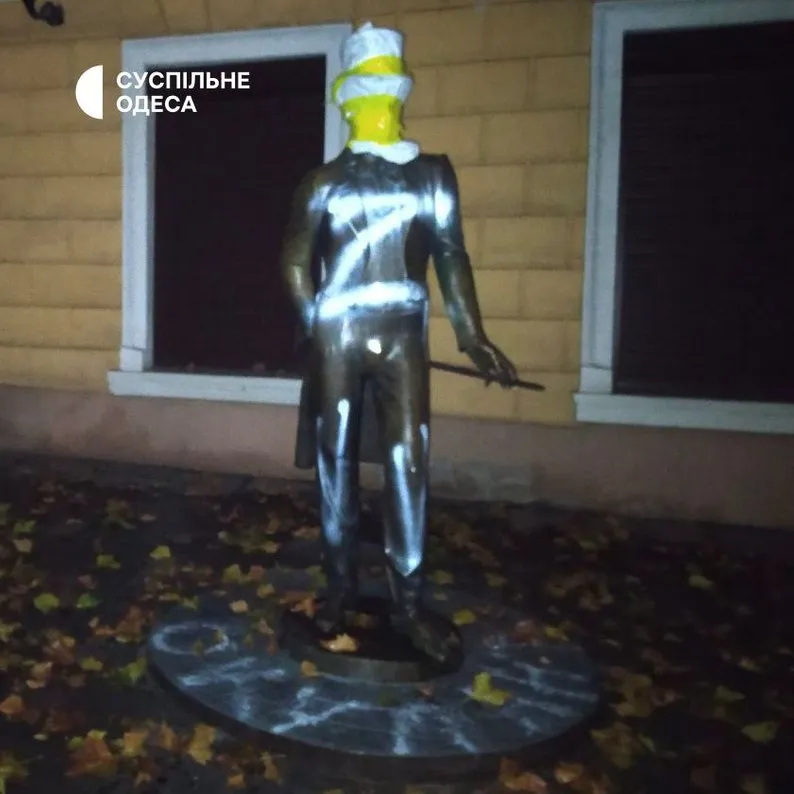
The monument to Pushkin in the city was daubed with symbols of the Russian people, Odesa. Photo: Suspilne Odesa
This was reported to Ukrinform by the letter’s co-author, anthropologist Anastasia Pilyavsky.
Its other authors are the poet Ilya Kaminsky, the art historian Yevgeny Demenok and the writer Maya Dimerli.
“As a result of Russia’s attacks on Odesa, at least 106 architectural monuments have been damaged. Now a new threat looms over the city’s heritage. This summer the regional administration marked 19 monuments for demolition, stripping the rest of their protected status. Some are an integral part of Odesa’s architectural ensemble in the very heart of the UNESCO protection zone,” the appeal says.
The authors stress that most of Odesa’s historic centre, which is now within the UNESCO protection zone, was built under the rule of the Russian Empire, and that the decisions on demolishing the monuments were taken without public consultation.
“Implementation of the decolonisation law has led to the removal from the streets of the names of Odesa’s most famous figures. Among them are the Nobel laureate Ivan Bunin, who condemned the Soviet regime in his writings, Nobel Prize nominee Konstantin Paustovsky, who criticised the Soviet revolution, Alexander Pushkin, who was exiled to Odesa for anti-tsarist activity, and Odesa’s most famous writer Isaac Babel, who died in the Stalinist purges,” the authors of the appeal write.
They stress that Russia’s barbaric war against Ukraine not only puts cultural heritage under threat of destruction but also imposes a “cultural trauma”. The trauma leads to what Maria Böhmer, former chair of the World Heritage Committee, called “cultural cleansing”, which UNESCO has fought against in places such as Syria, Yemen and Iraq.
“Any decisions about Odesa’s cultural heritage must be carefully weighed through expert assessment, reasoned dialogue and truly open public debate,” the authors of the appeal emphasise.
The letter of appeal has already been signed by 115 people. Among them are Isaac Babel’s daughter Lidia, who lives in Tallahassee, and the writer’s grandson Andrei Malaev-Babel, Odesa Philharmonic Orchestra conductor Hobart Earle, sculptor Mykhailo Reva, writer Yulia Verba and her sister, singer Lesia Verba, pianist Oleksii Botvinov, actor and writer Boris Barsky, local historian and now soldier Oleksandr Babich, and others.
A remark from “Ukraine Incognita”:
Konstantin Paustovsky, mentioned in the appeal of admirers of the “Russian world”, although he had Ukrainian roots, was, like any “russified foreigner”, a rare Russian chauvinist and Ukrainophobe. About the times of the Ukrainian People’s Republic he wrote the following in his “Story of a Life”: “When will this senseless amateur performance with hetmans, atamans, Petliura, with the shouting of bombastic slogans, the muddle of thoughts, the complete confusion of concepts and a malice far greater than the circumstances justified, finally end? When will the curtain fall on this hastily knocked-together stage, where, unfortunately, it was not cranberry juice that was spilled, but real, hot blood”


