

Ancient Ukrainian icons neglected by Moscow priests are being saved in Kremenets
In St. Nicholas Cathedral in Kremenets, which the reserve recently won back in court from the “Gundiaiev followers”, restorers from Lviv are conserving icons. They chose the 10 images that have survived worst.
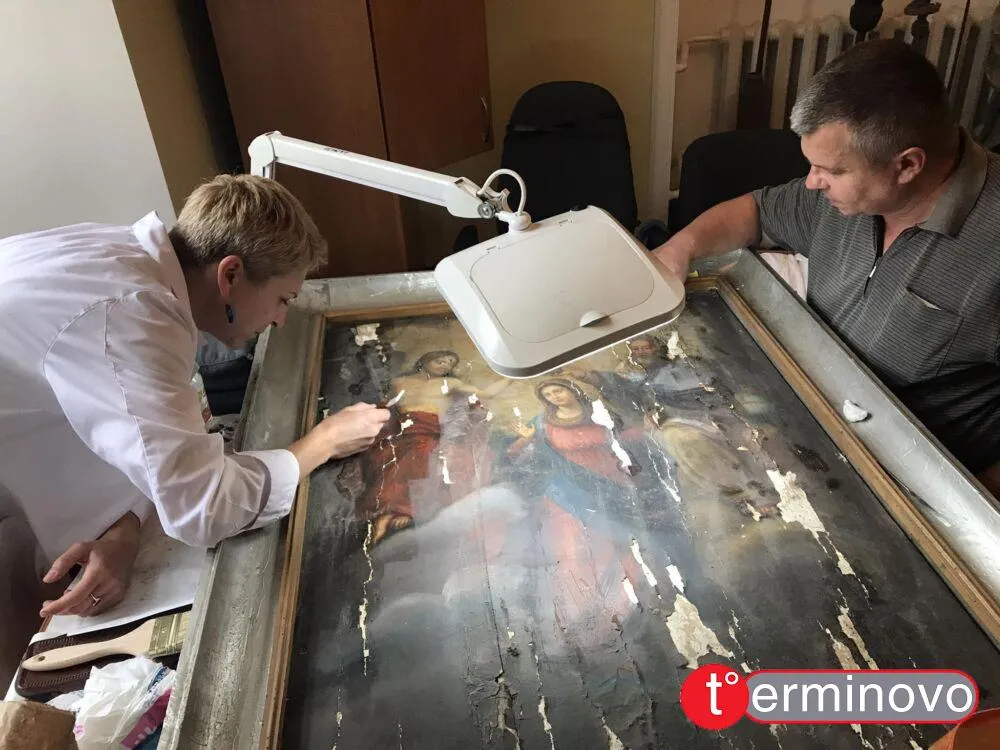
Moscow priests threw this icon into the bell tower attic as junk…
This was reported to Suspilne by Taras Otkovych, head of the branch of the National Research Restoration Center of Ukraine. “We started cooperating with the Kremenets Reserve, and with this particular site, this year. We came in winter to see what the situation was after the church was handed over, and agreed with the head of the reserve that we would come for a few days and carry out serious conservation work. We are now working on the icons that most need conservation measures.”
“Mostly it is a situation where they are flaking. The paint layer or ground is flaking off, there is damage from woodworm beetles, and we are giving these icons urgent first aid. At the moment this is not restoration, it is so-called on-site conservation, when we carry out work so that the icons do not deteriorate further. If we continue the cooperation, the second stage will be transporting these works to Lviv, to our branch. There we will carry out full restoration, which may take several months or a year, depending on the complexity of the work.”
Taras Otkovych says they plan to keep coming and determine what they can take for restoration. Five specialists are working now. “These are mostly restorers, and a research entomologist, a person who studies and fights woodworm beetles. This is a very important area of work, because the woodworm beetle does extreme damage to wooden objects, icon panels and wooden sculptures. It is a big problem that we constantly struggle with.”
Taras Otkovych explained why the icons are in such a state: “It is typical that works of art or sculptures in churches are stored rather poorly, because of the specific conditions: a large space, difficulty in maintaining a temperature and humidity regime, constantly many people and temperature swings. In addition, some icons were repainted and renewed later. This also happens when an icon or work of art stays in a church for several hundred years and is constantly supplemented and touched up. That is, the varnish darkened, there was soot, and people did not know what to do about it. They simply took paints and painted over it. Over hundreds of years this accumulated, layered up: multi-layered overpaintings and repaintings, and after that flaking. In restoration we try to deal with this. We try to remove all of it, all these layers and damage, and get back to the original author. In addition, we follow the principle of museum restoration, that is, we add nothing of our own, make no renewals, and intervene in the original painting as little as possible.”
The images also differ in age, the restorer says, and one of them is unique. “This is the bas-relief “Communion of St. Onuphrius”. It is probably from the second half of the 18th century, Baroque or Rococo. This icon is truly valuable and unusual. It is the one with the most damage, losses and additions. We will carry out research to establish how many interventions there have been in the painting, and we will build a further strategy for its recovery.”
A vivid fact that shows the attitude of Moscow priests to Ukrainian heritage: the icon “Coronation of Mary”, from the late 18th or early 19th century, was found by museum staff in the bell tower attic, where it had been thrown as junk by priests of the Moscow Patriarchate and where it was doomed to destruction. Fortunately, it was discovered by the reserve’s staff, and specialists are now working to save it:
“The icon is in critical condition. There is blistering of the gesso and the paint layers. We are securing the necessary areas with collagen. This is the conservation stage, and the restoration process itself will come later. Depending on the complexity, it can take 2 to 6 months or more,” said terminovo.te.ua tempera painting restorer Yevhen Manko.
Recall that in October last year “Ukraine Incognita” reportedthat the Western Commercial Court of Appeal upheld the decision of the Commercial Court of Ternopil Oblast of 15 June 2023 to return St. Nicholas Cathedral, an architectural monument of the 16th–17th centuries, to the state; at that time it was still run by the faithful of Moscow Patriarch Gundiaiev.
Later “Ukraine Incognita” reported that after the “Muscovites” were evicted from the ancient church, plundered burials were found there.


