

Virtual tour of the famous 17th-century Maharsha Synagogue presented in Ostroh
In Ostroh the cultural project “Virtual Tour of the Ostroh Synagogue” was presented, supported by the European Union under the House of Europe programme.
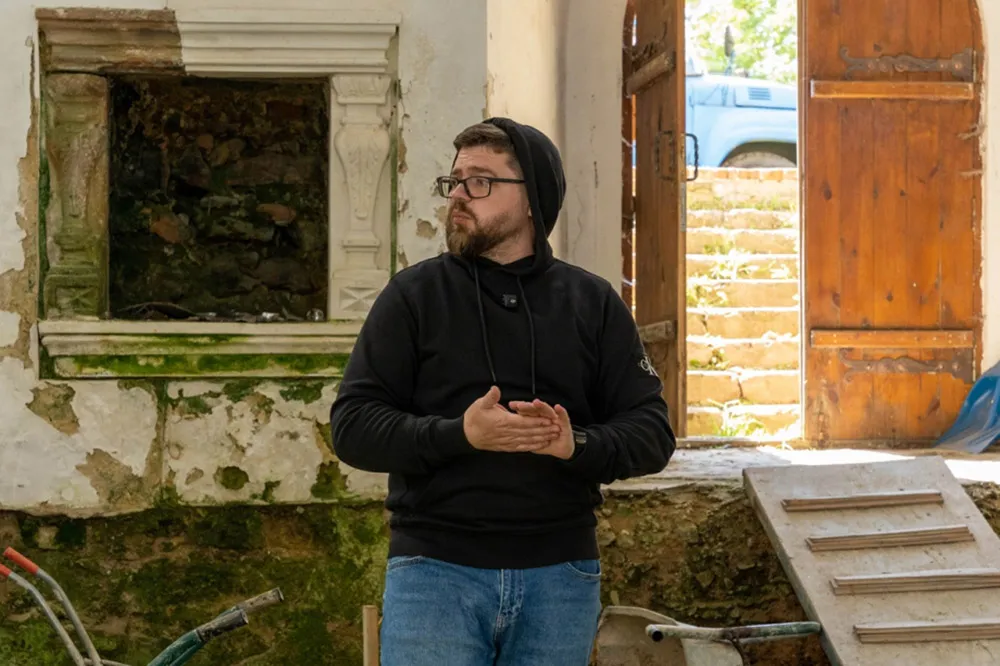
As “Raion Ostroh” reports, the event took place on Friday, 30 May, in the monument itself.
The project was carried out by Andrii Maliuskyi, head of the NGO “Town Image Studio” (Studio for the Development of the Tourist Image of Small Towns), whose task was to create a visual 3D reconstruction of one of the key monuments of the city’s Jewish heritage, the Great Maharsha Synagogue, as it stood at the beginning of the 20th century.
The aim of the reconstruction is not only to preserve historical memory of the architectural heritage but also to create an innovative and informative product.
Work on the virtual tour went through several stages. First Andrii used photogrammetry, a 3D scanning technology based on building a detailed model of a structure from a large number of high-quality photographs. From these images, with the help of special software, a basic 3D model was built.
Next came a review of the archives. The work consisted of searching for all photographs of the Ostroh Synagogue. A large number of scholarly articles and books mentioning the building were also analysed. To reproduce the synagogue’s proportions and details more accurately, camera calibration was used, which made it possible to calculate the correct dimensions of the architectural elements from the photographs.
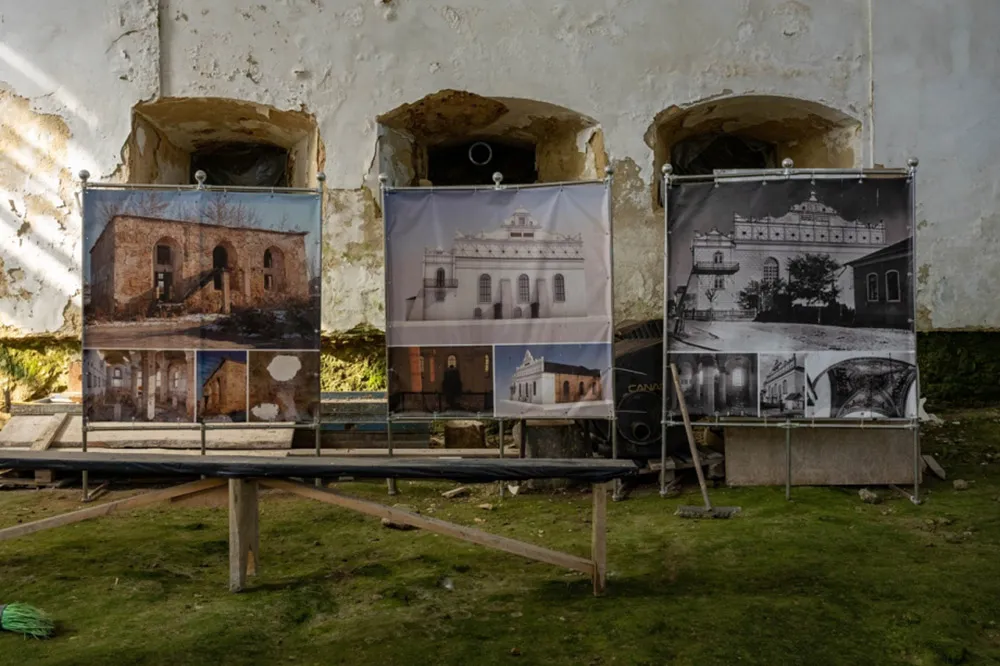
After that an exact 3D model was created, followed by texturing, which ensured a realistic depiction of the synagogue’s exterior and interior.
During the presentation of the results Andrii Maliuskyi spoke about the history of the project and about the construction and destruction of the building. For convenient exploration of the 3D model a virtual tour was created, thanks to which participants were able to walk through the halls of the synagogue.
The building can be viewed at this link. The result of the project can also be viewed in 360° format on YouTube.
It is known for certain that the synagogue already existed in 1603. By 1608 there was a printing house here, and in 1610 the synagogue was repaired with funds from Shmuel Edels, the Maharsha, a righteous Jew who was regarded as a saint even in his lifetime. He built the women’s section in the temple and for a long time was rabbi of Ostroh. At that time a school of rabbis, a yeshiva, began to operate at the Great Synagogue, and was considered one of the best in the territory of the Polish–Lithuanian Commonwealth.
The Jews of Ostroh lived in a separate district, a ghetto. Interestingly, next to the Jewish district the town had a Tatar district. The Tatars became the best friends of the Jews after saving them from a Haidamak pogrom. For a long time the rabbis in the synagogue read prayers in memory of the day of the miraculous rescue, but a far more wonderful rescue lay ahead of them. A rescue that made the Great Ostroh Synagogue famous throughout the Jewish world…
The synagogue was built no later than the 15th century, at a time when wars and raids by Tatars, Turks and others were commonplace. So it was a real fortress, with walls 2.5 metres thick. In 1792, during the Russo-Polish war, the Russians approached Ostroh. The Polish garrison, being small in number, left the town, and the frightened Jews shut themselves in the synagogue. The Russians took the synagogue for Ostroh Castle and began to shell it with cannons. The siege of the castle-synagogue lasted two days. The cannonballs that flew into the temple through the windows did not explode or fall: they simply hung in the air. So says the legend. At last a brave Jew was found who went to the Russians and told them that they were shelling not a castle but a synagogue, and that inside it was not a Polish garrison but frightened Jews. He also promised to show the Muscovites a ford across the Viliia, and they withdrew from the temple. In memory of this miracle several cannonballs were walled into the synagogue’s walls, and several were hung on chains.


