

Book revealing the secret “codes” of ancient Jewish gravestones presented in Sataniv
On 17 July, a book by the Podillia historian and member of the Ukraine Incognita team Dmytro Poliukhovych, “The Jewish Cemetery of Sataniv. Stone Beasts and Magical Rites”, published by the Dukh i Litera publishing house, was presented in Sataniv (Khmelnytskyi Oblast).
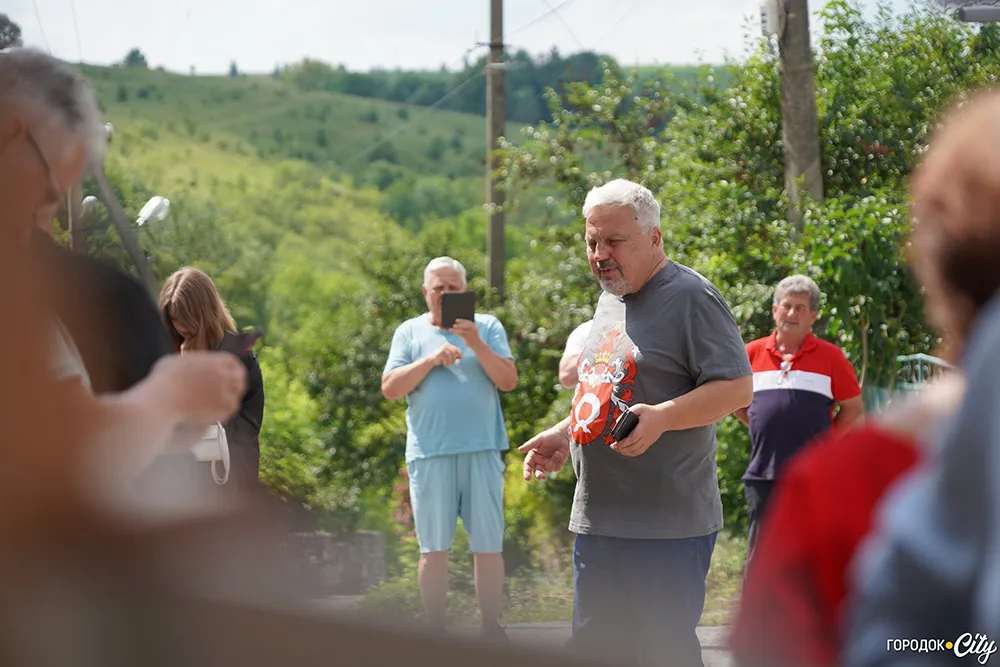
Despite its “local” title, the study covers a wider subject than the history of Sataniv and its famous cemetery, which was in use from the mid-16th to the mid-20th century, until Sataniv’s Jewish community was destroyed by the bloody wave of the Holocaust.
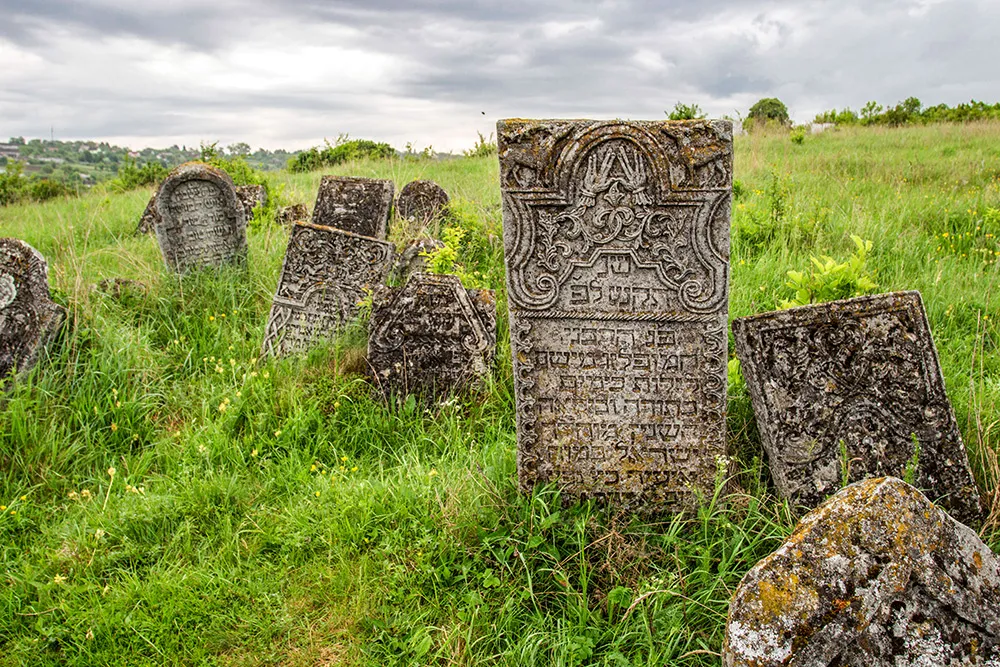
Sataniv. The cemetery. Photo: Ukraine Incognita archive
Dmytro Poliukhovych’s study is a true encyclopedia of Jewish necropolis studies, explaining the symbolism, sources and origins of the various images and motifs with which Jews decorated their matzevah gravestones over the centuries. The “stone beasts” in the title are mentioned for a reason: the “encoded” meanings in the decoration of the matzevot are based above all on zoomorphic images. Here we see a whole bestiary: lions, wolves, stags and hinds, foxes, hares, squirrels, various birds and snakes. There are also fantastic chimeras such as fish with lions’ heads, griffins and unicorns.
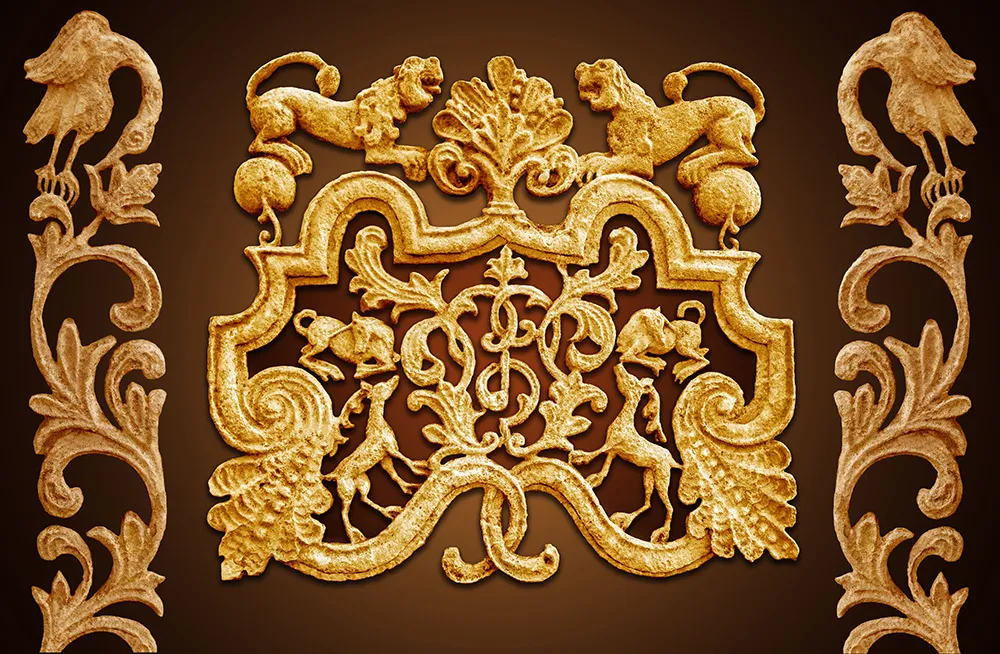
An illustration from the book. We see lions, hinds, storks and unicorns. A composition based on the decoration of a late 18th-century matzevah.
This study is relevant to any Jewish cemetery in Central and Eastern Europe, and most of the motifs it examines are universal in their use. Similar images are also found in the decoration of synagogues, manuscripts, and sacred and everyday objects. In other words, this study is not so much about necropolis studies as about traditional Jewish folk art in general.
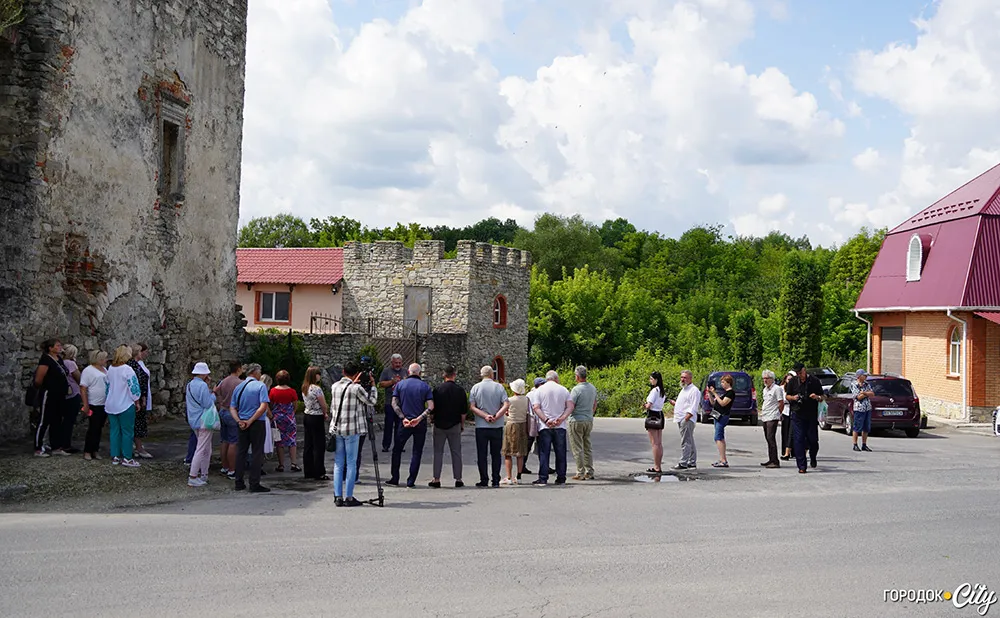
The presentation began at the town gate
The images speak of the expected coming of the Mashiach-Messiah, faith in the resurrection of the dead, and the sweet fruits of the Garden of Eden for righteous souls. They also often encode information about the deceased, their origin and name.
This is a vivid and extremely interesting page of our shared Ukrainian heritage. After all, the islands of the shtetls arose and developed amid the boundless Ukrainian sea and absorbed a great deal from it.
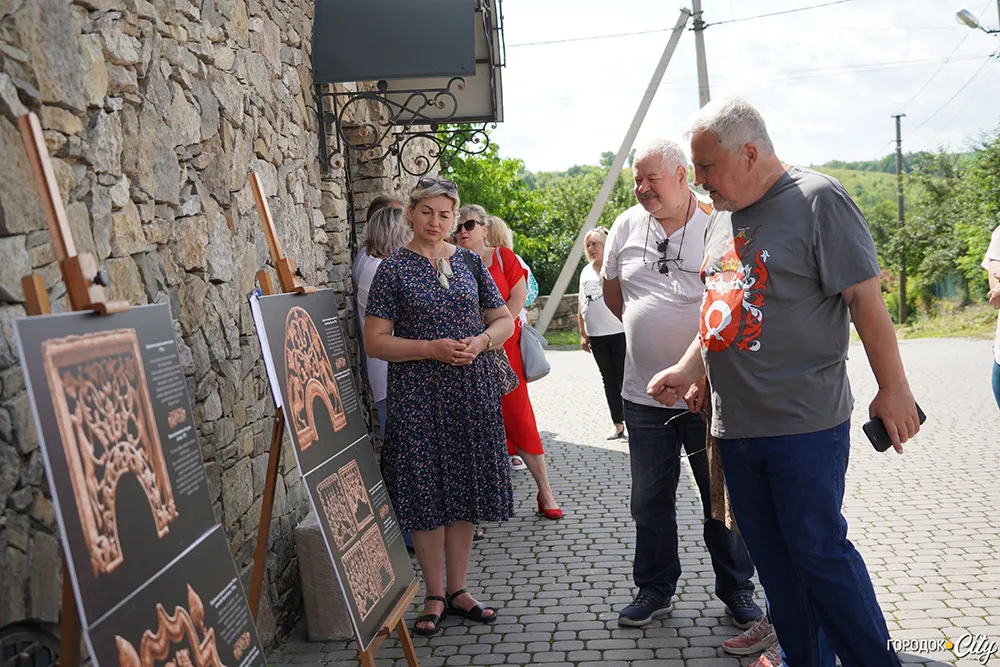
The presentation also included an exhibition of Dmytro Poliukhovych’s works “Sataniv: the lost world of an ancient Jewish cemetery”
Invaluable help with the book was given to Mr Poliukhovych by well-known scholars from Israel, staff of the Hebrew University of Jerusalem Dr Sergey Kravtsov and Dr Boris Khaimovich, as well as Ukrainian researchers of Judaica Anatolii Kerzhner and Yevhen Shnaider.
The search for interesting motifs on the matzevot was also helped by the expeditions of the project “Graves of the Ancestors”, carried out in partnership between the NGO Ukraine Incognita and the Department of Culture, Nationalities, Religions and Tourism of the Horodok City Council, under the auspices of the leadership of the Horodok amalgamated community. As a reminder, this project is studying ALL the ancient cemeteries of this corner of Podillia. The necropolis is huge (more than 5,000 gravestones), and many bas-reliefs are hidden under moss, so it is hard for one person to work here. The author is especially grateful for help to the local historians from Horodok Oleh Fedorov and Valentyn Nyshchyi. Later, staff of the Department of Culture also helped with organizing the book presentation.
As Ukraine Incognita reported earlier, thanks to the “Graves of the Ancestors” project, researchers in Sataniv were lucky enough to find the oldest image in Ukraine, and possibly in Europe, of the famous Western Wall in Jerusalem.
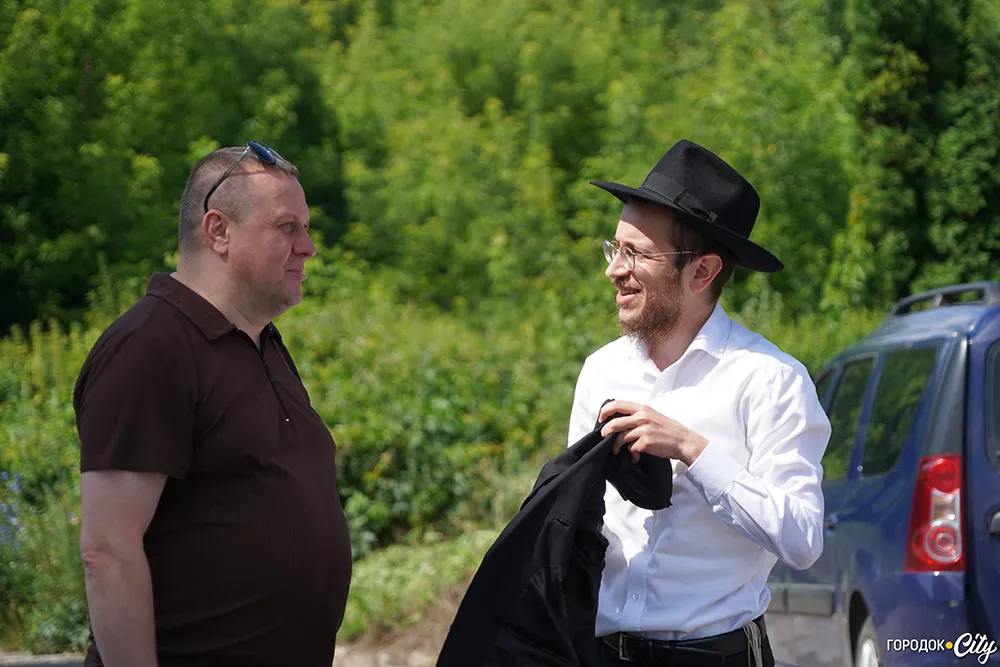
Oleksandr Pshenychnyi, left
Financial support for the project was provided by Oleksandr Pshenychnyi of Khmelnytskyi:
“Sataniv is not a stranger to me. My wife’s parents live here. Visiting them, I was always surprised: we have so many interesting and unique sights, yet there is precious little information about them. When I learned that our fellow countryman Dmytro Poliukhovych was preparing a huge study of the Sataniv necropolis, I understood that this work was not just interesting but socially significant, because it promotes interethnic peace, harmony and unity in the face of the enemy…”, he said of his decision.
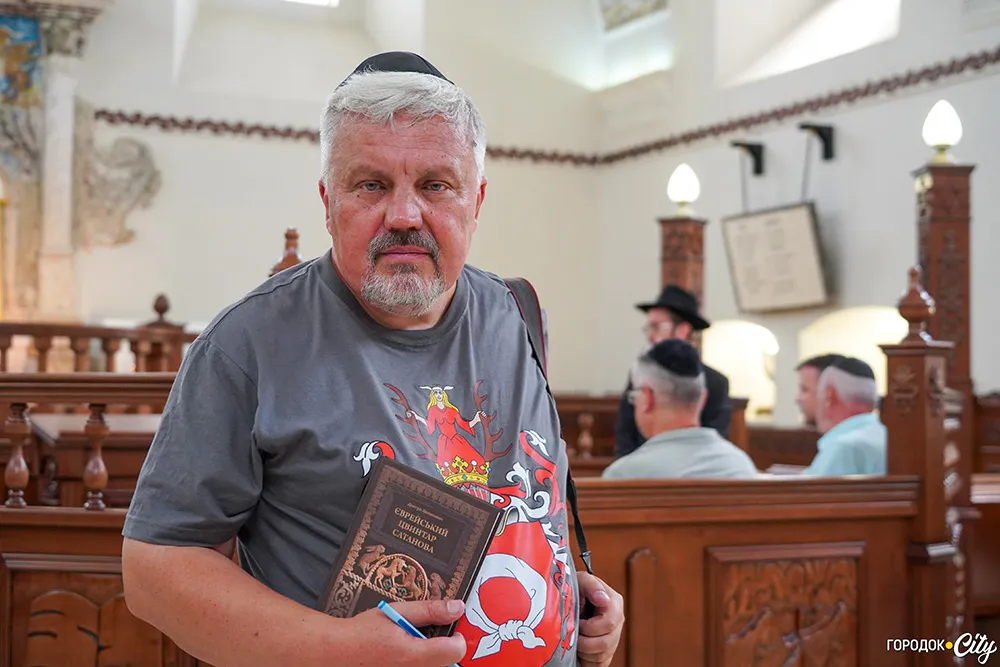
In the synagogue, all men must wear a kippah
Dmytro Poliukhovych says the following about his book:
“This study was created by a Ukrainian and is addressed first of all to Ukrainians,” the author stresses. “But most modern Jews also know practically nothing about this aspect of their culture. I sincerely hope the result of my work will be of interest to everyone.”
Besides locals of Sataniv, guests came to the presentation from Dnipro, Lviv, Kamianets-Podilskyi, Khmelnytskyi, Medzhybizh, Horodok and elsewhere…
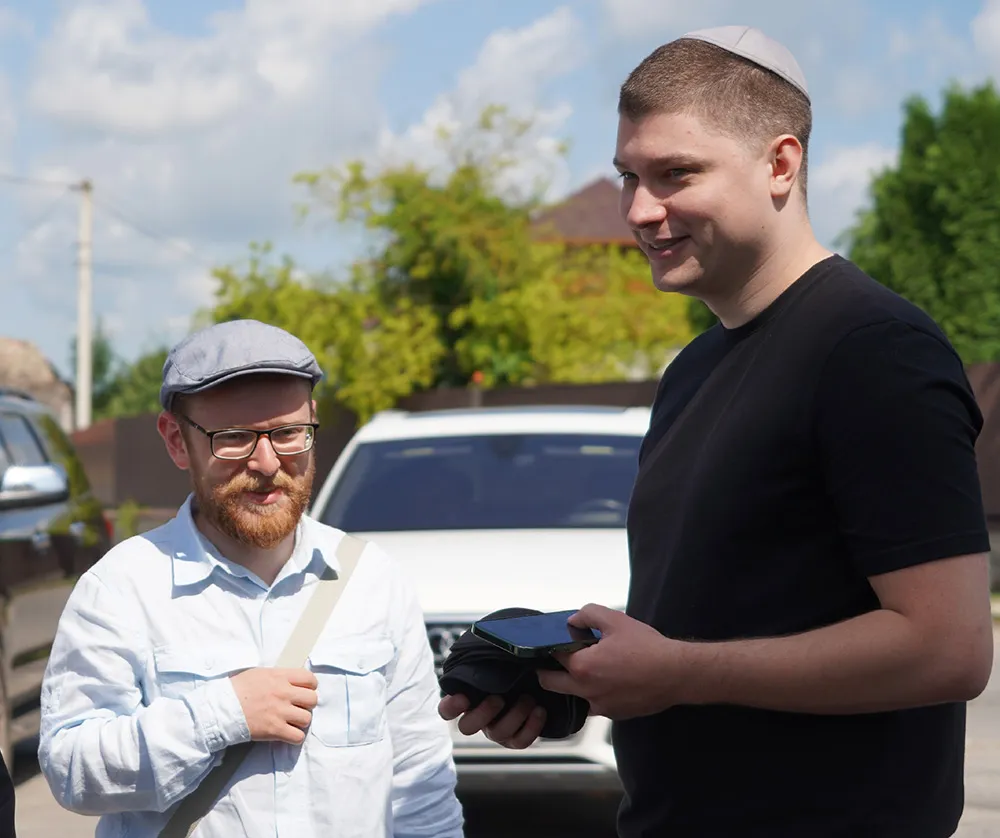
Yevhen Levinzon (left), executive director of the Judaica Certificate Program, and Vitalii Kamozin, executive director of the Jewish Confederation of Ukraine
“It is very telling that this large-scale study appeared precisely in the Khmelnytskyi region,” comments Vitalii Kamozin, executive director of the Jewish Confederation of Ukraine (Dnipro). “Podillia was once at the centre of the social and spiritual life of Ukraine’s Jews. It was here that Hasidism arose, today the main current in Judaism. It is symbolic that the author of the book is a Ukrainian. He not only discovered for himself the vivid, deep world of Jewish sacred art, rich in hidden meanings, but also shared it with others. I have no doubt that this book, which opens to Ukrainians the culture and art of a people who have lived alongside them since at least the 10th century, will promote national unity and harmony in our common homeland,” Mr Kamozin concluded.
The well-known Ukrainian historian Oleh Pohorilets, director of the Medzhybizh State Historical and Cultural Reserve, commented on Dmytro Poliukhovych’s study as follows:
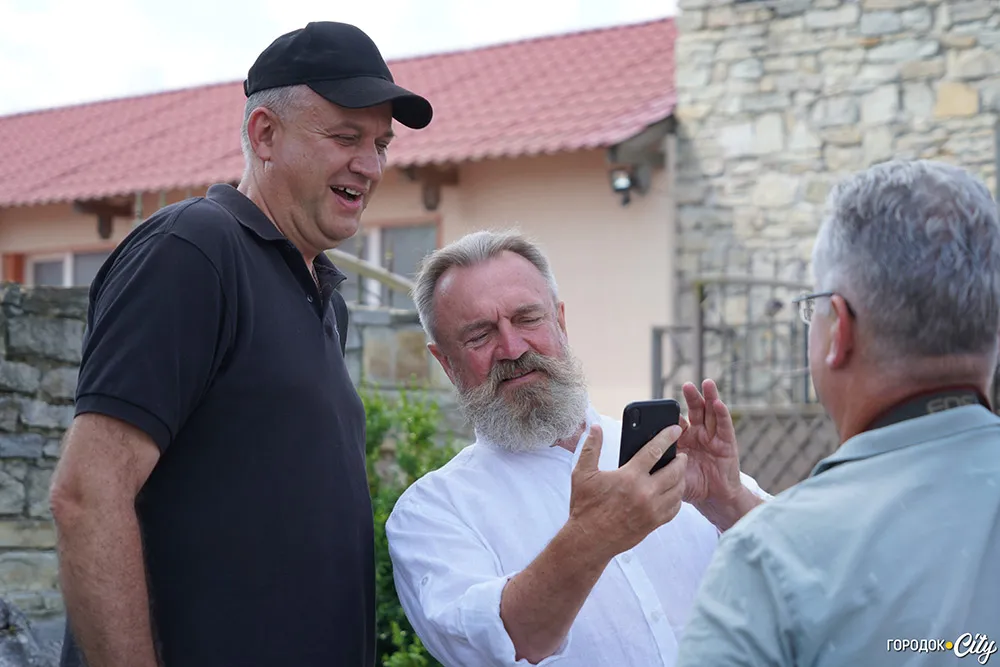
Oleh Pohorilets (centre)
“This book is an encyclopedia for the ‘uninitiated’, a decoding of a ‘secret script’ for Ukrainians. It is a key to understanding the life of the Jewish shtetls in the towns of Ukraine. It is the shared history of our peoples, in which we should find the best moments and motifs, as our ancestors did. It is our history unfolding against an artistic backdrop, and these are artistic masterpieces that tell our history. In Medzhybizh we have an equally interesting ancient Jewish cemetery with similar images, so it will be useful in our work too,” the historian concluded.
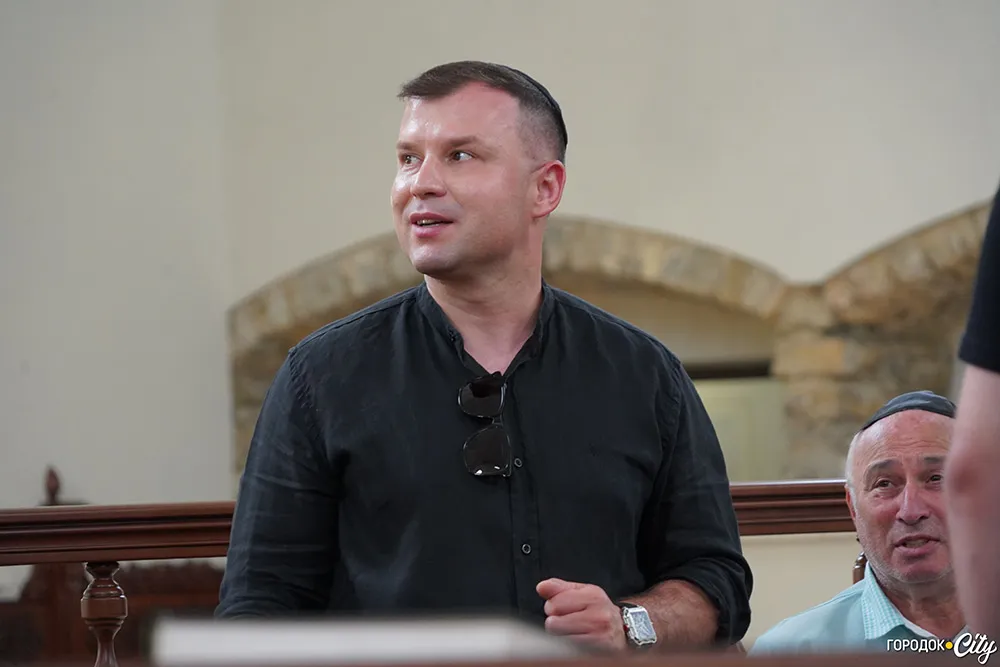
Artur Kosinskyi
Artur Kosinskyi, first deputy mayor of Horodok, who also came to the presentation in Sataniv, said:
“The histories of Horodok and Sataniv are closely intertwined. And not only because for more than half a century they were part of one district. The book, for example, mentions a detective story that spans the territory of both towns. Its main hero is Yosef Delmedigo, a favourite pupil of Galileo Galilei himself. Delmedigo skilfully unravelled a mysterious and mystical affair that thundered across Europe in 1620.
The fact that the author of the book is a native of Horodok further underlines the friendly and fraternal ties between our communities. Its content is relevant for our Horodok too: we also have a very interesting old Jewish necropolis, which, moreover, is repeatedly mentioned in the study.”
Albert Sobkov, head of the Sataniv territorial community, said the following:
“Sataniv is famous for its numerous historical monuments,” notes the head of the Sataniv community. “The publication of a beautifully illustrated study of one of the most striking monuments of our region’s antiquity cannot fail to please residents. Not every large city can boast a publication of such quality. All the more so since the Jewish component of Sataniv’s past was at certain periods decisive and shaped its character. The wave of the Holocaust destroyed the bearers of traditional shtetl culture, including in Sataniv. But this publication preserves the memory of our shared past,” Mr Sobkov concludes.
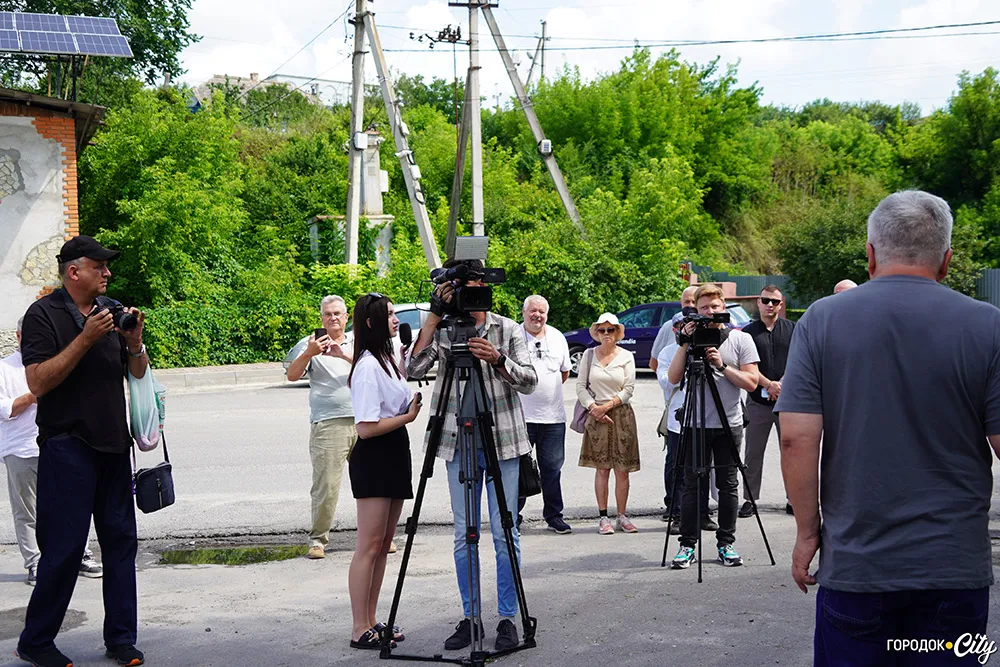
Rabbi Yosef Teitelbaum, chief rabbi of Khmelnytskyi Oblast and the city of Khmelnytskyi, who attended the presentation, also praised the book highly. He did not hide his delight at the depth of the research and welcomed this important event, which perpetuates the memory of a once-respected community, of which not a single person now remains in Sataniv itself.
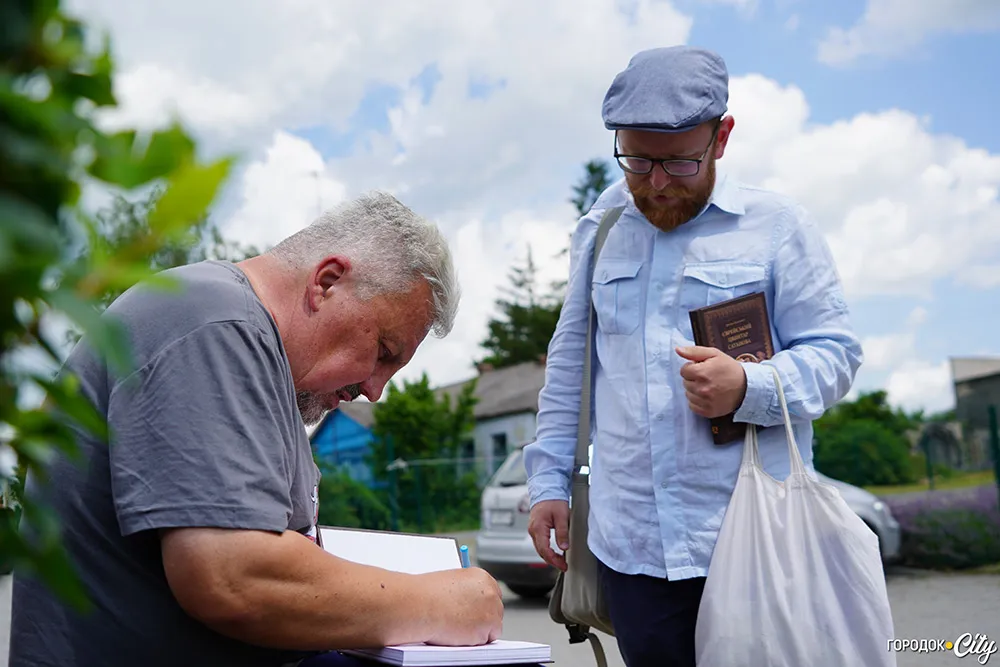
Finally, Dmytro Poliukhovych gave those who wished a tour of the ancient Jewish cemetery, to show the subject of his research in person.
Photos by Marianna Shkavron, “Horodok.City”
The book can be bought on the website of the publisher “Dukh i Litera”


