

UNESCO approves a list of 20 sites that will be under enhanced protection during the war

· 3 min read
On 7 September representatives of the Ministry of Culture and Information Policy of Ukraine took part in the third extraordinary meeting of the Committee for the Second Protocol to the Hague Convention for the Protection of Cultural Property in the Event of Armed Conflict. This is reported by the Ministry’s official website.
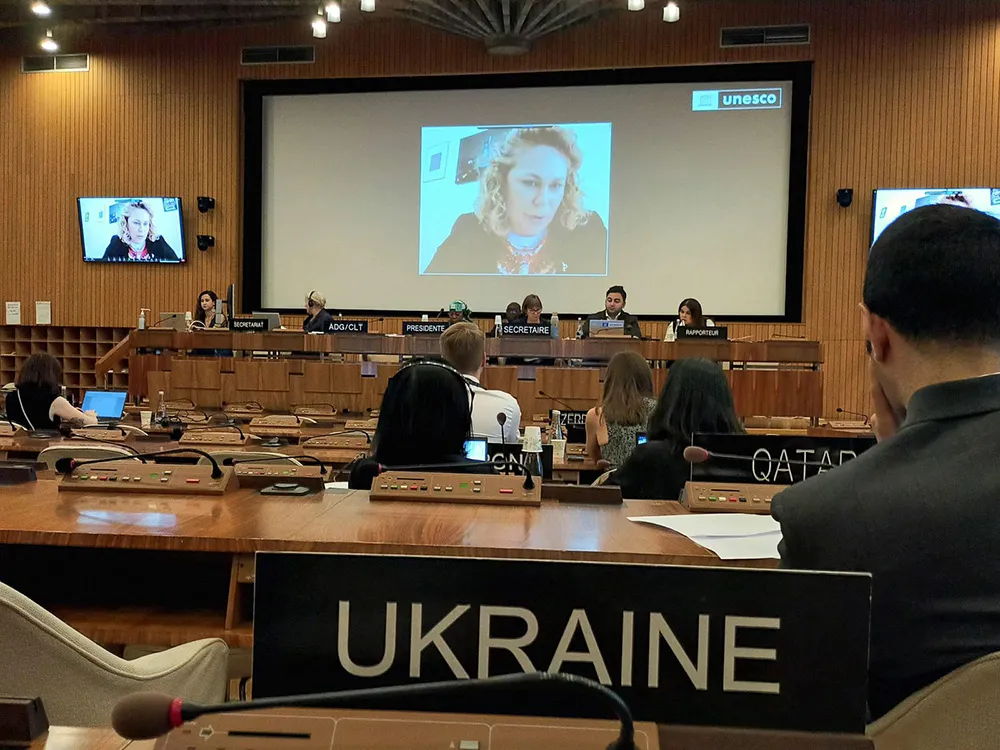
The Committee meeting. Photo: press service of the Ministry of Culture and Information Policy
During the meeting the UNESCO Committee supported Ukraine’s initiative and decided to place sites under enhanced protection.
This concerns most of the sites on the UNESCO World Heritage List and on the UNESCO Tentative List, not counting sites in the temporarily occupied territories and the historic centres of Odesa and Chernihiv. It is an unprecedentedly large list. The sites are as follows:
1. St Sophia Cathedral and related monastic buildings, Kyiv Pechersk Lavra;
2. Lviv – the Ensemble of the Historic Centre;
3. Wooden churches of the Carpathian region. Yasinia Church of the Ascension of the Lord;
4. Wooden churches of the Carpathian region. Zhovkva Church of the Holy Trinity;
5. Wooden churches of the Carpathian region. Matkiv Church of the Presentation of the Most Holy Mother of God in the Temple;
6. Wooden churches of the Carpathian region. Nyzhnii Verbizh Church of the Nativity of the Most Holy Mother of God;
7. Wooden churches of the Carpathian region. Potelych Church of the Descent of the Holy Spirit;
8. Wooden churches of the Carpathian region. Rohatyn – Church of the Descent of the Holy Spirit;
9. Residence of Bukovinian and Dalmatian Metropolitans;
10. Struve Geodetic Arc – Katerynivka;
11. Struve Geodetic Arc – Baranivka;
12. Struve Geodetic Arc – Felshtyn;
13. Struve Geodetic Arc – Staro-Nekrasivka;
14. Astronomical Observatory of Kyiv National University;
15. Cultural landscape of the canyon in Kamianets-Podilskyi;
16. Sofiivka Dendrological Park;
17. Derzhprom (the State Industry building);
18. Research Institute (RI) Astronomical Observatory of Odesa National University;
19. Research Institute (RI) Mykolaiv Astronomical Observatory;
20. Taras Shevchenko’s Grave and the State Historical and Natural Museum-Reserve.
“For more than 500 days now the Ukrainian people have continued to show their resilience and their determination in the fight against the aggressor. We do not accept war as an ordinary thing. We accept neither the occupation of our territories nor the destruction of our cultural heritage. So let this meeting be one more step in our common mission – the preservation and restoration of cultural heritage sites,” said Deputy Minister of Culture and Information Policy of Ukraine Anastasiia Bondar in her speech.
The meeting also considered questions of international support for Ukraine. The States Parties to the Committee confirmed their readiness to assist Ukraine. In particular, Ukraine will continue to receive international assistance from the Fund for emergency measures. This will take into account the preliminary conclusions of the UNESCO International Expert Mission assessing the damage to cultural and religious sites in Odesa. Training of specialists in the field of protecting cultural property, training sessions for the military and other measures are also planned.
Participants and attendees of the Committee expressed solidarity with Ukraine and the Ukrainian people, and also expressed deep concern at the deliberate destruction of the cultural sector by Russian troops.
Following the meeting, the Declaration on the Protection of Cultural Heritage in Ukraine, proposed by the Ukrainian side, was adopted.
As Ukrinform reports, more than half a thousand cultural heritage sites, including monuments, have been damaged or destroyed as a result of Russian aggression. But this is only the visible part of the iceberg of Ukrainian cultural losses, because in the occupied territories the Russians have already carried out more than 70 illegal archaeological excavations and plan another 100. In this way Ukrainians are being deprived of those layers of culture and history that had not been thoroughly studied and are now lost for ever. The occupiers have looted museum collections in the occupied territory, such as the Kherson Museum of Local Lore or the Stone Tomb (Kamiana Mohyla) in Zaporizhzhia region, and are also digging valuables out of the ground along the Tavrida highway and at Chersonesos Taurica, which is a UNESCO World Heritage site.


