

Ukraine’s oldest depiction of the Western Wall found
Thanks to the “Ancestors’ Graves” project, initiated by the NGO “Ukraine Incognita” and the Department of Culture of Nationalities and Religions of the Horodok City Council (Khmelnytskyi Oblast), the oldest depiction in Ukraine, and possibly in Europe, of the famous Western Wall in Jerusalem has been found in the ancient Jewish necropolis of Sataniv.
The “Ancestors’ Graves” project has been under way for almost a year, and thanks to it quite a few resonant historical finds have been made, which have been reported many times not only on the Ukraine Incognita website but also in national and foreign media. The aim of the project, through the study of the old necropolises (Ukrainian, Polish and Jewish) of the former Horodok district, is to study and show the multinational and multi-confessional culture of Podillia and of Ukraine as a whole.
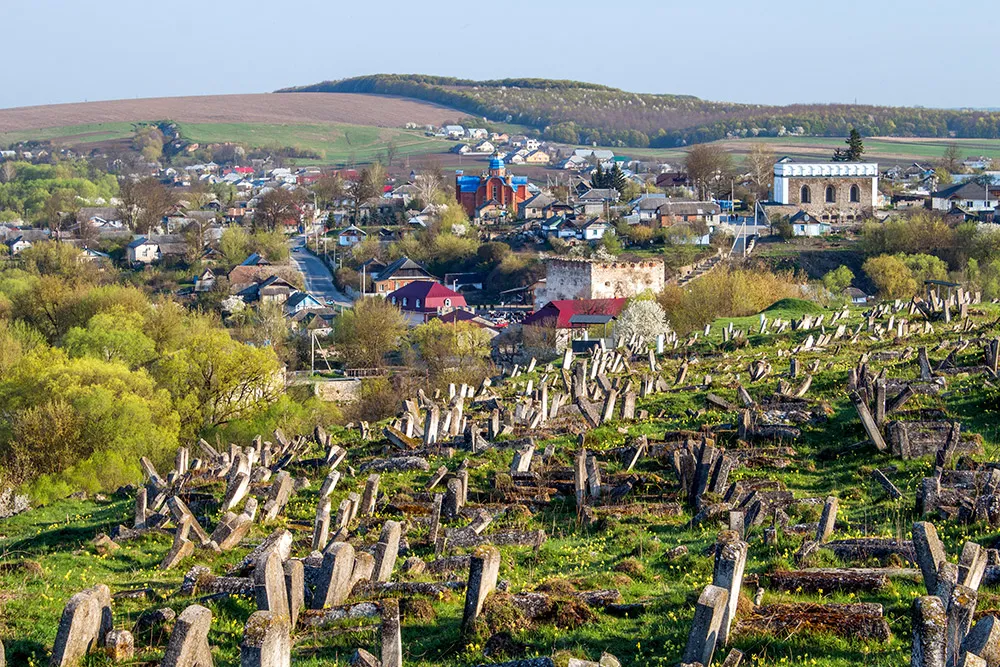
The old Jewish cemetery in Sataniv
The old necropolis of the town of Sataniv is one of the most outstanding Jewish necropolises in Europe. The oldest burials here date back to the second half of the 16th century.
The cemetery has been studied for a long time. In particular, on the basis of the decoration of its matzevot of the 17th and early 19th centuries, with the assistance of the United Jewish Community of Ukraine, an exhibition was even created, “Sataniv: the lost world of an ancient Jewish cemetery”, which has been shown at respected museum venues in Kyiv, Dnipro and Odesa. The list is not complete: negotiations are under way with a number of museums about displaying it in other regional centres.
The matzevah with the sensational subject was not shown at the exhibition. Against the exuberant Baroque of the gravestones of the second half of the 18th century it looks rather pale, and it is also considerably damaged by time and by a clumsy “restoration”. It dates from approximately the end of the 17th century, possibly the very beginning of the 18th.
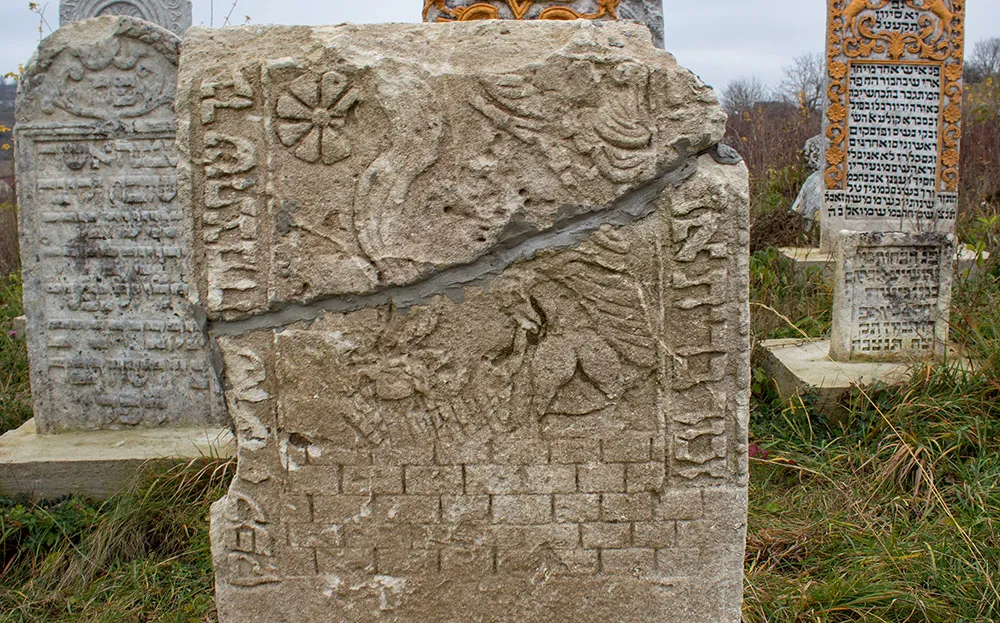
The gravestone with the depiction of the Western Wall is badly damaged
Its decoration is still quite archaic and crude. The gravestone has interested researchers for a long time, but it has only just been possible to make sense of it.
Help came from a specialist at the Center for Jewish Art of the Hebrew University of Jerusalem, Professor Sergey Kravtsov. Thanks to the scholar from Israel it was possible to establish that we have a quite unique subject.
First, the gravestone shows a subject that is quite rare in Jewish funerary art, illustrating one of the key episodes of the Torah (the Old Testament), the “Sacrifice of Abraham”. In the Jewish tradition it is the “Akedat Yitzhak”, literally the “Binding of Isaac”.
The carver immortalized the moment when an angel stops Abraham at the last moment, when he was already about to sacrifice his son Yitzhak (Isaac) to God
This is indicated by the inscription: “remember the covenant of Abraham”.
Given the religious prohibition on depicting people, the master replaced the actors with images of animals and birds traditional for Jewish gravestones.
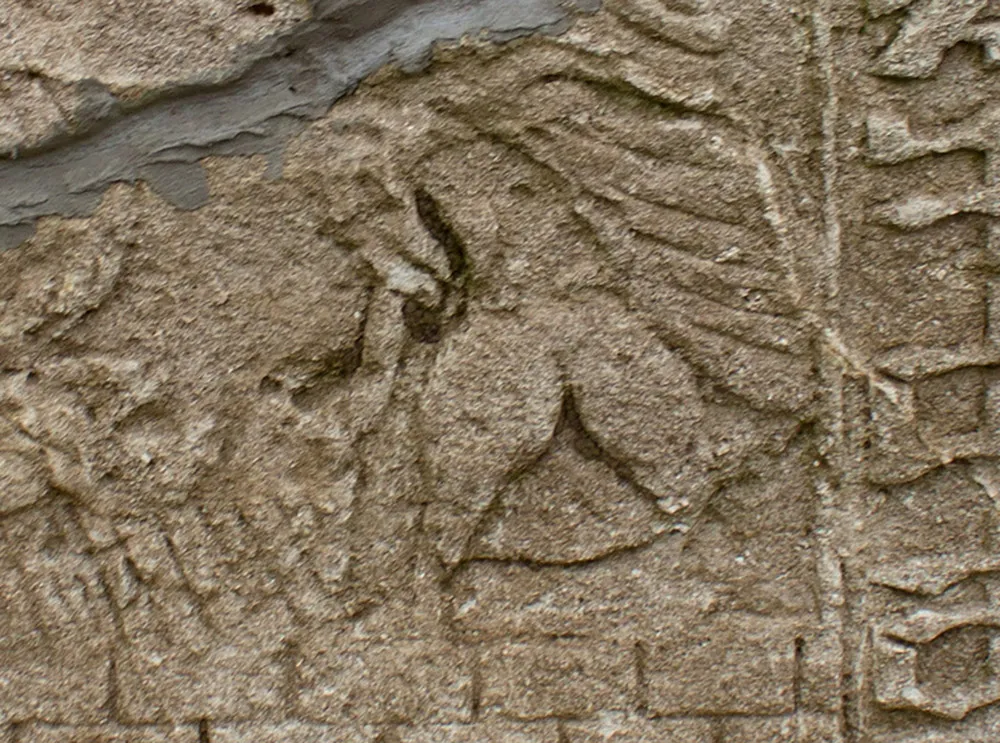
A pelican tearing at its breast
On the right we see a bird tearing at its own breast with its beak. This is a pelican, a symbol of self-sacrifice. In keeping with one of the tasks of the “Ancestors’ Graves” project, to show also the mutual connection between the cultures of the peoples who lived for centuries in Podillia, this is also a vivid example of cultural exchange.
The pelican came into Jewish art from the Christians, where besides self-sacrifice it also embodies Jesus Christ. It does not look at all like a real pelican, just like most “pelicans” on Christian icons (how could people in Podillia know what it looks like?), but a bird that tears at its breast with its beak is always a pelican.
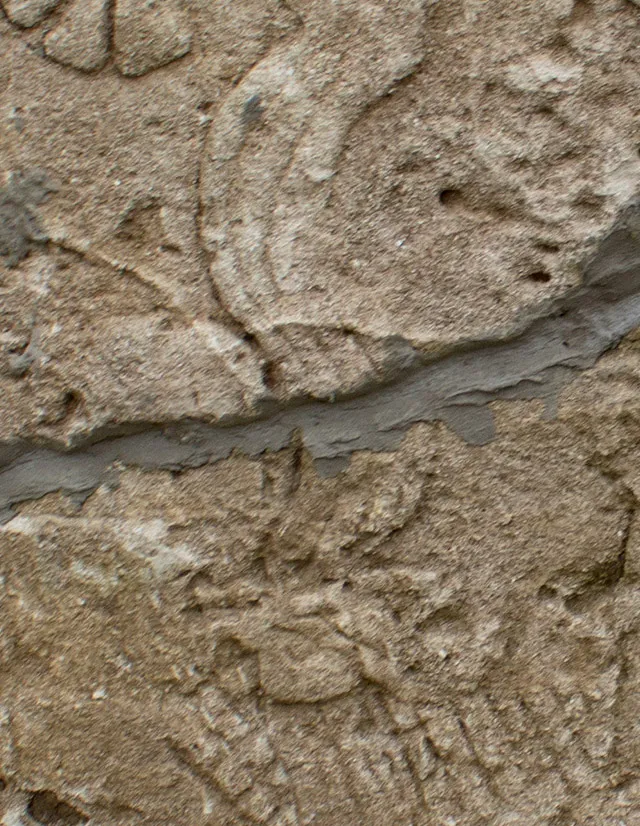
The sacrificial fire, some hoofed animal and smoke
Here it embodies the self-sacrifice of Abraham, who by the Lord’s will agreed to give Him what was dearest, his son. On the left we see the sacrificial fire from which smoke rises. On the fire, if you look closely, you can see a fawn or a ram (clearly some cloven-hoofed animal) that embodies Isaac. In the upper right corner we see an eagle, which in the Jewish tradition embodies God.
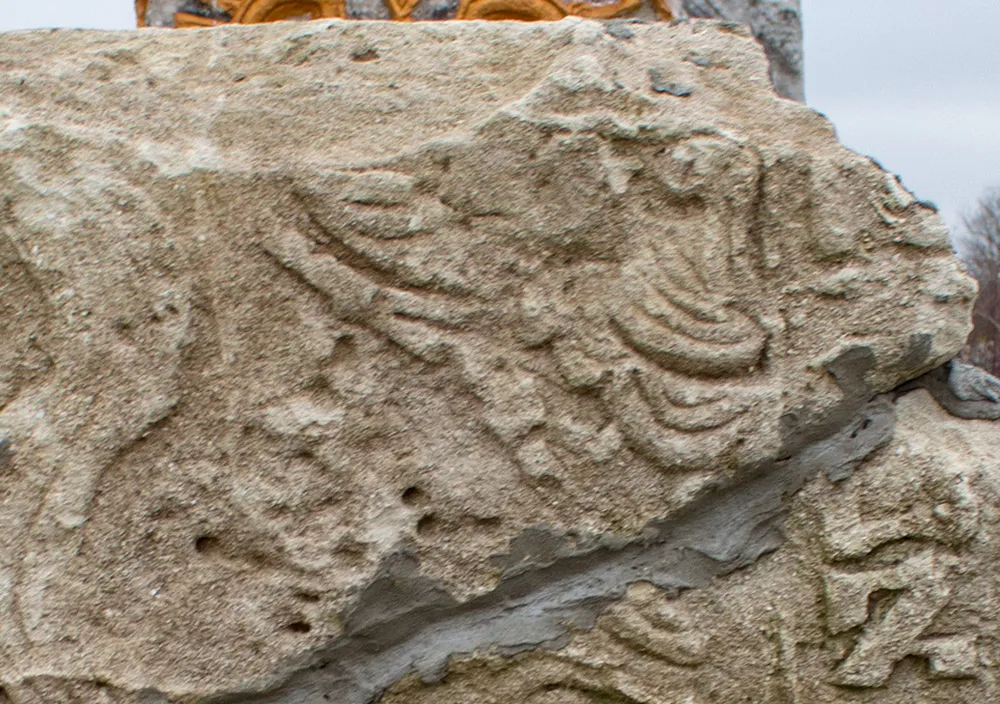
God as an eagle
The mountain on which Abraham offered the sacrifice was later named Jehovah-jireh (the Lord will see). Later King Solomon built the Jerusalem Temple on this mountain, of which at the time the gravestone was created only the famous Western Wall remained, and it is this that is depicted beneath the sacrifice scene.
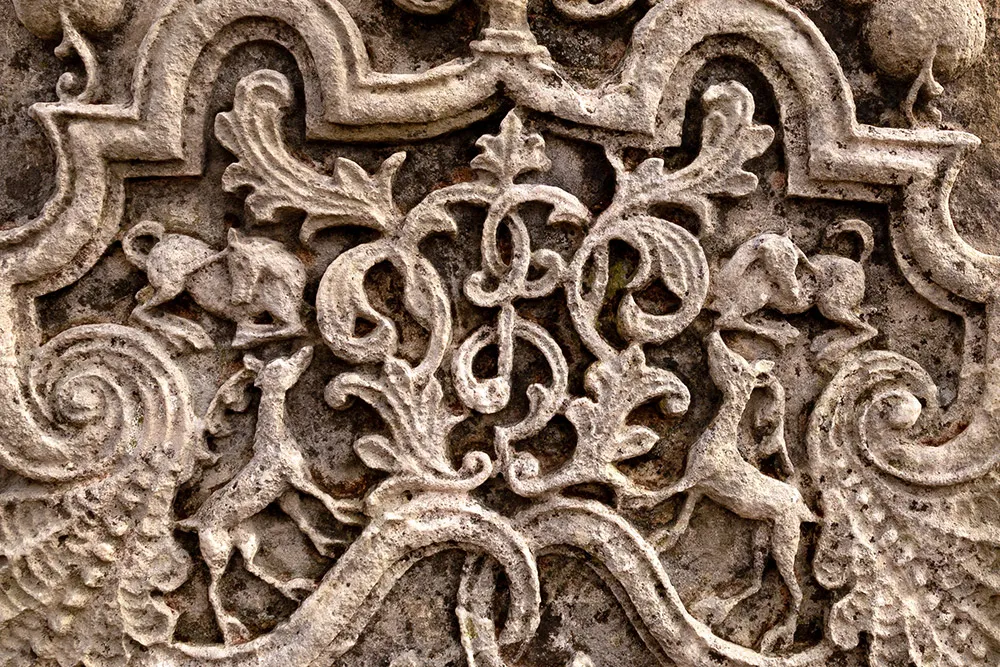
The gravestone with the Western Wall loses aesthetically to its 18th-century Baroque neighbours (pictured), but it is unique
The date is badly damaged, and the text of the epitaph is lost altogether. So it is hard to say why the carver turned to such a rare subject, unusual for gravestones. It can be assumed with a high degree of probability that the deceased was named either Avraham or Yitzhak, and in this unusual way the master embodied his name.


