

Activity of Russian developers threatens the existence of Cembalo Fortress in Crimea
The cultural and archaeological heritage of Balaklava in occupied Crimea is going to be dug up: gas pipelines and utility networks, to be built as part of a yacht marina, are due to pass through several historical monuments. This is shown by the data of the “state historical and cultural expertise” report posted on the “Sevnasledie” website. This is reported by Voice of Crimea.
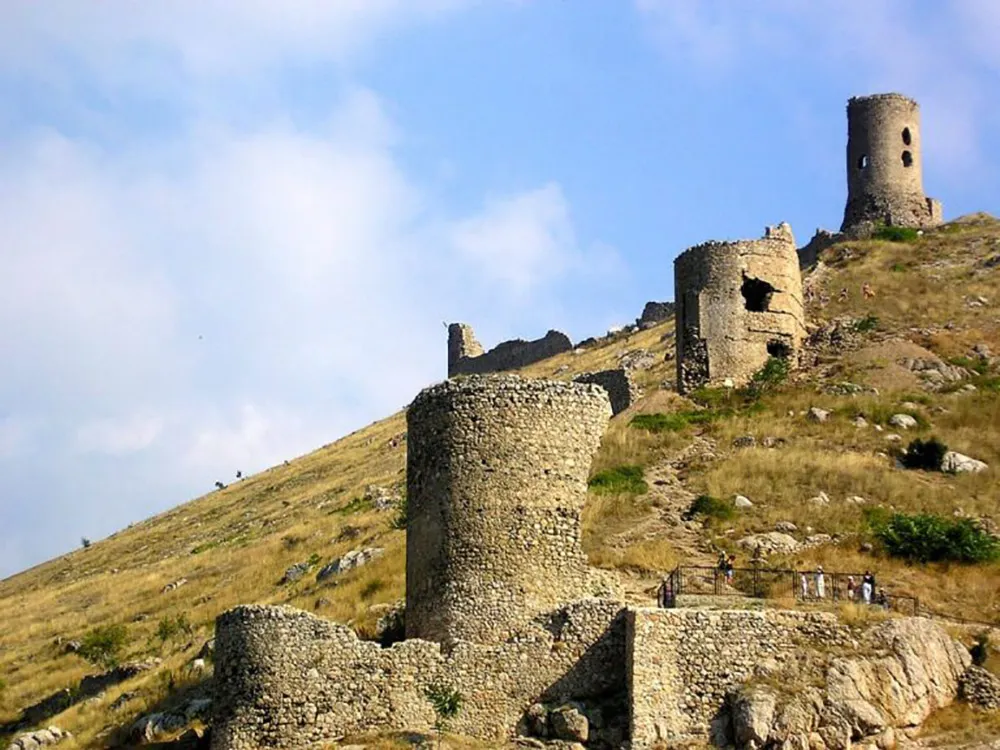
The Genoese fortress of Cembalo. Photo from open sources
According to this document, earthworks and construction will affect cultural heritage sites of so-called federal significance: the monument “The ancient city of Chersonesos Taurica and the fortresses of Cembalo and Kalamita” and “The walls and towers of the Lower Town of St. George”, as well as the archaeological heritage sites “Northern suburb of Cembalo fortress”, “Northern suburb of Cembalo fortress, plots 2 and 3” and “Cultural layer of the town of Balaklava”.
Archaeological surveys commissioned by the company “Design Institute Geoplan” were carried out back in 2019, but now the section of the project documentation on cultural heritage sites has needed adjustment.
The point is that the area of the design territory has increased significantly, from 10.6 to 18 hectares.
The “state historical and cultural expertise” report states that the section was adjusted in accordance with a contract concluded with the company “Engineering Centre Bridges and Tunnels”, and that no additional test-pit work was carried out in 2024, since the territory had been sufficiently studied in previous years.
It is worth noting that designers from the company “Design Institute Geoplan” pointed to the difficulty of the engineers’ work precisely because of the “large number of specially protected zones and cultural heritage sites” in the surveyed territory.
According to the engineers, “wherever you look, it is solid historical structures, so we simply cannot place structures where we want and where it makes engineering sense. We had to develop a whole programme of measures aimed at preserving the integrity of the cultural heritage sites.”
Within the design territory of the project “Creation of a yacht marina, city of Sevastopol” (coastal area), such sites as the “Medieval fortress of Cembalo”, the “Northern suburb of Cembalo fortress” and the “Northern suburb of Cembalo fortress, plots 2 and 3” lie wholly or partly.
Thus, in the immediate vicinity of the Genoese fortress, earthworks are planned to tie a medium-pressure gas pipeline into the existing gas pipeline. A lawn is also planned there.
As the “specialists” who carried out the expertise note, the design solutions supposedly will not affect the structural components of the archaeological monument, but, to avoid a negative impact on the medieval fortress structure, they advised conducting so-called archaeological monitoring.
“If, in the course of archaeological monitoring, areas with an undamaged cultural layer are found, earthworks must be stopped immediately, and further research must be carried out in accordance with the methodology of archaeological excavation or methods of preserving the site at the level of the design marks,” the “state historical and cultural expertise” report states.
However, it is no secret how construction is done in Russia. So all that remains is to hope that the archaeological monument will not be destroyed for good…
As previously reported by “Ukraina Inkognita”, Moscow priests, using the hands of Russian soldiers, are ravaging ancient Chersonesos. These actions are carried out by subordinates of the Military Construction Complex of the Russian Ministry of Defence (VSK). They continue construction work to create the so-called historical and archaeological park “Chersonesos Taurica” and to destroy the cultural and archaeological landscape.


