In 1621 Ukrainian Cossacks saved Europe. The Battle of Khotyn and Sahaidachnyi

· 14 min read
It was at the end of September 1621 that the Khotyn War, which unfolded around the beautiful fortress we all love so much, came to its resolution.
We need to say a few words about the context of this confrontation and our Cossacks’ preparation for it.
The era of the great Cossack sea campaigns of the late 16th and early 17th centuries against the coasts of Crimea, Bulgaria and Turkey was coming to an end.
Our warriors took part in several episodes of the victorious wars against Muscovy, which was thoroughly torn apart in 1618. But they also understood that the approach to military skill and to the organisation of their ranks had to be fundamentally changed. A light cavalry march and attacks with drawn sabres would not work against a more serious opponent than the Muscovites.
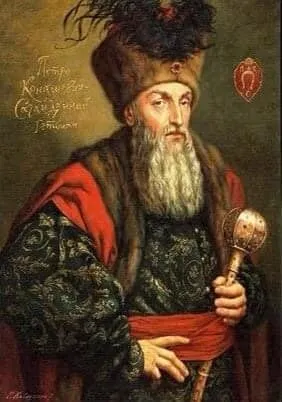
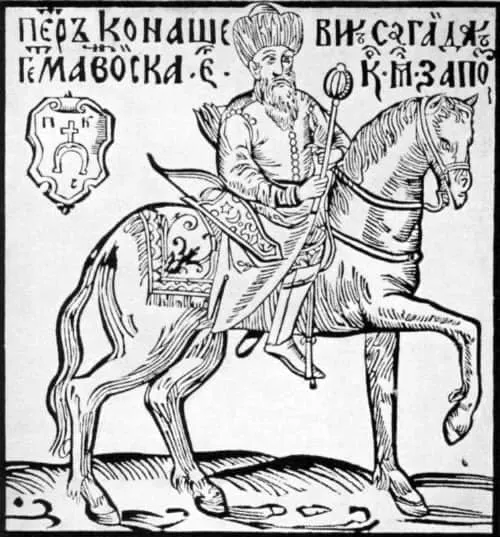
Photo: Petro Konashevych-Sahaidachnyi
Then the Cossacks set about actively borrowing European experience from the great Thirty Years’ War, which was blazing across Europe at the same time. Participation in battles on the territory of today’s Czechia, Slovakia and Hungary in 1618-1621 significantly added to their understanding of modern approaches to war and gave invaluable experience in building fortifications, manoeuvring and so on. Tactical field exercises began, the result of which was an improvement in the tactics of the Cossack infantry on the battlefield. The Cossacks demonstrated these changes in their tactical art superbly in the next war against Turkey, in which they fought on the side of the Polish-Lithuanian Commonwealth in 1621. There we already saw elements of the linear battle order used in Western European armies in the first quarter of the 17th century. Most likely it was a formation similar to the so-called “Dutch” one. The Cossacks could have become familiar with its structure when they served in mercenary light cavalry units of the army of the Austrian emperor and took an active part in the Bohemian campaign of the Thirty Years’ War, in its decisive Battle of White Mountain on 18 November 1620.
At the same time, in 1620, the Battle of Cecora took place between the armies of the Commonwealth and the Ottoman Empire, in which the Poles tried to take the field almost without Cossacks. Although a small detachment of them was present and was even led by Bohdan’s father, M. Khmelnytskyi, it had no influence on the battle. In the end, in 1620 Poland lost almost its entire army; on the battlefield fell the Grand Crown Hetman S. Żółkiewski, many commanders, and with them M. Khmelnytskyi. And among the prisoners was the future hetman B. Khmelnytskyi. The consequences were almost catastrophic.
And so, in less than a year, the army of the Ottoman Empire, having regained its strength and knowing of the split between Catholics and Protestants, again approached the borders of the Commonwealth in order to push the whole horde still further into the depths of Europe. The bled-white Polish-Lithuanian army could not gather even a remotely decent number of men to avoid a rout. Even the invited German and other mercenaries did not constitute any serious obstacle for the force that was advancing on Europe.
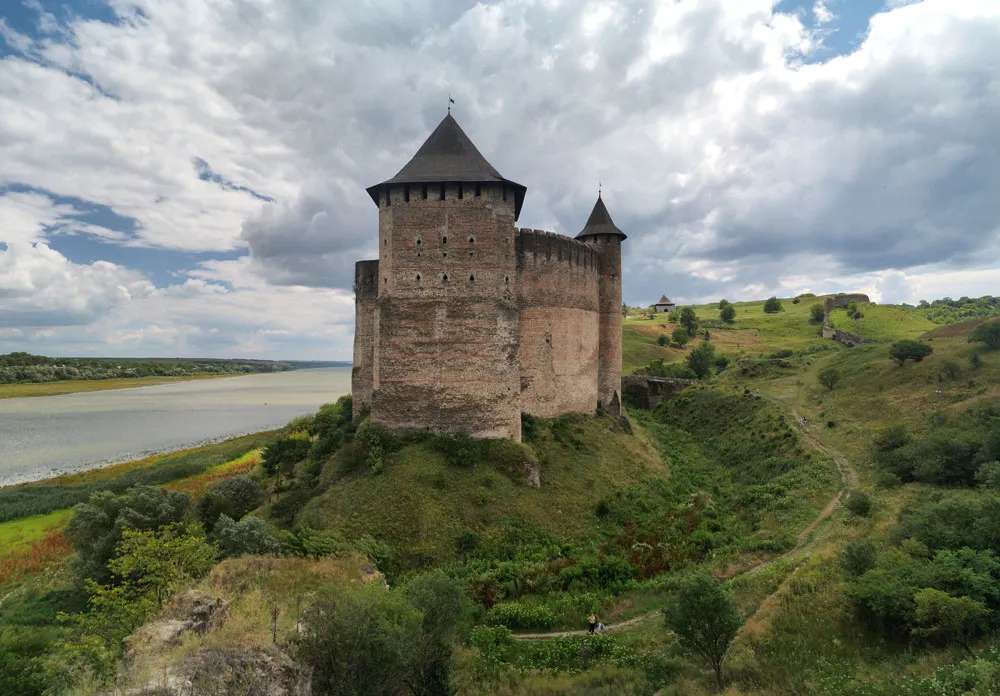
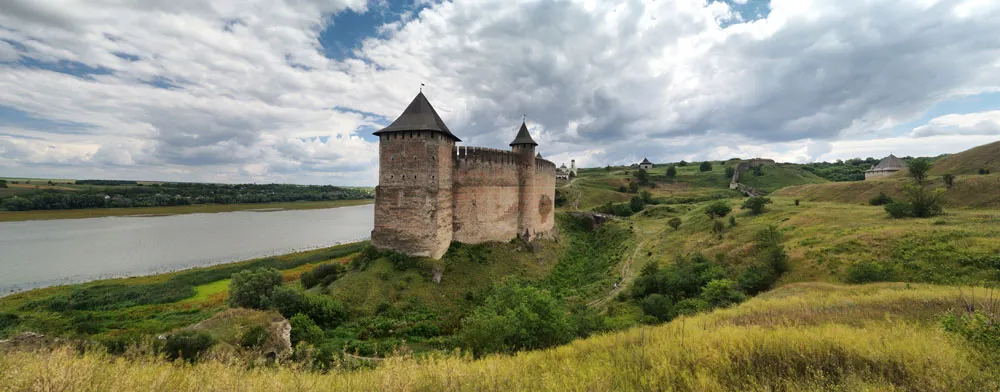
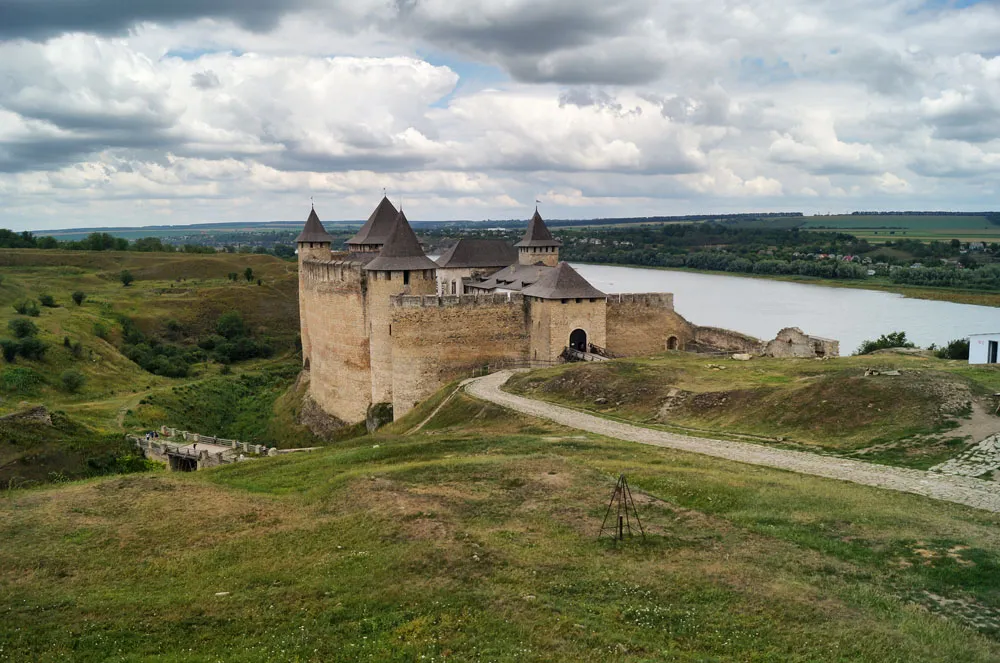
Photo: Khotyn Fortress. Author: Roman Malenkov
In these conditions Sigismund III Vasa was forced to seek military help from the Cossack army.
At the same time, Petro Konashevych-Sahaidachnyi, successful in sea campaigns and in building up naval forces, was seriously set on outlining the plans for a state project of Rus-Ukraine and was just then turning an ingenious combination on the spiritual front, which was to help lay one of the pillars of statehood: the autonomy of the Church.
He responded to the Polish request with a personal visit and certain demands for the autonomy of the Cossack state (rights and liberties). Having received preliminary approval, he set out into the hell of a war that foretold nothing but defeat, and which for him personally did indeed become the last.
It must be said that this battle was significant for the whole continent, and so much has been written about it that there is no point in repeating it. I will only draw attention to the fact that there are numerous memoirs of direct participants, who recorded interesting details straight from hell, as well as dozens of volumes of later analyses, interpretations and assessments.
One can mention only the “Diariusz of the Khotyn campaign” and the “Commentaries on the Khotyn War”, or J. Jerlicz, who wrote in his diary that between the object of his observation, the Turkish soldiers on the left bank of the river, and himself there was “only the Dniester, so that he could clearly recognise each one”, and who left us many interesting details of the battle and its participants.
The account of the personal gunner’s experience of J. Czapliński, who served in the army of the Crown Cup-bearer St. Lubomirski (who after the death at Khotyn of the Lithuanian hetman J.-K. Chodkiewicz became the new commander-in-chief), is interesting.
Broadsheets have also survived, which tell, almost in the form of a diary, many details, and so on.
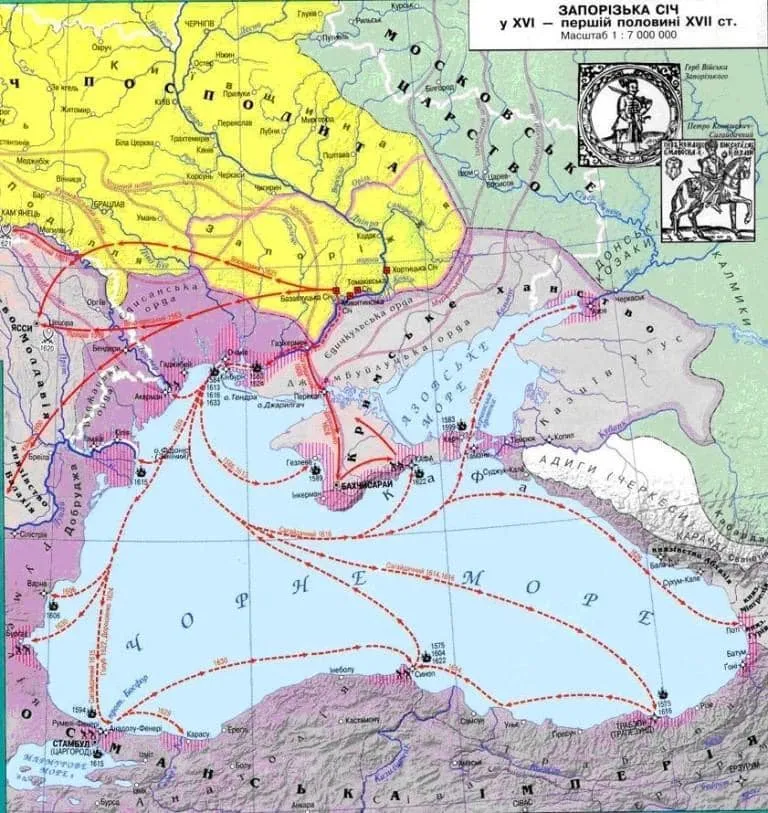
Photo: The era of the great Cossack sea campaigns
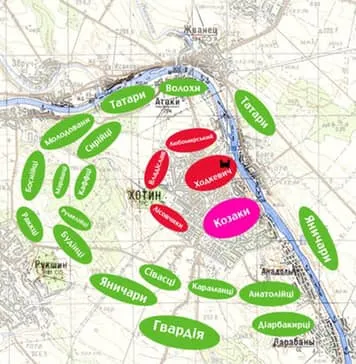
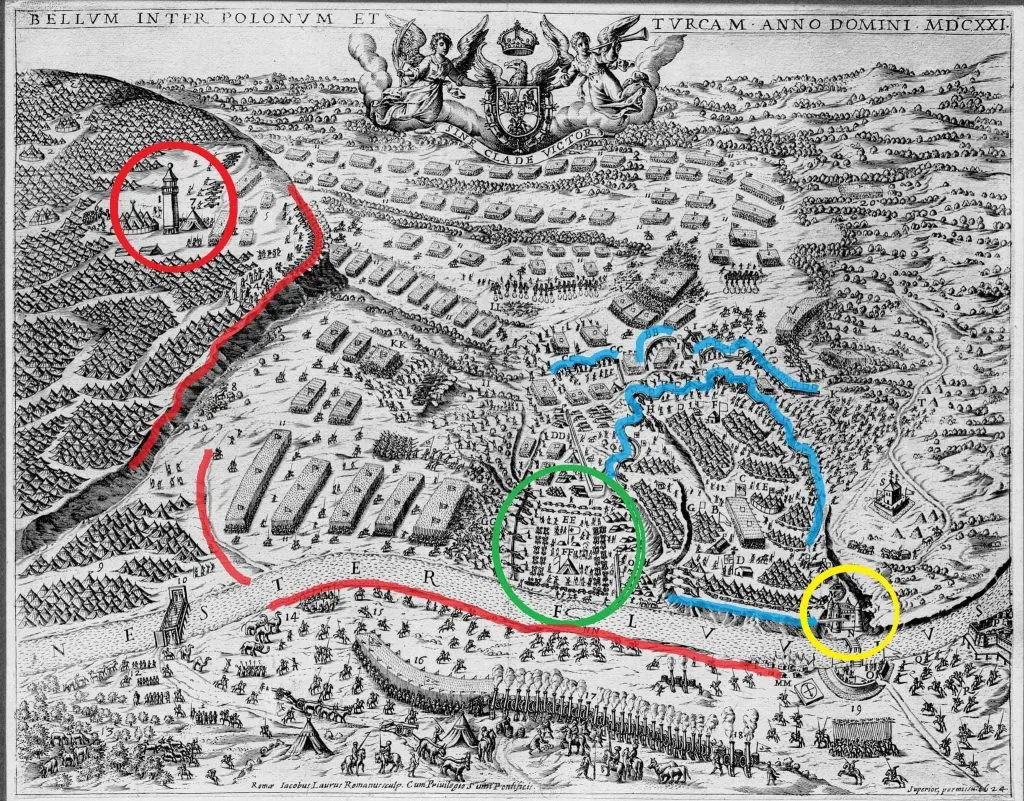
Photo: Versions of the reconstruction of the troop positions
The Cossacks entered the game as early as 9 May 1621 on the Black Sea, with an attack by a Zaporozhian flotilla on Ottoman ships heading for the future theatre of land operations. The Zaporozhians sank several dozen ships, including 9 galleys carrying heavy siege guns. Until early October the Cossack flotillas repeatedly attacked the Black Sea coast and engaged the Ottoman fleet, destroying many enemy ships, causing considerable devastation in enemy territory and disrupting sea transport supply. The Cossacks’ actions significantly complicated the position of the enemy land forces. According to some historians’ estimates, up to 4-5 thousand Cossacks may have distinguished themselves on this front.
Meanwhile their main forces moved directly to Khotyn, trying to get ahead of the Ottoman forces already approaching the Polish-Lithuanian positions. Although with their main contingent of 41,520 warriors the Cossacks (total strength 45-47 thousand) more than doubled the forces of Khotyn’s defenders, they were still considerably outnumbered by the Ottomans (by some estimates 2 to 2.5 times).
The war was positional, and at the start the guns played first fiddle. In the diary of one Polish nobleman, a participant in the battle of Khotyn, there is a remarkable reflection on this. He wrote that the Turks “began to batter the Cossacks and the lisowczycy with cannon; but these are people with three souls, it is not easy to see and crush their black soul” (Zbigniewski P.). The author of these lines, despite his alienated and negatively coloured perception of the Zaporozhians (and, together with them, the Lisowczycy), nevertheless acknowledged their ability to withstand enormous trials, including enduring artillery bombardment without particular losses.
Here the experience of engineering fortifications that the Cossacks had gained, as well as that of the 360 Lisowczycy who joined them, proved just the thing. At the beginning of the Thirty Years’ War there was a prevailing confidence that it would not be long, and commanders set decisive tasks for their troops, trying to defeat the enemy in a general battle, seize his political centres and thereby end the campaign. That is exactly how the warring sides acted in 1619-1623. At the same time, mercenary light cavalry units, in which Cossacks and Lisowczycy served, played an auxiliary role. They were mostly used to pursue a defeated enemy, and also for so-called economic warfare. Within a few years it became clear that the ability to play the long game would be far more useful. The Cossacks too began to learn this.
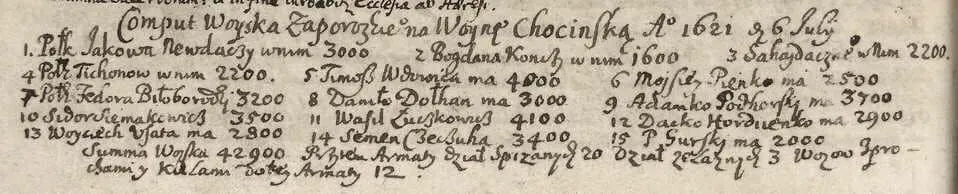
Photo: Part of the Cossack register for the battle of 1621
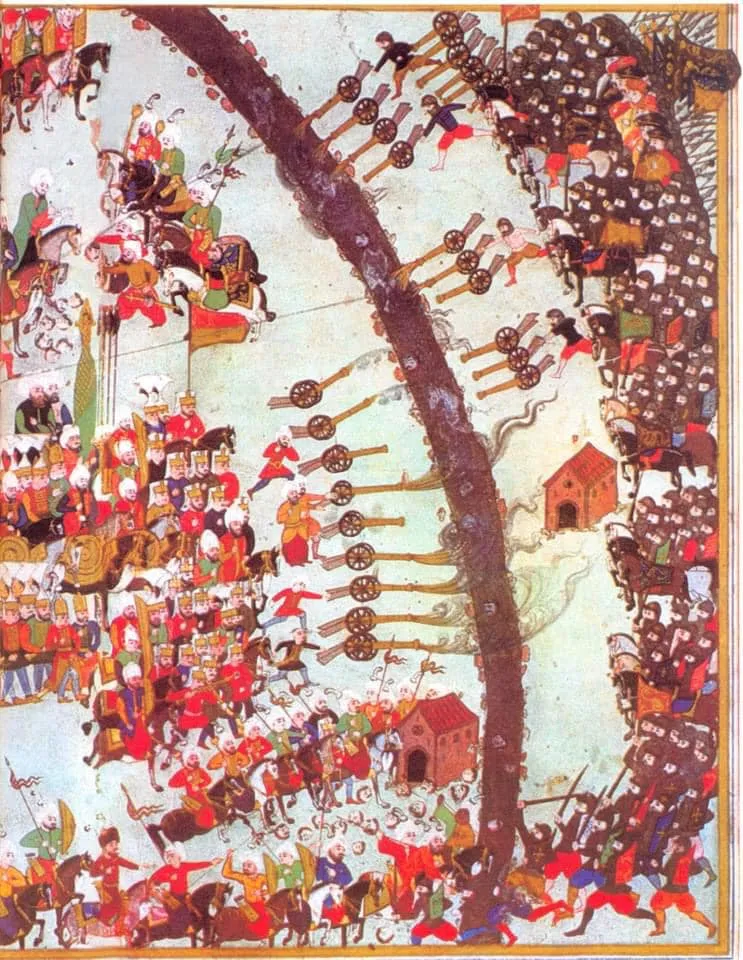
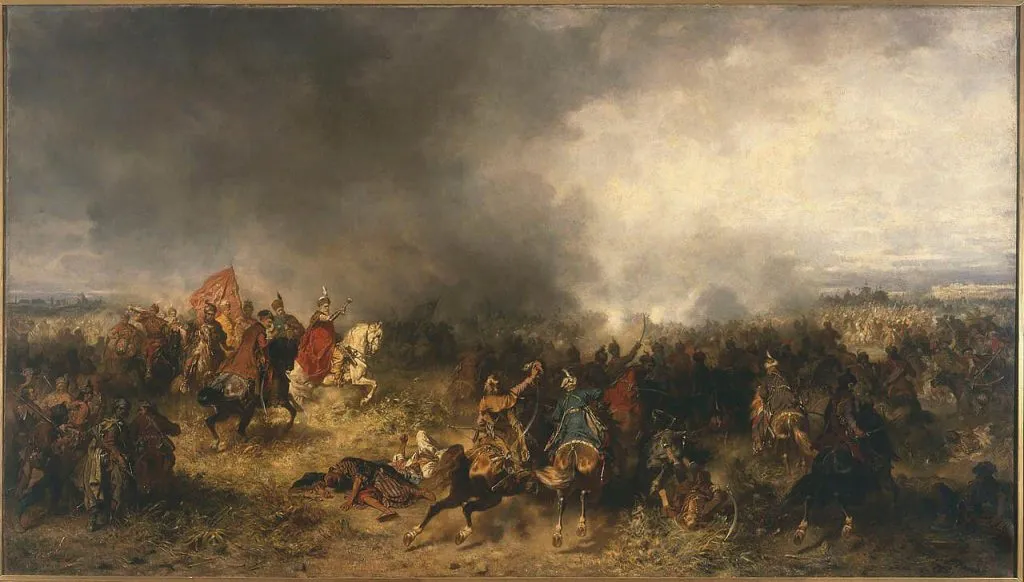
At the beginning of September 1621 one of the fiercest battles took place, which is described in detail. The Turks began the third assault of the day on the Zaporozhian positions with an artillery bombardment that lasted more than an hour. It was so powerful that many in the Polish-Lithuanian camp decided it was the end for the Cossacks (“it was doubtful that the poor Zaporozhians would remain alive”) (Diariusz wojny tureckiej pod Chocimem r. 1621). In reality, however, the Turkish bombardment did little damage, because the Ukrainians were at that time in earthen fortifications: they were protected by an earth rampart, wagons banked with earth, and dugout-type defensive structures.
And after that, the Cossacks boldly emerged from their fortifications and sometimes simply repelled the Ottoman attacks, and sometimes counterattacked in such a way that, had it not been for the fright and distrust of the Poles, who refused to support them, they might have achieved victory in the war by an unexpected blitzkrieg. After all, with their bold raids they broke into the very heart of the Ottoman camp.
But after several such attempts the element of surprise was lost, and they had to endure an unequal artillery war in the fortifications.
Artillery costs accounted for over 44% of all the revenues of the Crown treasury, which were moreover considerably increased compared with peacetime. It is easy to guess that the Zaporozhian Host could not afford such large sums for artillery and was therefore not effective in such confrontations. However, whether or not the Zaporozhians had money for heavy siege guns, they did not need them very much. First, the Cossacks did not wage wars to annex territories, which in those times were accompanied by long, systematic sieges of enemy cities and fortresses with heavy guns. Second, such guns were hard to transport, which made the army slow-moving and its actions rather predictable to the enemy. All this entirely contradicted the Zaporozhian tactics of warfare, which were based on high manoeuvrability and maximum use of the element of surprise.
Since the Zaporozhians were powerless to suppress the enemy batteries with shots from their own guns, they dug into the ground in order to sit out an artillery raid in deep cave-like dugouts. And then they counterattacked at an unexpected moment, and more often made night subversive sorties into the enemy camp.
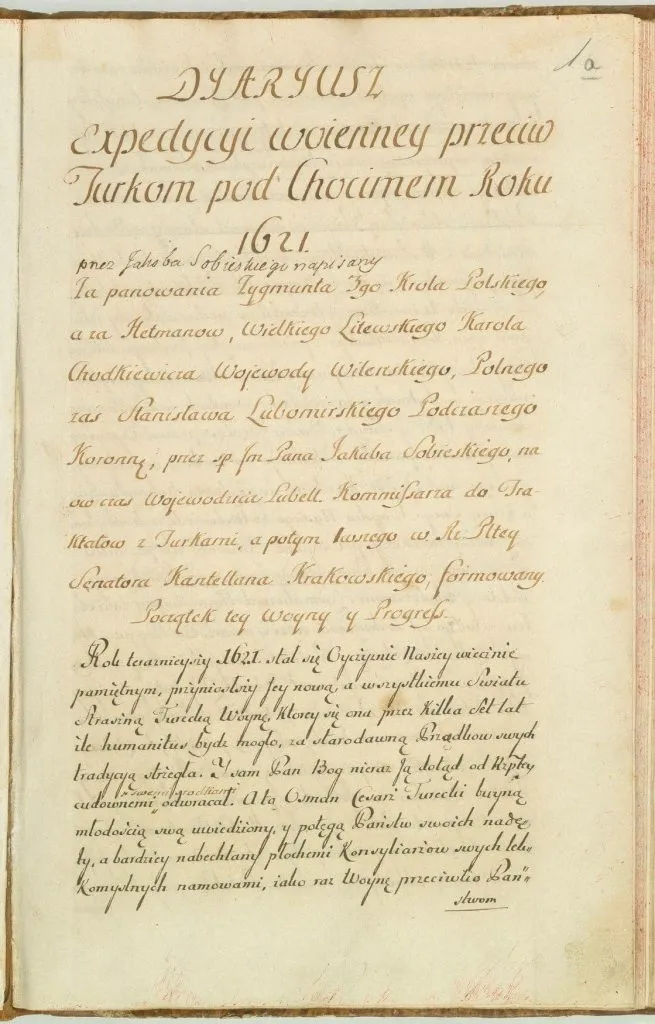
Photo: The original of the Diary of the Battle of Khotyn of 1621 by Jakub Sobieski
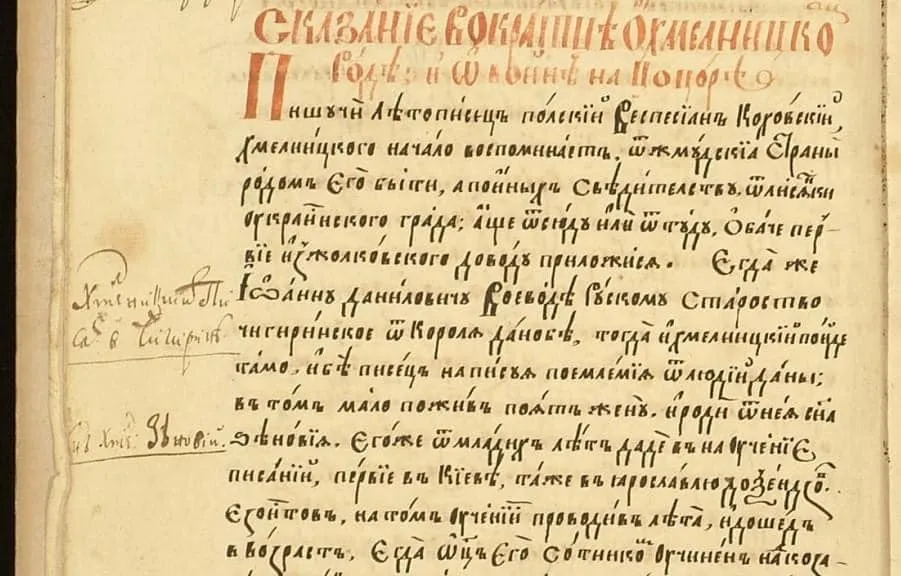
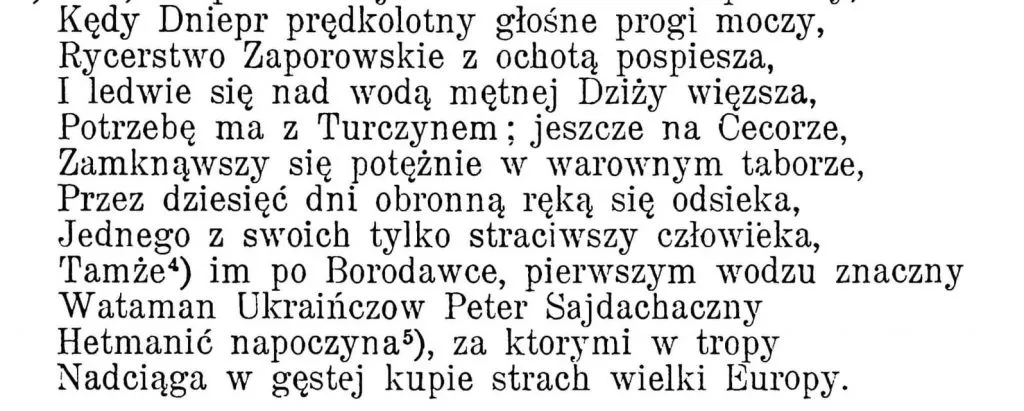
Photo: In 1623 the Lviv poet Bartłomiej Zimorowic wrote and published in Kraków a large poem, “A Memorial of the Khotyn War of 1621”. In it he described the feat of the Cossacks at Khotyn, whom he called “UKRAINIANS”, and noted their role in defending Europe from the Ottoman Empire… Image: a fragment of B. Zimorowic’s poem “A Memorial of the Khotyn War”. Kraków, 1623.
Another way of strengthening the defence was the rationalisation of positions. On the night of 22-23 September the Cossacks secretly abandoned the line they had held against the right wing of the Turkish army and the Janissary units of its centre. Having destroyed all their fortifications so that the enemy could not use them, the Zaporozhians moved the line of defence in a north-westerly direction, drawing closer to the entrenchments of the German infantry under the command of G. Denhoff; that is, they rose somewhat from the lowland to the plateau and, accordingly, moved away from the Turkish batteries that tormented the Cossacks with fire from the left bank of the Dniester. However, this could hardly have radically strengthened the defence of the Zaporozhian positions against the enemy’s left-bank guns. It seems that in deciding to move the forward edge of the defence, P. Sahaidachnyi took into account first of all the situation in the Polish-Lithuanian camp, which was daily becoming more depopulated through the desertion of soldiers. This circumstance also troubled the besieged Poles and Lithuanians, many of whom doubted the further expediency of holding such a large perimeter. Therefore, simultaneously with the Zaporozhians, the Polish-Lithuanian command narrowed its line of defence on the right flank, abandoning the trenches of the Chełmno voivode J. Weiher. The decision on this was taken at a council of war with Prince Władysław on 21 September. In effect, everything rested on the desperate resistance of the Cossacks and their subversive activity, which did not allow the Ottomans to feel confident and to finish off the weak Polish-Lithuanian army.
The commander of the armed forces of the Commonwealth, Hetman J. K. Chodkiewicz, was forced for subjective reasons, in the words of J. Sobieski, “to hold a defensive position and cautiously await the fortunes of war. All his fighting strength was lodged in the entrenchments, from behind which he counted on safely firing at the enemy…”. The command of the Commonwealth adhered to this strategy until the very end of hostilities.
Unlike the supreme commander-in-chief, the leaders of the mercenary Cossack army at his disposal, in particular P. Sahaidachnyi, held different strategic principles. Their concept consisted of an active defence combined with a decisive counteroffensive, crushing attacks on the enemy by day and by night, aimed first of all at destroying the enemy’s manpower. Such measures by P. Sahaidachnyi often met with opposition from the Polish supreme command. Nevertheless, the Cossack leader obtained from the Sejm of the Commonwealth itself sanction for the right to carry out night attacks against the enemy. They not only dealt crushing blows but were also a way of replenishing weapons, ammunition and provisions (the favourite “Cossack bread” won in battle), and most perceptible to the enemy was their demoralising force. V. Sodonovych testified: “At night the Cossacks quietly broke through right to the Sultan’s Turkish tent. Osman, terrified, fled from the tent, while the Cossacks killed many Turks…”
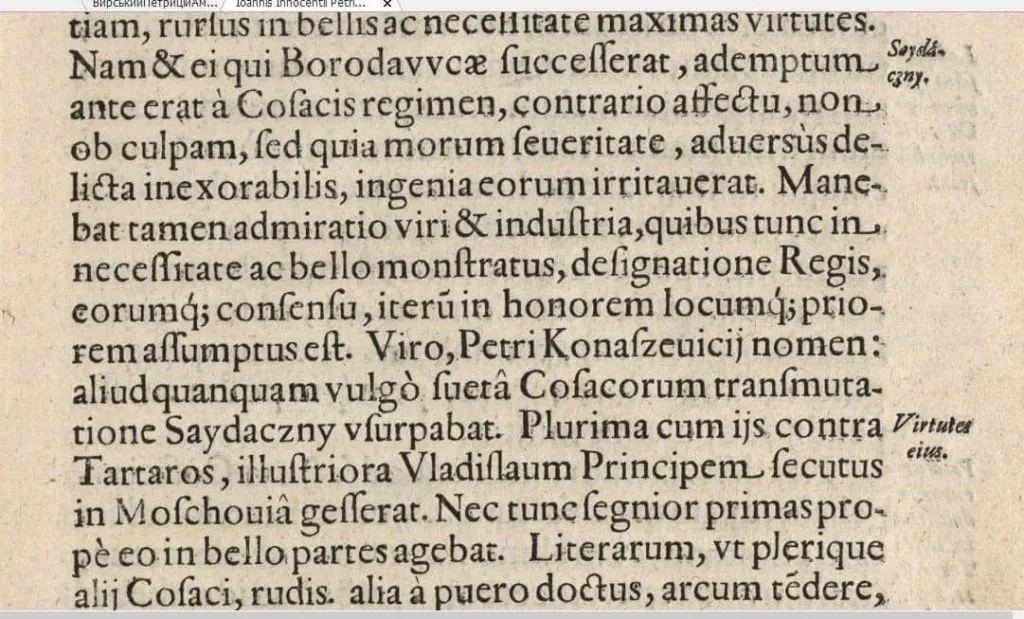
Photo: After 1621 leading Ukrainian, Polish and European historians, writers and political figures began to write about Hetman Petro Sahaidachnyi, among them not only Kasiian Sakovych, Jakub Sobieski, Szymon Starowolski, Stanisław Lubieński and Paweł Piasecki but also Jan Ignacy Petrycy, presented here. In his book, which was printed in 1622 and reissued many times, he published a short paragraph titled
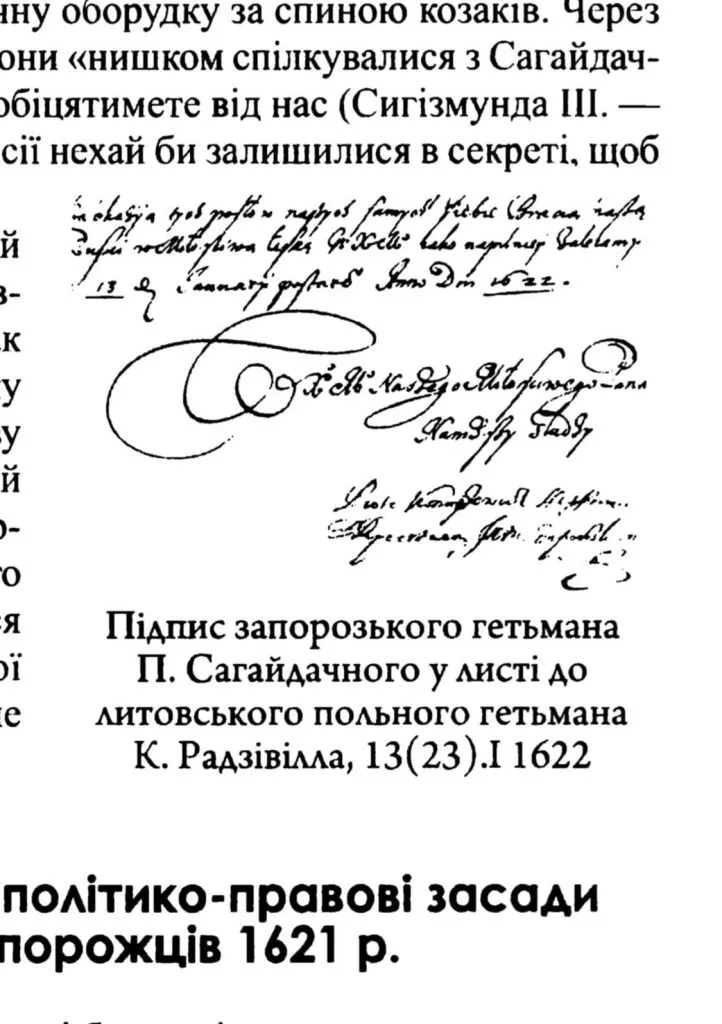
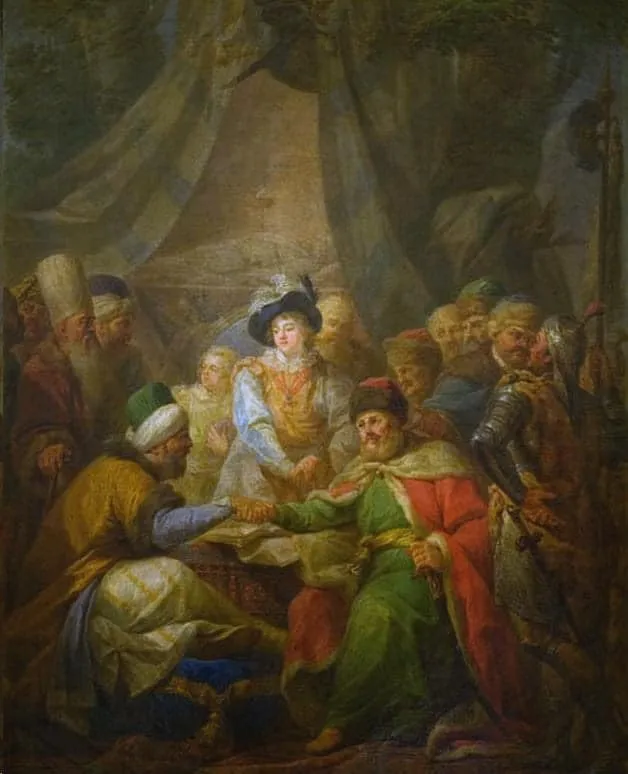
Photo: The outstanding Italian artist Marcello Bacciarelli once painted the famous picture “The Peace of Khotyn of 1621 between Istanbul and Warsaw”.
J. Sobieski, a participant in the events at Khotyn, asserted: “After the unexpected invasion of the Zaporozhians into the Sultan’s camp, panic seized the Turks: people of all ranks and estates were gripped by unheard-of alarm; Osman himself, who so recently thought that there was no one in the world more powerful than he, now saw with his own eyes the whole precariousness of his position, and his earlier self-confidence gave way to womanly lamentations when he became convinced that his hopes were groundless. His plans, with which he had counted on defeating not only the Polish army but on conquering the whole globe, were dispelled; now only hope for a shameful peace remained.”
It was precisely this strategy that brought the Commonwealth a tactical victory in this war.
In view of this, Sultan Osman II was forced to begin peace negotiations, which in effect meant his military and political defeat (given the absolutely winning starting positions and a twofold superiority in numbers).
On 9 October the Treaty of Khotyn of 1621 was concluded, which put an end to the war and returned the positions of the parties to the starting conditions of several years before.
Although Osman II did not consider it a defeat that his greatly superior forces had been unable to overcome the Polish-Lithuanian-Ukrainian forces, and conceived a series of reforms that were to allow another attempt to seize Europe, the Janissaries thought otherwise, staged a mutiny and disgracefully killed their sultan.
Thus the Cossacks saved Europe and set off on new astonishing adventures of the Thirty Years’ War, about which I will write later.
Author: Ihor Poluiektov
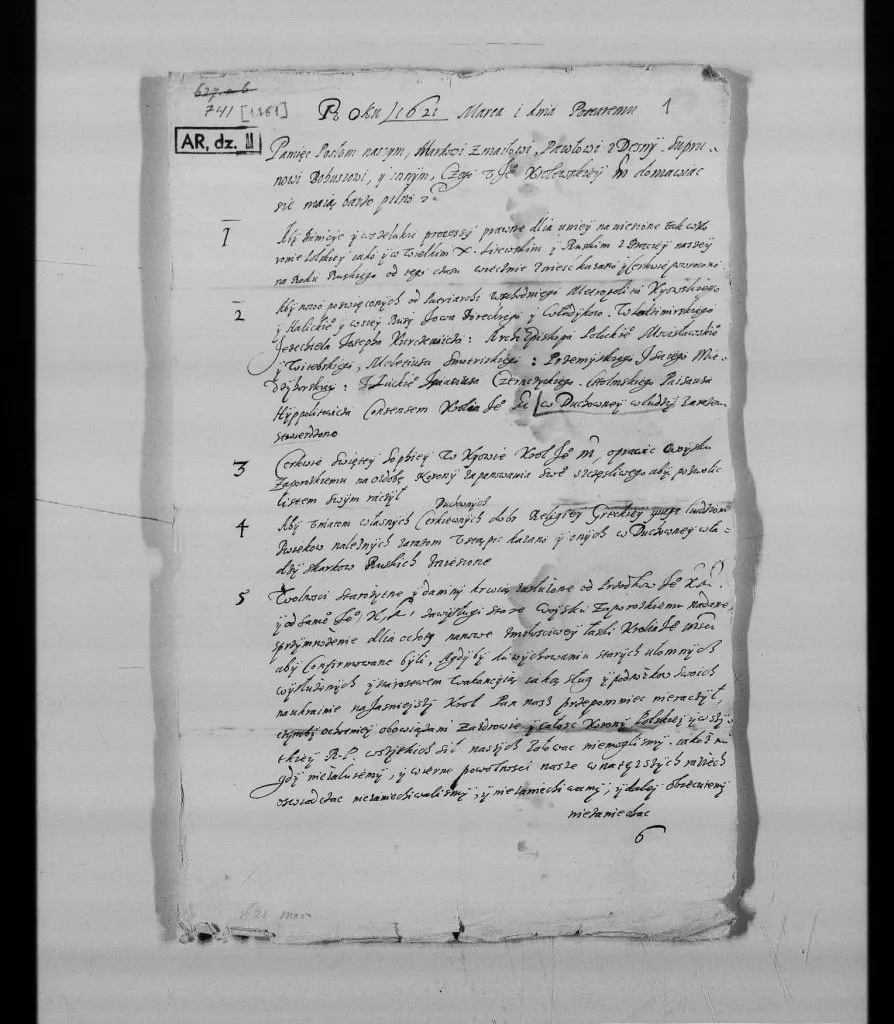
Photo: concerning the full restoration of all the ancient rights of the Orthodox population of Ukraine, and the confirmation by royal universals of Metropolitan of All Rus Job Boretskyi, consecrated earlier by Patriarch Theophanes of Jerusalem, and of the newly consecrated bishops.
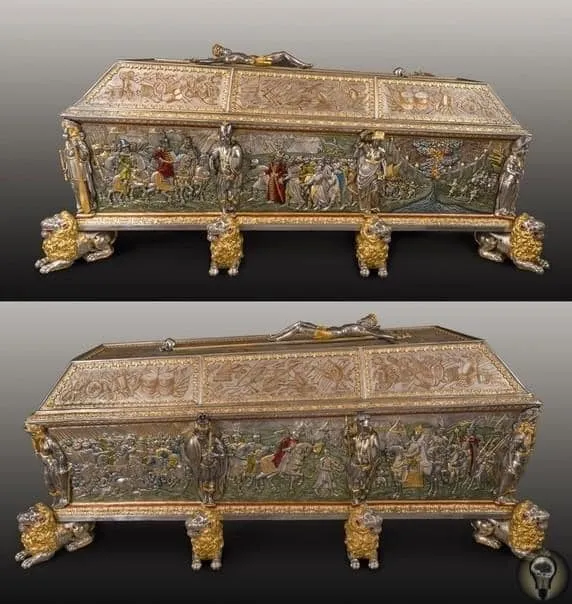
Photo: images from the sarcophagus of the King of Sweden and of the Polish-Lithuanian Commonwealth Sigismund III Vasa (1566-1632). They depict scenes of the victorious Battle of Khotyn of 1621 against the Ottoman Empire.
On the side walls of the sarcophagus, among Polish, Lithuanian and Turkish soldiers and commanders, we see Ukrainian Cossacks and the hetman of the Zaporozhian Host, Petro Konashevych-Sahaidachnyi.
Wawel Cathedral in Kraków
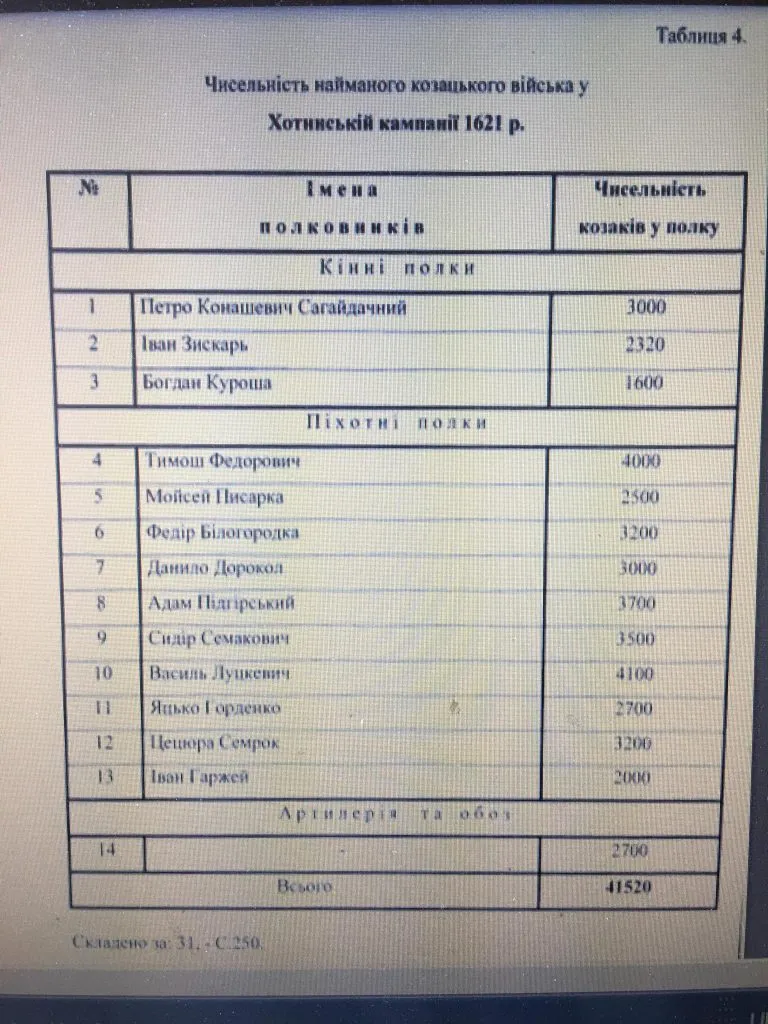
Photo: The size of the mercenary Cossack army