

Ukraine Incognita researchers refute the most common myth about the castle in Sataniv
Regarding the castle in Sataniv, the canonical, textbook and until now established view was that in 1924 the local authorities wanted to demolish it completely. The author of these lines has also voiced it more than once. It stems from the publication “Defensive Castles of Western Podillia of the 14th–17th Centuries” (Kyiv, 1928) by Yukhym Sitsinskyi, who rightfully bears the honorary title of “Father of Podillian local history studies”. In particular, Sitsinskyi reports that in 1924 the local authorities decided to demolish the Sataniv fortress because it allegedly threatened human life, but the All-Ukrainian Central Executive Committee (the government of the puppet Ukrainian SSR, then based in Kharkiv; note by Ukraine Incognita) annulled that decision and ordered the fortress to be restored, allocating 5,000 karbovanets for the purpose. Sitsinskyi then complains that the money was allocated but the work never began.
As we have managed to establish, this textbook view is wrong. For some reason it has been mistakenly assumed from the start that by “fortress” Sitsinskyi meant the castle. But this ignores the fact that the whole of old Sataniv was a fortress town.
Moreover, tying the information given by the “Father of Podillian local history studies” to the castle raises several odd points. The most important: what danger did the castle ruins of 1924 pose to local residents? And second: where did the 5,000 karbovanets go? The latter has yet another illogical aspect. As of 1924, 5,000 Soviet karbovanets was a considerable sum. A monetary reform had taken place before that, and the Soviet karbovanets of the time corresponded to the same karbovanets of the Russian Empire as of 1913 (that is, before it was devalued by wartime inflation). But even under these conditions the sum would not have covered even a tenth of the funds needed to restore the castle!
In fact, as the author found out, Yukhym Sitsinskyi was writing not about the castle but about the gate!
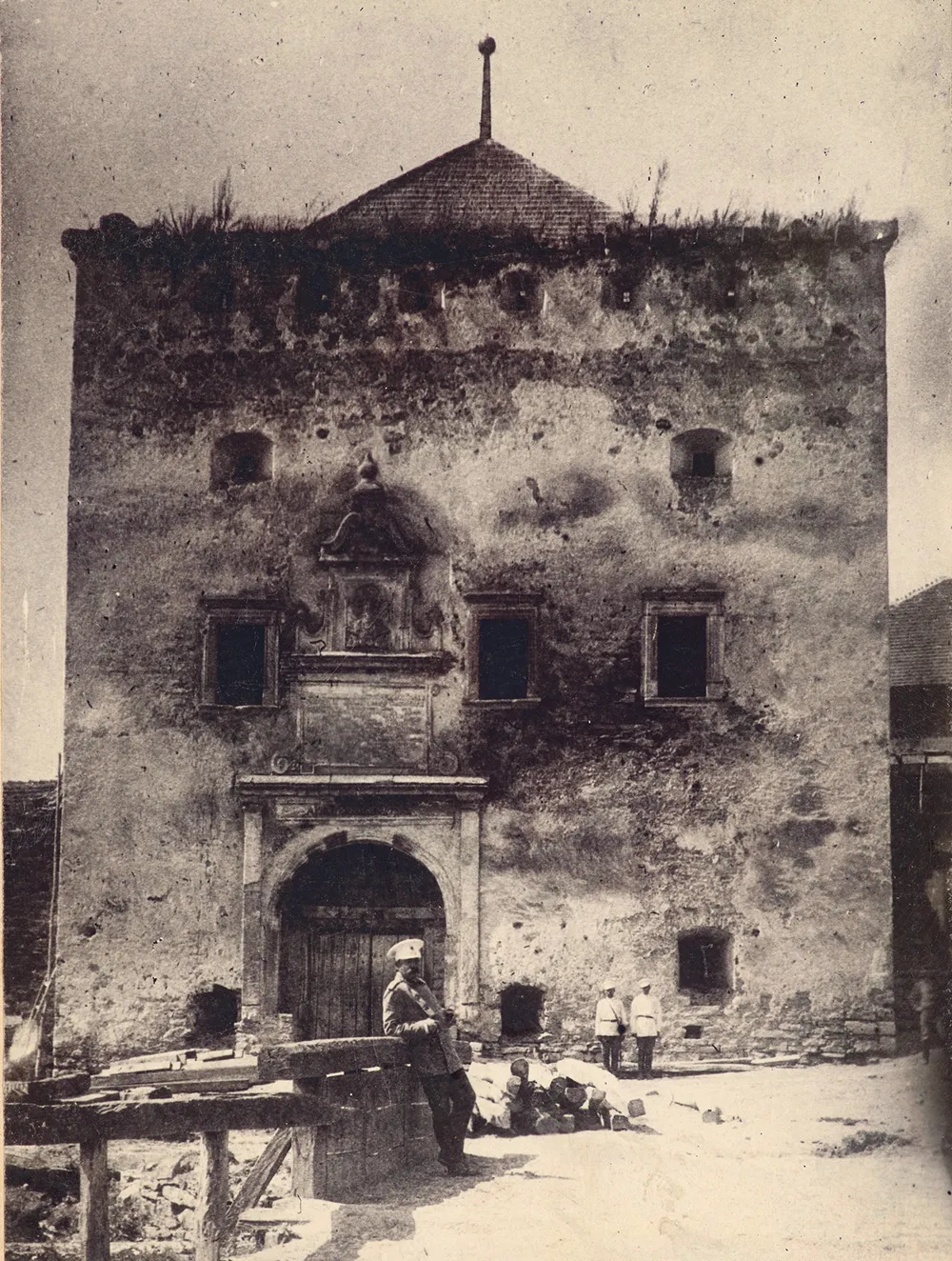
Russian border guards at the gate. Late 19th century. Photo by Mykhailo Greim
The Russian border guards, who had settled in the gate from the early 19th century, did not much care about looking after the monument. When by the turn of the 19th and 20th centuries its condition had become dangerous, a new two-storey customs house was built in front of the gate, which the customs officers shared with the border guard. Around that time the roof of the gate collapsed, followed by the floors of the 4th and 3rd tiers. Exactly which year this happened is unknown. But in photographs of the late 19th century the roof is still there, and in 1910 it is already gone.
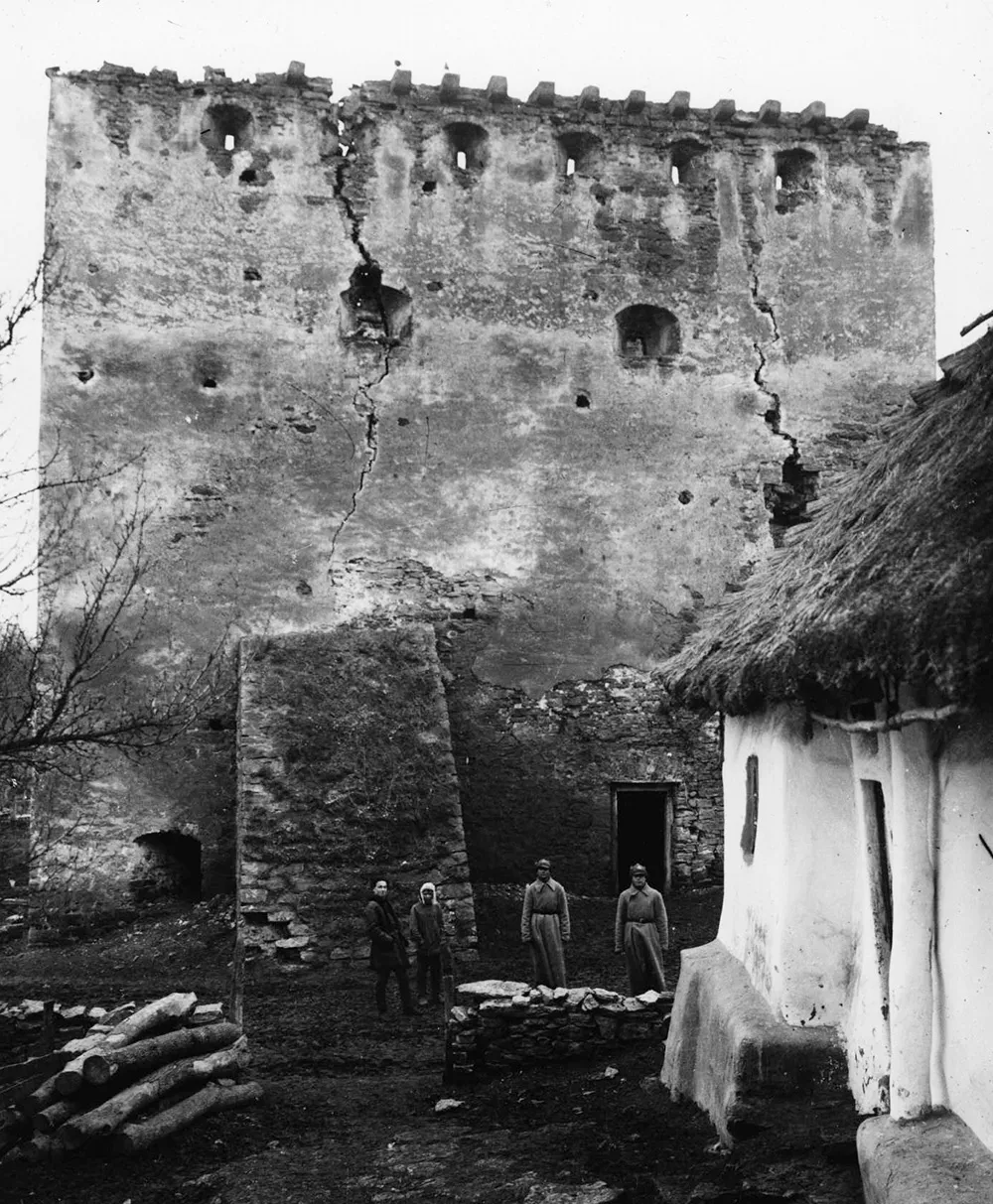
Soviet border guards. Early 1920s. Note the cracks. The road ran between the homestead and the gate.
By the early 1920s the gate was in a dangerous condition and truly posed more than a serious threat to local residents. In particular, the photograph of the time clearly shows huge cracks running across the north-eastern wall of the gate. Considering that a very busy road connecting Sataniv with Kamianets-Podilskyi and dozens of surrounding villages passed right up against this wall, the situation was, without exaggeration, truly catastrophic.
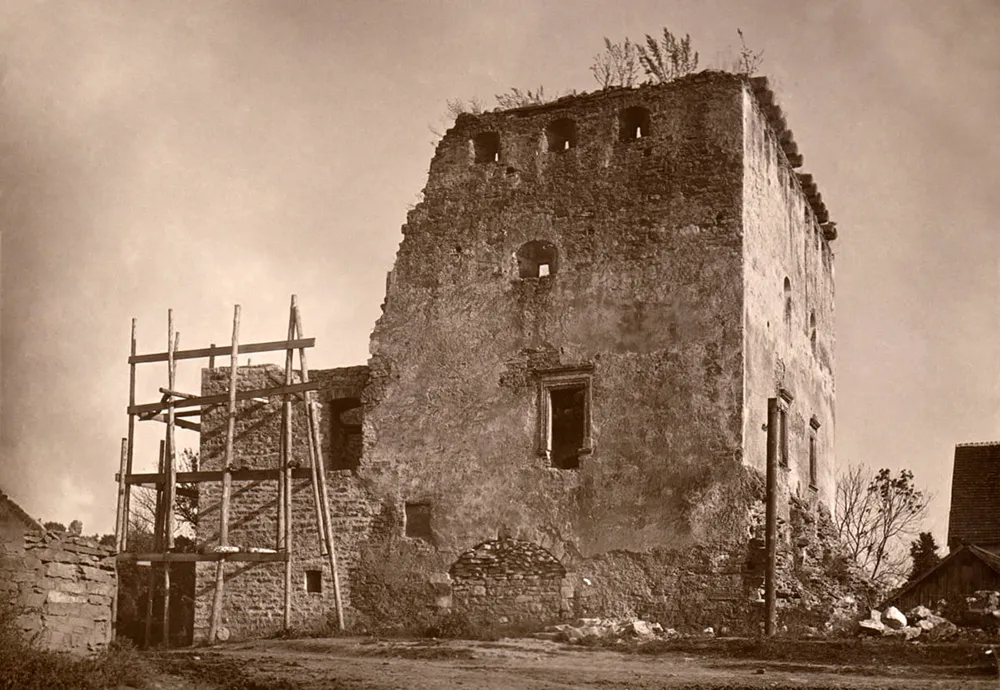
And here is the restoration mentioned by Sitsinskyi…
Sometime in the late 1920s the unsafe wall was pulled down and, as the government order required, restoration of the gate began. We even have a photograph from 1930 taken by Stefan Taranushenko’s expedition that records this process. Unfortunately, the restoration was not completed then, with only half of what was planned carried out. The reason, probably, is that the bureaucratic red tape dragged on for many years (Sitsinskyi himself, by the way, complains of this). By the end of the 1920s, when the restoration was finally begun, inflation had successfully “gnawed away” a considerable part of the allocated funds, and there was simply not enough money to finish the work.
Dmytro Poliukhovych


