

Horodok gave Ukraine an artefact found in no museum
The word “unique” is often applied to archaeological finds, needed or not. But in this case the adjective is entirely apt and true to fact. No other tobacco pipe of this type is known in Ukraine! Even in the whole of Europe we know of only one pipe similar in type. It dates from the 17th century and was found in Spain. The Horodok pipe most likely belongs to the second half of the 18th century. What kind of pipe it is, and what makes it one of a kind, read on after the preamble.
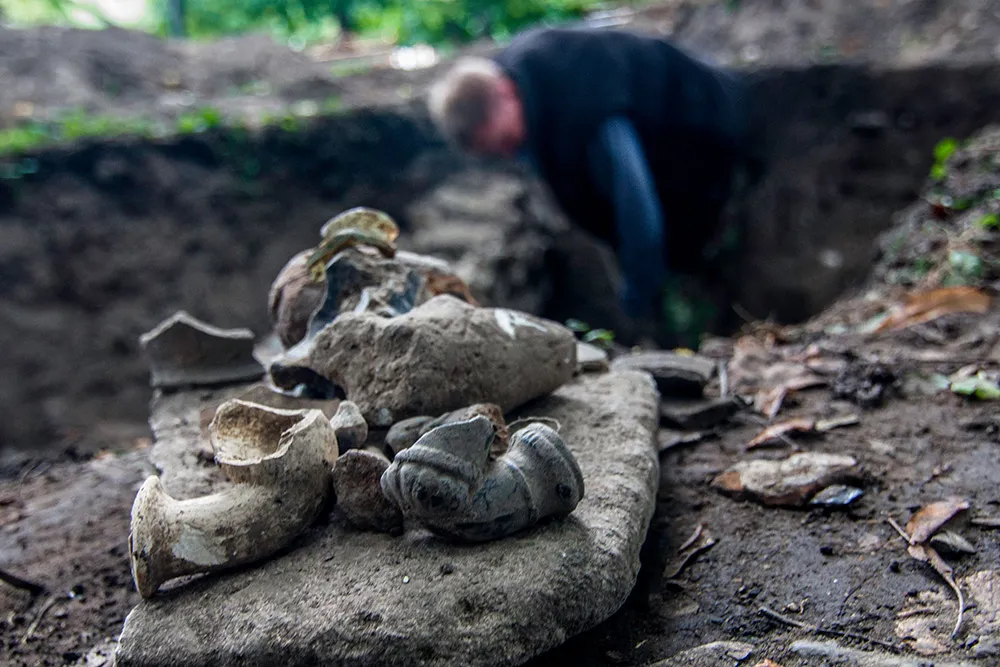
Excavations in the square. 2017
The author of these lines has known since the 1980s that the south-western corner of the square in Horodok (Khmelnytskyi Oblast), recently named after the famous Russian-French microbiologist of Little Russian origin as “Serhii Vinohradskyi Square”, is a veritable “pipe Klondike”. Around 1985 a bread pavilion was being built on this spot (today it is the “Alcohol-Tobacco” shop). A strip foundation was laid for the building, about half a metre deep and as wide. From the spoil heap the author then pulled out about a hundred ceramic tobacco pipes, some 20–25 different types. However, not a single one among them was whole. In fact there was several times more of this stuff there, but fragments preserved at less than half were paid no attention. Later, some fifteen of the most interesting, most beautiful and best-preserved ones were given to Ivan Makarovych Honchar, whom the author knew well at the time and visited at home many times. I hope the pipes in question are now somewhere in the storerooms of the Ivan Honchar Museum in Kyiv.
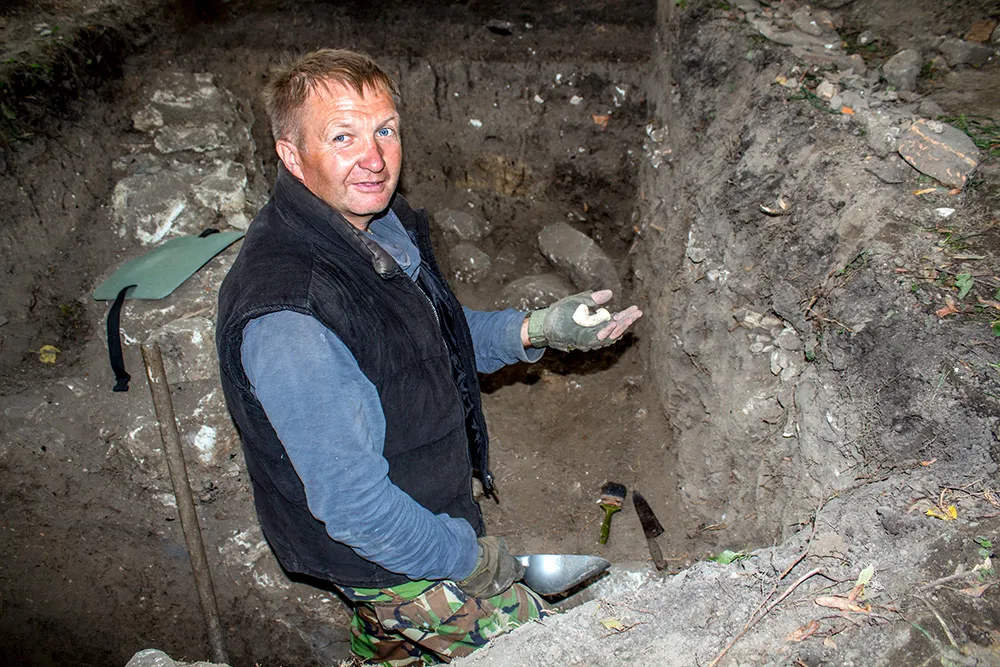
Archaeologist Petro Boltaniuk has found another pipe
Important: all the pipes found then, except two or three, were unused and were waste (rejects) from a pipe workshop.
One more circumstance is important to know here. In the 17th–18th centuries there was a market square in the middle of the square. Around its perimeter stood shops, workshops, and the dwellings of merchants and craftsmen.
When in 2017 an expedition led by Pavlo Nechytailo, Candidate of Historical Sciences, carried out archaeological excavations in Horodok, the author of this post advised digging a test pit under the walls of the former pavilion as well.
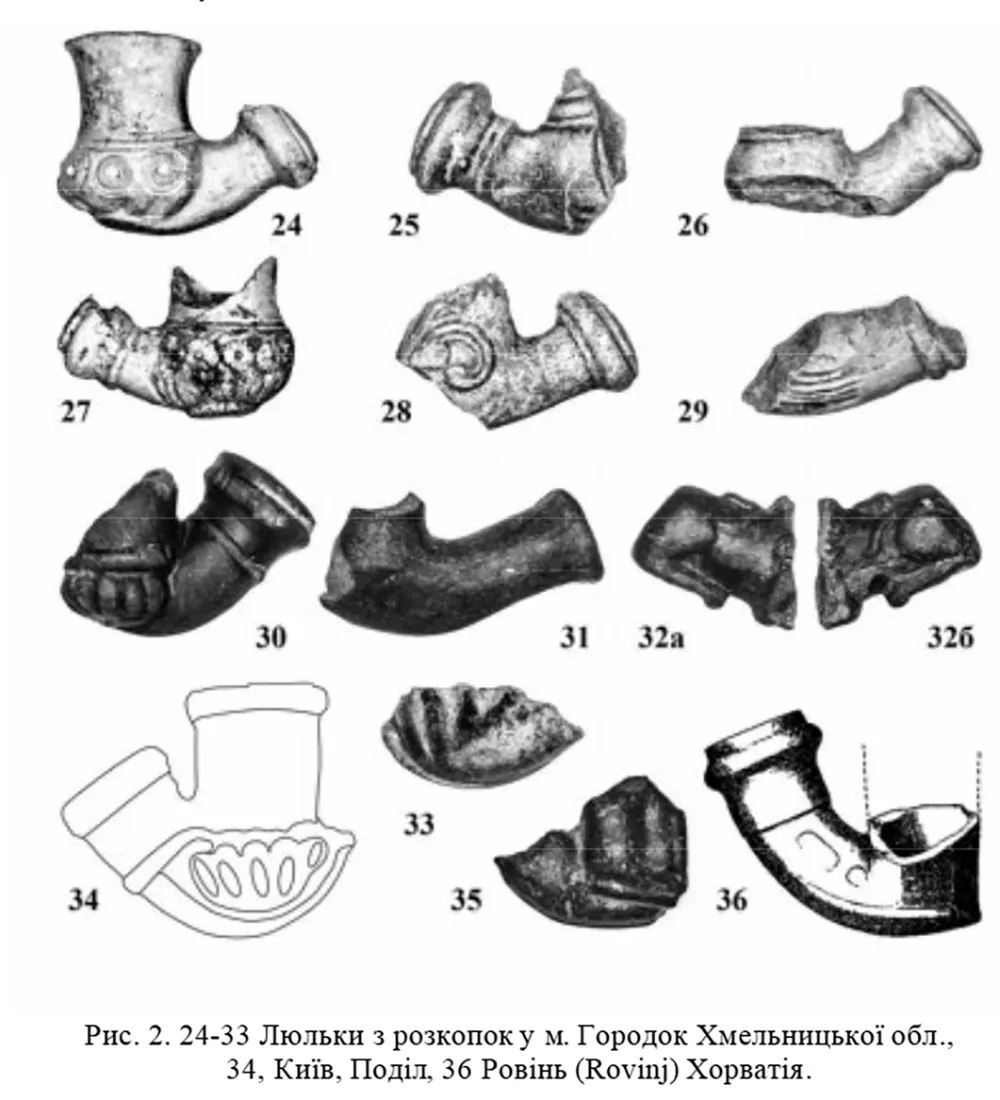
One of the illustrations to the publication “New finds of ceramic tobacco pipes from the excavations in the town of Horodok, Khmelnytskyi Oblast, in 2017”.
Pavlo Nechytailo, Andrii Chekanovskyi
Quite a few pipes were found there. And also stove tiles decorated with eagles, fragments of forest glass, coins, glass ornaments and so on.
During the excavations 43 fragments of ceramic tobacco pipes were found, mostly production rejects. Interesting, of course, but these artefacts were not especially unique. Yet one fragment turned out to be truly unique! Whether it is again a defective product or simply a pipe that was broken and thrown away is impossible to say.
As it turned out, the stem of the pipe was made in the form of a recumbent lion. Four paws, a tail with a tuft and even fragments of a mane survive. Unfortunately, the head, which served as the bowl for the tobacco, is lost.
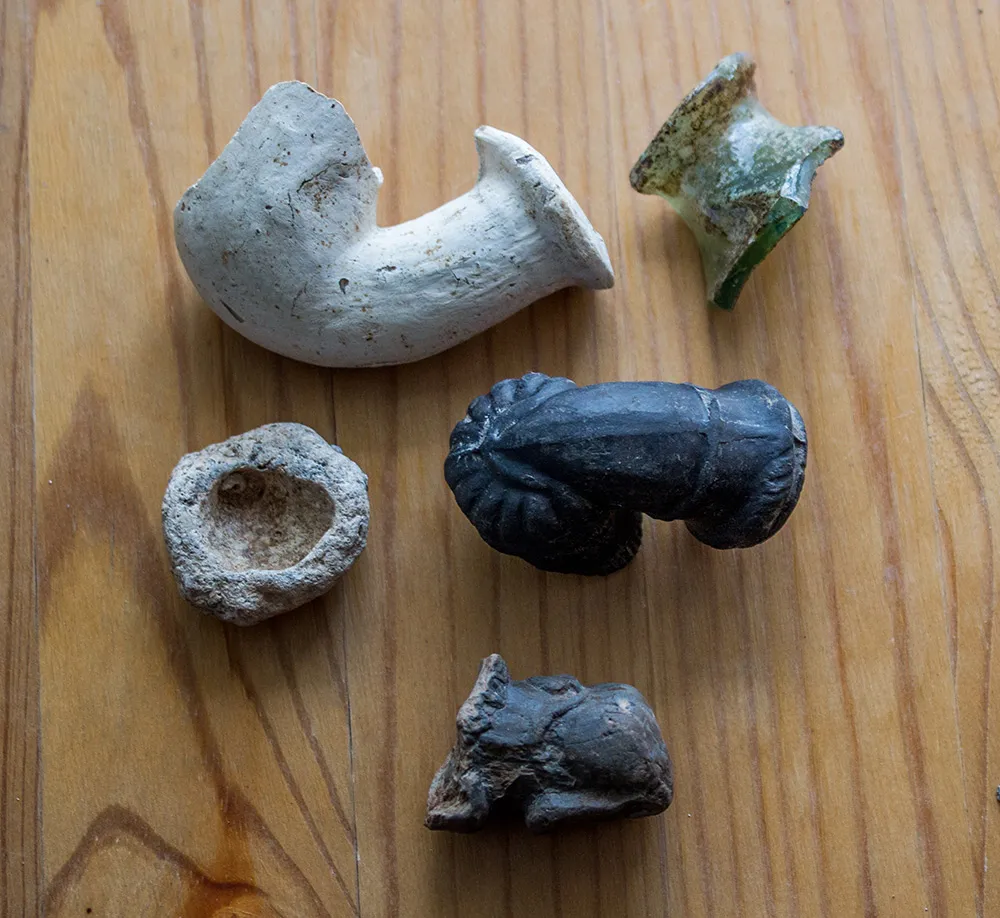
The lion pipe. Bottom
From the start it was clear that the find was far from trivial. But during the later processing of the finds it turned out that this pipe is simply UNIQUE! As Andrii Chekanovskyi of the Institute of Archaeology, who is arguably the best specialist on pipes, established, this type of zoomorphic pipe is entirely unknown in Ukraine!
Let us stress the word “unknown”: it is possible that analogues exist in private collections, but none are in scholarly circulation. It later emerged that such pipes are unknown in the rest of Europe too. An analogue was found only in Spain!
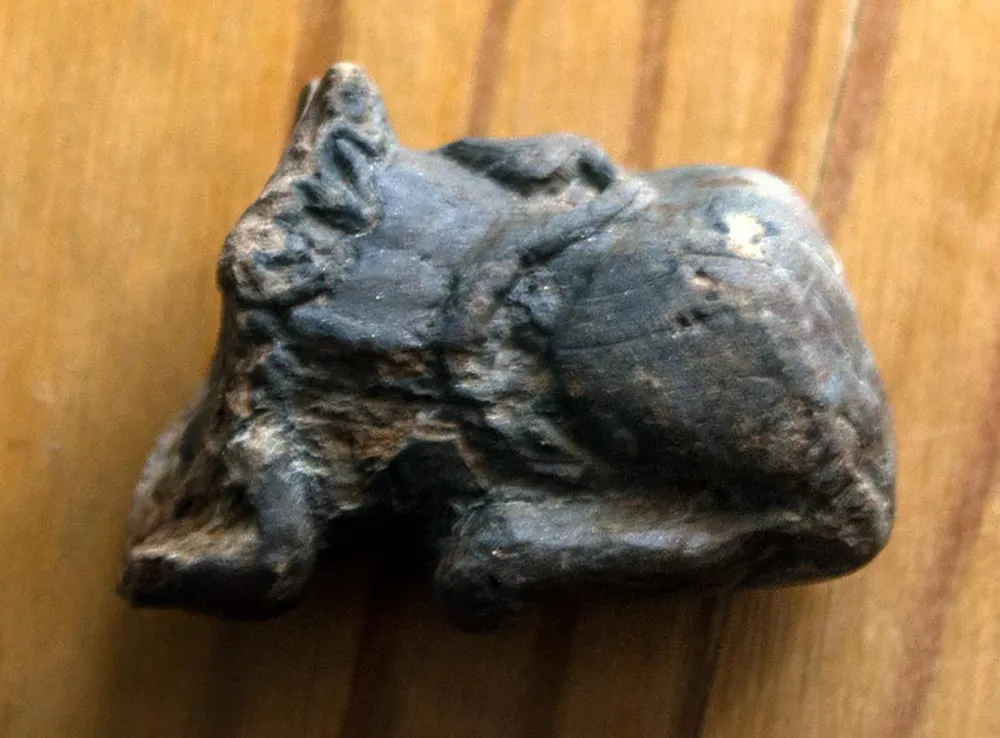
The uniqueness of this pipe was specifically emphasised in the scientific report that Pavlo Nechytailo prepared following the archaeological excavations, and the artefact itself, together with the others, was handed over to the Horodok Local History Museum. The finds from the 2017 excavations formed the basis of the exhibition devoted to the 17th–18th centuries in the history of Horodok. However, the unique pipe, which has no analogues in any Ukrainian or European museum, did not make it into the exhibition. For some reason…
The situation is astonishing! Such UNIQUE artefacts, which no one else has anything close to, usually become the symbols of the museums lucky enough to have them. Today the Horodok Local History Museum has only one comparable artefact: the famous Trypillian “serpent”.
I hope that after this publication by an “amateur”, the professional specialists of the Horodok Local History Museum will pay attention to the treasure hiding somewhere in the storerooms (if it has not been thrown away by now, of course).
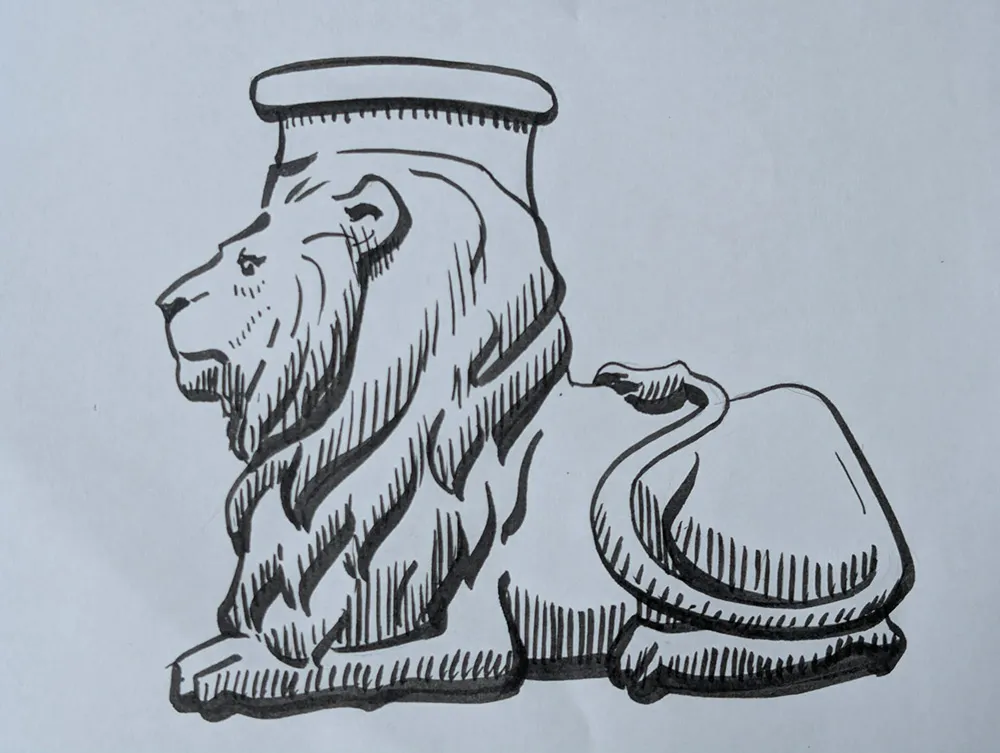
Specially for them, at the author’s request, the Ternopil artist Liubov Povoroznyk made a hypothetical reconstruction of the unique pipe. It is unlikely that the lion’s muzzle was executed at an academic level, as in the reconstruction. More likely it was a lion in the style of folk primitivism, like those on the 18th-century Jewish gravestones in Horodok and Satanov. But overall the probable appearance of the unique pipe has been recreated almost exactly. The fragment itself will, of course, not look very impressive on display, but together with the graphic reconstruction it will make quite a show.
A new find from the square
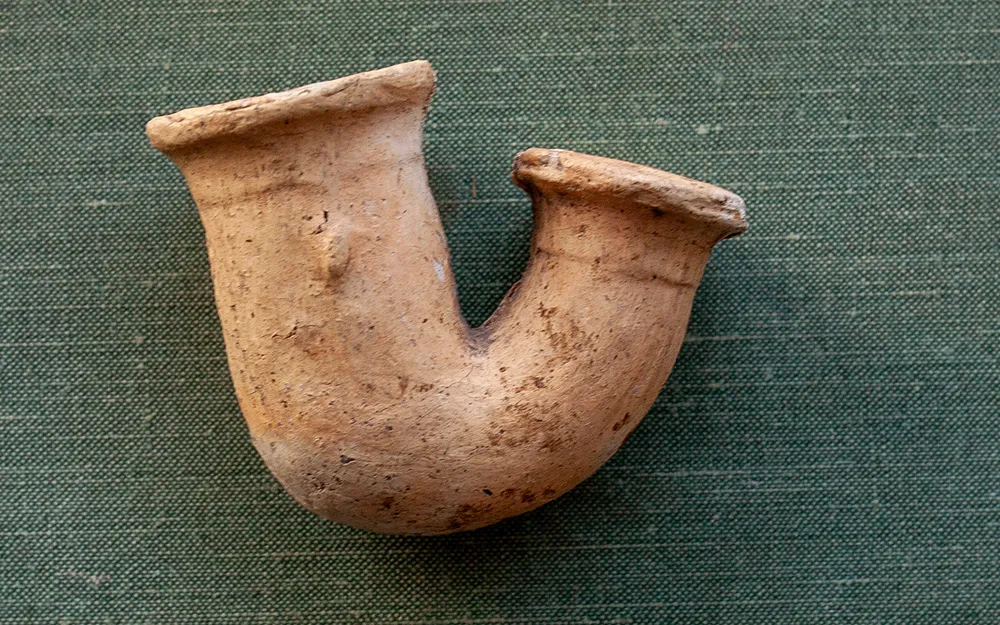
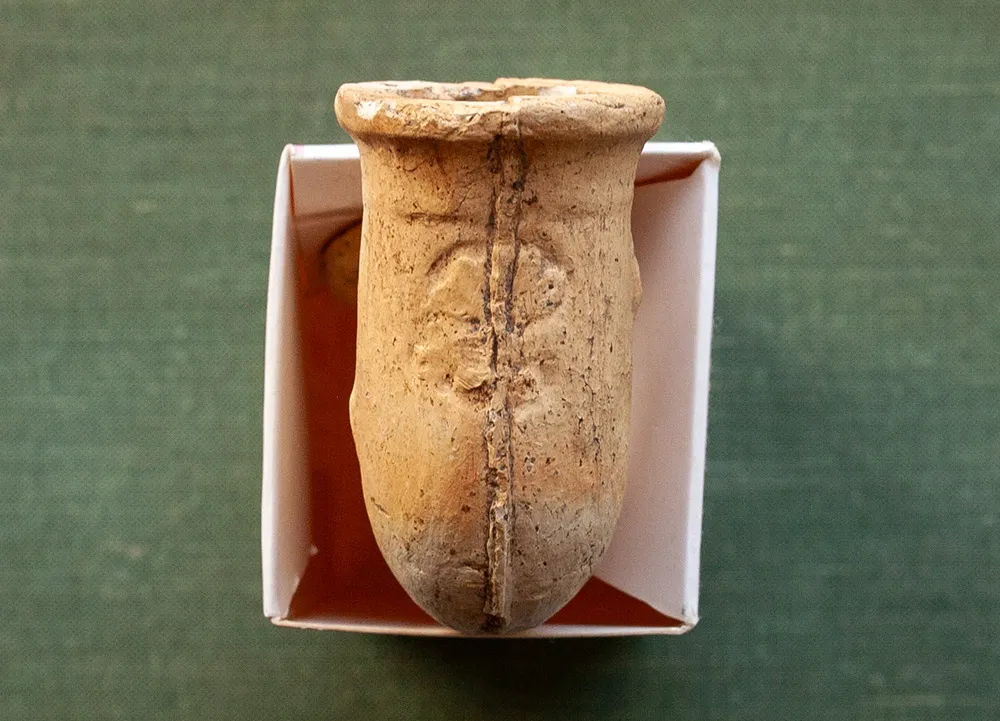
The author was inspired to return to the story of the pipes from the square by a small but very pleasant find. For several weeks a small trench, a spade’s depth, was being dug in the square. A pipe was found in the spoil from it. Interestingly, it was brand new and unfired. Why it was once thrown out as a reject is a mystery. Perhaps because the little flower in the centre came out poorly… But it is a pleasant find all the same. I hope the time will come when it can be donated to the museum.
Text and photos: Dmytro Poliukhovych


