

Khoroshe: the hillfort, Huliai-Hora and the monastery

· 8 min read
Not far from Kharkiv lies the settlement of Khoroshe, whose history is interesting but has never been fully studied, since it holds many secrets and riddles, especially connected with the ancient hillfort and with the Ascension Convent.
We already have an article about the Donetsk hillfort. The Khoroshe one is mentioned together with it in the lists of watch posts for 1571, established by order of Ivan the Terrible to defend the southern frontiers. We read: “And down the river Uda through Pavlovo selishche to the Donetsk hillfort, and to the Khoroshev hillfort through the Khoroshev well.” And most likely these two hillforts were the largest of their time.
In the time when the region was settled by Cherkasian migrants, namely in 1653, the sloboda of Khoroshevo was founded near the hillfort. An old document has been found in which it is written: “the Cherkasian Tymoshka Mykhailov said: they now stand and wish to settle on the river Uda, ten versts or more from Chuhuiv”. Filaret Humilevskyi wrote about this too.
The hillfort itself arose long before this. It dates back to Scythian times (4th-3rd centuries BC); later, on the basis of the Scythian fortifications, a settlement of the Siverians appeared here, and subsequently a settlement of Kyivan Rus’.
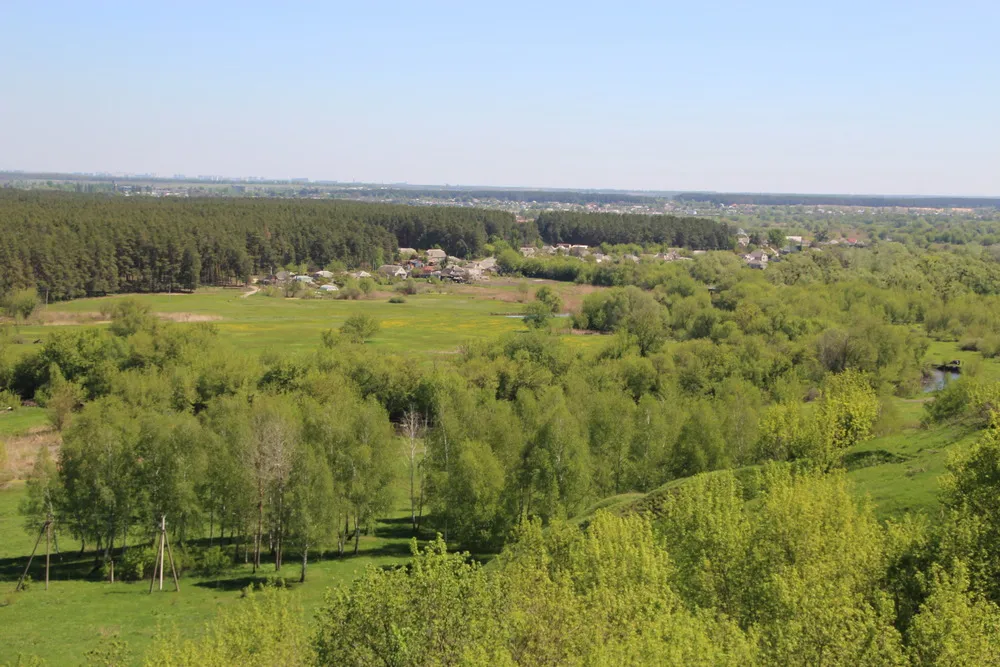
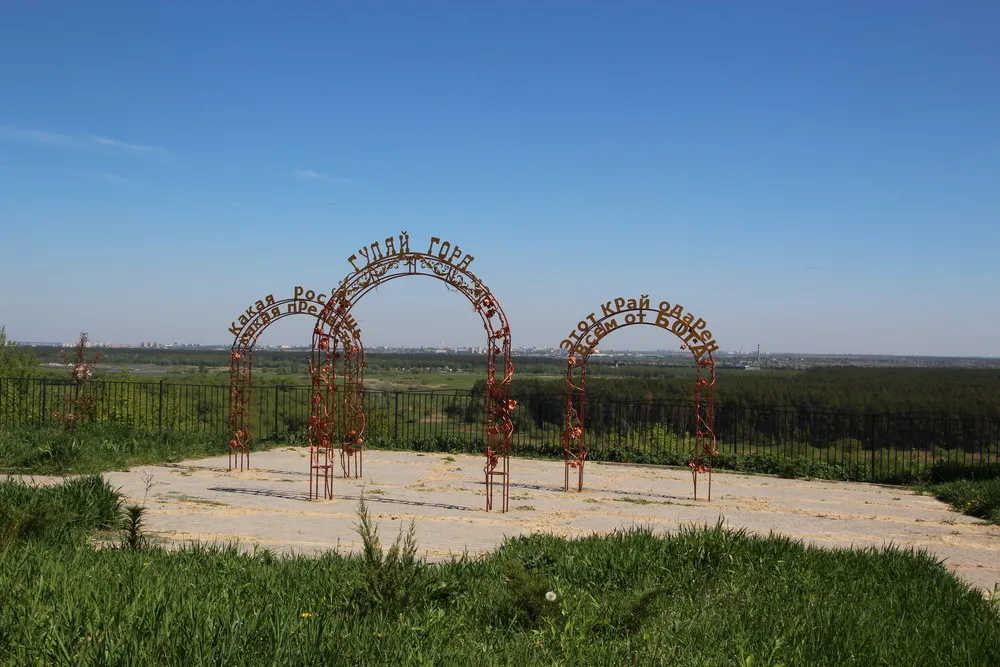
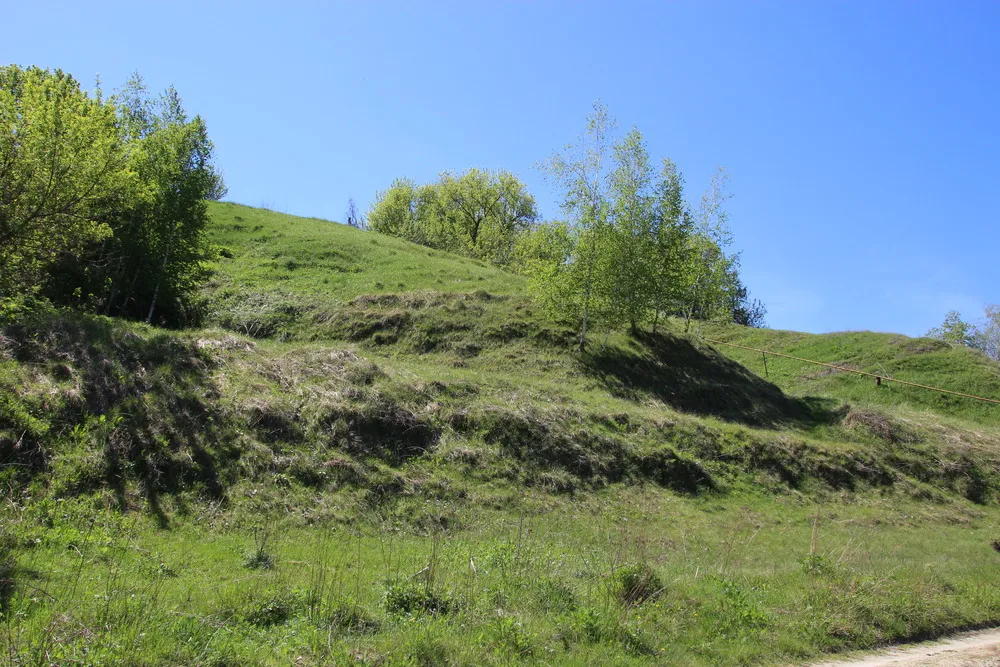
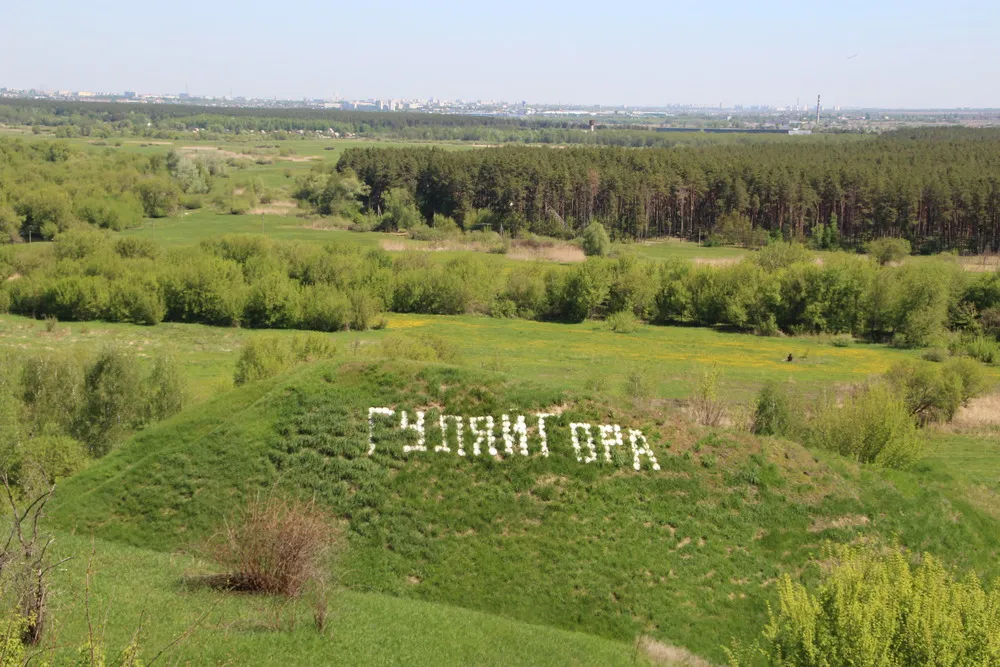
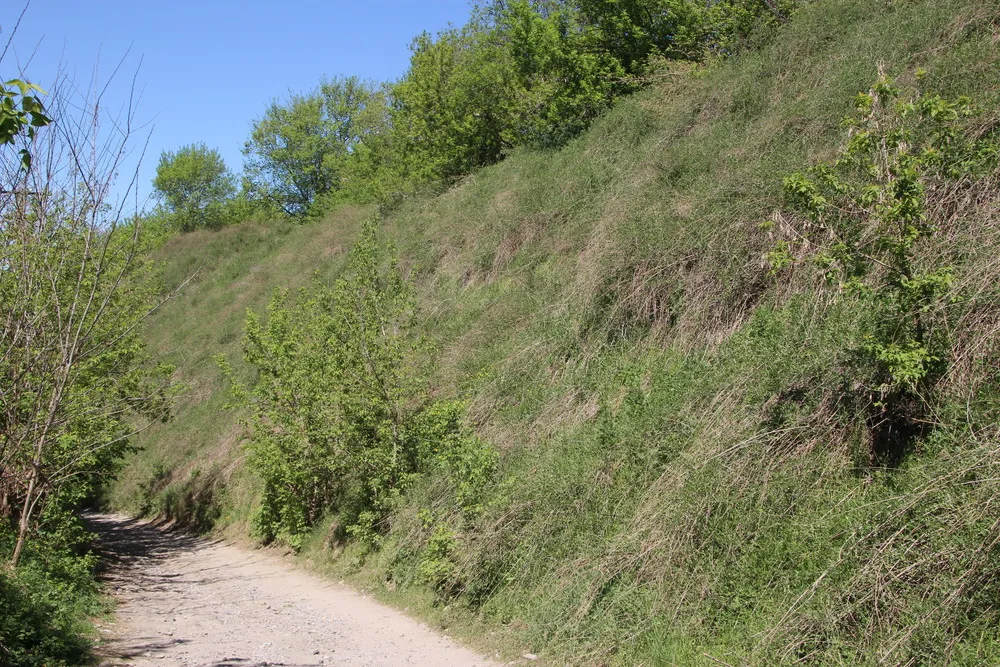
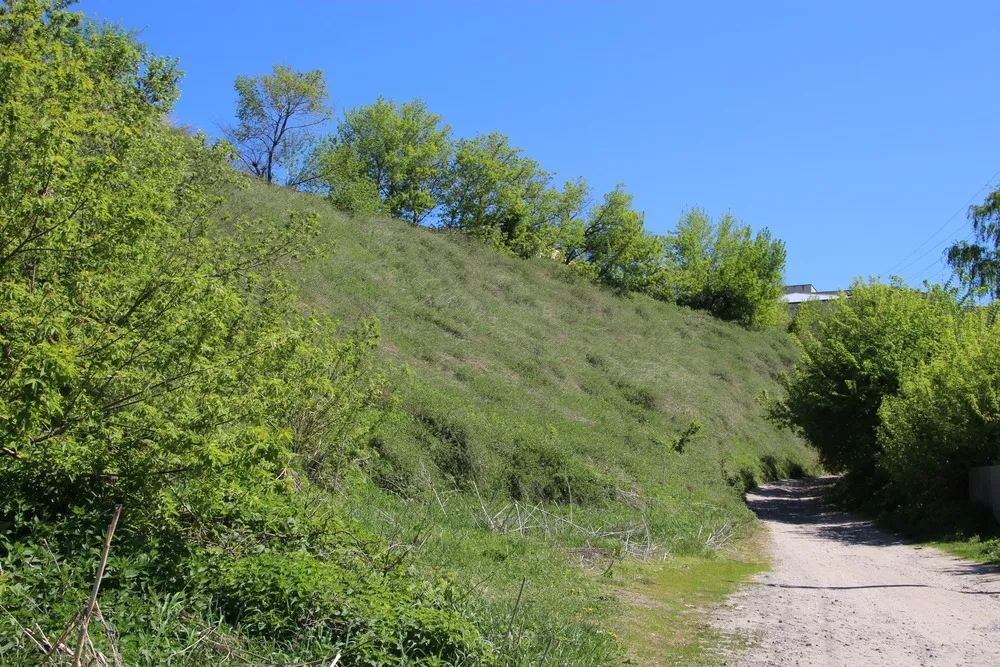
And no wonder: it would be hard to find a better place. Nature has done its work excellently here. The area itself is quite isolated and protected on all sides. To the north, west and south everything was overgrown with dense forests – the forests to the south are still called the Black Forest – and to the east lies the marshy valley of the Uda, with the river bank rising above it by about 50 metres and forming an outlier promontory, the steepness of the bank sometimes reaching 60 degrees. And two deep ravines nearby serve as additional protection. All that remained was to reinforce with moats and ramparts what the landscape had already done. This promontory is the centre of the hillfort, its dominant feature; the detinets was here, extraordinary views open from it, even the outskirts of Kharkiv can be seen, and it also has a very beautiful name – Huliai-Hora.
Incidentally, the settlement that belonged to the Scythians was quite large: the length of its walls, calculated by scholars, was up to 5 km; the Slavic one occupied only part of it, with the detinets covering 0.5 ha. After several centuries of desolation caused by the Mongol invasion, this area came to life again. The Cossack sloboda of Khoroshevo, settled by Cherkasian Cossacks, is mentioned from 1654. In time Khoroshevo became a company town of the Kharkiv Sloboda Regiment. Let me make a small lyrical digression. In the 1742 census of the Khoroshevo company, among others one can see this entry: “Regimental yesaul Herasym Romanov son Butskyi, 80 years old, his son Herasym 3 years old.” Well, what can one say – he was a mighty Cossack!
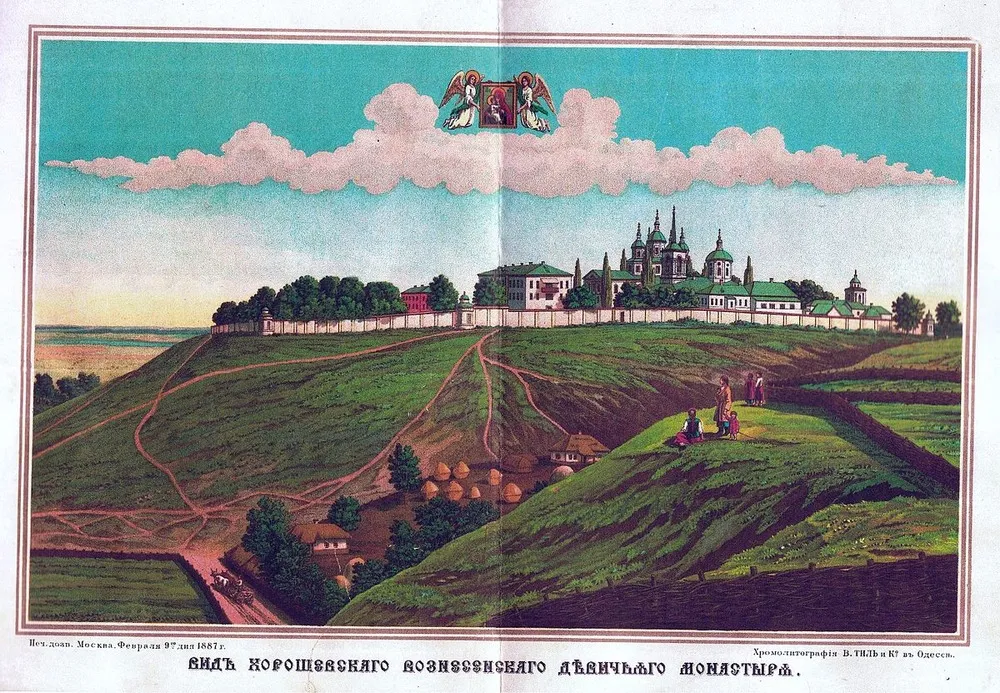
Already in the years when the Cossack settlement arose, namely in 1656-1660 (according to other sources, 1664), nuns who had come from the Right Bank chose the place on Huliai-Hora for building the Ascension Convent. Researchers give different dates; I will not describe the arguments historians put forward here, I have got tangled up in them myself. I rely on the opinion of Filaret Humilevskyi that the monastery was founded no earlier than 1656 and no later than 1660, by charter of Metropolitan Pitirim, and that the first abbess was Oleksandra, through whose efforts the convent arose.
From the very beginning the monastery grounds had the Church of the Archangel Michael; by the end of the century the Church of the Ascension was built too. In 1744 a great fire almost destroyed the convent; many monastery buildings burned down, including both churches. The first decade after the fire was the hardest for the convent; those years coincided with crop failure, and the nuns had a very difficult time.
Both churches were rebuilt, though not at once, and both now in stone. The Ascension church in 1754-1759, through the efforts of Abbess Mariia Kvitka (Kvitkina)-Hamaliieva, daughter of the Kharkiv colonel Hryhorii Semenovych Kvitka. Funds for the construction were provided by the nun Yefrosyniia, widow of the Vovchansk company commander Nesterov. Do not be surprised: the monastery was, as we would say now, “elite”; the nuns were mostly of noble origin, with considerable fortunes which they bequeathed to the church. Funds had been collected earlier too, since 1749, first by Abbess Afanasiia Kovalevska, sister of the company commander Hryhorii Kovalevskyi, then by Abbess Feofaniia Kvitka, a relative of Iosaf Mitkevych, Bishop of Belgorod, who made the request to rebuild the church. In a charter of 1754 Iosaf of Belgorod wrote: “we bless and permit the said church to be founded anew as a stone building”. Under Feofaniia they managed to build the church foundation and the cells. Running ahead, I will note that the relics of Abbess Mariia Kvitka were hidden by the nuns in the church crypt in 1920, when the monasteries were being closed, and they stayed there until 1978, when the monastery began to be finally destroyed.
In 1835-1837, under Abbess Anatoliia Veriovkina, also of noble birth, the church was substantially enlarged and three more domes were added to the existing two. Under her a hospital and a brick wall with towers were also built.
The second church, the refectory Church of St. Michael, was rebuilt much later, in 1785, under Abbess Tavifa Rozalon-Soshalska. A year later it was consecrated. The shrine acquired its final appearance at the beginning of the 19th century, after a bell tower was added at the expense of the first-guild merchant Dmytro Kovaliov.
For completeness I will add that in Khoroshe itself there was also a church, the Resurrection church, built in 1776 at the parishioners’ expense. It no longer exists; a new one, of the Kazan Icon of the Mother of God, was built in our times, in 2004-2009.
In general the greatest development of the monastery, its heyday, falls in the 19th century. Many nobles and merchants donated to the convent, some considerable sums, some land, some mills. The abbess’s building was built to a design by the architect Thon, a hotel was built, and from 1871 to 1899 a children’s religious orphanage operated. By the end of the century the monastery had up to 500 nuns and novices, and, as written above, the majority of them came from well-known noble families. Before 1917 the convent counted 722 residents, joined by 150 sisters of the Horodyshche women’s monastery from Volyn, who found refuge here during the First World War.
In the early 1920s (1920, 1921 and 1922 are all given) the Bolsheviks closed the monastery, and the nuns were forced to leave. In the cells they first created a sewing colony for “fallen women”, then a sanatorium for disabled veterans of the Civil War. Neither institution lasted long, but the geriatric boarding home opened on the monastery grounds and in its outbuildings in 1924 exists to this day.
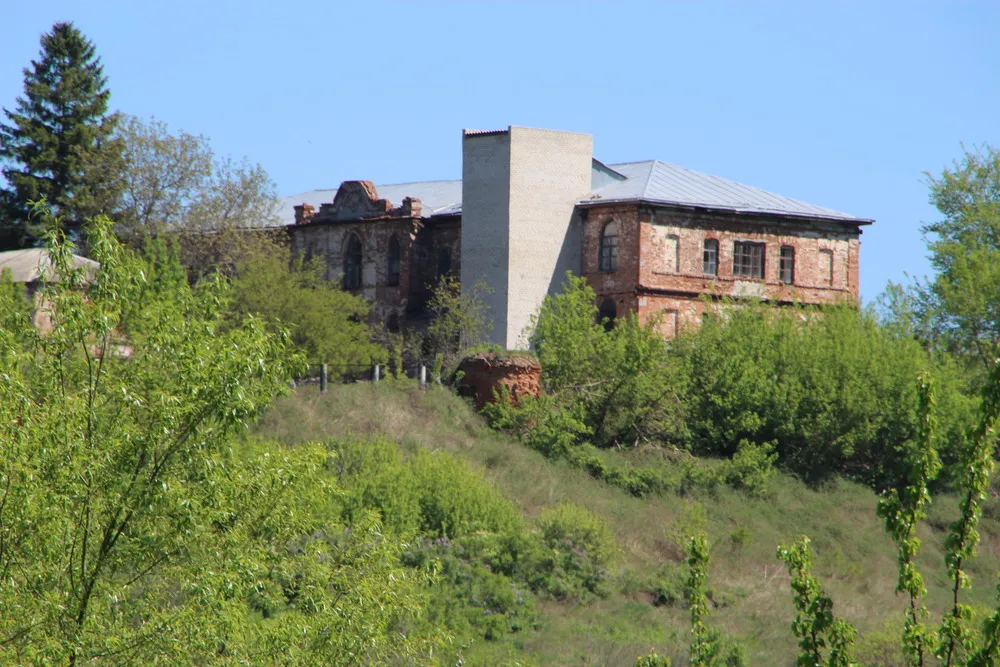
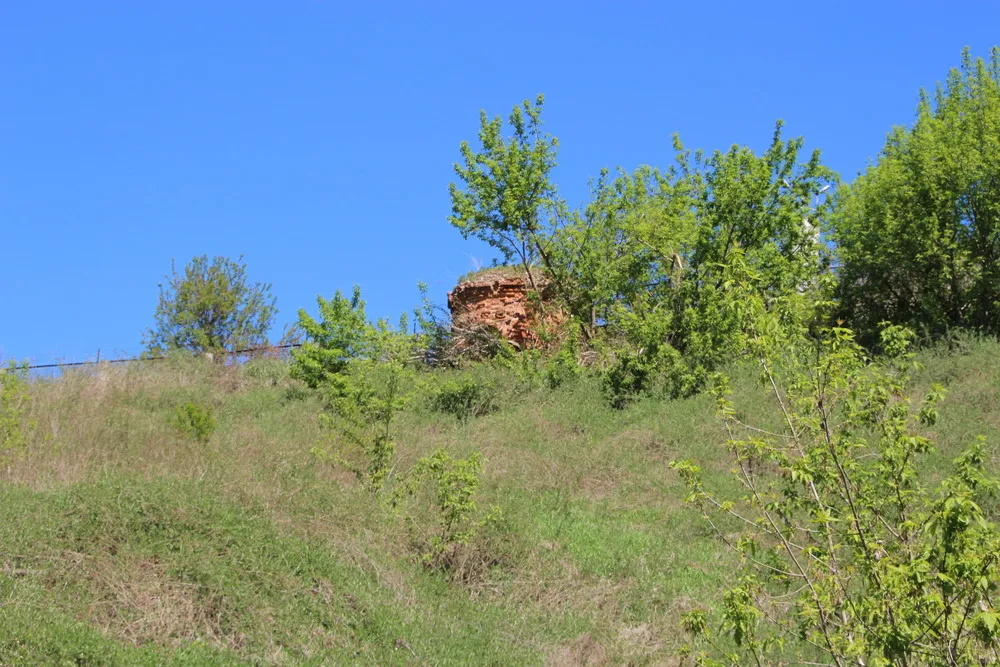
The ruins of the Ascension church, which had suffered during the war, were blown up in 1978; two years later a five-storey boarding-home building was erected near the former north gates, destroying part of the monastery cemetery and of the Khoroshe hillfort, and by 1986 the monastery was practically wholly destroyed. Only part of the wall, a few small towers, a well and the abbess’s building were lucky. Such is the fate of what was once one of the larger monasteries of the Left Bank.
And finally, a few legends and mysticism.
Once, in an article about Bronka in Transcarpathia, I wrote about the many legends connected with the Bronka castle. I admit that Khoroshe can compete with it in their number; at least I have not met so many legends about one place anywhere on the Left Bank.
Back in old times there was a legend of treasure (and can there be a place without one?): that some ancient owner of this place buried a hat and mittens somewhere, and whoever finds them will have six underground chambers opened to them: in the first gold is hidden, in the second silver, in the third tableware, in the fourth weapons, in the fifth gunpowder, in the sixth a Cossack field church. There are also variants of this legend. In one the treasure was hidden by Cossacks, in another by Tatars, in a third by robbers. And a horse with a golden harness and golden horseshoes was supposedly hidden somewhere in the underground too. And the underground passages are not small either, wide enough for four horsemen, and lead all the way to Poltava.
But the most famous Khoroshe legend is about the church. They say that not far from the cemetery on Huliai-Hora a church stood since ancient times. And one day, during a service, it somehow went underground together with all the people. Since then, if you put your ear to the hill in the right place, you can hear voices, prayer songs and the echo of bells. However fantastic this story is, there is still some grain of truth in it. In the mid-1980s, during excavations of the Khoroshe hillfort led by Professor B. A. Shramko of Kharkiv University, a deep pit, a chasm, was found, at the bottom of which wooden fragments were discovered that could have been part of some building. Why not a church?
It is also said that one day the earth on the slope of the hill slid away and exposed an iron door with a huge lock. What is this if not the entrance to an underground chamber? The door, to be safe, was concealed again by planting trees on the spot.
So there are more than enough riddles. Perhaps answers to them could be found in large-scale excavations, but, it is thought, carrying them out here is no longer expedient: the cultural layer was mixed up during later construction, and black archaeologists have done their work too.
Text by Ihor Dorozhko, photos by Maksym Nazarenko.


