

Sataniv cemetery, a “voodoo” doll and greetings from China (applied magic studies)

· 11 min read
From the point of view of adepts of magic, cemeteries and burial places, as territories where the worlds of the living and the dead meet, have always occupied a prominent place.
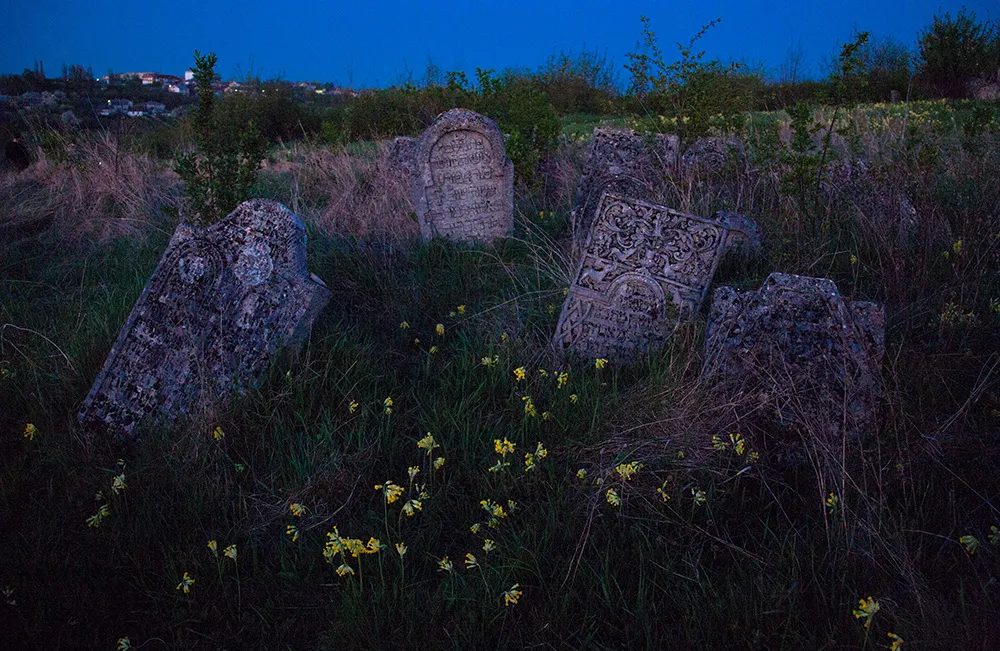
Sataniv cemetery
The former little town of Sataniv in Khmelnytskyi Oblast is famous for its old Jewish necropolis, one of the most artistically and historically valuable in Europe. The oldest burials here date from as early as the second half of the 16th century! The most interesting are the gravestones of the 18th and early 19th centuries. Almost every such monument is an exhibit for an art museum. It is no accident that this cemetery is also called the “Jewish Lychakiv”.
The author often visits it with tourists, and not only from Ukraine but also from Poland, the USA, Britain, Israel and elsewhere… Besides numerous tourists, Jewish pilgrims constantly come to the cemetery – many famous rabbis and sages are buried here who, as the Hasidim believe, strengthen their prayers. One of the most revered graves is the burial of the famous 18th-century rabbi Yosef ben Avraham Bloch, author of the book “Ginze Yosef”, a collection of sermons in the form of instructive parables with elements of mysticism. The book was published in Lviv in 1792, after its author’s death.
As it turned out, at the grave of Yosef ben Avraham Bloch not only pilgrims pray, but also… local women cast spells!
This happened some four years ago…
A love spell with thousand-year-old roots
The magic ritual itself, of course, did not become public knowledge – who does such a thing in front of witnesses? But it left behind rather eloquent traces in the form of a motanka doll twisted from grass and tied to the fence of the grave.
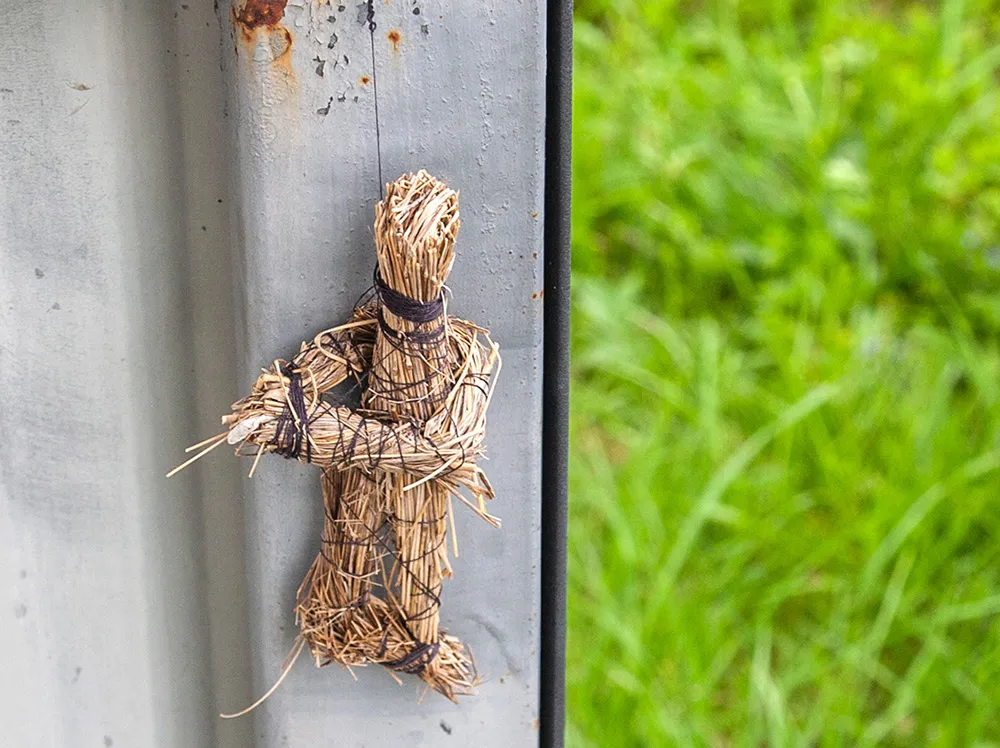
Sataniv. The “voodoo” doll
The author made similar grass motankas in the lower grades at handicraft lessons. However, the cemetery figure was made carelessly. The main thing was that it resembled a little man. There was another important circumstance. Whereas children’s grass dolls have arms and legs sticking out merrily in different directions, this one had them tied like a prisoner’s…
The phenomenon was so intriguing that a photo of the magical object was immediately sent to a whole range of cultural studies scholars, historians and folklorists. In the end some rather interesting circumstances surfaced.
As it turned out, the cemetery doll is most likely evidence of a love-magic ritual, a “love spell”, and the roots of this ritual are measured in millennia!
The latter should not be surprising – “folk magic” is quite conservative.
In particular, in the Louvre one can see an almost identical magical object of the 3rd–4th century AD, originating from Egypt. The vessel with the “magic set” was found by archaeologists in the burial of an unknown young man. As historians believe, it was secretly slipped in by someone from outside and did not belong to the things that were traditionally placed in graves at that time. The Egyptian set consisted of a clay figurine of a woman with bronze needles stuck into her.
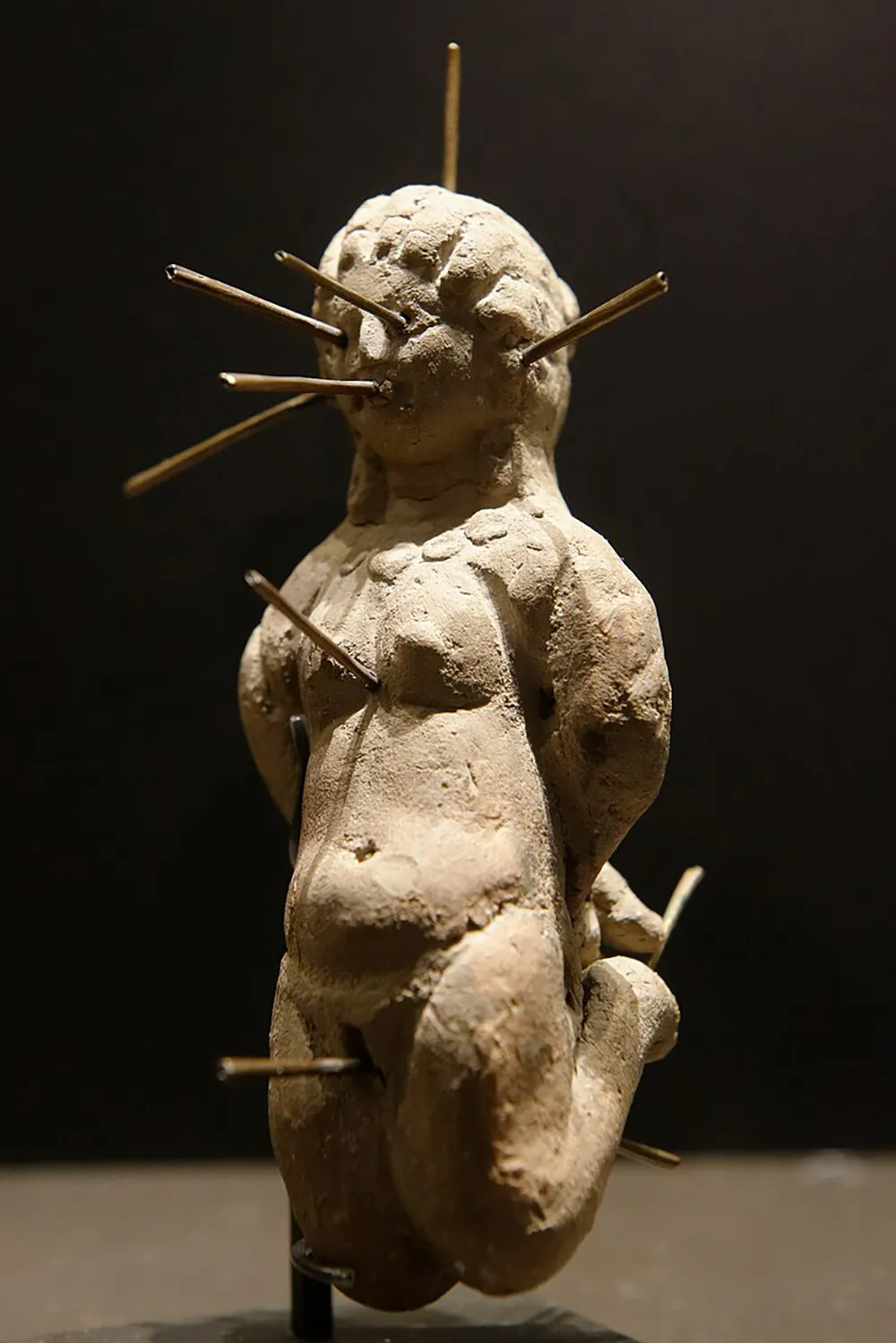
Like the Sataniv doll, the figurine from Egypt also has its hands and feet bound. In both cases this was done to deprive the person the doll represents of the ability to resist the magical influence (photo source: Wikipedia).
The Egyptian figurine was accompanied by a lead tablet scratched with magical formulas. When it was deciphered, it turned out to be the text of a love spell for a girl. The needles were stuck into the head, heart, vagina, and also the palms and soles – so that she could neither walk nor do anything except think about the young man who had set the magical ritual in motion.
In Sataniv we see a practically identical rite. True, the conduit here is a revered rabbi rather than an ordinary deceased person. Moreover, the figure is not of clay but wound from grass (most likely cemetery grass). True, there are no needles here, but magical formulas are most likely present too. When the photo is enlarged, one can clearly see a piece of thin polymer film protruding from the doll’s hand.
Perhaps the “sorcerer” put a slip of paper with magical writing inside the doll. As well as “biological material” – the victim’s hair or nail clippings.
If in late-antique Egypt the magical love spell was the work of a young man, here a woman or girl most probably resorted to magic – today it is the fair sex that most often takes up various love spells and other “magical” nonsense.

The cemetery in Sataniv
It should also not be forgotten that this ritual has nothing to do with Judaism. It is classic ancient folk everyday magic, which lies outside religious doctrines and ethnic groups.
The specialist in Jewish folklore, the late Anatolii Kerzhner, once suggested that the grass magical doll was made not by Jewish pilgrims but by one of the local residents. In his view, the notion is still very widespread that the prayer of an “outsider” has special power. Hence the visits of Christians to tzadikim in the time of the Polish–Lithuanian Commonwealth, when even magnates and titled nobility turned to them.
In this case it concerns an outstanding representative of the “outsiders”, at whose grave, in the organiser’s opinion, the magical ritual should work more effectively.
For our part, we note that Jews, too, used “outsiders” within magical rituals, of which more below.
Another interesting case came to my attention about a year later. Although this is not quite classic magic, the case is vivid.
The Lord’s Prayer and the tzadik
Among the revered graves of the Sataniv necropolis there is also the burial of a disciple of the founder of Hasidism Baal Shem Tov (the Besht), the author of the kabbalistic book “Tiferet Yisrael” (“The Splendour/Glory of [the people of] Israel”), the famous tzadik Yisrael Harif (1695–1781). Many Jewish pilgrims come to this grave from practically all over the world. Visits are vividly attested by small pebbles, which Jews customarily lay instead of flowers.
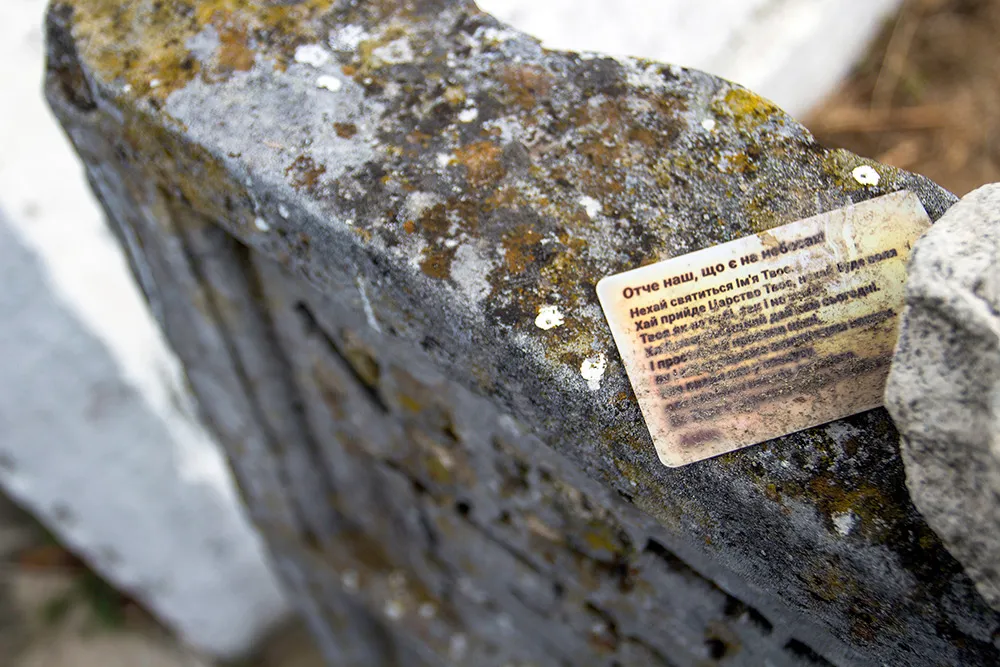
A Christian prayer on a Jewish gravestone
Under the pebbles there are usually notes written in Hebrew, in which pilgrims ask the rabbi to help resolve certain problems or simply to grant good things to themselves and their families.
Once, under a pebble, there turned out to be not only the traditional note but also a small card (the size of a bank card) with the Christian prayer “Our Father”.
Only the strict taboo on reading other people’s letters, even to the dead, prevented me from looking at what the author of this original message asked of the tzadik.
The latest case, when traces of some magical ritual were found at the cemetery in Sataniv, happened quite recently – at the end of October this year.
The magic of three hares
In the aforementioned necropolis there are several unique gravestones (all dating from the very beginning of the 19th century), where the main element of decoration is an image of a medallion in which we see three hares running ceaselessly in a circle. Each hare has two long ears. But looking closer we see that they are all earless at the same time! For the ears of each animal belong to its neighbours. This image has long been considered magical. This puzzle-image was devised as early as the 6th century by Buddhist monks in the Qianfodong cave monastery in the middle of the Gobi Desert (China).
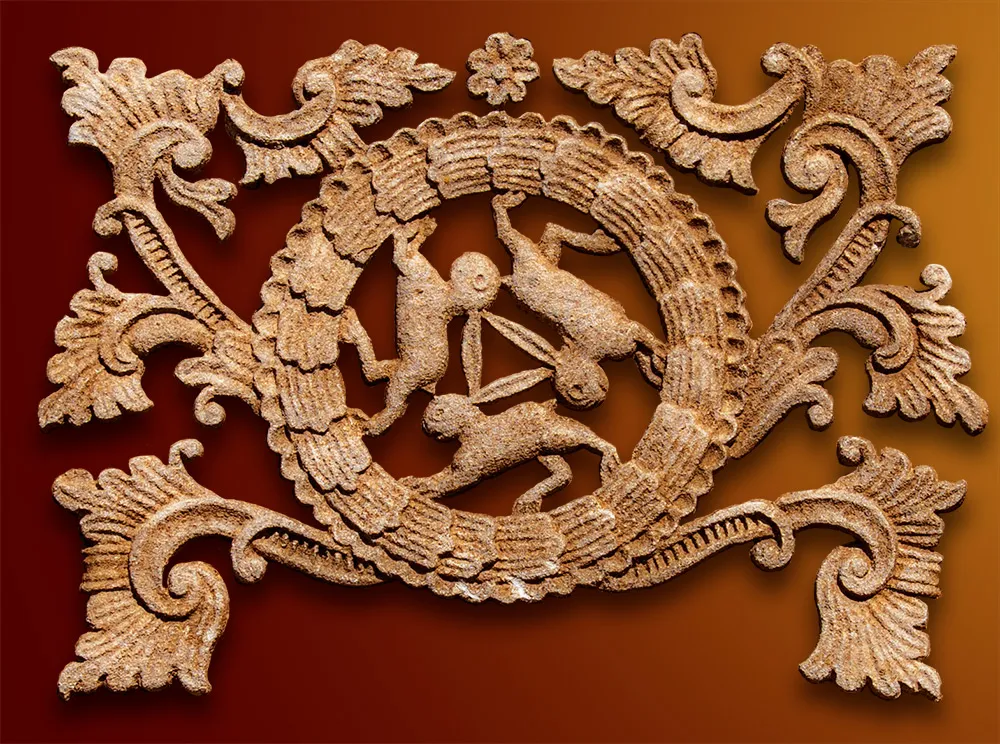
Three hares from Sataniv (specially processed photograph)
In the Buddhist tradition these hares symbolise immortality, infinity and the flow of time, as well as the reincarnation of the soul that is traditional in this religion.
In addition, the triangle formed by the ears points to the trinity of Heaven, Earth and Man. It is believed that amulets with an image of such a medallion bring their owner a multitude of blessings and longevity.
In the 13th century the Chinese hares reached Europe, where the ancient Buddhist symbol gained a new life and became an embodiment of the Holy Trinity. After all, each hare is by itself, yet at the same time they are one whole.
The image of hares “fused” by shared ears becomes a popular adornment of Christian churches. Such church hares are found in England, Italy, Germany, France… The hares even appear on the coat of arms of the town of Hasloch in Bavaria.
From the 16th century the three Buddhist hares also become a popular Jewish symbol. Such an image is found in the decoration of synagogues, manuscripts and, very rarely, gravestones. The number three, throughout the world and among all peoples, has had and has magical and sacred significance. In the hare medallion we see three threes at once – three animals, three ears, three corners in the triangle formed by the ears.
Three hares in a medallion decorate, among others, the gravestone on the grave of Yaakov, son of Ari Leib Bloch, 1803. This is one of the most decorated monuments of the Sataniv cemetery. Besides hares, this grave stele has griffins, storks with snakes in their beaks, a squirrel with a nut, a deer and lavish plant decoration.
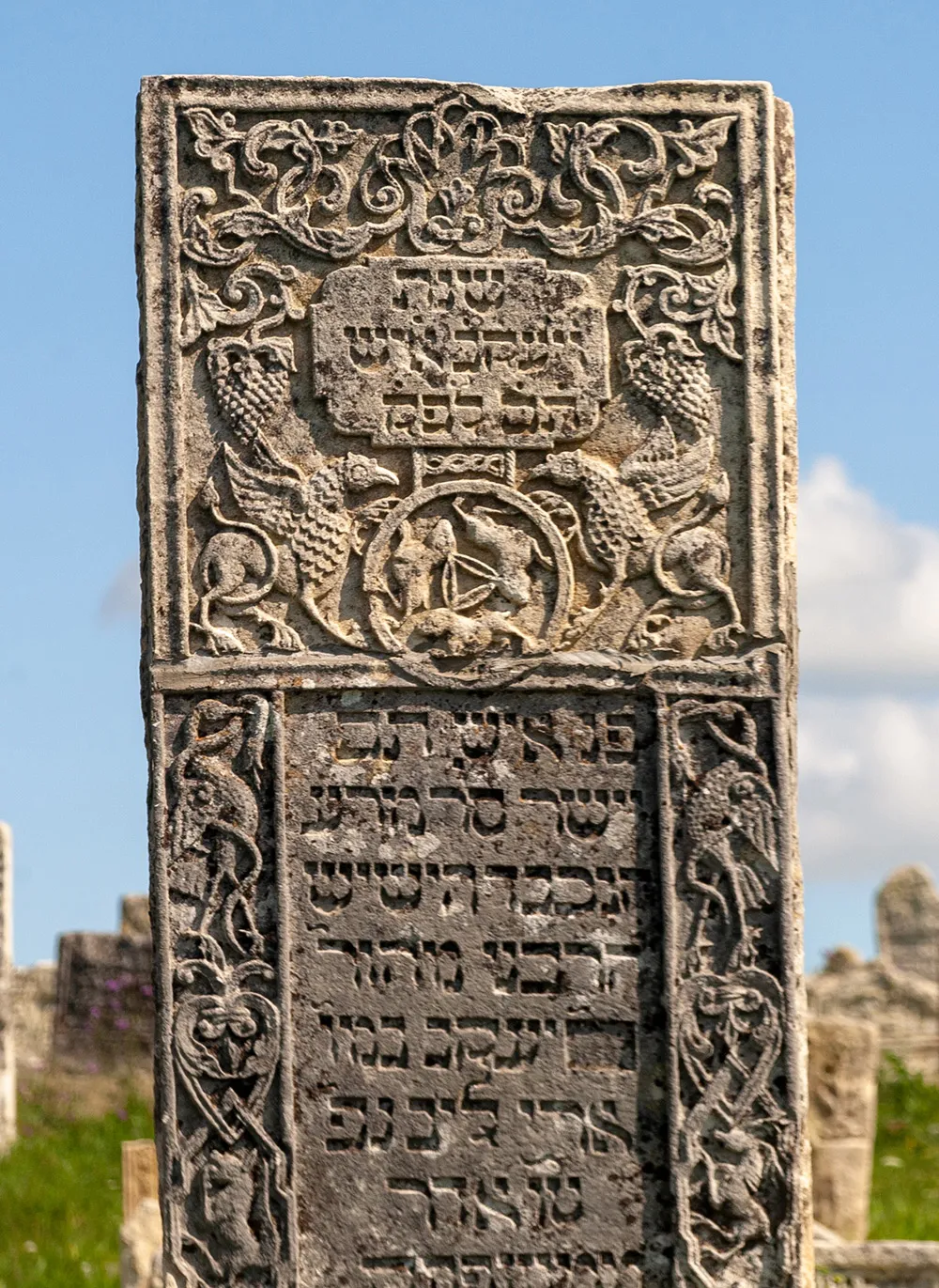
This gravestone is also one of the largest in size.
That day the author of these lines was giving a tour of Sataniv to his historian friends who had come from Kyiv (who could doubt that they were representatives of the NGO “Ukraine Incognita”).
Beside the gravestone with the hares lay some coin. When it was picked up, it turned out to be a magical amulet on which exactly the same hares were stamped!
For Ukraine this is a unique item. And in Western Europe it is uncommon. Why and how the amulet ended up at the cemetery is hard to say. But here it is worth turning to the symbolism of the image.
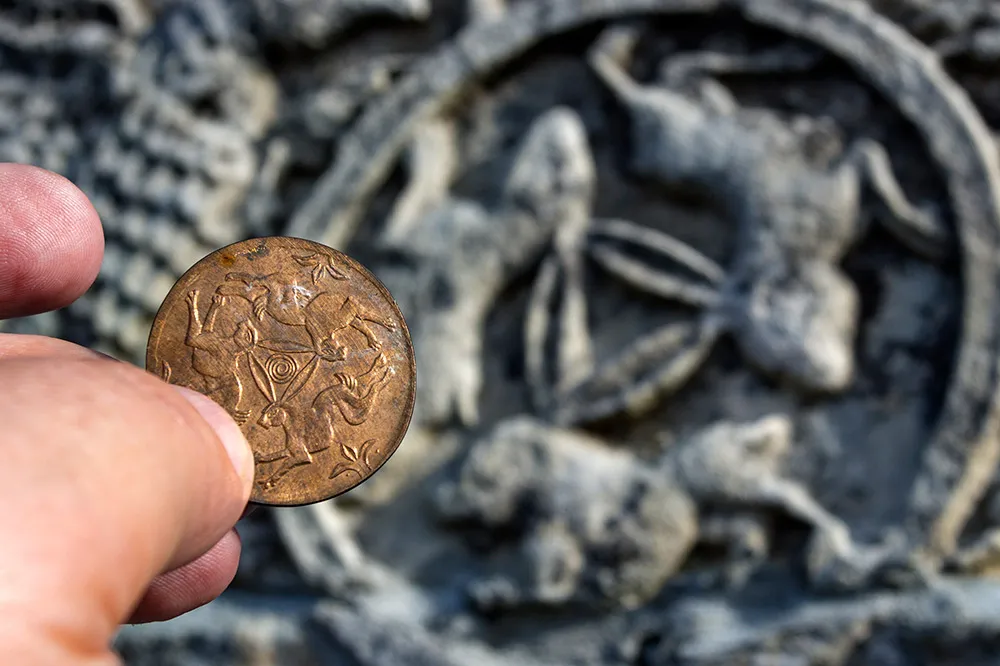
A magical amulet against the background of the gravestone
Traditionally the hare or rabbit symbolises femininity and fertility. The triple hare is usually associated with the feminine principle. It is possible that some woman interested in esoterica and mysticism, and there are plenty of those nowadays, performed here some ritual for the birth of a child. It is possible that the amulet was left for a time in order to “charge” it.
Cholera and a gold chervonets
Another “magical” story is connected with cholera.
For Sataniv the most terrible was the epidemic of 1830–1831, which took the lives of almost four hundred of its inhabitants.
At that time cholera was considered a mystical Punishment of God, which was fought not so much by boiling water and observing hygiene (by the way, wash your hands before eating!) as by prayers and magic.
It is one such anti-cholera magical ritual that we shall discuss.
Let us note at once that this tale is most likely an anecdote of the time – almost identical stories are still told today in many former Jewish towns of Right-Bank Ukraine.
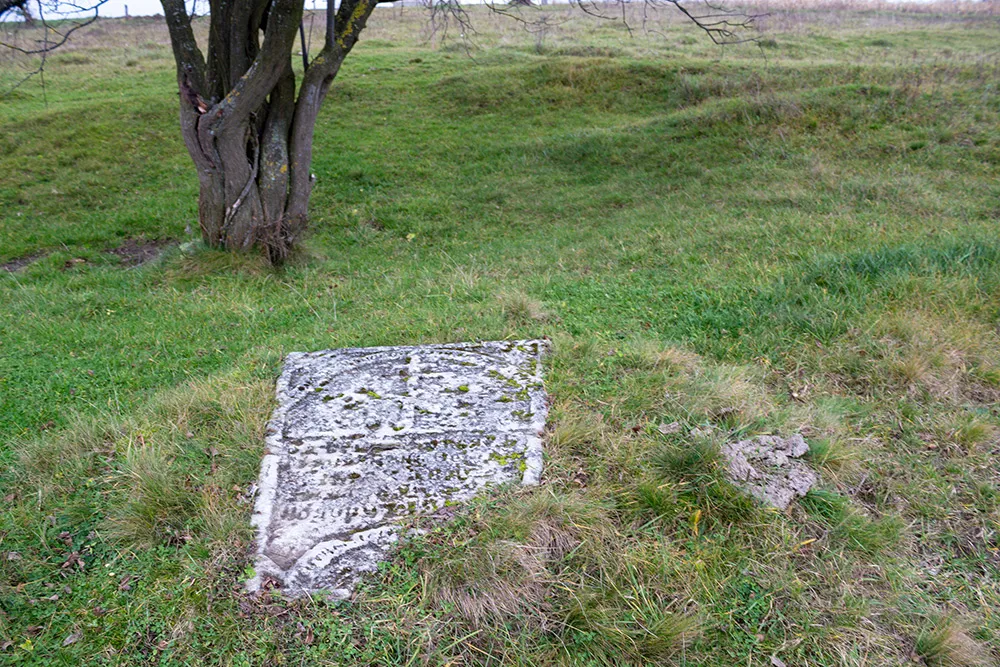
The Christian “cholera” cemetery of Sataniv (1830–1831). Jews were buried at the kirkut, because it was outside the town even then.
So, when the cholera epidemic reached its peak, the leaders of the Jewish community decided to perform a protective magical ritual. As cemetery watchman they specially hired some newcomer Muscovite who had settled in at the side of a local widow.
The foreigner, of another faith and a stranger as well (that is, an absolute outsider), was to act as the ritual gatekeeper of the World of the Dead.
According to a pre-agreed script, the fellow had to stand in the way of the next funeral procession and not let it into the cemetery. During the “quarrel” with the gravediggers the Muscovite watchman was to repeat key phrases as often as possible: “enough dying!”, “enough deaths”, “there is no room for cholera” and so on.
It is a classic magic of the word, known since prehistoric times.
In the end the watchman was to “take pity” and, in exchange for a silver rouble, let the procession through, saying at the end: “You are burying the last one! That’s it! There will be no more deaths from cholera, because there is no room left in the cemetery!”.
They say that the ritual watchman did everything just so, even better! For which the organisers of the ritual, instead of the promised rouble, thrust a gold chervonets into his hand. The “Muscovite magician”, stunned at first by such an attraction of unseen generosity, then supposedly exclaimed: “Well, I’d lay the whole of Sataniv here for that kind of money!” In a word, he spoiled everything and all the magic went down the drain.
Nota bene: we emphasise that this account is by no means an advertisement for magic or esoterica. It is merely a presentation of interesting and, in the author’s view, amusing facts. A sort of cross-section of folk customs, beliefs and superstitions. It is also a vivid illustration of how deeply an archaic magical worldview has taken root even in our supposedly modern society.
Dmytro Poliukhovych
First published in Polish in “Kurier Galicyjski”


